The fool with the gun

Coulsdon, London, August 2015

The woodpigeons take flight as the gunshots ripple through the air from a neighbouring farm. I heard a little girl say, with great sincerity, that she wanted to come back to the downs with her sled when it snows, ‘I love it here,’ she said. So, what gives the fool with a gun his pleasure? It’s a question that needs answering the world over. But it’s not just pigeons that disappear into the trees at the sound of ammunition, a sharp-winged kestrel evacuated a tree in the middle of this hillside meadow, slipping into nearby Devilsden Wood like a compact disc. Thankfully the insects and wildflowers aren’t fussed by the gunfire, instead common blue butterflies drink from wild marjoram, a hornet mimic hoverfly, Volucella inanis, does the same. A white tailed bumblebee’s heft droops the heads of yellow rattle, still flowering low. From amidst the flowers birch, willow and ash leaf like little green fires ready to burn these grasslands up into centuries of shade. The man with the strimmer will hold back their revolution with those of his machine. If only the ammonia stench from the grazing cow’s dung could be cut back like vegetation. When you step in it, it follows you around wherever you go. At least I’ll have a carriage to myself on the train home.

Photography: Evening meadows

Evening meadows

Evening meadows, Farthing Downs, London, June 2015

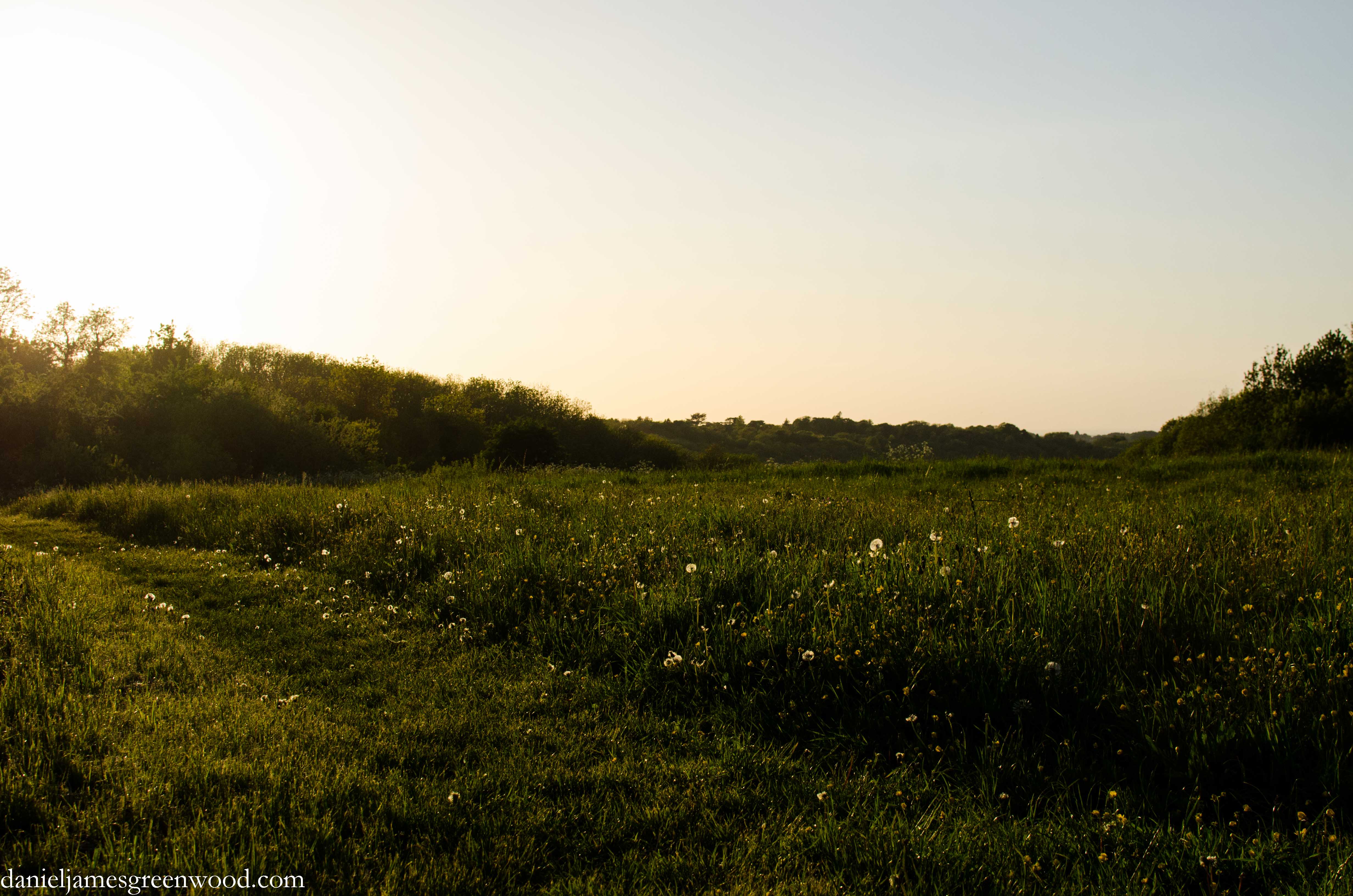
It’s that time of year when the meadows are reaching their height. Here you can see the yellow rattle in flower, soon field scabious will appear to be fed on by burnet moths and bumblebees.

Please click through for more of my pictures of Farthing Downs on Flickr

From here to Canterbury

Wildflowers

The North Downs, Coulsdon, May 2015

Entering onto the Downs, a group of teenagers are fixing their upturned bikes in the buttercups and silverweed. They spill out onto the lane, calling across to each other when a car comes past. It’s evening and the sun hits the mounds of anthills overgrown by birds-foot trefoil and speedwell. The glowing yellow and blue petals are a precursor to the summer yet to hit these chalky meadows, their flowers like a stash of forgotten jewels. From the strip of trees and bushes that separates Farthing Downs from New Hill, a flow of blackbird music runs, moving here and there as the wind tugs and carries their songs to different places. A red fox slips into the hedgerow. Song thrushes evade the wind with their daggers and trills. Up ahead, a pair of young women pose on the path, and only until a few paces ahead do I see the selfie-stick with their phone on the end. Disappearing off, knowing they aren’t alone, they throw a few more statuettes to their camera, before slinging hand bags back into the crooks of their arms. Skylarks call from up on high, one with its wings and bill working as if it all depended on that verse. In the hawthorns the linnets ping and pang, a green woodpecker lifts up from the turf and submerges itself in some oak scrub. The magpies tread through short tufts of meadowland coloured by buttercups and the hot red stems of salad burnet, still yet to leaf. Before me is Happy Valley, its wayfaring trees flowering in white spots on the hillside. Slipping off into the chalk hollow that will lead to Devilsden Wood, the defiant song thrush sings into the tunnel of hazel and yew, a master of this underworld. On the track before me is a light brown toad, sitting in the middle of the path. Like a baby it crawls towards me and nuzzles in against the side of my boot. I remove my foot and let it continue its journey into the undergrowth.

In Devilsden Wood I feel the first hints of the evening cooling, the sun having reddened my skin in the open land. The new, hardening green leaves of beech explode in the canopy where the light hits them, the few slithers of sky that can be seen between their branches leaves nicks of light along the trackway. A couple with their two sons walk with sticks, picking their way through the undergrowth to find new paths and treasure. The bluebells hum purple in the dark hazel coppices, brightened in part by the helmets of yellow archangel and splashes of stitchwort. The wood ends and the buttercup meadows of Happy Valley simmer at the break of trees. A man and a woman stroll the way I have come with butterfly nets in their hands, a happy day spent on the Downs, I am sure.

Blog pics-2

The route leads back into sun dappled bluebell woods swamped by bramble. Two dogs shoot past from behind a small mound and Iโ€™m taken by surprise. Meeting company in the dark wood I waste no time breaking out again into the valley. On the hill that will take me to Coulsdon Common, two lads are rolling down, swearing as their tumble takes a surprising turn. At the bottom of the hill waits a girl with hands on hips, as if deciding between them who she will choose when their race climaxes. The lad with long black hair and grunge hoodie lies on his back, raising himself up on his elbows. The girl jockeys him and lies back. They rest in the sun-draining valley like a pair of Siamese twins. I pass them and head towards Coulsdon Common, overtaking a man in his seventies:

โ€˜Evening,โ€™ I say.

โ€˜Good evening, sir!โ€™ he fires back, as if still in the military. He stops, casting his eyes across the flowering meadow to the scene of a white gazeebo in a garden where a PA system amplifies a ceremony of some sort. He is a lone figure on that track, wearing a cap and winter coat. On Coulsdon Common the goal posts gape in shade as the sun breaks through the branches, illuminating the grasses: cocks foot and meadow foxtail. Itโ€™s approaching eight oโ€™clock and so I chunter on, passing Saturday evening strollers fresh from an afternoon in the Fox pub. A man drives a mower along the verges, a clutch of bluebells given a stay of execution around a fencepost. I drop down into Rydons Lane past houses with vast lawns dotted with wildflowers left over from their previous incarnation as meadowland or wood. The absurdity of suburbia strikes its note โ€“ carp ponds, seven cars, gates with intercoms. I leave on an incline swallowed by yew trees and bursting with chalk, a Labrador storming past me. A voice blurs with the tree dark.

โ€˜Heโ€™s over here,โ€™ I shout.

โ€˜Oh, thanks mate,โ€™ is the reply of a man in a white t-shirt, stranded amidst dogs mercury.

I walk through a familiar farm where women ride horses, a Jaguar parked close by. In winter these fields are boggied by the deep clefts of horse hooves, now they are sealed by the heat of a hot dayโ€™s sun. Crossing a stile I arrive in a field where a man smokes a cigarette at a pathway in from his house, evidently in need of some silence and peace, he does not see me. I follow the mowed path alongside a hedge of poplar suckers, beyond a dead oak and its dead ivy which has only collapsed in the past year. In need of a snack I sit on the grass and notice paths which I had not seen before. A young, fresh red fox bounds into view, skipping as if from something invisible to the human eye. It sees me and stops, staring, unsure of what I might do. But Iโ€™m only here to sit and chew a Tunnockโ€™s Caramel. I watch it through my binoculars, its image framed by buttercups and hedges, a house at the fieldโ€™s edge. Insects move in small clouds along the edge of the mowerโ€™s reach.

Blog pics-3

On Hayes Lane I dodge speeding cars and see that patches of wild garlic are being harvested with scissors, hollow stalks standing leafless on the verge. Their thoughtful foraging will make no dent in this robust lily, a plant flowering in profusion along the trackways from here to Canterbury in spring. At the entrance to Kenley Common a song thrush rises to a protruding branch, smashing a snail against the wood. It drops it and flies away. Taking a closer look I see the snail still curled up in its brittle, fractured home. The Common is not empty, the same spreads of buttercup full with human life. A man lies on his stomach in the flowers calling for his dog to run towards him, the remaining sunlight channelling straight down his lens. I look at the English oaks, swelling woods and distant wounds of chalk quarry and wonder what draws us so readily to gather professional images of our pets. With time on my mind I snatch a glimpse of the Caterham valley and head towards Whyteleafe, the remainder of the Common swamped in the shady wood pasture by cow parsley. The wood of mature ash and wayfaring trees are bright white, naked limbs in the twilight. At the end of my walk a poorly, urban fox cub nips into the road, pausing to watch me, like its healthier meadow counterpart, to see what I might do. I watch it disappear into the avenue of parked cars and take the pavement down to catch the next train home.

A thousand years

Parrot waxcap

Farthing Downs, London, November 2014

Blue smoke plumes from the dreary Downs, the crack of piled ash trees cuts through the distant wash of the M25, and now the noise of chainsaws. This work is good fun. How many people panic at the sound of this machine, waking to find that their favourite tree is gone from the frame of their bedroom window. In the town I am always suspicious when their itch carries. But this is the restoration of the chalky meadows swallowed by the incoming of woods. We as a species have been trying to halt the loss of woods but at the same time deny new ones for thousands of years. This is a thousand-year-old view, the only change the exchange of machines for the pop of axes on heartwood.

Against a view of near leafless beech, a green woodpecker rises from the anthills, its flight reminiscent of a puppet tugged at intervals as it passes. Robins sing, gulls create the aura of the Sussex coast, and rain specks add a pinch of cool. In the now flattened meadows fungi can be found: a parrot waxcap plucked and left, yellow gills that ripple like flames around its stem. Puffballs are scattered across the path, little footballs deflated and unwanted. I press my toe into one, flattened and leathery grey, its brown spores puffing out like effluent. I definitely take them with me.

ยฉย Daniel James Greenwood 2014

This is it

Six-spot burnet moth

Farthing Downs, London, July 2014

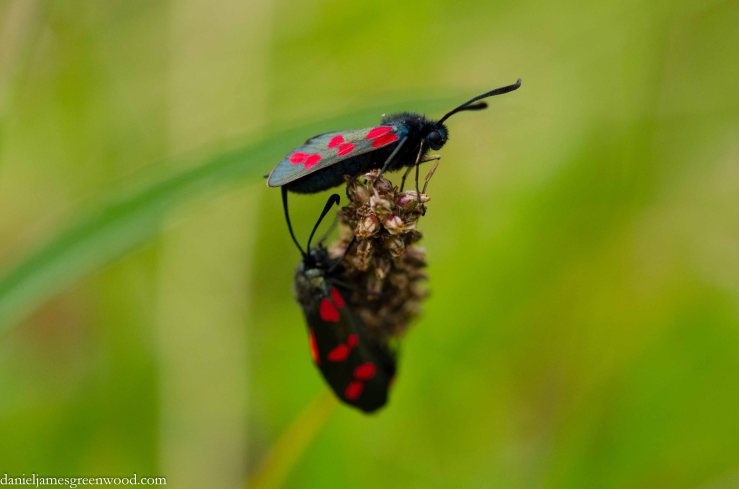
We leave the chalky, wooded hollow and appear in an ocean of field scabious. The sun setting in the west catches the pale, lilac petals of these daisies. In the other meadows across on New Hill and in Happy Valley greater knapweed has begun to flower, that deep purple gives me the sense of summerโ€™s final movements, splayed florets that say: this is it. The meadows, too, abound with the motorised flight of burnet moths that were not here two weeks ago. Many of them are mating, one pursued by a pair of skippers unwilling to share a flowerhead. I wonder, what harm could a butterfly do a moth? Anthropomorphism excused, their quarrel does have the feel of a playground spat. That landscape is behind us now as we return along the crown of Farthing Downs. The sky is split in half to the west, smears of rain hurrying our return to the urban landscape. The liquid song of the skylark pours from the sky and we search for its shape. After giving in and then locating it I see it some forty-feet up in the sky. My companion canโ€™t quite believe how clearly its song comes yet from so high. We stand, our exit delayed, the two forces of incoming weather and skylark display gluing us to the soft turf of Farthing Downs.

ยฉย Daniel James Greenwood 2014

A neon waltz

FD may blog-2

Farthing Downs, London, May 2014

I sit on a path new and slight, pressed into the grasses. Last year I sat in a spot close by under the shade of ash trees watching a willow warbler make return visits to a nest down in the brambles. Now the brink of a small copse of trees has gone, the bird, perhaps returning, may have decided this was no longer a place to raise young. In the absence of willow warblers, brimstone butterflies, perhaps reaching double figures, mark the new space of downland that has been reopened from the folds of trees. The piles of logs and branches stacked in the iron beds are still here, yet to be burned or hedged. I like that slowness, that I can come back some months later and no one has felt too pushed to tidy the place up.

A male and female brimstone fly together and then fall down amongst the twigs and low, woody brambles. Iโ€™m interested to see what theyโ€™re doing so I get up and have a look. Theyโ€™re mating, bodies bent round, facing away from each other. They part. High in the sky, against the blue and its herring and lesser black-backed gulls circling on thermals, a huge flock. I wonder why, I wonder what for. Down here with me the female brimstone is again on the wing, met by a band of battling males. They pass her and are turned immediately onto her, each forgetting their quarrel and targeting the paler female. This is the perfect reflection of the adult butterflyโ€™s life: the males seek as many females as they can; the female, having mated, defends herself from latecomers as she strives to find the right plant for egg-laying. The males attack her, but she breaks free, up into the sky. She is not free of them. The four males cloud her, their colours so close as they gain height that all sense of defence has disappeared into a neon waltz. They go up, up and over my head to the world of gulls and warm air rising.

ยฉย Daniel James Greenwood 2014

A careless act

Gull

Farthing Downs, London, January 2014

From the hawthorn trees comes the sparkling sound of thrush and finch chatter. All around the landscape is weighed down by weeks of rain, the sodden grey and blackness, but this conversation lightens the scene. A flock of goldfinch burst into the sky, skipping through the air in their piecemeal flock. Their yellow wingbars flash against black feathers like miniature human warning signs. I train my binoculars on the thorns and see a redwing sat in the branches, contributing to the bird discussion. As I step towards them it ends instantly and so I turn and take a path to leave them.

The stumps of ash trees glow resinous on the hillside, the felled trunks lie supine beside them, the bark darkened by rain, the green and blue lichens thrive without a care for the treeโ€™s demise. The brash has been piled and burned in elevated corrugated iron beds, and to many people this would seem like a careless act of deforestation. But itโ€™s not. Farthing Downs sits on a bed of chalk and is home to a vast array of wildlflowers which are disappearing from the English countryside. The City of London Corporation are here engaging in a battle of restoration. Further along the path a black-headed gull skates low over the lane โ€“ Iโ€™ve not seen them so close to the grasslands here โ€“ propelling itself up and into the wind. Its relationship to winds so cold and blustery seem uneasy, and against this vista of meadows and woods, all the more unique.

The shock of the heartwood

Farthing Downs

Full set of photographs here on Flickr

Farthing Downs, London, January 2014

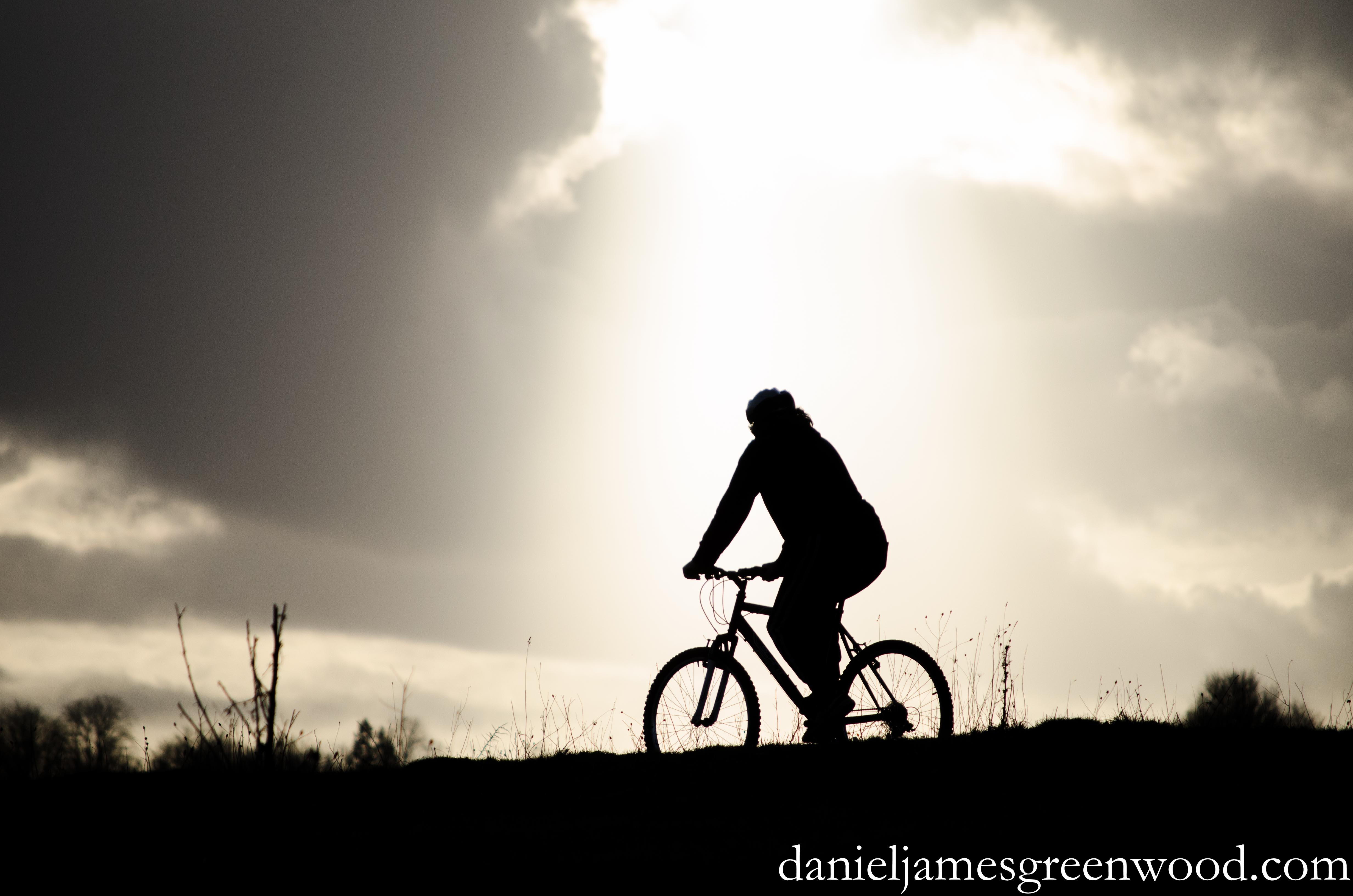
The long shadow of a jogger crosses me and at first I think it’s someone approaching. A peek over my shoulder shows the silhouette of a toiling woman, but is it new resolution or good habit? She is followed over time by a trail of cars, parents clutching the hands of young children, and finally the huffing shape of a cyclist rolling past. The world of the Downs reminds me again that the earth is something of a cauldron, everything is always changing. Groups of people walk along the lane, shadows breaking and reforming, pausing to watch something, perhaps a bird, perhaps the view of houses creeping up the hill, or views of a distant, spiralling city.

Jackdaws dot the horizon in the east, their indentations against the sky encourage the play of human language. They are a slow swarm of insects, embers from a smokeless blaze, or simply jackdaws doing their winter dance. Woodpigeons pass them in the foreground, redwing, too. I sit and watch. On New Hill, the land beneath the jackdaws, the small ash trees are indeed like matchsticks, or else the stiff hairs of a broad and worn broom. More have been felled, chopped and piled, and against the brown wash of wood and winter grasses the shock of the heartwood is telling.

The sun slips down to me, the ant hills like boulders at the edge of a lake, dropping chunky shadows from the daylight. Squirrels cavort, their music one of scratched syllables, like little huffing corvids. We regard them with equal disdain, forgetting their own intelligence and desires. They feel a dislike for their kind, too, sometimes. A helicopter careers overhead, a primitive design still, but how long until tiny drones trail through these skies, how long before they snag in the branches of oaks or the tangle of hawthorn? Who will collect them and what will be done with them. The helicopter is navy blue and white, it heads south-west towards the North Downs as vulnerable as flesh and feathers.

The fabric of time

Devilsden Wood

Farthing Downs, London, September 2013

Standing on the track leading into Devilsden Wood I look to the ground for dryness, somewhere that hasn’t been soaked by this perpetual rainfall. I see fallen ivy leaves that appear like cuts of leather when really they are crisp under foot. Dog shit, too, the new waybread for the modern ancient footway. I hate the stuff. My waterproof sheds its load onto my jeans and it’s wait and become cold or move and receive woodland raindrops, some chucked from the canopy of mature yew, ash and beech, some fifty feet up. When they get behind glasses, these droplets shock the senses.

It’s fungi season, the signpost of falling temperatures, not too cold but a shift from the sultry summer. I gawp at log piles with an explosion of mushroom caps, marked by striping and shapes that would define them to those who understood them. But still, I spy an oysterling appearing from a rotting trunk and feel that in two years of woodland obsession I have at least learned something about this magical animal that appears so fleetingly it could almost be through the fabric of time, a monitor on how we’re doing. Checking the sole of my boot again, we’re crap. I wipe it off in a mud puddle. The rain has not lessened. I head back out from the dark, autumn-beckoning woodland and onto the wet warfare of the Downs. The change in mind is clear, the atmosphere of a woodland changes you. It is not like the open land, so much a canvas for human experimentation, our impact on woodlands is never so clear as the plough’s to the open landscape. A woodland to all but a minority could have been in that state for millenia, before human time. The wood is a wild city, with nature’s social housing, swimming pools and fast food. It was our home once, too. There is the semblance of a summer out here, yellow rattle not yet rattling, knapweed funked-out in pinkish purple, even a bit of scabious. These wildflowers have something of January’s left over Christmas decorations about them. A car passes along the lane. Woodpigeons are striking through the rainy sky, turning their wings and bodies at an angle – to avoid the direction of the rain? – always as individuals. These birds cut several different figures in a year – hurried, panicked on the wing, or else male birds cutting arcs out of the sky as they display to females long into the summer recesses. Now they could be migrating, they could be hunted. Mostly they are gorging on elderberries outside my bedroom window.

On the Downs a flock of goldfinch are startled into the sky like pieces of a broken vase put back, its smash rewound and fixed. They sit in a small hawthorn bush and I look more closely. On the end of a branch, clear and possibly not so fearful of man is a juvenile, all grey on the head, interested in looking but unaware of the perils of being watched. My advances fracture them once more and I’m left with a snapshot of their escape into the landscape captured on my camera.

Something new

Fly orchid 4

Farthing Downs & New Hill, London, July 2013

On the Downs the butterflies are immediately evident, the week old broods of meadow brown ferry amongst the long grasses, rarely stopping to feed on flowers. Breeding season is ending but still the song of skylarks comes from over the slope, some ancient language remembered, its translation lost. Greater yellow rattle blooms now, the spring buttercups lost to a swathe of Yorkshire fog and other grasses I don’t know. The suntan lotion on my arms acts as an adhesive, my skin covered with seeds. The grasshoppers are conjuring up their rickety, wooden percussion. I am hopeless in finding them, except for one that hops between seed heads, a micro Tarzan in this meadow jungle. But where are the people? A man drives a BMW sports car along the lane, revving its engine. I know where I’d rather be. Men in England are bare chested at the slightest chance and here a couple stroll along the lane drinking from big bottles of water. The tattoo stamped on the man’s back stands out in this simple landscape of slopes and flowers.

Lovers

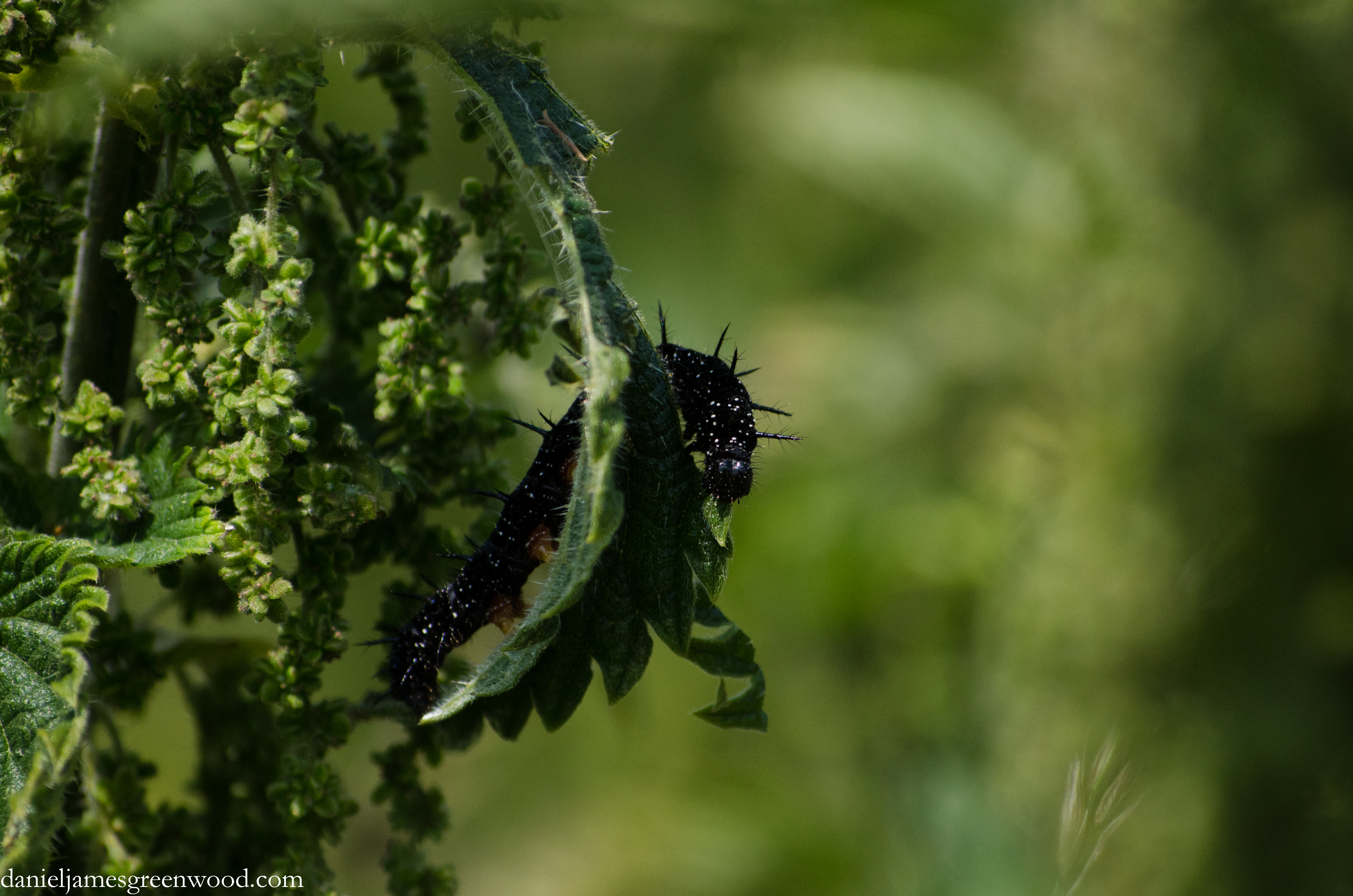
Ghostly day-flying moths spread at my every step through the long grass. Bumblebees forage on clovers, dropwort and yellow rattle, small heath butterflies appear again, two fly together, eager to fulfil their short lives with as much fornication as is possible. I cut back on to the path I know best. A chiffchaff sings in the hedgeline at the bottom of the hill, a single blackbird and a whitethroat, too. Thereโ€™s no sign of spring’s willow warblers or their clutch of young. A crowd of peacock caterpillars munch through nettle leaves, leaving only the dreadlocks of flowers. A yellowhammer appears from across the lane, landing in a small hawthorn bush, its strong yellow plumage brighter than dandelions, a South American yellow, and at its brightest here. I take a few photos. Along with skylarks, this is a bird I have to travel to see, when once, before my time, you might have woken to it flocking in the hedges and fields.

Peackock caterpillar

Leaving the Downs I enter the chalky wooded hollows at the bottom of the slope, with tor grass growing along the track, an indicator of the calcareous soil. My sweat cools with the breeze that slips through here. In the dappled shade I scan the path edges for orchids, black bryony creeping out from the darkened hedges. And there it is: the fly orchid. I change lenses and struggle to get the image right, sweat dripping, bringing lotion down my face. But it’s beautiful to look at – a bit like a bumblebee pinned and proffered by the long spike, with its little eyes and short antennae. A family are passing behind the hedge, discussing how to control the dog.

‘She’s pulling me down into these weird places,’ says the mother.

‘Just let her off the lead, let her off the lead,’ the dad says.

They arrive on the path heading down hill. Their daughter warns the dog to stay with them. I only see the mother, she’s dressed in an apricot coloured dress and heeled shoes. She’s young and glamorous, so fitting with the array of flowers bursting from the hillside.

‘Who needs Box Hill when you can come here, eh?’ says the dad. They disappear down towards Happy Valley.

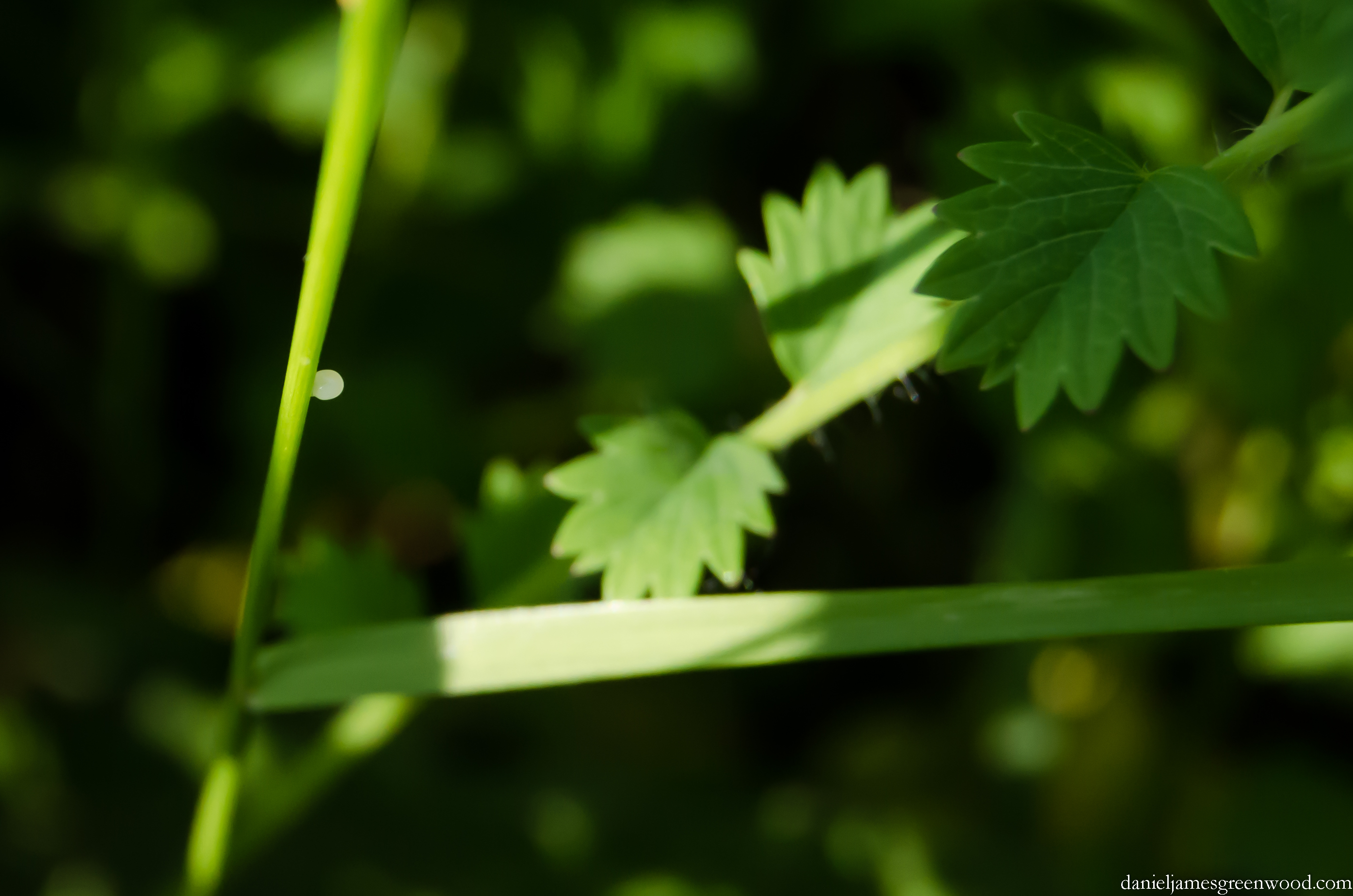
Speckled wood egg crop 1

I carry on along the ridge and settle on the desire line drawn down the hill and through the flowers. Ringlets move through the meadow, the first I’ve seen this year. They move at the same time and, stitched together, they are a tapestry of flickering wings. In my silence and stillness wildlife begins to move around me, perhaps more trusting. I see more plants now: twayblades, common spotted orchid, salad burnet, marjoram, ox eye daisy, rough hawkbit and bladder campion with its inflated, balloon like calyx-tubes. The wind blows through the trees. A speckled wood butterfly flaps about me, its wings audible as it hits my khaki shorts and leaf stalks. It clasps hold of a spear-like grass stem and curves its abdomen, laying a tiny pearl of an egg. This, for me, is something new.