#FungiFriday: more like #LichenJanuary

Midhurst - 15-1-2019 blog-1
Flooding from the river Rother in West Sussex

Fungi Friday: 17th January 2020

Storm Brendon rocked up this week in Sussex and gave freedom of movement to the Arun and Rother. Temperatures have tickled 11 degrees but are set to crunch back down this weekend. Mushrooms must think, guys, WTAF?

Midhurst - 15-1-2019 blog-18

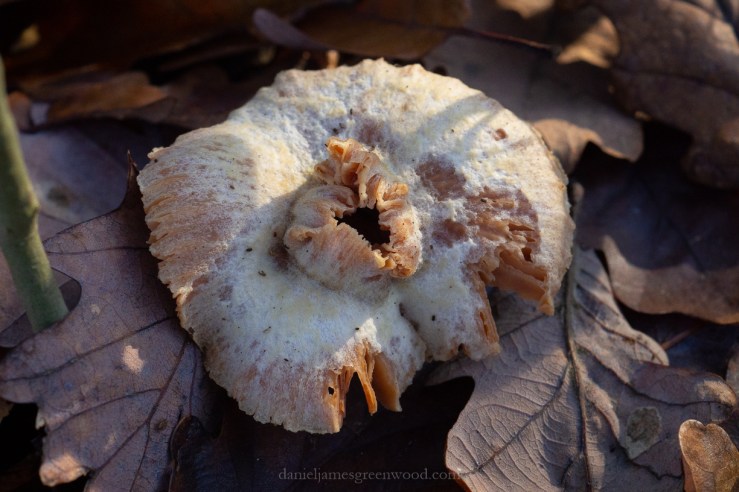
I see images of nice looking shrooms on social media, things like velvet shank glowing orange like sweets on tree trunks. All I saw were the melted ice lollies of sulphur tuft (Hypholoma fasiculare) on an embankment. It gets worse:

Midhurst - 15-1-2019 blog-14

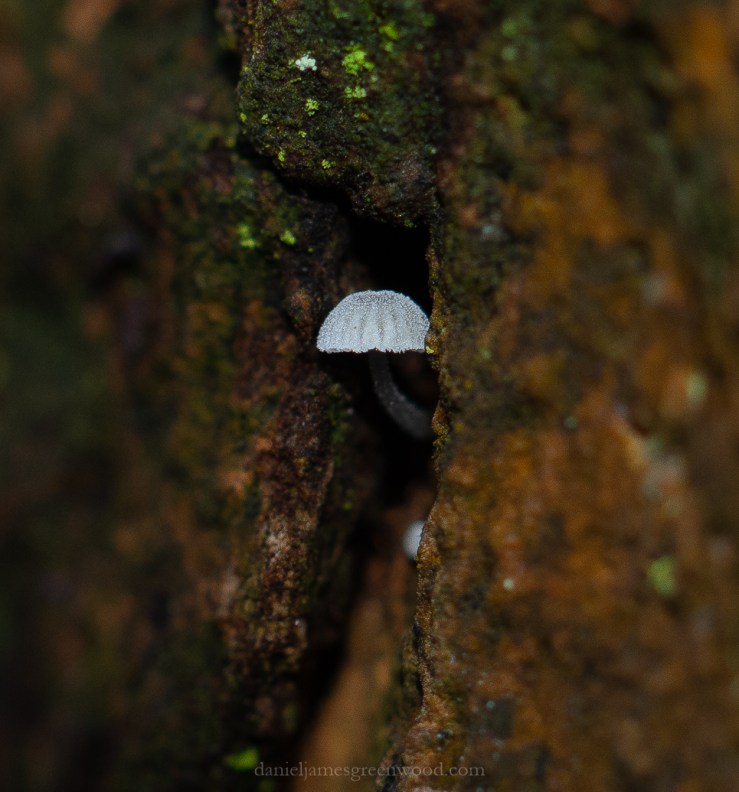
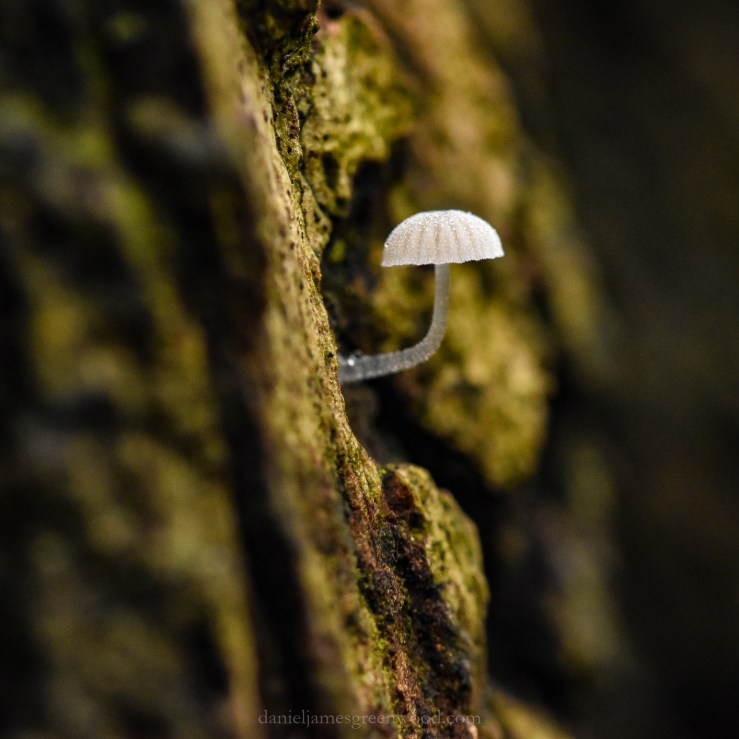
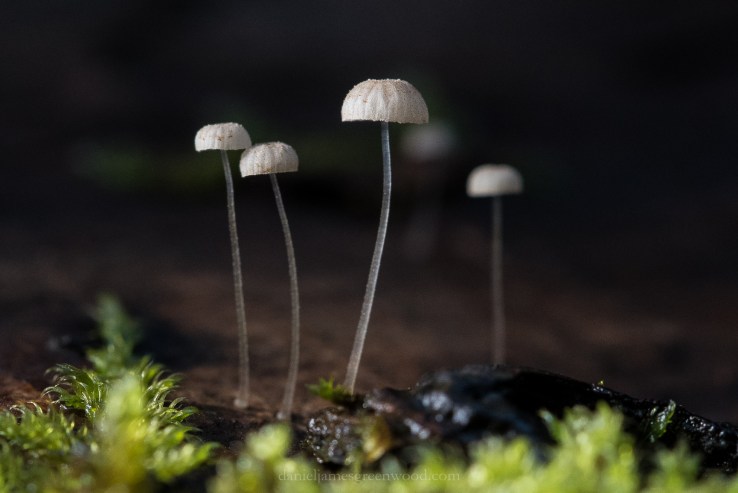
Probably some bonnets, like a scene from the Netflix drama You. The rain has been too much for these Mycena. But have hope.

Midhurst - 15-1-2019 blog-15

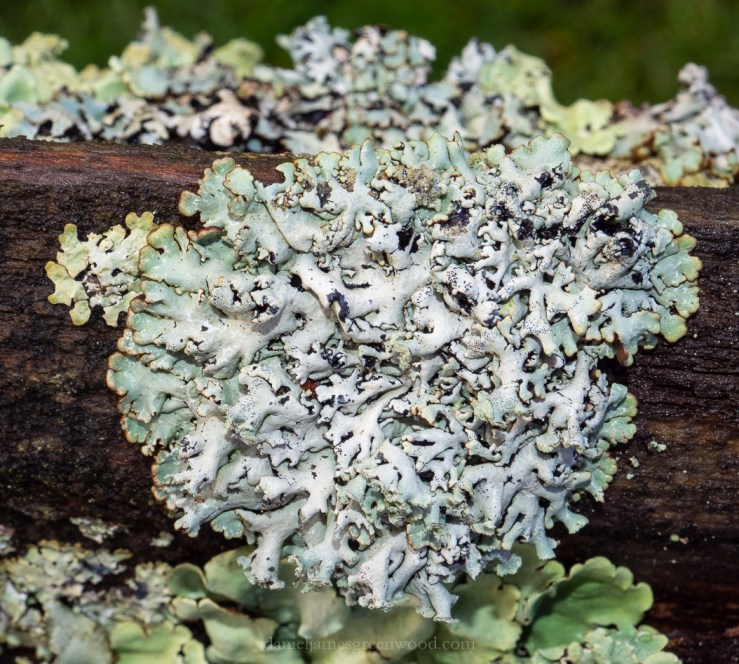
Where there are non-chemical treated fence posts, there is hope. That hope comes in the form of our symbiotic fungi-algae friends, the lichens. This is a great time of year for lichens due to the amount of rain and their resistance to winter weather. They are hard to shift.

Midhurst - 15-1-2019 blog-13

The fruiting bodies here are known as apothecia. I love them. They are like cartoon eyes or mouths. Wonder what they’re trying to say. Obviously it’s a climate warning.

Midhurst - 15-1-2019 blog-12

This one just takes the biscuit. My lichen guide is in Ireland where it belongs, with all the other lichens. So I’m sailing in the dark and just here to appreciate the beauty of these ancient, life-giving organisms.
Midhurst - 15-1-2019 blog-5

These fencing rails are a reminder of how important dead wood is in the biosphere as a structural support for biodiversity. No doubt lots of other organisms will make a home for themselves in these lichens.

Midhurst - 15-1-2019 blog-17

This is a finger post with the yellow being the paint of an arrow pointing in the direction of the public footpath. I love the little apothecia eye cups on the right hand side.

Midhurst - 15-1-2019 blog-10

Living wood also provides a platform for lichens to grow. I can’t cope with the colour range in the species which dominates the image here. They were growing on the bark of a fairly young beech tree. A few people did glance over when they saw me effectively hiding behind the tree with a camera. In actual fact the camera was jammed up against the bark taking macro pics. Still, could have gone wrong.

Midhurst - 15-1-2019 blog-11

Here you can see the brown streaks which are fissures in the maturing bark as it grows. Patches of foliose or leafy lichens are growing in among the crustose species.

Midhurst - 15-1-2019 blog-19

This was their view, an oak tree fanned out before the South Downs ridge. Not a bad place to be for a lichen.

The British Lichen Society are running the hashtag #LichenJanuary. Lichens are for everyone so it’s good to see such a niche group spreading their knowledge to the masses(?) for free.

Thanks for reading and please share any interesting lichen finds (or indeed identifications) in the comments. Some interesting mycological articles this week:

Mushrooms and orange peel: could biotech clean up the building industry?

Ikea to use packaging made from mushrooms that will decompose in a garden within weeks
More mushrooms


#FungiFriday: snuffling for shrooms in midwinter

Midhurst - 3-1-2019 blog-6

Fungi Friday: 10th January 2020

I’ve barely made it out this year, as young as it’s been. That poses a big threat to the Fungi Friday machine but thankfully I know where to look. The focus at this time of year is on small and hardy species in the Kingdom of Fungi, species like candlesnuff fungus (Xylaria hypoxylon):

Midhurst - 3-1-2019 blog-2

I found this macabre specimen at the foot of a handrail post. They look so much like hands reaching out from the soil. No wonder other Xylaria have the names of dead man’s fingers and dead moll’s fingers. This species is called candlesnuff because you can flick the tips, in drier weather, and the white spores are released. It looks like a puff of smoke from a snuffed out candle.
In the fungal world candlesnuff is an Ascomycete or spore-shooter. Most mushroom-style fungi are Basidiomycetes, a group which spread their spores by ‘dropping’, usually on the wind. Mushrooms with gills are the perfect example of this. Wind-dispersal of spores is one of the oldest forms of reproduction on Earth.
St. Leonards - November 2018 djg-35

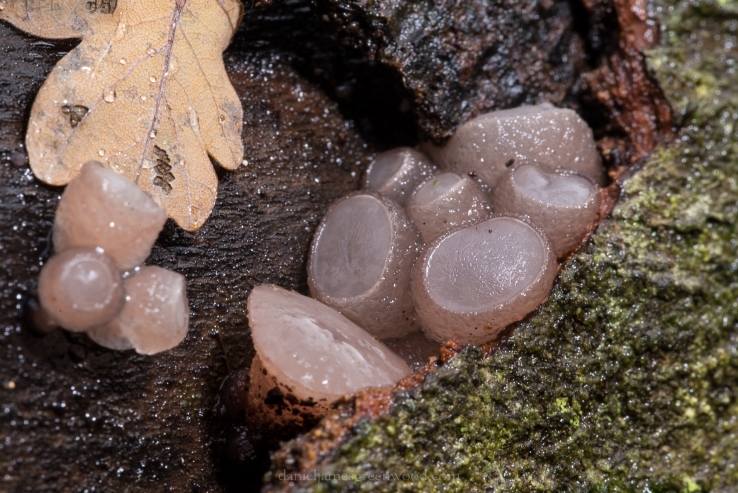
Other classic spore-shooters are beech jellydisc (Neobulgaria pura) above, which is common on fallen beech trees in November.

Midhurst - 3-1-2019 blog-13

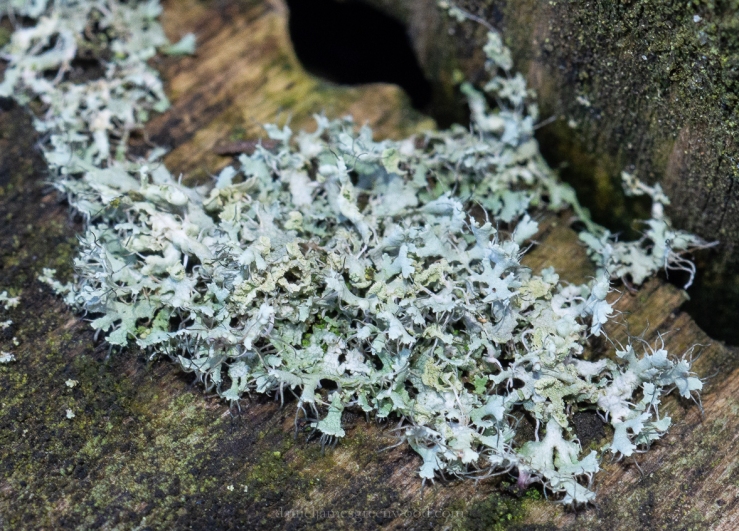
The lack of January fungi can be helpful in reminding us of those which are more slow to colonise, things like lichen. This foliose lichen was growing on a fencepost (do not underestimate the wonder of fenceposts). Lichen is a symbiotic relationship between fungi, algae and cyanobacteria. The fungus produces the physical structure which provides a home to the cyanobacteria and algae which are capable of photosynthesis. It’s another reminder that fungi exists in the world in partnership with other organisms, something which we are so ignorant of as a species at times. For anyone who has tried to read Hegel, the German philosopher, I once read that a lichen is an example of the master-slave complex. The fungus is the master and the alga is the slave. The thing is, without the slave the master can’t prosper or maintain its status, so the master is in fact enslaved to its own prisoner. What’s that, myco-philosophy?

Midhurst - 3-1-2019 blog-7

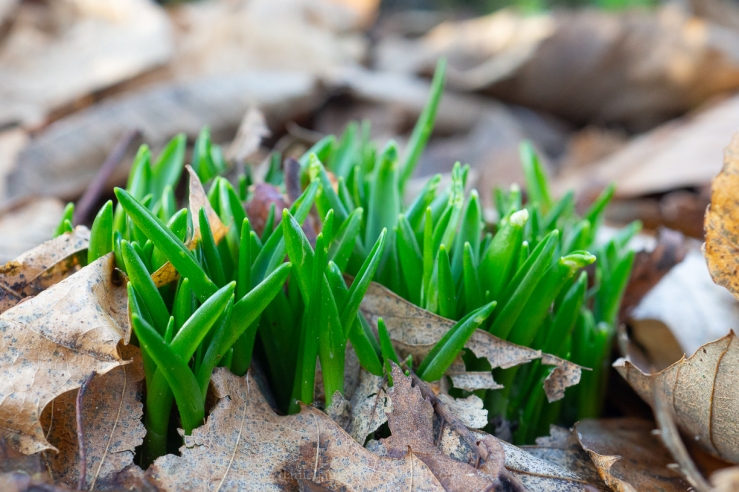
In winter I look for signs of spring. In the 10 years that I’ve spent looking closely, the often mild winters have provided glimpses of the coming season far earlier than we expect. Here bluebells were breaking through the fractured leaf litter of oak and chestnut. It’s been a mild winter again at the end of the warmest decade on record.

Midhurst - 3-1-2019 blog-3

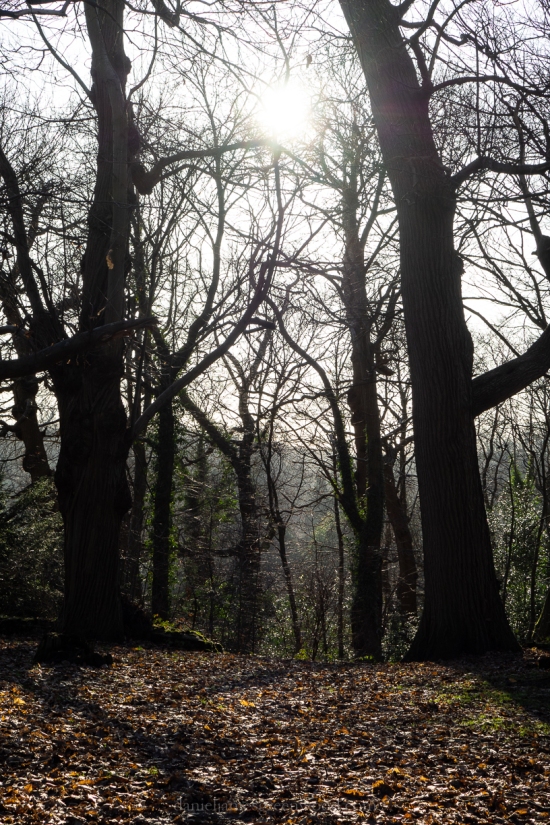
Winter sun, that precious resource.

Thanks for reading. Let me know if you found anything interesting this week. Here are some articles I spotted recently:

100 million years in amber: Researchers discover oldest fossilized slime mold

โ€˜Decompositionโ€™ Series Knitted By Fiber Artist Leigh Martin aka Bromeleighad

My fungal archive

#FungiFriday: a mushy Christmas in south London

OTH 25-12-2019 blog-4

Happy Fungi Friday everyone!

I’m a Londoner and I learned most of what I know about fungi and nature in London. Take that in physical and psychological terms, having spent most of my life there. One Tree Hill is a Local Nature Reserve in south-east London that has offered many happy wild hours (ecologically). I visit One Tree Hill as often as I can and did so to find some Christmas shrooms this year.

One Tree Hill has a weird history of being a remnant ancient woodland that had been cleared of trees and then has re-wooded itself in the past 60 years. It has old oak trees and new oak woodland spread across areas of old acid grasslands, which are rare but not in good condition anymore. It provides one of the best views of London you can find. You can read more about it here.

OTH April 2016 lo-res-5

December is never a good month for the most exciting fungi species because it’s cold and they struggle to fruit without milder weather. But I found a few species that I look for at this time of year.

OTH - December-2018 djg-1

This photo was actually taken over Christmas 2018 at One Tree Hill but it’s one of the more photogenic things you can find at this time of year. They grow out of the fissures in bark, most of the time on oak. I’m not sure of the species.

The Mens - 19-10-2018 djg (5)

I think this is the same species but growing from a horizontal position in the late summer.

OTH 25-12-2019 blog-6

In the more open, grassy areas atop One Tree Hill I found something I’ve not seen before. This is a deceiver (Laccaria laccata) with gills growing out of the top of the cap. I don’t know what the name for this ‘deformity’ is and an internet search definitely didn’t help.

OTH 25-12-2019 blog-8.jpg

Deceivers get their name because they come in many different shapes and sizes, looking like different species each time. This year I saw huge numbers of them in the Sussex Weald. Here’s one in better condition:

Scotland - September 2019 djg lo-res-2

This is from Scotland in September, which you can read about here.

Wishing you many happy wild adventures in 2020. Thanks for reading and of course please share any interesting sightings or ID requests in the comments below!

Daniel

More mushrooms

#FungiFriday: little white brittlegills

SLF - 14-12-2019 blog-26

Happy Fungi Friday!

When temperatures touch freezing, it spells the end for the mushroom season. This is because fungal fruiting bodies are largely made of water and most species simply can’t excel if they’re frozen stiff. But temperatures in Sussex have been mild at times this week.

A good 6 mile walk in the High Weald produced almost no soil-based fungi. That is except for these tiny Russulas, otherwise known as brittlegills. This family of mushrooms is very big and beyond identifying them to that level, I find that doing the same to species level (especially with a photograph) is not really possible. These specimens had already been uprooted and had a pinkish cap to go with their Kendal mint cake white stipe. I would guess it is birch brittlegill (Russula betularum) due to the colouring and the fact it was under birch trees.

SLF - 14-12-2019 blog-23

You can see from the comparison with my thumb just how small but perfectly formed this mushroom was. They are a family of mushrooms to see in late summer when autumn’s cogs are beginning to turn and all the way through to the season’s close.

SLF - 14-12-2019 blog-2

On a mossy log I found this staunch shroom growing. The faint white remnants of a veil on the edges of the cap made me wonder if it was a webcap (Cortinarius). The webcaps are a huge family of mushrooms.

SLF - 14-12-2019 hi-res-35

You know you’re getting desperate when you’re photographing mushrooms in the condition above. This is an oyster mushroom growing from a dead birch tree alongside a stream.

More mushrooms

#FungiFriday: December jelly ear

Midhurst - 10-12-2019 blog-2-2

Happy #FungiFriday!

You may have seen my attempts to photograph a mushroom every week on Twitter. I have hundreds of fungi images that I want to share so I’m now going to start posting a species each week (or one I’ve seen in that week). I’m not a forager and have never cooked or picked wild mushrooms to eat. I prefer taking pics and leaving shrooms for others to see.

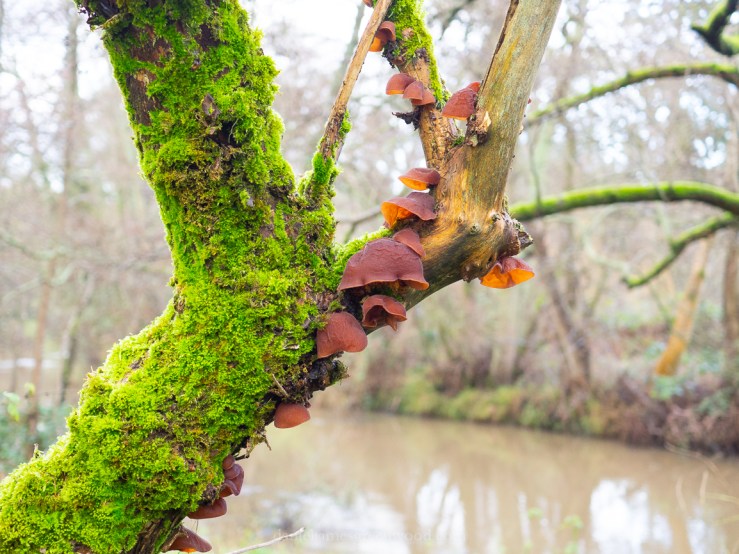
To kick things off, this week I photographed jelly ear. This is a common species that, like in the image above, can be found growing on elder trees. It stays on a branch all year round and goes through a process of de- and rehydration. It seems happy in the winter months.

Jelly ear once had a more derogatory or racist name. This is largely because of the Latin name (Auricularia auricula-judae) which relates to Judas Escariot and the species’s association with elder. Judas is said to have died from hanging in an elder tree but that is almost certainly impossible because it is a very soft wood. The ears are said to be a remnant of his spirit. I call it jelly ear, as do all up to date field guides.

SHW 17-1-18 djg-11

More about fungi

The Sussex Weald: the glowing neon church

Ebernoe - 8-11-2019 blog-6.jpg

In memory of Joseph Reilly

Ebernoe, West Sussex, November 2019

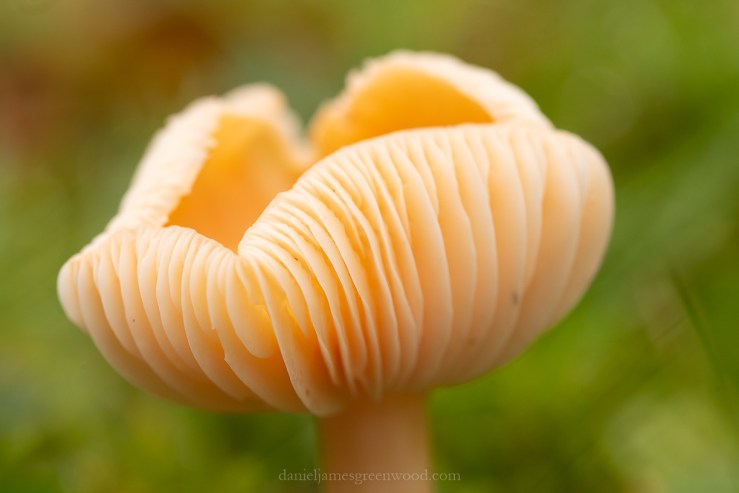
At Ebernoe I enter the yard of a church with neon algae glowing on the brickwork. In among the graves meadow waxcap mushrooms grow, one with its cap curled up and over like a pale petalled poppy. โ€˜The church is open but the handle is stiffโ€™ reads a sign on the door. I turn it and enter inside. That cold stone church air hits my skin, no one else is here. At least no one human.

There is a bird in here. It flies across the aisle and lands on a hanging lampshade, rocking with the force delivered by its flight. Then it moves to one of the windows clinging to the iron frame that separates panes of glass. Itโ€™s a blue tit. I wonder how long itโ€™s been in here, perhaps overnight. I think for a few seconds of what to do and walk to the church door. I pull it wide open, moving away to give the bird space. Within seconds the little blue tit flies through the open church door and back out into the woods where it belongs.

I sit on the bench and experience silence but for the dripping of water on the roof. There is a peace in here that I only ever seem to find in places like this. In the stained glass windows images of Jesus Christ, stories depicted that I don’t remember from childhood. The glass’s vibrancy is at odds with the dark and glowering morning that has crept in over one of sun-drenched hedgerows and beech trees lit like fires. I write a word of thanks in the visitor book and make my way back out into the churchyard.

Explore the Sussex Weald

The South Downs: the otherworldly nature of Kingley Vale

Kingley Vale - 27-10-2019 blog-7

Kingley Vale, South Downs, West Sussex, October 2019

We enter the ashy woods of Kingley Vale, one of the most spellbinding places in the South Downs. Mushrooms are everywhere at the feet of yew, ash and oak trees as the season enters its peak.

Kingley Vale - 27-10-2019 blog-1

The light is weak so we kneel down next to the mushrooms to look more closely. We find blushers, ceps, deceivers and many brown species that are very difficult to identify.

Kingley Vale - 27-10-2019 blog-3

Archetypal mushrooms grow with black gills and caps that glow purple. Their collars hang loose like pastry over the edges of a tin.

Kingley Vale - 27-10-2019 blog-6

Kingley Vale is famed for its ancient yew trees, particularly one area that is heavily visited, the roots of the trees beginning to show above ground from the impacts of footfall eroding the ground around them. They feel like one of the most still and unmoving of tree species, owing to their hardness and strength. Their living tissue is some of the strongest in the plant kingdom and their heartwood is not at all needed for them to remain upright. Their roots can go on producing new trees even when those above ground have died, like the Borrowdale yews in the Lake District.

Kingley Vale - 27-10-2019 blog-8

Out from under the yews chalk grassland spreads to the foot of the ridge where yew and ash woods cover the hills. Many of the ash trees are succumbing to ash dieback disease, in a landscape where they are content. It is a tragedy but then it is our own fault for unchecked trade of wood products, combined with the eventual spread of fungal spores.

Kingley Vale - 27-10-2019 blog-9

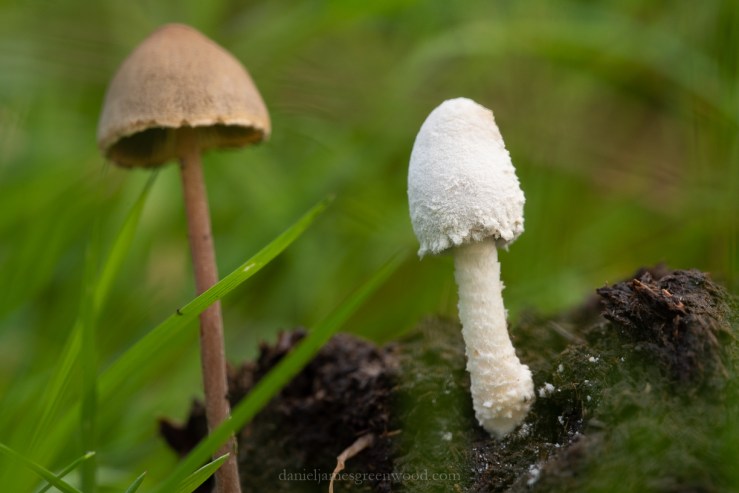
In the chalk grasslands we find a cowpat with mushrooms popping from the poo. One of them is snowy inkcap, a species I have never seen before, with its powdery cap and stem. It looks like something you might find in a snow globe.

Kingley Vale - 27-10-2019 blog-16

Climbing up onto the ridge the sun slips away in the west, casting a final glow across the chalky bowl of Kingley Vale.

Kingley Vale - 27-10-2019 blog-12

The grunting of a male deer echoes in the yew woods broken by the white stags of bare bone ash branches. Knowing some of these trees may be dead lends them a ghoulishness. Their brushheads are fading into history. Many will not be here in years to come.

Kingley Vale - 27-10-2019 blog-33

The sun glimmers in Chichester Harbour and the sea. A plume of smoke spirals into the evening sky.

Kingley Vale - 27-10-2019 blog-37

In the dense and dark yew woods on the slope we hear the strange, tropical bubbling of a tawny owl. Here yews reach out into the light at the edges like multi-limbed bodies sucked into a vortex. The yews have clarified the soil, no other plant can compete. Combined with the tawny’s song, the experience is otherwordly.

Kingley Vale - 27-10-2019 blog-42

At dusk rooks flock in a sea of black over a field-edge wood. Their cawing grows louder and closer as they envelop the sky above our heads, drawing in jackdaws, drifting back beyond the tops of the trees. On the darkening hilltops deer graze like slow-footed, four-legged people. We are left with so many questions.

Explore my Wood-Wide-Web

The Sussex Weald: Riders of the mushroom storm

Owlbeech - 18-10-2019 lo-res-28

St. Leonard’s Forest, West Sussex, October 2019

After a night of stormy weather, the high winds blew through the woods and really I probably shouldn’t have been there. But October is such a special time in the woodland year that any time spent there is to be cherished.

Owlbeech - 18-10-2019 lo-res-3

I walked for three or so hours in the Forest and found lots of species, masses of small brown and grey mushrooms in the leaf litter that don’t make great photos. My first find was a lovely species known as twig parachute.

Owlbeech - 18-10-2019 lo-res-4

Staying in macro mode these miniscule bonnets were were growing from a bed of moss on the buttress of a tree.

Owlbeech - 18-10-2019 lo-res-6

There is a small clearing I’ve recently found, well hidden from paths but obviously the secret space for other visitors as well. Here a thick humus of leaf litter and, in particular, beech nuts were creating good fruiting ground for mushrooms. This little brittlegill (I always prefer their Latin name of Russula, indicative of their redness) was one of those to benefit.

Owlbeech - 18-10-2019 lo-res-5

A beech tree has dropped a large limb and deadwood fungi have begun to colonise it. This is a splitgill and only really comes to life after prolonged rain. It’s a process of re-hydration. They’re tricky to photograph but always look nice with some bokeh (the baubles of light) in the background.

Owlbeech - 18-10-2019 lo-res-8

In the mosses growing in the dark and wet corners under holly trees, species like what-I-think-is curry milkcap were fruiting. This species is said to have a curry-like taste.

Owlbeech - 18-10-2019 lo-res-14

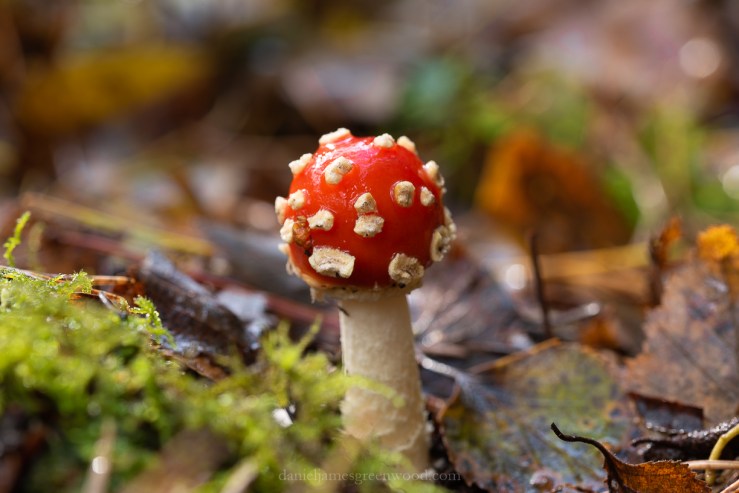
St. Leonard’s Forest sits on the edge of sandy heathland soils and Wealden clay. Passing into the heathy areas which make it a ‘Forest’ (forests were open landscapes used for hunting by the aristocracy, and don’t denote woodland alone) fly agaric suddenly arrived. These shrooms are thought to have given Father Christmas his red and white outfit and provided the hallucinatory impact that gave visions of reindeer flying. I’ll write something about that one day but still, these should be treated as deadly poisonous.

Owlbeech - 18-10-2019 lo-res-39

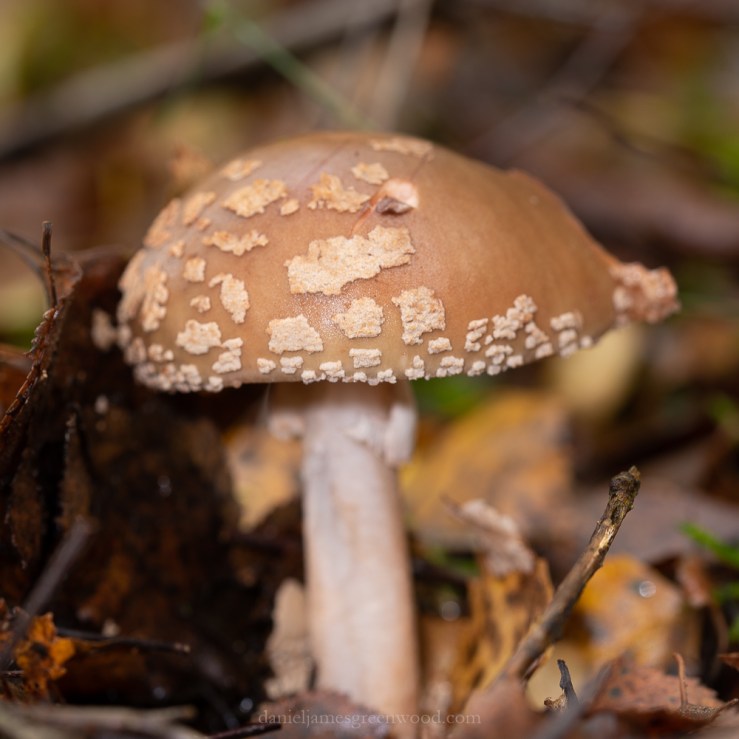
While we’re on deadly shrooms, this relative of fly agaric is panther cap. It’s definitely poisonous and is more photogenic when it’s in its bulbous stage. Again it’s common on sandy heathland soils.

Owlbeech - 18-10-2019 lo-res-25

There is some constant pleasure about seeing boletes. Perhaps it’s because the cep/penny bun/porcini is the tastiest. This bolete scares me. Can you see the smiley face and squiggle of hair on the cap?

Owlbeech - 18-10-2019 lo-res-20

Days of cloud were broken up by the storm and it was a relief to see some sunshine. This footbridge runs over a gill that cuts between the clay woods and the heathland on that travels further east into St. Leonard’s Forest and the wider Weald. The gill was as full as I’d seen it because of torrential downpours.

Owlbeech - 18-10-2019 lo-res-51

On my way back home I found a gang of clustered bonnets on a trunk that crossed a path. It had been chainsawed in half so people can still walk through. It’s the perfect height and position for photos.

Owlbeech - 18-10-2019 lo-res-45

Owlbeech - 18-10-2019 lo-res-38

The sun broke through the trees and lit the bonnets where they had squeezed their way out from behind the bark. To me they look a little bit like they’re hiding from something beyond the wood they cower behind.

Read more:

The Sussex Weald

My Wood-Wide-Web


The Sussex Weald: a mushroom cloud rests over West Sussex

Ebernoe - 11-10-2019 djg-3

Ebernoe Common, Sussex Weald, October 2019

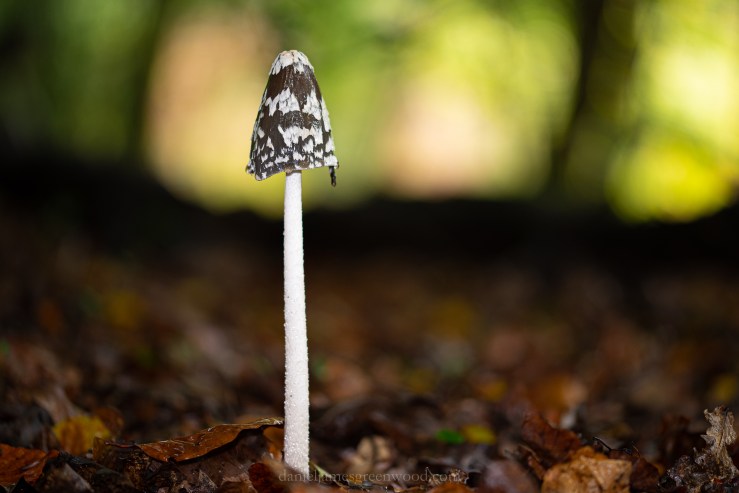
Last week I spent a drizzly and dark afternoon at Ebernoe Common, a National Nature Reserve managed by Sussex Wildlife Trust. It was raining not only water but mushrooms. The first signs of the good times came in the shape of a magpie inkcap. This is something I’ve only seen three times, twice at Ebernoe and once on the North Downs.

Ebernoe - 11-10-2019 djg-1

The word magpie relates to the English phrased ‘pied’ which means black and white. This species goes into the delicious state of deliquesce (an inky kind of melting), just like its relative the shaggy inkcap. Unlike the shaggy inkcap, though, it’s toxic so don’t eat it. The thing I like about this image is the glow of green in the background gradually turning to yellow as autumn progresses. Beech usually provides this kind of backdrop.

Ebernoe - 11-10-2019 djg-4

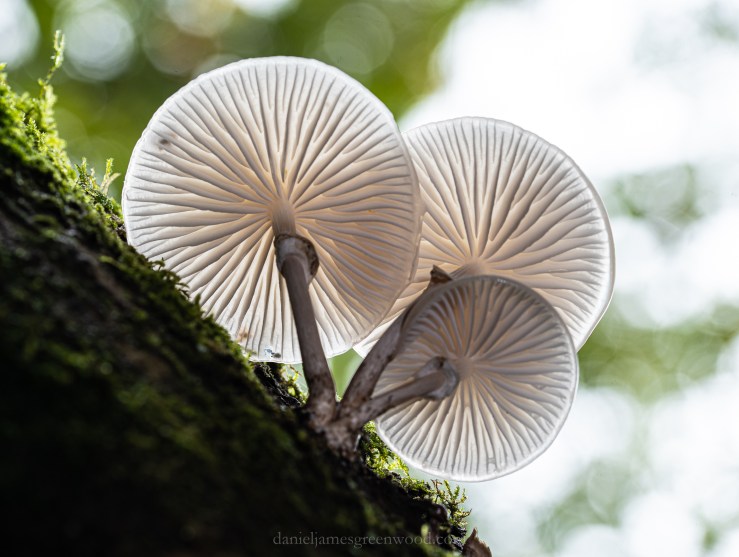
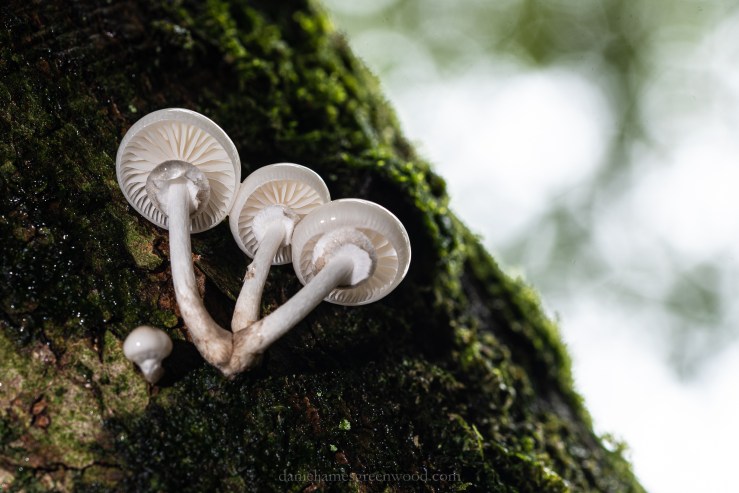
Porcelain fungus is a reliable species. It fruits in the same place, often en masse, each year. It is a beautiful species but the beauty, like so many things, lies underneath.

Ebernoe - 11-10-2019 djg-7

The gloopy glimmer of the cap is photogenic but the gills of porcelain fungus are stunning.

Ebernoe - 11-10-2019 djg-13

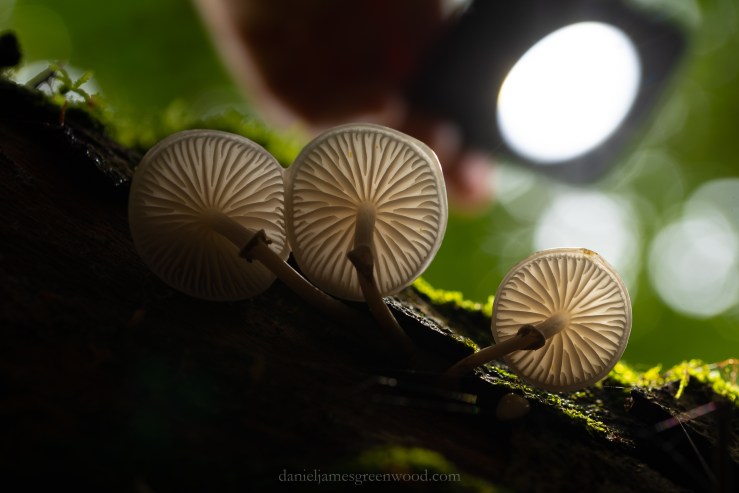
I use a small LED light to illuminate mushrooms in this way. I can’t tell you how much more character this can offer to photos. Actually I can: a lot more.

Ebernoe - 11-10-2019 djg-21

Here you can see my roving light (yes, I meant this!) mixing it with some delicious bokeh in the background. Leaves and branches create lovely bokeh because of the break of light in the gaps.

Ebernoe - 11-10-2019 djg-20

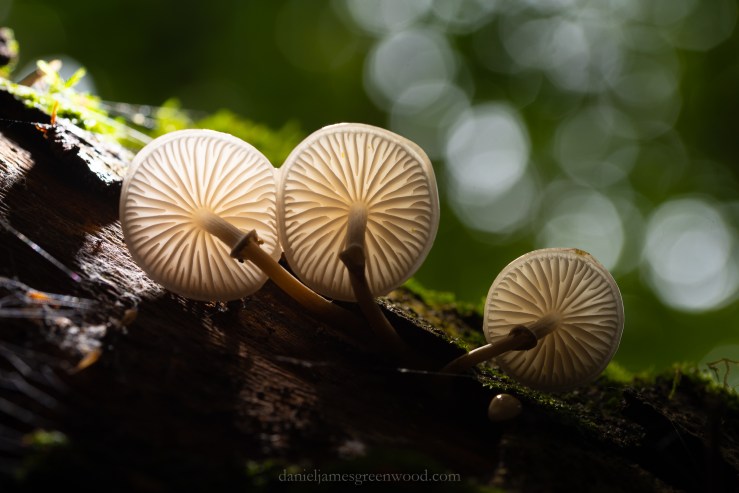
Here is one of ‘the finished images’. I like that the light circles can imitate the caps of mushrooms in photos and offer a deeper layer of resonance and reflection. Who knew.

Ebernoe - 11-10-2019 djg-38

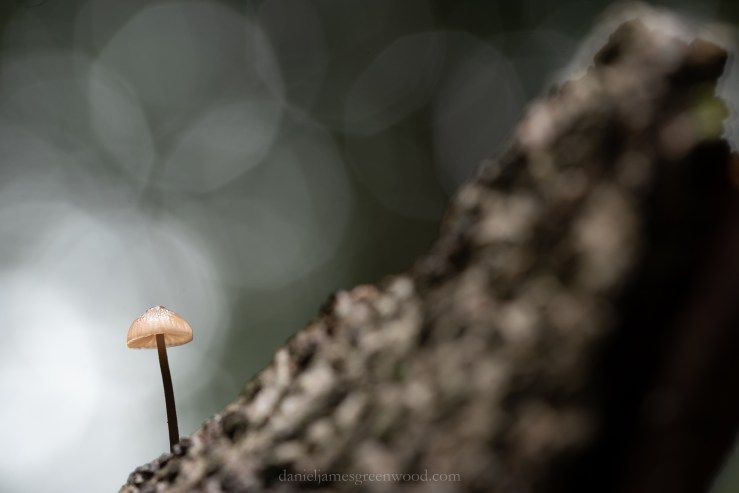
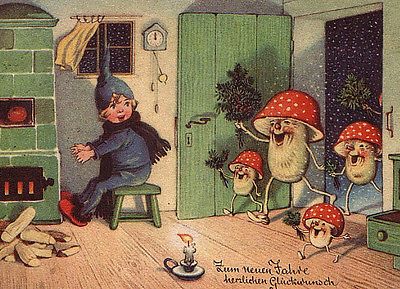
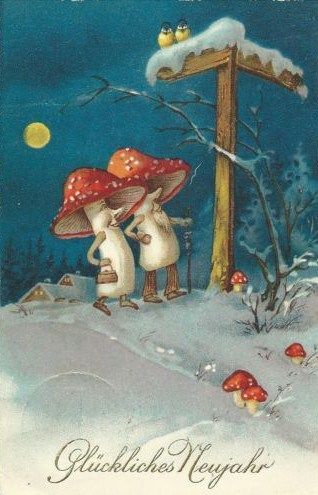
In photography, macro is where the fun happens. There are so many amazing things happening at our feet that our eyes are incapable of seeing without the help of magnification. If you want to have a go at macro, don’t hesitate. Just do it. I call this one ‘Climb every mountain’. The piece of deadwood does have the appearance of a peak in this light. The mushroom is like a protagonist, playing on a theme of mushrooms as individuals or sentient beings throughout human history:

16a9e28079e352a3d6d8ff664898b820-christmas-themes-christmas-cards

5d58176f8caa8c1e9faf25e0ab9f6bc8-picture-postcards-mushrooms

This seems to be particularly prevalent in German culture and Christmas or New Year celebrations. Christmas has evolved from Pagan traditions (Paganism was once considered any religion which was non-Christian) and the place nature has in the human imagination is pretty clear here.

Ebernoe - 11-10-2019 djg-16

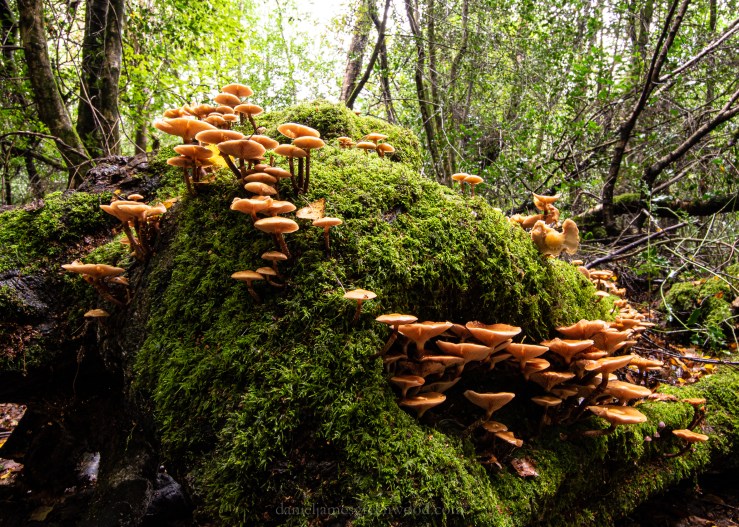
Back to life, back to reality. Honey fungus is enjoying its first boom phase and seems to be having a good year.

Ebernoe - 11-10-2019 djg-18

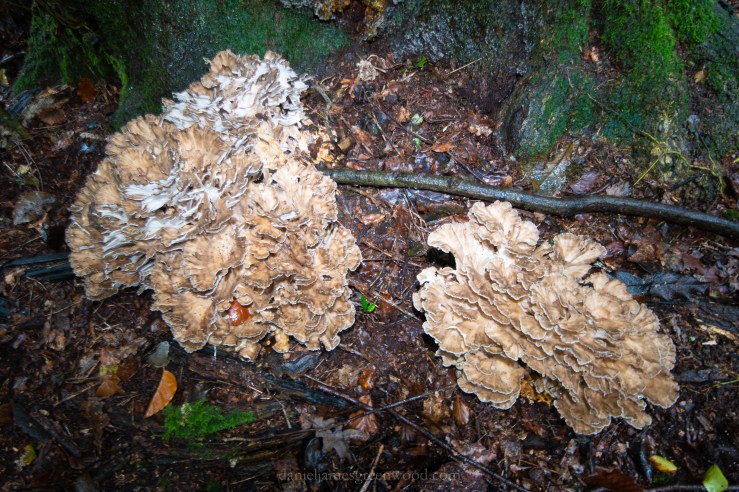
There is a dead veteran beech tree at Ebernoe Common which is basically where all the mushrooms live. This wide angle image shows just how many larger species were making a home within the tree. Here you can see giant polypore (bottom left), honey fungus in the middle and Ganoderma brackets everywhere. This is a stunning tree and of the highest ecological importance because of all the species, not just fungi, it supports. All of these species are contributing to the tree’s decay and recycling into organic matter (soil).

Ebernoe - 11-10-2019 djg-9

Not far away was a patch of hen-of-the-woods, an aggressive root-rotter (harsh). It’s said to smell like mice (more harsh).

Ebernoe - 11-10-2019 djg-42

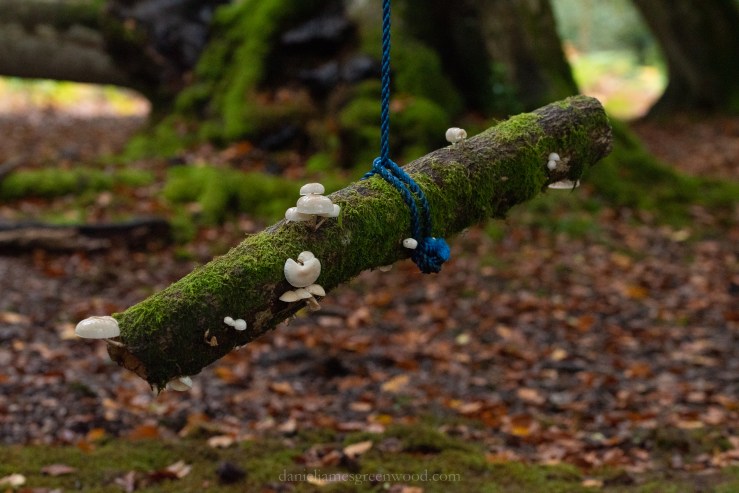
You can imagine how I thought someone was playing a trick when I passed this. A swing made from a beech log that was covered in porcelain fungus. It was embarrassingly hard to photograph well. Thankfully only the mushrooms were looking and they haven’t evolved to use Twitter yet.

Ebernoe - 11-10-2019 djg-47

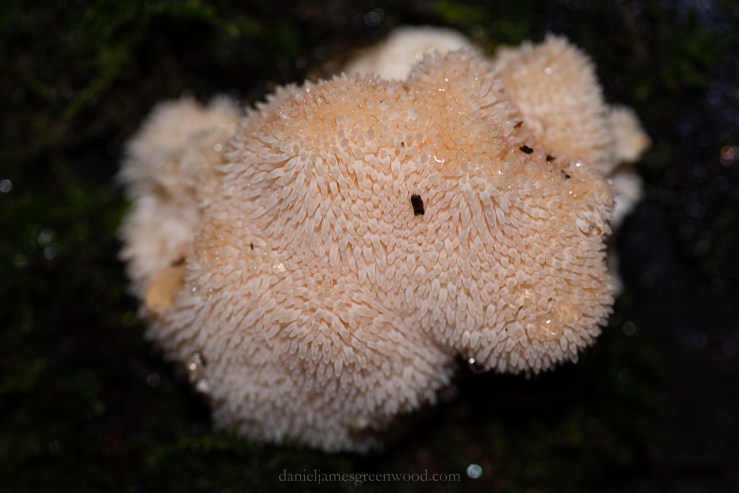
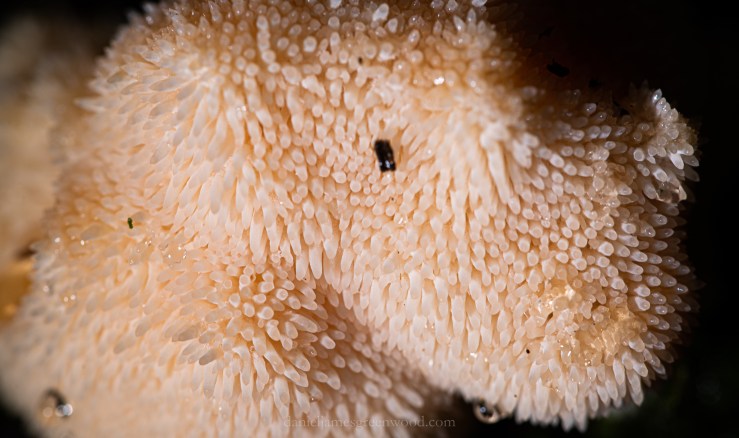
On my way out I spotted this slurp of fungus low on a log by the path.

Ebernoe - 11-10-2019 djg-50

Looking closely with the macro lens it has the appearance of something you might find in a coral reef. Then that’s the beauty of woodland, it has a depth to it that you have to dive in to experience for yourself.

Thanks for reading.


Read more:

The Sussex Weald

My Wood-Wide-Web


The Sussex Weald: Something is right with the world (and it’s mushrooms)

Ebernoe Common, Sussex Weald, August 2019

Looking out of the window at work one morning, a colleague agreed with me:

If there are no mushrooms after this rain, then something is very wrong with the world.

Fast forward a few hours and there is something ok about the world.

Stepping out onto the track and into the woods there was a clear indicator of a mushroom party with lots ofย Boletus-like species typical of the season. This time, I was invited. All too often looking for mushrooms can be like arriving at a party the morning after when everyone is discarded like shells around the living room and slime coats the walls.

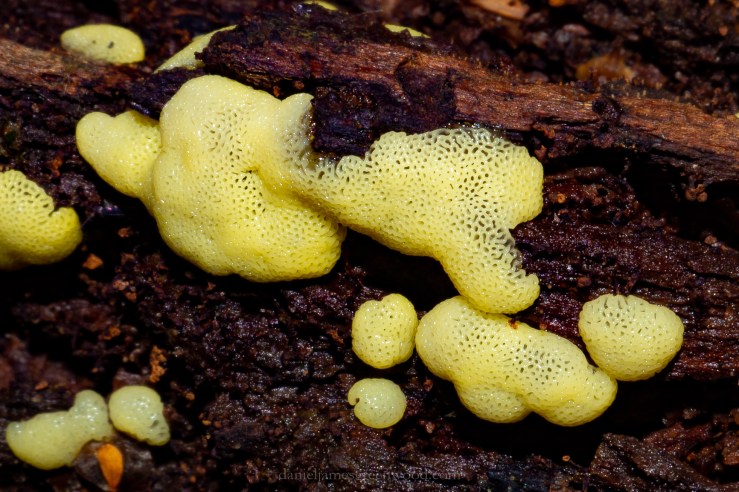
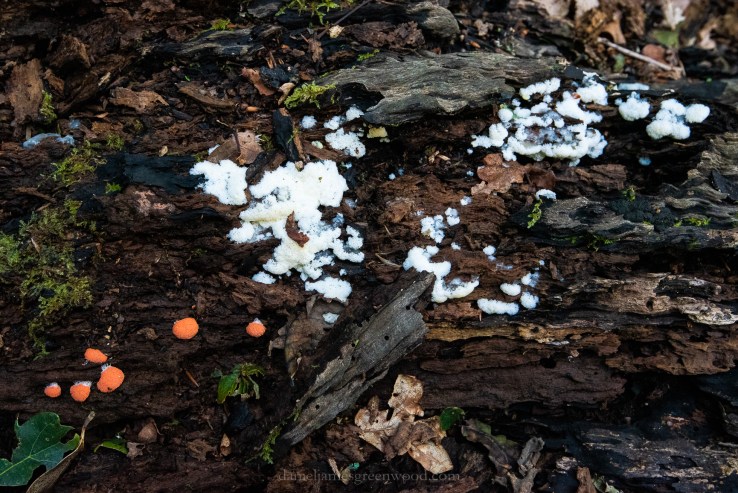
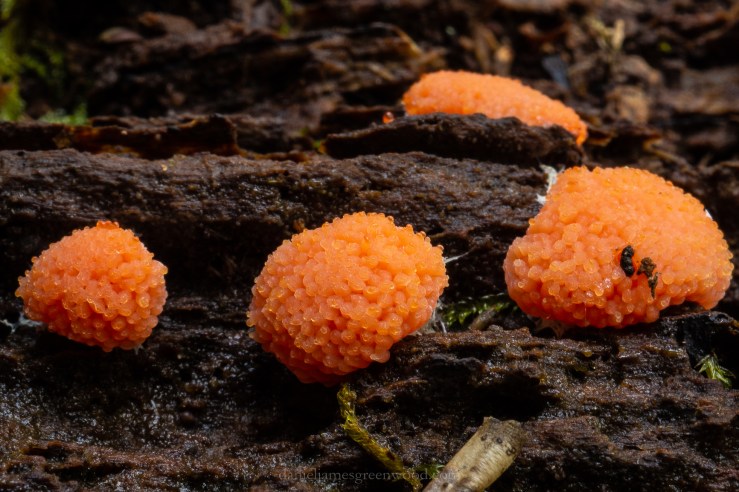
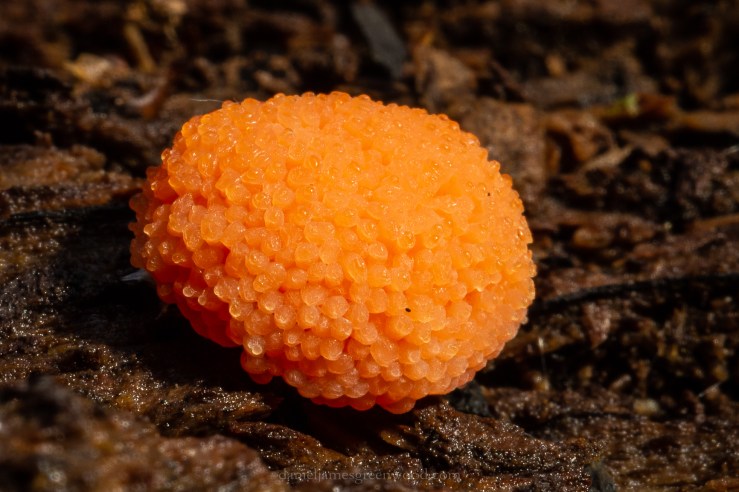
There was still slime on the walls on this pleasant summer’s evening at Sussex Wildlife Trust’s magnificent Ebernoe Common. It’s part of the Low Weald, an area or ancient woodland that is very much intact and once connected Canterbury with the New Forest. The slime here was the real deal, with beautiful splodges of slime mould spreading across fallen oak trunks.

Further inspection with my trusty macro lens showed the intricate beauty of this slime mould. Trouble is I don’t have the field guide yet so I’m stuck for an identification. But really does it matter? I’m not a scientist in the traditional sense and it’s their beauty I cherish most. Scientists, while we’re here, don’t even know where to put slime mould in their taxonomic kingdoms. That sounds like one hell of a euphemism.

This walk was a blitz of about 3 miles with eyes scanning the woodland floor alongside the path. By pure fluke I found this small mushroom, not dissimilar to something like a funeral bell, popping out of the soil. It is surrounded by the most beautiful palmate leaves of star mosses. The wonders of macro photography allow this world to be glimpsed and indeed shared. Macro photography is an art (not necessarily in this case) as fine as landscape photography.

I also had my larger DSLR slung round my neck with a wide angle lens. The golden hour is not quite so golden in an August wood, but it’s still worth appreciating. Notice the growth of lichens and algae on the north-facing side of this beech here for 10 points.

Ebernoe - 15-8-2019 djg-17

One of the recent additions to my mushroom portraiture war-chest is an LED light. It’s a pretty fun way to add a new layer of interest to photos, especially of mushrooms. I also have a mini tripod for it so it is a bit like a pet android that wanders the woodland floor for me illuminating fungi. This shroom was growing down between two big boughs of a fallen beech tree. It was land of the mosquito and I made substantial donations to their bloodthirsty cause. This does look rather angelic if I may say so.

A trio of bonnets were evidence of the recent rain. Up they spring before collapsing not long after.

Ebernoe - 15-8-2019 djg-32

Have you ever noticed just how long bluebell seed casings linger after spring? It’s a good way to identify an ancient woodland out of season. This flower was present on the edge of the woodland where a field opens out. The sun poured in and lit the tulip-like papers of the bluebell.

Ebernoe - 15-8-2019 djg-29

My dad said he read my last post and had to look up what ‘bokeh’ is. It’s the circles or light in this image above that are caused by isolated areas of light. They are most pronounced when you have a wide aperture, so f1.4 on my brightest lens but usually f5.6 on most SLR lenses. It creates a beautiful blurred effect. Of course, I couldn’t resist it here. Looking at this image being photographed in the moment, what you can’t see is the twinkling of the light as the leaves moved in the breeze and the sun slid down. It took the breath far more than the image ever will.

Thanks for reading.

Explore my Wealden archive

Explore my wood-wide-web