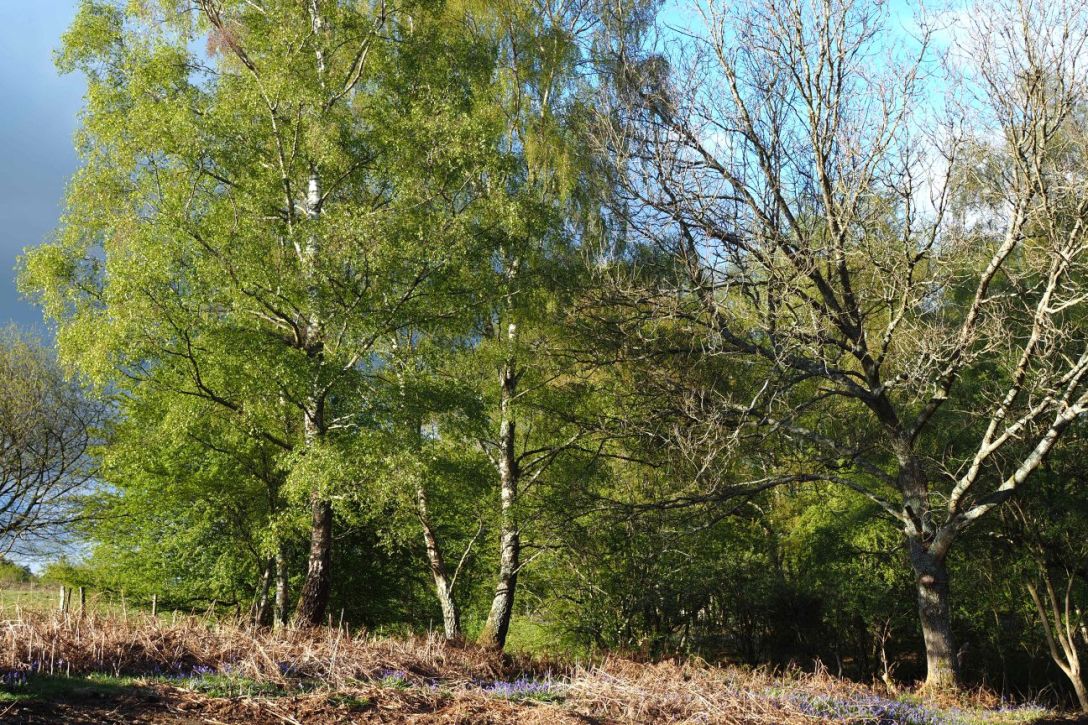
Last week I went to visit a woodland that was for sale. I wasn’t buying and the woodland was quickly snapped up anyway. I hope it went to someone who will care for its wonderful ancient woodland wildlife, and that the badger sett within it will go undisturbed. Leaving this beautiful snippet of the Sussex Weald, I found some mushrooms growing in an area of grassland alongside more woodland.
Common inkcap
We have been inundated with rain in the past 10 days, after a very dry April in southern England. Things are leafing and flowering later than last year, and there have been no spring mushrooms from what I have seen. These were mushrooms that were so plain I really wasn’t sure what they were. I took some photos and posted them on iNaturalist.
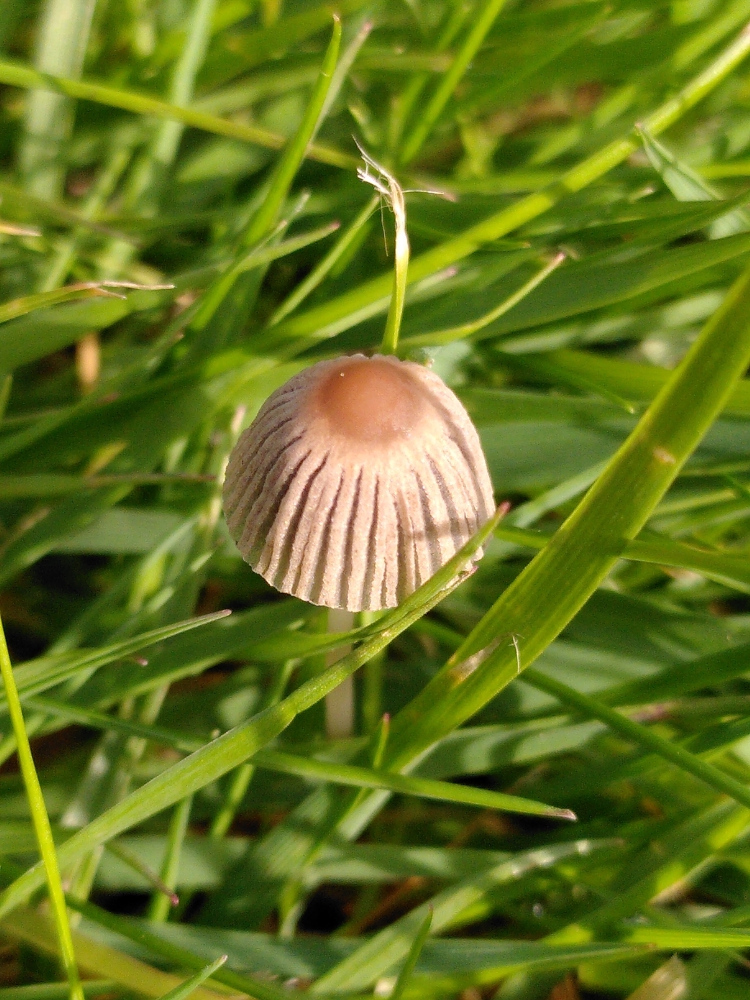
They are common inkcaps. I’m not sure how I’ve missed this species before, as this was my first known sighting of them. That wasn’t the final grassland inkcap I was to see in that week.
I have a small garden which is ‘managed’ for wildlife and gentle recreation. We’re currently in the midst of #NoMowMay, an initiative in the UK to let any grasslands grow so flowers can thrive, and all the life that comes with that. It’s not just about flowers, though. I was pleased to see (and nearly step on) a tiny inkcap in the lawn.
This is a golden haired inkcap, quite easily confused with pleated inkcap, I would say. The most obvious difference is the size, with the former much smaller.
After all the rain we’ve had, quenching the woods’ thirst, I’m hopeful of some more shrooms appearing in the next week or so. Fingers crossed!
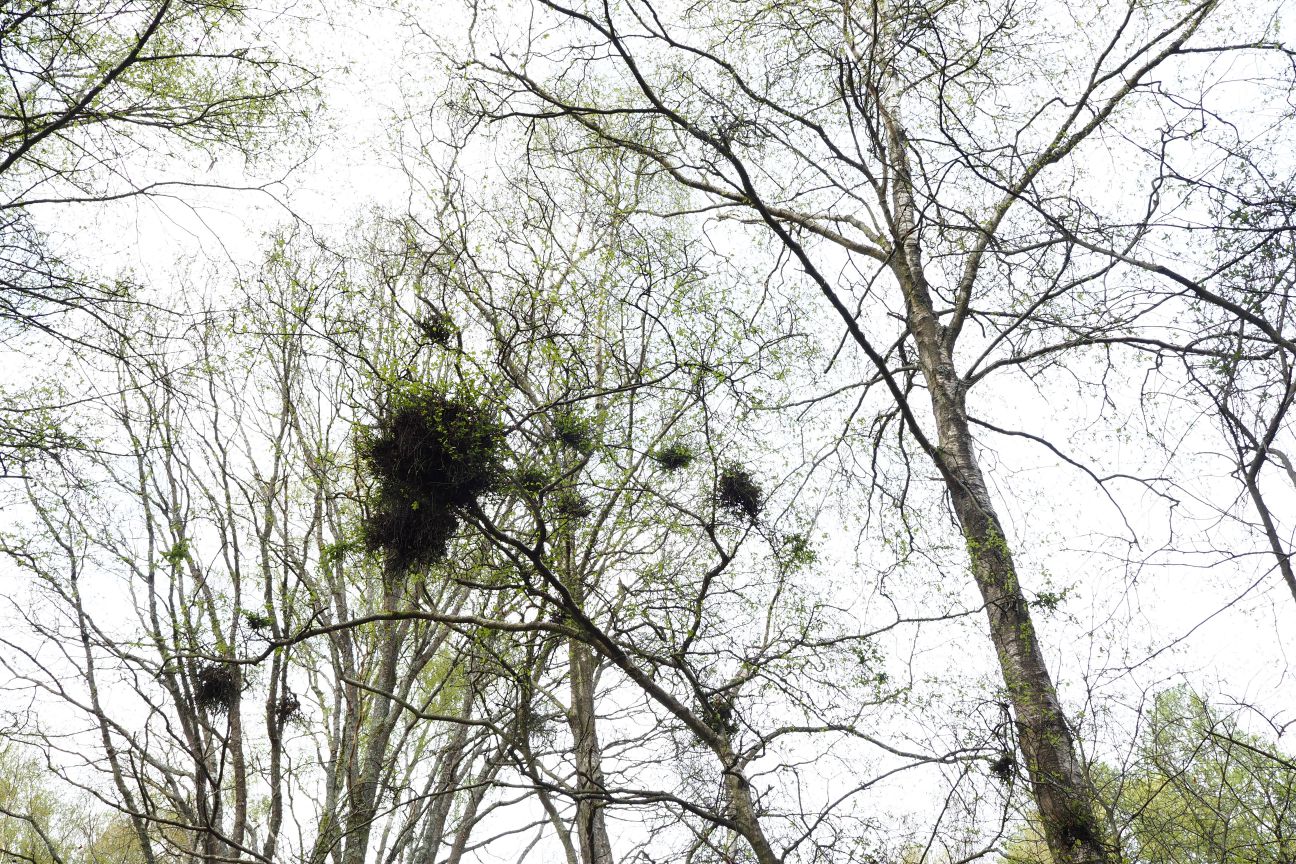
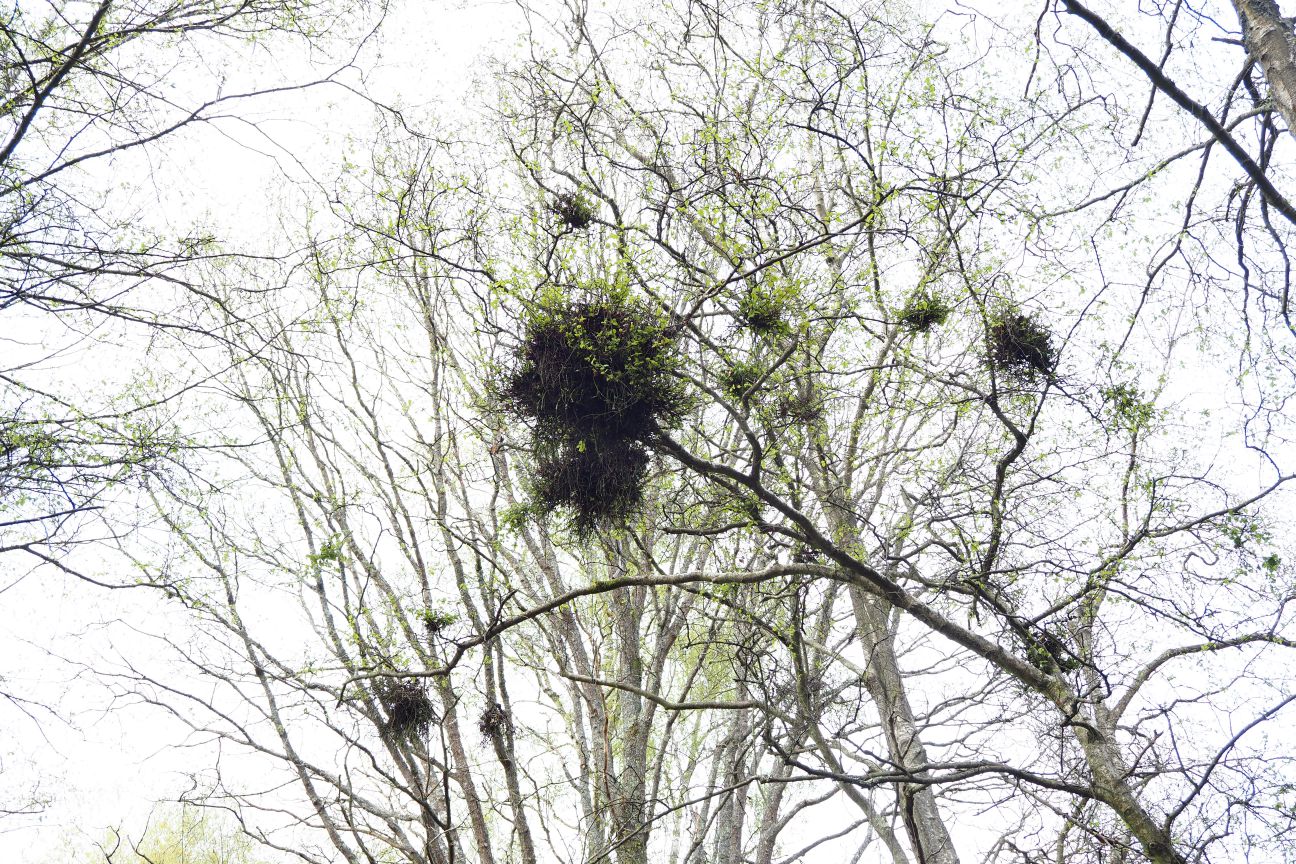
For a long time I’ve noticed an explosion of twigs among the canopies of birch trees but never taken the time to find out what it was. Recently I read that this unusual grow pattern, if that’s what it was, could be caused by fungi. Last week I was out walking in a woodland not far from home when I saw a fine example of this strange occurence.
You can see how this could simply be confused with mistletoe, a similarly bushy growth high up in the tree. But mistletoe is caused by the sticky seeds of the plant becoming attached to a branch. The ‘deformity’ in birch trees looks all the more unusual. I took some photos and had a look online when I got back. When I submitted the record to iNaturalist for some help, I got the result of a fungus with the scientific name of Taphrina betulina. ‘Betulina’ relates to birch in Latin, Betula pendula.
A sunburst lichen with the ascomycete fungi visible in the form of the fruiting cups
This fungus is an ascomycete, related to cup fungi and the fungal fruiting bodies found in lichens. Unfortunately I couldn’t get close enough at this point to ever see those details on the witches’ broom.
It could easily be confused with random birds nests, and you have to wonder if they may actually form decent nesting habitat for some species, probably woodpigeons more than anything else. One thing I notice about the cultural significance of the species is its name – another reference to witches. It must be that anything which looked unusual in nature was referred to as the work of ‘a witch’.
Yellow brain fungus
In the fungal lexicon (is that a thing?) there are a host of jelly fungi which go by the name of witches’ butter. It may be in the case of witches broom that the cluster of twigs looked like the flying broom of a witch, as per the old folktale. That or Harry Potter, anyway.
It’s been such a dry spring that I’m starting to wonder if there are any on this planet! They’re probably not on Mars but it’s a nice idea. Here’s more info on that story.
While I have your attention, allow me to explain some changes to the way this blog works. I am moving from the fixed days of #FungiFriday or Macro Monday. If you’re a regular reader you may have noticed that already. Now I’m making a monthly podcast, I need more flexibility with posting, and I actually sometimes have more to post about on both macro and fungi than just once a week. Also deadlines of Thursday and Sunday are not ideal!
Back to life. After a barren period (no morels for me), I did manage to find a couple of species on a long walk the other day, hiding away in the shade of a country lane. Get ready for phone pics.
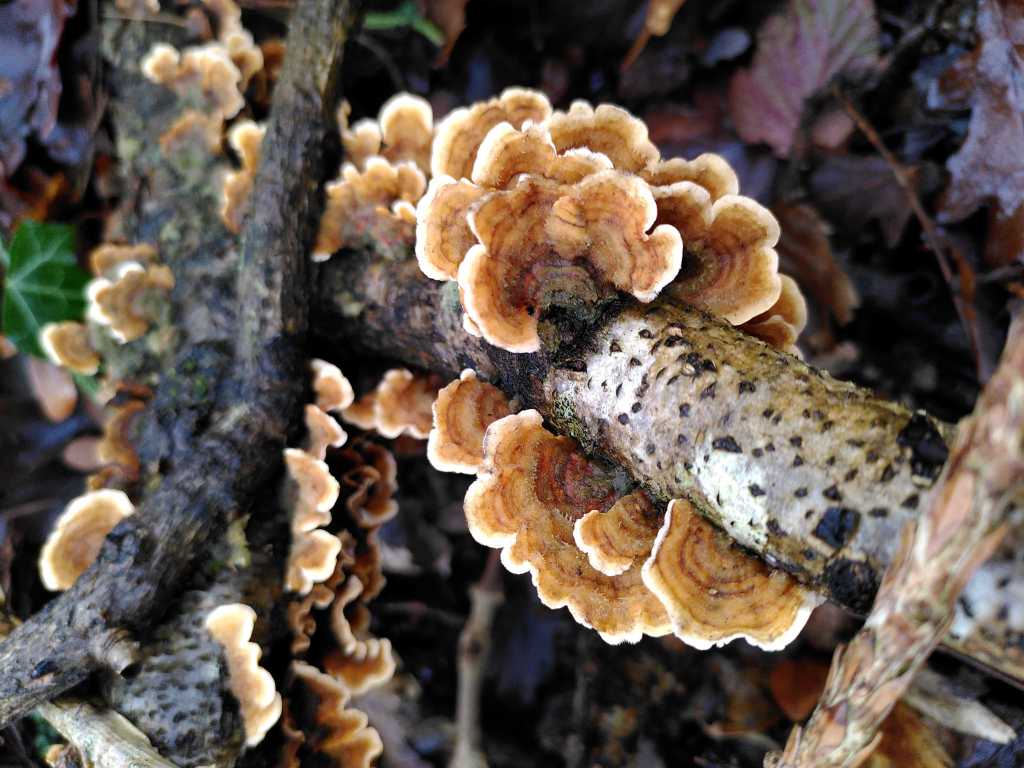
This is turkeytail, one of the most common fungi you can find, distributed across the world. It is sometimes used to make tea and extracts are used for their anti-cancer properties.
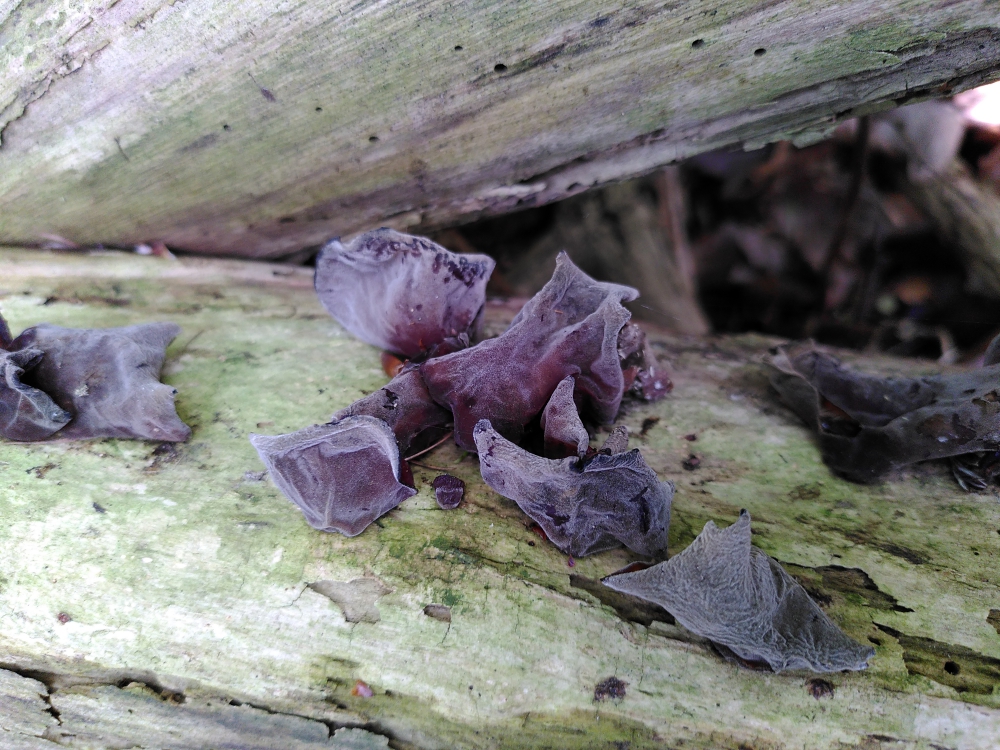
Dehydrated jelly ear, sometimes known as ‘wood ear’
In Sussex we have recently had rain after a very dry April indeed. If this is climate crisis related, it means that the British tradition of April showers could be confined to the past. Once again, wildlife can point to wider issues in the environment which we are often oblivious to.
In that not-quite-fungi-but-probably-animal category are the slime moulds, of which I found one on the same walk.
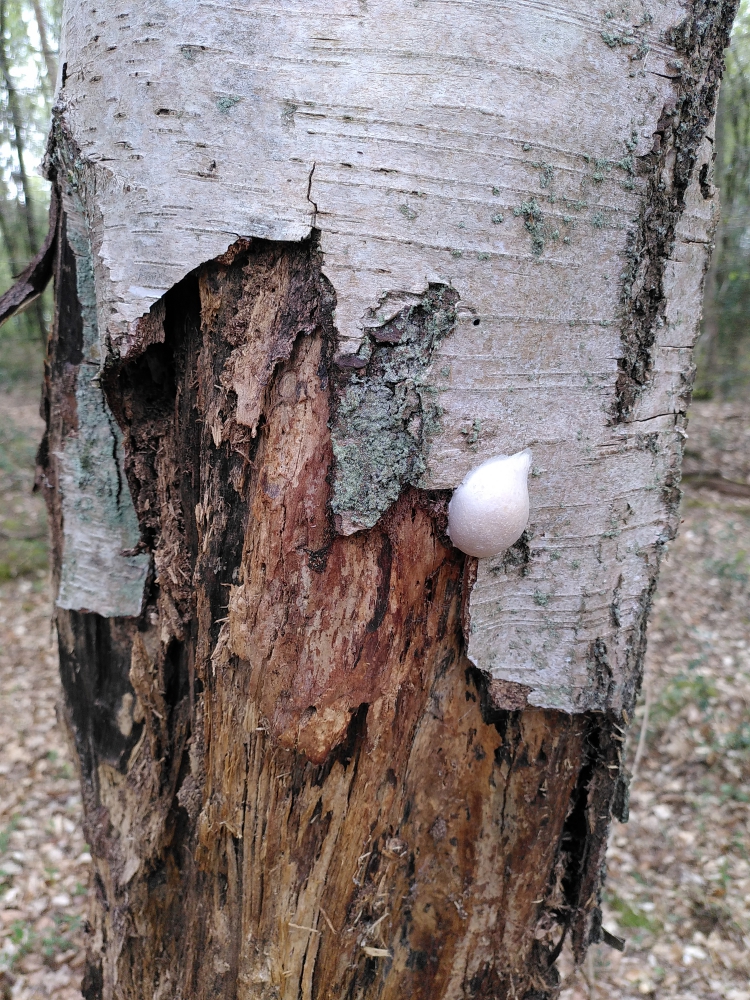
This is a great advert for fungi and slime mould because it’s so blatant. It’s a species you see cropping up on social media time and again, with many people intrigued by its presence, often on deadwood. It’s false puffball, a slime mould. Looking at iNaturalist, April seems to be its peak month.
In other news, I’m giving a fungi talk online on Tuesday 18th May at 19:00 (London, UK time) for Bell House, a charity that supports people with dyslexia. There is a suggested donation of £5 towards their work. You can see the full details and how to book here.
There may not be many mushrooms around at the moment but I do have some good fungi-related news to share. In April and May I’m giving fungi talks on Zoom for two London-based charities!
On Tuesday 6th April at 18:30 I’m giving a talk entitled The Weird and Wonderful World of Fungi for London Wildlife Trust. This is part of the Trust’s Great North Wood festival. The talk is going to be focusing a lot on London’s fungal ecology in terms of woodlands, in keeping with the theme of the festival.
You can see more on the Trust’s website. The event is free but donations are welcome. London Wildlife Trust is a fantastic organisation dependent on the support of people who care about London’s wildlife, so please donate generously!
On Tuesday 18th May at 19:00 I’m giving talk for Bell House, a learning charity based in Dulwich, south-east London. This talk is entitled Fungus amongus: common mushrooms in England and will be about common mushrooms you can find in the UK. This will be more about the basic identification of species rather than the myriad avenues you can disappear off to in the world of fungi.
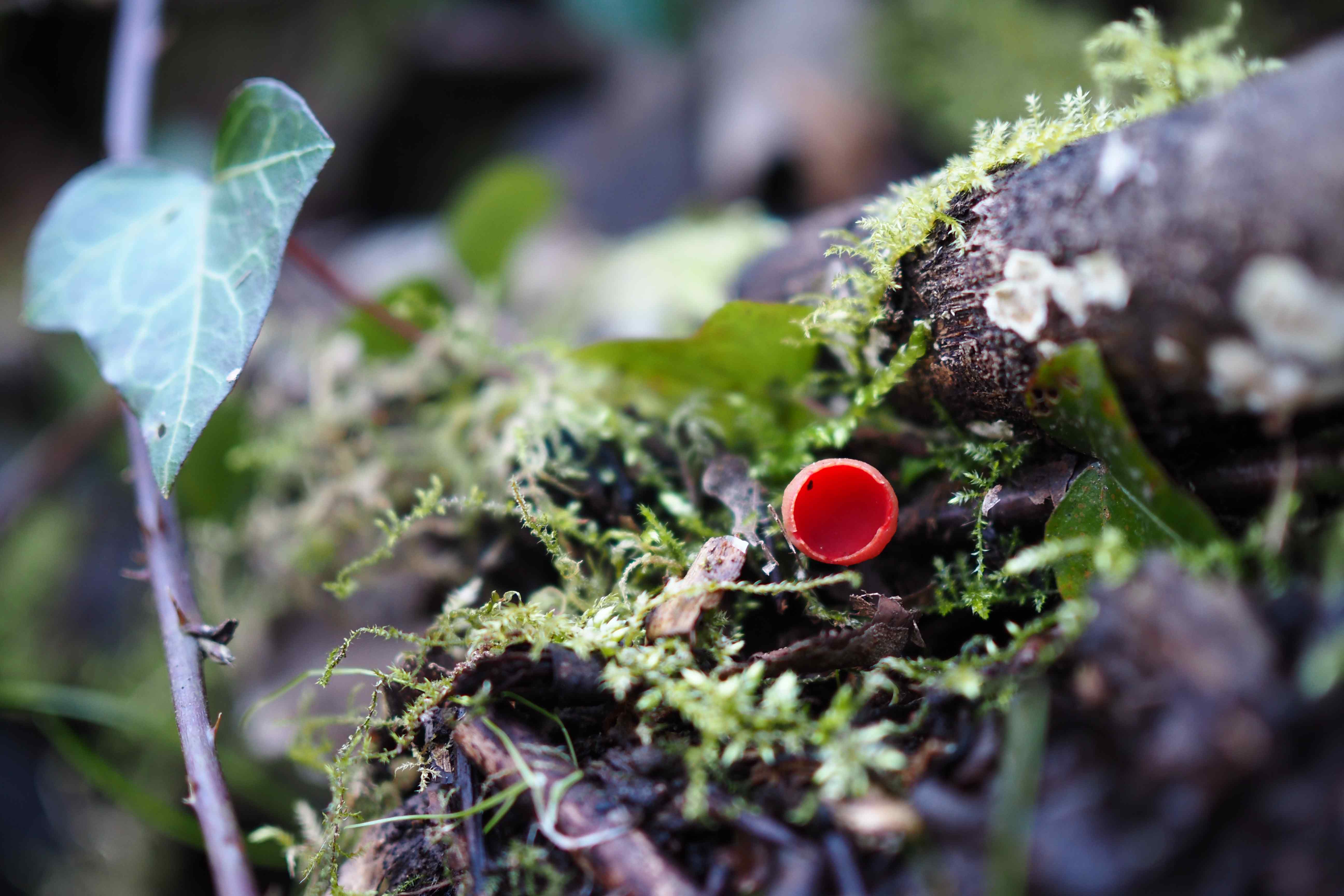
On social media in recent weeks one of the dominant fungi photographed has been a bright red cup fungus. This species is one of the most visually stunning, standing out like an elf’s sore thumb in a winter wood. I’m talking about scarlet elf cup.
I visited an area of woodland I have featured many times here, but a place I haven’t been to this year. I don’t know why, it’s close to home but usually requires a car journey because it’s awkwardly difficult to walk to. It’s a mixed ancient woodland with a stream running through it and heathland on its upper slopes.
In the UK heathland is a sandy habitat dominated by heather and pine. In terms, dry lowland heath is rarer than rainforest.
This woodland is managed with the support of volunteers. I don’t know the people who do the good work there but they clearly spend a good amount of time building what I know as dead hedges. These are barriers or piles of cuttings, branches, twigs and sometimes logs. They are there mainly to protect sensitive areas of soil where ancient woodland plants grow. It’s to keep people on the paths, which is best for the health of a woodland overall. These dead hedges also happen to be excellent habitat for wildlife like fungi.
From my experience in the woods and by looking at other people’s photos, I would say scarlet elf cups are happiest in damp, shaded areas. I would even say they are so keen on dampness that alongside streams and rivers is usually a good place to find them. This was a bit of a way from a stream but it ticked all the other boxes. You can see here that it’s growing from a small stick.
This is a nice example of this gorgeous fungus (not something you hear often enough). They grow on something similar to a stem but are a different set of fungi to the usual stipe-based mushrooms. Cup fungi are ‘ascomycetes’ (ask-oh-my-seets) and are spore shooters. ‘Basidiomycetes’ are spore droppers, most of them being the gilled mushroom types.
This area probably had hundreds of scarlet elf cups growing in this long stretch of dead hedge. It will be good habitat for lots of other species as well, including invertebrates and sometimes they’re big enough for small birds like wrens to nest in. The specimen above was snug as a shroom in a trug.
From what I know it’s an edible species, but I wasn’t about to clean out all these fungi from their wild habitat. I had mushrooms in my fridge that were a couple of days close to their best!
This week’s encounters with the fungal kingdom (that I know about), are piecemeal. I am still sticking close to home, so no woods or wildernesses, if you even believe in the latter. You might think fungi can only be found in specific places, but we’d all be wrong about that. Let me tell you, fungi are everywhere. We’re the ones who are harder to find.
Stick of the week
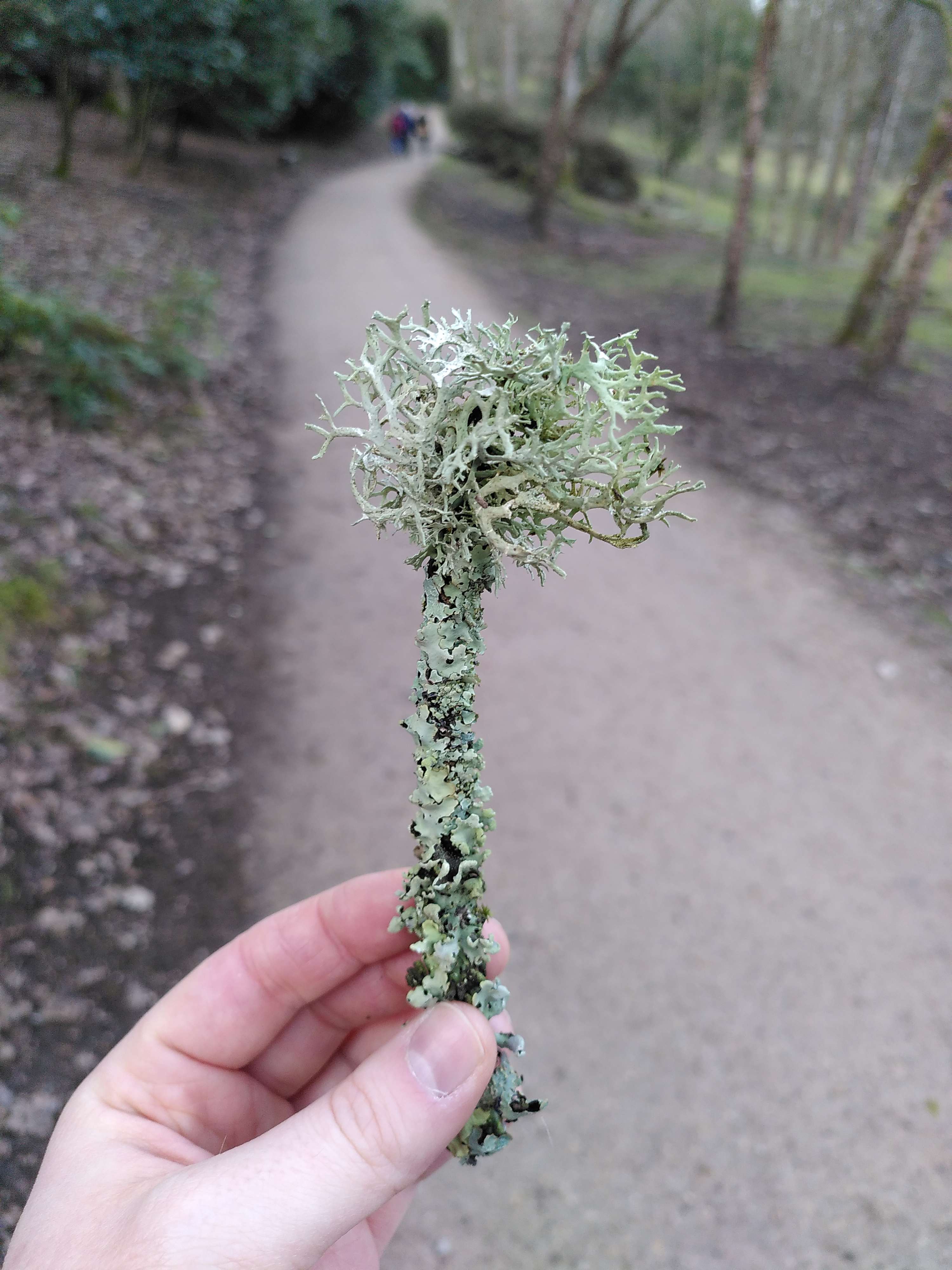
On a walk at a local estate garden in the Sussex Weald, I found and nominated this lichen-encrusted twig for stick of the week. I’m not sure where the hashtag #StickOfTheWeek started but I think it has something to do with the illustrator @Bernoid.
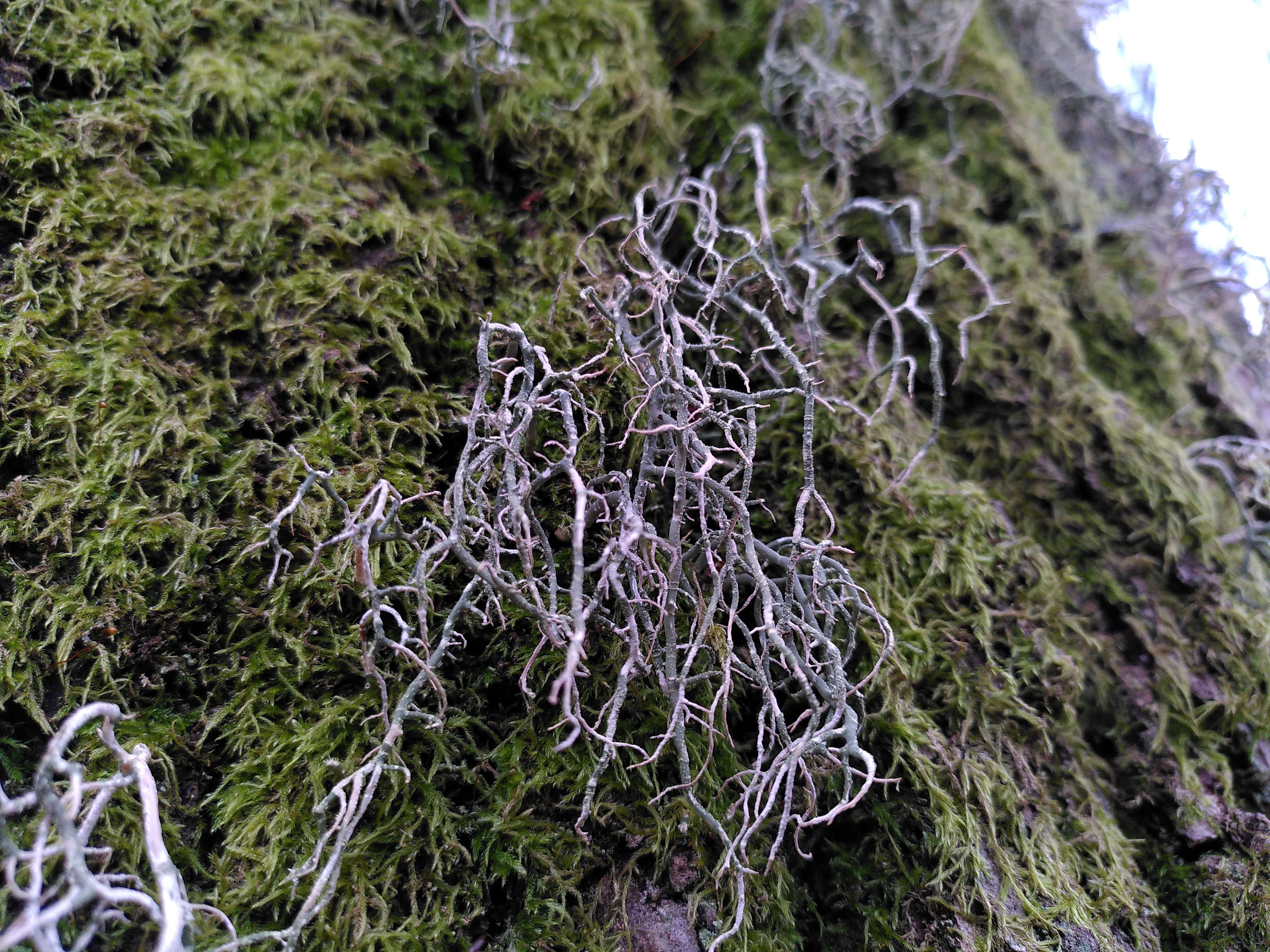
It’s not common that I personally find any unusual lichens in south-east England. Usually you need to go west to Devon, Cornwall, Wales, Ireland or up north to Scotland. This massive oak tree had a sheath of moss growing on its trunk, which was then home to a colony of beard lichens!
I think these are a species of usnea lichen, species I’m more used to seeing in Ireland and on Dartmoor. I learned from a fellow blogger recently that you are supposed to say ‘on Dartmoor’, because ‘in Dartmoor’ means you’re in the prison. I’ve been to the prison museum and have no intention of being ‘in Dartmoor’ no matter how good to lichens are on its doorstep.
Velvet shank
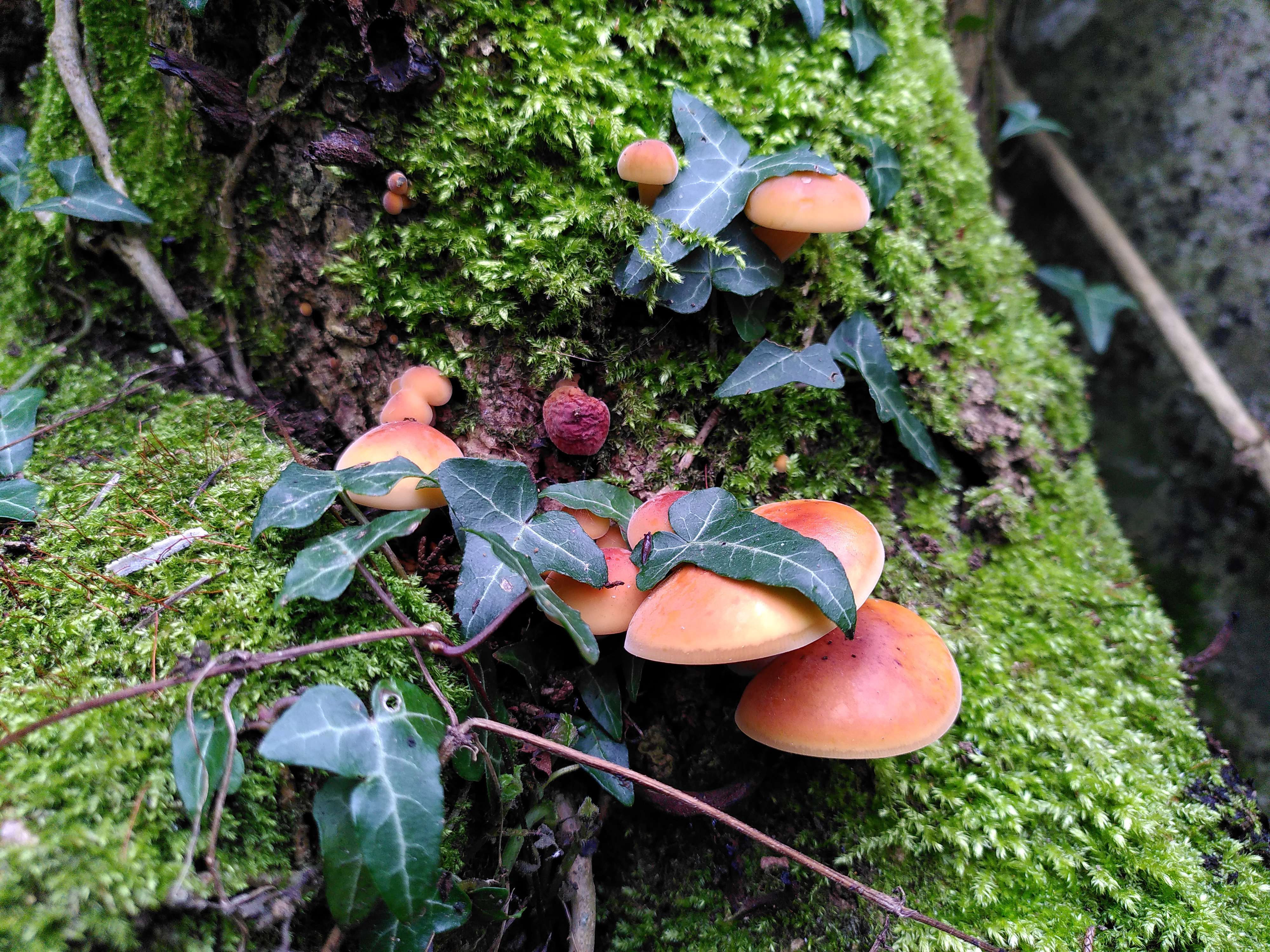
On a lunchtime march from home I re-stumbled upon a gang of velvet shank (Flammulina). I was actually drawn to the site of the first cherry blossom of spring, when I spotted that this churchyard stump was still sprouting shrooms. This is fungus is hard as nails, in terms, because it has toughed it out through the snow and continued to put out fruit. It’s a prime candidate for snowcapped shrooms.
I have some exciting mushroom-related announcements to make in the next couple of weeks. I’m also about to start Merlin Sheldrake’s much anticipated Entangled Life. Have you read it, is it as good as everyone says? Maybe I’ll share some of it in the weeks ahead.
I’ve had a burst of American visitors in recent days (to my blog, not my house). So thanks for visiting, y’all, and sorry about the year you’ve had. You may have noticed I’ve slipped to monthly posts on here. Between April and October I posted blogs every Monday without pause, which is a tricky task…
Here’s my seasonal update of stuff you don’t need to know about, but then welcome to the Internet. What I’m writing Soon I will be self-publishing my third poetry collection, Fool’s Wood. It’s seven years since my last one and this collection has taken longer because of LIFE. There will be a booklet and also…
Here’s another entry in my slow-blogging Oak Timbers series. You can view my galleries and posts archive here. I visited Salisbury in Wiltshire (south-west England) for the first time in 2023 and was really charmed by the place. If you’re interested in this kind of thing, Salisbury is the place for you. Here’s a gallery…
In Sussex we’ve been treated to snow and ice, followed by a sudden jump in temperatures to something spring-like. For mushrooms, it must be a confusing time. It definitely is for this manshroom.
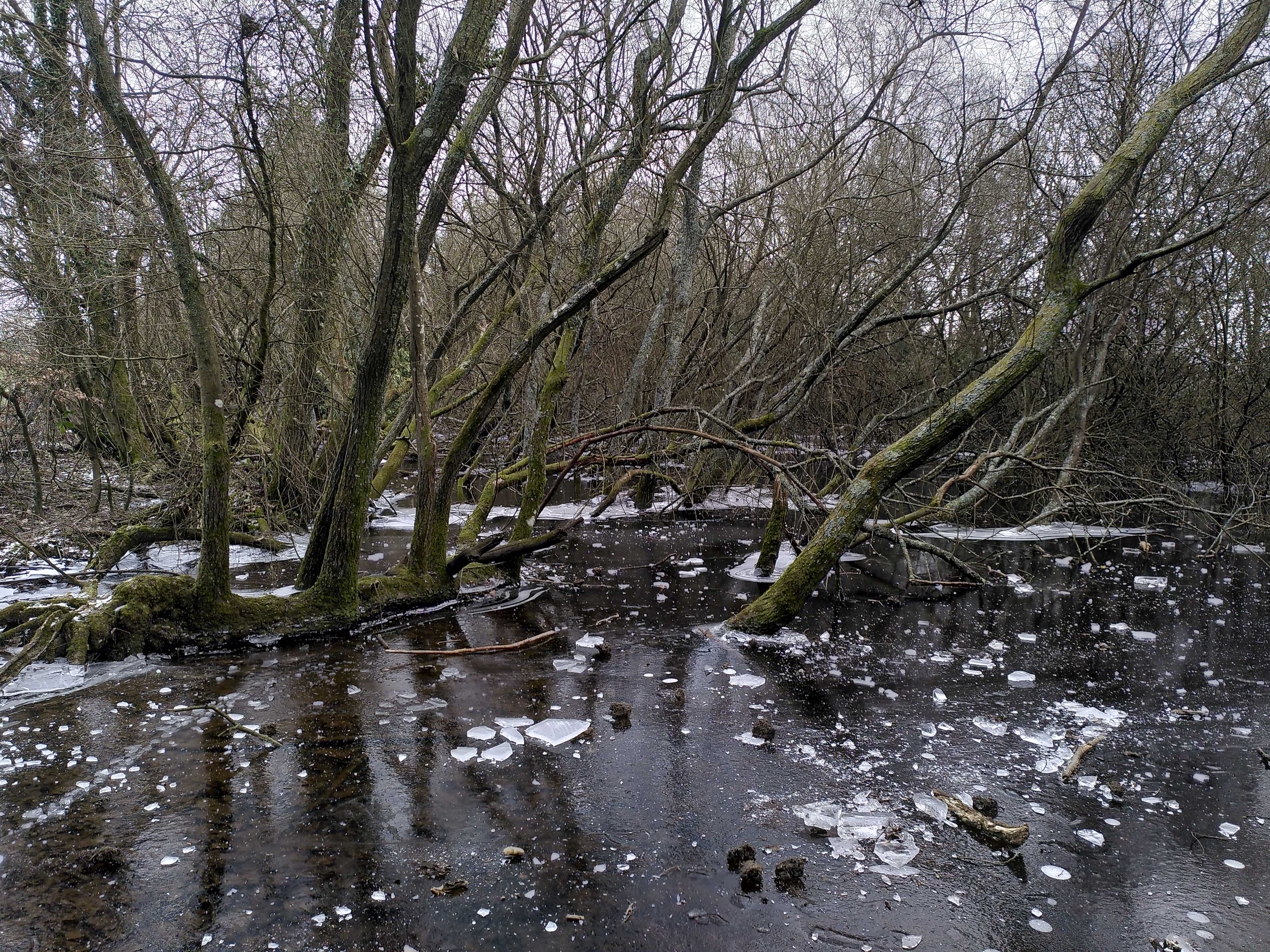
A frozen pond in the Sussex Weald
Today’s post is brought to you by phone pics. I’ve been a bit confused by messaging around lockdown laws in the UK, where it’s unclear if you can do photography at all. It’s just not that important, though. People are suffering beyond my comprehension and in England our National Health Service is under incredible pressure. I’m lucky and I do not take for granted the privilege I have in being able to access the countryside within a few miles of walking.
Yellow brain fungus
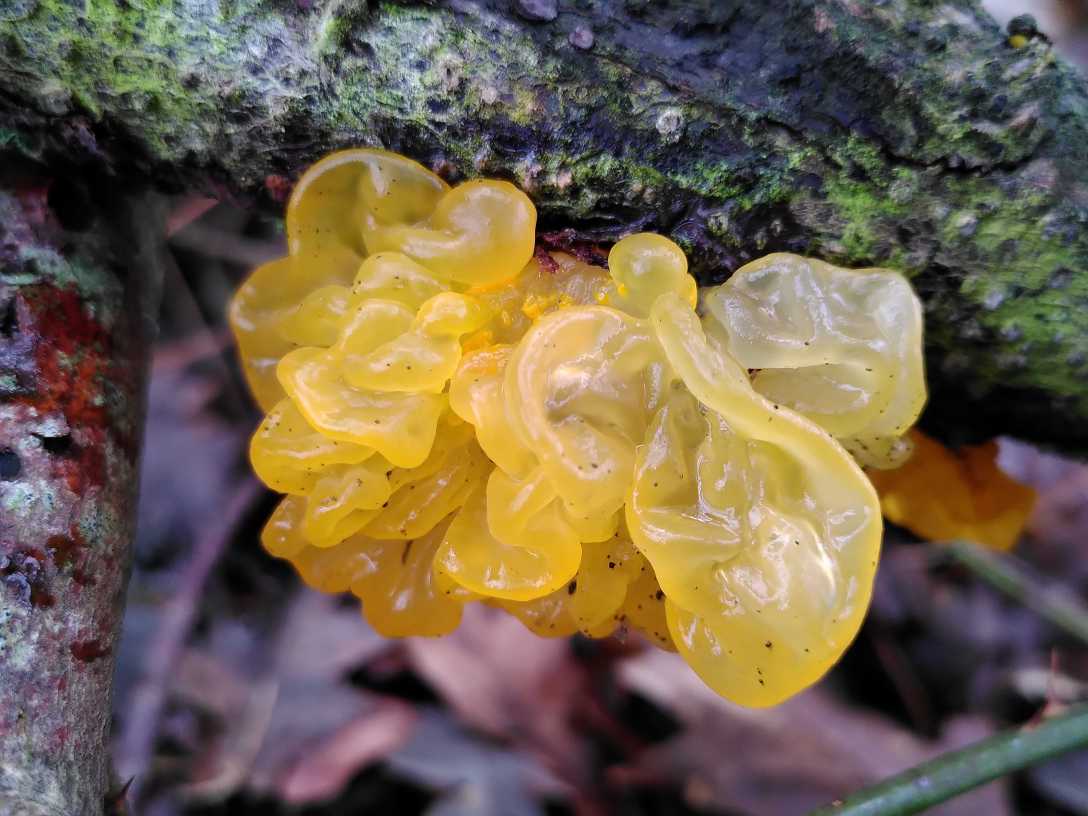
For the benefit of international readers, in England we’re supposed to only do walks from home or those involving a short journey. I’ve not been to my usual local woods in a while, but I can get to the edges of them or at least some mature, tree-lined avenues within a couple of miles whilst keeping away from other people. The standout fungus during walks this winter has been yellow brain, Tremella mesenterica. It is such a beautiful fungus and so unusual to see something so bright in the dark scenes of an English winter.
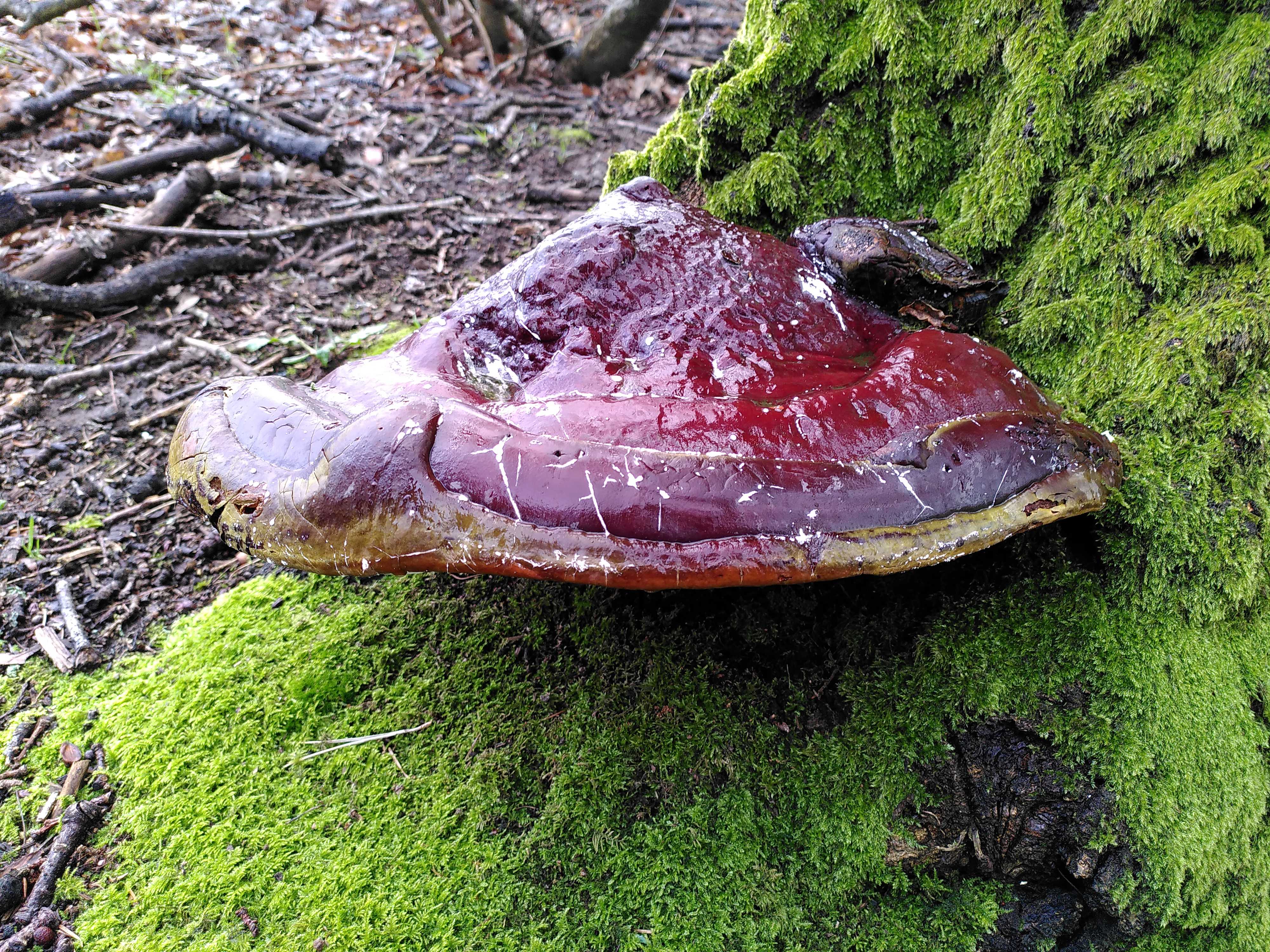
Lacquered bracket (Ganoderma lucidum)
There’s a reason so few soil-based mushrooms are found in winter – the ground freezes and most fungal hyphae are unable to move through the frozen substrate. Fungi that grow from dead wood or other material can continue to do their thing. This rather pooed-upon bracket fungus is known in the UK as lacquered bracket. On social media you see lots of American accounts raving about reishis. There is even a website dedicated to the species under that name.
A stick rich in life
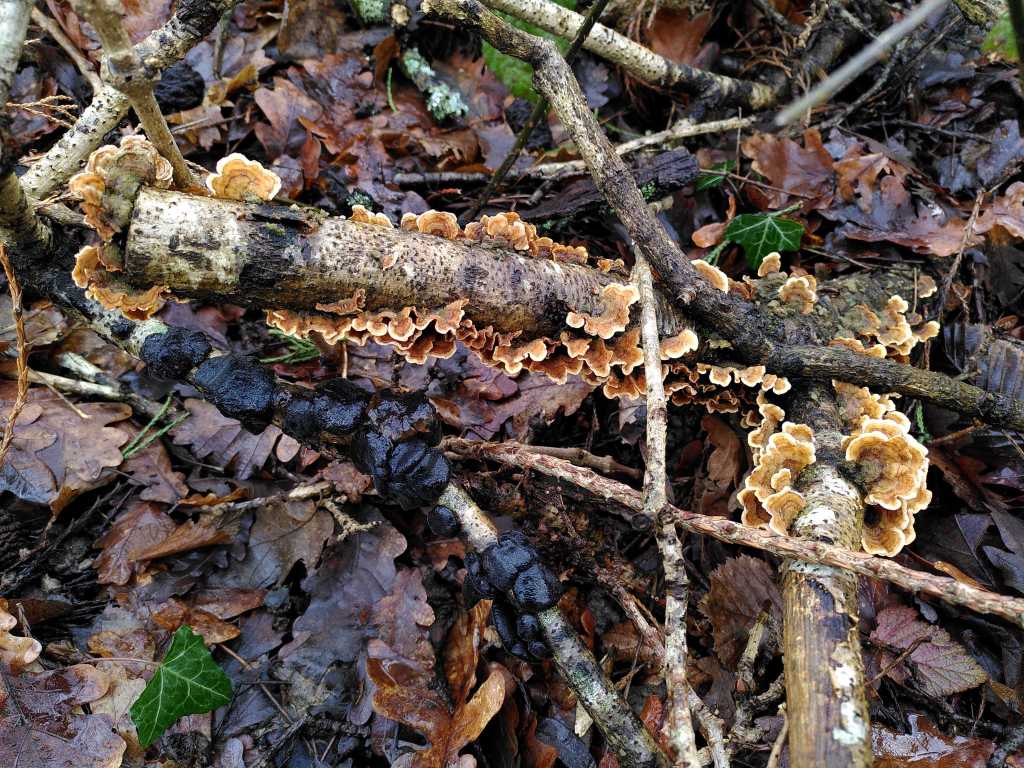
I wrote a little bit about turkey tail last week, and this week’s post is late because I entertained the idea of a turkey tail post in itself but eventually didn’t have the time. I think this is turkey tail. It’s quite a variable species so if you don’t know the basic features, can be confused with others. I’m it that camp.
Jelly ear
Jelly ear has to be one of the species people notice first. It was my first ever #FungiFriday post! It looks like a body part, is tactile, non-toxic and grows on a common European tree – elder (Sambucus nigra). It’s also very common in urban woodlands and green spaces, which means it reaches a wider audience.
Curtain crusts
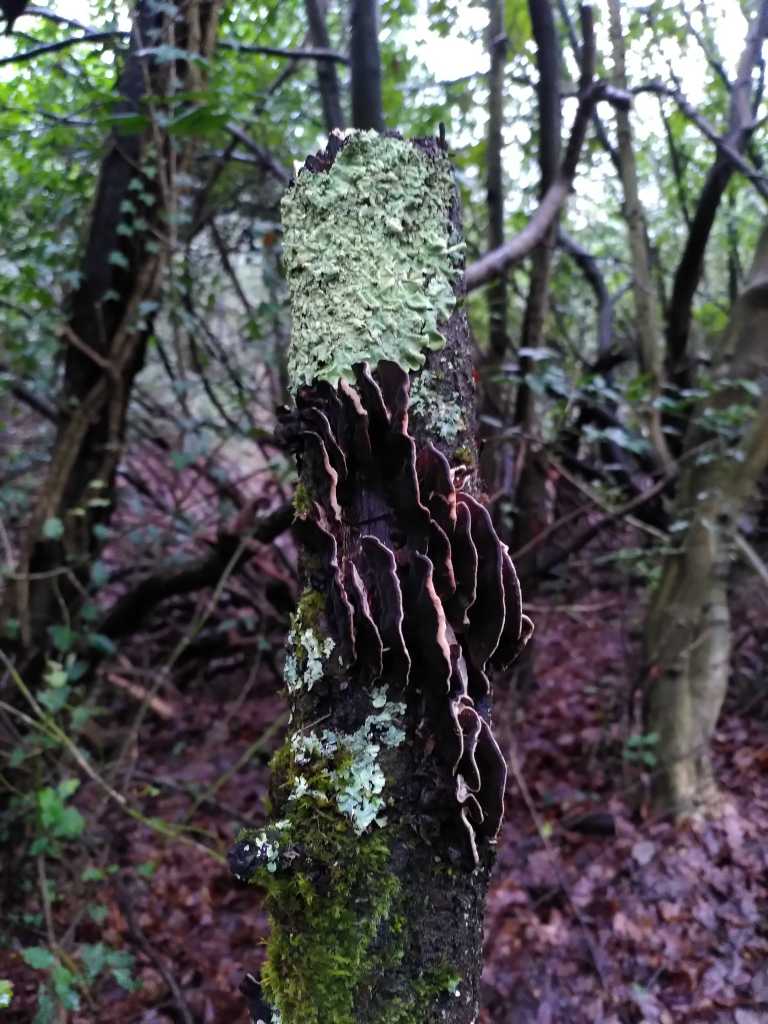
Quite similar to turkey tail is the Stereum family. This is probably hairy curtain crust (yep) and is very common in these months when rainfall is high and temperatures are hovering between 5-15 degrees Celsius.
Ganoderma bracket fungus on a veteran beech tree
On a longer local walk I found this veteran beech tree. It had a massive bracket fungus growing at its waist. This fungus had become very woody in texture, which shows how they can survive cold weather. I’d like to get back to see it when it starts to build up its next layer. You can read more about bracket fungi here.
I’m getting into more of a routine of recording and editing audio, so here is the latest episode of Unlocking Landscapes. Listen on Podbean or via the usual platforms. Also via YouTube: https://youtu.be/y1K9Pqx68to?si=B-Fdhf3sdDH35Z8w Following on from July’s rather optimistic fungi walk, I popped back to the same area of ancient Wealden woodland to see if…
Innsbruck, Tyrol, Austria, June 2025 This is a longer post of the images I captured during a recent visit to Innsbruck in the Austrian Alps. We travelled to Innsbruck on a sleeper train from Amsterdam. It’s such a great experience and is significantly lower in carbon emissions compared with flying. If you consider the fact…
I’m back from my annual visit to the west of Ireland. I managed a couple of day trips to forage for photos, which will crystallise later this year into dedicated posts, all being well. Like many people I enjoy the Blind Boy Podcast, none more so when I have the headspace to take in all…
This is the first of a series of posts I’ve been working on covering national relationships with mushrooms. It’s just a bit of fun, but there’s definitely some interesting stuff to share.
For a long time I’ve been intending to watch Fantastic Fungi, a feature-length film about, you guessed it, fungi. You can watch the film for a fee via the Fantastic Fungi website.
I thought the film was inspirational. In dark times it gave a sense of the deep resilience of fungi and their role in the world. The time-lapse footage is some of the best you will see, from my experience. There is also stunning CGI visualising the interconnectedness of fungal hyphae and the roots of trees and plants. The image of a perished mouse decaying, being recycled by insects and fungi, and then sprouting with plants, will stay in my memory.
A clip from Fantastic Fungi
Perhaps that’s one of the things about fungi that is so hopeful – it can give a vision for life beyond dying. Death is not an end.
One surprise with the film was the extensive coverage of Paul Stamets, one of America’s leading mycologists. As one person commented to me on Twitter, he was so prevalent in the film it could really have been named after him! He is an incredibly engaging speaker and has achieved fame with his YouTube talks.
Stamets makes a great point about the need to protect old growth woodlands, especially those where he lives in North America. The argument (beyond many, many others) is that they are reservoirs of undiscovered medicines and scientific advancements. There are species going extinct which we have not yet even identified. There are plants and fungi which could change the world, or indeed save it, which are being destroyed with their habitats. Much of this is for logging and clearing land for agriculture.
In August I made my annual visit to the Weald and Downland Living Museum in the South Downs. You can see my timber-framed building photo gallery here. This is the first view you encounter inside the museum grounds after you pay your entry fee. Amazing to think the medieval hall house is from Cray in…
Not that kind of battle, but instead to the village in East Sussex. Battle the village is the site of one of the major battles of the Norman Conquest of England of 1066, when the Normans invaded Britain and defeated the Anglo-Saxons. It’s a period in history that absolutely fascinates me. The land ownership brought…
Get ready for bad mushroom photography. But first I wanted to link to this interesting Mushroom Hour podcast with Learn Your Land, that I listened to this week. Some very thought-provoking ideas around landscape conservation, belonging in the landscape and our own impact as individuals. Here’s an example of one of the Learn Your Land YouTube videos:
Back to the bad fungi photography.
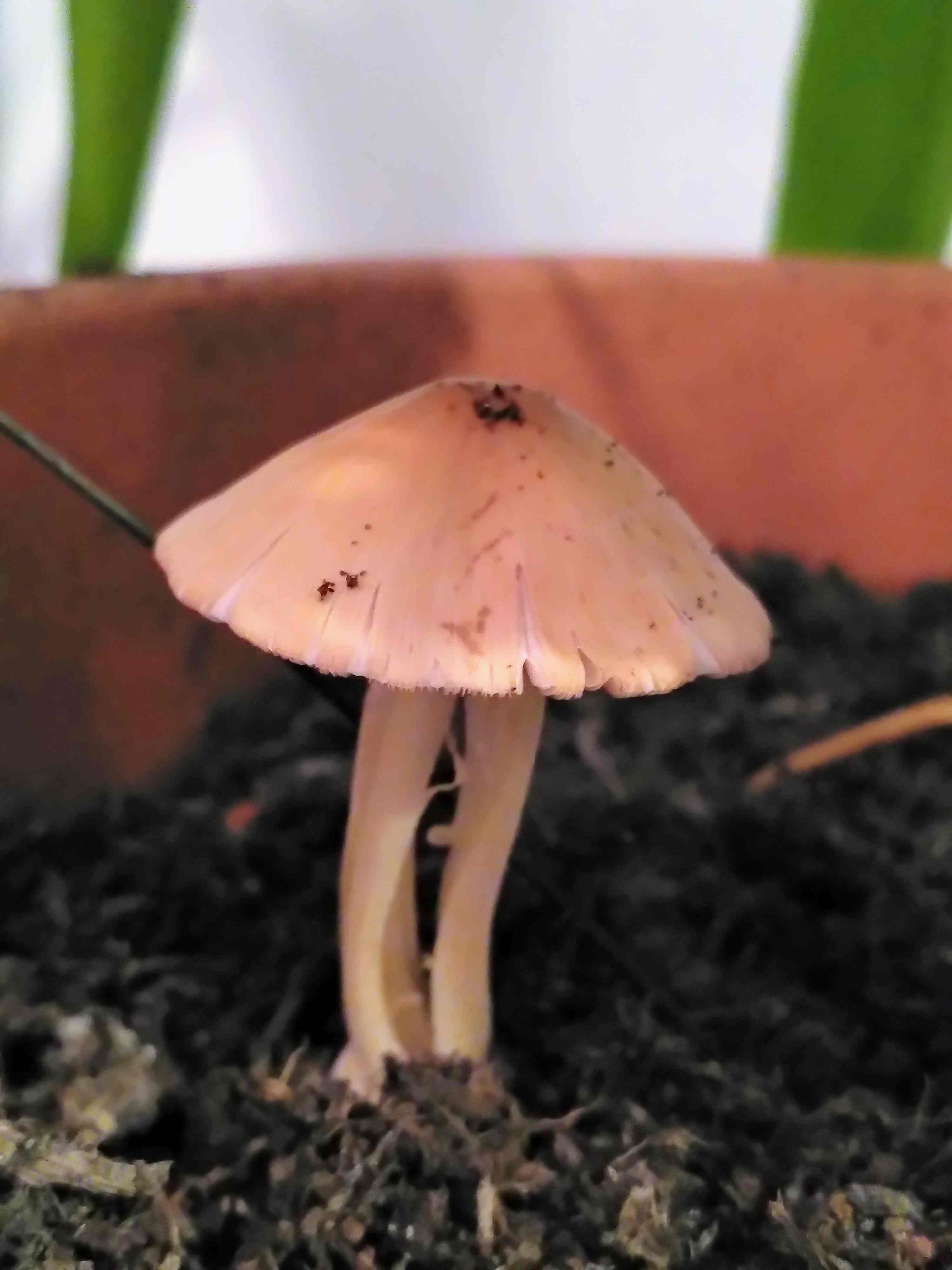
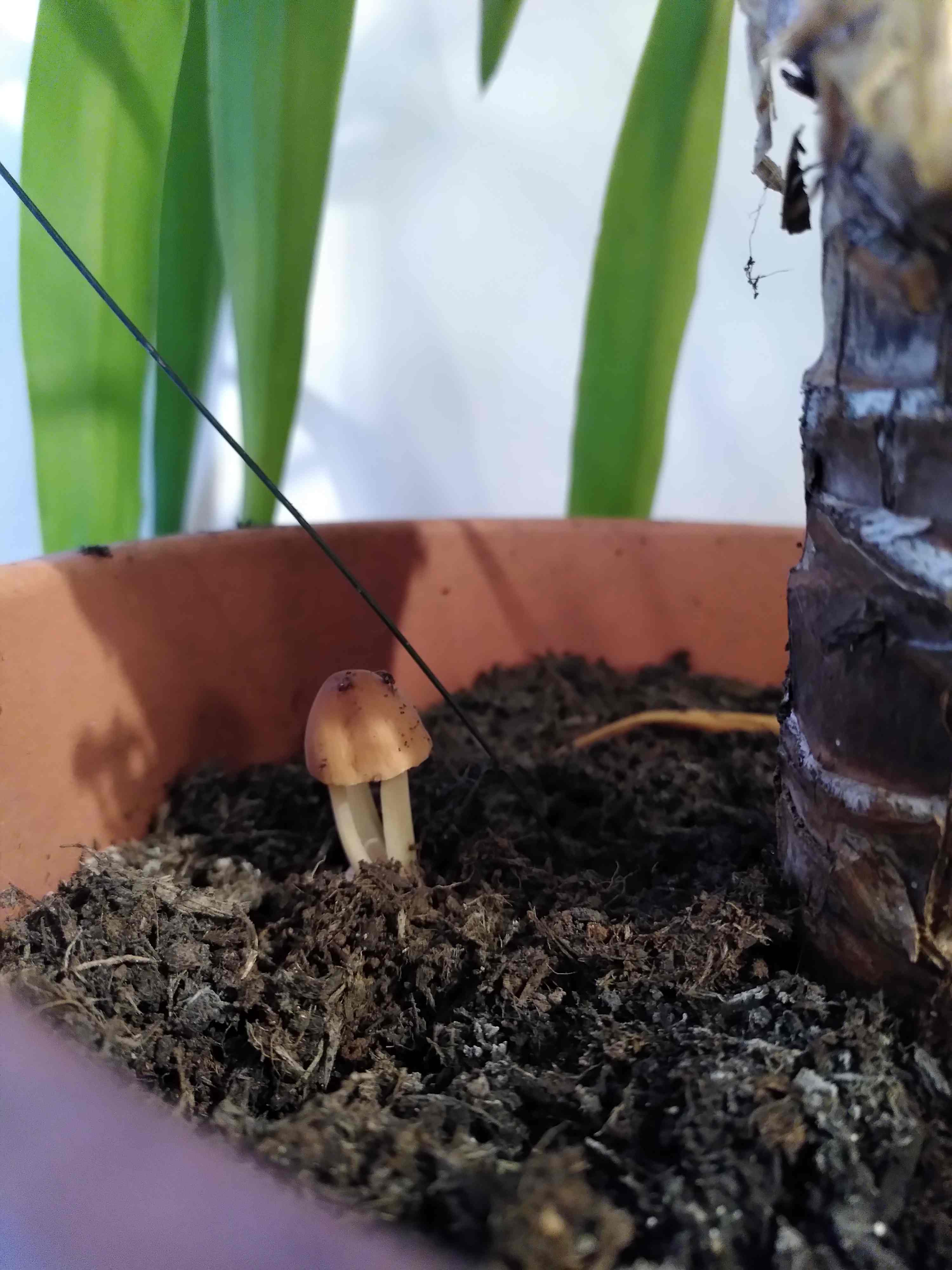
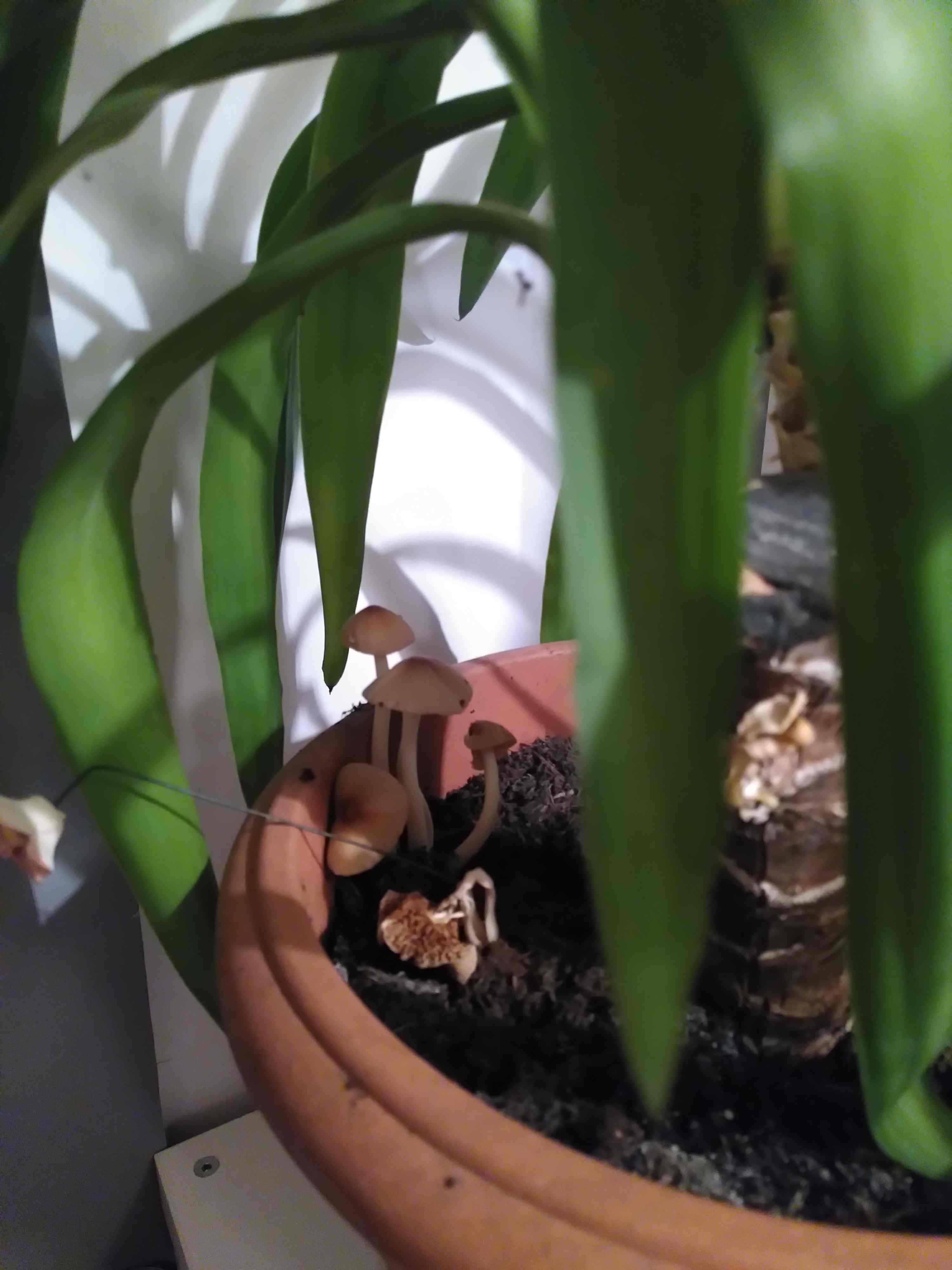
In December, I was sitting at my desk, working from home, when I turned around and saw a mushroom growing behind me. This was quite unexpected. The mushroom was growing from the soil of a houseplant on a cabinet behind me.
The plant itself had spent the summer outdoors, so I expect the spores of the fungus have landed on the soil while outside. You can see that the stipe (or stem) has split, probably due to rapid growth and the heat coming from the nearby radiator.
Here is that same mushroom possibly a couple of hours earlier. It moved incredibly quickly through its fruiting stages.
That wasn’t to be the end of it. The following day I noticed more shrooms appearing at the edge of the pot.
This shroom family also moved fast. I think they’re a species in the very big brittlestem or Psathyrella family.
Didn’t I promise you the pics would be bad?
It’s probably not great having mushrooms growing in your house, and I fully expect a barrage of comments about how my house is going to fall down now from builders. All in all, however, I was quite pleased with the tropical scene on those dark midwinter nights.
It’s been more than 20 years since I studied First World War fiction in sixth form college. It remains some of my favourite reading and has dominated my book consumption of late, so here’s a run-through of my adventures in this very challenging area of literature and history. My family and the First World War…
I noticed some good news about ash trees recently and wanted to share my experience of a difficult decade for the European ash (Fraxinus excelsior, referred to here as ‘ash’), as well as some of the photos I’ve taken of this iconic tree.
This has been a surprisingly good winter for fungi. One thing I have learned about following the stuff all year round is that it is everywhere, all the time. I knew before that fungi ruled the world, now I know it. Look at the blusher mushroom dominating this post and try and tell me it ain’t true.
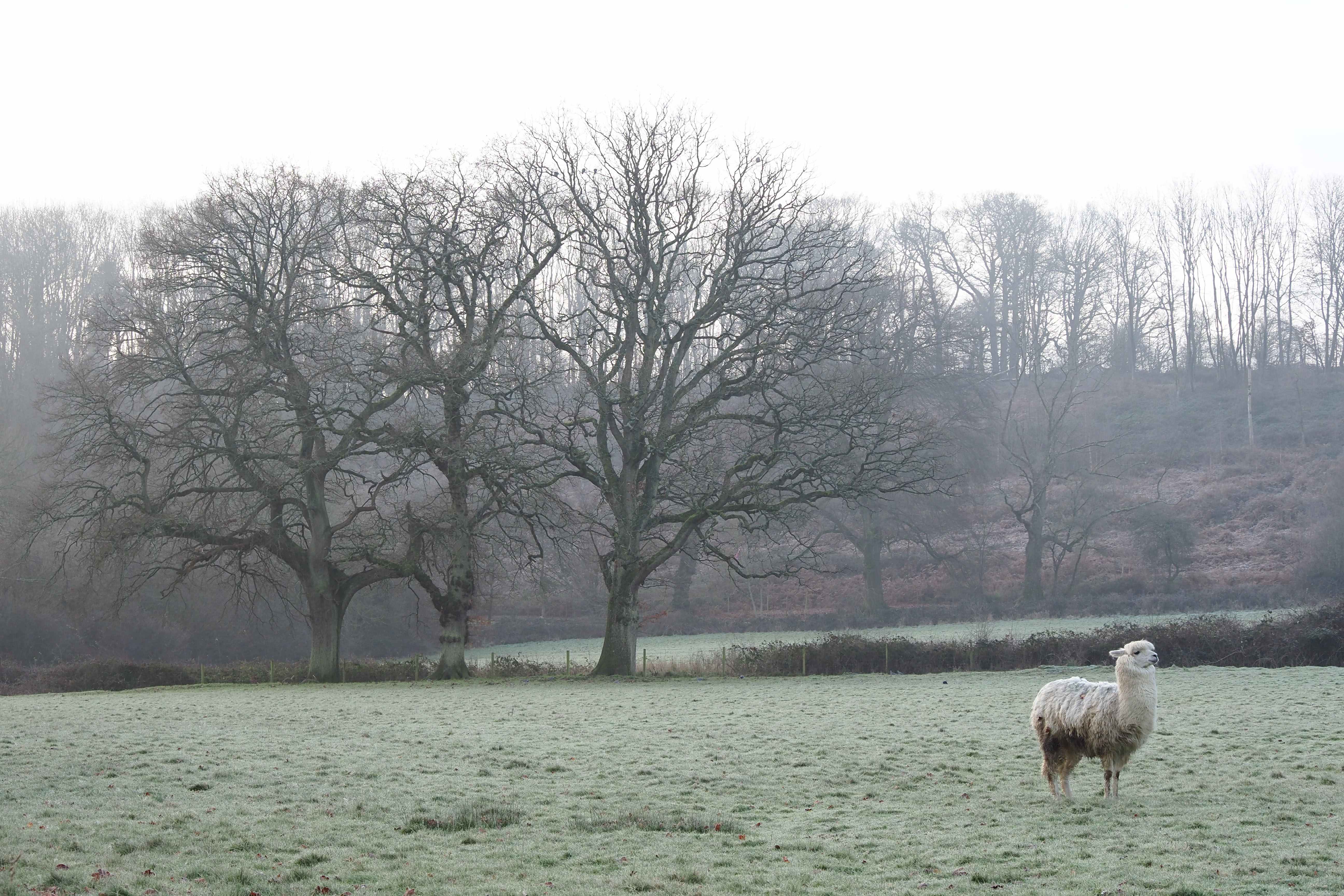
Frosty the alpaca
December in southern England has been colder than we are used to. In the past decade some Decembers have been, on average, around 10 degrees Celsius (remember him?), with one Christmas Day rocking an incredible 16 degrees. Instead we have had temperatures around zero for longer periods and last weekend there was snow. It lingered in London, Hampshire and other parts of the UK but in Sussex, it didn’t. Oh well.
I should probably move on, I have a lot of photos to catch up on.
I learned a new species in December, thanks to an ID on iNaturalist. I was walking in woodland in the Sussex Weald, in my local area, looking for macro subjects. By chance I saw some small white mushrooms on a piece of oak wood on the ground. I have a new camera which can stack together several photos to make one which has a large range of focus.
I hunkered down with these tiny shroomlets and managed to work the image stacking, as seen above. These tiny white mushrooms are oak pin (Cudoniella acicularis).
On the same day, and on several following, I noticed the prevalence of blewits. The blewit above (probably wood blewit) was growing from some leaf litter on the buttress of an old oak.
Around Christmas I found some other populations in a local cemetery. It obviously was having a little winter fruiting period, or shroom-boom.
This felled fungus offered a good chance to show off the mycelium. The white fibres in the substrate of twigs and leaves, are the hyphae of the fungus. They are what produce the mushroom that we see above ground. These hyphae will be extracting the minerals and nutrients from this detritus and turning it into soil. Fungi rule the world.
In that same cemetery I found an absolute stonker of a twig. This is a species of oysterling (Crepidotus). From above they look like weird little white bits on a damp twig, but when you turn them over, they are beautiful. I always look for them in December when there is generally not as much to see.
Also in the cemetery I found this. What on earth is this? It was growing on the single lobe of an oak leaf, lying on the soil near to the oysterling twig above. This image is also a stack done in the camera. I think it’s probably a slime mould, so not a fungus, but behaving in a way that is similar of course. If you know what this is, please do enlighten us the comments!
While we’re on slime moulds, this is a very happy cluster of something like dog vomit slime mould. You can see its journey across the ivy leaf from the white trails in the background. Let’s leave that one there.
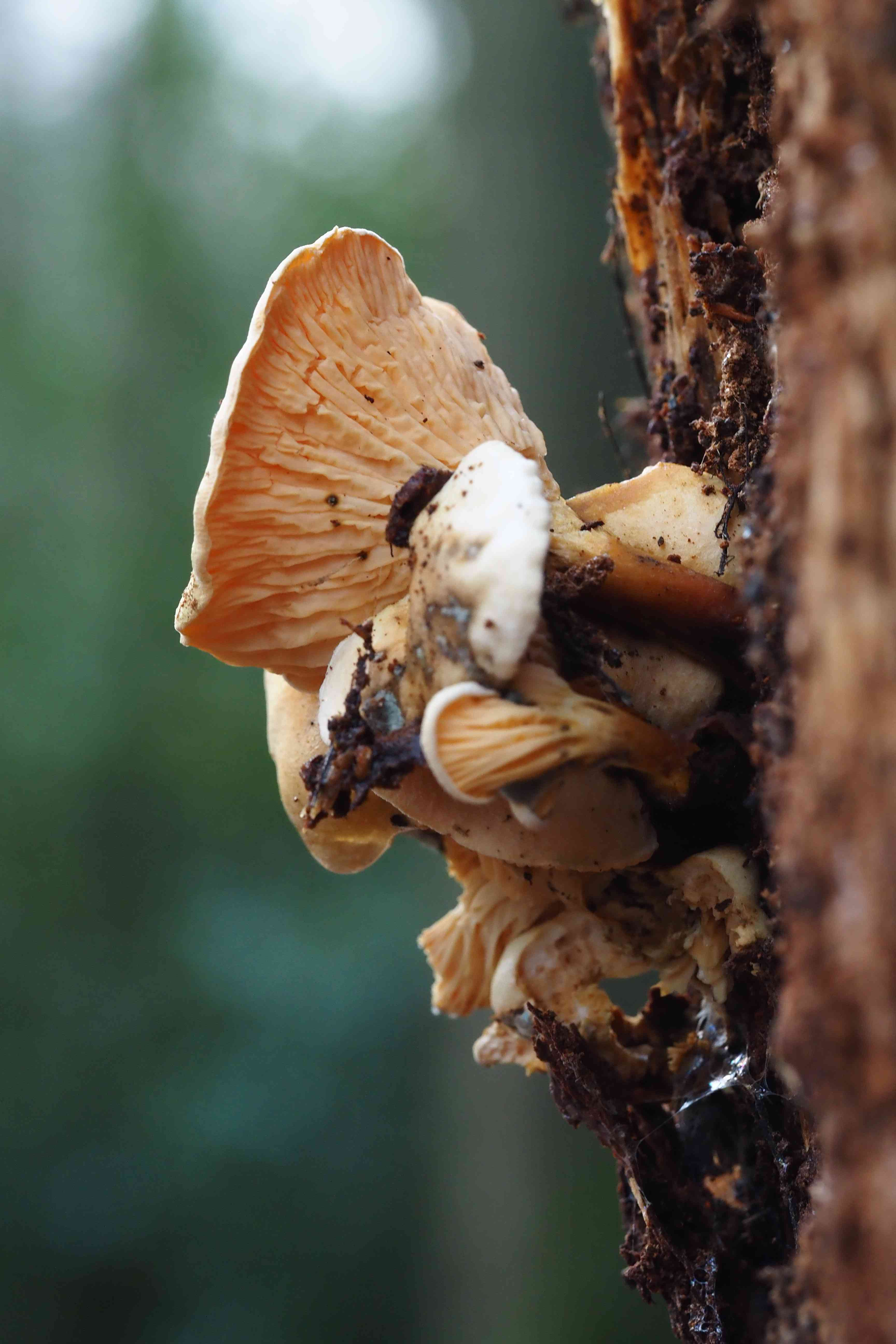
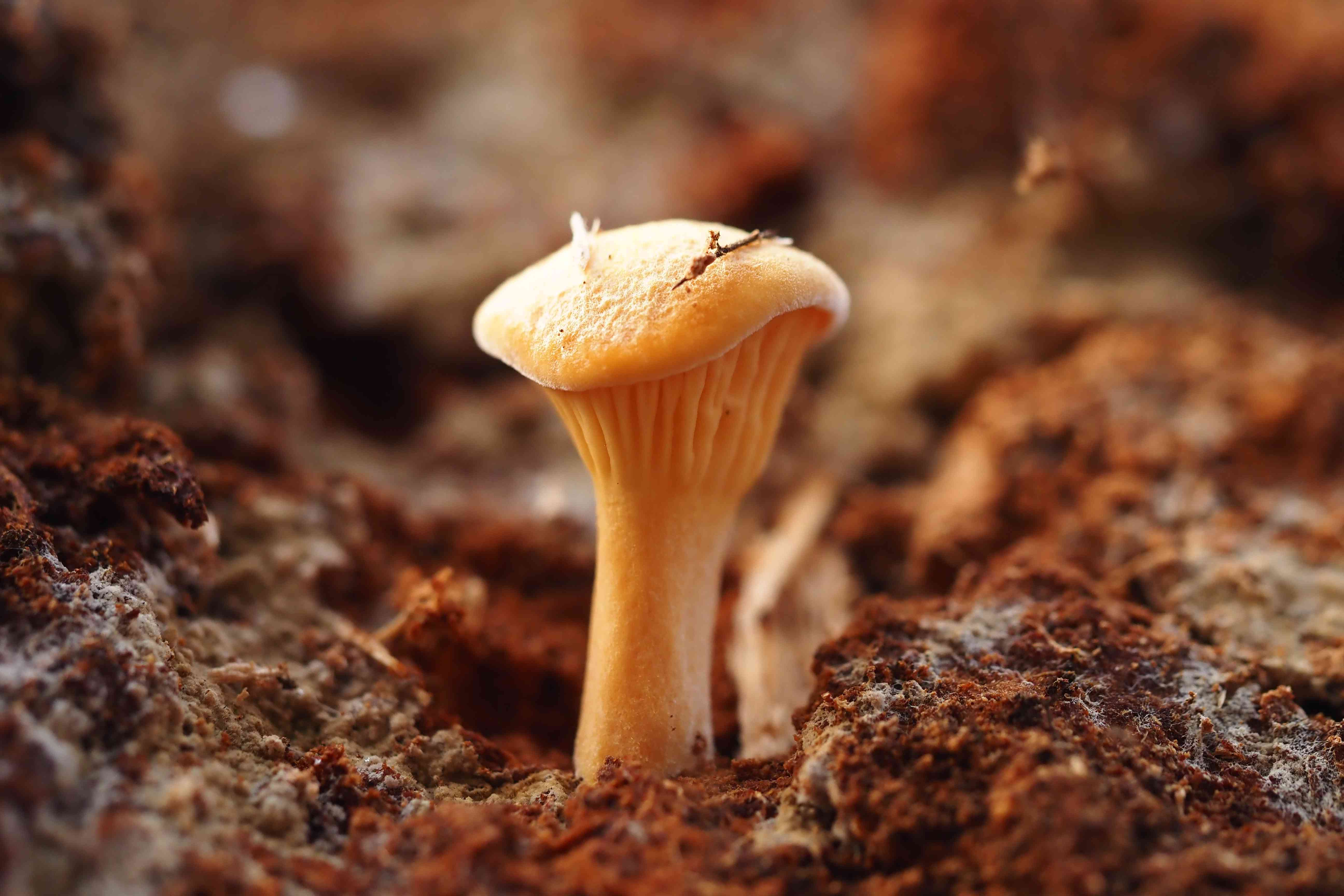
This one kept me guessing over Christmas. I found several of this species growing out of a standing dead pine tree in oak woodland. It smelled really nice, so sweet, just like chantarelles in fact. People on social media were unable to identify it, but the consensus was that it was probably false chantarelle.
You can see why people might confuse it with the real deal. There are several features which will help you not to make that mistake… Maybe another time.
I have been lamenting my lack of luck with the flammulina family, as in the mushroom, not a group of people. That would be a great surname though. My one true encounter with velvet shank, the most common of this family, was at a distance from a boardwalk surrounded by high levels of water.
This illustrates that point rather well. This is funny (only for me) because they are one of the most photogenic species you can find:
Velvet shank in January 2019
One rests one’s case.
While this toffee-like secretion may not be quite so eye-catching, it’s a new species for me. It’s cushion bracket (Phellinus pomaceus) growing on a blackthorn or other cherry family wood.
It’s probably best to end with a more appropriate species for the times. My walks are now close to home, in a town and into the rural edges if there’s time and light. On one lunchtime walk I found this colony of coral fungus from right next to the pavement. I have seen this before in London, at the roadside.
It’s even difficult to get photos of something like this because people are passing by and me lingering too long can literally force someone into the road to avoid me. So the photos aren’t focus stacked and they’re a fast food alternative to the slower pace I usually prefer for taking a mushroom pic.





























 Unlocking Landscapes