Earlier this week I went for a short walk around part of the Sussex Weald to see if any mushrooms had popped up. We’ve experienced one of the driest springs on record and the warmest June for England, as well as three heatwaves already! Me and mushrooms don’t need three heatwaves, thanks.
Mushrooms need rain, warmth and moisture to thrive, and after a downpour earlier in the day I thought it might be worth having a look. Here’s what happened:
At the beginning you can hear my water bottle in my bag and a great spotted woodpecker ‘kicking’
I began in the presence of Bambi, or a fallow deer
This is a showcase of the posh mushroom pics I gathered with my proper camera during a visit to the wonderful Dartmoor National Park in November 2024. Mad props to my wife who is chief squirrel during these Devonian photo forages.
The photos were taken on Sunday 10th November 2024.
I write these blogs in my spare time because I want to raise awareness about the beauty and diversity of fungi. If you enjoy reading them you can support my blog here.
A reminder that I am not encouraging people to pick or remove mushrooms in these areas. You could very easily clear all the mushrooms we saw within minutes. I think that would be sad because it would mean other people wouldn’t get to see them and learn or be inspired by them. I think with rare species like waxcaps that are featured here, we should be taking photos and submitting them to apps like iNaturalist or Plantlife’s waxcap campaign. In some areas that would be illegal anyway, due to site protections.
While I don’t believe 2024 will go down as a vintage mushroom season, there were a lot of lovely waxcaps to be found on the moor in a place we’ve been visiting since 2016. Moorlands seem to be quite good for waxcaps, not that I know why, and also for lichens because they are rocky, wet and the air is fresh.
I’ll post the images in chronological order for my own sanity.
This is the landscape where the fungi lived – moorland with a view towards the Teign estuary.
The first fungal find were these eyelash cups (Scutellinia) growing on animal dung! Plenty more dungi to come.
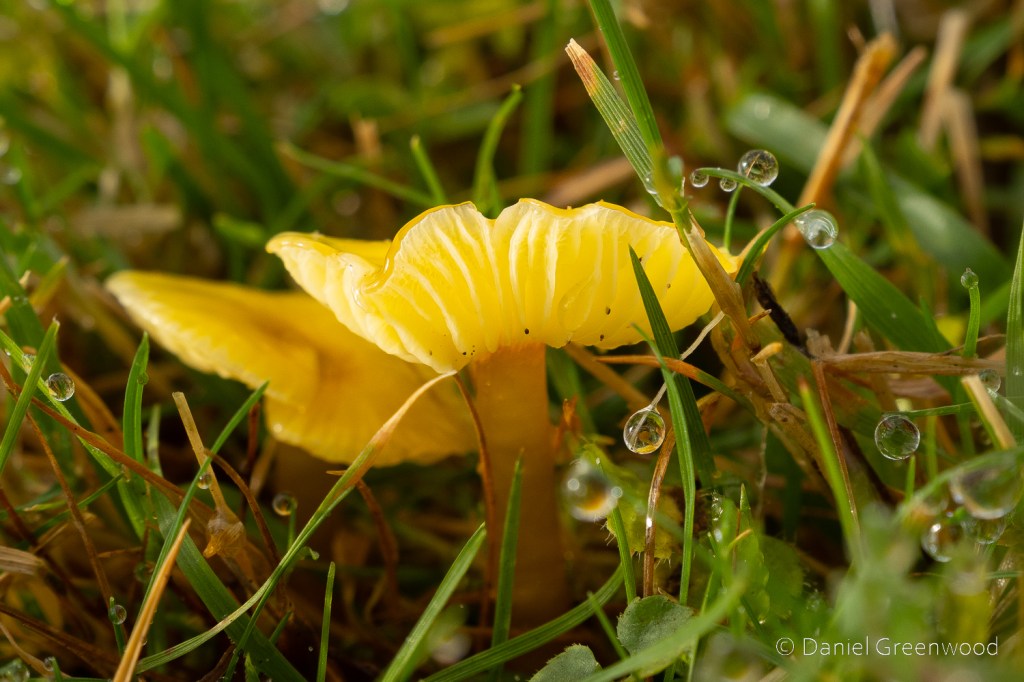
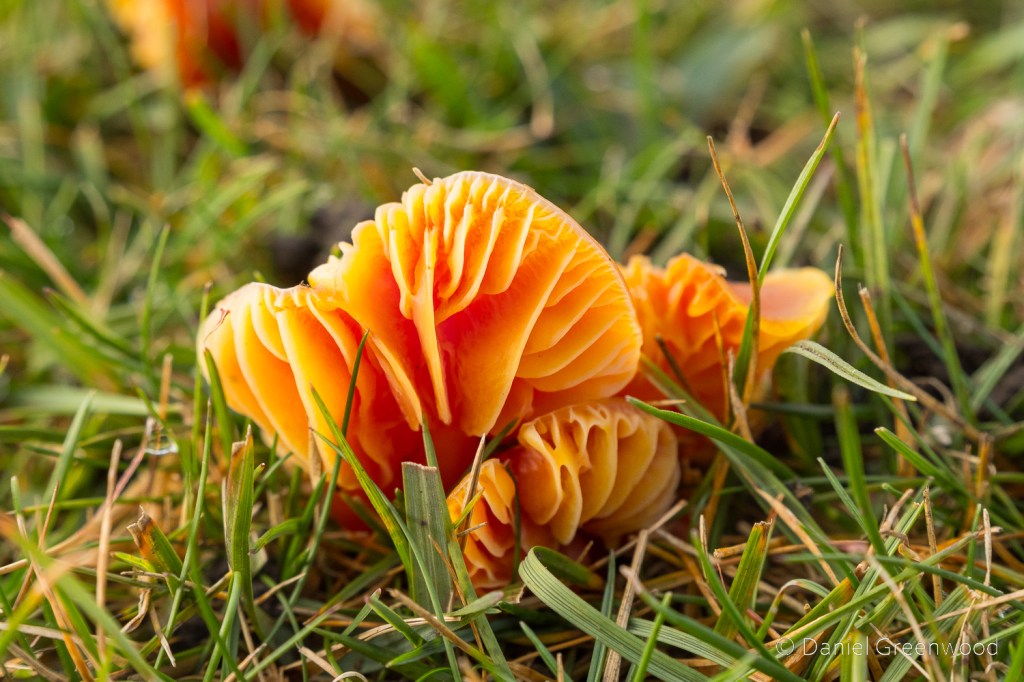
Waxcaps make up the crux of the mushrooms we found. These beauties are butter waxcaps (Hygrocybe ceracea).
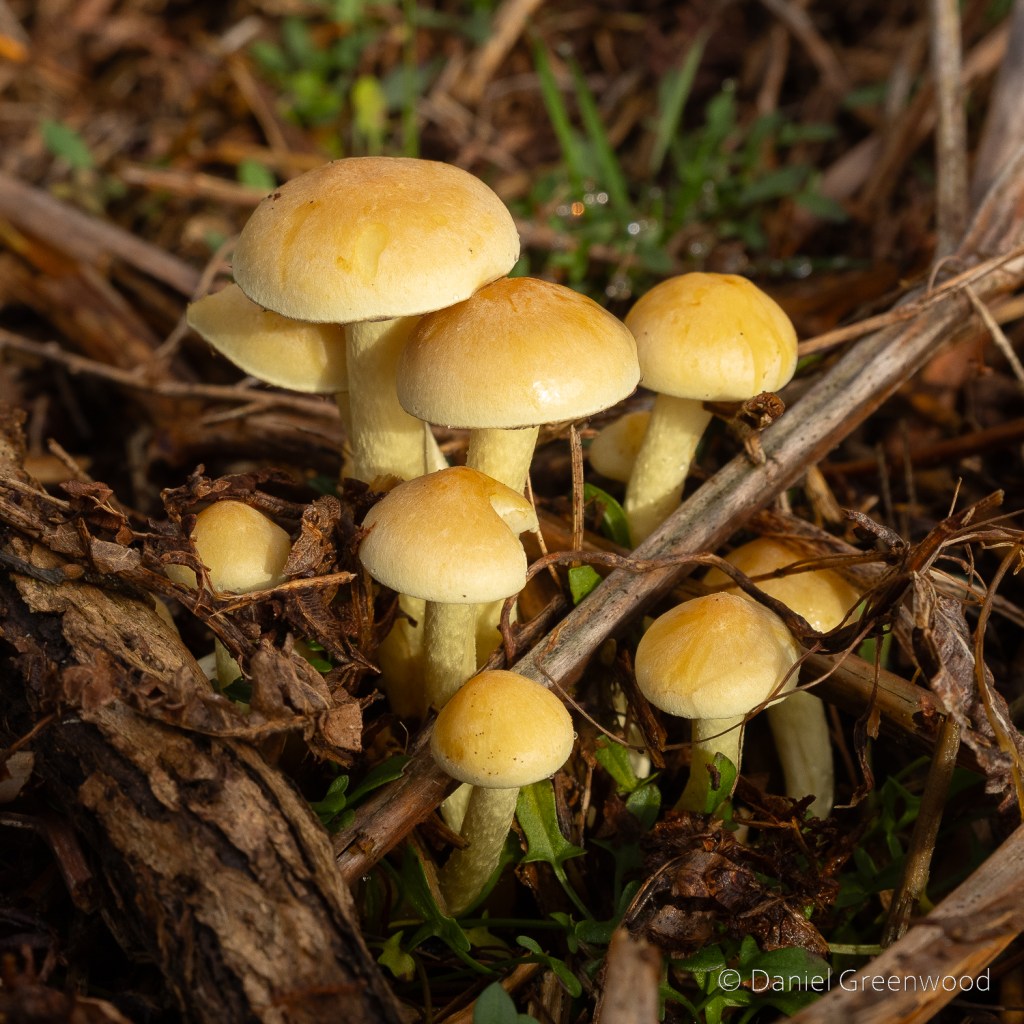
Not to be outdone, some very photogenic sulphur tuft (Hypholoma fasciculare) were found as we climbed the moor.
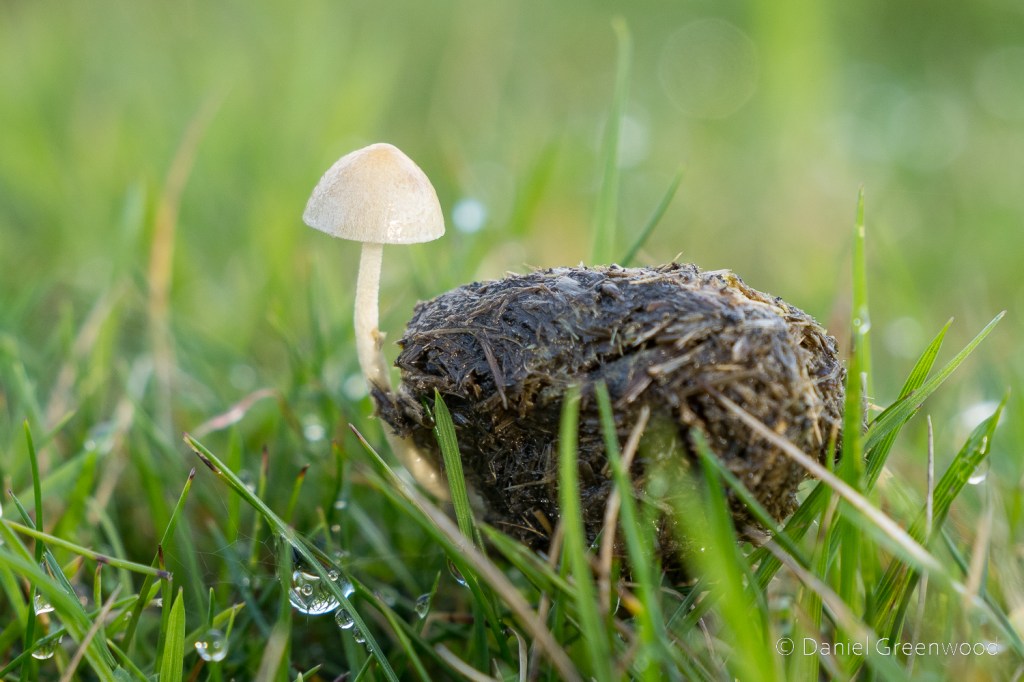
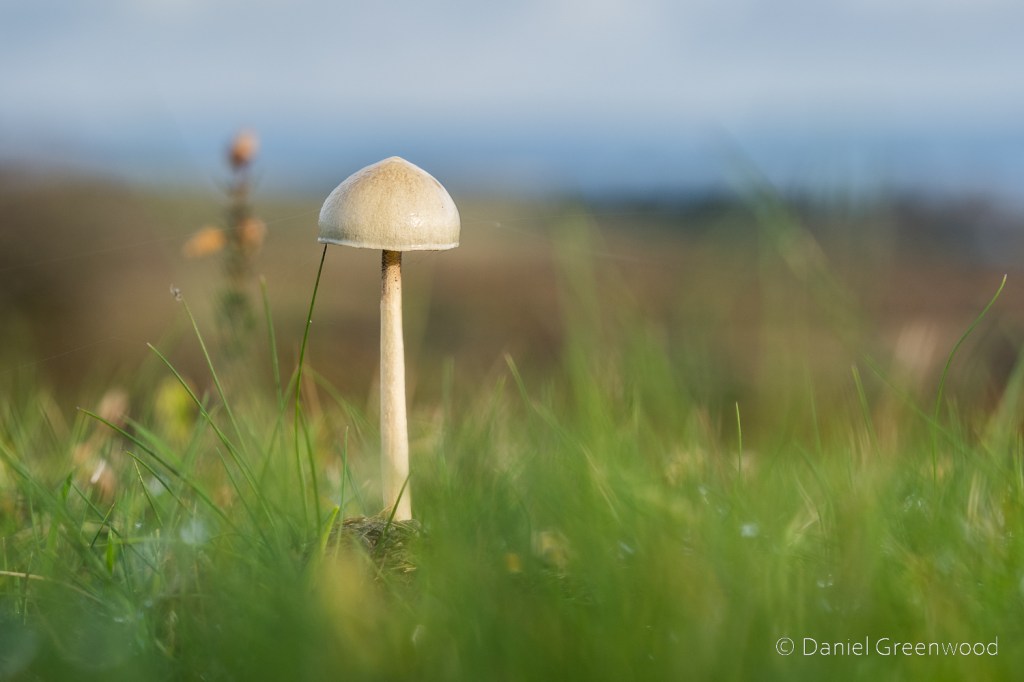
These mottlegills (Panaeolus) are quite common in places with grazing livestock like Dartmoor ponies.
My best guess is that this was one of the moss bells (Galerina).
These lichens are beautiful. I don’t see them very often because I have to travel west see moorland. They’re probably gritty British soldier lichens (Cladonia floerkeana).
I’m unsure what this species is, but it’s a beauty.
As we approached the more remote moorland (in terms of people living out there) the waxcaps began to appear in the cropped turf. This is another example of how important grazing to some degree is, and how it mimics very ancient processes. These mushrooms would not grow in closed-canopy woodlands.
This is one of the red waxcaps, but I’m unsure if it’s honey waxcap or not. It looks too orange for scarlet waxcap.
This is one of several species under the umbrella of blackening waxcap or witches’ bonnet (Hygrocybe conica complex).
This is a species I only really see in the west of England or Ireland. It’s one of the dog lichens (Peltigera).
These are crimson waxcaps (Hygrocybe punicea), stunning mushrooms indeed. There were some young men passing by who stopped to admire the colours of these impressive shrooms.
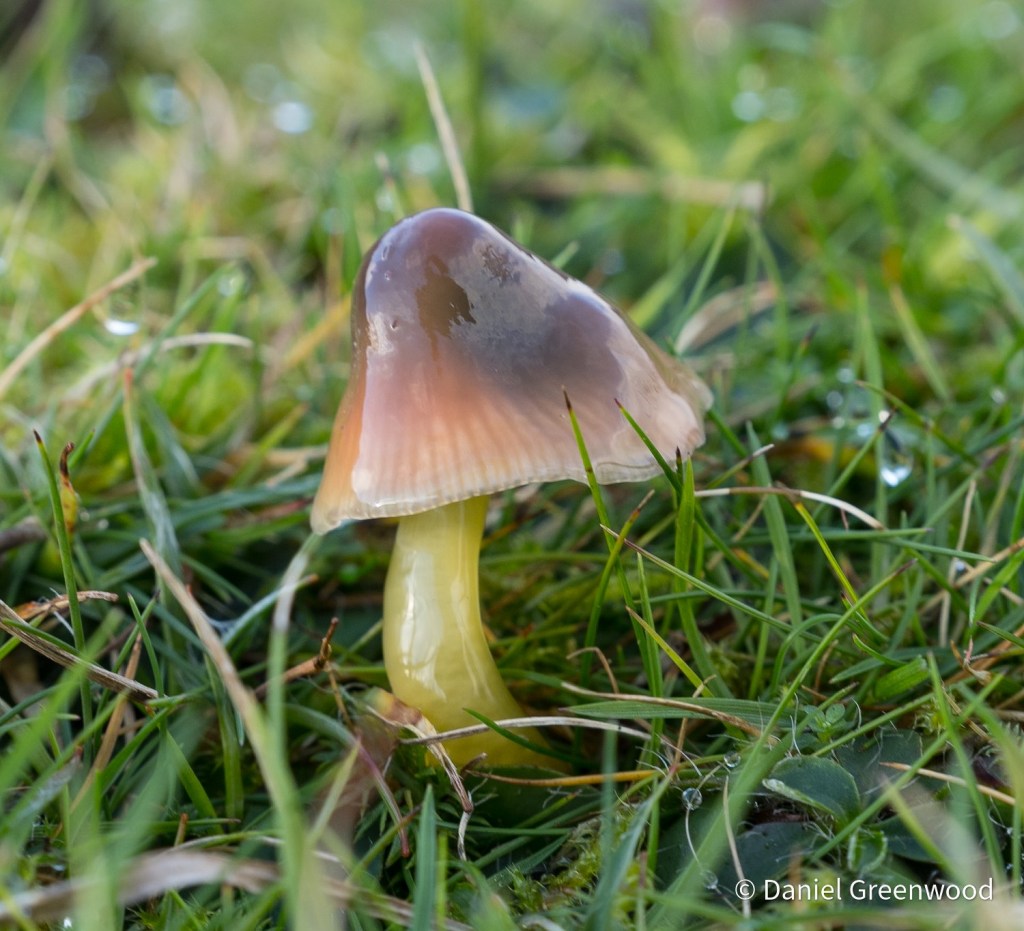
I don’t have an identification yet for this gorgeous waxcap and the closest I can guess is a colour variation of parrot waxcap (Gliophorus psittacinus).
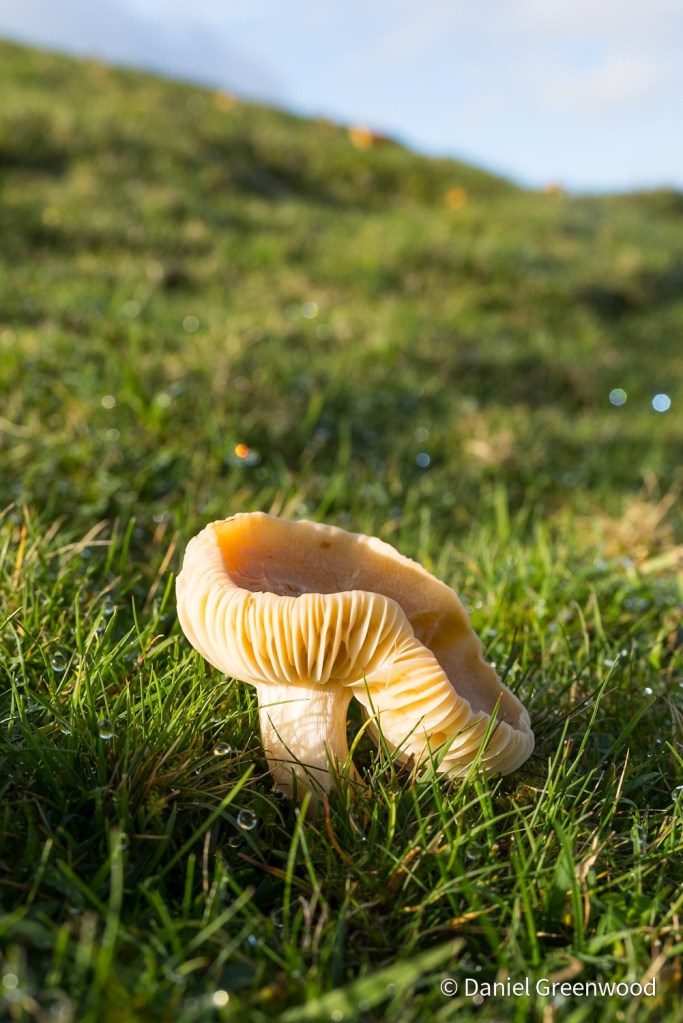
This is meadow waxcap (Hygrocybe pratensis), often fan-like, always best photographed from ground level.
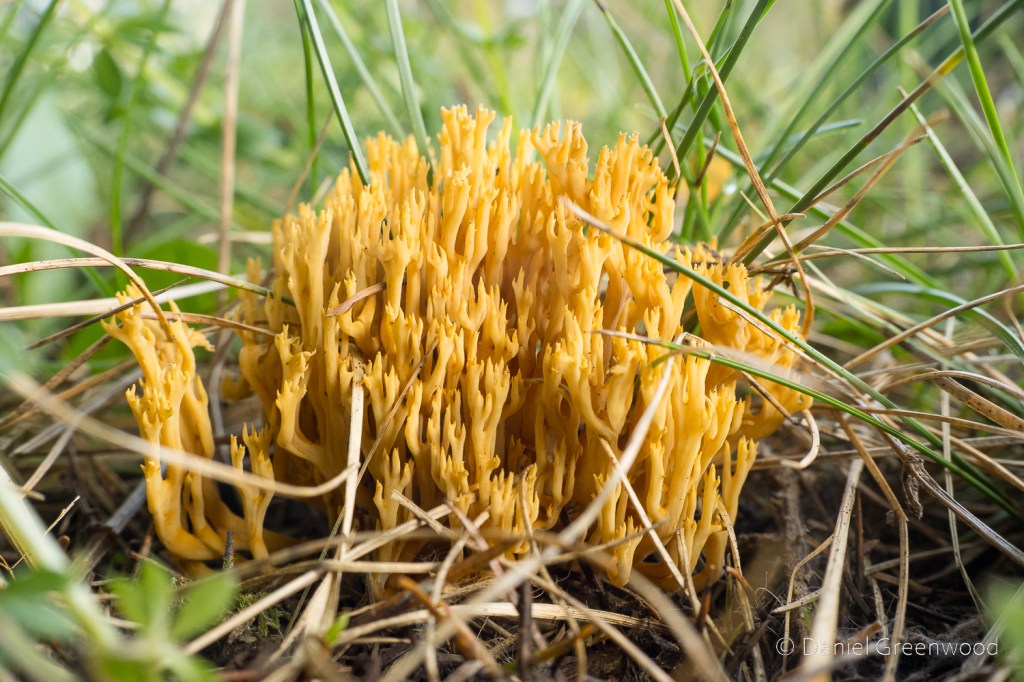
I’m not up on my corals and suchlike, but these are probably in this family.
The walk ended in a little graveyard, great places for waxcaps, by the way. That was evidenced again by this clutch of what I would say were scarlet waxcaps (Hygrocybe coccinea).
Phew!
Thanks for reading.
I write these blogs in my spare time because I want to raise awareness about the beauty and diversity of fungi. If you enjoy reading themyou can support my blog here.
Hello! Here’s another of those seasonal blogs where I post stuff you don’t necessarily need to know.
The header image visible on the blog here is of November in the South Downs looking south towards Angmering.
Thanks to everyone who has viewed, commented on and liked my posts this year. Posting stuff on here is a joy for me and it’s really nice to have your questions and comments to deepen the narrative. These posts tend to get more comments than some of my most finely-sculpted photo or prose posts, so let’s see what you have this time.
Where have all the mushrooms gone?
Not a comment on a mycological crisis in the woods, but the content that seems to ‘drive traffic’ to this website. As some of you may have seen, I’ve set up a separate fungi blog/website for my mushrooms pics: www.fungifriday.co.uk
The Fungi Friday blog is a home for my fungi photos with a focus on southern England’s rich funga.
I created it for a couple of reasons. One the main motivations was enforced – social media like Twitter (RIP) and Instagram are moving away from photography and instead towards poorly functioning hate-posting for the latter, and TikTok-lite in the case of ‘The Gram’.
Then there’s Threads, which reminds me of the ‘smartshop’ self-scanning interface from Sainsbury’s. It’s also owned by Meta/Facebook, which is not great.
The second reason was that constant mushroom content doesn’t really fit with a personal website with varied, landscape-related subject matter. I value bringing hand-written landscape writing to this website, which the fungi content is not. If I’m ever going to make it as a writer, I’ll need to spend more time working offline with a pen and paper, and typing it up later.
Another key point is that fungi are ‘hyper-diverse’ and there is a lot to cover. I’m aware that quite a few people read this blog through their email inbox, and a mushroom a day probably isn’t what you need (though to some people, that’s exactly what they need). I’d like to post more longer reads about fungi in the cultural sense, as I did in lockdown (2020-21).
Anyway, I hope FungiFriday.co.uk can last the pace, and I’ll be posting my autumn photos over these bleak midwinter months. Please do #LichenSubscribe if you have a WordPress account.
Music in 2023
My favourite album of 2023 (though released in 2022) is Blue Rev by Alvvays. You can watch a live studio set from them above. Molly Rankin is part of the famous Rankin Family, and her voice positively sings of her ancestry. After the Earthquake is the song I couldn’t stop listening to in the spring/summer and the album has such depth to it for something so rockin’ and short. They are a total joy. Check them out!
As mentioned in the spring, The Gallows Pole by Benjamin Myers has been one of the best books I’ve read in ages. It’s brutal, violent and bleak, which isn’t my thing, but it had that pull that keeps you wanting to know what’s going to happen next.
Colm Tóibín has been one of my other favourite authors I’ve read this year. My Irish diaspora family seem to spend a lot of their time consuming Irish culture in books, films, TV and music. I know I’m getting older because I am now doing that. This year I read Brooklyn, The Magician, House of Names and The Blackwater Lightship by Tóibín. Those books aren’t all about the Irish, but Brooklyn tells the story of a young woman’s migration to New York from a rural Irish village. England has descended into extreme far-right territory with its political language around migration, which you are probably sick of hearing about. But reading about the stories of migrants is probably a helpful way to educate one another and those close to us about the plight of others.
In other Irish lit, I also enjoyed reading all of Donal Ryan’s novels, especially The Queen of Dirt Island.
Another book I really enjoyed was close to home – Between the Chalk and the Sea by Gail Simmons. Simmons walks a path from Southampton to Canterbury she translates from the Gough Map, visiting large areas of the South and North Downs along the way. I love this part of the world and am so lucky to be a few train stops away from either landscape. This is definitely a great Christmas present and a book that walkers will love, especially if you like how the landscape can be read to tell the story of its past.
Also shout out to Owls of the Eastern Ice, which is an astonishing book that’s been around for a while now. I loved it.
My favourite film of 2023 is obviously Barbie.
Thanks for reading and your support in 2023. Ciao for now!
On Saturday 21st October I led a fungi walk in the Bramshott area for the South Downs National Park’s Heathlands Reunited project. Thanks to Olivia and Dan for setting the walk and guiding us on the day.
It was a chilly and showery day with breaks of sunshine to light up the birch and bracken.
Autumn had crashed in with its typical rain and leaf fall. I think the early mushroom season has been shortened by the hot September and sudden shift to seasonal storms. Just a thought.
Sulphur tuft was one of the first mushrooms encountered, among a whole load of small grey/brown mushrooms that I wasn’t able to ID on the spot.
This looks to me like one of the grey spotted amanitas but after a bit of a downpour.
This is very probably a blusher, amanita rubescens. You can see a slight pink hue at this premature stage.
Fly agarics were slow to show but when the walk passed through grassy open woodland, they abounded. This one was almost like a russula with its typical white veil remnants
Amanita citrina, the false deathcap, was one of the most common mushrooms on the walk. It was abundant in the areas of beech woodland and also the open, grassy birch and oak woodland.
I’m not sure which waxcap this is, but heath waxcap, Gliophorus laetus, would make sense because it’s a waxcap on a heath!
This was one of the few red russulas, though there were tens of different-coloured varieties along the way. Sometimes the only mushroom around was a russula.
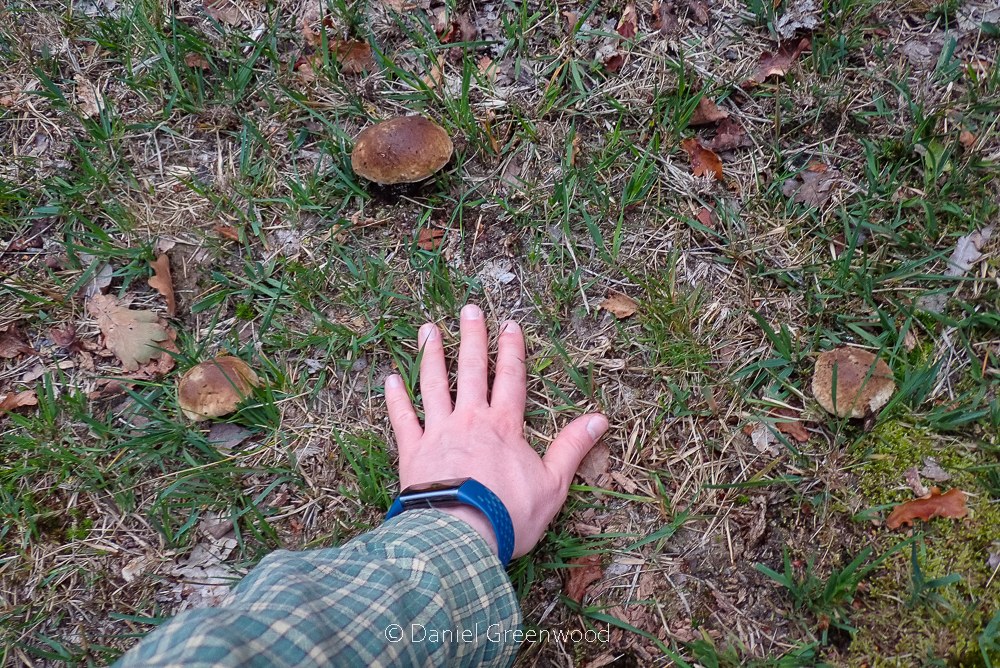
This was a very large mushroom under an oak tree. I’ve not seen this species before but am leaning towards an ID of giant funnel, Aspropaxillus giganteus.
The only cep, Boletus edulis, in the whole area. I think most of these have been picked for the pot already by other visitors.
This nicely shows the change that occurs in blackening waxcap, Hygrocybe conica. It looks like a jelly sweet to begin with then becoming rather liquorice.
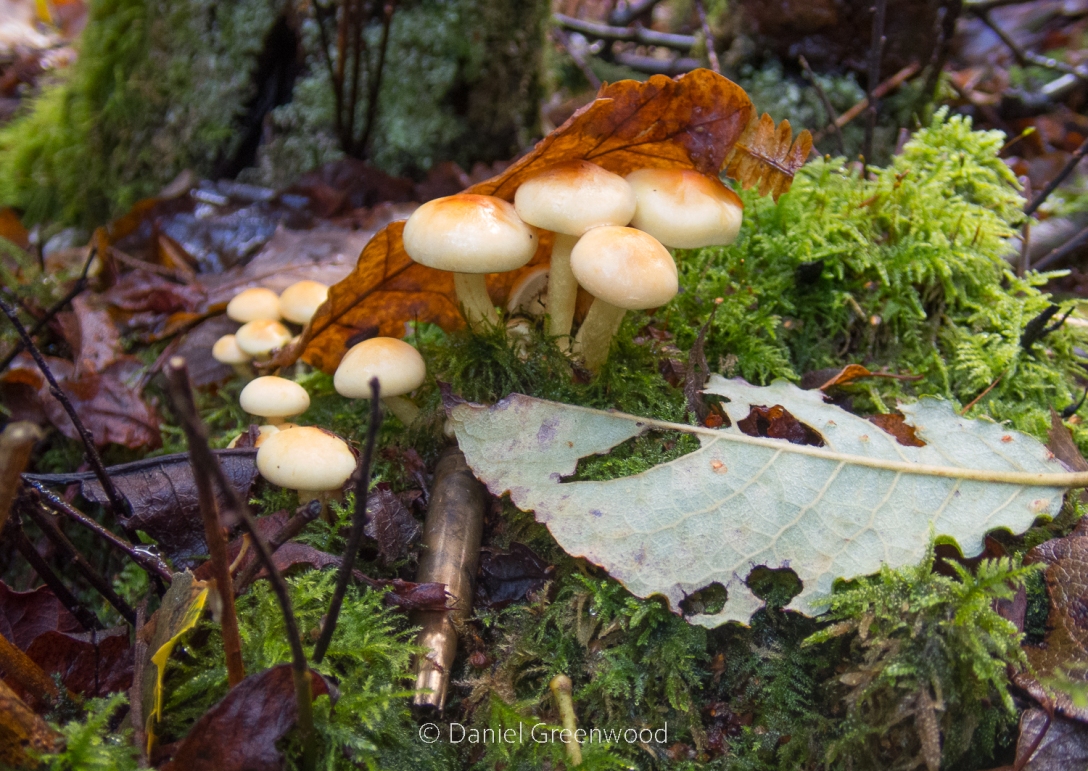
One picture that sums up the status of this wooded heath – an empty blank bullet casing underneath sulphur tuft.
I was in the New Forest National Park camping for a couple of nights in August. The rainy July in southern England gave me great hope of finding some nice shrooms in what is one of England’s mushroom wonderlands. It didn’t disappoint!
Bolete bonanza
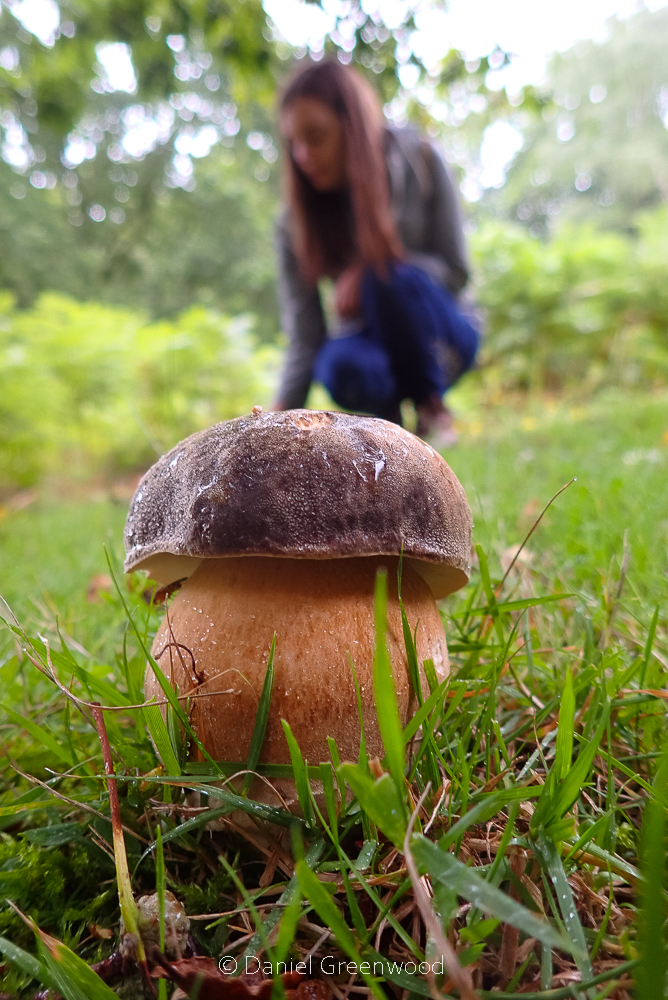
I was so happy to find these boletes, one having already been uprooted. They were the perfect shape and just an absolute joy to see. I have been told these are ceps, but I’m not entirely sure if they’re not another species. I’m unclear on the variety among cep-like boletes, and if the colouring isn’t indicative of another species.
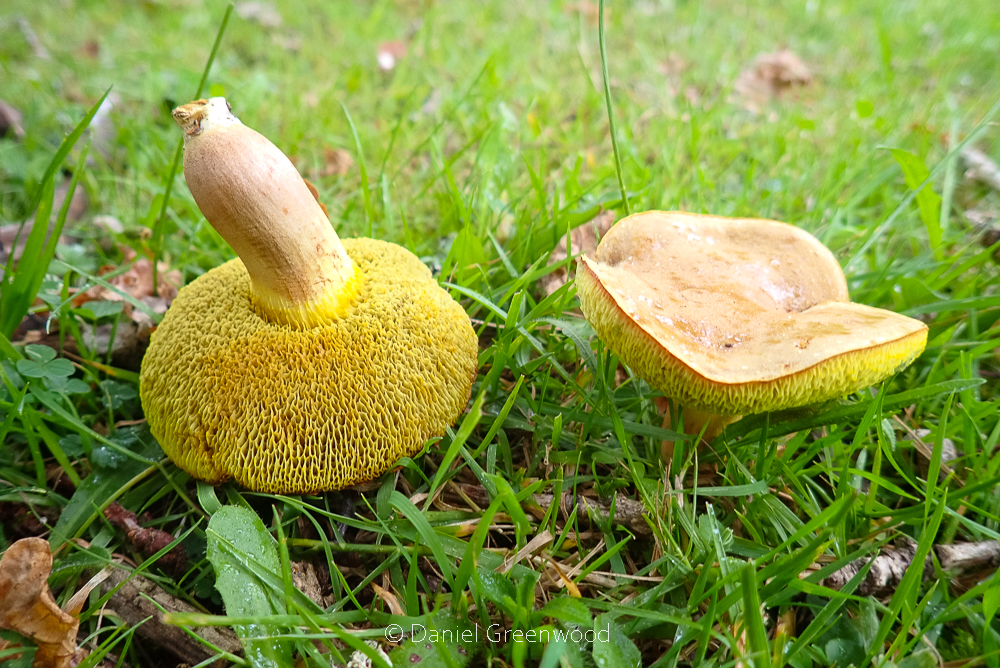
These lovely yellow-pored boletes are in the genus Xerocomus.
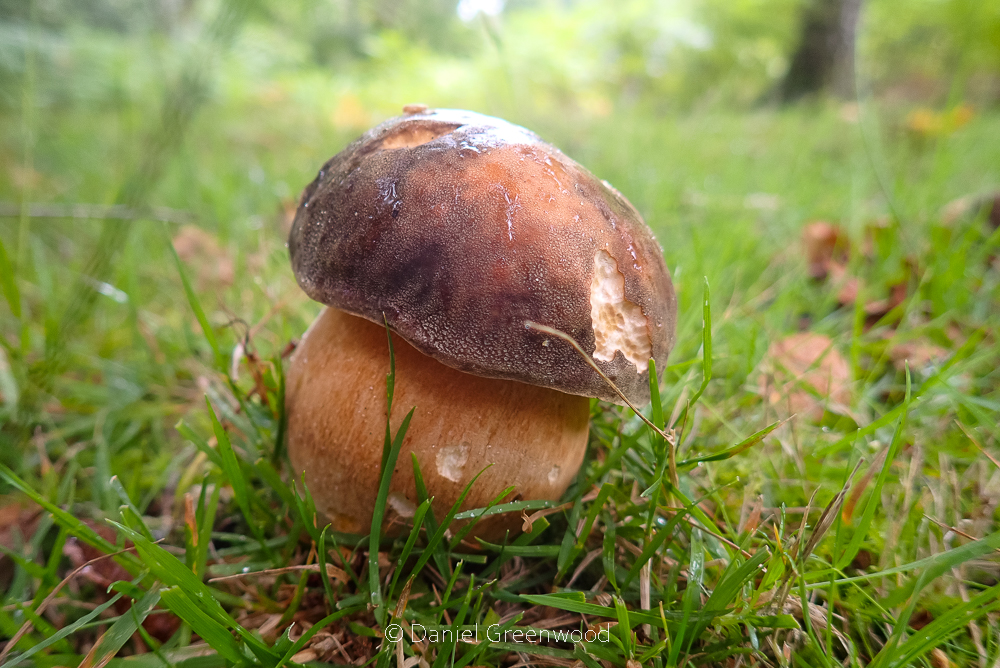
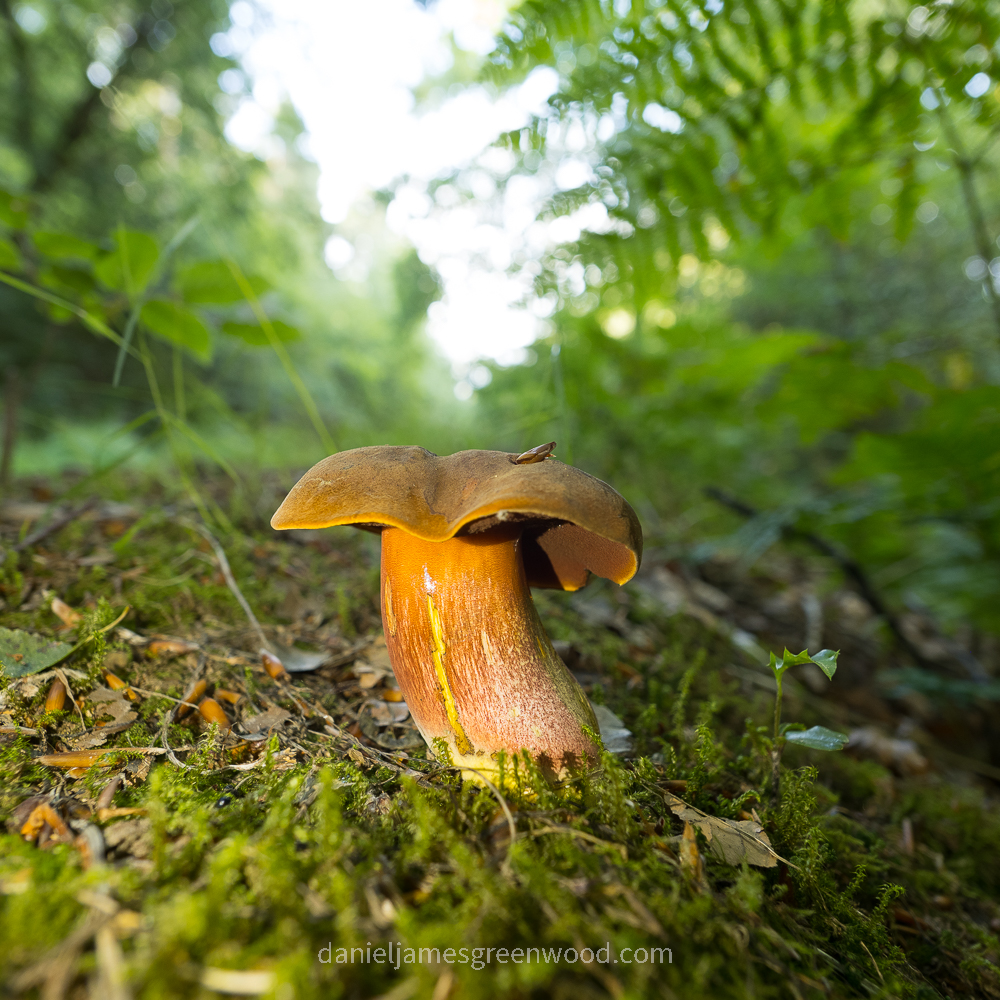
About half a mile or less away we found this beauty sitting alone among the grass and leaf litter. It’s an orange bolete. It doesn’t appear to have a distinct association with one species of tree, but this area was common in oak and birch.
Much later that day, on the return stretch, we found this well-camouflaged group of what I am sure are ceps due to their colouring and other diagnostic features.
You can see the distinctive webbing on the stipe here, and the pennybun cap is all you need really:
As the evening drew in, I found this orange bolete that may have been picked by a deer (there was a herd in the area).
Webcaps
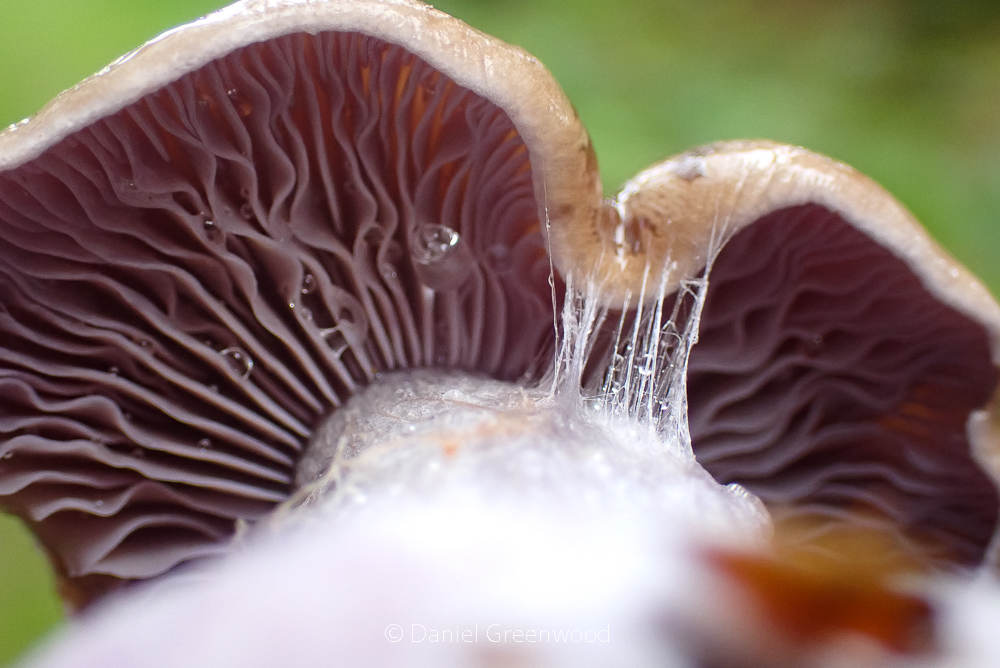
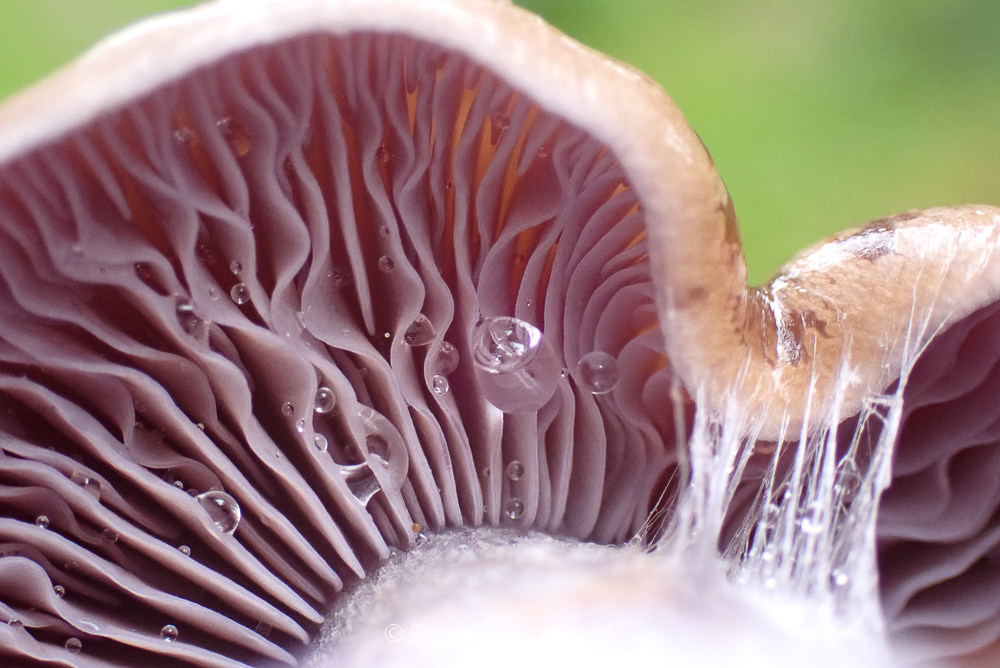
Earlier in the day, while passing between two plantations on a grassy ride, I noticed this uprooted mushroom on the ground. Two bites had been taken from it, probably by deer or a small mammal. The remnants of the veil between the cap and stipe, covering the gills, gave me the thought that this was a webcap. The gills were very beautiful, embellished by the water droplets.
iNaturalist has come back with an ID of webcap subsect ‘Purpurascentes‘. I can’t find any other info on the subgroup distinction.
Rustgills
Rustgills are a group I’m not particularly familiar with. Having developed my fungi knowledge in isolated city woodlands, I didn’t really see rustgills until I moved to Sussex and spent time in larger areas of woodland. This patch was unavoidable. No wonder there is a species known as the spectacular rustgill.
Rustgills are in the genus Gymnophilus. They’re confusable with scalycaps (Stropharia) due to shape and colour.
Chantarelles
And finally some golden chantarelles, already nibbled by slugs and uprooted, probably by deer (as I have said 1000 times in this post!).
The New Forest has a “no pick” policy and there are concerns about illegal, commercial-scale picking for posh restaurants, just FYI. All of these mushrooms had already been “naturally” uprooted(probably by deer).
Disclaimer: this blog is now riding high in the search engines under the tag ‘Kent Fungi’ (not sure why, to be honest). On the back of this Forestry England contacted me to ask for me to point out to any readers that foraging is an offence, or more specifically:
‘Bedgebury Pinetum is protected by Forestry Commission bylaws that prohibit the damage or removal of any plant on site.’
While this is a photography and mycology post and not a foraging blog, it’s important that if you do go looking for fungi at Bedgebury that you don’t get caught out. Regardless of the fact that fungi are not plants, I think that byelaw must include fungi for some taxonomically archaic reason. I’ve written about this wider issue here.Thanks.
I visited Bedgebury Pinetum in Kent for the first time in early September 2023. It was impressive to see a noticeboard highlighting the Pinetum as one of ‘the best places for fungi in the country’!
Here’s the proof:
It has 12,000 specimen trees and a ‘world-leading collection of conifers’
Tell you what, though – they were not wrong about the dragonflies. The most impressive sight of the visit was dragonflies swarming on the margins of a field of, erm, monkey puzzles! Here’s the video:
It was dry and rather hot so I don’t think the Pinetum was at its best in the funga stakes, compared with the dragons.
As usual, I wasn’t there to forage, just to photograph. I don’t think Forestry England are fans of foraging on their sites. One of the first sightings of the visit was that common species in this part of the world – sulphur tuft.
I haven’t seen brick or conifer tuft yet, to my knowledge, so was wondering if this landscape where conifers were so dominant might change that. Looking at the gills and the caps, I don’t think I’m there yet.
Here’s the nice early stages of a bracket, which I haven’t identified yet. Might be a mazegill.
Tawny grisette is a lovely early Amanita. There were a couple at Bedgebury.
I have cobbled these together, even though they’re in different stages. I think they’re in the Clitocybe group, and are very likely funnels. The habitat and seasons are right, and the features look right (gills). It seems that there has been a taxonomic shake-up with this group, but it’s beyond this blogpost (and author!) to go into detail on that. Please comment if you have any suggestions.
It’s easy enough to plop these mushrooms into the ‘dungi’ category, and am confident that they’re mottlegills (Panaeolus). I’m half suspicous that the pale-capped shroom is a yellow fieldcap, rather than a saturated older fruiting body, just hanging out in the dung.
I haven’t done much work on trying to identify these yet, but they look like a group I am not familiar with. They were growing under an unusual type of turkey oak, but I don’t think there will be a mycelial connection there. Then again, what do I know.
So was it one of the best places to see fungi in England? I have no idea, but it will definitely be a good place to visit in the autumn months. Bear in mind the car parking fee is about £14, and I don’t know about public transport links in the area.
I’m pleased to say that I’ve created a new home for my mushrooming fungi content – www.FungiFriday.co.uk
I’ll still be posting about fungi from time to time on here, but I felt it would be interesting to explore a fungi-only site, such is the breadth, depth and diversity to that area of nature. There is also massive interest in fungi nowadays.
I do have a lot of fungi posts that don’t make it onto here because they seem to species-focused and fungi is just such a massive area. Sometimes just dipping your toe in doesn’t feel like enough.
I don’t post photos on Twitter anymore because it has gone downhill so much. So I needed a new home for my stream of mushroom content!
It’s not a science website or one I would ever describe as being ‘expert’. Instead it’s a feed of fungi photos, events and info, with a bias towards southern England and the UK (with a bit of continental Europe). We’ll see how it goes over the first year. I’m inviting some fungi friends to contribute posts too which will be nice.
It’s been a very busy summer so far for me of working and commuting. I had a free afternoon and so headed to my local dreamspace, but with no mushrooms on the mind – literally or figuratively.
Red admiral (phone pic)
The number of butterflies was remarkable, perhaps the sense of doom about 2023’s poor invertebrate spring had dampened my expectations too much. There were red admirals, skippers, whites of course, and even a white admiral on the sandy track. White admiral is something I don’t see that often, mainly because I lived in London for so long. Then again, it is cropping up in SE London now, which is interesting.
I was enjoying the sense of a butterfly summer, when I nearly spilled my invisible coffee at the sight of a deep red mushroom on the edge of the track.
Mushrooms, so abrupt, unapologetic. They know how welcome they are, even if you don’t realise it yourself at the time.
This was one of the summery, colourful boletes that can be found at this time of year. It’s probably a neoboletus, but my iNaturalist record is without community input and I haven’t had the time to do any research myself. So it remains an unknown jewel.
A few paces away was a more common and typical summer shroom, what I would guess is a blusher.
This short walk on the edge of the High Weald was notable for its green-ness, surely close to peaking as August nears.
We’re lucky over here that we aren’t experiencing the mega burns and record high temperatures of Greece, Italy and Arizona. You have to wonder how some of our fungi will cope with the drought and the impact on our woods. No doubt fungi will outlive humans in the long, long run (they can survive and thrive in nuclear reactors) but the heat can’t be good for the health of our woods which may struggle to adapt to pace and intensity of change.
When are we going to see serious action on climate, rather than flip-flopping by both major political parties? The kind of urgency we saw in crisis-managing COVID-19? Am I destined to see meaningful environmental policy remain as a marginal ideal in my lifetime?
No doubt fungi will rise into conservation thinking beyond the obsession with bringing back questionable, extinct species. But will that be too late as the heat rises and the woods burn?
Fungi, ever-resilient, have been found to benefit from burning in Australia, but of course that is just a handful of species.
It would be foolish no to follow one of the key messages fungi can teach us: don’t forget the present, you never know what might pop up.
Here we are, week three of #30DaysMacro as part of #30DaysWild. This week, things took a fungal turn after thunderstorms burst onto the scene.
Day 15/30: a bumblebee feeding on purple loosestrife in a car park in West Sussex. I took two photos all day on the 15th, and this was one of them!
Day 16/30: another day where photo opps were scarce, but I saw this little solitary bee (maybe a Colletes?) on the oxeye daisies in my garden. These daisies have been a massive boost to invert life in my garden this year.
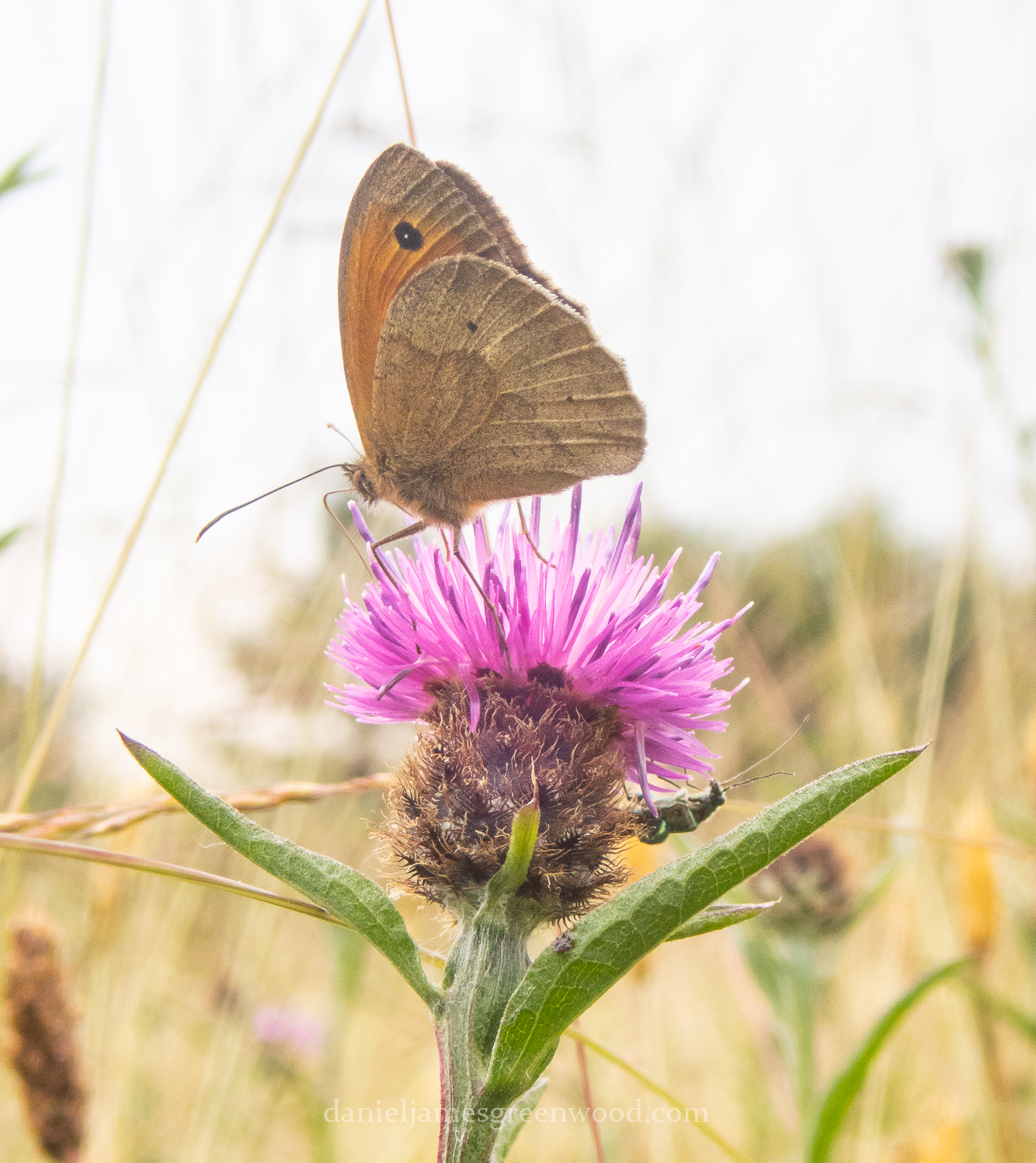
Day 17/30: this photo made me laugh – a meadow brown butterfly on common knapweed in a Wealden meadow in West Sussex. I didn’t notice the green swollen-thighed beetle hanging out below until I put the photo through Lightroom!
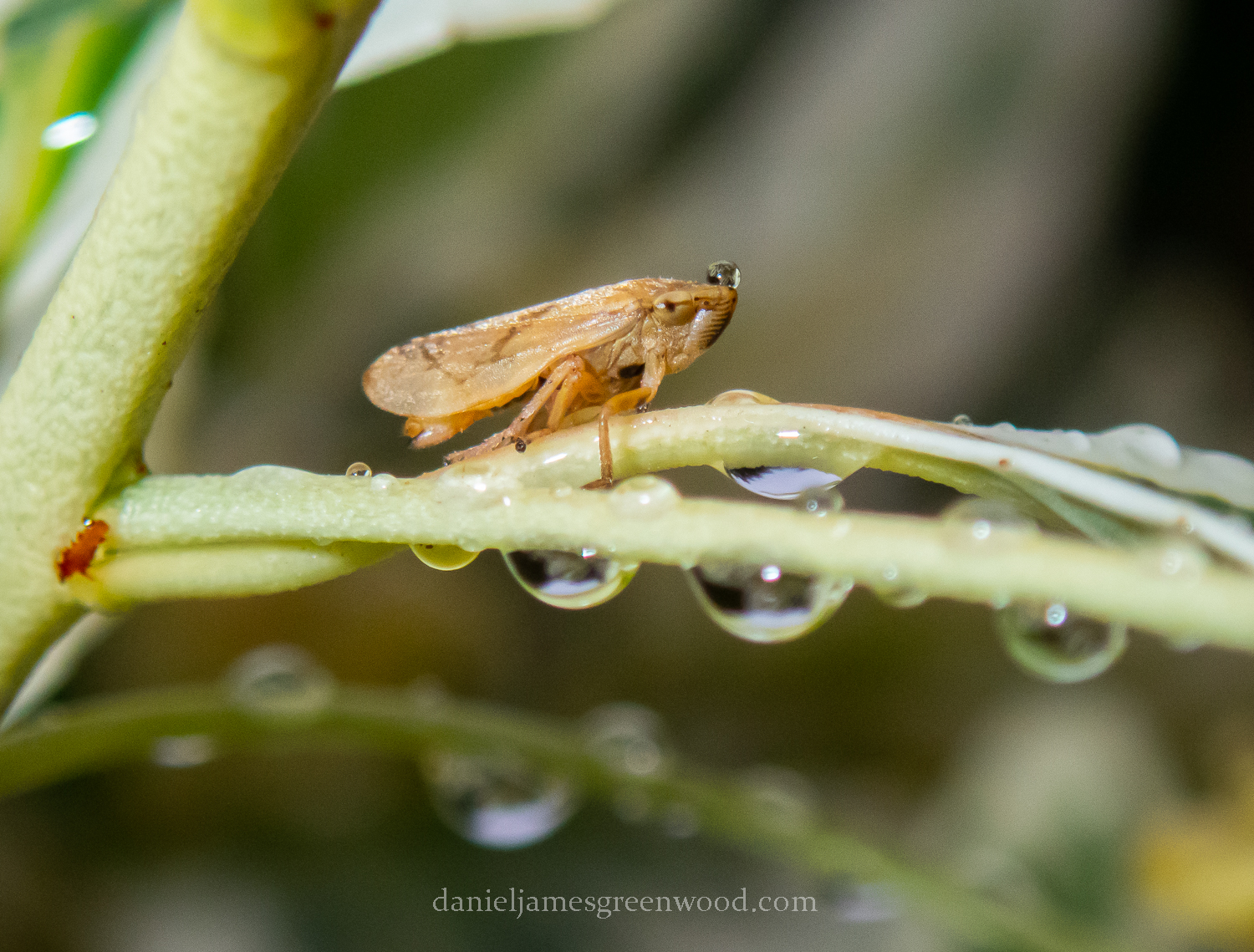
Day 18/30: storms have been the only source of rain recently, and they have been incredibly powerful. After some of that rain, I went looking for some life in the garden and found a common planthopper with a little droplet on their head. I see this as pushing the camera (Olympus Tough TG-6 compact) to the extreme due to lack of light and small size of the subject, and the results are great (though cropped and edited in Lightroom).
Day 19/30: on a lunchtime walk to stretch my legs I found this ashy mining bee foraging from one of the umbellifers that grow alongside my local river.
Day 20/30: things took a turn for the fungal on the 20th, as the rain gave a much-needed drink to the thirsty lichens in my local churchyard.
Day 21/30: the first of the summer/early autumn mushrooms, spindleshank, growing in the place where I learned what they are at Sydenham Hill Wood.
No nationalism was expounded in the making of this blogpost.
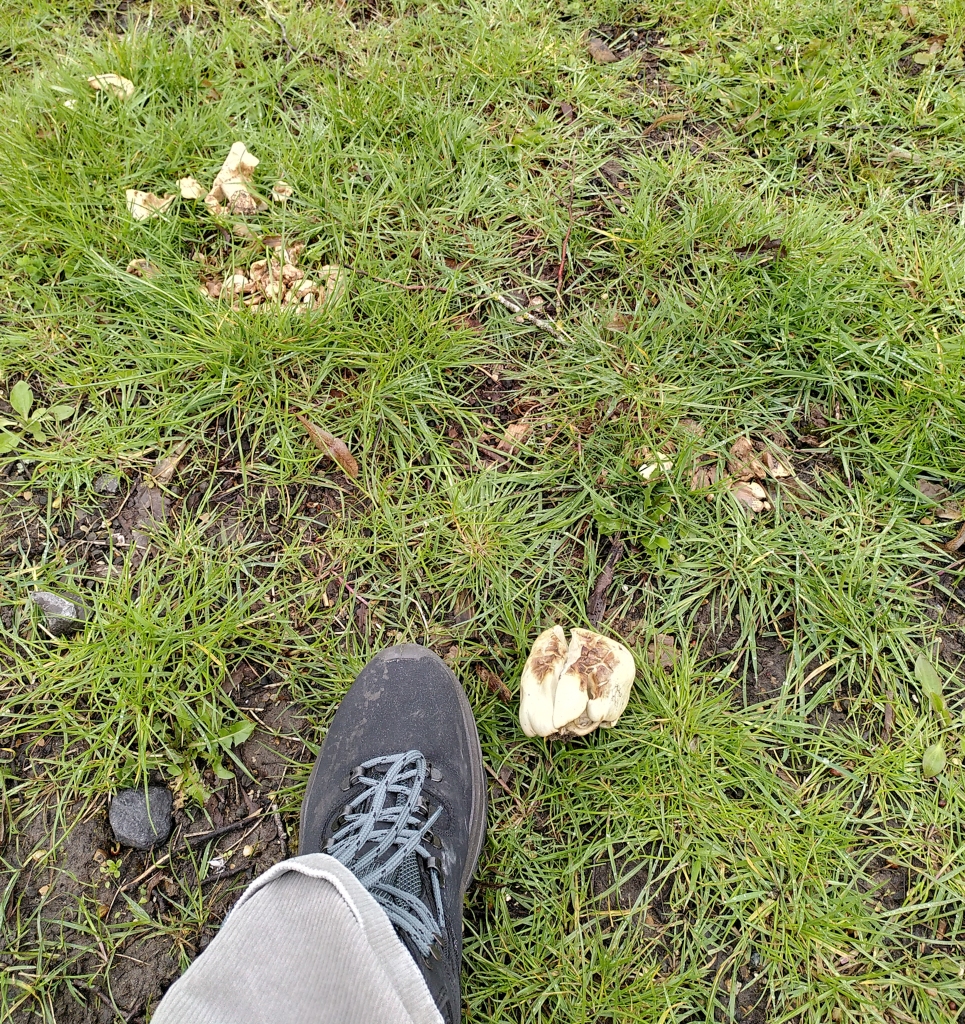
On a recent visit to the National Trust’s Nymans Gardens I spotted some big, cream-coloured things in the lawns near the car park. No, these were not scones or cream cakes, or even pasties discarded by visitors. It clicked almost immediately for me that these might be St. George’s mushroom – and guess what? I found them on 23rd April, St. George’s Day!
That is definitely the most enthusiasm I have offered for this national day. If it were to be made a holiday, then we can talk.
Spring can be a time of shrooms, as the frosts end and the temperatures rise. We’ve had quite a lot of rain this spring in SE England and so some mushrooms will fruit in response. St. George’s mushroom is one of those springshrooms.
Like many people in the UK my sense of personal identity is not straightforward, and I don’t celebrate St. George’s Day. I have strong Irish roots and as a Londoner of 50% Scouse parentage I feel an affinity with a more regional, culturally complex identity, rather than one of red and white, chest-thumping ‘Englishness’, whatever that is.
It makes me wonder though – is this England’s unofficial national mushroom?
A simple online search shows up no such award, which is probably a good thing. Surely that accolade should go to honey fungus!
You may not be surprised to find that its common name changes depending on its location. In Germany the mushroom fruits in May and is known as Maipilz. That means ‘May mushroom’. In fairness to Maipilz, that’s only 8 days later.
St. George’s mushroom is also edible. I didn’t pick or eat this one, and it’s not on my radar to do so anytime soon. The above seems to have been nibbled free in actual fact. Also, I wouldn’t encourage people to forage from National Trust properties generally because I don’t want to get banned.
The cap turns brown over time making it look like a barbecued chicken piece
St. George’s mushroom appears to enjoy garden lawns, so if you’re lucky you may have one popping up outside your front/garden door. As ever, you should be cautious about eating wild white mushrooms as there are several toxic species which can be confused for edible ones.





























 Unlocking Landscapes