North Downs diary: Where the buttercups erupt

North Downs diary, Coulsdon, May 2016

Buttercups cover the secret meadows of Happy Valley, an almost unthinkable break from the towering darkness of Devilsden Wood. There the bluebells are going to seed, the yellow archangel flowering on the edges of the track where the buttercups erupt. With a macro lens I stalk the flowerheads for insects. There is a note of impatience. A sawfly buries itself between the petals and stamens of a buttercup. It is powdered yellow by pollen. A variable longhorn beetle with demonic elytra grapples with stems of ribwort plantain. I rock back and forth turning the focus ring to try and get a picture of its eyes, my camera firing off shots in hope. It’s never easy. Micro moths stir at each step. One rests finally and I frame it against a buttercup background, blurred, it could be the sun rising.

The meadows are edged by hedges and woods, nuthatches call, chiffchaffs sing. A song thrush moves through its repertoire, conjuring mimicry and melodies that could be tens of species to the uninitiated. Blackbirds draft a soundscape that I cling to, I never want this hubbub of thrush music to end. I love the margins of woods, especially when they are met with meadows as full with life as this. I know a trick: lie down, cover your face and be still. See what comes your way. Flies teem around my ears, on my clothes. I spy them cleaning their legs in the corner of my eye. From this perspective my walking boots toe a roof of flowers. Three swifts appear from over the woods and for the first time I hear their wings, a rippling sound I forget almost instantly. Beetles whirr and slap down onto my hat. An animal arrives in the grass behind my head and, spooked, it escapes. A gull calls and I look up to see fifty or more rising on warm air. A single swallow travels across. It must be good here, why else would they cross the Sahara.

North Downs diary

North Downs diary: Skylarks lift from the turf

This slideshow requires JavaScript.

Rainfall on the downs. Still the jackdaws toe the grasslands in their flock, still green woodpeckers cut arcs across the landscape, still the spring’s song builds in hedgerow blackbird music. Linnets flock to the small bushes of rose and hawthorn, skylarks lift from the turf, dropping back down onto the grassy mounds of anthills. So few flowers, but rosettes are massing at the margin of soil and sky, the dropwort, rattle and eyebrights feeding on the thinnest layer of nutrients, readying to flower. But the rain still falls and so I make for Devilsden Wood where bluebells have peeled from green to that almost purplish colour. Our common name feels a little inadequate. But then that’s the joy of common names, there are so many, they each tell a tale of our senses through time. Wood anemones, probably my favourite flower, were known as windflowers because people thought that they only opened their petals when the wind blew. Here they bloom in their little flocks amidst dogs mercury and more bluebells.

North Downs diary: The pendulum has swung

This slideshow requires JavaScript.

Explore my North Downs Diary

Farthing Downs & Happy Valley, March 2016

A motorbike oozes across the road that runs through Farthing Downs, its deep, unsettling groan scatters woodpigeons and magpies from the branches of trees. When it’s over another sound breaks through: a male yellowhammer. Its song is never quite the ‘little bit of bread and no cheese’ it’s accepted as, but the mnemonic is so memorable that those of us who might not have known it ever existed can remark upon it, can seek it out. The bird is a silhouette, a blackhammer in a hawthorn bush against the bold march sun.

Winter’s decorations still remain, it is a time of flux. The cropped green grasslands and anthills look like a sheet, the racket of chalky wildflowers hidden below. If you didn’t know this was chalk grassland now you wouldn’t expect much else to come. Redwings dot the tree lines, their calls which were in October nocturnal now add to a soundscape that includes the spring skylark, high up above my head, marking out a territory that signals an intent to force new life. I see two of these birds. The skylark is one I hear or see only every few months. Its song has no hint of monotony. But one that I have missed this winter and can hear day after day in spring is the blackbird. From trees that separate Farthing Downs and New Hill it lights the valley with its gentle verses. The shadows grow long, reaching into the blackbird’s dreamy hedgeland.

In Happy Valley the hazel trees’ tails mass like wigs. Looking closely, the buds are cocked ready to leaf, some with the purple tongues of flowers poking out. The yellow grains of pollen that have come from the dangling tails can be seen. I flick the tails to help. The twigs of hawthorns are coloured yellow and blue by Xanthoria parietina. Trying to get a close up photo of the fruiting cups, the apothecia, I find the ‘roosting’ buttons of ladybirds. Who would ever see them here? Dogs, voles, mice, flowers, lichens. Surely only the most inquisitive birds would ever find them.

In the shelter of scrub the primroses bloom in old dogwood leaves. I love this time, the birds singing from the woods and trees, the first flowers breaking the rule of death and decay. No doubt, spring and summer have plenty of that to offer, but at least now the pendulum has swung the other way.

Photography: Ash tree

Ash coppice, North Downs, October 2015-1

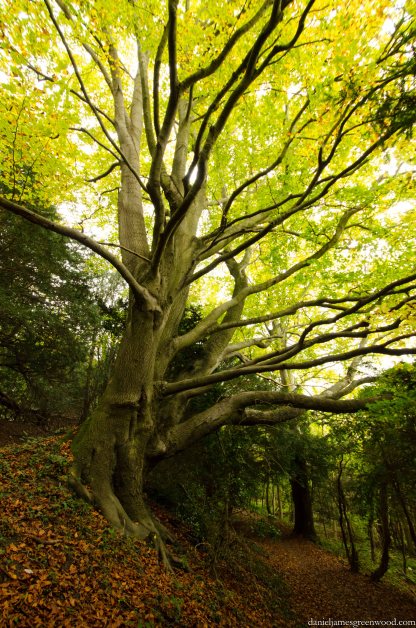
A coppiced ash tree along the North Downs Way near Oxted, October 2015. Coppicing is the act of cutting a tree at its base to harvest wood and encourage more growth in the following years. This ash is now grazing land and is likely to be left over from formerly coppiced ancient woodland, tracts of which are still found along the edges of the field. The tree is full of holes and crevices for fungi and invertebrates but must be feeling the pressure of the hoofs of grazing livestock on the ground around it.

See more in my North Downs diary

North Downs diary: the wreckage of waxcaps

Farthing Downs, Coulsdon, November 2015

It’s a struggle, this time of year. The early darkness feels new and staunch. It’s a time to dread as far back as July, when the birdsong goes and some butterflies begin to look tattered. The newness of spring feels far away. But here we are, a mild November once more, knapweed and scabious in flower on Farthing Downs. I’ve often heard people say November flowers are confused, a human trait, of inaction. Really these hardier daisies are taking advantage of the warmth, ‘waiting’ for the frost to kill their petals off. Where there are no flowers I find instead the wreckage of waxcaps, trodden in by human, cow or canine. Some meadow waxcaps lie young and picked. There is a natural urge to do so, though the City of London Corporation won’t allow you to. I lie on my side to photograph a bright red honey waxcap that had me magnetised and muttering upon seeing it. Farthing Downs and neighbouring Happy Valley are rich in this family of mushrooms, due to the ancientness of the grasslands. The Corporation’s workforce have cleared a large chunk of post-war oak, hawthorn and ash woodland, opening up more ground for the rare waxcap habitat of this chalky landscape. I ponder the fact that a similar area of trees is to be landscaped up north in the borough of Southwark at Camberwell New and Old Cemeteries in order to provide new burial space, resulting in a campaign and a heated debate amongst the local community. Here at Farthing Downs this important work passes with no such fuss.

The grazing cattle’s cowpats merge with the mud coughed up by the machines brought to clear the trees. Looking closely, the surface of each poo is dotted with tiny orange coins. They are the fruiting body of Caprobia granulata, a dung fungus. But that is not the only life to be found on the cowpats. Yellow dungflies, one of 54 species in Britain, perch on the ledges of the pats, brawling and mating in the furrows. Some rest in perfect stillness until I venture too close and their mounds are vacated in an instant. I hear the alarmed calls of a crow and look up at the faintly blue sky. Nothing. It is usually the crow’s indicator of talons and curved bills. Indeed, I see them now – two rooks and a crow, the latter with a piece of food held between its bill, chasing a sparrowhawk. They dive and the hawk turns its talons up at the incoming corvid, righting itself with a 180 degree spin. The sparrowhawk slows, turns, ducks another attack and then moves off, gliding to the safety of Devilsden Wood.

North Downs diary: the endless scene

Sweet chestnut coppice

King’s Wood, Kent, December 2012

The piles of birch trunks tell us that this chalky fringe of King’s Wood has recently been coppiced. The heartwood glows golden against the black, brown and grey of a winter’s afternoon. The paths are boggy, holding the tracks of boots and the tyre marks of cyclists and scramblers. Large ditches appear at intervals, home to trees and dead wood. A Soakham Downs poster a little way back identified these as chalk pits dug in old times to extract the chalk from the soil. The chalk was then spread in the fields – what once would have been woodland – to fertilise the soil, left to weather under sun and rain.

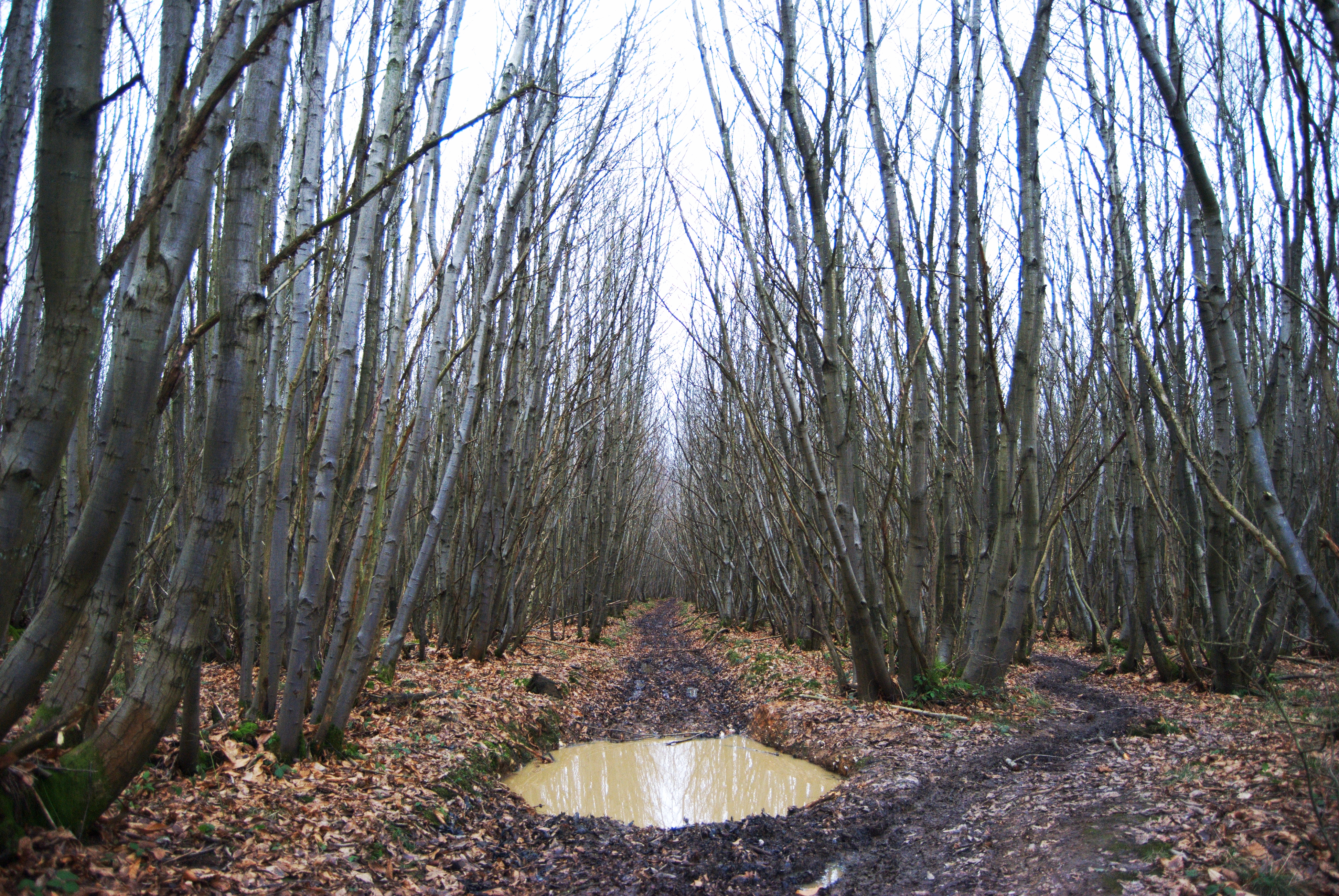
Further ahead the woodland opens in earnest, endless tracts of sweet chestnut coppice climbing into the sky. A brown puddle reflects the bare branches. Sweet chestnut provides the nuts we like to roast at Christmas, as well as forming the most economically viable form of coppicing in today’s market. The poles are cut after about five or six years and split down the middle to make chestnut paling, a type of fencing used in parks and nature reserves up and down the country. It’s another aspect of the Roman’s botanical legacy – they brought it along with them. The vertical slant of the branches is interrupted by a movement of four legged animals crossing our path in the distance. Our talking pauses as we watch an endless trail of deer move from right to left, disappearing into the trees. One of them was all white and it sticks in my mind like a puncture. We make our way towards Chilham, stopping briefly to search amongst these overgrown trees for walking sticks. We listen to the multiple stems tapping together as the wind steals through, some trees creaking. This a sound that in the endless scene of coppiced trees we mistake for shrill and distant calls of people.