Daneway Banks, Gloucestershire Wildlife Trust, Cotswolds, July 2014
Figures stalk this tumbling chunk of meadowland. Severe expressions are worn: eyes drawn to-and-fro, either side of the gently worn path. But all they see are the scattered clouds of marbled whites. This is where the wild thyme grows, creeping along the turf, appearing in small spreads on the miniature hillocks of ants. And here you have the reason for all the skulking souls, though some boast of their sightings as they lay flat on their bellies in wildflowers, with camera lenses mounted by donut-shaped flashes large enough to save a life at sea. The wild thyme is the food plant of the large blue butterfly, once extinct but now successfully reintroduced from Swedish stock, this insect depends on the work of red ants taking its pupa into their nests as one of their own. The large blue pupa will then eat the other ant grubs it’s lodging with, eventually destroying the entire colony. To find something that was once extinct is, to many, to contend with the immortal. We haven’t seen it, instead we hear stories of large blues sunning themselves beside gate posts ‘just fifteen minutes ago’. We also hear of the creature’s phased movement, down the hill with the sun’s heat. We meet a softly spoken man making his fifth visit in search of the ghost. He identifies the yellow spike of flowers that is agrimony. He suggests we look it up in my friend’s wildflower guide (one which I tossed, jokingly, into the air out of faux-botanical disgust some minutes ago). There’s much more to see: clustered bellflower, common centaury, yellow wort, pyramidal orchid, lady’s bedstraw (which we shamefully contended ourselves with as golden rod), the simple colours of bird’s-foot-trefoil, and edibles like marjoram and salad burnet.
Rain comes and we leave these meadows of lost souls, leading up into Dorvel Wood. There is that change, the sudden loss of colour, all has become green and brown – leaf and leaf litter. The wood flowers appease the loss of butterflies – the underlying stench of wild garlic, the sight of violets, wood spurge, wood melick and no desire for the unusual. No man can be found here lying in mud and puddle to capture a photograph he can later sell on. But the ash leaves, crinkled, brown – is this ash dieback disease, the greatest threat to British wildlife since Owen Paterson? This was a moment I had expected but had somehow felt to be too far away. The canopy leaves are curling and dying, too. Is this the end for the common ash? We ponder it and tread out of Dorvel Wood, into the beating and blazing meadows of Sapperton.
In the towns swallowed by London’s urban lurch, summer is flowering knotweed, rosebay willowherb and lupins, all non-native, all bold and blooming along Victorian railway sidings. At Farthing Downs summer strikes out in meadows of yellow rattle, dropwort, field scabious, hawkbit, ribwort plantain and sheeps sorrel. The first meadow browns, ringlets and small heaths take flight, the latter locked in a pair, mating, flying as one away from my lens. Stopping to take in these grassy Downs, the sheer number of butterflies is clear.
But the birds have not retired just yet. I hear a cry from the blue sky and see a buzzard tucking in its wings and bombing towards Coulsdon. This is the first I’ve seen here, and its arrowing for London is without doubt. This is now officially the most common bird of prey in the UK. I also hear the songs of linnet, song thrush and chiffchaff. Spring and summer have clashed in a frenzy of yellow, green and the common blue butterfly. On New Hill pyramidal orchids cascade across the slope, the leaves of spring cowslips now tucked in under the shade of orchids, rough hawkbit and yellow rattle. The bed of marjoram bounces, its fragrance only felt when touched with the fingers. On the other hillside jackdaws flock with two sheep grazing, their medieval world clattering along with their calls, like bullets ricocheting. The sheep go about their tasting, the meadows purpler still.
I sit on a path new and slight, pressed into the grasses. Last year I sat in a spot close by under the shade of ash trees watching a willow warbler make return visits to a nest down in the brambles. Now the brink of a small copse of trees has gone, the bird, perhaps returning, may have decided this was no longer a place to raise young. In the absence of willow warblers, brimstone butterflies, perhaps reaching double figures, mark the new space of downland that has been reopened from the folds of trees. The piles of logs and branches stacked in the iron beds are still here, yet to be burned or hedged. I like that slowness, that I can come back some months later and no one has felt too pushed to tidy the place up.
A male and female brimstone fly together and then fall down amongst the twigs and low, woody brambles. I’m interested to see what they’re doing so I get up and have a look. They’re mating, bodies bent round, facing away from each other. They part. High in the sky, against the blue and its herring and lesser black-backed gulls circling on thermals, a huge flock. I wonder why, I wonder what for. Down here with me the female brimstone is again on the wing, met by a band of battling males. They pass her and are turned immediately onto her, each forgetting their quarrel and targeting the paler female. This is the perfect reflection of the adult butterfly’s life: the males seek as many females as they can; the female, having mated, defends herself from latecomers as she strives to find the right plant for egg-laying. The males attack her, but she breaks free, up into the sky. She is not free of them. The four males cloud her, their colours so close as they gain height that all sense of defence has disappeared into a neon waltz. They go up, up and over my head to the world of gulls and warm air rising.
A lady with a crutch and white hair slipping from a woollen hat stops me in the road. She saw me photographing the upturned soil and root plate of a gigantic spruce. Her accent suggests she has moved here from England:
‘I’ve seen about half a dozen deer in the woods just up there,’ she says. ‘If you’re quiet you might see them.’
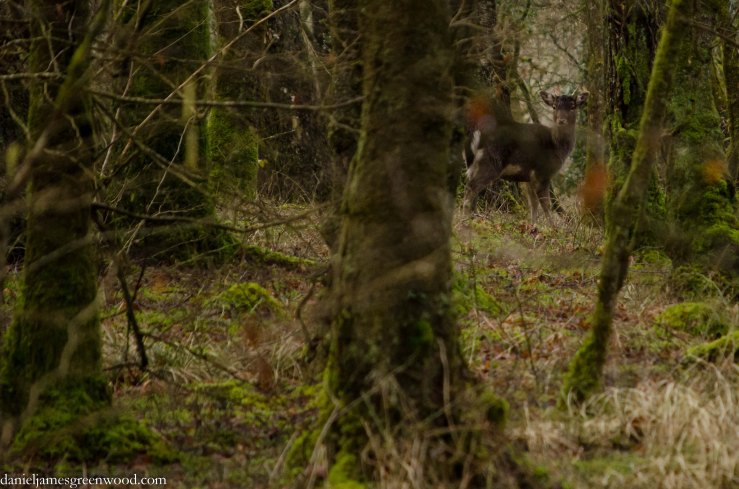
I thank her and take my camera from the bag, pulling my hood up to shade out my face. The day is bright, sunny and warm. Beyond the dry stone wall the woodland begins, a line of evergreens creating a dense bank of shade along the wall, before the characteristically decrepit and mossy trees of an old Scotch wood. I look into shadows and see that a deer is watching me. It’s a sika deer, the first one I’ve ever seen. It doesn’t seem frightened. It turns to me, then away again, grazing behind the line of dark trees. I follow it along, it doesn’t gallop or run. Its path leads me to two more animals, one of them a stag, new antlers primitive but still impressive. It stares at me behind the wall – there’s a good twenty-metres between us. I’ve been photographing them the entire time. I think back to the venison sausages I had at the Galloway Arms, the conversation I had with the bar man:
‘Everyone thinks they’re all cute and cuddly, like Bambi,’ he’d said. ‘No one wants to kill them.’
‘But not everyone knows what they do to woodlands,’ I’d said, thinking aloud.
‘Well, exactly!’ he’d affirmed in his thick Scotch accent.
I know their numbers are at their highest in the United Kingdom since the last Ice Age 10,000 years ago (so are ours, by the way). I know the link between the nightingale’s sudden decline in England and deer overgrazing woods, not that the nightingale makes it up here to Scotland. But I could not kill one of these animals. I’d rather leave that to the lynx, or even the wolf. I put my camera away and make my way along the empty road.
Cairnsmore of Fleet, Galloway, Scotland, February 2014
A wading bird bursts from the bog. I watch its sharp wings cut into the wall of mist and descending treeline. I put my binoculars to my eyes and the bird is lost. The world has been reduced. All terrestrial life but for water, a few lichens, heather and wintry moor grasses has escaped. I have left behind oak woods overcome by rhododendron and cherry laurel, and Cairnsmore Burn choked by the former, its water crashing from the shadows. It was not right. Snowdrops still managed to create small rugs of white flowers and winter green leaves. Bluebells peeked through the leaf litter amongst them. Behold the denizens of Galloway’s oldest woods. Up here those are images in the mind. The life in the lap of the Cree estuary – the buses, postman, trees and gentle flowering plants are mere memory. The cover of Glenure Forest’s regimental spruce is the last notion of protection. It’s now up to willpower, my body and clothing. The path leads clear from 20 metres, visibility coming and going with cloud.
I climb over a wooden ladder and the landscape ascends suddenly from 400m towards the 711 that marks Cairnsmore of Fleet’s summit. I have not seen a single person since snowdrops. Why would anyone want to be here? I come for the brutal solitude, even if I wanted to see another person I couldn’t. I come because I know that people once had no choice but to walk this path, a path that zigzags and climbs, an uncomfortable choice of jutting rock or slippery grasses. I attempt to find a rhythm on stone. The path curves east and the winds propel me on. I see boulders and mistake them for cairns – this is not the summit. My thighs are soaked, woollen gloves, too. I took my jumper off some miles back and now need it. It’s sodden and looped around the strap of my bag. The winds are harder, colder and the rain splatters against me. What the guidebook called a nice introduction to Galloway’s hiker’s paradise has the makings of a minor ordeal. Water streams down the rocky path as I step up and through it. The music of the running water cuts through the wind, it’s almost all I hear, but for my own mutterings. I can say what I want now, no one can hear me. There will be no repercussions. I cherish that.
The false sense of the summit has given me energy. I’m so hungry. I begin to see my breakfast as vital, I value it differently, as something I was fortunate to have. I see the first cairn of the summit approach and slump down behind it onto wet stone, moss and crustose lichens, barely protected from the gelid gusts. I push some cheese into a crusty bread roll and swallow it. I feel the onset, the flickering of panic. The wind and rain has thrashed me, and I didn’t realise it had or that it might. Visibility is now down to 10m, I put my gloves back on, the cold hammering without, almost burning. I think of real mountains and feel stupid. Hills aren’t to be taken for granted, either. My glasses are blotted by rain on both sides, I recall my friend’s maxim that the descent is worse than the climb. There is no notion of friendship here. The supposedly fine views of the estuary are not on my mind just now. I tread blindly back the way I came, finally removing my glasses. The path of rock, the fog, the bog, it’s all clear. There is no need for detail. I tread in hope and long to see the cloud drift and for the undetectable sound of the wind dropping. The spruce trees appear again, black and warming, even a glimpse of the Cree. From the bog two grouse explode into the air and I leap in surprise. It’s the start of a world I can live with.
Carrbridge, The Cairngorms, Scotland, October 2013
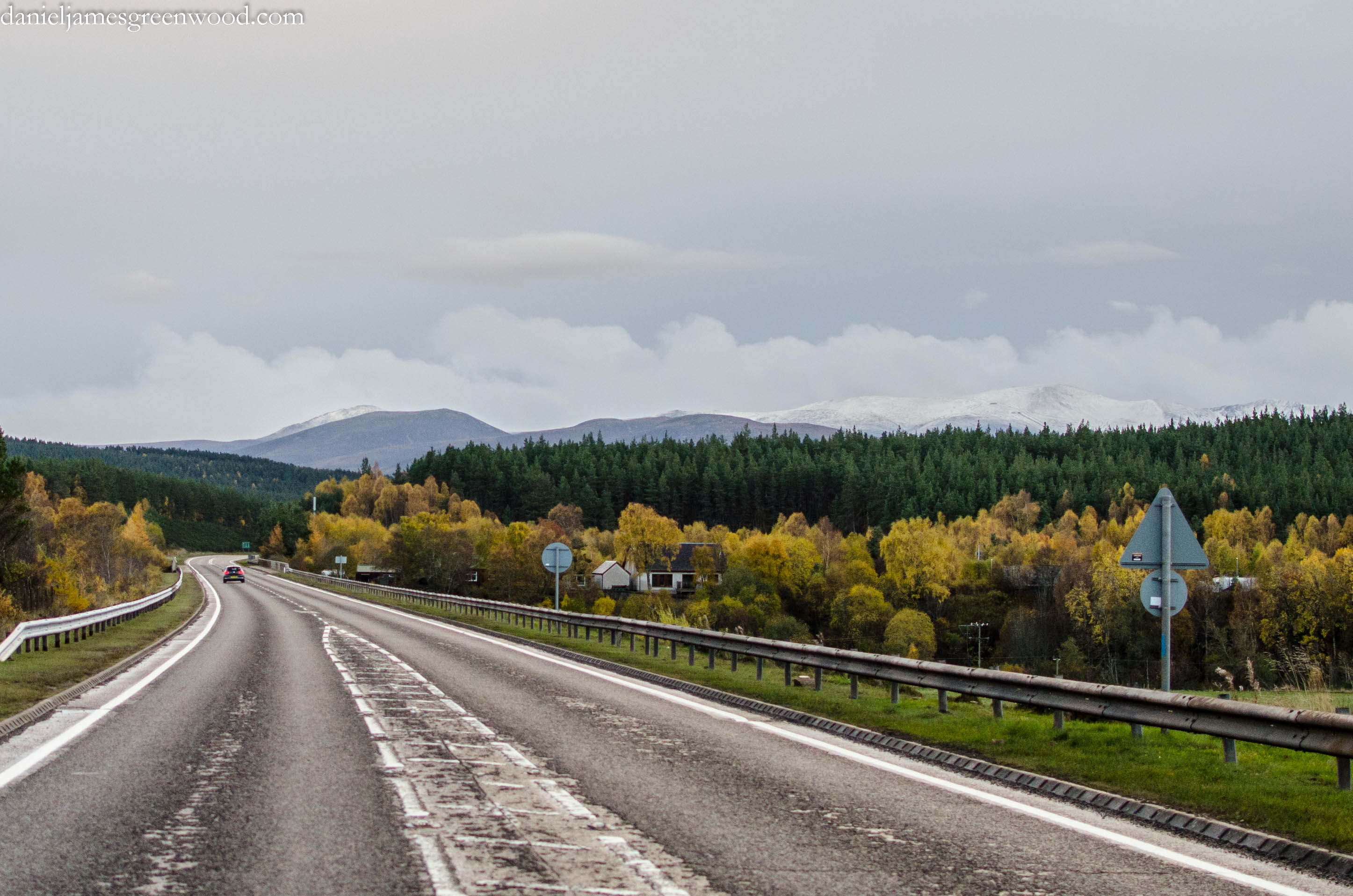
Arriving in the fields, the lichen frosted pinewood in our wake, I admire an old alder tree coppiced and growing by a brook. The landscape unfolds, the Cairngorms rising in the east, fringed in all corners by the yellow of birch leaves. We look to the hill where we had observed this scene only two hours ago, from a spot where a sheep skull hung from a piece of standing wood. We follow the River Dulnain as it runs east, the sound of traffic returning along the A-road. A buzzard floats over a line of trees, calling out, the sound severing the reminder of motor vehicles. We egg it on – ‘go on, my son!’ – and approaching a small farmstead we find a rabbit freshly mutilated, its neck bone protruding, eyes gone. Was this the buzzard’s work, or perhaps a mustelid. We cross a tributary of the Dulnain and a goosander bursts from underneath the footbridge. This saw-billed creature is one I had never seen before now. It steers itself upstream into the dusky light reflected by the water. We continue past a dilapidated cottage and fiery beech tree, watching as sheep leap and bounce away from a row of cabbages they had been eating in a neighbouring field. We meet the main road and wait patiently for our chance. Having crossed, we train our binoculars on the summit of Cairn Gorm, the restaurant and funicular railway car scratched into its slopes. All is dressed in a layer of snow.
Standing on the track leading into Devilsden Wood I look to the ground for dryness, somewhere that hasn’t been soaked by this perpetual rainfall. I see fallen ivy leaves that appear like cuts of leather when really they are crisp under foot. Dog shit, too, the new waybread for the modern ancient footway. I hate the stuff. My waterproof sheds its load onto my jeans and it’s wait and become cold or move and receive woodland raindrops, some chucked from the canopy of mature yew, ash and beech, some fifty feet up. When they get behind glasses, these droplets shock the senses.
It’s fungi season, the signpost of falling temperatures, not too cold but a shift from the sultry summer. I gawp at log piles with an explosion of mushroom caps, marked by striping and shapes that would define them to those who understood them. But still, I spy an oysterling appearing from a rotting trunk and feel that in two years of woodland obsession I have at least learned something about this magical animal that appears so fleetingly it could almost be through the fabric of time, a monitor on how we’re doing. Checking the sole of my boot again, we’re crap. I wipe it off in a mud puddle. The rain has not lessened. I head back out from the dark, autumn-beckoning woodland and onto the wet warfare of the Downs. The change in mind is clear, the atmosphere of a woodland changes you. It is not like the open land, so much a canvas for human experimentation, our impact on woodlands is never so clear as the plough’s to the open landscape. A woodland to all but a minority could have been in that state for millenia, before human time. The wood is a wild city, with nature’s social housing, swimming pools and fast food. It was our home once, too. There is the semblance of a summer out here, yellow rattle not yet rattling, knapweed funked-out in pinkish purple, even a bit of scabious. These wildflowers have something of January’s left over Christmas decorations about them. A car passes along the lane. Woodpigeons are striking through the rainy sky, turning their wings and bodies at an angle – to avoid the direction of the rain? – always as individuals. These birds cut several different figures in a year – hurried, panicked on the wing, or else male birds cutting arcs out of the sky as they display to females long into the summer recesses. Now they could be migrating, they could be hunted. Mostly they are gorging on elderberries outside my bedroom window.
On the Downs a flock of goldfinch are startled into the sky like pieces of a broken vase put back, its smash rewound and fixed. They sit in a small hawthorn bush and I look more closely. On the end of a branch, clear and possibly not so fearful of man is a juvenile, all grey on the head, interested in looking but unaware of the perils of being watched. My advances fracture them once more and I’m left with a snapshot of their escape into the landscape captured on my camera.
Last night we arrived to watch the mountain burn. The flames licked up from behind the plantation at the end of the field, capturing the tinder of last year’s heather. I thought of how dry that wood was, how it would go up in an instant. The farmer ghosted down the lane, no knowledge of who could have set fire to the mountain, or why. He always strikes me as part wild, so accustomed to the lay of this land that he has partly-merged with its bogginess, its giant boulders and streams, in the way I am accustomed to the wildness of streetlamps and new woodlands, how they impact me. Seeing an Xbox and satellite TV in his house a few years back diluted that idea. This isn’t the first time the mountain’s been set on fire, five years ago it happened. Waking up this morning it’s as if last night was a dream brought on by the exhaustion of a long and early journey from London, across the Irish Sea from Holyhead and then from Dublin. At the foot of the Ox Mountains this morning I see no sign of fire, no people, no animals. It must have been much further away than we thought it was. The bracken lies dead and dry, concealing crevices between rocks. How quickly this could burst into flame. The ground is dry at the foot of the mountain, the sphagnum mosses and reindeer lichens spreading as I climb with the wind. A herd of feral goats watch me from the top, filing away, perhaps in disappointment that I’ve blocked their path. Turning to look to the west I see Nephin in silhouette where the valley of farms and gorse-covered bog ends. I head south-east and up into the Ox Mountains.
Trees are sparse, only a hawthorn or a mountain ash in 100 metres, bedraggled and gnawed by the animals that graze between the rocks. The heather is growing again, and where there is some dampness a cladonia cup-lichen pouts its miniature red lips on pale blue stems. I search along the south-facing banks for wildflowers and find dog violet and wood sorrel. Being a woodlander at heart, it draws me back home and to the question of origins – did woodlands once grow on the Ox Mountains? They must have. Looking around me, I am not convinced. But early or common dog violets do grow in ancient woodland in south London, and wood sorrel, too. One of my holiday reads is Oliver Rackham’s Woodlands. I will be tearing into it on my return back to the cottage.
A small bird is calling, barely audible above a wind that’s gained momentum as I’ve gained height. Two giant boulders sit like mountain fauna and all I see above and between them is sky. The ground is boggy, covered by the papery yellow grasses and red mosses. A goat path is indented through it all. I take it, stepping up into the goat hoof clefts and up between the two boulder gods. Though unseeing, they will have presided over a valley wrought by famine in the 1840s, worn only by the deep breaths of time. Last night they will have been coloured by fire, unmoved. To be rock is to be asleep.
The rocks are beneath me now, a plane of damp dead grasses and moss pervades. The wind is stronger, still. How strange that even on a tree-less moor of a mountain the movement between rock and mound can feel like entering somewhere new. I sit on the rocky deity’s scalp. Down below, the plantation is crossed by bare larch trees, and in the distance the blue promise of Sligo Bay. Further west, in the realm of the imagination: America. But I’m hungry, and the basic desire for food always wins out over beauty.
I wander across and down, away from the sheer drop. At least the fall would be into a mattress of bog. A raven calls out, kronk, kronk, kronk, but so bare is the mountain the call could be a thing of the distant past, or my imagination. I grab onto heather forgetting that the soft ground will give and I nearly tumble bearing yet-blooming flowers, but a goat print saves me and I land on my backside. Gradually the song of a robin replaces the mountain wind, the images of sheep return to life and the mountain looms again, forgetful, triumphant.
Easter Sunday
It’s evening, the weather is warmer here than in England but when the wind blows it cuts through you. I have been reading Rackham’s Woodlands. In the period between 1350 and 1500 woodland cover expanded in the United Kingdom in the wake of the Black Death. England’s population declined by 1/3 and so too did global warming[1]. Why? Less trees were being felled and burned. The woodland came back and captured the carbon. I wonder when that will happen again. Today we visited my grandfather at his nursing home in Kiltimagh, it’s an old estate with pollarded horse chestnut and beech trees. On the hillside wind turbines have been built. They do not look a scar or a slight on the land. But granddad never leaves the house to see these things, most of the people there drift in and out of sleep and eating, the radio playing in the background. It was Aerosmith when we arrived. He used to live in Ballindine, crossing the motorway to the shop, forgetting how many times he’d been. He always asks me when I’m going to get a haircut. I feel a little apprehensive about visiting the home but when I get there I enjoy it, the people are friendly even if some aren’t in their right mind and there’s a welcome warmth about the long faces, slow gestures and blazing radiators.
After a day spent in the car I decide to visit the mountain again. I’ve never been to the top. Me and my dad nearly got up there a few years ago but we didn’t feel the desire to. I take to the path again, passing the sheep in the field, the caravan shot to pieces, a lace curtain blowing through the hole where the window once was. I climb up the track again and feel no desire to reach the summit. I turn into a small cove where a stream runs down and the path becomes sphagnum moss, soft, white and red. I sit on a boulder and look up at the sky and the mountain. But for the stream there is no sound at all. All my thoughts come in and out again. Having had my fill of silence I return back down. On the way I see Nephin traversed by the sun setting behind clouds, the trees silhouetted on a hill before it. I can’t help but think of those who used to live on this mountain and in this valley who were shackled and degraded by famine. How did they view this overbearing rock and heathland, the sight of Nephin and sunsets like these? Surely they couldn’t have had the energy or mind to even think about it. It would not have mattered. I was reading a book called The Great Famine last night. When one ship carrying food and aid from England arrived in Ireland during the famine, three went the other way. At times I feel torn between my heritage, between my anger for the cruelty wrought by the British and the suffering inflicted upon the Irish. I do not feel completely one or the other.
On the way back down I have a sudden desire to remain, to sit against a rock and enjoy the fresh Atlantic air. I remember hearing a cuckoo a decade ago, but it hasn’t returned yet. After my breather I continue into the valley and meet the farmer on the track. I ask him if cuckoos still come here. He doesn’t understand me. I sometimes forget that my accent isn’t clear to everyone. He eventually realises what I mean and points to the plantations growing on either side, comfortable with the knowledge that they come often.
‘But it’ll be too cold for them here now,’ he says.
Mountain ash, Ox Mountains
Easter Monday
From Woodlands, page 206: ‘Ancient woods are not the place to look for ancient trees. Indeed, the presence of ancient trees, unless they are boundary pollards, indicates that the wood is not ancient, but has grown up around freestanding trees (in-filled savannah).’ There are no ancient trees at the foot of the Ox Mountains, there are barely even trees. I still have hope of finding something.
Tuesday
We aren’t visiting granddad today. We drive to Westport to see what they have in the bookshop there. On the river a grey heron is mobbed by black headed and common gulls. They stand on the wall having their pictures taken by everyone, including me and my family. We drive to Achill Island for the day, the sun beating down but the cold wind still lingers. It’s snowing in London. The views from Achill are astounding, rock pipits merge with the winter grasses and silver boulders as they feed at the cliff’s edge. Spring is still not with us, the leaves are not on the trees, no swallows nest in the barn and no cuckoo calls from the wood. The bogs on Achill are strewn with rhododendrons, thriving on the acid soils, clearly admired by the locals for their unusual pinks and purples when in flower. I bought The Story of Ireland by Neil Hegarty. This quote from Oliver Cromwell stuck with me:
‘For to what purpose was it to plow or sow, where there was little or no Prospect of reaping? – To improve where the Tenant had no Property? This universal Neglect of Husbandry covered the Face of the Kingdoms with thickets of Woods and Briars; and with those Vast extended Boggs, which are not natural but only the Excrescences and Scabs of the Body, occasioned by Uncleanliness and Sloth.’ (page 136).
It’s what I love about Ireland, the bogs, the boulders, the ‘Excrescences’, the 1970s Opel car rusting in the ditch. In Mayo the Irish are not erasing their visual history, the ghost towns of the 1990s are still standing and the eerie cottages of the times gone by are still decaying at the roadside. In England we are obsessed with tidiness.
Today has again been spent in the car, imprisoned. I haven’t been able to contend with the landscape other than through the camera. It’s evening and the sky is broad and blue. The children are playing in the fields, traversing the margins and fence lines. Now I feel the need to see the mountain’s top, I want to know what’s on the other side. I make it to where I stopped the other day, no need of silence or thought, I continue up through the goat clefts, driving shin-first through midge clouds. A wren is singing up above me as I dip in to the path as it bends around an alcove home to boulders that have become dislodged and crashed down over time to sit in the vegetation, cool. I pass back out and the track becomes more steep, the heather creeping across. Now I can see another fire in the south, the smoke blowing to the west across the glassy Roosky lake. The field lines are clear from up here, the margins deep and defined. I turn and clamber to the top. The zenith opens out with a gust of a cold, cold wind. I put my hood up and watch as a meadow pipit raises aloft, calling, a single peep, escaping on deep undulations. So that was the little bird I’d heard the other day. The top of this mountain is peat bog, the feral goats see me and disappear over a peat bank. There are lines where the peat has been removed in the past, a practice which is now criticised by environmentalists because so much carbon has been stored in the bogs. To the Irish who cut out this peat it was just a local and available fuel, it was not an evil act. A trough in the heather is full with water reflecting the sky. The wind ripples the surface. Frogspawn sits in large clumps in one corner. It’s only the second lot I’ve seen this year, here and on Exmoor. I decide to head back down the mountain
A meadow pipit appears and clings to a sprig of heather. I watch it through my binoculars as it looks from side to side, its speckled breast twisting. I pass the winding path again and overshoot, taking the wrong goat path this time. I spot an unusually verdant green peeking from behind a boulder. And here we have it, lesser celandine, wild strawberry. Woodland indicator species hiding behind a rock. So, could it be, did the Ox Mountains once have ragged woods rather than heather? How long ago? I think of how I came to find these plants, by following a goat path. There will be no woodland as long as the goats roam these moors. A man is standing on rock down below covering his eyes, looking around in a fashion not far from the meadow pipit’s.
‘Have you seen a sheep and a lamb passing up these ways?’ he asks.
I haven’t. I see the smoke plumes again. ‘Who is setting fire to the mountain?’ I ask.
‘Just cats,’ he says.
Wednesday
I walk up to the top of the mountain again but with my family this time. I want them to see this view. I see how much good the walk does them, out of the car, not worrying about granddad, if he has enough clothes, if he remembers us, if he’s happy.
Thursday
Stepping off the main road we tread carefully over the rocky steps to Lough Conn, the water lapping against the rocks as it flows under Pontoon Bridge. On the opposite bank the gorse is flowering at every opportunity. North of Foxford it’s bright orange, the dry weather and warm sun has lit fires across the Ox Mountains, this morning the sun shone through the smoke and lit everything brown. It’s not arson this time. In the nursing home they mentioned it on the radio. This place feels like the whole world, the only place. In Pontoon the cars passing at 50mph on the road are not regular enough to dominate the soundscape. I listen – no birds. To the left is a pile of rocks and boulders, leading to a shoreline of reeds, grasses and willow. Beyond the water’s edge is woodland, rising into a lip that looks out over the lough. To me, from here, that is an ancient wood. I look through my binoculars and I’m sure I can see oak buds against the blue sky, growing amidst the straggly birch trees.
How can I get there without drowning? It’s a family holiday and my parents are with me, so dad suggests climbing across the boulders to the left. When we were on holiday in West Cork in the 1990s he would go fishing off rocks our mum deemed dangerous. My sister and I would sit at the window waiting for him to appear on the lane, unsure if the ocean, a shark, a giant squid might have captured him from us. He risked it, and so I’ll do it. The water isn’t deep immediately below the boulders but a cold soaking isn’t on the cards when I’ve got my camera with me. I clamber up onto a big boulder, leading with my feet, stepping onto smaller, and sometimes shifting rocks. I bring my right arm round and the sleeve of my coat unclips my lens cap – and off it goes, somersaulting into the brown water. I can’t help but think of Leonardo di Caprio disappearing into the sea at the end of Titanic. This feels like one of those times when things go a bit wrong. I slip down onto my backside and try to drag the cap towards me with my boot. The lens cap begins to sink. I fish again and drag deeper, I pull my boot away and it’s there, I snatch at it and zip it away.
I climb across the final few rocks until the water has receded and a sandy shore is under foot. This route is rarely taken, it’s blocked by crouched willows and twigs that are so dry they snap as I move. Further along the shore is a stone hut with an iron roof. It looks old, really old, but renovated. The ground is sandy, boggy, midges and mozzies frolic in their respective mobs. Cutting across the marshy path towards the trees I get my first view of it – the green of an Irish rainforest. Everything is vibrant with moss, the tongues of ferns and decrepit trunks of birch and oak trees. At last, I’ve discovered one of Mayo’s ancient woodlands. A chiffchaff is singing from over the bank of collapsed oak and rock, the first of spring. There’s a slender path through the moss, leading to the lip I’d seen from the other side of the water. I wave to my family and call across. It’s ancient! It’s like entering into a new kingdom, a homecoming, a piece of land that hasn’t been twisted and torn by the plough. But there are signs: the stone hut on the shore has a back window (open casement) with a bar running through it, inside it’s dark and wet like a medieval prison.
A swing has been tied to an oak and some clothes are hanging up like the sails of a ship moored in this wood. I feel as if I’m trespassing, like in Frances Horovitz’s poem ‘Winter Woods’: ‘we have encroached – /this is not yet our land.’ There are signs of people yet I’m alone. A flock of long-tailed tits pass overhead, one holds the body of an insect and its sprawled limbs in its mouth – spring isbeginning to move now – I wonder if that’s for a baby bird. I take one last glance at the mosses, a script lichen etched into hazel bark, the wood sorrel and ferns and head towards the water. A path through some heather leads up and out to the main road. I needn’t have scrambled after all.






 Unlocking Landscapes