I headed to the woods again this week to see how the Amanita from last week’s post was faring. There had been almost no rain again until that point. The woodland floor was crunchy and dry. It never feels good seeing a woodland like that.
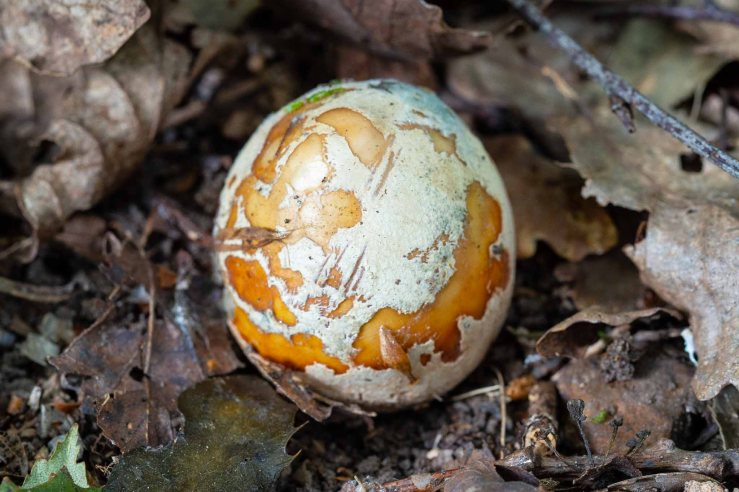
I was surprised to see that the mushroom hadn’t advanced. It was still encased in its bone-dry veil. I had a closer look to see if it even was a mushroom and found that it was actually attached to the soil through fungal roots. It was a learning point – I thought that even without water a mushroom can advance. Evidently it’s very difficult and sometimes they can’t.
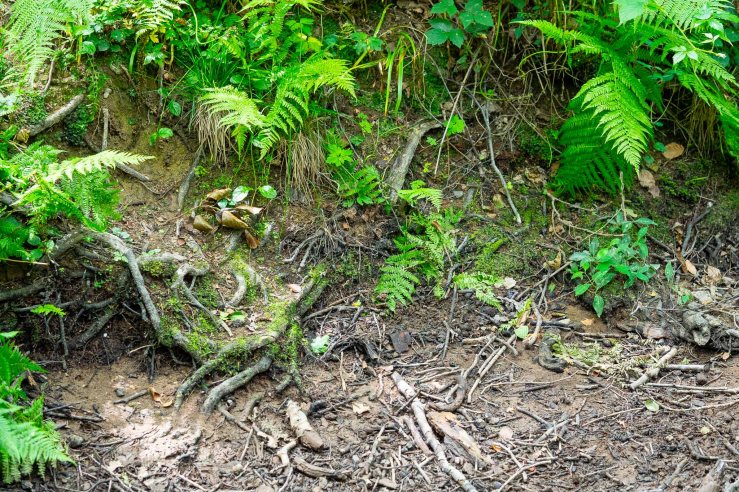
It’s worth saying that fungal fruiting bodies (usually ‘mushrooms’) are 90% water. The photo above shows a woodland stream (‘gill’ in the Weald). It has been an exceptionally dry spring.
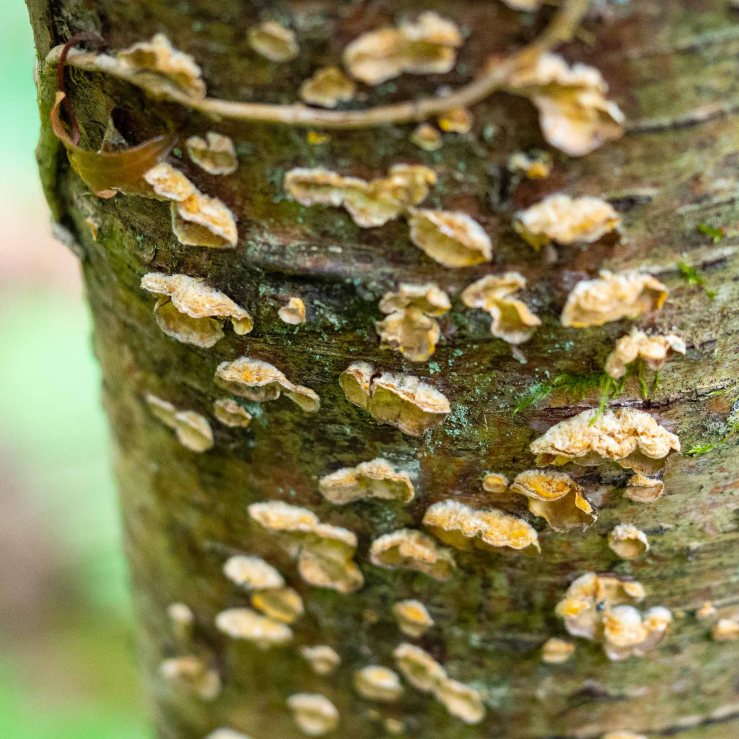
A good indicator of how much potential there is to find fungi can be seen in bracket or polypores on trees. This is probably hairy curtain crust which is looking as sorry as you’ll find it.
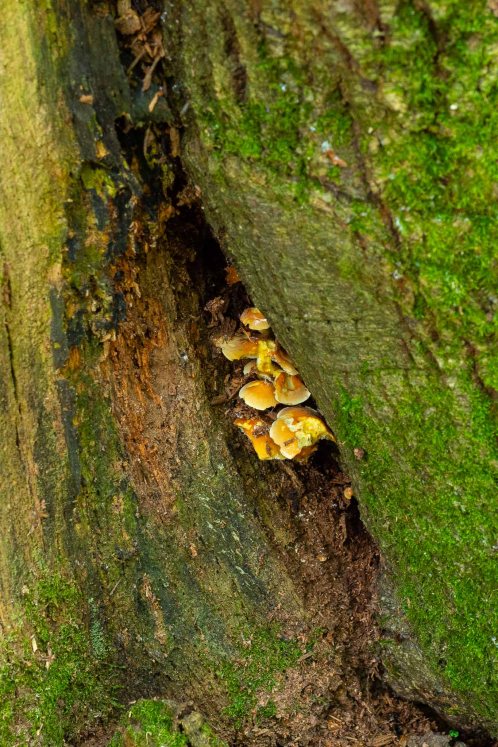
Despite the super-dry conditions I did find more fungi. It was one of the most common species in the UK – sulphur tuft.
These are places where fungi can fruit in these conditions. The inside of a decaying oak tree stays cool and damp, especially with holly surrounding to create shade and thus cool.
You can see how hungry the local slugs are. To humans this is a poisonous species, so don’t be a slug. Even though these had been heavily munched, it’s nice to see a shroom. Rain has come in the past 24 hours, so it will be interesting to see how things might change in the next few days.
It’s the blue hour and already birdsong rises from the woods: an unbreakable wall of blackbird and song thrush. The thrush pierces through with repetition as the blackbirds pause. Chiffchaff, robin, wren, the cascading song of a willow warbler.
Straight away, the hoot of a tawny owl in the echoing micro-valleys of gills flowing through the woods. Over time new owl sound-posts arise in distant corners of the landscape.
5am comes. In the birchy patches roe deer crash away through old bracken. Their sheer weight can be heard. A roe barks a warning – we have been seen.
The owls’ calls grow with the onset of dawn. The darkness still sits in the beech, oak and birch woodland. Pine, forever green, holds it that bit longer.
A sound from far away, slipping over the owl and deeper into the Weald. The cuckoo, master messenger of spring. We heard him here last year and wonder if he is the same bird back from the Congolese rainforest where he spent the winter. Whoever he is his life has been richer than any human’s could ever be. And the female cuckoo, she too will be hidden away somewhere in silence, listening.
We meet the crescendo of the dawn chorus now. Owls hooting on the crest of song thrush and blackbird. Cuckoo rising over everything. Crows begin the first administrative duties of the day, checking outposts of their web and marking party lines. The owls will not be lost on them.
Down a sunken track enclosed by holly, we notice the shapes of bats hawking. It’s the path we need to take. On approach they disappear, as if they were never there. The mosquitoes landing on our foreheads are glad we’ve moved them on. I’d love to tell them, the bats will be back.
At last, this week some rain arrived. I headed to my local woodland to see if any mushrooms had taken the bait. I went there with a slender hope of seeing anything because it has been so dry this spring.
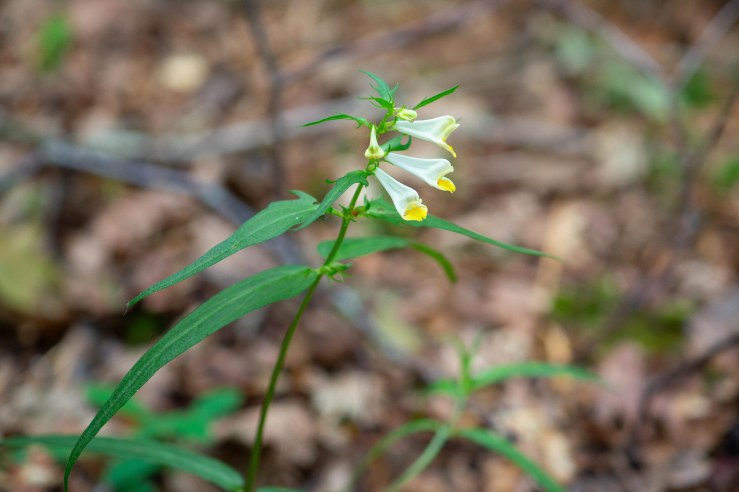
Common cow wheat
It was pleasing to see special woodland plants such as common cow wheat, another of those species which is not actually so common anymore.
Juniper haircap moss
The bryophytes also looked more lush and watered after a day of rain in the past week.
This stunning drinker moth caterpillar was chilling (literally) on a boardwalk. I moved my fellow redhead to safety before it got squished by evening strollers.
My special summer patch was free of fungi, it may be another month before anything comes up there.
The mycelium of green elfcup
Just like last week, green elfcup was evident in those beautiful blue-green stains on bits of fallen wood.
I was quite startled to spot this growing out of the buttress of a tree. I think this might be rooting shank, a species which is often found at this time of year. It’s a signal of summer.
The slugs are obviously hungry at the moment because much of the fungus had already been eaten. The slime trails below are the smoking gun.
Nearby I saw what I thought was an old tennis ball. Upon closer inspection it was in fact a mushroom making its way up into the world.
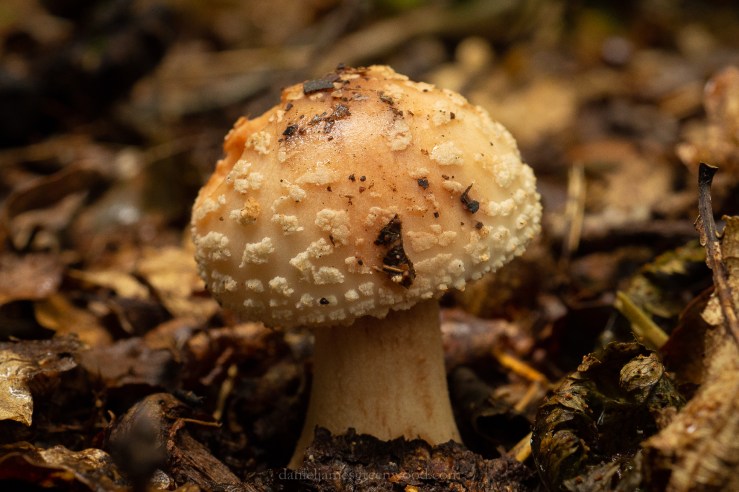
This is almost certainly a member of the Amanita family, home to fly agaric and the death cap. It could be tawny grisette. You can see it is appearing from a veil. There is the typical Amanita patchiness to the remnants of the veil. I did wonder if this might even be Caeser’s mushroom. I will try and check back in a few days if it can last that long.
This blog has now entered into its sixth month and the real-time fungi action hasn’t really happened, as this one will illustrate. Last week I went for an optimistic jaunt to my local ancient woodland/plantation/heathland to see if anything had popped up. I was astonished, not that there was very little to see, but at how dry the woodland was.
It should come as no surprise that I only found one fruiting body, growing out of a bit of deadwood, which would already have some moisture inside the decaying wood. My footsteps were so loud as I walked across the leaf litter. But then we have just had the sunniest May and one of the driest springs on record. Across the south of England warnings have been in place about the high risk of fire. Very disappointingly but not surprisingly, fires are ravaging heathlands as I type. At least some of these are because of visitor impact, either arson or things like disposable barbecues.
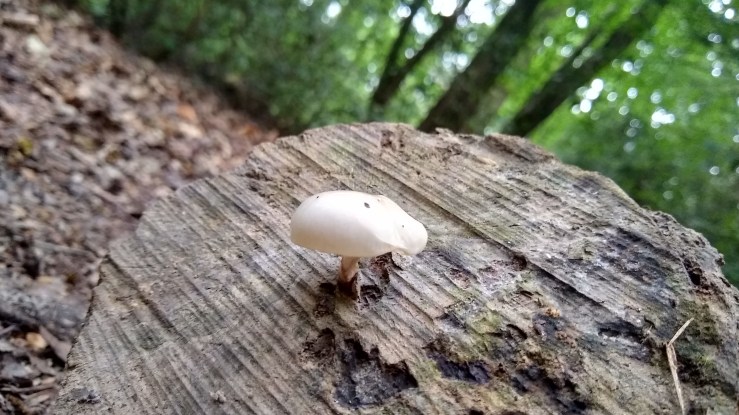
I went for a second mushroom hike – that’s how dedicated I am to this series – and found that an area of more wet oak woodland also had almost nothing appearing. I found so little that I didn’t even get my camera out and instead just used my average phone camera. Sign of the times. The best I could muster was the porcelain fungus above, growing from a beech log that had rolled into the dried out gill. Last winter I saw that stream overflowing.
It would be wrong to say that there is no fungi, because fungi is the life we do not see. This stick, looking a bit like a blue whale or a squid, is made green by green elf cup. This is the work of the mycelium, the true living part of the fungus.
In autumn small green fruiting bodies will appear as above. This was taken in October 2019.
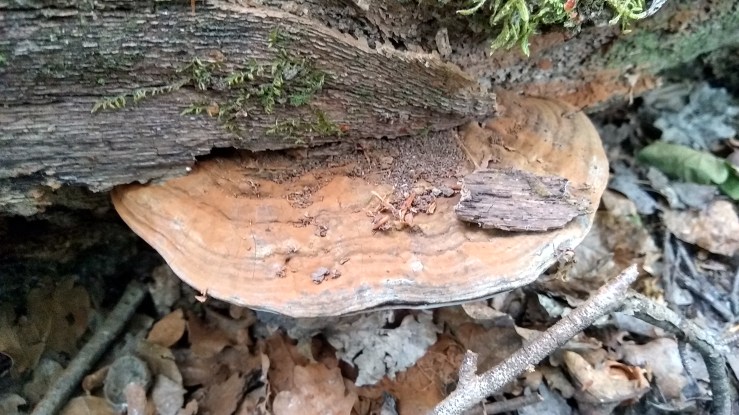
If you need them, you can always rely on a bracket fungus in the dry season. This is artist’s or southern bracket, what most people will generally call by its Latin name Ganoderma.
I found these blushing brackets (I think) on the path, they were crisp and dry. This species begins pale, blushing red and then turning to black.
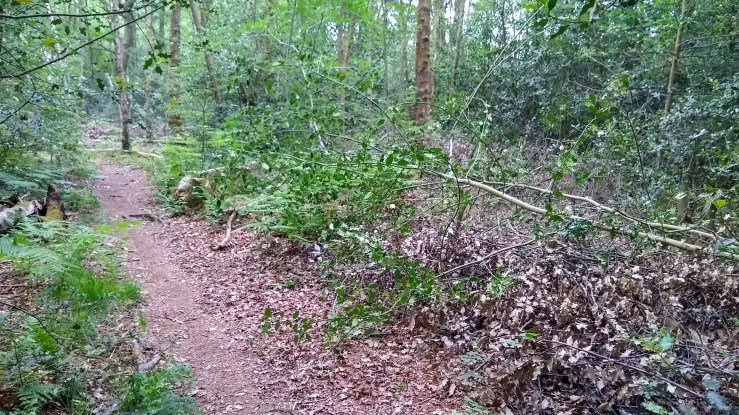
This is an area of woodland that is quite good for fungi, compared to the wider condition of the wood. It suffers from a huge amount of trampling. Please see what I’m about to say as objective comments on the physical state of this place, I am not attacking the land managers. Last autumn much of the holly in this area was cut and left. The aim was almost certainly to allow more light in to replenish the woodland floor. The brash, as it’s called, now covers where most of the fruiting bodies appear, and the holly will not break down soon enough for those fruiting bodies to appear again in perhaps the next five years.
In a previous job we would undertake thinning of holly and dead hedging to protect areas from trampling. The majority of pubicly accessible woodlands in southern England have fairly high levels of footfall, dog walking and the nitrogen enrichment that comes from dog waste. I mention this because I worked in a woodland which was only 20 acres in size but which had 100,000+ visitors annually, with probably around 50,000 dog visits. Holly was absolutely key to protecting soils from erosion and the creation of news paths, and protecting birds and other wildlife from disturbance.
Removing holly on this scale can result in the opening of areas to unintended impact where it could infact have the reverse effect desired. More light will come in to replenish the woodland floor, but more feet will come too and the soil will suffer, along with everything that needs it. Basically everything. I write this absolutely knowing that I provide some of those footsteps, but they are kept to desirelines and I do not have a dog that I allow to run free in these areas. Dog walkers will tell me that children have the same impact.
The blusher, found in this area in July 2019
The holly creates a microclimate which in hot dry periods such as this, means that soil retains moisture and fungal fruiting bodies can do their thing, a thing that is a key part of the reason a woodland is there in the first place: reproduce, break down organic matter, feed the trees that need them, and recycle organic matter into new soils.
Grey spotted amanita, July 2019
I wonder, do woodland managers ever think about fungi through anything beyond leaving dead trees to stand and logs to rot down on the ground? Does anyone consider the need for microclimates within woodland to ensure a mosaic of micro-habitats? Again, this is not an attack, just observations and pointers from my own experience.
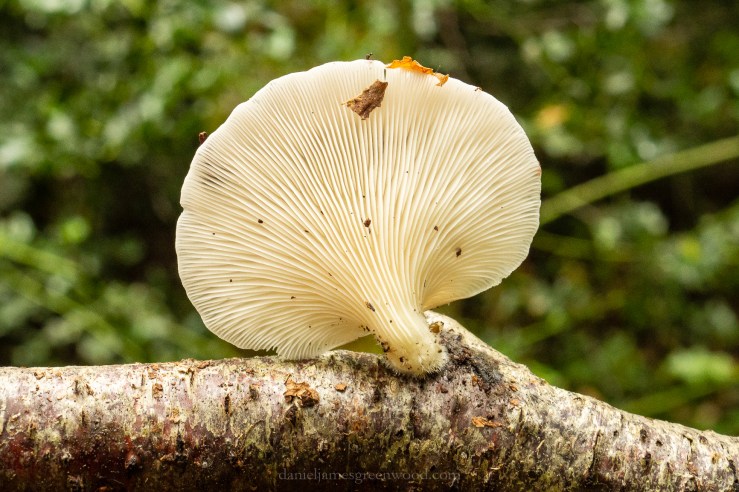
An oysterling on a birch branch in this area, July 2019
When I began in woodland management (the account of one of my first days is the post visitors seem to read in their droves to on this website) I did not consider fungi as I do now. Seeing as fungi has such a crucial role to play in our woodlands, sooner or later we need to ensure that in dry spells such as these there are safeguards, like holly, to support fungi.
The sun glows in the slowed Arun, the alders casting long shadows broken by the entry of a dog fetching a stick. It’s evening and this once quiet track has more walkers, runners and cyclists than I can remember. We all try to stay two-metres apart. Even here on this April evening far from a city, the fear of the virus can be seen.
It’s disarming to see a dog eating horse poo.
‘Disgusting dog,’ its owner scolds.
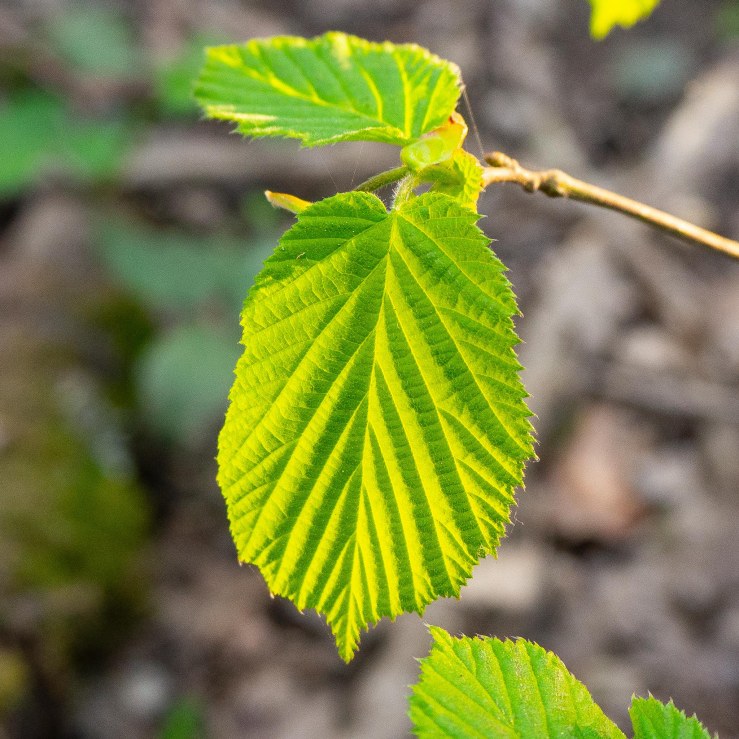
Quieter again but for a white globe of a cyclist, we inspect the first hazel leaves where they glow in the setting sun. We consider the age of this old pathway cutting along the edge of a field, the birch and bracken-choked slopes on the other side. In the shade bluebells flood, the first I’ve seen this year. The birdsong is such a mesh, a spring frenzy, that in my mind I can’t recall its parts. But blackbirds, cheerleaders of this unimaginable time. Of spring, that is.
A few years ago I experienced a Sussex evening just like this in April, waiting for badgers to leave their sett. It helped me to fall for Sussex – its woodland bluebells like purple gases aglow in the low-slung sun. The inability to travel beyond my new home has brought me back to that moment.
Further ahead the canopy has closed for the first time this year. Hornbeam appears, an indicator of ancient woodland in the Sussex Weald, key charcoal fuel of the lost iron industries that roared across this landscape centuries ago. Their leaves shade little suns of goldilocks buttercups. Here with bluebells, wood anemones and ramsons they are in their element. They are home.
We climb the hill on a winding, muddy path through woodland. The trees are sprawling yew, rotten beech and broken holly. On the thick, black soil holly leaves have fallen. We listen to the spinning coins of a goldcrest’s song as it moves close over our heads in the twigs of a yew. These tiny birds weigh little more than a 20p piece and must eat 90% of their body weight each day to survive in winter.
The light at the top of the hill comes through the branches. Woodland becomes heath of gorse, bilberry and birch. The voices of a walking group echo down as we step up through sandier soils now. A screen of crooked birches are splayed across the view, desperate to keep its secret. Their birchen secret is out.
From up here, the highest point in the South Downs National Park, the Sussex Weald opens out. Soft brush woods are broken by fields where individual oaks express themselves as they once would have, in landscapes kept open by now extinct herbivores like aurochs and wild horses.
Then there are the folding Downs catching in a spill of light from the west. The beechen clump of Chanctonbury Ring, with the heavy metal orchids of Truleigh Hill further east.
A woman is here with her son and his girlfriend, walking the dog. She tells them in a faintly Irish accent that you can see the Isle of Wight on a good day. This is not one of those days.
The families and walkers are dissipating and the view is now ours for a moment. Just as the last person leaves, a call rings out from the woodland we crept up through.
One call, and then the truncated follow-up. A tawny owl, calling from the rafters of the Weald at 3pm on a Saturday afternoon.
A couple of weeks ago I was inspecting a bird table in my garden and spotted a moss growing from its ‘roof’. This bird table has been, literally, around the houses and has probably gathered many organisms along the way. Looking more closely I found some jelly fungi.
The weather has been showing signs of spring, with queen bumblebees on the wing and what I am sure was a male hairy-footed flower bee travelling through the gardens. On Monday I was in the garden briefly and had a closer look at the bird table. On the edge I found a nice cluster of what I think are lemon disco (yes, great name!).
During a brief trip to The National Trust’s Nymans in the Sussex Weald this weird species was on the decaying heartwood of an old cherry tree. It’s a slime mould known as false puffball. If you press it with your finger it bursts, a bit like other Lycoperdon slime moulds such as wolf’s milk (search for it).
Elsewhere, the state of Sussex’s rivers shows how high the rainfall has been so far this year. But the lichenised-fungi are benefitting.
Along this stretch of the river Arun, these beard lichens were profuse. One hawthorn was so covered with them it seemed like there would be no room for leaves in a couple of weeks!
Not far away from the gushing Arun was a veteran ash tree with lots of King Alfred’s cakes growing from the damaged bark. In this image you can see the folds of the cambium where the tree is trying to protect itself from fungi and other invading organisms. This fungus will have a boom from the amount of dead ash trees caused by the evil fungus behind ash dieback disease.
To people outside the UK or without a grasp of English history, this name is quite meaningless. It is based on the tale of King Alfred who was exiled in the Somerset Levels during the Viking invasion of Winchester. Alfred failed to keep an eye on a woman’s loaves of bread that were on the fire and they burned. It is said that she had no idea he was the King, so far removed was his from his throne. Don’t worry, he eventually came back and pushed the Danes away a bit.
In the real world this fungus is said to be a host species for hundreds of invertebrates. It’s also used as a kindling and many people who know of it do so for that reason.
Let’s hope for milder temperatures and less rain and see if some more photogenic fungi pop up!
The Weald holds so many future Fungi Fridays. It’s an ancient wooded landscape that stretches across Sussex, parts of Surrey and into Kent. It covers the most wooded part of the UK in East Sussex. Once it will have connected with the New Forest, forming much of England’s post-glacial ‘wildwood’. I am very privileged to live within rambling distance of the Weald. I write about walks in it once a month, check that out if you will.
I managed to sneak ninety minutes in locally last week and found plenty of interesting things. As well as the ‘dark side’ of fungi, a reminder that a fungus giveth, and it taketh away.
We have had two storms in two weeks in Sussex and the winter streams are tickling through the woodland understory. Above, a tree was resting in a winterborne. This means a stream that only flows in winter when rainfall is higher. In Ireland, lakes (or loughs) that appear in winter are known as ‘turloughs’. Got plenty of those right now in Brexit-land.
The log was covered in some nice looking turkeytail, a very common polypore that is said have anti-carcinogenic properties. It was a nice way to start.
Then I happened upon these absolute corkers growing on a dead birch tree. These are blushing bracket in their mature stage. This area of the woodland is very wet, with mosses like sphagnum attempting to recolonise more places. It is set in amongst mature beech trees at the edge of heath-ier habitats, largely consumed by pines that were planted, rank and file, by the Forestry Commission in the 20th Century. It’s very wet and many birches are succumbing there. This is natural.
This is a standalone dead birch tree with birch polypore, also known as razorstrop fungus. It’s a tough bracket fungus that people probably once used to sharpen their razors. It naturally controls birch trees and breaks them down for other organisms to devour, and therefore new soils to be created.
Here’s a quick macro of one of the mosses from the work of the razorstrop, looking much like a cedar or a fern.
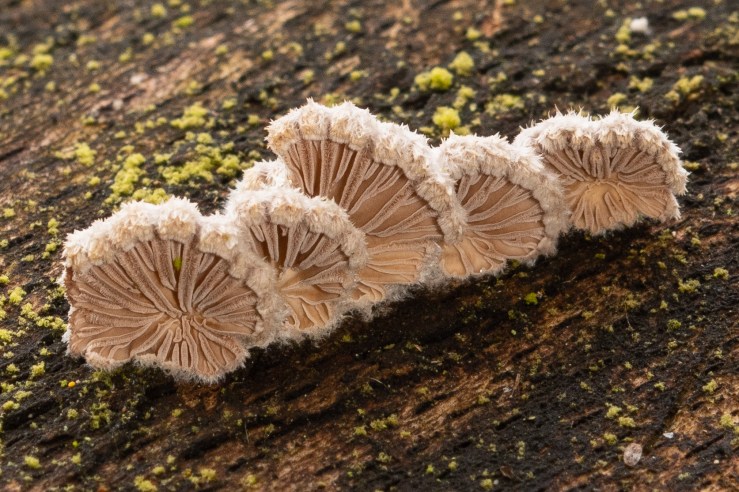
I found some split gills looking rather shaggy, in a good way. If you look at the yellow smatterings around, I think that’s a slime mould making its way across the surface of the bark.
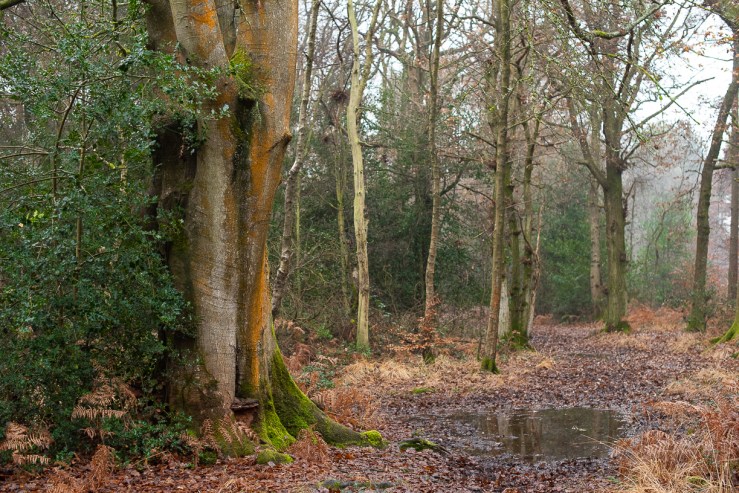
Rewind to May in this area, when the first leaves were appearing on the trees and the ground was far drier. This is one of my favourite trees to photograph in this woodland because of the orange algae and the beautiful buttresses at the tree’s base.
Here it is in December, the ground much more wet, the leaves all gone. Can you see the bracket fungus at its base? It has been damaged, probably by a visitor testing its strength.
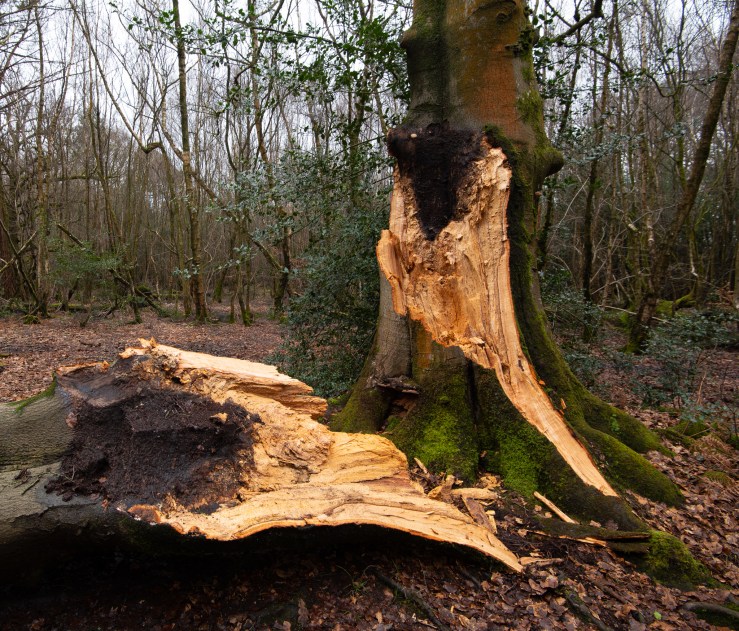
And here it was last week. Evidently the tree has been destabilised by the decay which has been accelerated by the fungus. This has softened the heartwood which leaves the tree vulnerable to storm damage.
But this veteran beech tree still lives, it has only lost one of its three trunks. I hope it can remain where it is and continue down its veteran path into the realm of the ancients.
It’s just another reminder that fungi has its own way in the world and there is no sentimentality involved. It’s there to break down organic matter. Trees were not a safety concern until we started walking underneath them everyday.
Some species share what they can find, others take, take, take. It’s in their nature. But in the end fungi are contributing to vital processes of organic recycling and renewal. Without the ecological role of fungi our species would not exist writing blogs, taking photos, hurling abuse at passers by, or walking under veteran trees in the woods.
The sun hasn’t yet reached St. Leonard’s Forest. Frost covers the depressed spreads of bracken at the edge of trees. A dawn chorus still rattles on, dominated by song thrush posted across this wooded landscape. In the distance there comes the clopping of horse hoofs, a throwback to the days when highwaymen roamed the Weald and when people travelled almost anywhere far away enough, on horseback.
The horse riders appear on the hard track ahead of me. They’re galloping until they see me, surrounded by a cloud of perspiration. Their upper bodies are coloured yellow, green and orange by hi-visibility vests. The man leading the troop glares at me from under his helmet as I pass with birch trees between us. Perhaps he thinks I’m a warden.
‘Good morning!’ I shout across to them, which is met with a murmur.
Off they trot.
Beyond the stands of spruce and pine planted on old areas of heath, the sun is climbing. I can hear the wash of the M23 as vehicles roar through its wound in the Weald. It’s one I use a couple of times a month, too, when heading further south and then east.
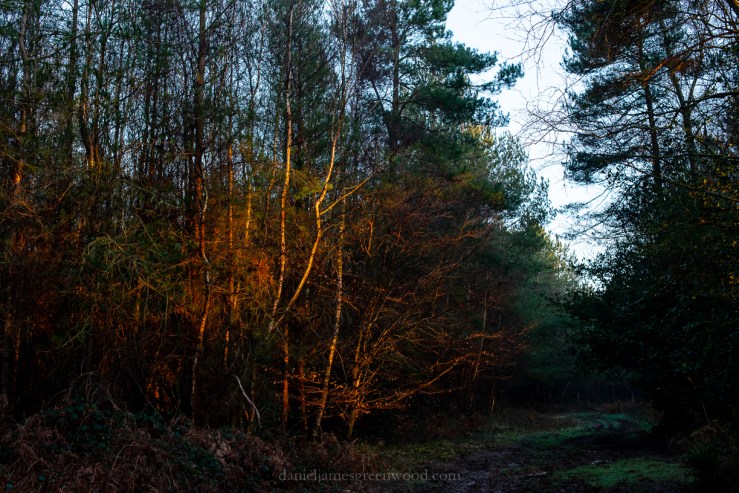
The first breaks of sun glow golden in birches and the spreading branches of pines. The remnant flowers of heather persist like leftover decorations.
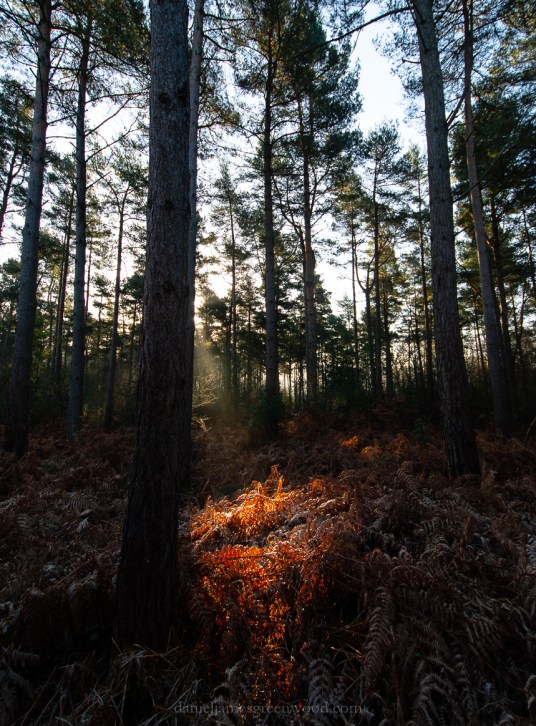
When the sun breaks the tops of the pines, things begin to change. Rays of light cut through the plantations and light small fires in the beds of bracken. They burn amber at the base of pines.
The birds remain elusive: crests, tits, siskins, woodpeckers. They’re all here but they’ve found all that’s left of the shadows. I can only see silhouettes.
More people are arriving now with the sun, all with dogs. One couple have more than ten between them, one pug-like thing snarls and froths at the mouth, following me for a good minute. Of course, the apologies come. It’s such a common thing, you get bored of saying ‘don’t worry about it.’
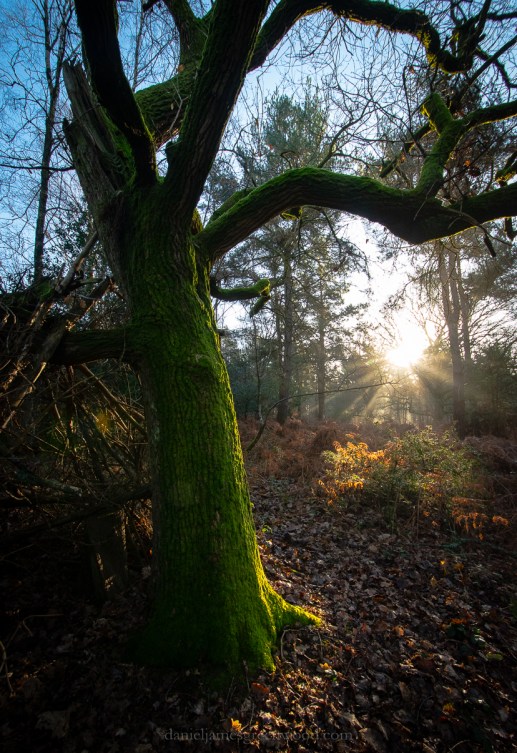
I notice a spread of oak trees, the sun crashing down through their boughs. One curved oak with a trunk lit entirely with green moss opens its door to yet more of its fellow species. These oaks are walking out of a cold and frost-bitten night, the icy coating on the vegetation around them steaming as it melts away in the day’s eyes.
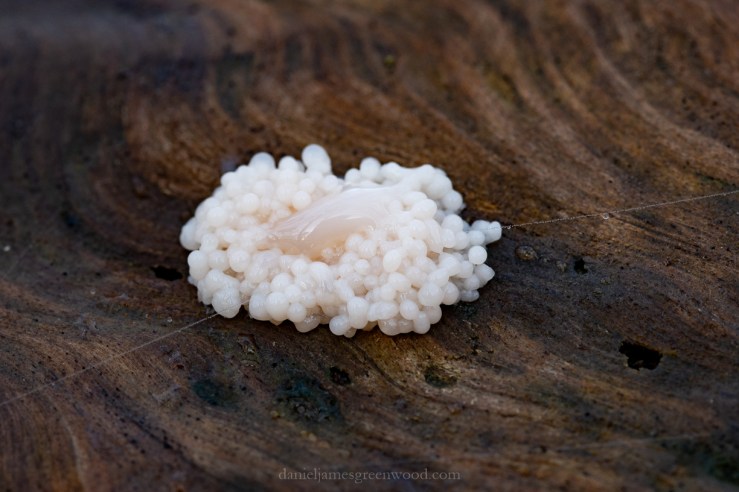
The winter sun floods the dark stands of birch, oak and sweet chestnut. It glitters in the frost as it melts away from crowds of moss. Steam rises from the soil as the sun warms the ground between oak trees, where nuthatches pipe and skip through their upper reaches. I scan a fallen pine tree for small things, fungi, moss, and find an incongruous clump of slime mould. The mould is like an emptied basket of boiled eggs resting in the swirling heartwood of the pine, smoothed by rain and people sitting.
The slime mould has a rope of spider silk crossing it and it has begun to melt in the centre like poached eggs that haven’t cooked for long enough. I set up my tripod as a man and his two black Labradors exercise themselves nearby. He stares at them, hidden behind a tree. I thought he had gone and left them until I stepped back and his monolithic profile appeared.
Mud squelches grey and beige under foot, still on the Wealden clay, with the sandy soils of the High Weald sitting only across the gill. Speaking of the stream, I can hear it gushing down below. The rain has fallen heavily all week, with the Arun and the Rother both bursting their banks and swallowing fields whole. This feels like the first sunny day of the year.
A song thrush scampers across under holly, with redwing dotting the branches overhead. Their contact call is a bit like a hiccough. A stock dove’s wings beat in a way that sounds to me like the gentle yaffling of a green woodpecker, stopping abruptly as they land on a branch. A real woodpecker, my first of this year, hammers in the top of an oak. Robins rise up onto waist-high branches and sing their songs. Spring is building in the winter wood.
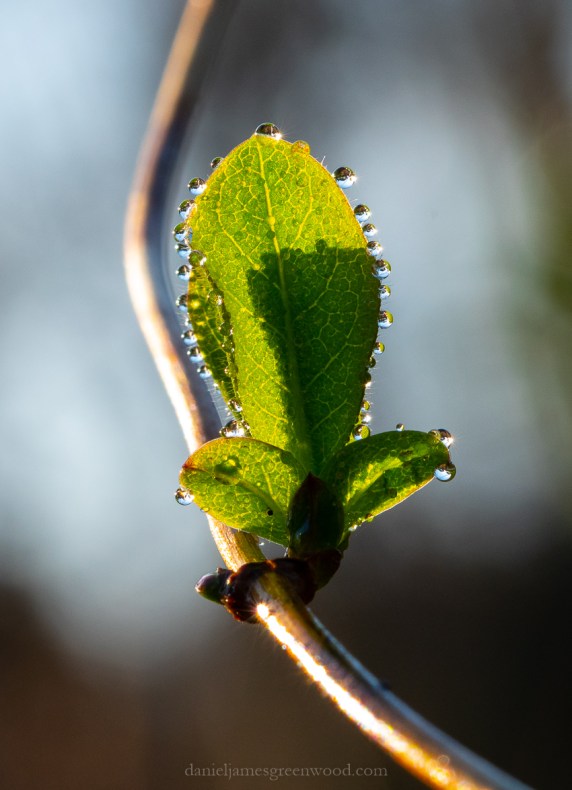
At the foot of the High Weald’s heathland, where the clay comes to an end, frost looks to have crashed down over night onto the bracken. The fences that protect the heath are topped with barbed wire, itself entwined in honeysuckle. The warm weather (eleven degrees on Thursday) have given the green light for some plants to grow. The honeysuckle spurts small green tongues, its leaves hold the water beads of melted frost. In the droplets the shape of pines, sky and open heath glow, in a world turned upside down.





















 Unlocking Landscapes