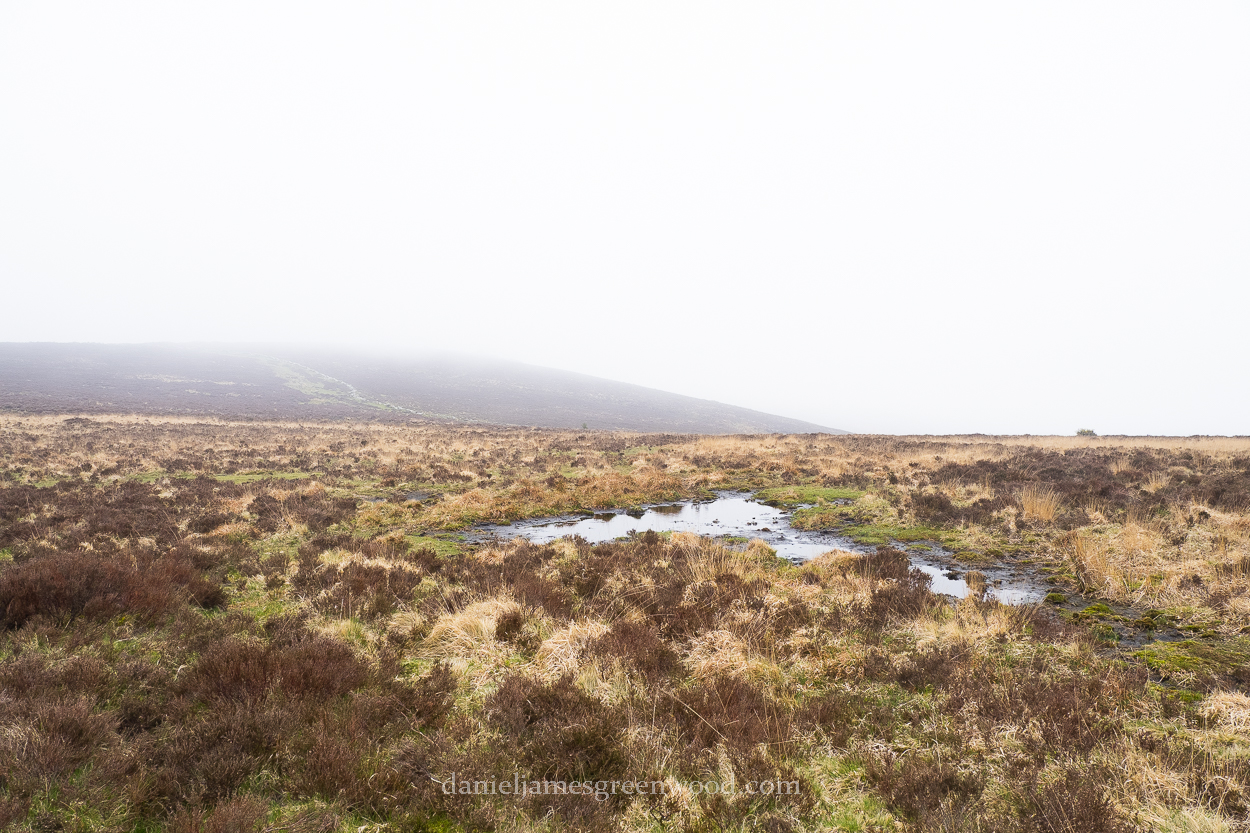
It was a misty morning high on Dartmoor. We began walking from Bennett’s Cross, passing Birch Tor and heading through wintry heather moorland. The white tails of wheatears burst across the paths as we disturbed them. Their journeys here are some of the longest undertaken by any migratory animal on the planet.
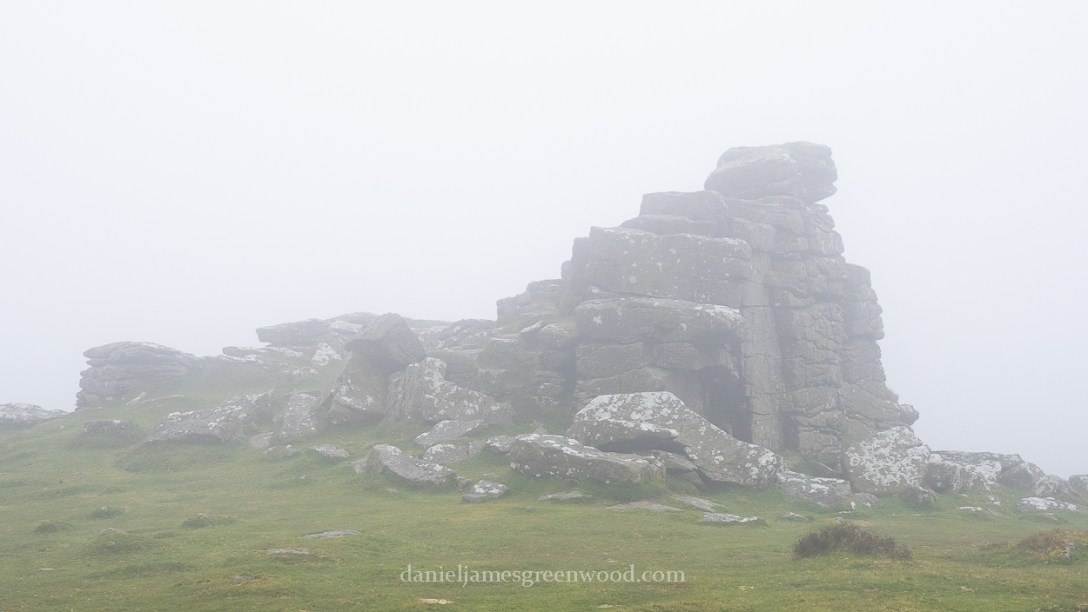
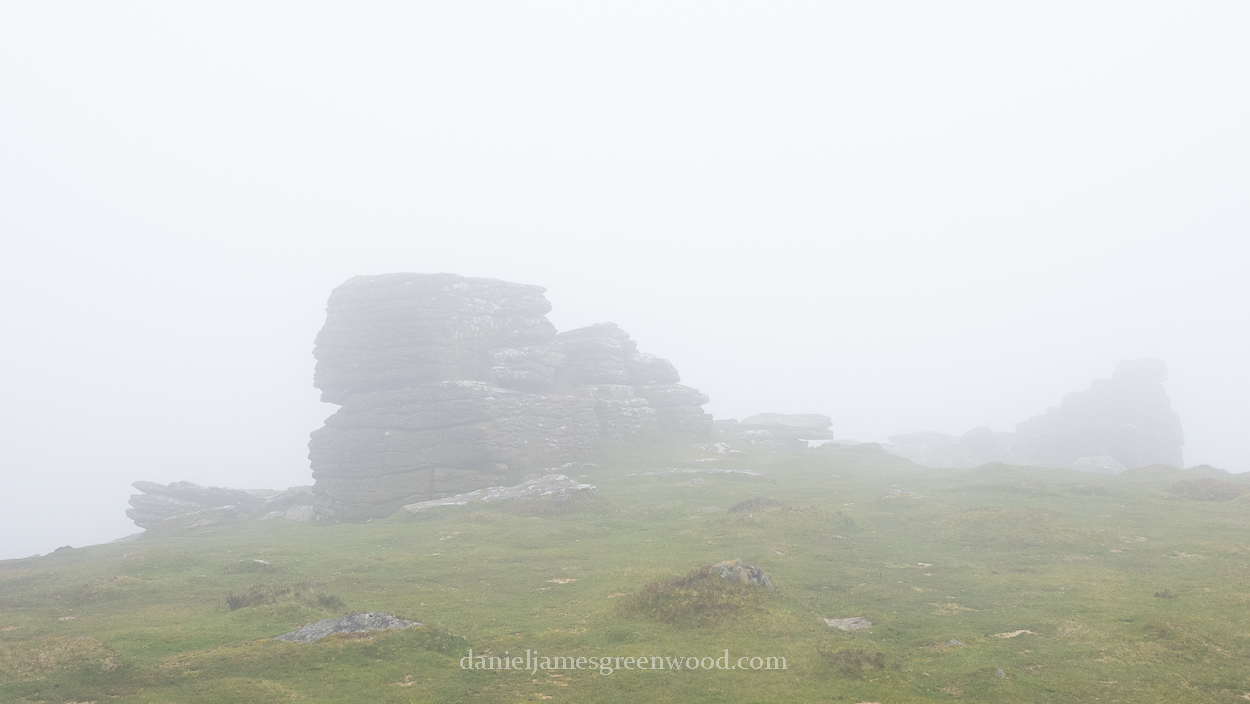
After a short plateau in the moor we crossed a quiet road and ascended Hookney Tor. Here the mist came in from the north, sucking up the wider moor, and the long stone wall that framed views in that direction. We switched east to pick up the unsigned Two Moors Way and walked between the rocky eruptions of Hookney Tor.
As we continued down on the Two Moors Way, a grey bird cut across the edge of the visible moor, some 25ft ahead, before the land was hidden by the mist. It was a male cuckoo, another African bird looking for a mate to breed in this harsh terrain.
The cuckoo slid away into the mist and we headed south for our prize – the 3000 year old settlement of Grimspound.
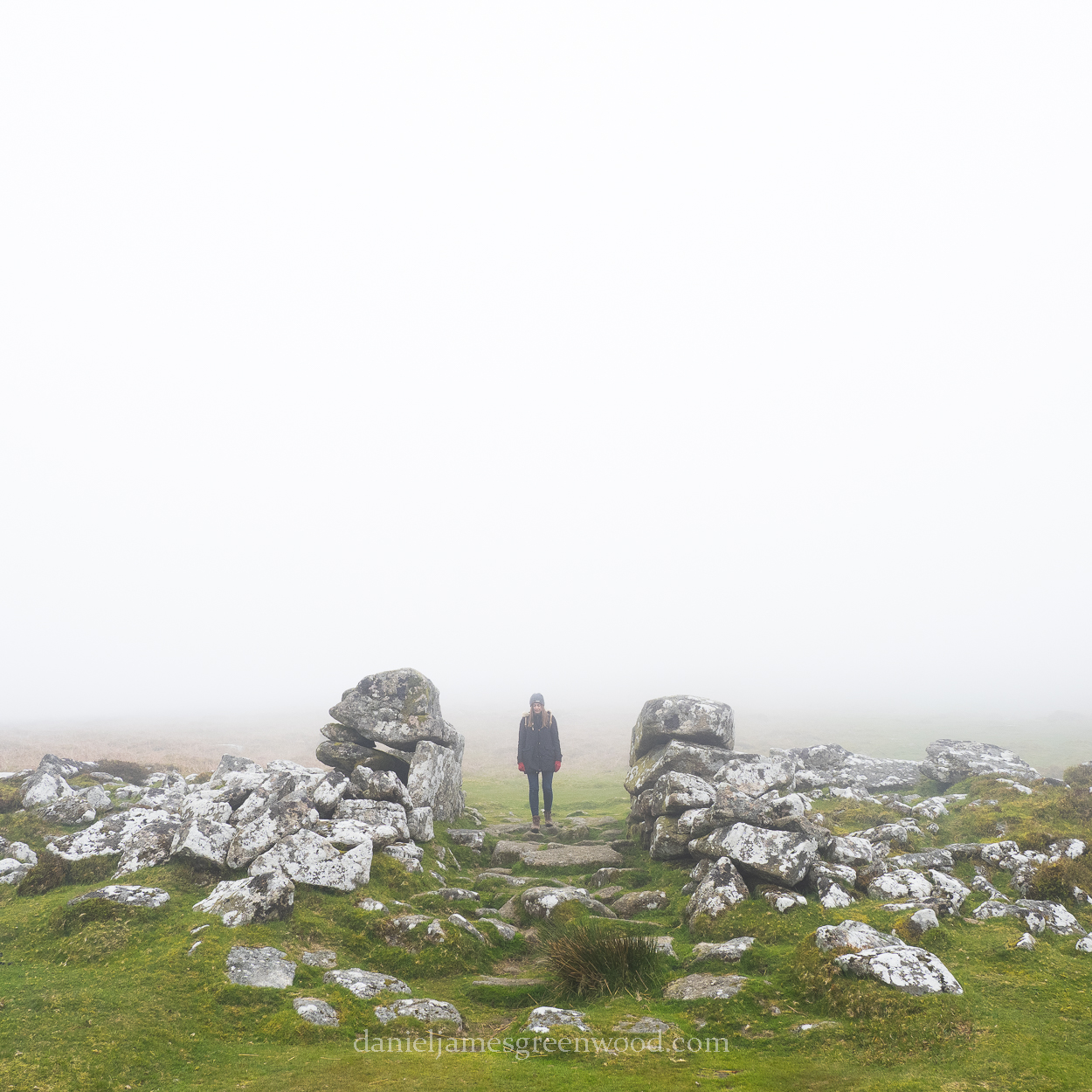
Approaching, only the collapsed stones of the outer enclosure were visible, painted white by the crust lichens that thrive on Dartmoor stone. In the distance we could hear the voices of other visitors to this ancient place. A family were visiting, posing for photos inside one of the small enclosures that had been rebuilt.
Entering into the ring of fallen stones, the smaller huts came into view. This wall will have been intended to protect the inhabitants and their livestock from wild animals like wolves (now long extinct) and any attacks from other people.
Another week of some sun, some showers, and some temperatures that got close to freezing. That sentence may turn out to be a spring epistrophe, but more of that later. In Scotland it reached as low as -5C. April 2023 has been a mishmash of seasons. Here’s what I encountered in my garden on 22nd April.
One of the joys of this time of year has to be the red mason bee. They are tricky to catch up with sometimes away from their bee boxes, but I managed to get close enough to this red-haired male in the skimmia hedge.
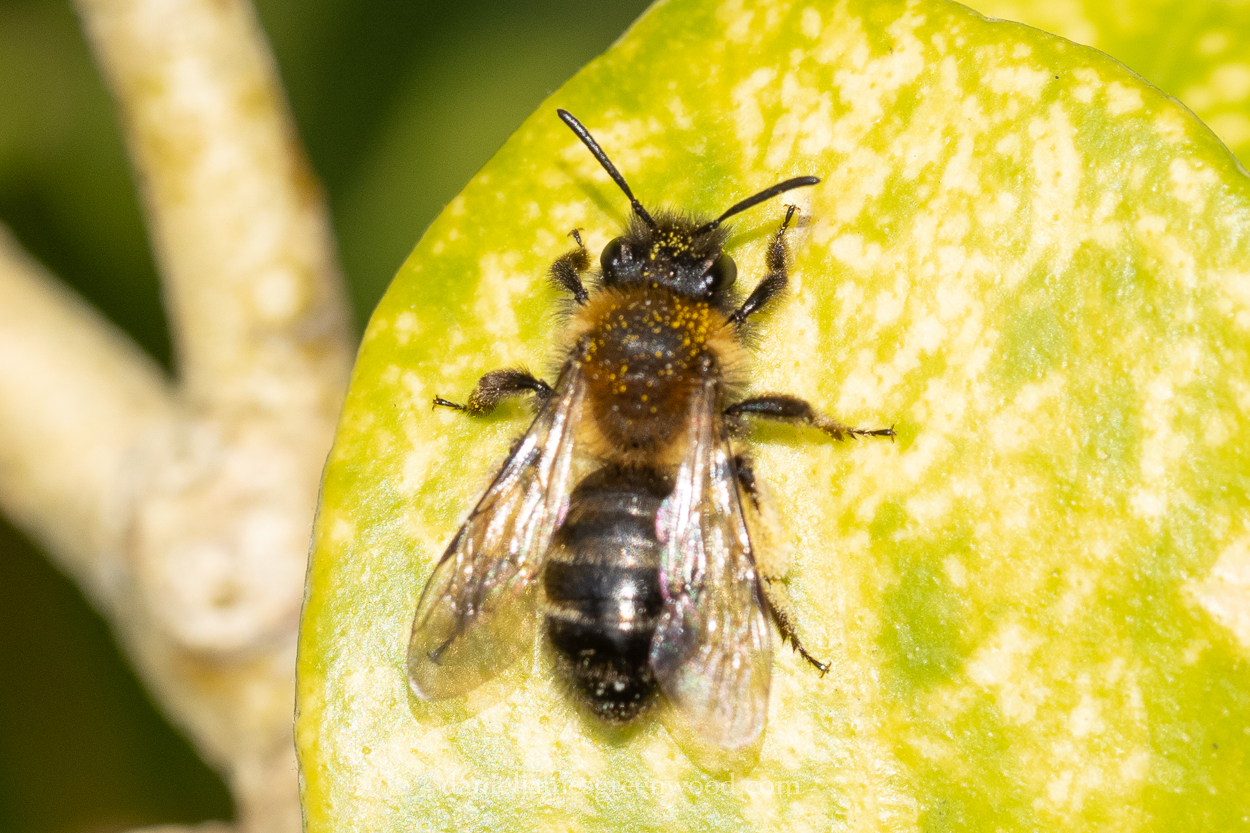
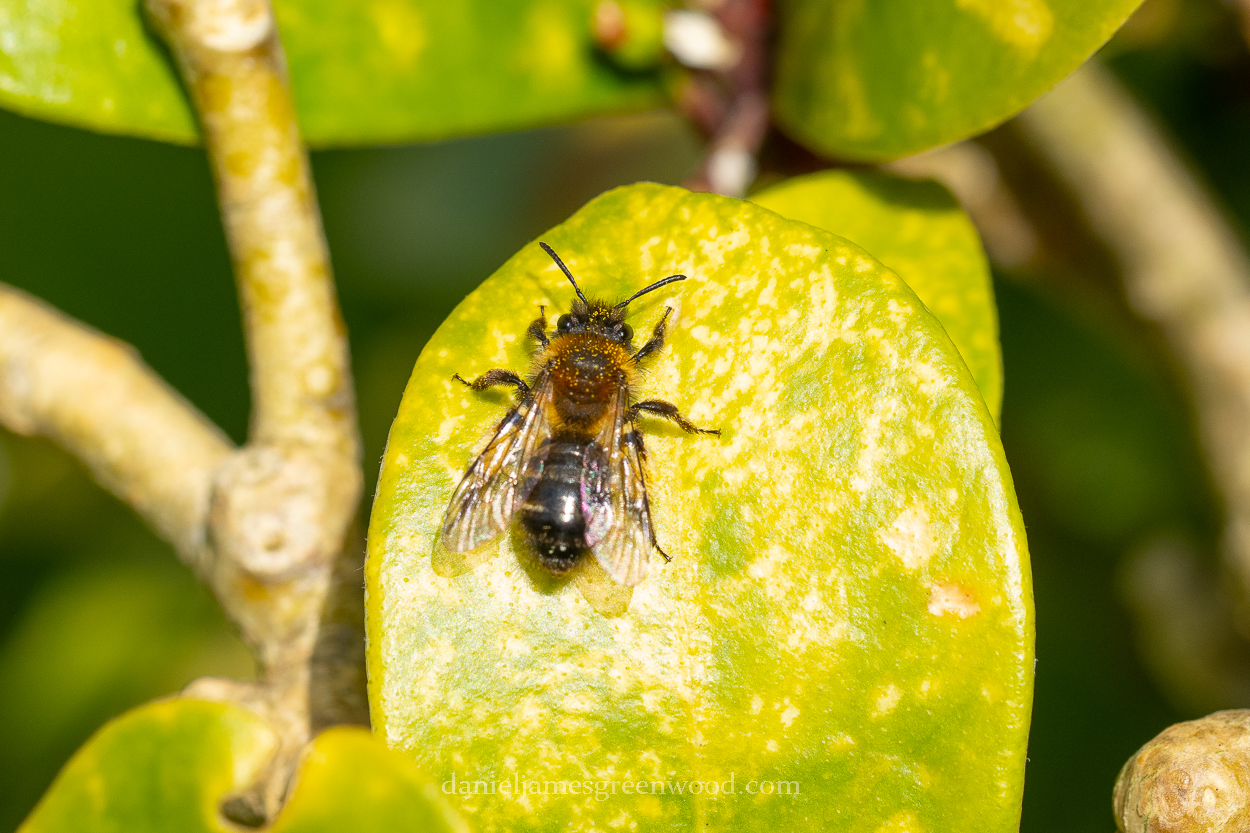
This is a mining bee that I can recall seeing each year early in the season. I’m not sure of the species, but it has a likeness to the chocolate mining bee.
I tried with this rather slender-shaped mining bee, but it didn’t like Homo sapiens approaching with a camera and macro lens, however small that equipment is nowadays.
He’s not quite in focus but this hairy-footed flower bee stopped for a snap. Never mind his hairy feet, look at those legs! They do look a bit like tiny Highland cows to me.
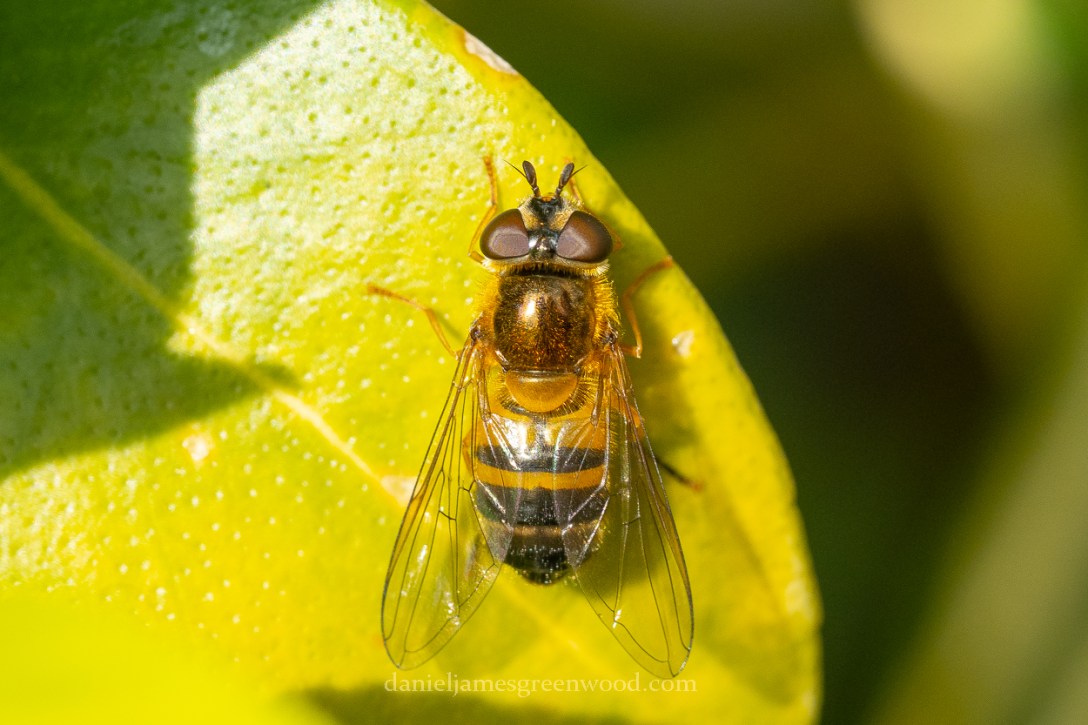
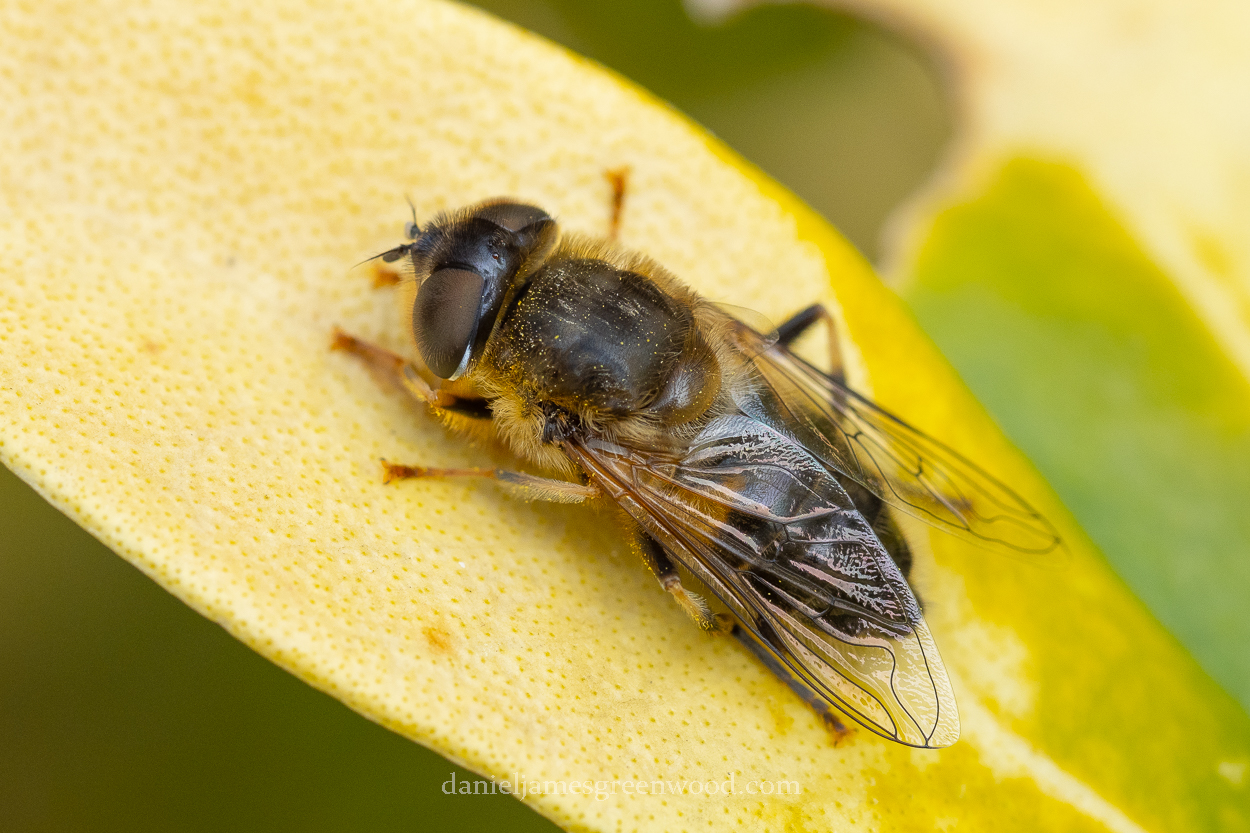
To finish this week’s post, I noticed this medium-sized hoverfly in the skimmia. Putting it on iNaturalist I received a quick response, identifying it as spring epistrophe. It has a huge range, from Sweden to northern Spain, and then as far as Ireland to the Caucasus (Russia). Its name obviously means it’s a spring arrival, but ‘epistrophe’: “repetition of a word or expression at the end of successive phrases, clauses, sentences, or verses especially for rhetorical or poetic effect” – via Miriam-Webster.
I’ll have to listen to the hoverfly more closely next time.
No nationalism was expounded in the making of this blogpost.
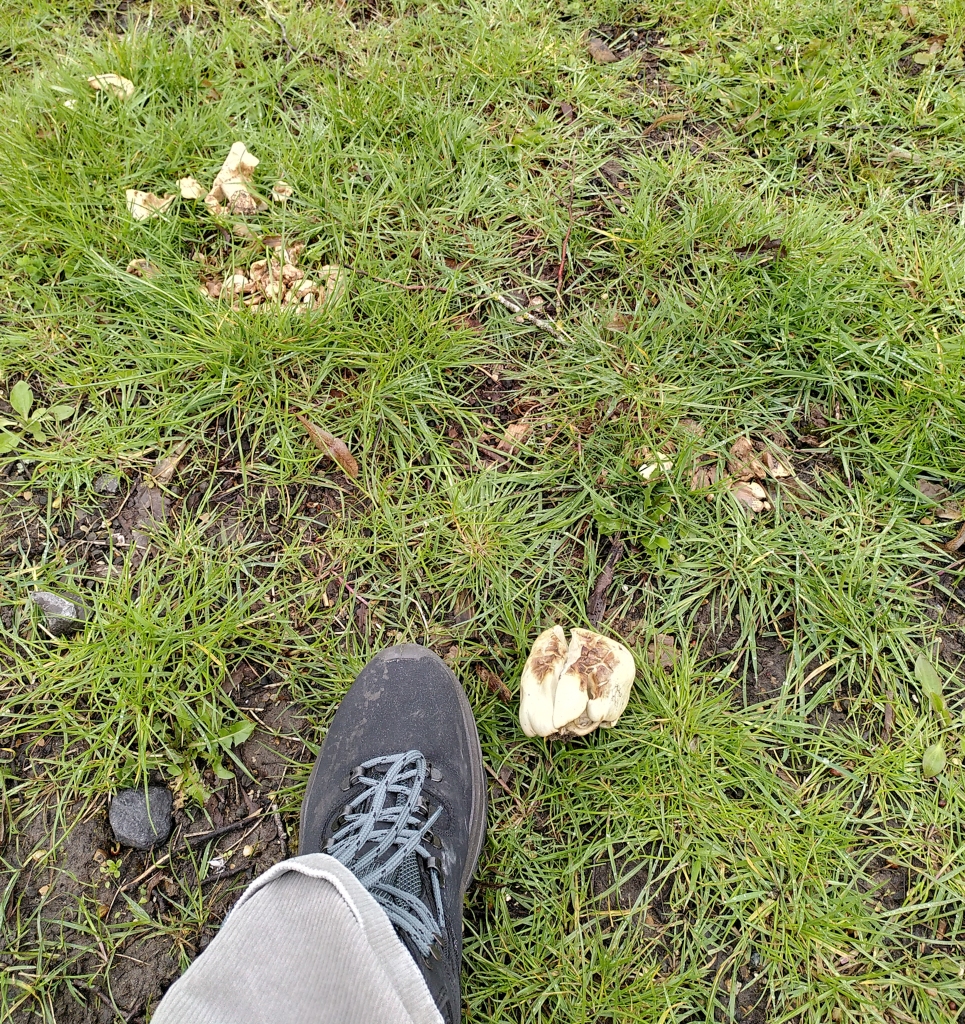
On a recent visit to the National Trust’s Nymans Gardens I spotted some big, cream-coloured things in the lawns near the car park. No, these were not scones or cream cakes, or even pasties discarded by visitors. It clicked almost immediately for me that these might be St. George’s mushroom – and guess what? I found them on 23rd April, St. George’s Day!
That is definitely the most enthusiasm I have offered for this national day. If it were to be made a holiday, then we can talk.
Spring can be a time of shrooms, as the frosts end and the temperatures rise. We’ve had quite a lot of rain this spring in SE England and so some mushrooms will fruit in response. St. George’s mushroom is one of those springshrooms.
Like many people in the UK my sense of personal identity is not straightforward, and I don’t celebrate St. George’s Day. I have strong Irish roots and as a Londoner of 50% Scouse parentage I feel an affinity with a more regional, culturally complex identity, rather than one of red and white, chest-thumping ‘Englishness’, whatever that is.
It makes me wonder though – is this England’s unofficial national mushroom?
A simple online search shows up no such award, which is probably a good thing. Surely that accolade should go to honey fungus!
You may not be surprised to find that its common name changes depending on its location. In Germany the mushroom fruits in May and is known as Maipilz. That means ‘May mushroom’. In fairness to Maipilz, that’s only 8 days later.
St. George’s mushroom is also edible. I didn’t pick or eat this one, and it’s not on my radar to do so anytime soon. The above seems to have been nibbled free in actual fact. Also, I wouldn’t encourage people to forage from National Trust properties generally because I don’t want to get banned.
The cap turns brown over time making it look like a barbecued chicken piece
St. George’s mushroom appears to enjoy garden lawns, so if you’re lucky you may have one popping up outside your front/garden door. As ever, you should be cautious about eating wild white mushrooms as there are several toxic species which can be confused for edible ones.
This time of year will probably always remind me of 2020, when most people were entering into Covid-19 ‘lockdowns’. That spring was early, warm and sunny in SE England, which seemed to contrast with the extreme anxiety of the situation we found ourselves in over here. As the lyric in ‘Someone Great’ by LCD Soundsytem goes, ‘the worst is all the lovely weather‘.
This spring feels different: later than recent early seasons, wet, cool but also quite hot. On Monday I got a bit of sunburn on my neck (despite wearing suncream) and on Tuesday it was quite cold in comparison. This all affects wildlife in a far more immediate way.
On Sunday 16th April my garden thermometer (kept in the shade, don’t worry) read 16C, and the garden was alive. Here’s what I found in the space of about half an hour.
My first find is not actually pictured here. I was about to clean the kitchen hob when I noticed a small deceased insect on it, what turned out to be a lovely male red mason bee. I was surprised and a bit annoyed, so went outside to put its tiny little body into the flowerbed where its cousins were zipping around.
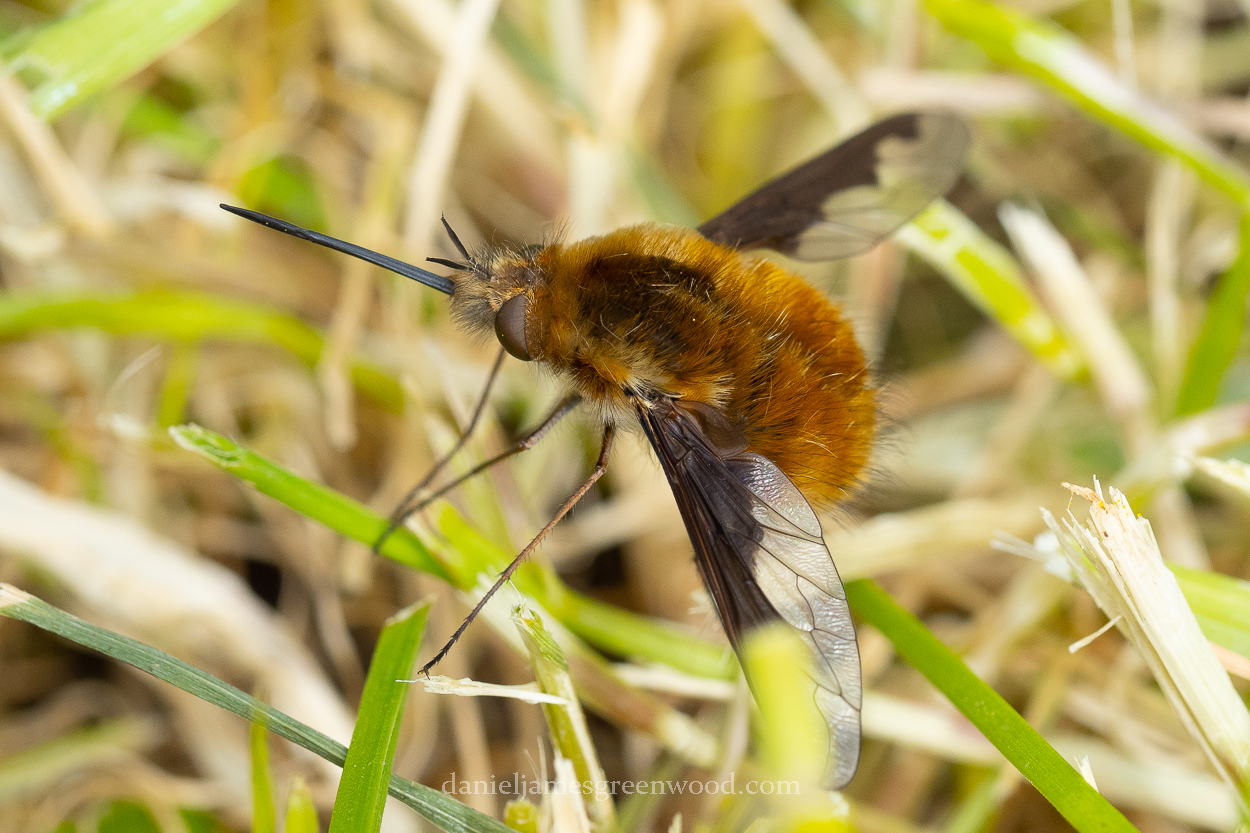
Nearby, I noticed my first bee-fly of the year, doing their usual flowerbed hovering. You can see from the image above why this fly is sometimes referred to as the ‘dark-edged’ bee-fly.
There were a large number of drone-flies in and around the Japanese skimmia that makes up much of the hedgeline in my small garden. I’m actually a big fan of this shrub, which provides excellent cover for invertebrates and seems to be a solid nectar source.
I’ve not seen any birds eating its berries which are held for a long time. I would pick this over the dreaded cherry laurel any day.
This is a common hoverfly, which I have come to know as ‘the footballer’ but is also called ‘sun fly‘. Their mimicry is to fool us predators into thinking they’re wasps and therefore able to sting. What this fly doesn’t know is that I’ve read books and have iNaturalist so I know it’s a hoverfly.
Meanwhile, there was quite a bit of activity from the wasps, with two or more queens busy in the skimmia. This queen was less busy so I could get a photo of her basking. To any new readers, I’m a wasp supporter, and I don’t mean the rugby team.
I have another non-native shrub that is proving itself to be a valuable resource for pollinators in my garden. This has flowered for the first time since it was planted three years ago.
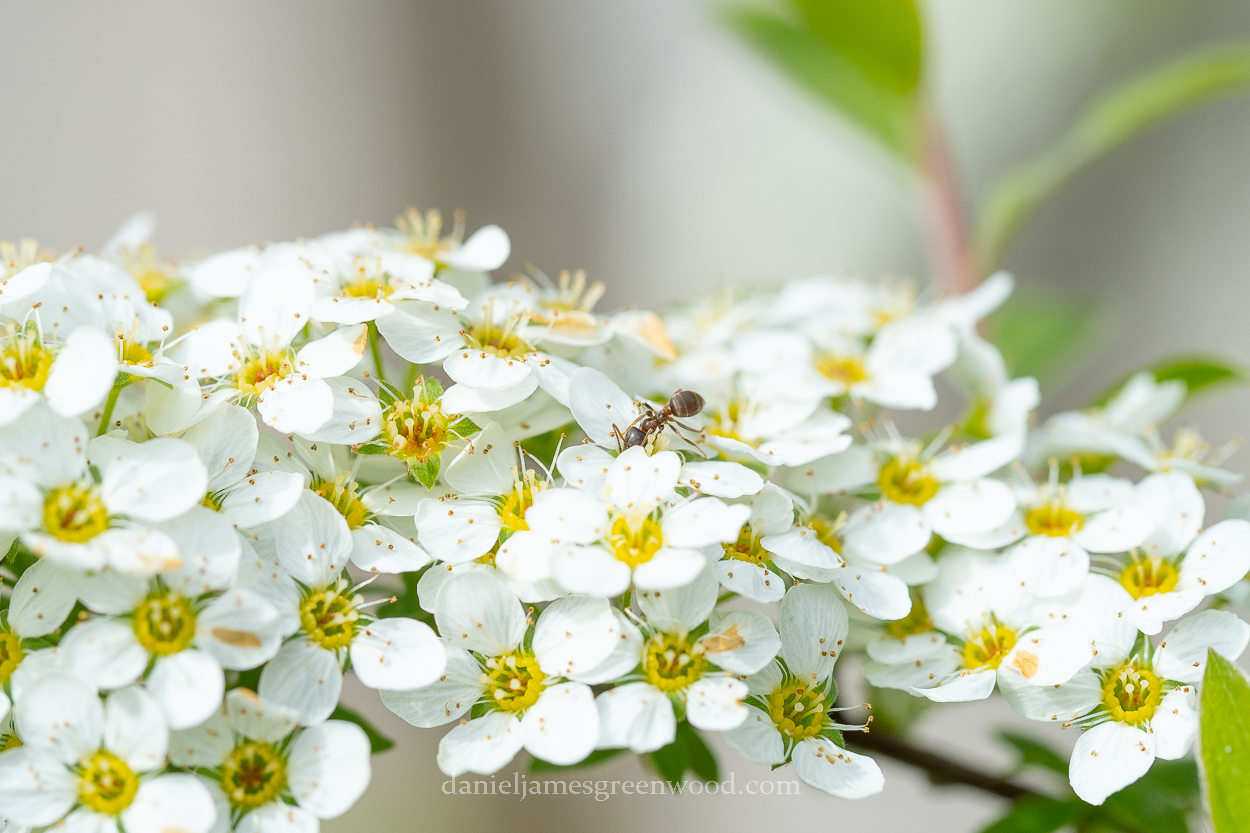
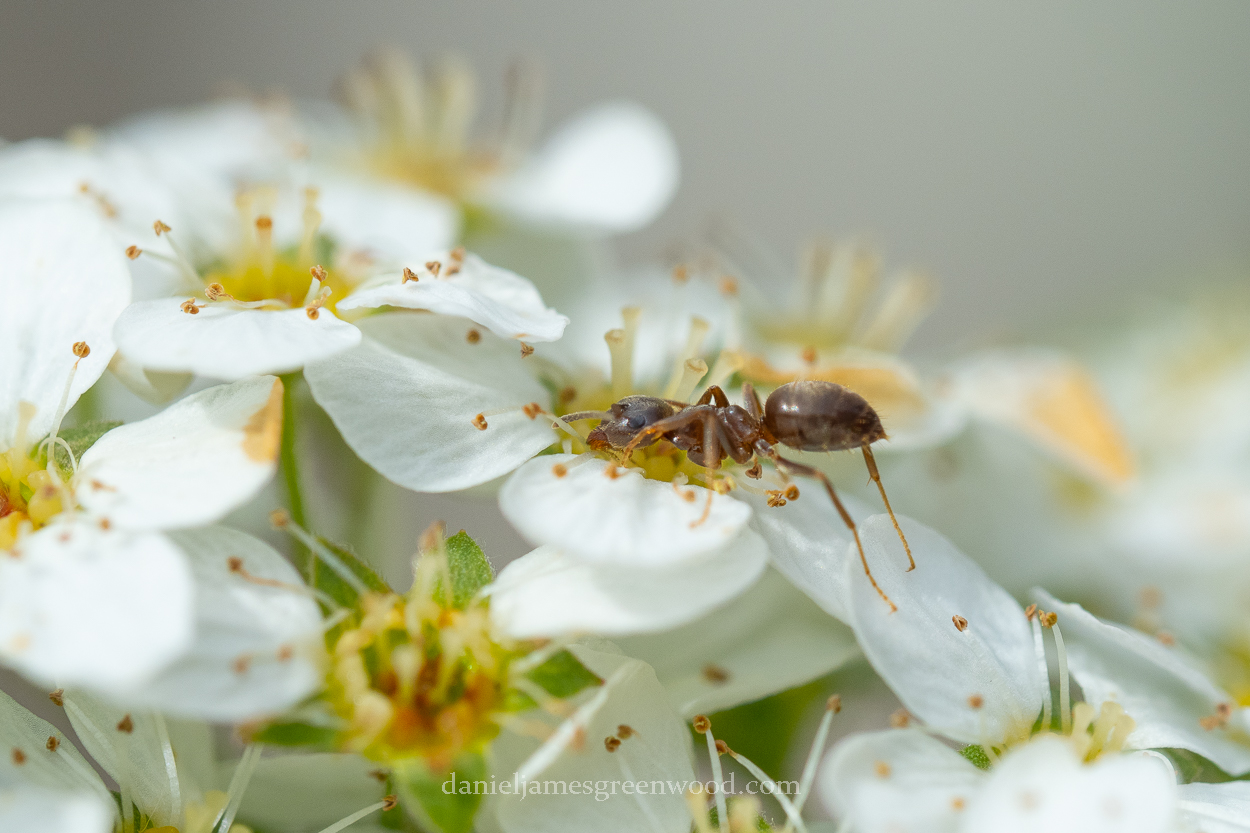
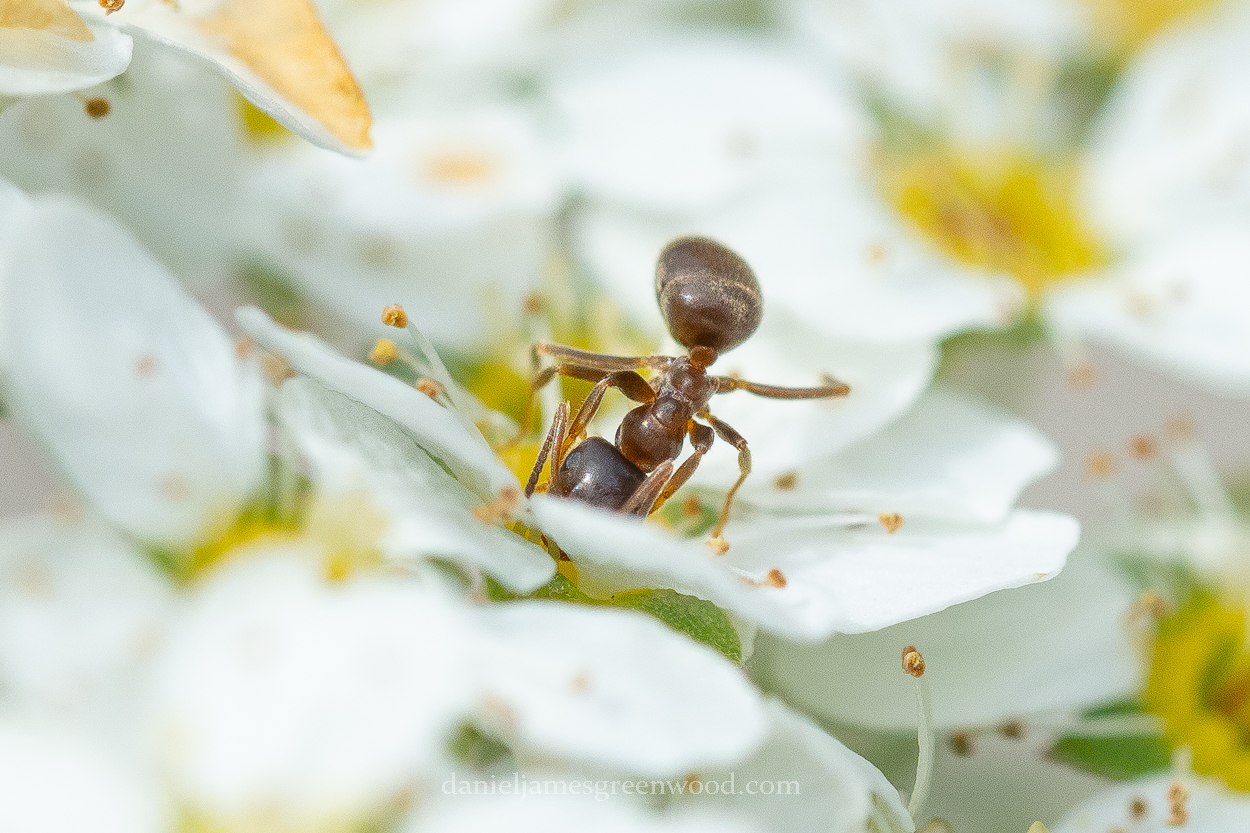
This is probably a the black garden ant. I hadn’t seen them nectaring like this before. I’d also seen red mason bees visiting these flowers, which is great news as it’s providing another source of forage for a wider range of pollinators.
This ant was definitely getting stuck in to the nectar on offer here!
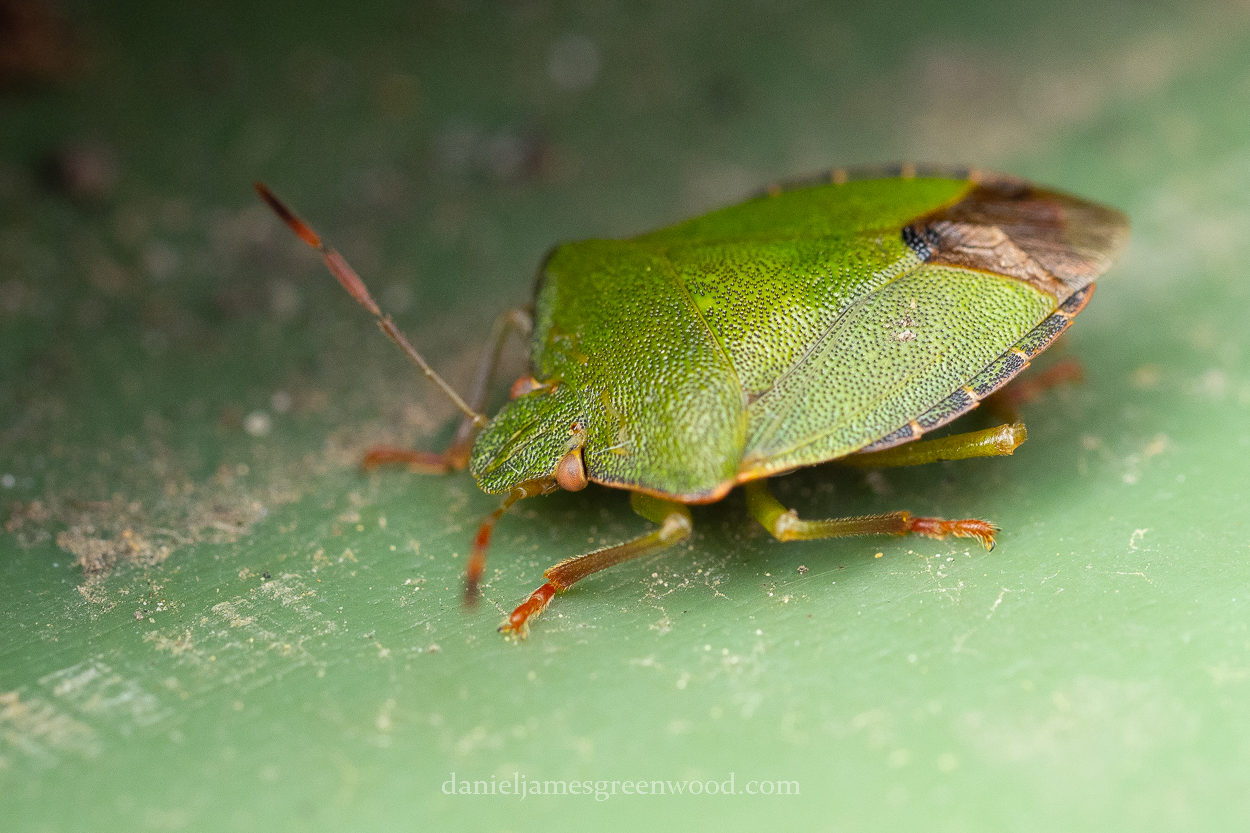
On my recycling bin I spotted this green shield bug, a fairly common sight in my garden. They are lovely insects but are also known as stinkbugs in North America because of their pungent scent that is deployed when they’re in trouble.
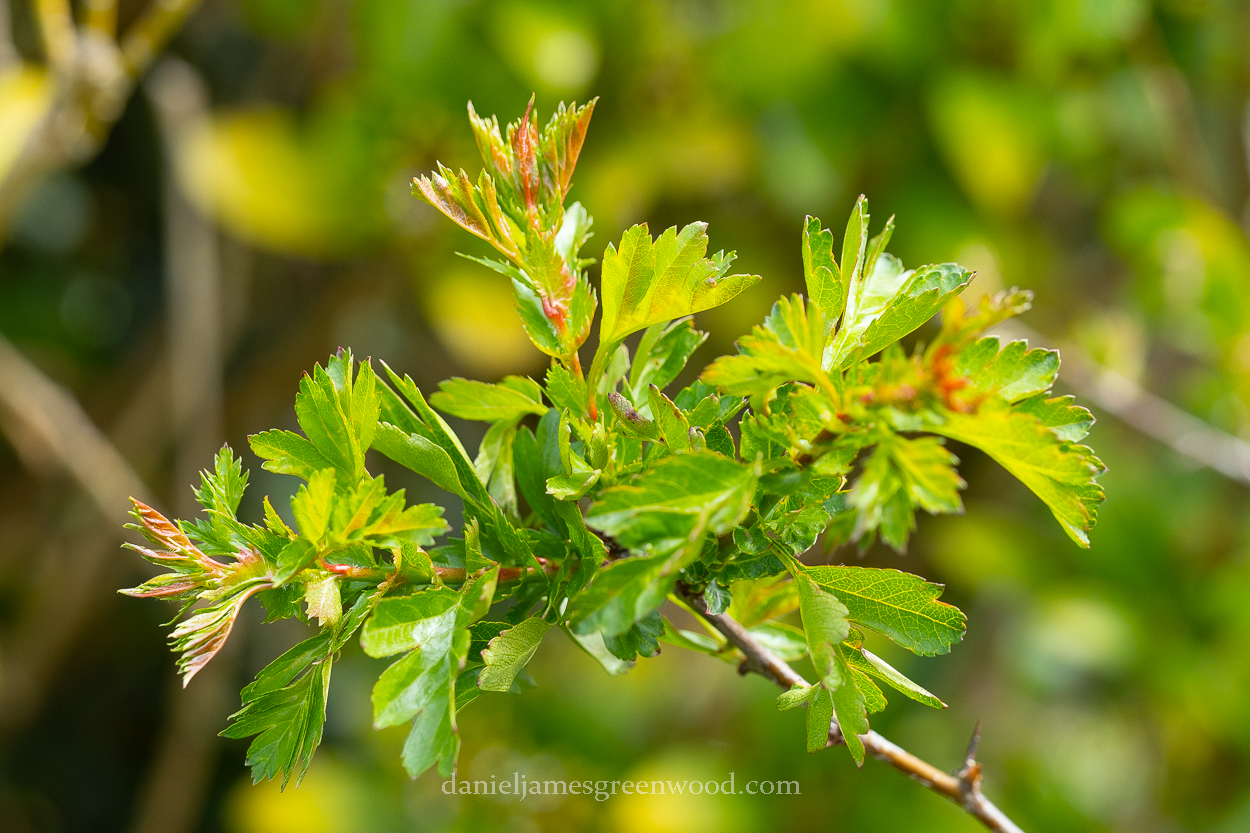
The hawthorn was in full leaf. I have since coppiced this hawthorn sapling to allow it to form more of a hedge, compared to the spindly tree it was forming.
Hazel is also in leaf. I love their small leaves when first appearing. You can see where I topped this sapling last year. I have also recoppiced it since to form a hedge.
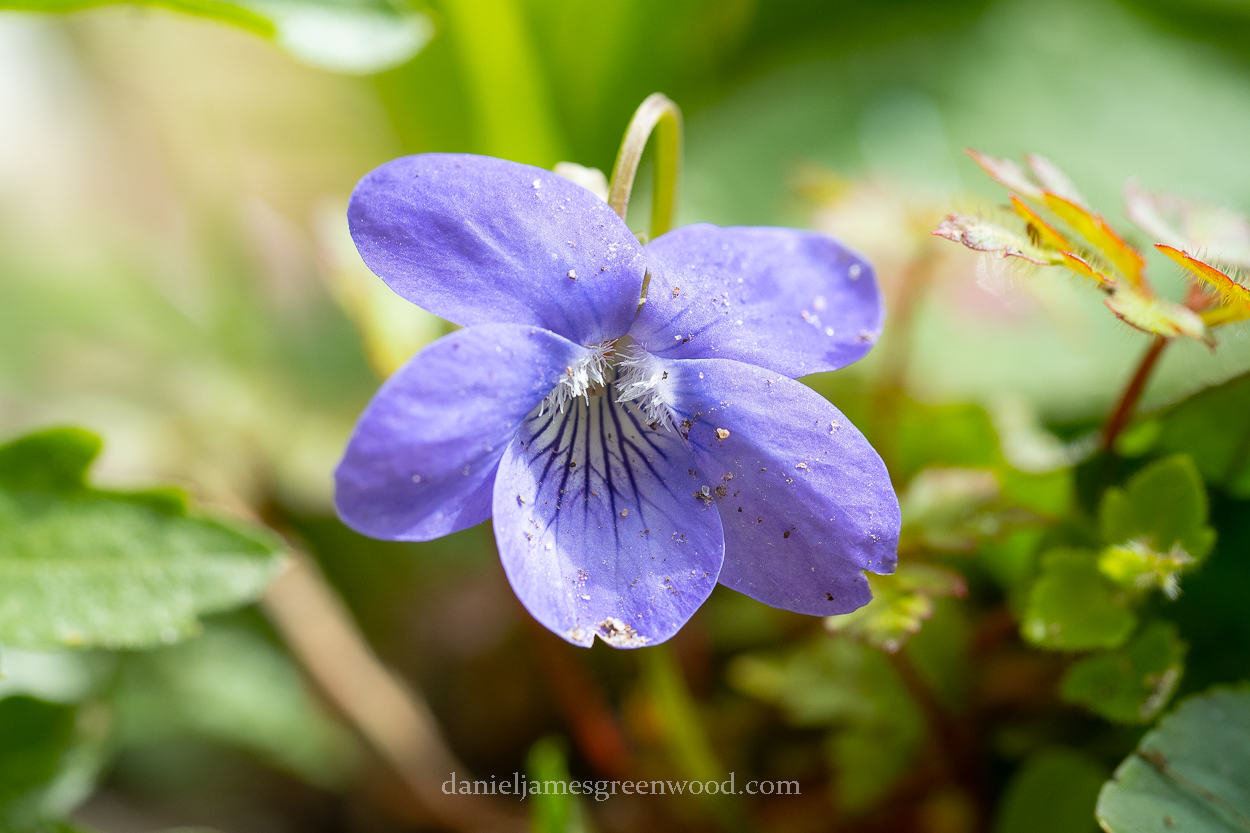
The dog violets are flowering between the brickwork on the twitten (a Sussex name for a type of path).
So too were the pea flowers of what I think is broom. It didn’t flower last year for some reason.
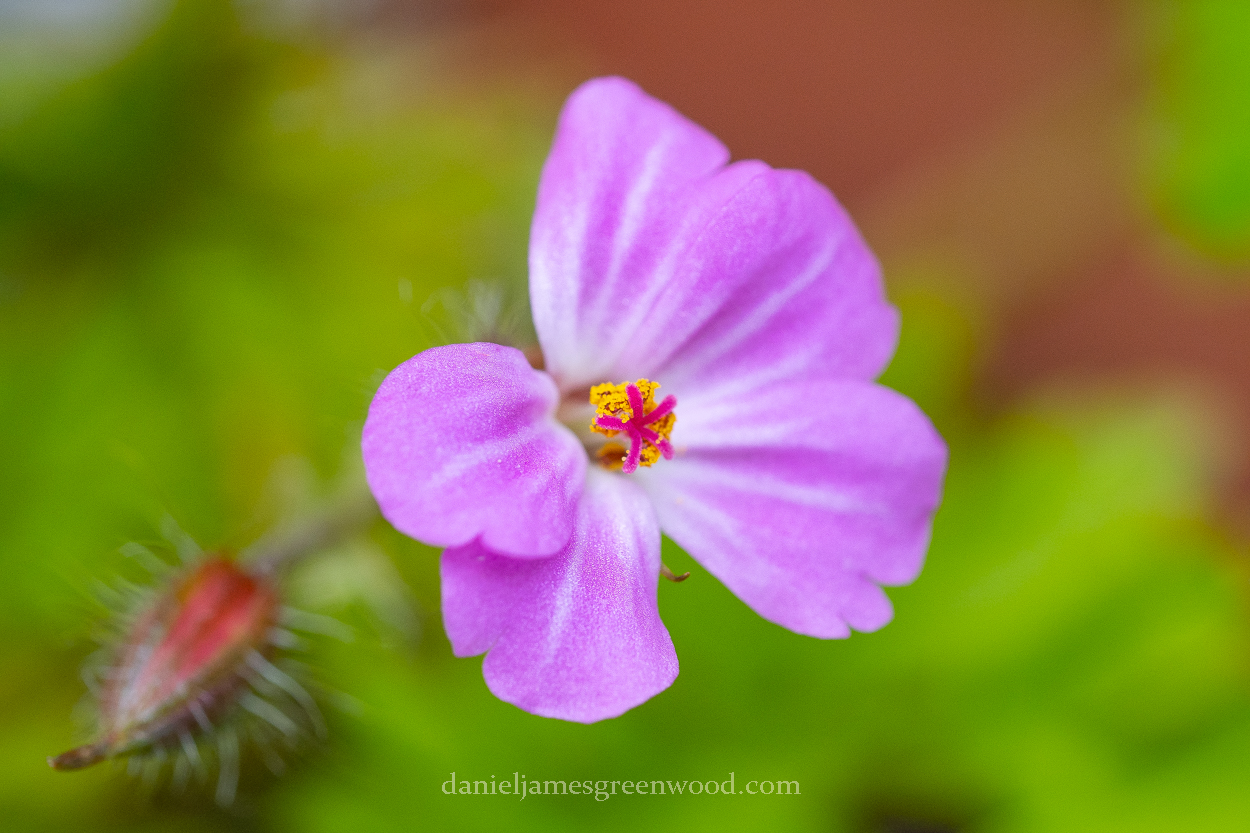
I think this close up helps to show how nice herb robert flowers are up close, with the yellow pollen grains highlighting their attractiveness to bees in particular.
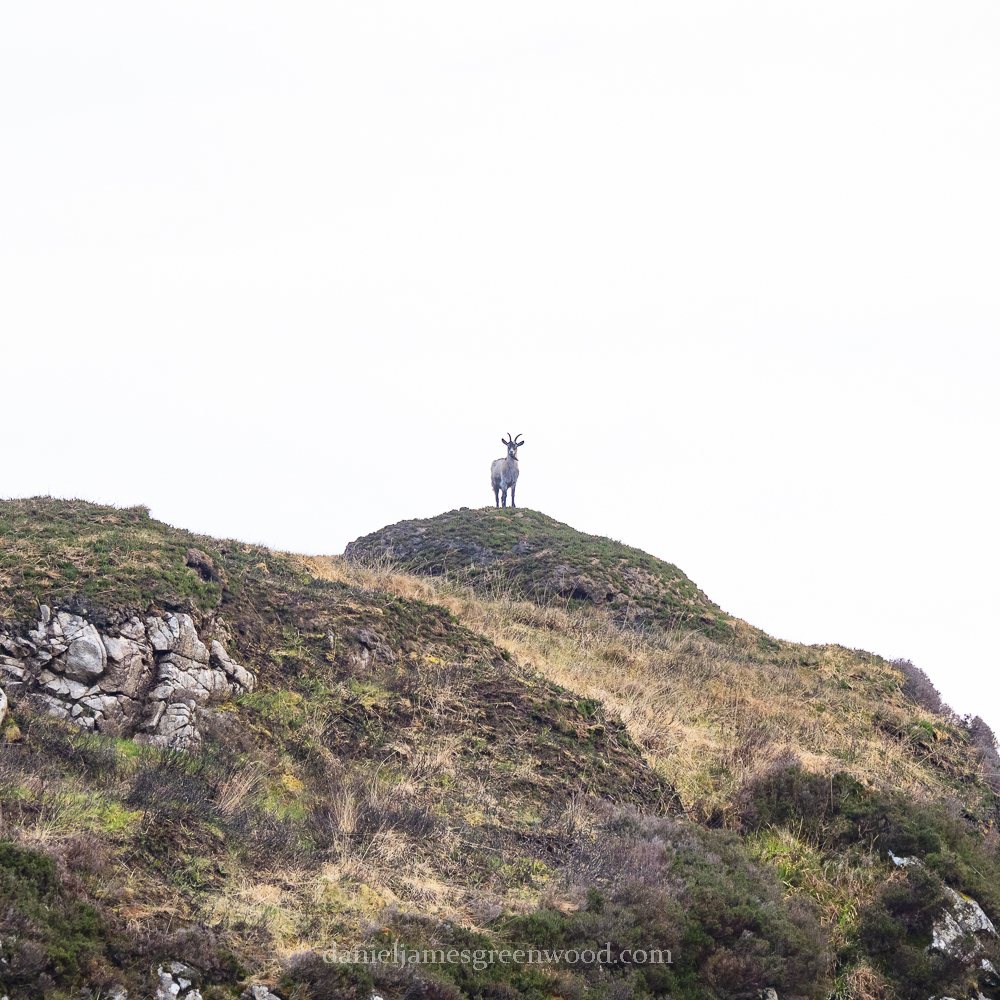
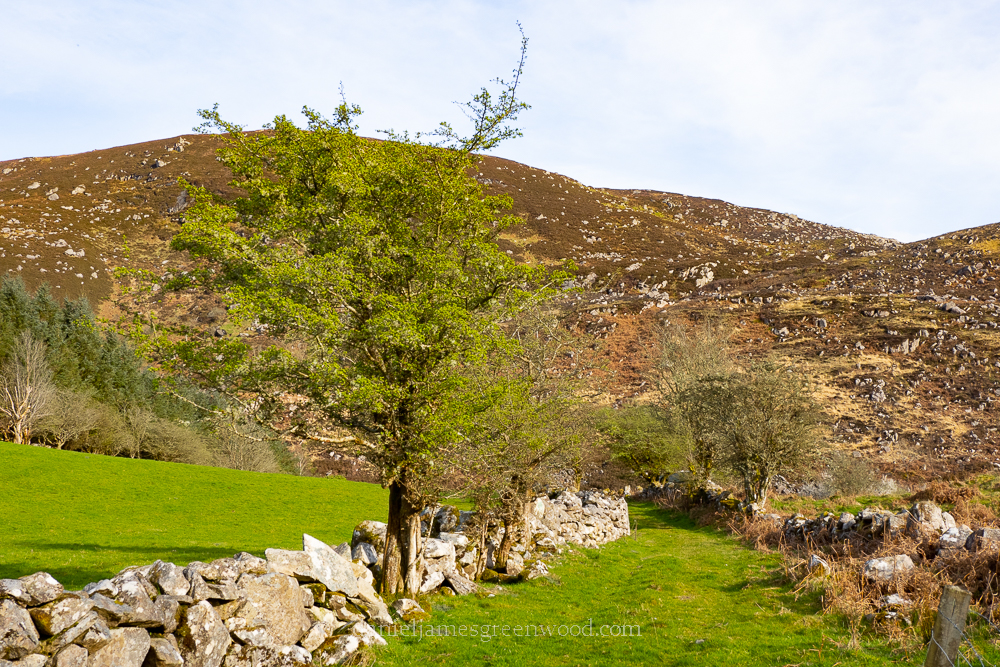
I went for an evening walk down the old trackway to the foot of the mountain. The track was flooded, meaning that without wellies I had to find tussocks and rocks to move further. Where the track turned, I noticed a ram of some kind grazing up ahead. After a time, I realised it was a goat, most likely a wild goat from the flock that roams the mountain. I had never seen one so close before and began to feel some concern for it. Why was it down here in the floodplain rather than up there out of reach among the boulders and bogs?
Its bleating was weak, distressed. I felt anxiety rising, that I needed to act. I looked at my phone about guidance for finding a wild animal of this size, but it was stuff I already knew and I realised I wasn’t acting rationally. I walked forward, a little fearful that the goat may show aggression, so when it turned to look at me, I backed away and waited.
The goat lowered itself to a sitting position, bleating in a way that suggested distress, weakness. Its voice was breaking, fading. It tried to stand but its legs gave way. It lay with its head on the ground, bleating again. I hadn’t moved, realising what was happening. Its stomach stopped moving. I approached it where it lay, its ears and lips were trembling. Then, stillness. Its eye remained open, and did not move. It had passed away.
A life lived wild on the mountain had ended at its foot, in a very short space of time. There was very little visible suffering, though some fear as it realised it was losing its ability to graze and trot.
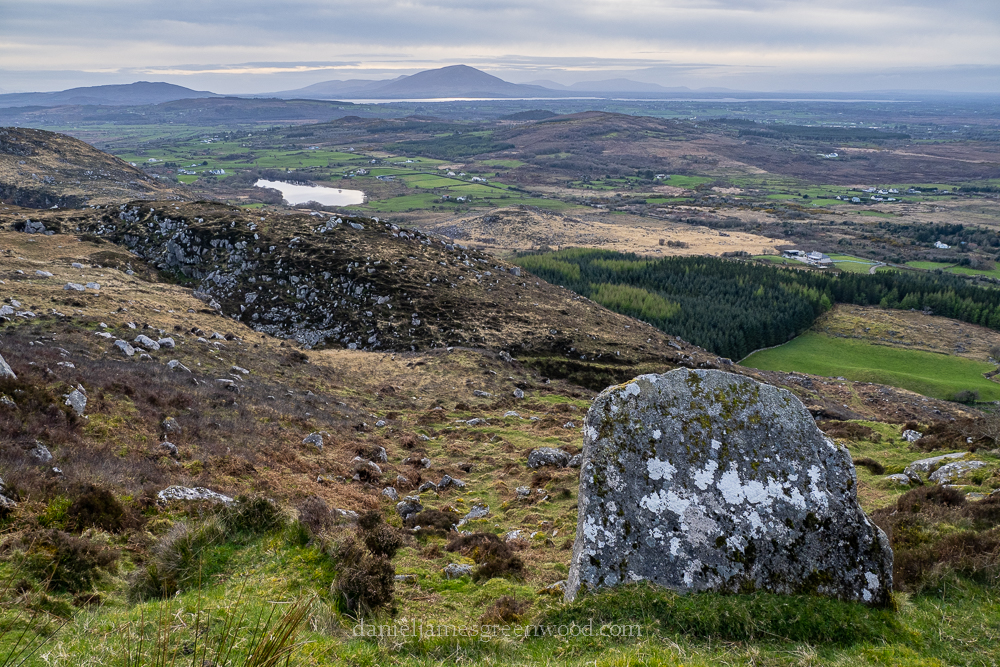
I continued on and headed up the mountain. Seeing the death of the wild goat made me want to press on, a gentle reminder that all life has its limits. To the west, Nephin appeared in the distance, Lough Conn as silvery as ever at its foot. In the south-west Croagh Patrick could be see behind a rank of wind turbines. As I reached a curve in the path, where a cleft had been carved into the hillside, a small group of wild goats appeared on the hilltop. We watched eachother for a while, before they headed off out of sight.
I reached the top for the first time since 2017. A broken flock of sheep circled me against the horizon of rocky outcrops, mountains and distant loughs. Being up there will always remind me of the times me and my Dad made it up, always out of breath and red-faced.
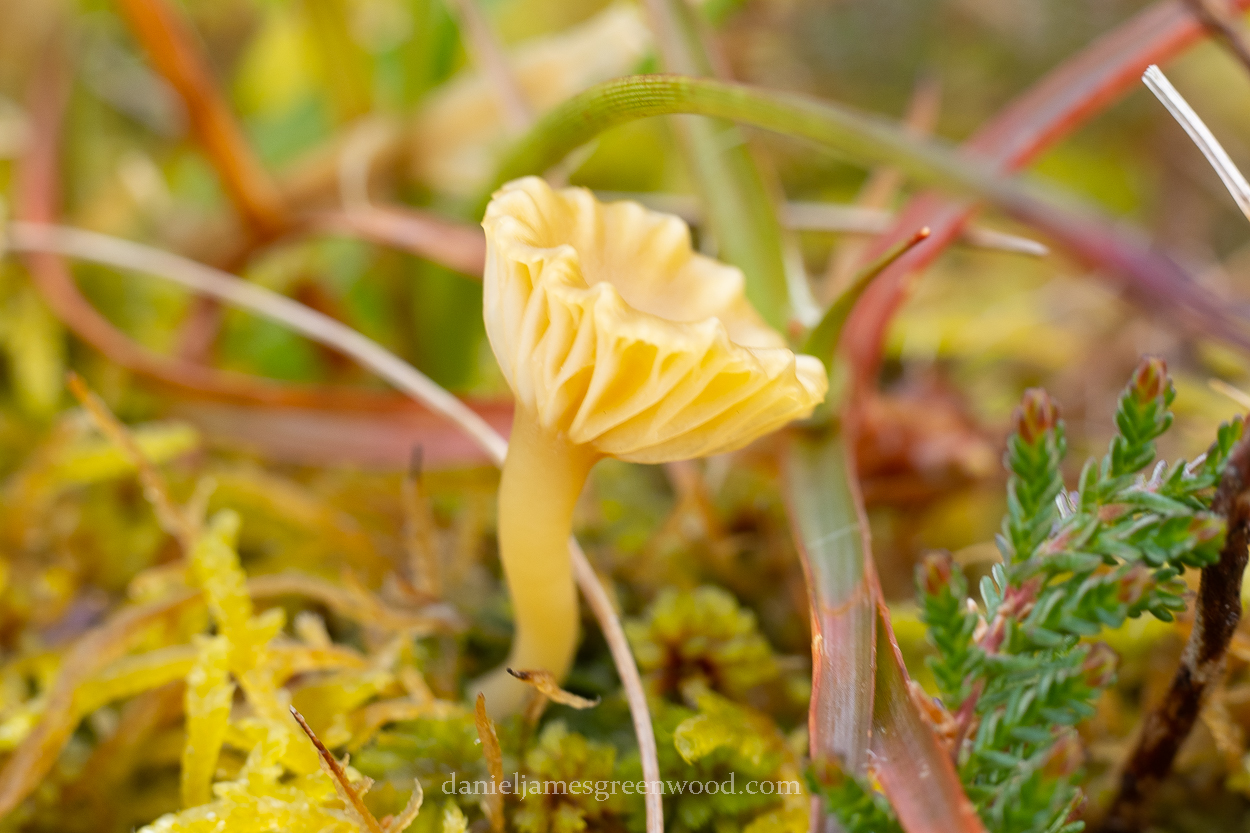
Surrounded by bogs and scars of turf cutting, I looked down to try find an unusual species of some kind that I might not see elsewhere, due to the remoteness of the place. Down in a small bit of bog, with sphagnum and other mosses, a group of golden mushrooms were growing.
I had a second camera with me that had a macro lens attached for ease. I took some photos, unsure of the species. Its gills were not unlike a waxcap (hygrocybe) but I knew so little about boglife that I was happy simply to find some shrooms.
I’m still waiting on feedback on iNaturalist, so this remains a mystery. Unless someone reading this knows and can add some information in the comments?
I headed back down the mountain and along the track. There the wild goat rested. I hadn’t imagined its death, and it wasn’t trying to fool me. I went back to the cottage unnerved, reminding myself of a life lived wild and free in the Ox Mountains.
Next Tuesday 18th April at 19:00 I’m giving an in-person talk at Bell House in Dulwich, SE London. The subject of the talk will be London’s wildlife, with (unsurprisingly) a focus on the woodlands that the city emerged from, and the role they still play today.
This talk should be of interest to anyone with an interest in landscape history, how wildlife is impacted by human development, both positively or otherwise. I’ll also be talking about some of the more iconic species found in the city’s reaches.
My life inside a snail shell The Funguy: How suggesting I’m into psychedelics made me interesting to other people Living in a badger sett for 15 minutes and other memories Dog poo diaries: a guide to chucking bags at trees Memoirs of a sexist birder: volume 9 and still they won’t edit me Seagull: a day in the life of Britain’s most hated white thing See no weevil: My failed journey through Britain’s beetle populations Guided by porpoises: I read all the field guides so you don’t have to Howling like a Woolf: Bloomsbury only publish you if you’re privately educated or on TV Grassways: wild lines So sewer me: a rat’s tail Chasing ground nesting birds: a dog’s tale Urban city wild jungle street town nature adventure chronicles Human nature: my vague explanation across 220 pages for why I am natural Human naturer: the sequel to the one above, this time with references to that one The Tree: they asked me to write something about trees Roamania: the year I walked on every inch of England Man chop wet wood, make fire eventually: my attempts to inject some much-needed masculinity into the nature scene Hedge fund manager: a guide to raising money for conservation projects Windy Cindy: the day I got blown away by a tweet someone wrote about the weather T O X I C: I ate all the poisonous plants so you… don’t… hav–
I wanted to do a blog update post as I have fallen behind with writing and photography, but am still in existence. Believe me it pains me not having the time or mental space to write anything, possibly more than it pains you to read this blog.
I’ve just finished working on a short-term project job and it’s been pretty full on. I’m hopeful that in April I’ll be able to post more, especially with the invertebrate world coming to life again. I’m also about to embark on a new project job, full-time, meaning I will have to be more organised about how I post on here. As ever I want to keep my blog as an outlet.
Hairy footed flower bee rescued from the road
Spring, it cometh
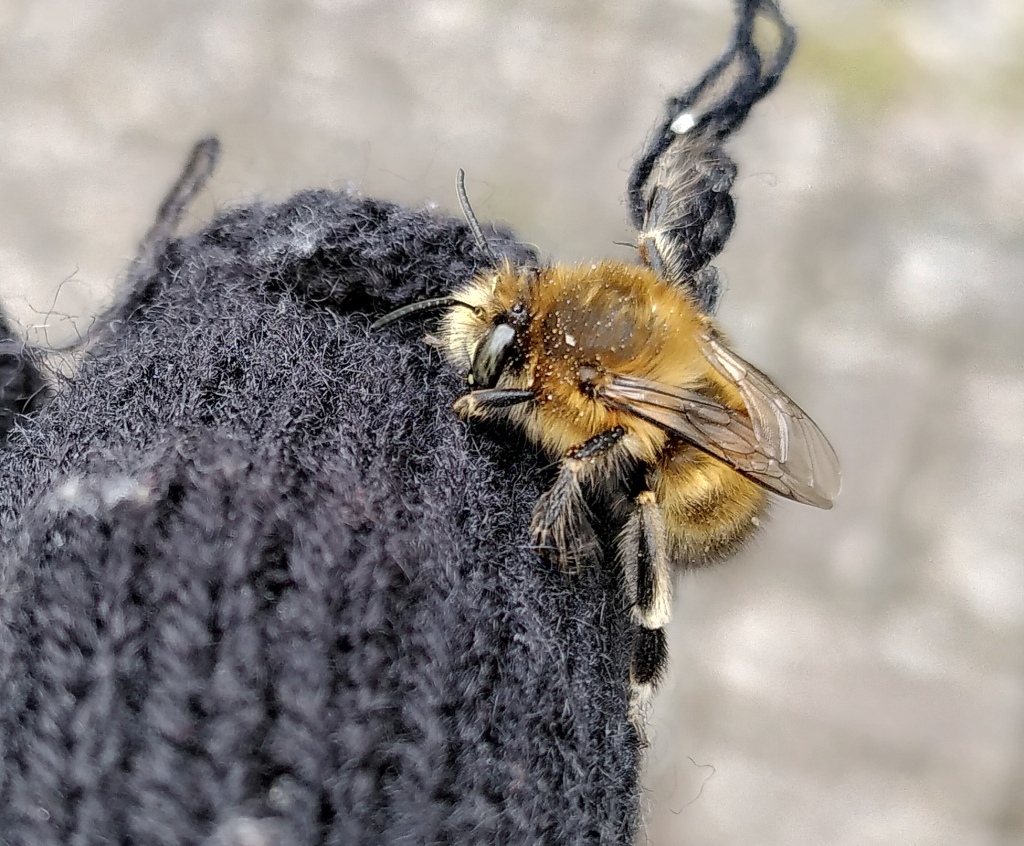
There have been a couple of signs of spring awakening in my garden, with a hairy-footed flower bee my most seasonal sighting. That said, I have only seen one, which is perhaps unusual for this time of year.
It’s late March now and the local green spaces have their chiffchaffs back.
In mid-March I led a spring walk in Dulwich for London Wildlife Trust. It was rather wet but there were still signs of the season changing.
Lesser celandines were the closest thing to a flowering plant I could find, but ramsons, bluebells and wood anemone were in leaf. That said, wood anemone appears to be a casualty of lockdown, in that the increased footfall has trampled this delicate ancient woodland plant out.
In terms of the more distant past, I spoke to the group about the Victorian impact on the woods, how invasive species like knotweed, laurel and rhododendron had been introduced by them. At the end of the walk one attendee spoke to me and told me something that astonished me.
“My family, back in the 1700s, were responsible for introducing rhododendrons to the country,” he said. “It’s in the bones.”
I was aware of the fact that my throwaway comment about Victorian introductions might have potentially been an insult. I explained that it was more in regard to their place in wilder landscapes which he agreed with, mentioning just how destructive they are in more rainy places like Scotland.
I’ve said before on here that one of the great things about leading guided walks is that people feel comfortable sharing their knowledge with you. Guided walks are always a shared experience, not a lecture. They’re an invitation for people to look differently at a place and make others aware of things you didn’t know yourself.
I’ll have to be more careful in my (mild) criticism of the role Britons past have played in changing the flora, fauna and funga of the UK.
A worrying extract from The Gallows Pole
The Gallows Pole
I’ve been reading the novels of Benjamin Myers recently, an author of poetry, fiction and place writing based in Yorkshire. While on a weekend break I read The Offing and gobbled it up. It’s the story of a young man walking in the north of England one summer after the Second World War. He becomes friends with a very charismatic woman who takes him under her wing, in the way that people in their 30s upwards can often do for young people at the end of their teenage years. It’s a beautiful book and much recommended.
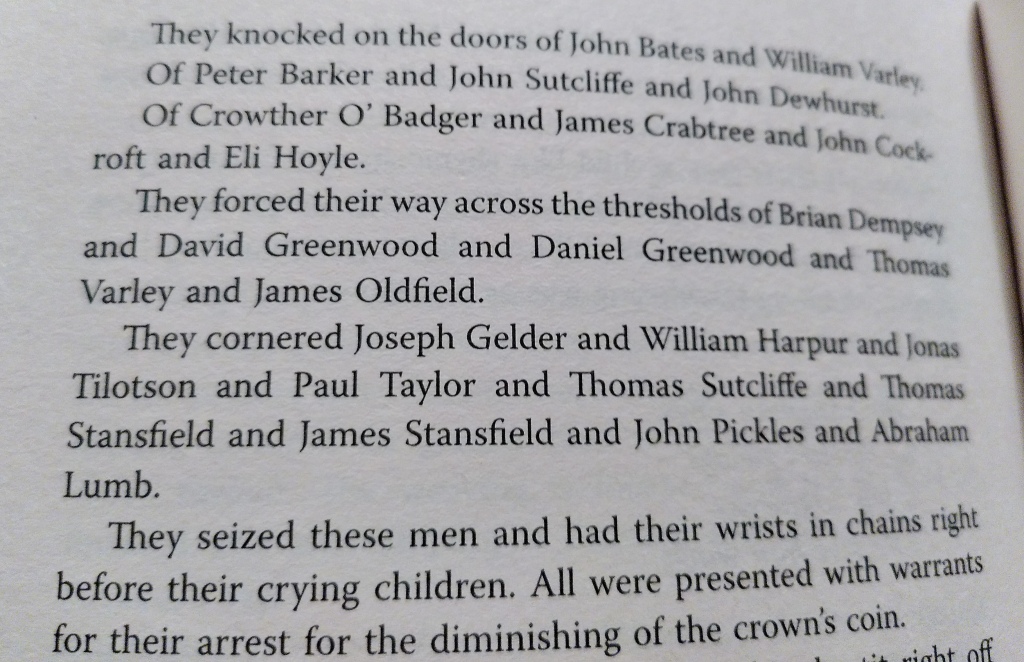
I’ve just finished the very brutal The Gallows Pole. The story is based in ‘the land of my forefathers’, the Calder Valley near Hebden Bridge in North Yorkshire. It’s a visceral, violent and disturbing novel but is one of the best I’ve read in years. It has that ‘unputdownable’ quality. More disturbing for me is the number of Greenwoods who crop up as part of the illegal coin clipping industry that blossomed in the rainy hills of Calderdale. Not least, a Daniel Greenwood! And it’s historical fiction! My family were hillfarmers there up until some point in the 1800s, living in the area around Haworth at the time of the Brontës, before moving to Liverpool where my father was born. Greenwood is a Yorkshire name with heavy concentrations around Lancashire, too, probably because they moved to work in the cotton industries at the advent of the Industrial Revolution. My Dad told me that Greenwood comes from a wooded place known as ‘Greenwode’. ‘Wode’ of course is the Anglo-Saxon name for woodland.
The Lost Rainforests of Britain
In the nature writing world, in February I read The Lost Rainforests of Britain by Guy Shrubshole. It’s great to see these woodlands getting some press, especially seeing as they have been decimated over the centuries, with very little of the the habitat left. Shrubshole shows the way for how much of the landscape in Western Britain can be home to more of this unique habitat. I hope it can progress but worry that in a warming climate it becomes less viable.
I felt the book might have benefitted more from a deeper focus on the landscape at its heart – Dartmoor, close to where Shrubshole lives. The random trips to tick off other woods felt a bit of a distraction from a more meaningful account, such is the style of this type of species or habitat-focused genre. In terms of personal taste, the name-dropping of other writers and musicians has become a tedious pastime of this genre and makes it seem like a clique. I don’t think that helps the movement, though again it’s probably about personal taste.
It’s definitely worth a read if you want to know more about things like Atlantic oak woodland and the habitats and landscape history of Dartmoor.
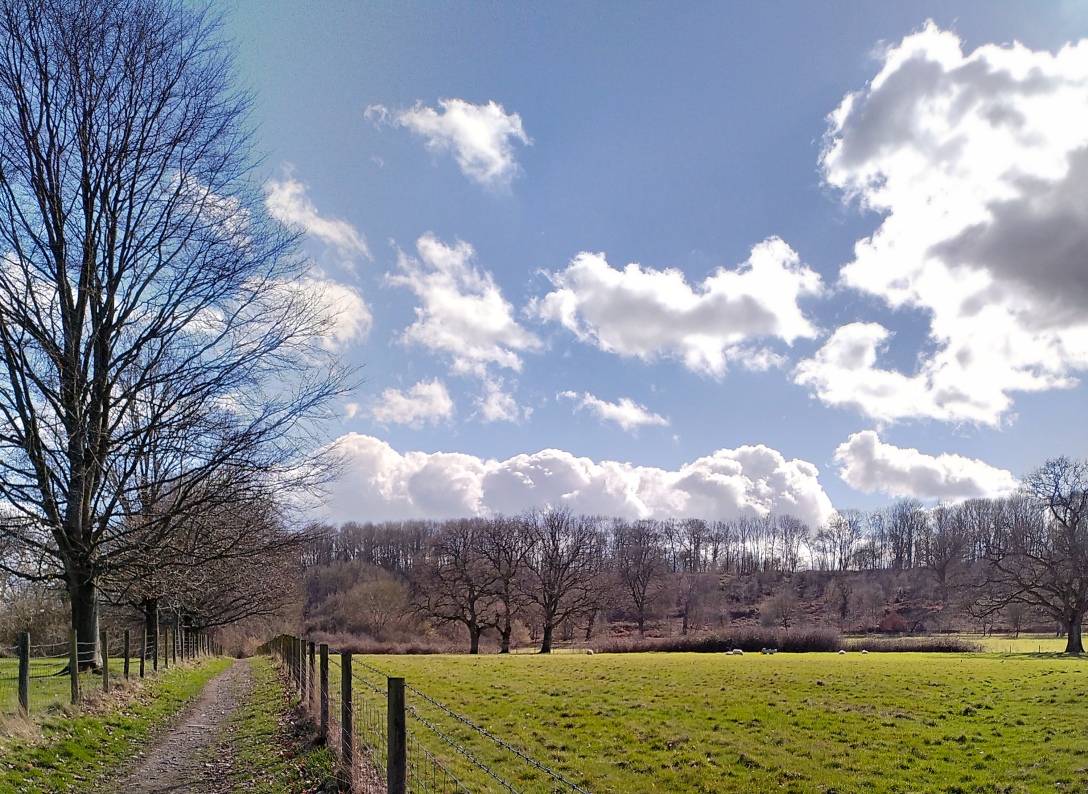
A walk from Steyning, along the field edge with those lumpy Downs caught in a smoke-like haze. The sun beat over the hilltops, the trees naked, grey and brown without leaves. Hazel catkins were the only decorations.
We walked through an old farm replete with buildings that seemed to be crumbling. The ground underneath was churned up with that grey gloop where the downland chalk meets the Wealden mud, a Sussex special.
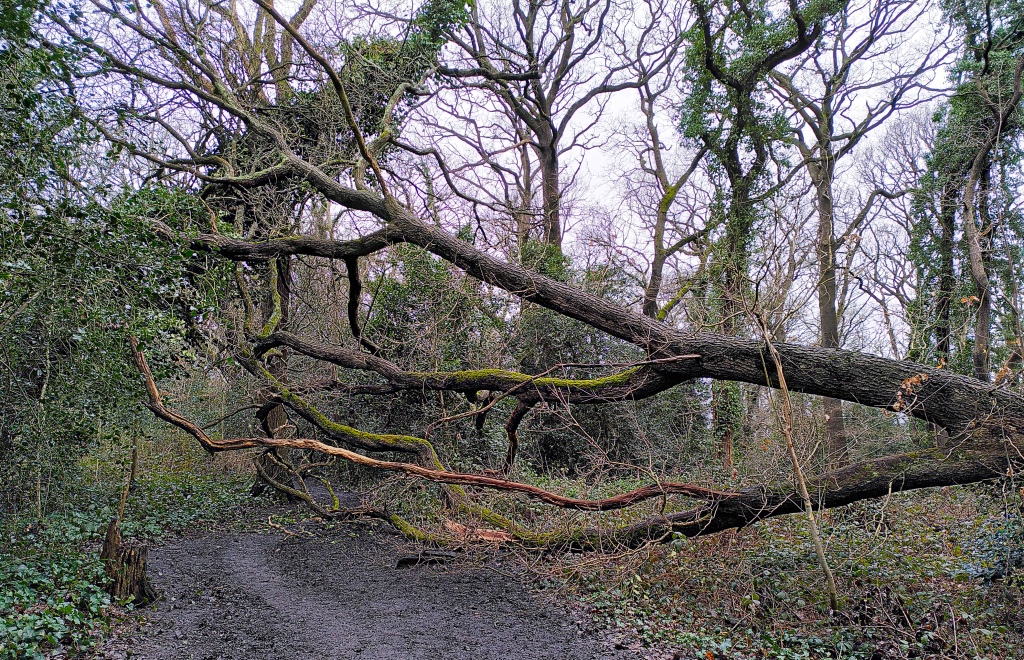
The woods were cold and quiet except when labourers felled a tree somewhere in the shade of the Downs. It crashed down and broke into pieces. No doubt an ash tree, dead or dying like so many of them across this once ashy landscape.
On the banks there were the first signs of woodland spring, with dogs mercury leafing and some flowering.
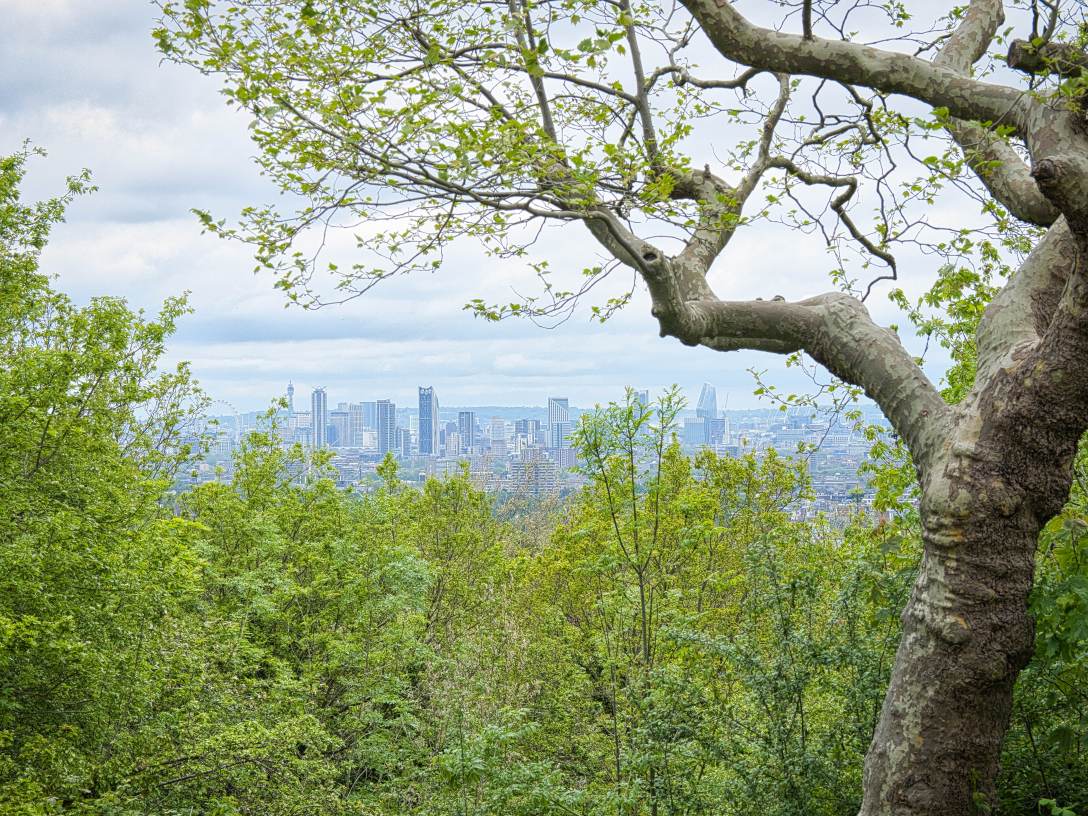
Rising up towards Chanctonbury Ring, the views north were dulled by a dense grey fog that looked like London’s winter pollution belt.
A stand of dead ash trees led to the top of the Downs, where a pair of marsh tit passed between the brittle branches, calling as they moved from tree to tree.
A new vista opened out with the views south, hills folding away into the haze. Black trees breaking the lines.
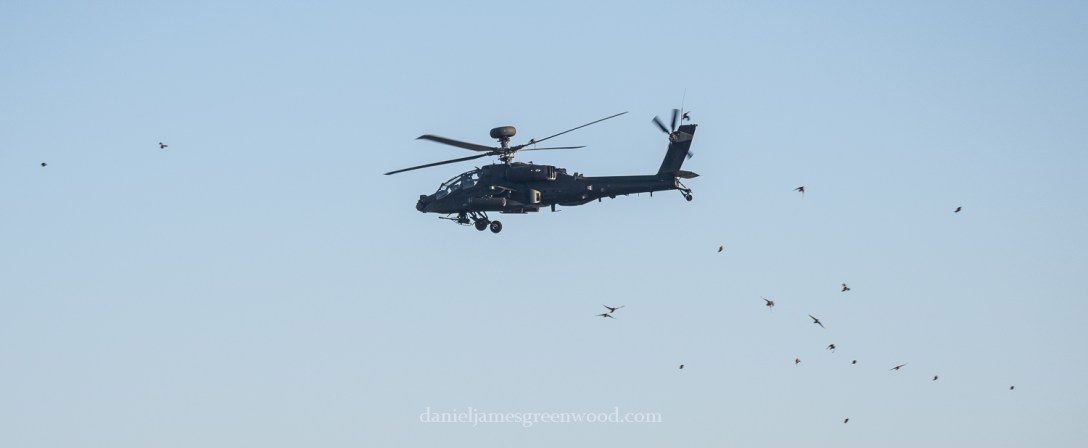
Further along the South Downs Way a great roaring emerged from the south and an Apache helicopter flew low overhead. It felt too low. A flock of what I thought were starlings were spooked and seemed to fly right at the helicopter.
A second helicopter appeared, banking north and turning 90 degrees as it slid over the edge of the Downs and dropped out of view into the Weald beyond.
A man came past on a bike and stopped to speak to us, registering our surprise: ‘Have you never been here when they do that? I just hope they’re training Ukrainian soldiers and that they’ll be sending them out there.’
We heard stories of accidents that had happened when the appearance of sudden, low-flying military aircraft had disrupted the flow of civil life in the wider landscape.
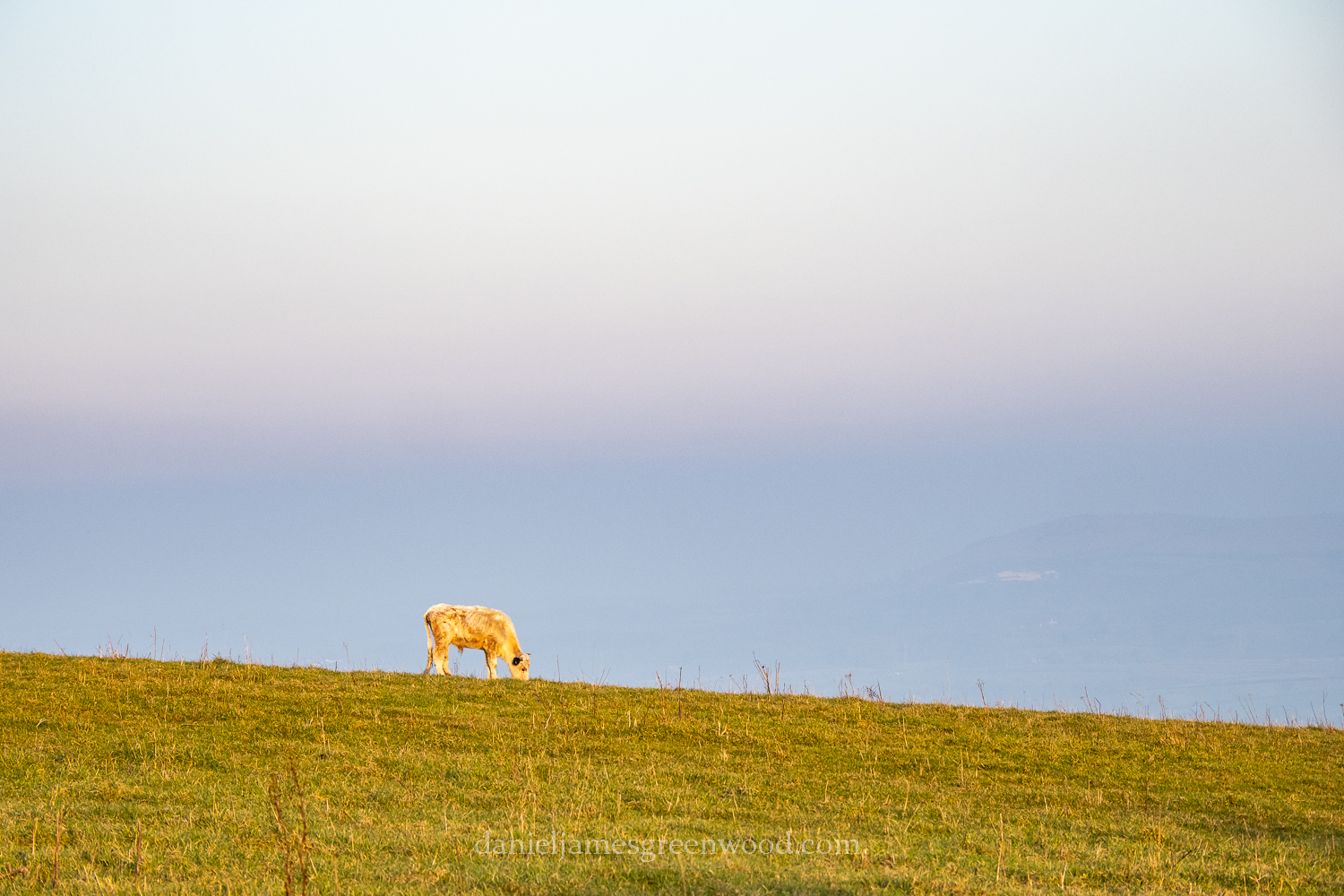
Up ahead beyond the enclosed South Downs Way, cattle grazed the green hill, unperturbed by the helicopters. In the valley to the south one of the few hedgerows to be seen jangled with the key-song of corn buntings.
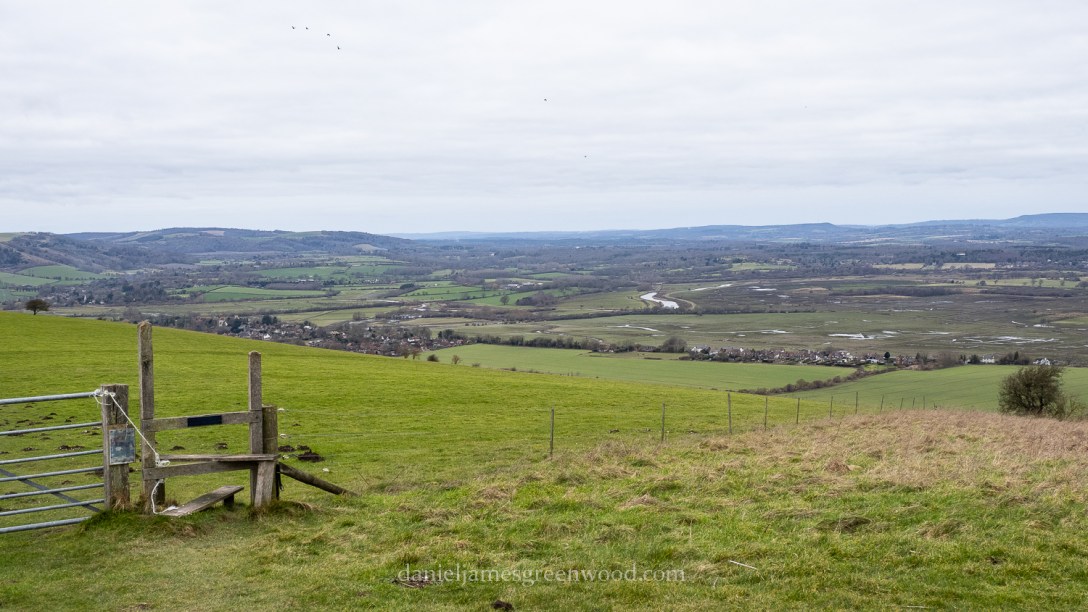
The light was low over the Arun valley. To the south the Sussex coast was a band of grey concrete, the horizon between sky and sea broken only by the pale sticks of the offshore wind farms. The Isle of Wight rested out at sea to the west like a great sleeping sloth.
The Arun’s floodplain had traces of silver, the remains of January floods. The rain had gone quiet in recent weeks, and so the wetlands were receding back to the river.
The birds were quiet, too. Every now and then a small flock broke and reformed in leafless branches, possibly linnets, goldfinches, chaffinches, it was hard to tell. A red kite followed the crests of the Downs for much of the seven I walked along the South Downs Way that day.
When I first turned off the main road onto the trail, I saw a couple planting out the fresh green leaves of cherry laurel, no doubt to screen their farmland. I gasped but said nothing. They worked at speed, focused intently on their planting.
Cherry laurel is one of the most invasive and ecologically destructive shop-bought species in the UK. I’ve spent much of my recent working life removing it from oak woods. I firmly believe it should be banned from sale. Holly and yew do just as good a job as screening hedges and are nowhere near as destructive. England’s most ecologically rich and diverse woodlands are usually oak, a tree that loses out every single time to cherry laurel. It can also become established in downlands, of which the South Downs are famous.
A couple of weeks ago I was working with a group of volunteers pulling cherry laurel saplings from an ancient oak woodland that holds a diversity of broad-leaved tree species, namely: oak, ash, wych elm, hazel, holly, yew, field maple, hawthorn, guelder rose, and more. Where cherry laurel has become established in this woodland, all of these species would disappear without intervention. So the task was very clear – remove the self-seeded laurel saplings before they become established and reduce the woodland to a monoculture of one species.
That is the fundamental issue with monocultures of invasive species: the diversity of plants, fungi and animals dies out. That is bad for everyone and everything, even laurel eventually.
This is a tree that originates in the Balkans and is available in most garden centres as a quick-growing, glossy evergreen to create a screen in a garden. It’s also toxic.
Of course there are many species which have toxic chemicals in them, and humans are experts at introducing them to the environment, but I’ve personally felt the impact of laurel’s toxicity.
Some years ago I somehow got a very small laurel splinter into the vein in my wrist. The following day my wrist swelled-up and a line appeared down the middle-underside of my forearm from the site of the splinter. I went to the accident and emergency and was forwarded through to a care unit where they injected my hand with antibiotics and took several tests, including an ECG. They puzzled over the issue and sent me home with a prescription of more antibiotics. Laurel wasn’t even on their register of toxic plants on that December day in 2017. The infection dropped away after the NHS’s treatment and a few weeks later a miniscule, redundant piece of laurel splinter appeared from my wrist.
Cherry laurel contains cyanide in its leaves and is used by entomologists, or so I’ve heard, to create kill jars for trapping invertebrates. That said, yew is of course also toxic, and the cherry family (which laurel resides in) holds cyanide as a defence mechanism in many of its relatives. The laurel is just doing what’s in its nature, its our role in spreading it to places where it causes harm that is an issue.
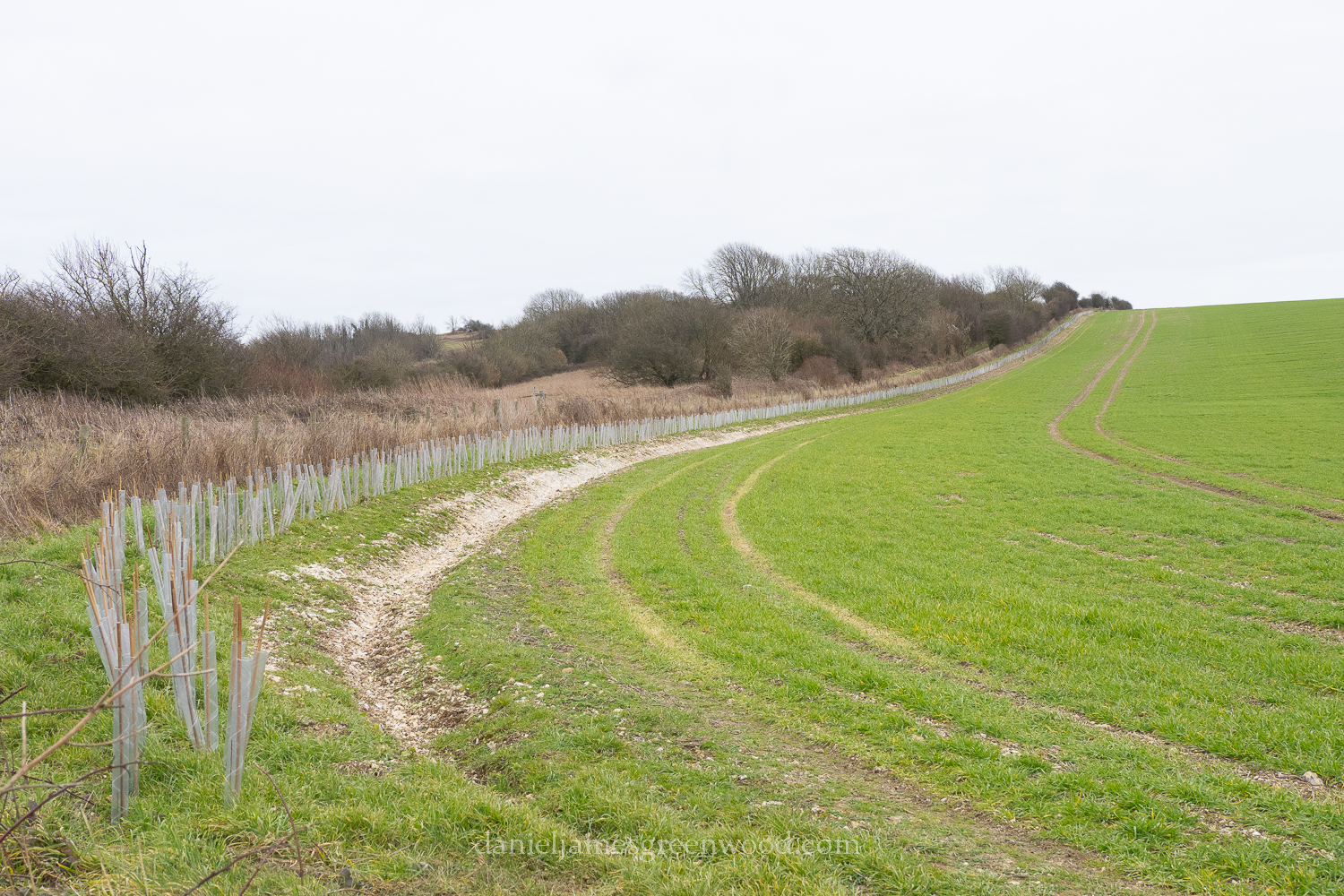
Along the South Downs Way, there was much better news. For miles I observed a trench dug into a farmer’s field and saplings of hawthorn and other native hedgerow species planted. This new hedgerow spread for several miles, an incredible contribution from the farmer, or perhaps volunteers who had been involved. Britain has lost 50% of its native mixed hedgerows since the Second World War and, in a landscape home to declining farmland birds like corn bunting and yellowhammer, this new habitat will make a huge difference.
In this case, the difference will be a positive one.