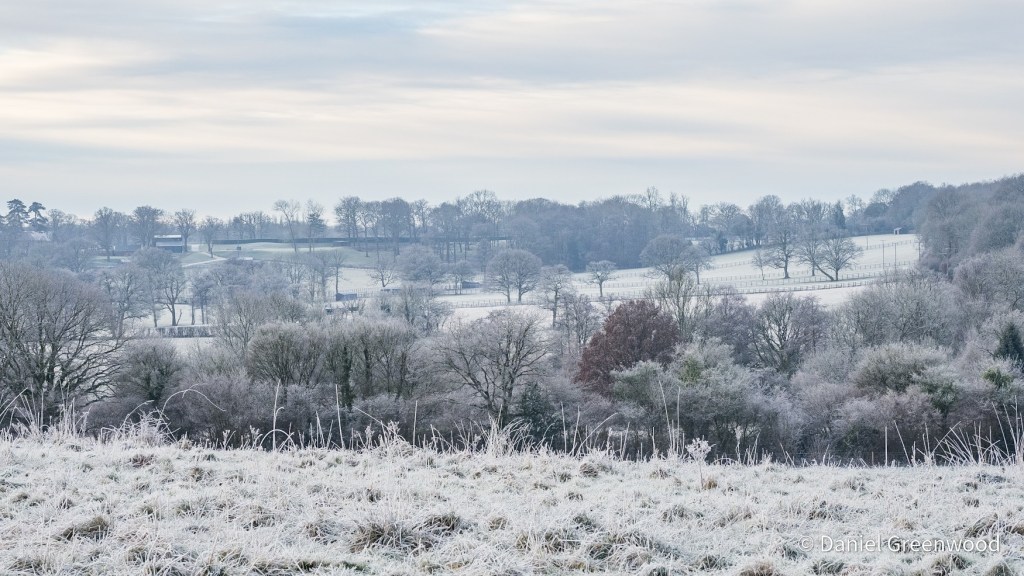
One of the nice things about not living in a city is that you get to see hoar frost. I know this because I’ve spent most of my life in cities where the ‘heat island effect’ usually won’t allow for hoar frost to really develop during daylight hours.
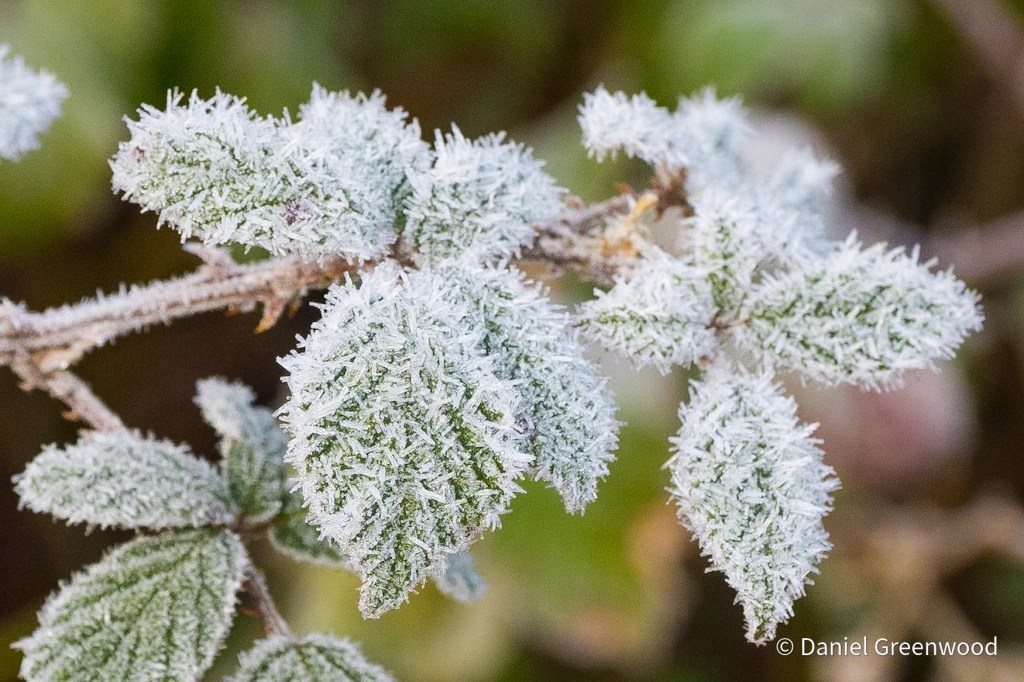
Bramble leaves make it through the winter, providing a good platform for these frost spikes.
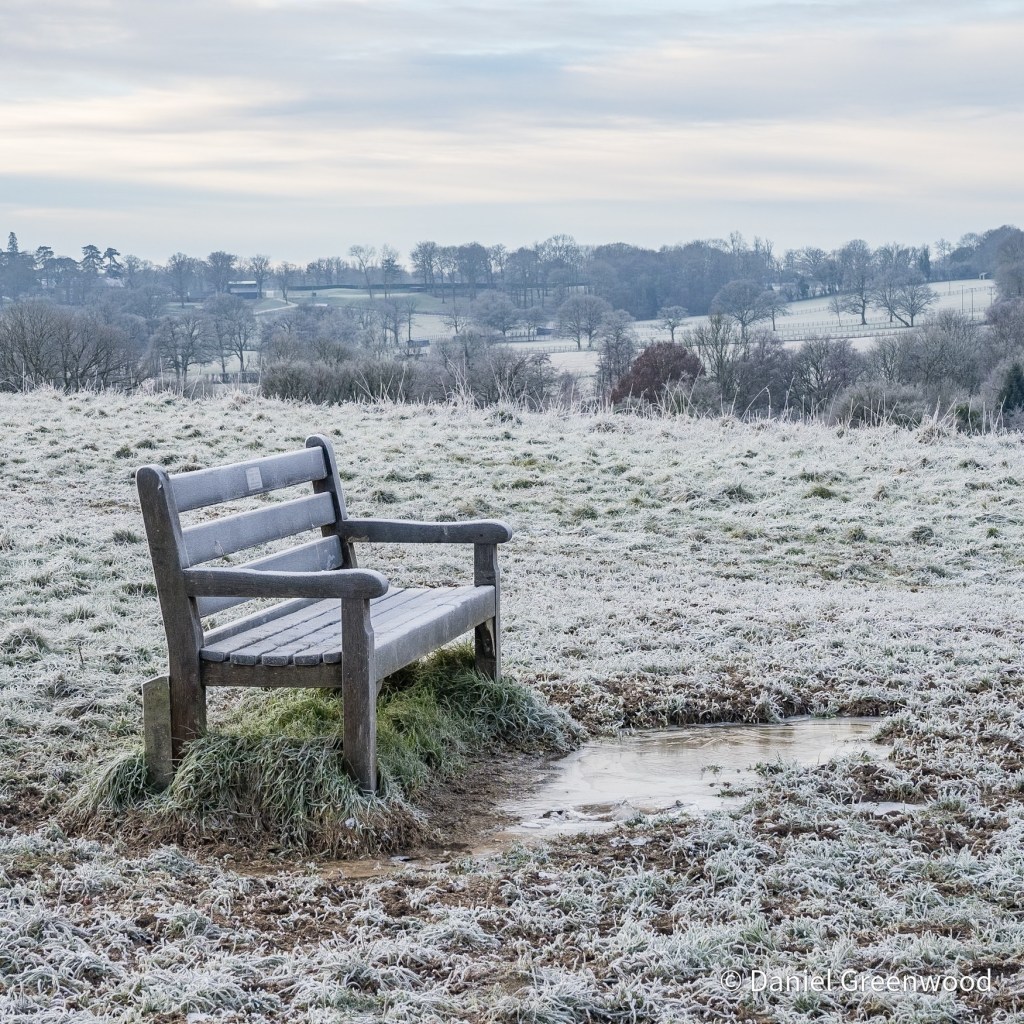
This thick frost covers the trees and hedges, everything vegetative really, in a thin veil of icing. The puddles become milky ice clouds.
After a very dark, grey and damp December, these blue skies and frosty landscapes have been welcome relief.
Not a great time to sit on a bench though.
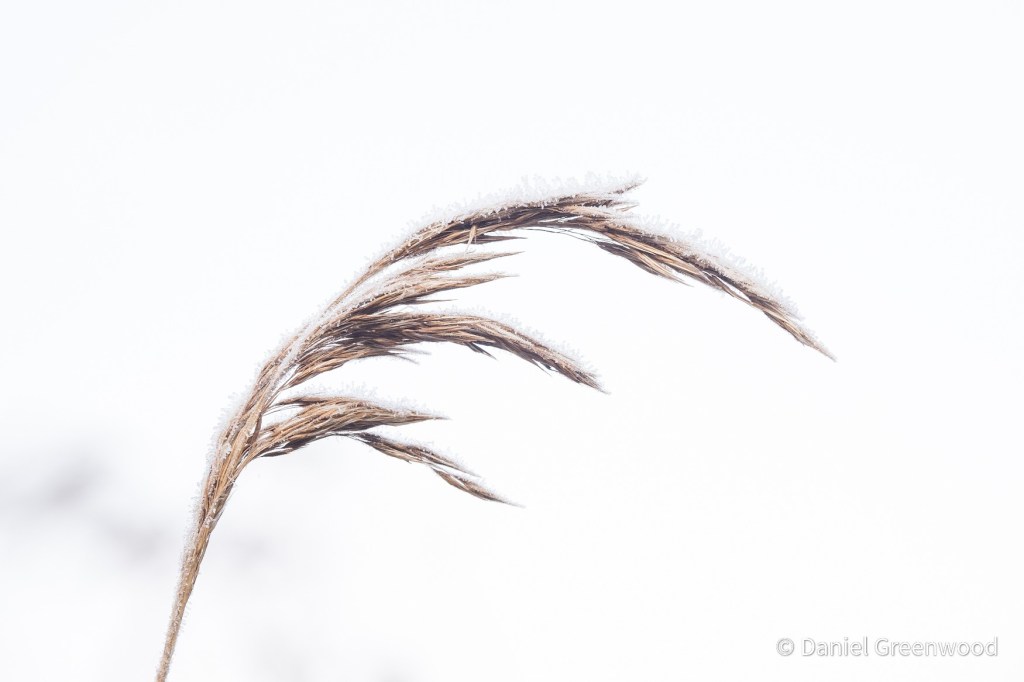
This is a reed with a coating of frost.
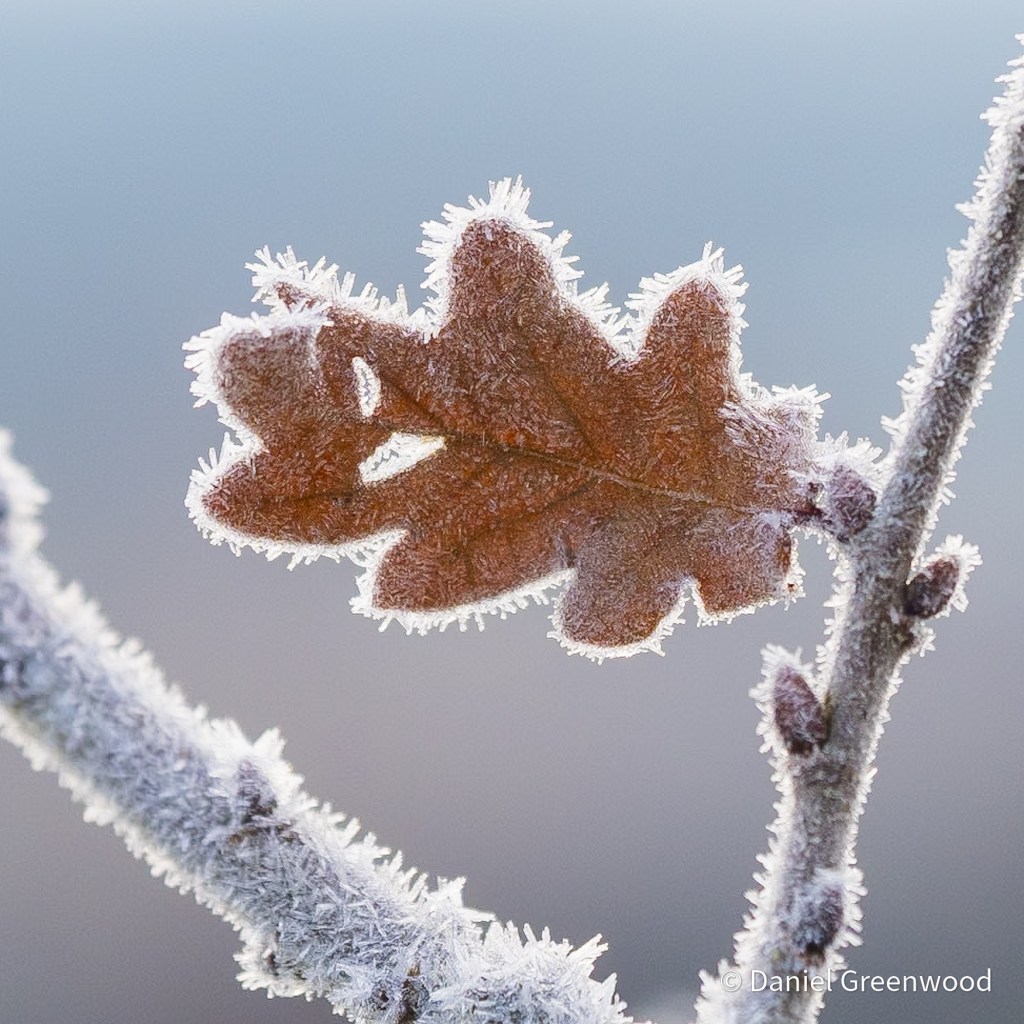
Remarkably this oak tree still holds its leaves, which is unusual outside of cities in January. I have known deciduous oaks to hold leaves into January in London.
I always seek them out in this weather, especially with a little bit of backlighting. This is quite a heavy crop so the sharpness is lessened a bit. You probably don’t care.
That distant landscape is actually an equestrian estate. It is chewed to within an inch of its life, hence the black sticks of trees, compared to the rough grassland where I stood to take the photo.
2025 will be a year of catching up on last year’s photos. 2024 was a really busy year of travel and life events after the fallow pandemic years (2020-22).
I was in Dublin in March 2023 for – you guessed it – my stag weekend. It was more a spiritual visit, made by ferry, rather than an idiots’ weekend away. This post wouldn’t have been possible without my best man Liam’s work in booking the boat tour, the only one on the river.
For the visit I took my Olympus TG-6 Tough compact camera, but didn’t take photos as raw files so these are edited jpegs, which is obviously a crime against photography. The images from the water are taken through glass, so they have degraded even more (you probably won’t notice). The light was nice though, and image quality isn’t everything.
Passing the Liffey is carved into my memories of Dublin having travelled so many times on the ferry, across and along the river in the car after disembarking. It’s also where my parents bought me my first Everton shirt in 1995.
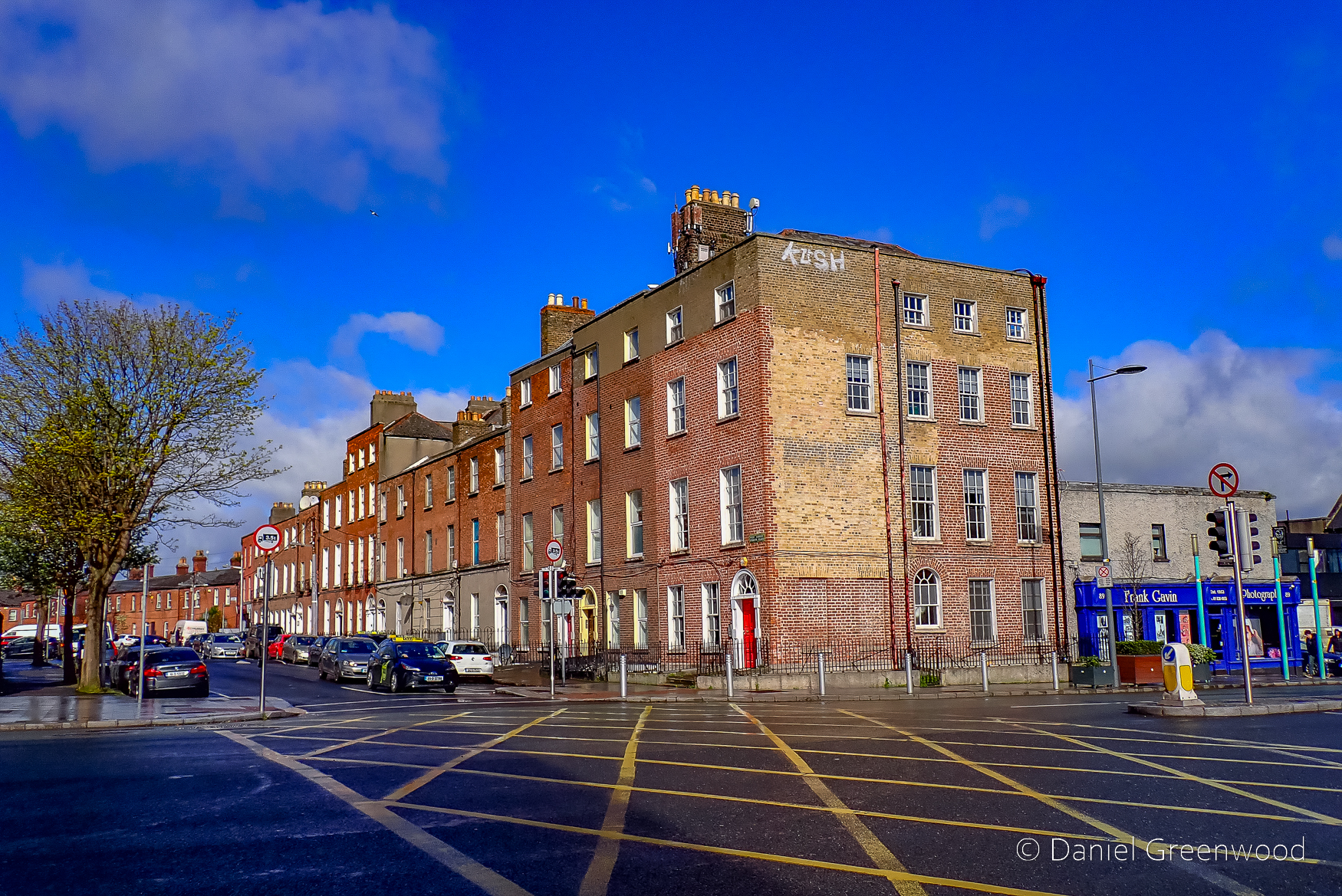
We were staying on the north side of the Liffey, the older part of Dublin.
Who doesn’t like some unofficial street sculpture – if it’s fly-tipping that’s obviously different. Now for a handbrake turn:
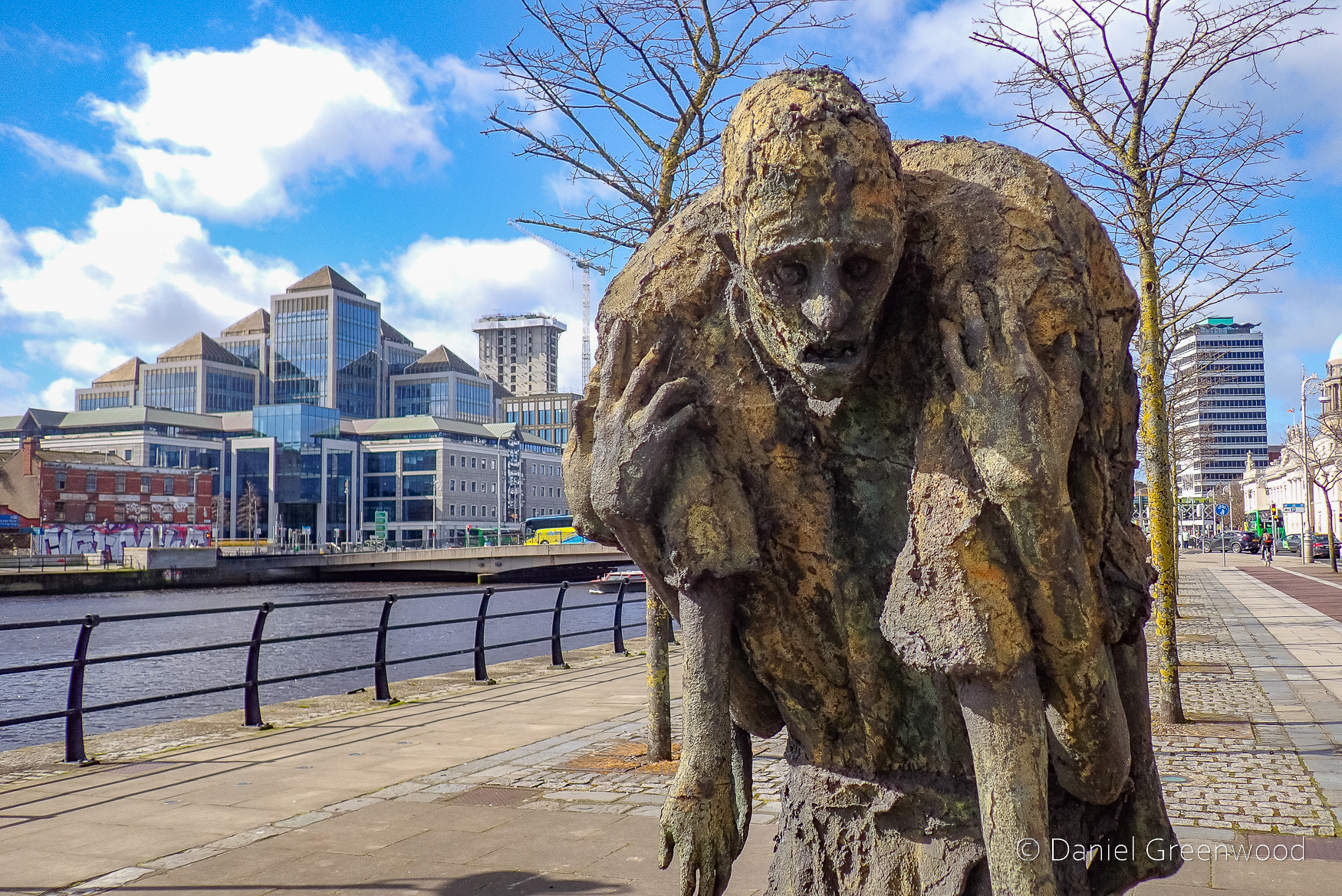
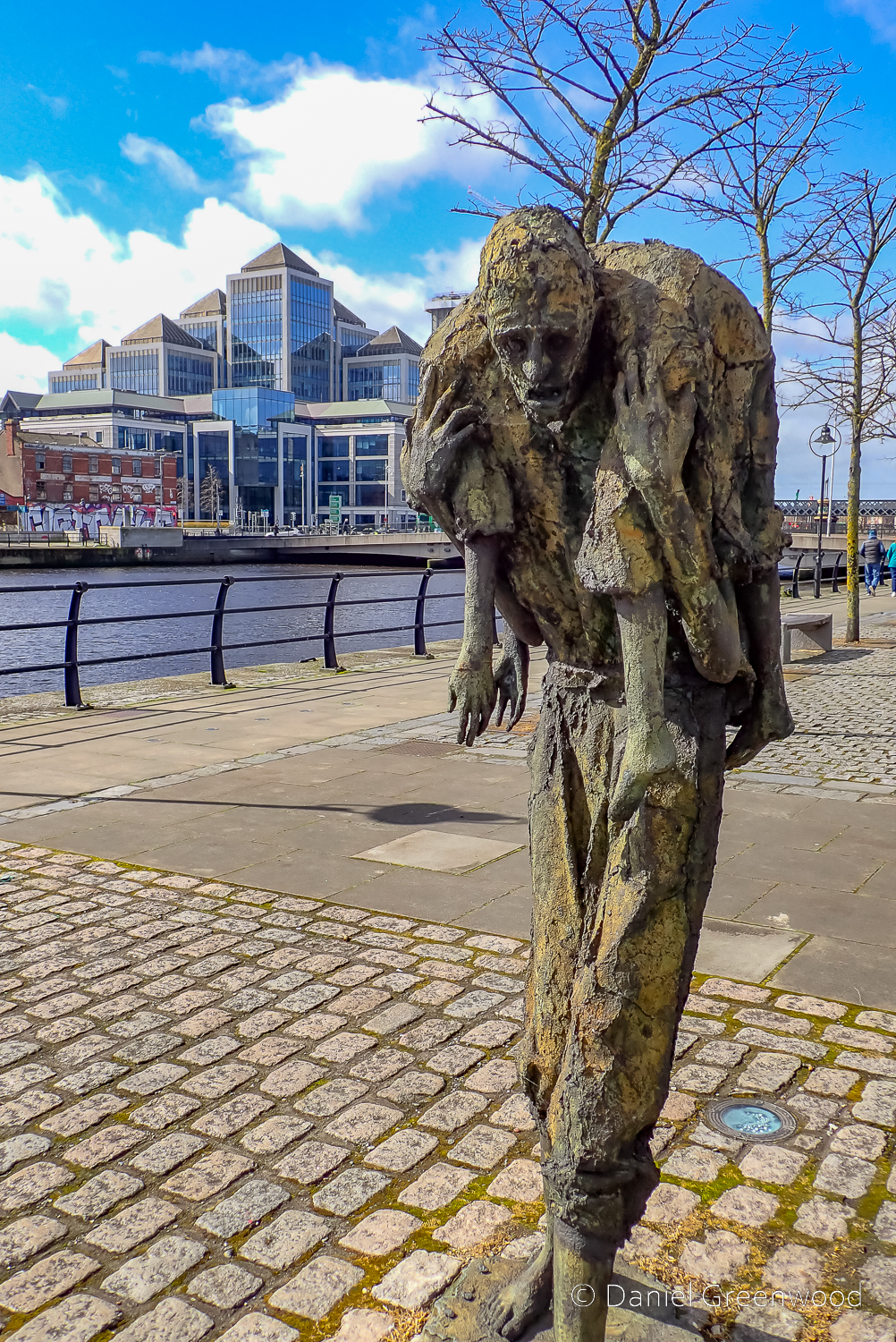
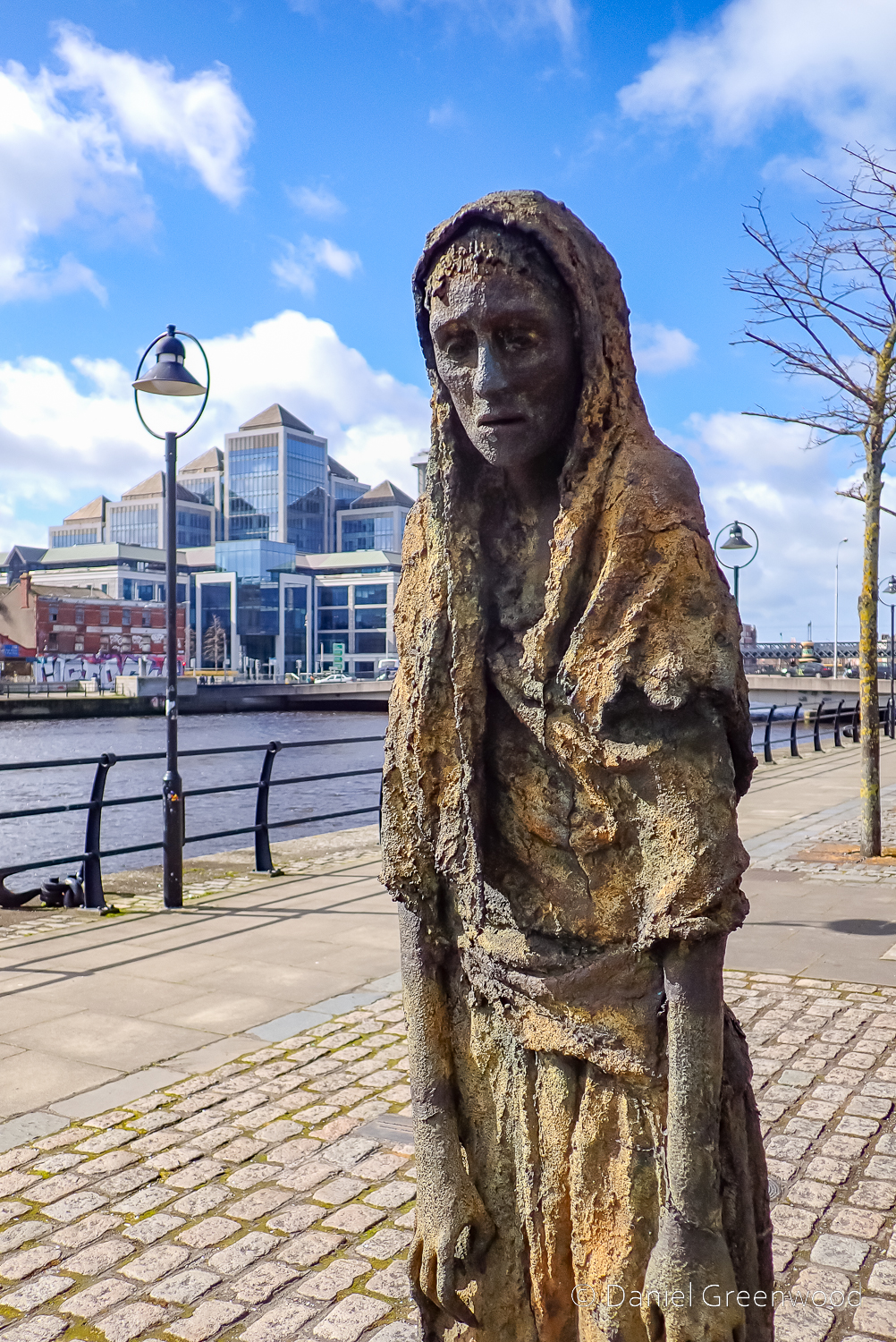
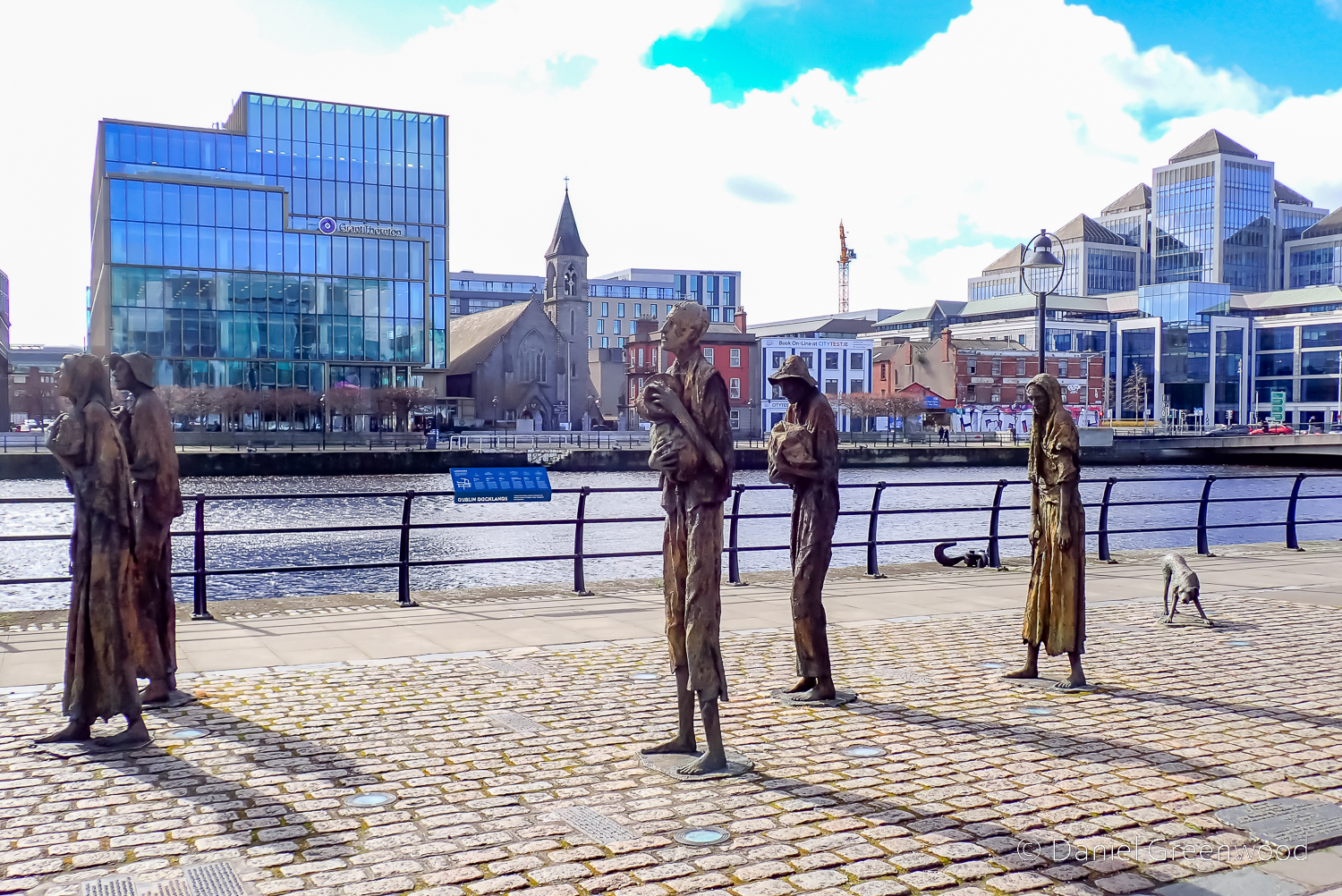
The Famine Sculptures are one of the most striking installations along the Liffey. They act to remind us of the millions of people forced to emigrate or leave their homes during the Great Famine (1845-49). It is a shocking event in British and Irish history and too few people in Britain are educated about it.
I don’t mean that from a place of “victimhood”, as one true British patriot put it to me once. It’s just that I’ve come to appreciate that the understanding of Irish history is very poor in Britain. Irish history is British history, too. There is so much more we could have learned in school about the role of the British Empire and how it explains the country we find ourselves in today.
On a lighter note, this Saturday Night Live sketch with Paul Mescal poking fun at those of us with ‘Irish ancestry’ is very funny:
From a personal perspective the famine drove my Mayo ancestors to attempt new lives in North America. The statues here are in place alongside where one of the “famine ships”, the “Jeanie Johnston” departed for New York:
The original Jeanie Johnston carried 2,500 Irish emigrants across 16 journeys to North America during the Famine.
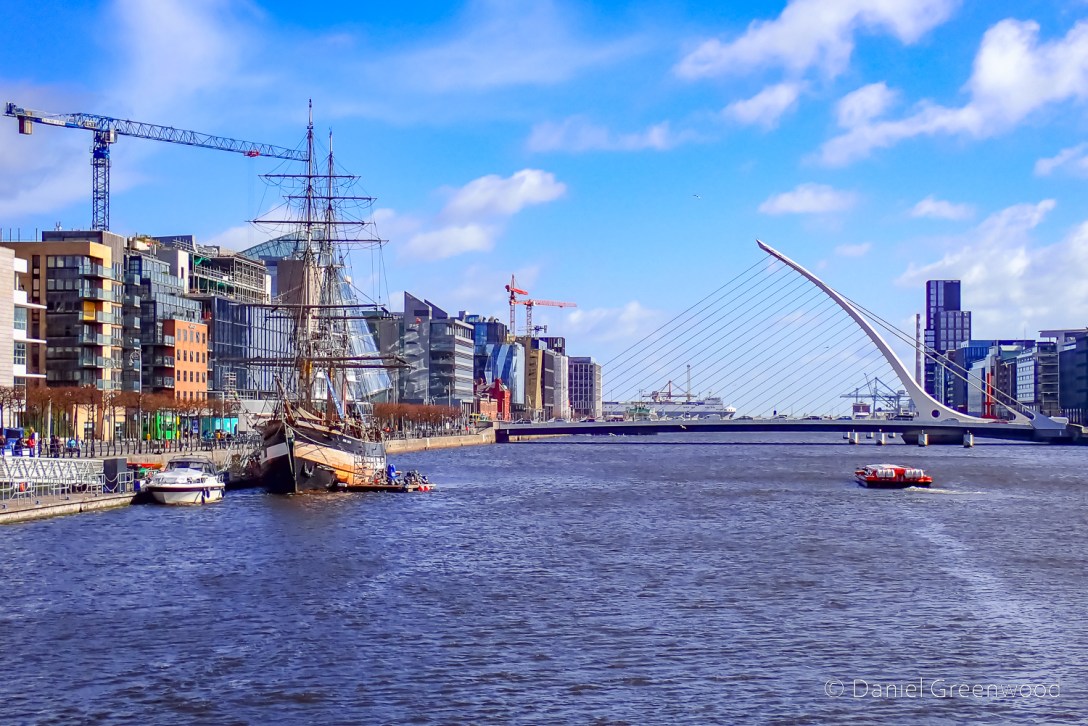
You can see the Jeanie Johnston moored in the left-hand side of the image below right.
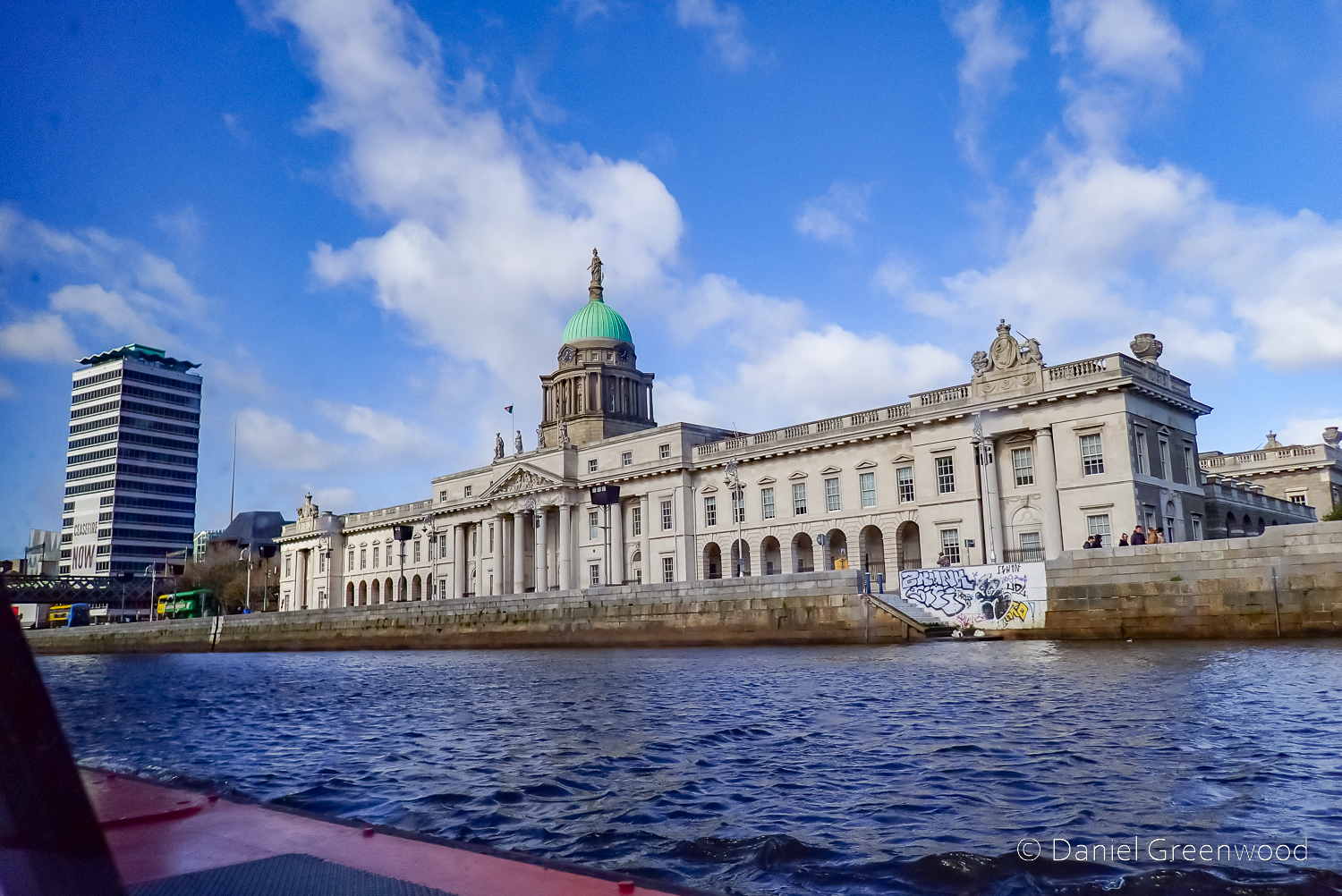
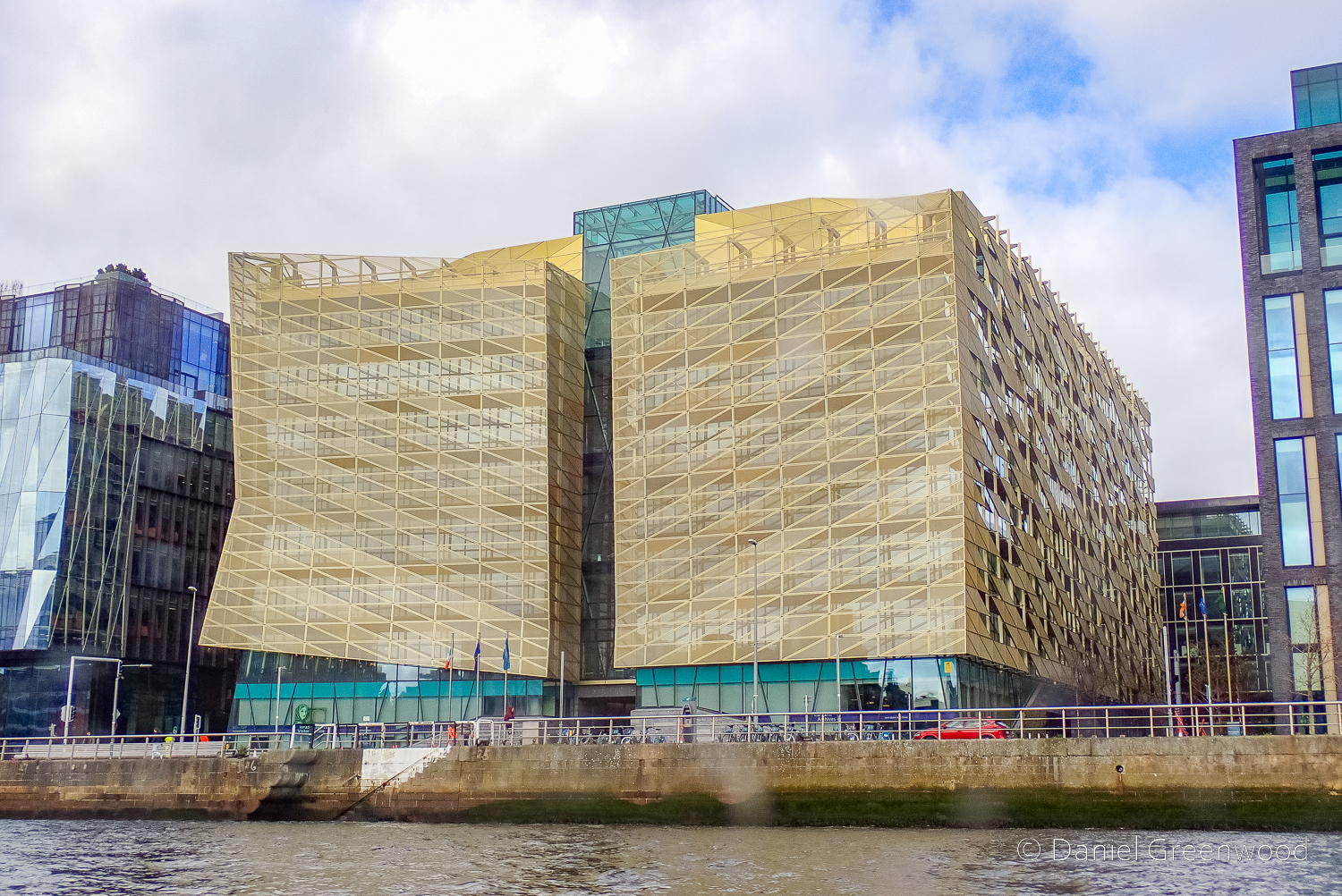
Custom House dominates part of the north bank of the Liffey. It was burnt down in 1921 as the Irish Republican Army attempted to destroy tax records in a raid.
This building once managed the movement of goods up the Liffey into Ireland.
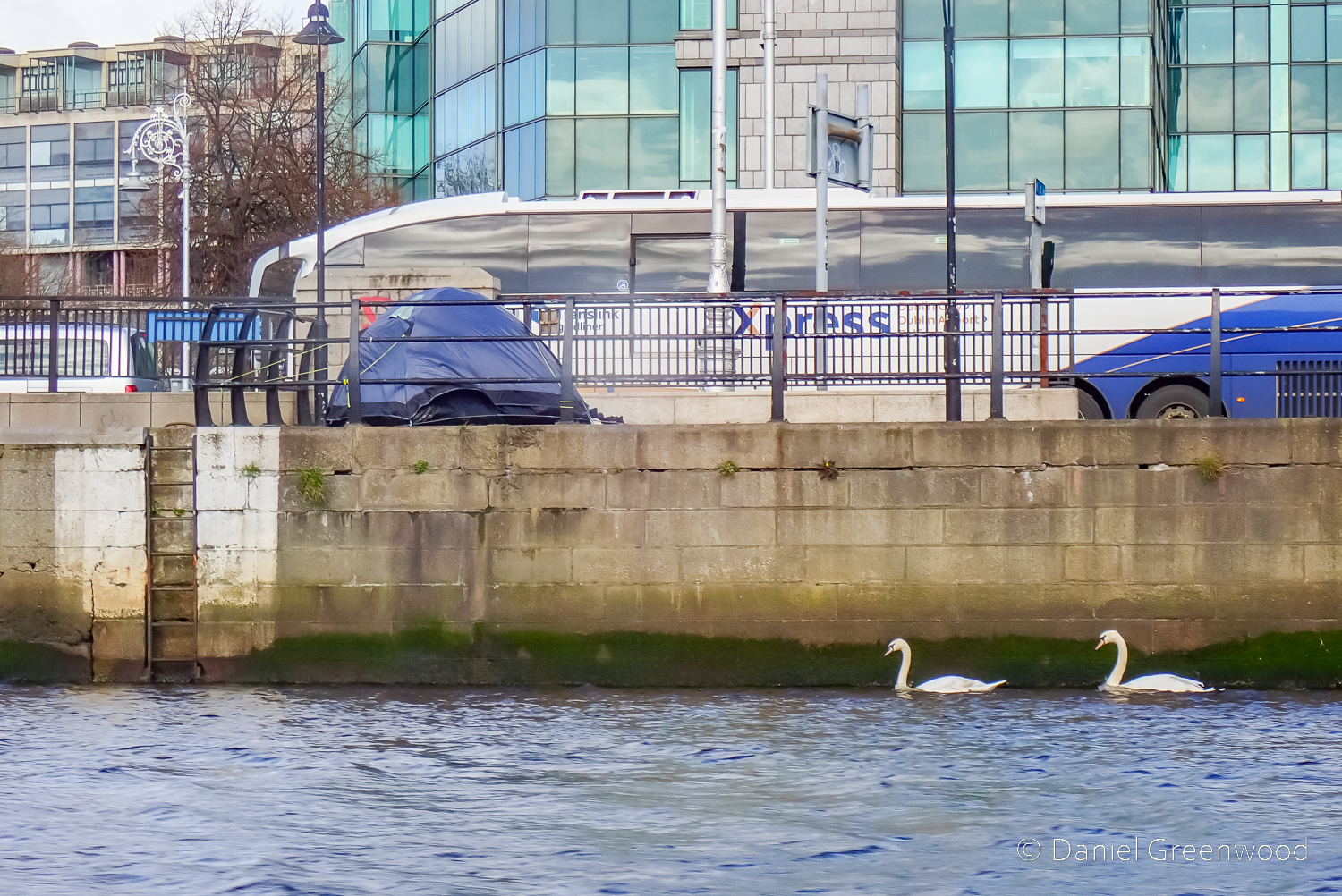
And here it is from street level. The tent on the left is where a person was rough sleeping. We were told that the river was once significantly wider than it is now.
Two swans in the river on the other side – taken a good half an hour later, don’t worry.
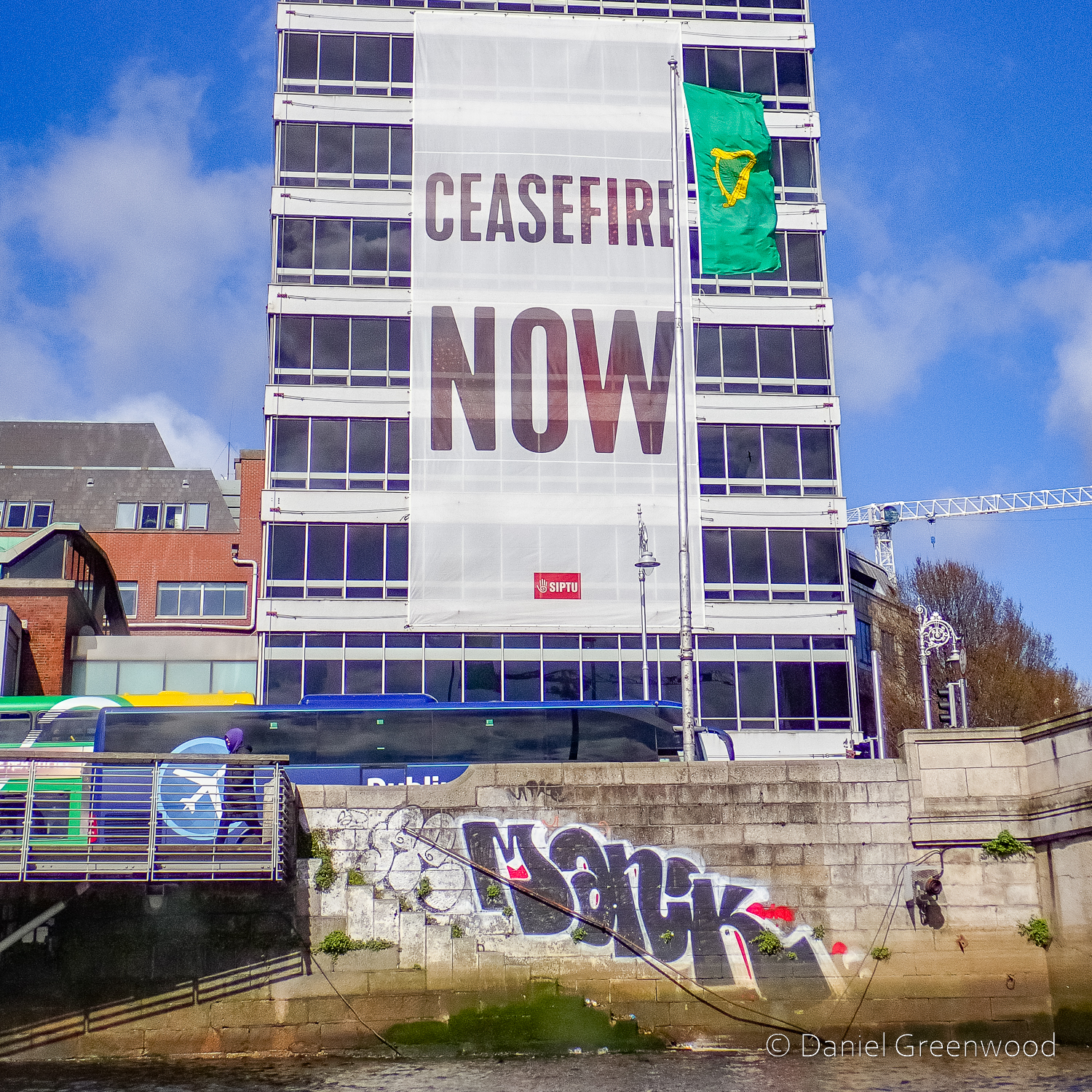
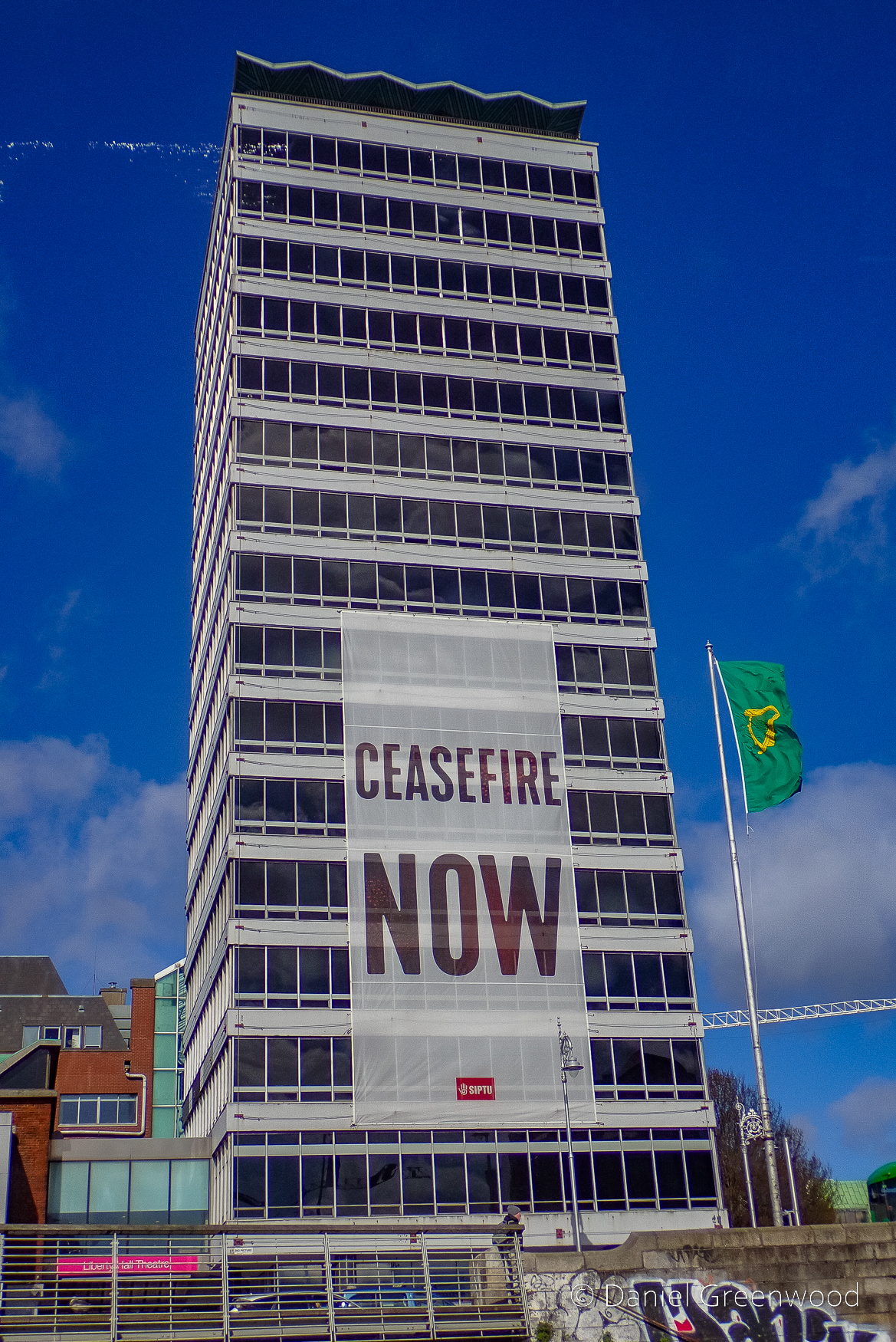
At first this tower looked disused but I’m not sure if it is. The banner’s related to the Israel-Hamas war in Gaza (at least 2023-present day). Ireland is outspoken on the need for a ceasefire, a two-state solution and for an end to the Israeli military’s occupation of Gaza and the West Bank. The banner seems to have the name of SIPTU – a trade union – branded on it. For the those who aren’t aware, the Palestinian cause is one of the most significant humanitarian and political issues for ‘the left’ in Britain and Ireland, probably more so than Russia’s invasion of Ukraine.
Another year completed and lessons learned. Creatively I have found a balance with my equipment and the actual process of photography. I’m into my 6th year of working with Micro Four Thirds cameras and lenses, giving more space to enjoy the process of gathering photos – walking – because the equipment is light.
Cameras used include Olympus EM-5 Mark III, Oly EM-1 Mark III, Olympus TG-6 Tough compact camera, and Pixel 7a phone camera.
These photos should show the range of things I like to take pics of – not just mushrooms! 😂
With the privileges available to me – health, location, resources, freedom of expression – here are my photographic highlights of 2024:
January
I did a couple of long walks in Sussex at the beginning of the year, exploring some new locations around the South Downs. I visited St. Botolphs church for the first time, one of Sussex’s special ones among thousands of already significant churches. Last year I set up a gallery for my fledging church photographs project which can be viewed here.
February
This felt like the moment of the light returning after the dark winter months. The Downs at Amberley are my gateway to the South Downs, and walking here is always worth the gentle climb.
March
In March I visited Dublin for a weekend and took in the sights along the great river Liffey.
For a friend’s birthday we spent the weekend in York, which gave me a chance to take some compact camera pics of a few of the oak timber framed buildings. I’ve added a gallery for my ‘Oak Timbers’ project here.
April
I got married in April so there wasn’t time for much beyond the odd local walk. I was trying out my new Pixel 7a, bought because of its value and reported image quality. The camera is spectacular, I just wish it wasn’t a G**gle product. I blogged about it here.
May
Ah, memories. In May we went on our honeymoon to Austria and Switzerland, all by train. You may be sick of reading about that! I am definitely not sick of blogging about it though!
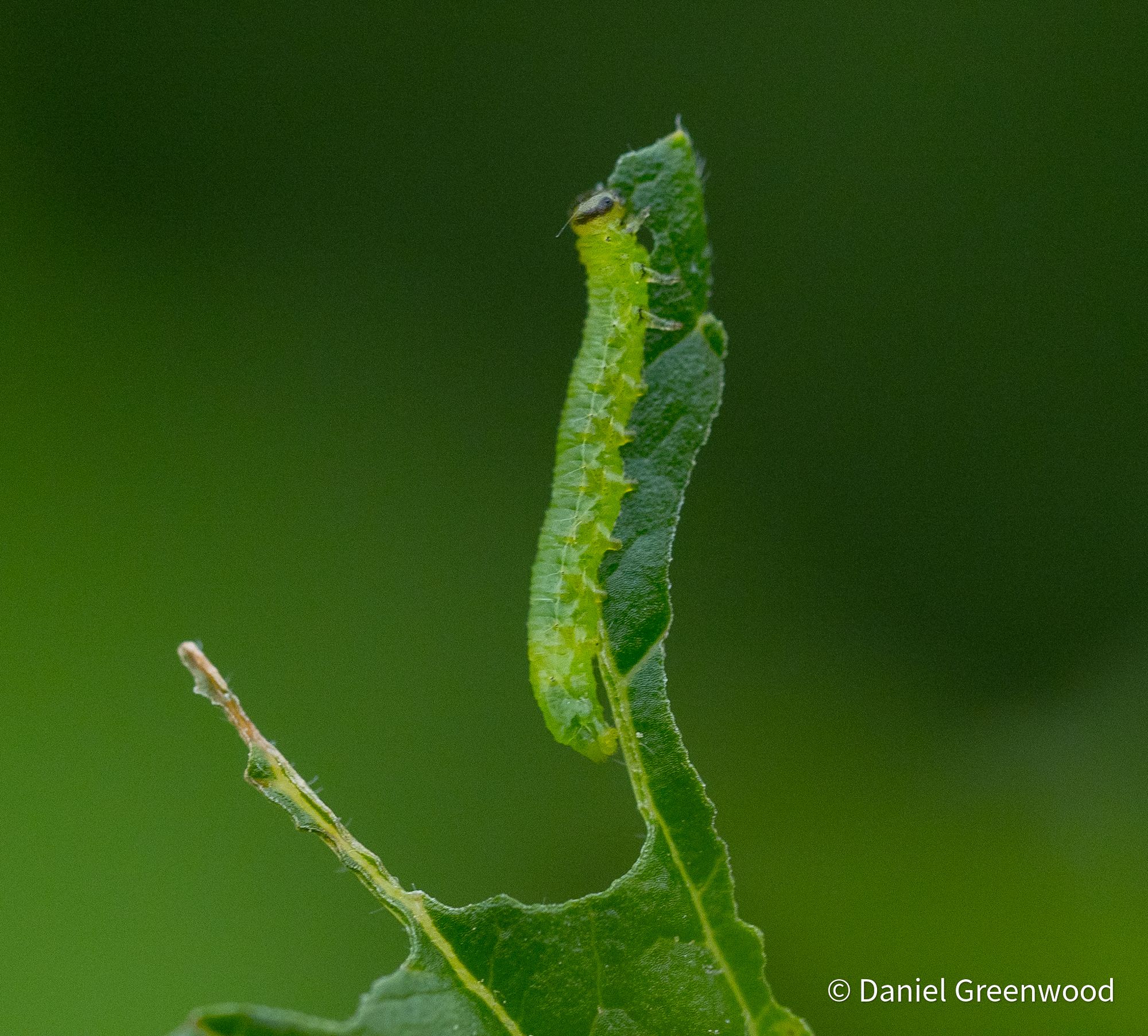
A bit of a lost month for photography because I started (yet another) new job and had to settle into a new routine. The highlight was probably these sawfly larvae which ate through some of the leaves on my gooseberry. Blog here.
July
“July, July, it never seemed so strange”, as the Decemberists sang. I caught Covid and didn’t really get back to normal for 3 months afterwards (Vitamin D is very important, people). My macro work was reduced by the evil contagion but I did find some nice bugs near home to share.
August
I managed to pap some pretty fine inverts in August, with this beautiful ichneumon wasp seen in my garden. I’ve not got anywhere near enough out of my Olympus EM-1 Mark iii and 60mm macro, but this showed just how good Micro Four Thirds cameras are for macro.
Another strongpoint for M43 cameras is that they can ‘stack’ images internally, something now copied by the big hitters. This is a composite of about 10 photos the camera has laced together to ensure the depth of field covers a deeper focus range. It means more of the, rather gruesome, subject can be seen in detail.
September
In September I made my first ever visit to the iconic sea stacks at Downpatrick Head on the North Mayo Coast in Ireland. Mayo has an international dark skies designation so I was able to mess around with the Milky Way. But for the astro photo I haven’t processed these images yet so here are a couple of phone photos.
October
As I have lamented on my Fungi Friday blog, 2024 was not the best mushroom season. But there are always things to find out there. I found this knocked over fly agaric, which was in perfect condition, ready for its portrait.
November
Autumn is a time for Dartmoor for me and my wife, and despite colds we managed some walks onto the moors in the National Park. We found an amazing array of waxcaps, like the crimsons above, which you can see in full on Fungi Friday.
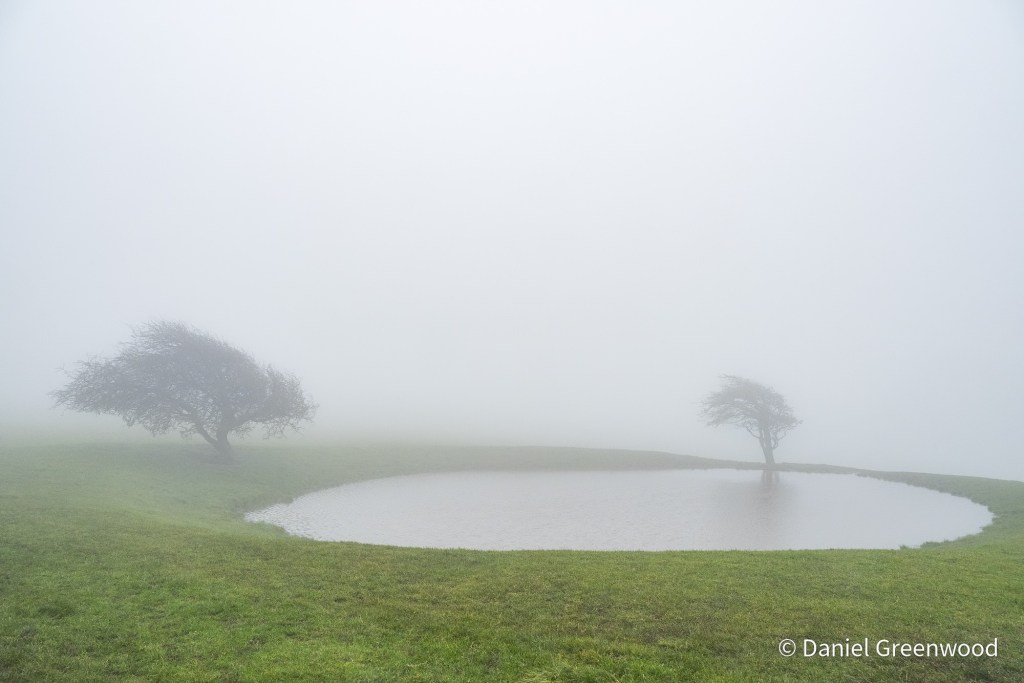
On the last day of November I hiked with my South Downs amigo from Ditchling into the mist. This is the much-photographed Ditchling dew pond, shrouded in mist.
December
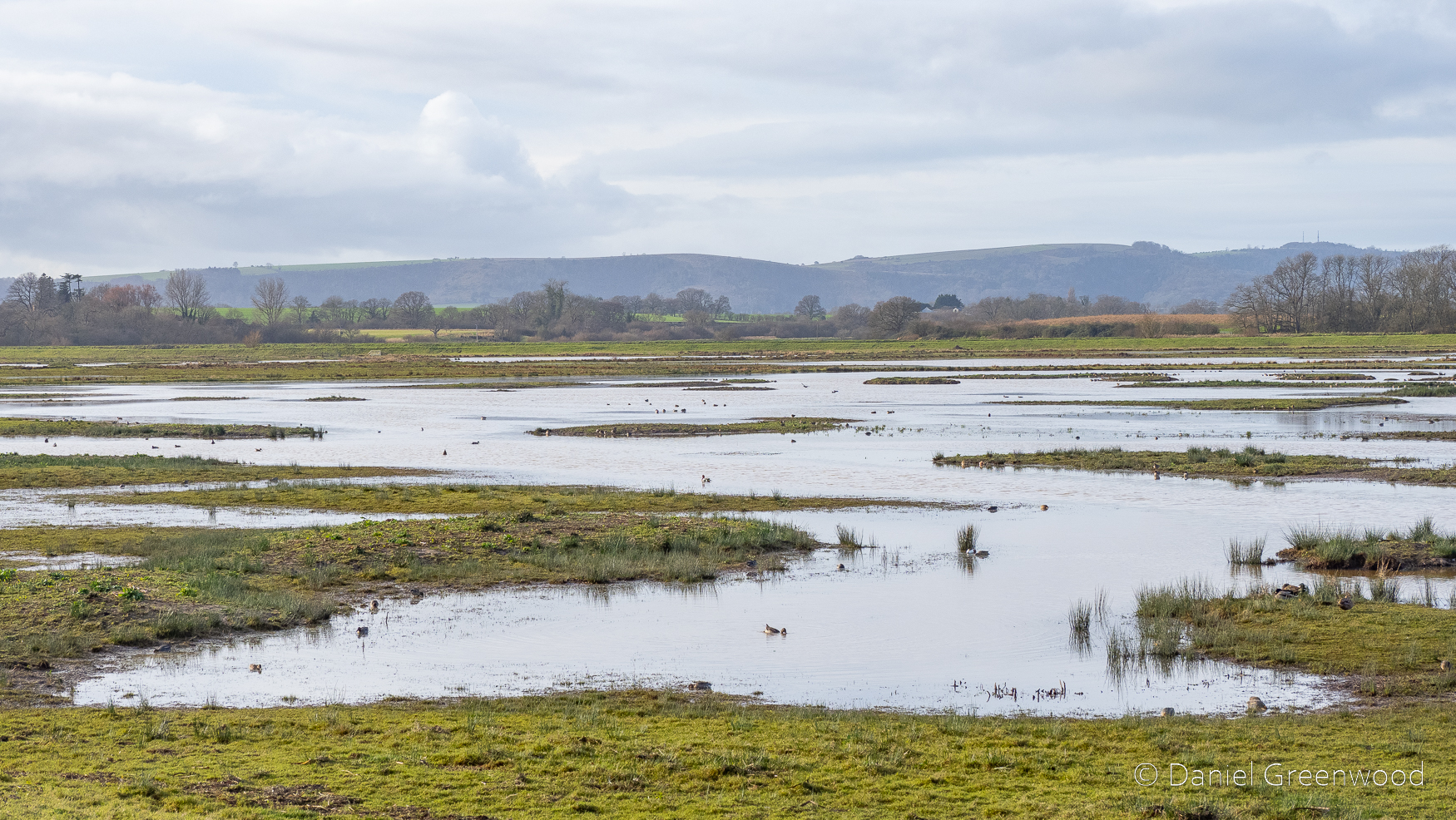
The weather in December was very grey and damp, and all the Christmas demands gave me only one meaningful walk – to Pulborough Brooks in West Sussex.
Thanks for all your support in 2024 and wishing you peace and happiness in 2025.
A few years ago I read Karel Čapek’s At War with the Newts. I can’t remember much of this absurdist Czech novel, and to be honest I struggled with it. It was not exactly grounded in ecology which all great novels must be. Kidding.
However, when the political news-cycle pedals round to how difficult politicians find it to build houses or appease the masses, I think of this book.
Why are newts (great crested, in this case) and bats getting stick? It’s because they have ‘strict’ protections (which are apparently very poorly applied, by the way) that can defer or even stop developments. Just ask our previous but three Great Leader.
Bats have strict protections because some species have declined by 99% since 1945. Newts and bats have no meaningful place in our lives unless you hold on to fond childhood memories or you’re an ecologist. This makes them fodder for politicians looking to distract.
I don’t see anyone decrying owls for their role in the cost of living crisis (yet).
And you definitely don’t see people going after that lovely snoring dormouse, another licenced species.
The protections we have for what little wildlife we have left in the UK are so weak, and so pitifully enforced, that it just beggars belief politicians will go after wildlife in this way.
It’s somewhat surprising the current government has gone there at all, let alone so early in their tenure. But who else has singled-out species for holding back economic development? You guessed it – the Communists.
Men in Maoist China shooting dead a tree sparrow with six guns.Well done lads.
In 1958 Chinese Communist Leader Chairman Mao tried to eradicate tree sparrows to protect grain by creating a populist uprising against this poor little bird.
What the war on ‘pests’ actually did was to cause large-scale famine among the very people who had undertaken the orders to eradicate tree sparrows – the peasantry. As many as 55 million people died. Little did that Great Leader know the precious grain was feeding one of nature’s great pest-controllers – the tree sparrow.
Continuing my series of posts about the landscape of the Jungfrau mountains in Switzerland, here is a look at some of the woodland plants seen above Grindelwald.
Just to say: picking or trampling on wildflowers is not advised, and may be illegal in some locations. The meadows shown here form part of people’s livelihoods as well as being sensitive habitats. Woodlands are extremely sensitive to our footsteps so stick to designated paths where you can. Check the regulations around foraging before you go and show respect for people and wild plants, animals and fungi when you visit. There’s a lot of livestock around, usually behind fences, but they’re so noisy you can’t miss them.
The photos here are a mix of mirrorless camera and phone. The plants photos are mainly taken with my Pixel 7a, the landscape photos with my Olympus EM1 Mark III. All have been lightly processed.
The walk
The walk was a fairly short one in length, mainly due to the altitude and general tiredness from travelling. It would be a good one if you’re visiting from Interlaken on a day when it’s not worth going higher or it’s too early in the season.
The walk is about 2.5 miles and can be done more quickly if you’re not taking photos of plants!
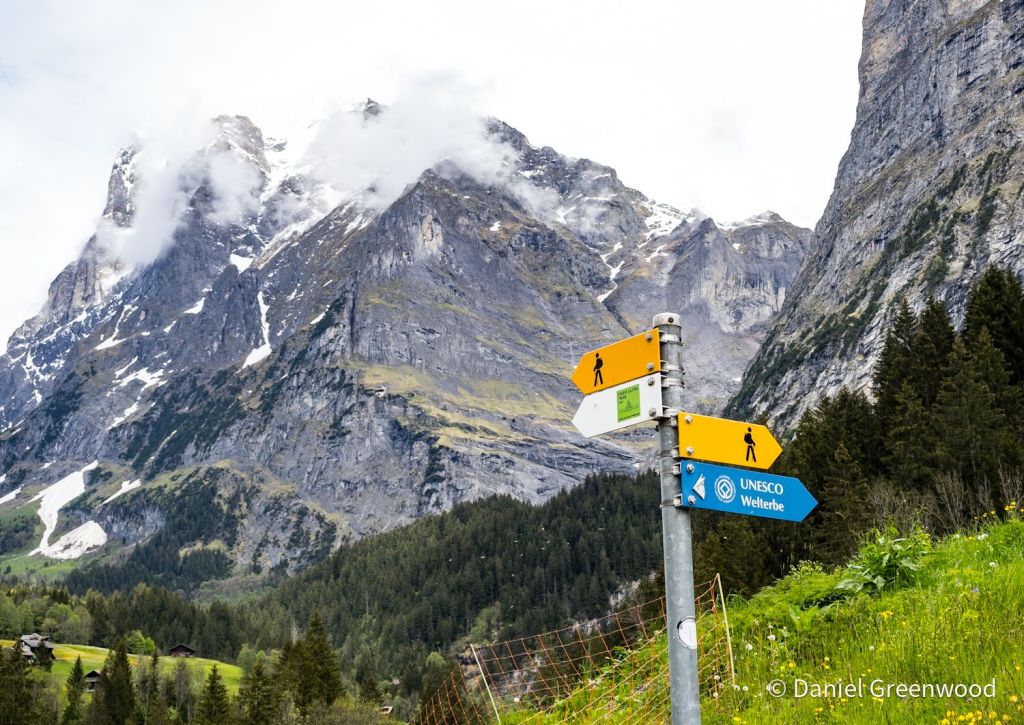
All the high trails, including the Eiger Trail, were closed when we visited. Climate change may be making rockfall more common and therefore the higher trails are more dangerous.
It’s possible you can do this walk and see absolutely no one, but for a farmer or two, after you pass the toboggan run.
We took the Pfinstegg cable car up to the Berghaus restaurant, had some chips, and walked down to the village, past the toboggan run.
What you can’t hear is the sound of middle-class Americans talking about their Adriatic travel plans.
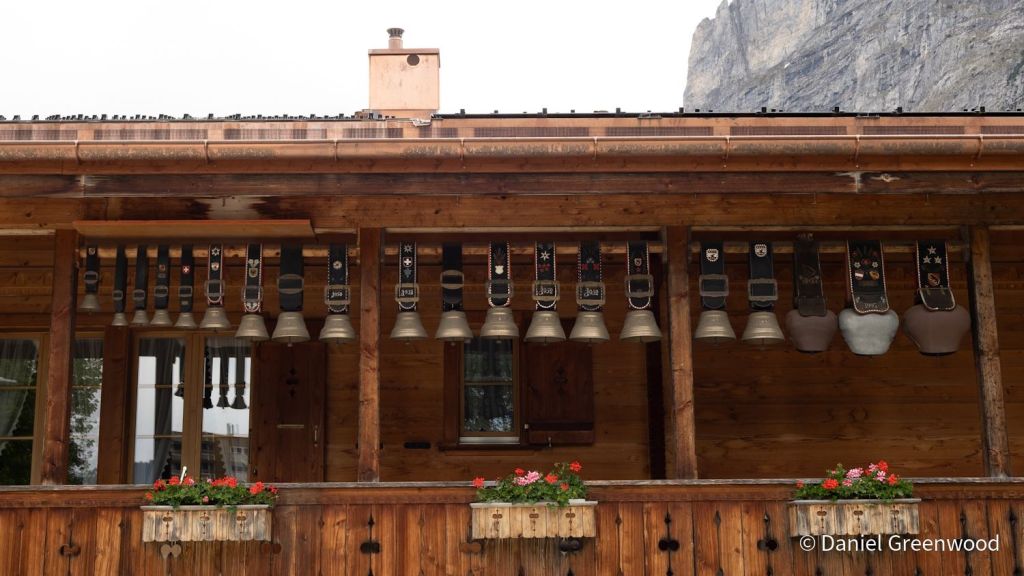
One image I wanted to share was this exhibition of alpine heritage. Here you can see the array of bells used in the Jungfrau for cattle management. The sound of the cowbells is one of the signifiers that you are in the Swiss Alps. Of course the same can be said for many mountain regions, but each one has its cultural differences. That’s a different blog entirely!
Alpine flowers (1300m)
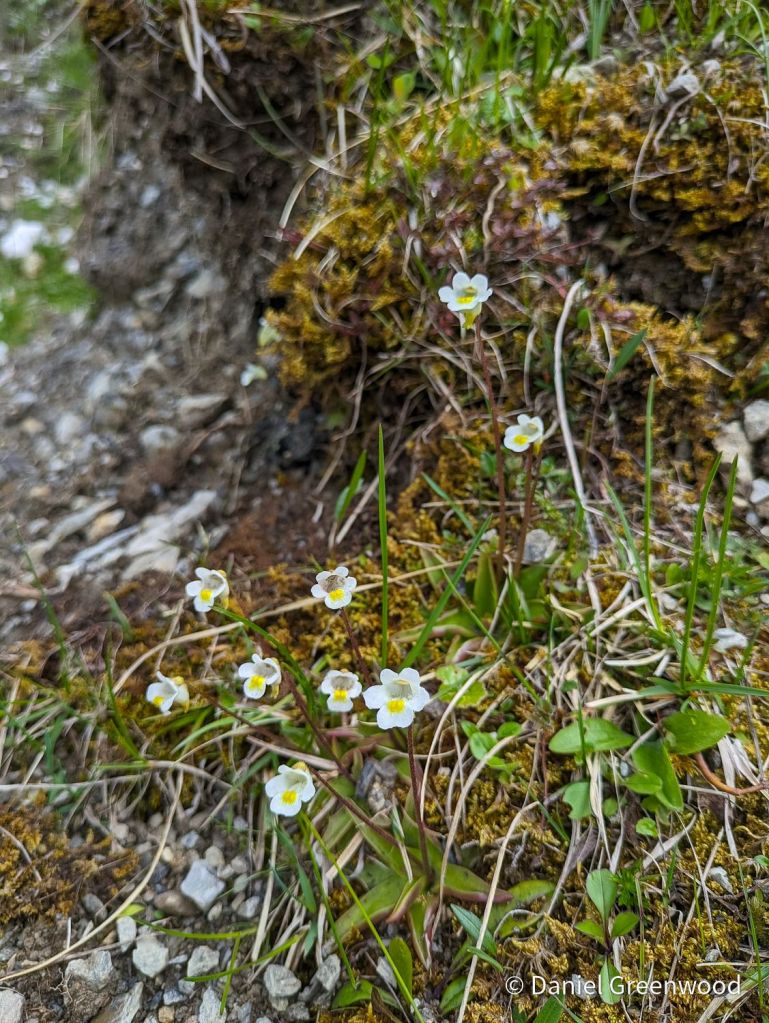
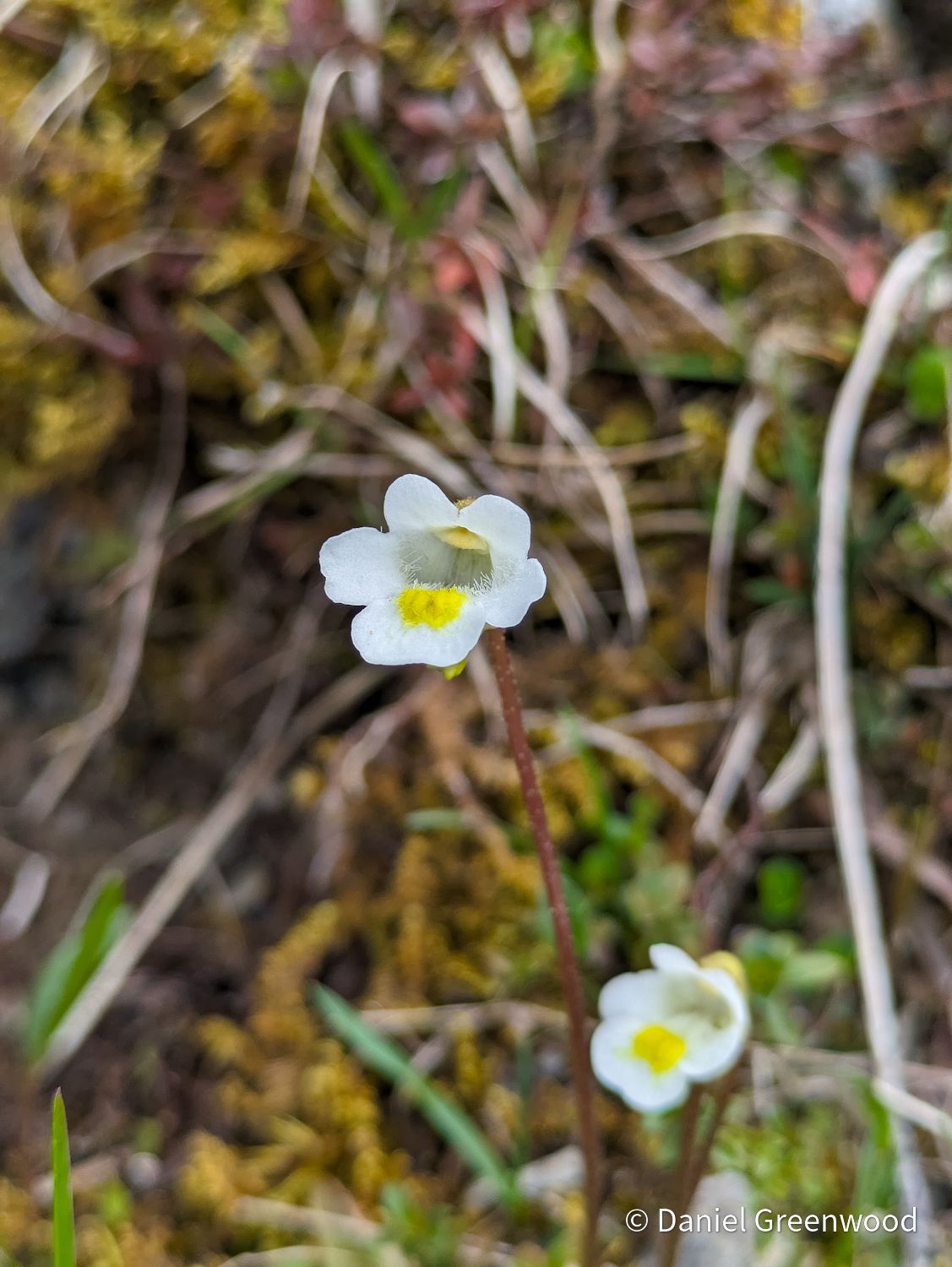
One of the more common sightings in the alpine zone was alpine butterwort, (Pinguicula alpina).
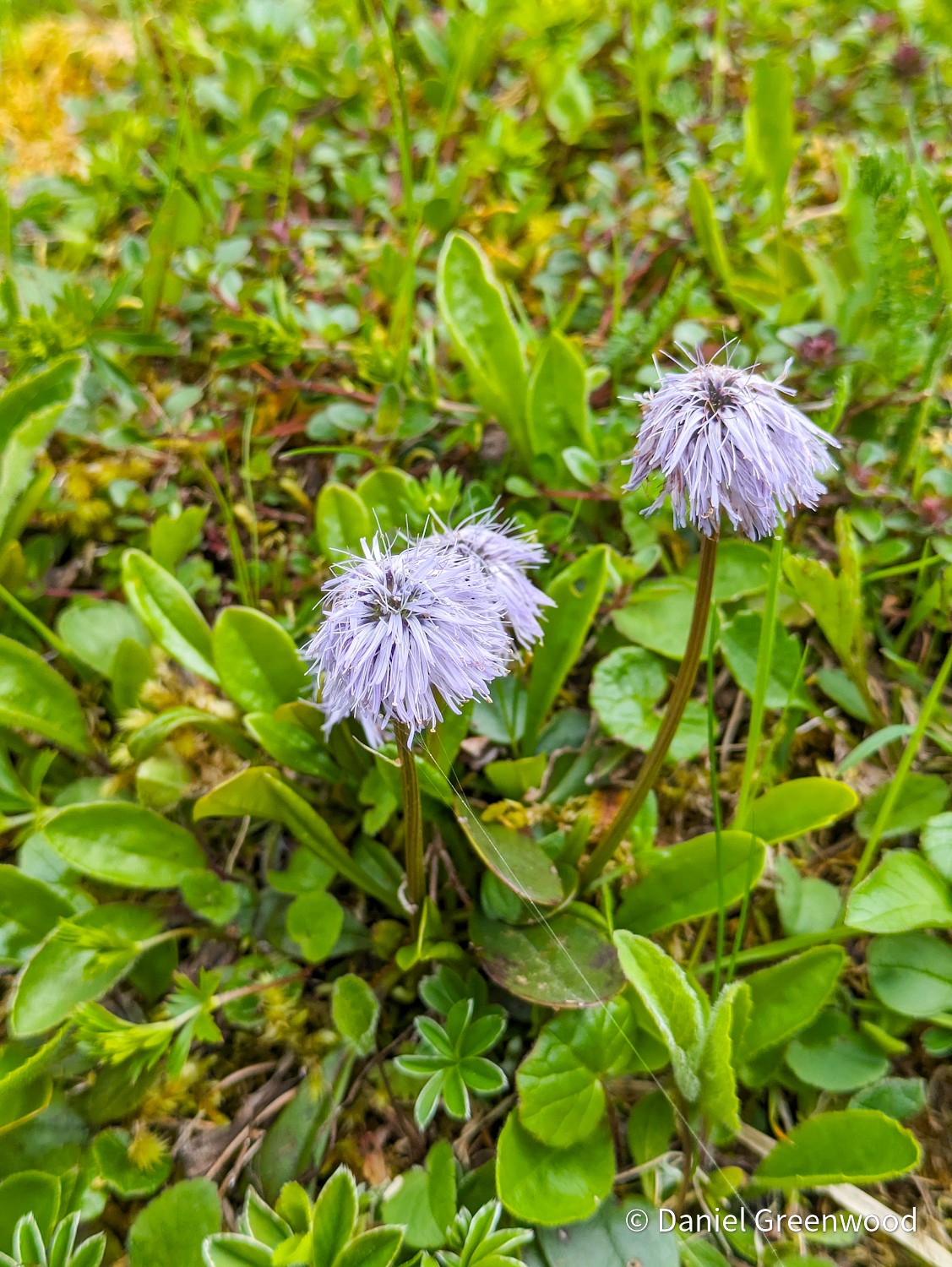
A regular of this habitat was leafless stemmed globularia (Globularia nudicaulis). They look like little lilac mops.
At this point the views of Grindelwald began to be swallowed by the spring woodlands.
In the woods
As you can imagine, the water was crashing down as the snow melted. A lot of work is going into observing the changes in the glaciers in the Swiss Alps, which is happening at an alarming rate here.
You can get views of the Lower Grindelwald Glacier from this walk (though this was taken lower down). This glacier shrunk by over a mile between 1973 and 2015.
I love a new violet species that’s easier to identify than ours at home. This is twoflower violet (Viola biflora) and was only seen in the woods at the edge of lanes.
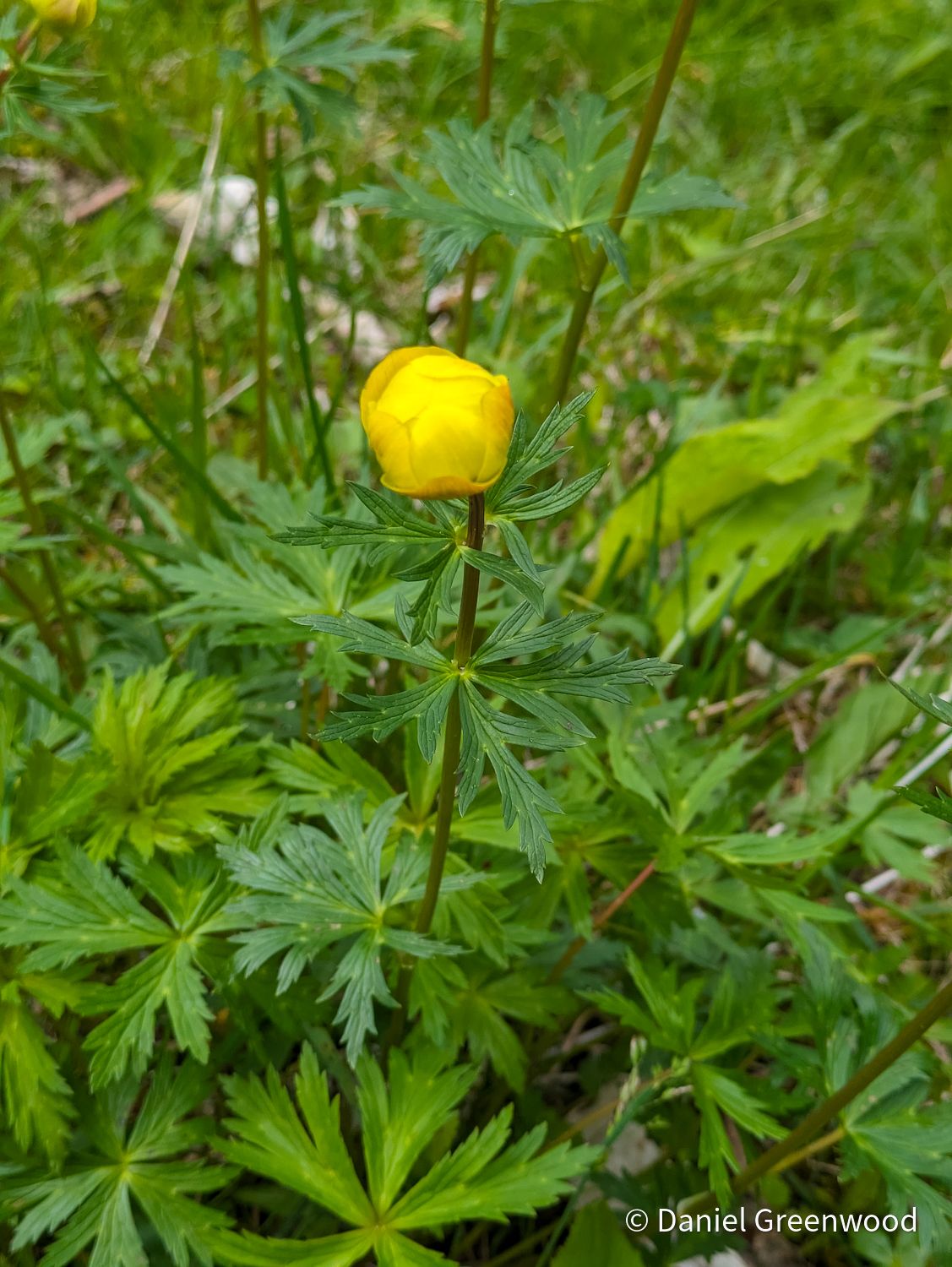
It’s always nice to find globeflower (Trollius europaeus), a species of buttercup.
This was a new species for me – may lily (Maianthemum bifolum). It looks more similar to something like black bryony or bindweed to the untrained eye (this one).
This cranefly was resting on the leaves of yellow archangel, a woodland plant we seem to be losing in the UK.
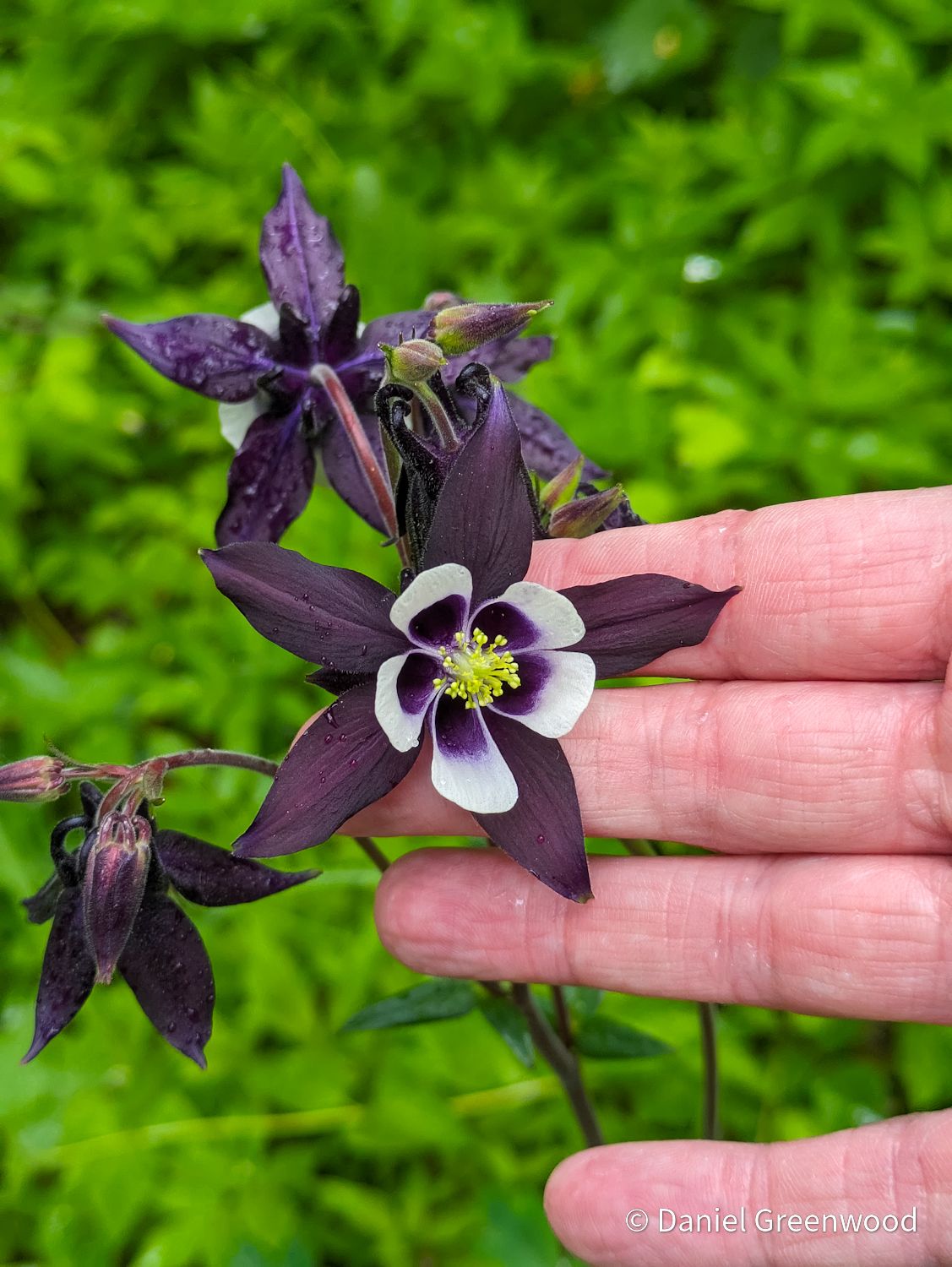
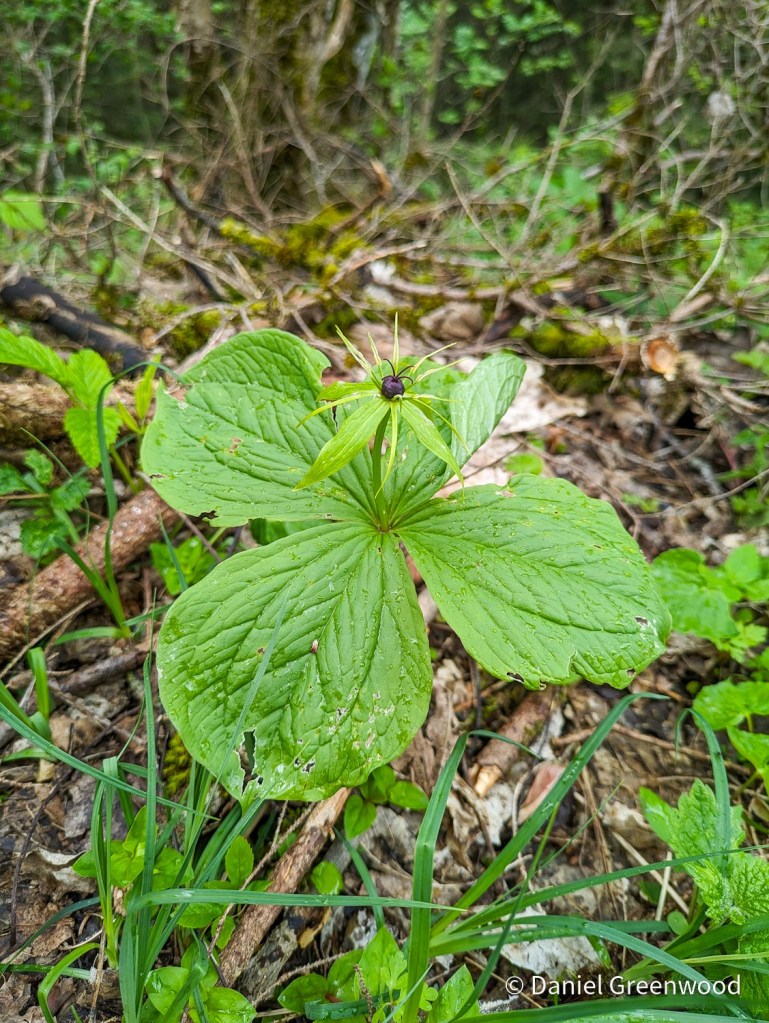
It’s always a joy to encounter herb paris (Paris quadrifolia). I think the columbine (Aquilegia vulgaris) seen here is probably a garden escape, though it is an ancient woodland plant as well, so I may be wrong. I hope it’s the wild one!
There was more herb paris, but only in the woods.
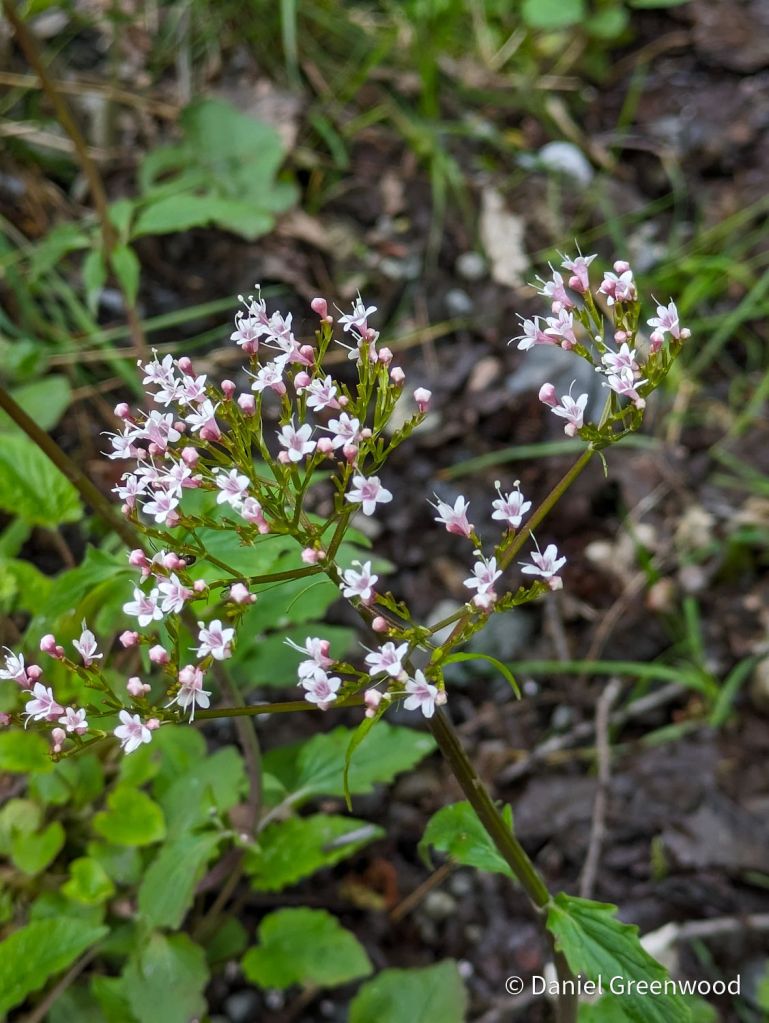
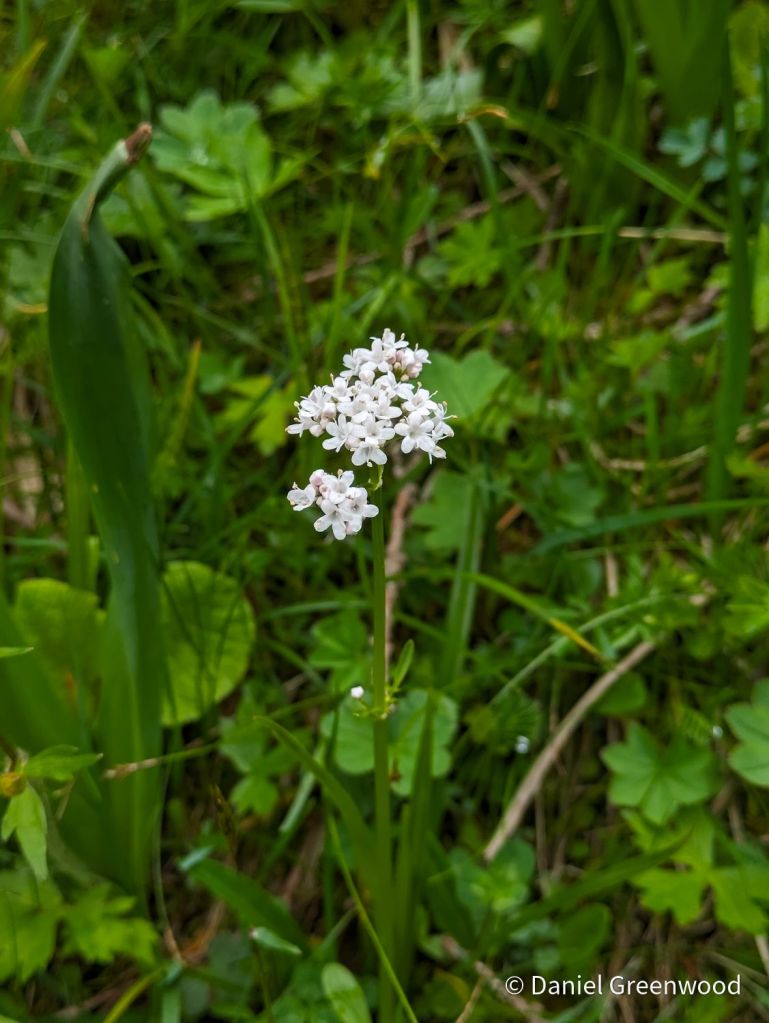
There were a couple of valerians. This one is three-leaved valerian (Valeriana tripteris). It was growing in wet areas.
Now, there weren’t a lot of orchids out at the time as it was probably too early in the season. But this is bird-nest orchid (Neottia nidus-avis), which I’ve only really seen in the chalky woods of the North Downs in England.
This is fly honeysuckle (Lonicera xylosteum), a strangely shrubby honeysuckle compared with the climber we have in the UK. It’s been introduced to Britain but I’ve never bumped into it.
Hillside meadows
Let’s just take in the views of the Wetterhorn for a bit…
I’d like to be out walking in World Heritage landscapes every week, but alas, it will just have to be once or twice in life.
Looking south-west towards the Eiger.
Mountain sainfoin (Onobrychis montana) was one of the most eye-catching plants, growing at the edges of the lane if I remember rightly.
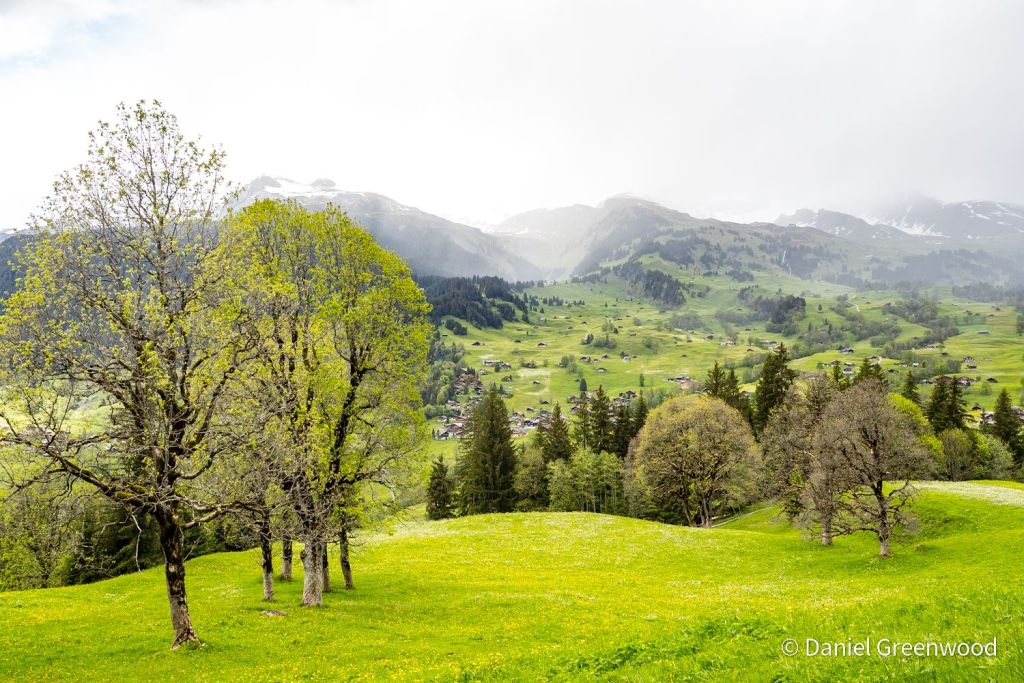
The spring really glows in this image, despite the misty conditions. The sycamores are coming into leaf.
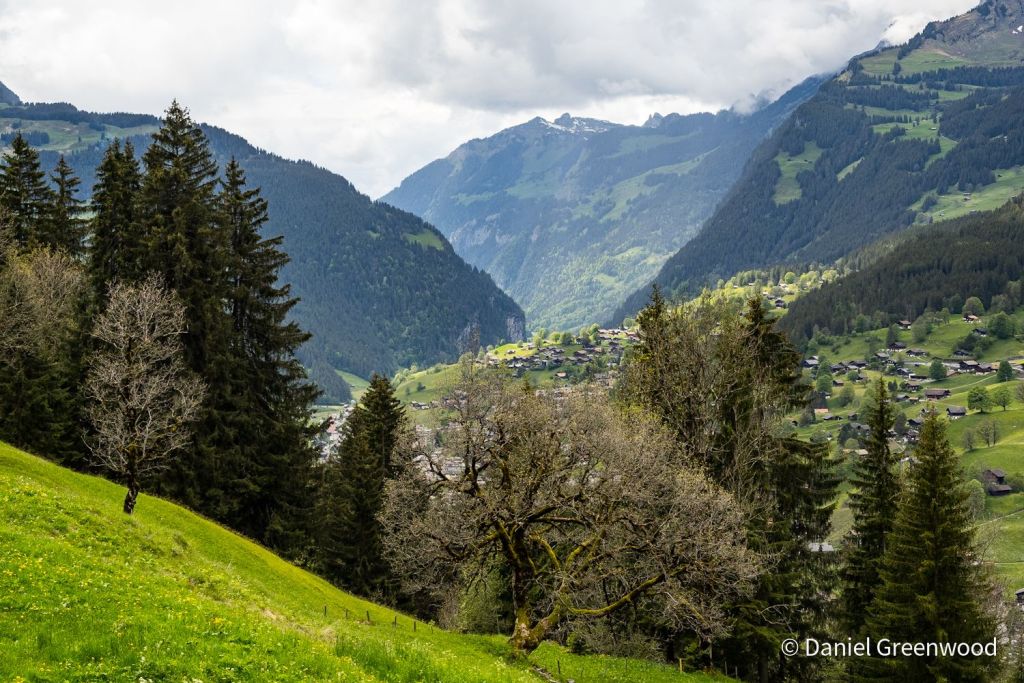
This is a view down the valley where the train returns to Interlaken.
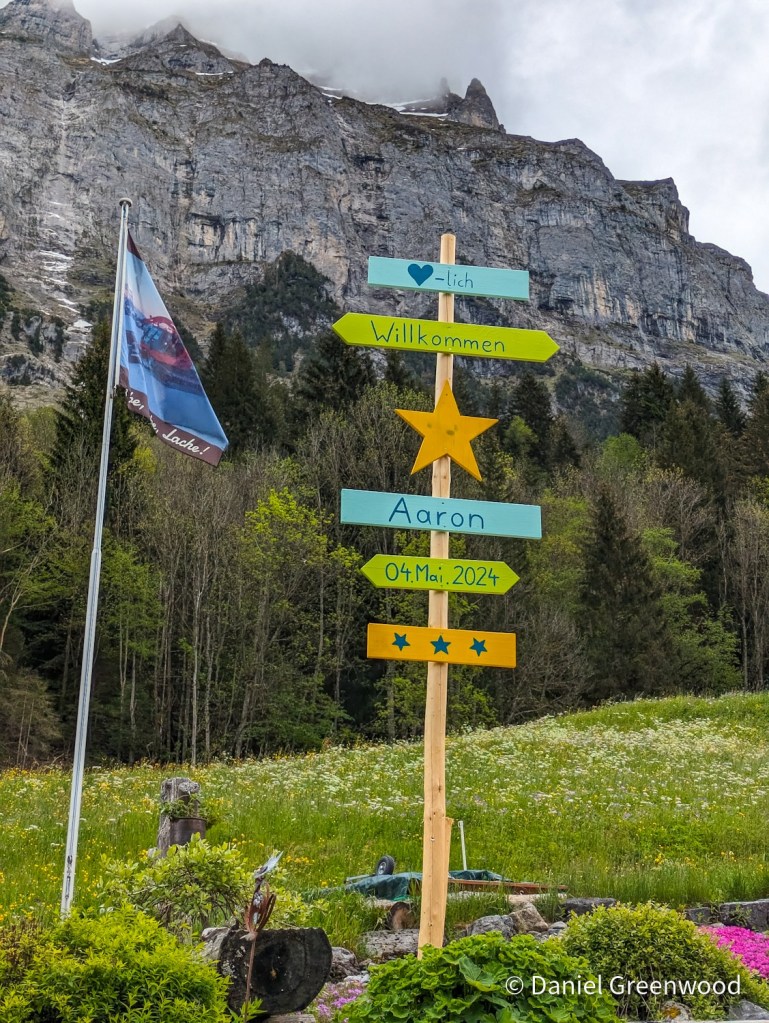
This is something I’d never seen before – a totemic welcome for Aaron who was born on 4th May 2024. Perhaps this is a tradition in this part of Switzerland?
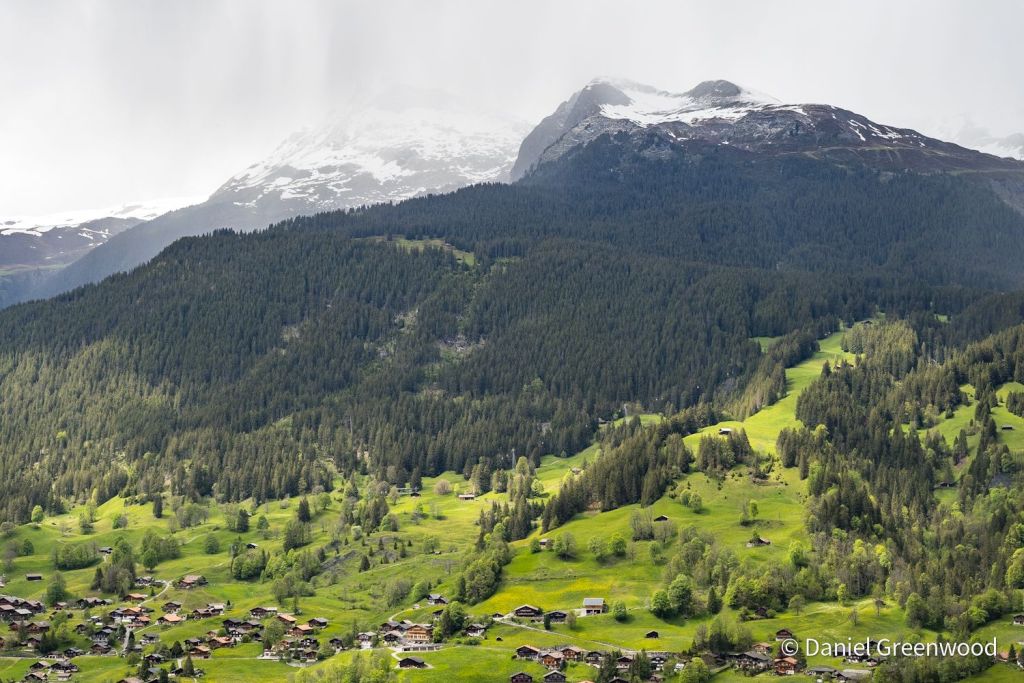
The views across towards Grindelwald First come into view as space opens up on the woods. You can see all of the chalets that dot the meadows.
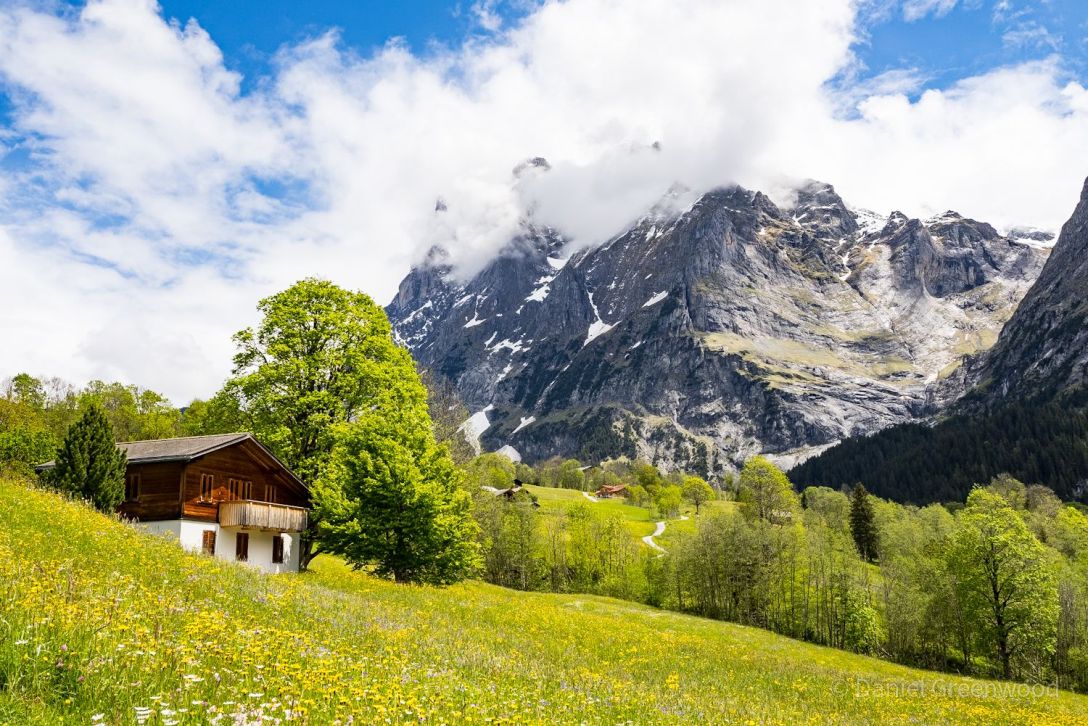
I was intrigued by these rustic chalets that were more indicative of a rural way of life, compared with the guesthouses in the valley. It looked lived-in or at least used by people who made use of wood products. What a lovely place to be able to escape to in the summer. Of course communities would have developed from these single dwellings across the Alps.
This image looks north towards the other side of the valley. The yellow hue in the meadows is either kidney vetch or birds-foot trefoil.
The lovely spiralling shell of a snail roosting in a tree.
These umbellifer-rich meadows were a joy to behold.
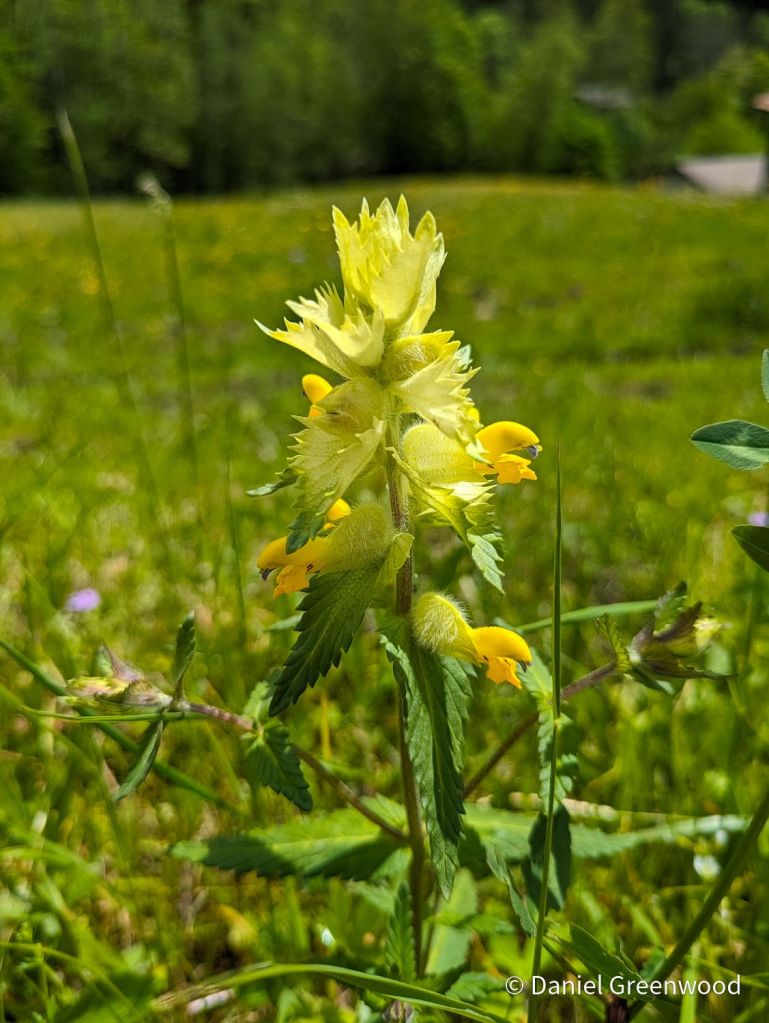
The lower we got (c.1000m) the more abundant yellow rattle become. This is probably Rhianthus serotinus.
This is the Black Lütschine, one of the rivers that flows into Lake Brienz. It was very powerful. Its source is the Lower Grindelward Glacier, pictured earlier in this post.
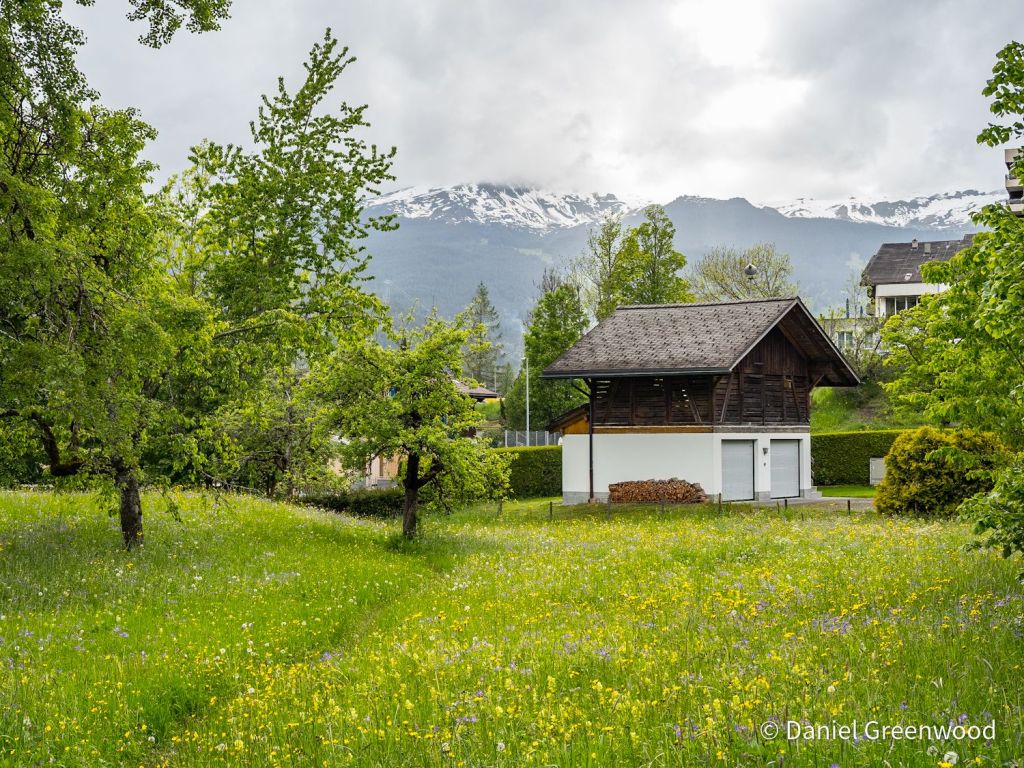
The meadows around people’s houses – this looks like an orchard – were in fine condition.
Thanks for reading.
I write these blogs in my spare time because I want to raise awareness about the beauty and diversity of our landscapes. If you enjoy reading themyou can support my blog here.
Welcome to my seasonal ‘brain dump’ of stuff. Now that I basically only use WordPress for anything that remotely resembles social media, there’s more to say.
I feel like I’m falling behind with writing and photography, mainly because of my job being so full on and having to work weekends of late, sometimes 6 day weeks. It can’t last.
While writing a book is not high on my list of things to do, I have a book there to be written about my time working at Sydenham Hill Wood and all I learned about woods during that time. I don’t know if it will ever come to pass though, it’s very hard to make space for that kind of writing when I work full time and have life to do.
Fungi Friday keeps flowin’
I’ve been quiet on here but the mushrooms are flowing every Friday on my dedicated fungi blog. You can now subscribe to posts on there via email if you want to.
The autumn of 2024 was one of the worst mushroom seasons I have known, having been keeping an eye on such things since 2011.
Why has it been so bad? I don’t know. But a lot of my normal sightings haven’t happened this year in places where they usually appear. The rain in recent months (so much rain) made me think that this would be a good autumn. It’s below freezing now and the leaves are down, so the season has passed. Next year we go again, as the footballers say.
Then again, my website has had an exceptional mushroom season, with October having double the traffic of some previous years entirely. It has got to the point that the Forestry Commission contacted me asking for me to edit blogs and add in information about their byelaws. I was happy to do that, having worked in woodland management in the past, and specifically in partnership with them on occasion. It doesn’t half feel odd when you get an email like that, though.
New photo galleries added
I’ve been updating some of the pages on my website and added two new gallery sections. I’ve now got a page for my oak timber-framed buildings and church photographs.
I’m not an expert on either subject and am not promoting any religion or building style, but these images need a home and are probably of interest in research terms to someone.
Check them out above. These pages will be updated as I find the time to organise the images properly.
Swiss Alps blogs
I’ve been working behind the scenes on more of my Swiss Alps blogs after visiting in May, with another two to come. I don’t know all the species I’m posting about so I need to identify them, which means it takes longer.
I think about those landscapes everyday and pine for a return.
Fishbourne Roman Palace
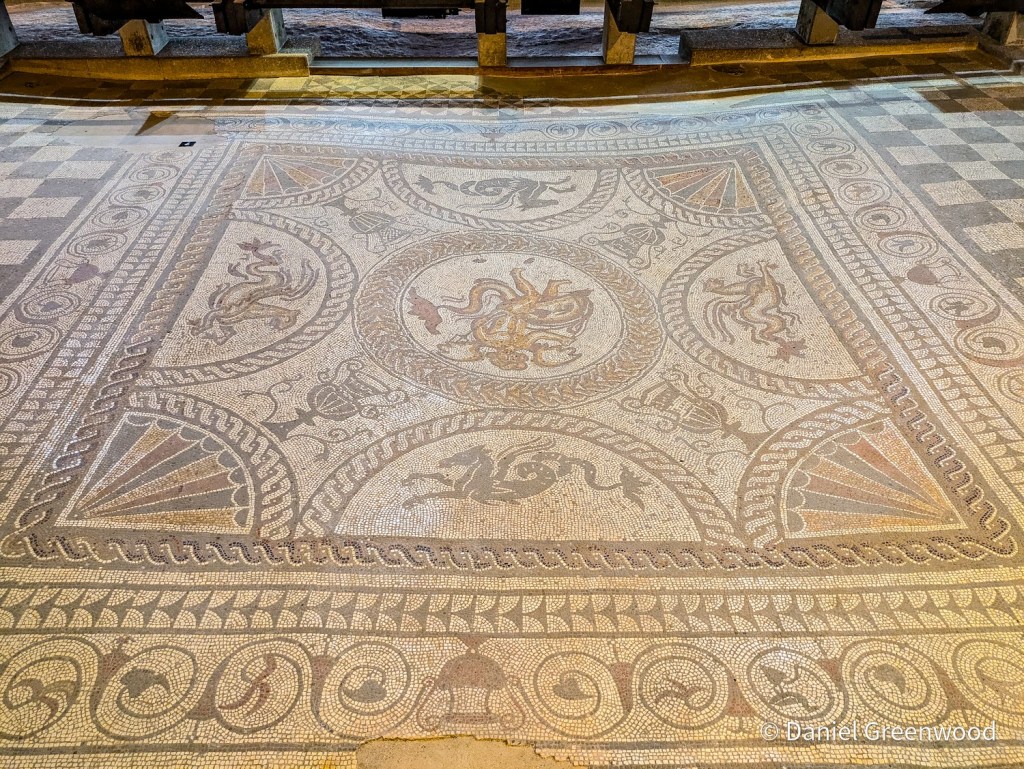
In October I visited Fishbourne Roman Palace in Chichester for the first time since childhood. Living in West Sussex and having worked across the county, you learn that Roman heritage is everywhere. It even forms the basis for some major roads like parts of the A29 or Stane Street.
This visit may have instigated an interest in Roman history, something I find to be very broad and difficult to find a way into. Mary Beard’s books and TV series have been a good step forward. Please let me know of any interesting Roman stuff in the comments.
My great-grandfather in his First World War military attire
Understanding the First World War
This year I’ve read six Pat Barker novels, all of which cover the stories of people living through and around the First World War (1914-18). I also realised that it has been 20 years since I sat my A-levels studying Barker’s novel Regeneration, among others. Last week I finished The Ghost Road, the finale of the Regeneration trilogy. It won the booker prize in 1995, and I can understand why. How lucky my generation was to grow up in a time of peace.
Remembrance Sunday has just passed here, but beyond the poppies it can be hard to see the real stories of the people whose lives were destroyed by the war. Poppies are everywhere, on everything, and I think this long article covers a lot of the issues arising from that.
My great-grandfather Wilfred served in that terrible war (pictured above) and I wonder how he, or my other paternal great-grandfather ever survived. My dad said that his grandfathers either didn’t say anything much at all, or they didn’t talk about the war. My aunt tells me that Wilfred was buried alive during some shelling and dug out by Canadian soldiers. I believe he was a runner in the trenches.
Lest we forget that several terrible wars rage today. If only they could end and their architects face justice for their crimes. History tells us that eventually that can, and often does, happen.
And finally, new music
One of my favourite artists of the last 20 years is Sufjan Stevens. I was introduced to him by my Scouse friends Kev and Graeme at university in Liverpool. Stevens has recently released Javelin, and it’s very good. A mix of his famous hushed acoustic tracks and his more eclectic electronic styles. He lost his partner and a lot of the grief has likely found its way into the record. You can listen to the full album above.
On Friday the legendary Joshua Tillman AKA Father John Misty released his latest album Mahashmashana. I’m waiting for the CD to arrive in the post! What I have heard, I love.
That’s it for now. Hoping you’ve had a good autumn, however many mushrooms managed to pop up near you.
Carrying on from the magnificent meadows of Grindelwald post, this post covers some of the alpine plants my wife and I saw on our honeymoon hike around Männlichen in May 2024.
The view from Männlichen
It was rather wintry atop the peaks of the Jungfrau with snow still covering grasslands above the treeline.
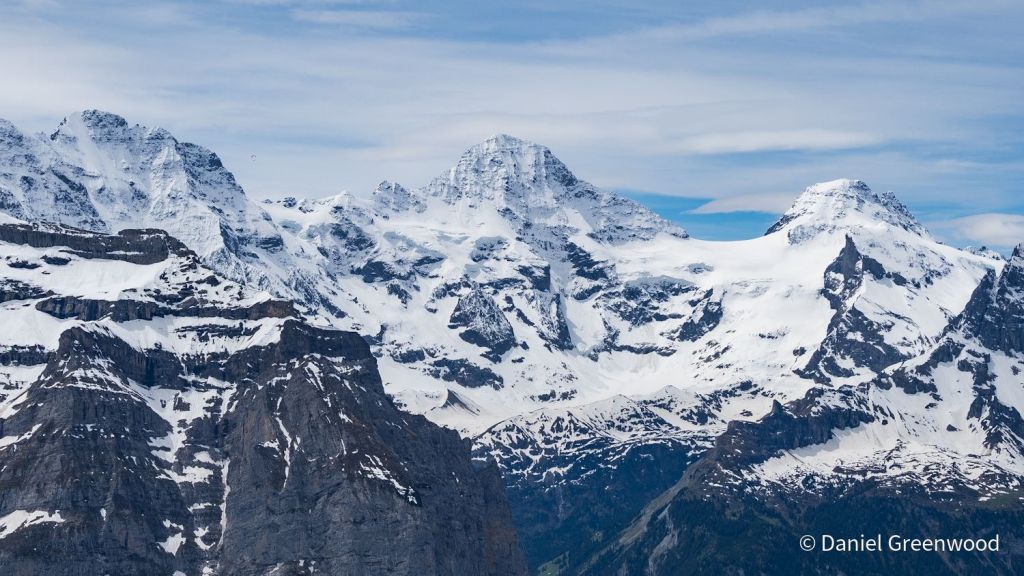
The Jungfrau peaksleft to right: the Eiger, Jungfrau and Mönch
The Peaks of the Jungfrau
Männlichen is accessible via gondola from the Grindelwald Terminal station. The Grindelwald stations can be confusing so do look into it to ensure you don’t get off at the wrong station, wherever you’re going.
View into the Lauterbrunnen Valley from Männlichen
When you reach the gondola station you alight at 2220m. Here you get fantastic views of the major peaks of the Jungfrau – Eiger (Ogre, 3970m), Jungfrau (Young Girl, 4105m), and Mönch (Monk, 4107m).
As it was still snowy and we were only kitted out for ice-free hillwalking, we walked down to the middle gondola station on the road.
Along the way we saw a lot of nice wildflowers, most of which we hadn’t seen before.
Wildflowers near Männlichen (2200-1800m)
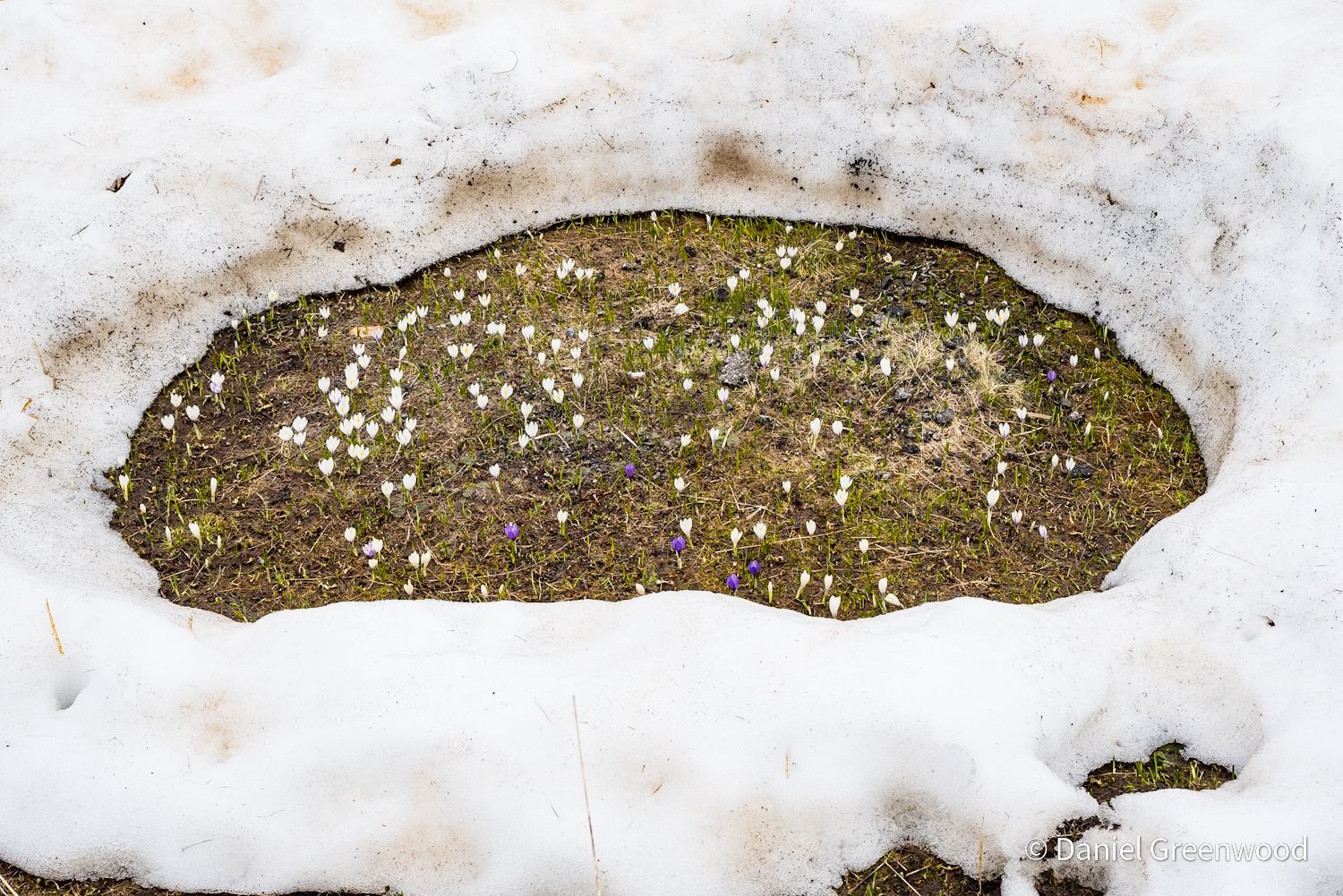
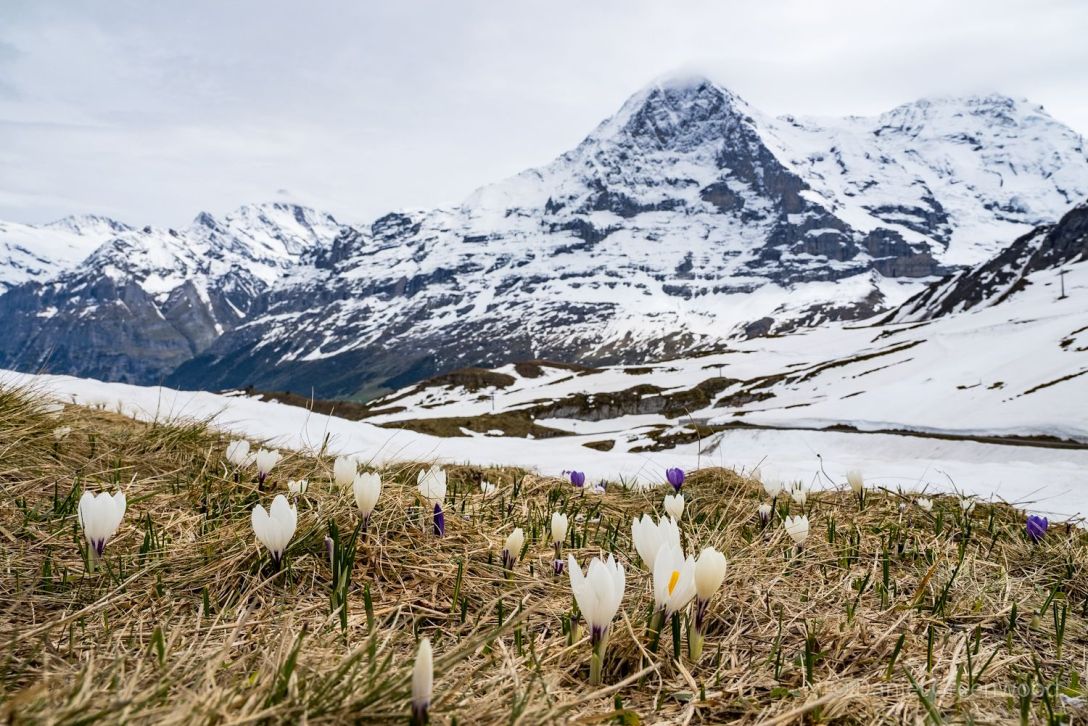
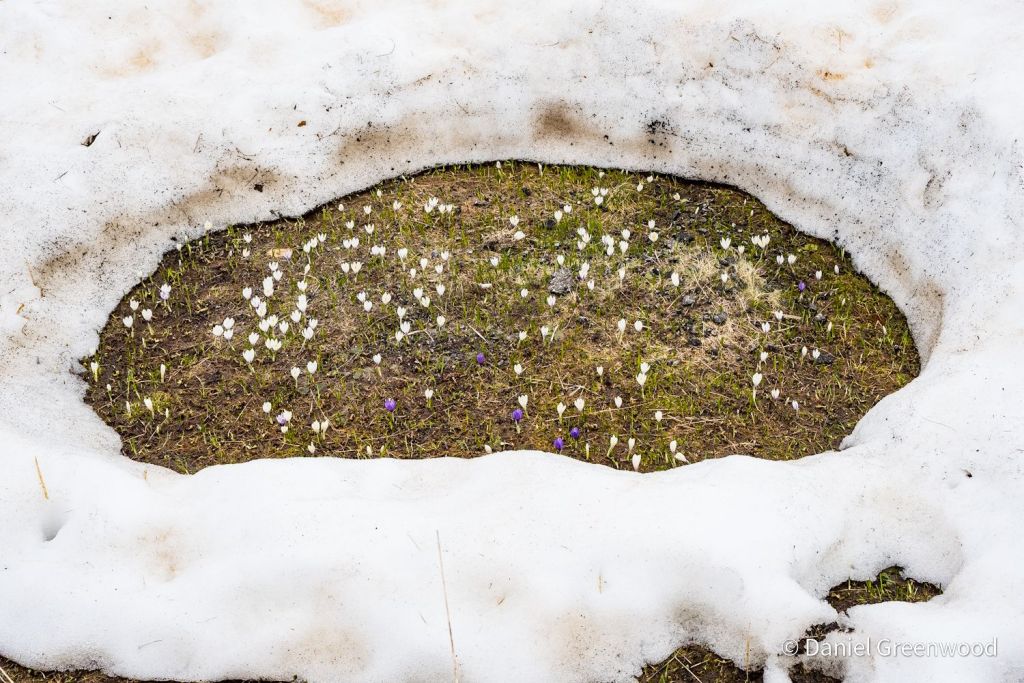
The most dominant flower was a species of crocus that was appearing from under the snow.
This shows that rather nicely.
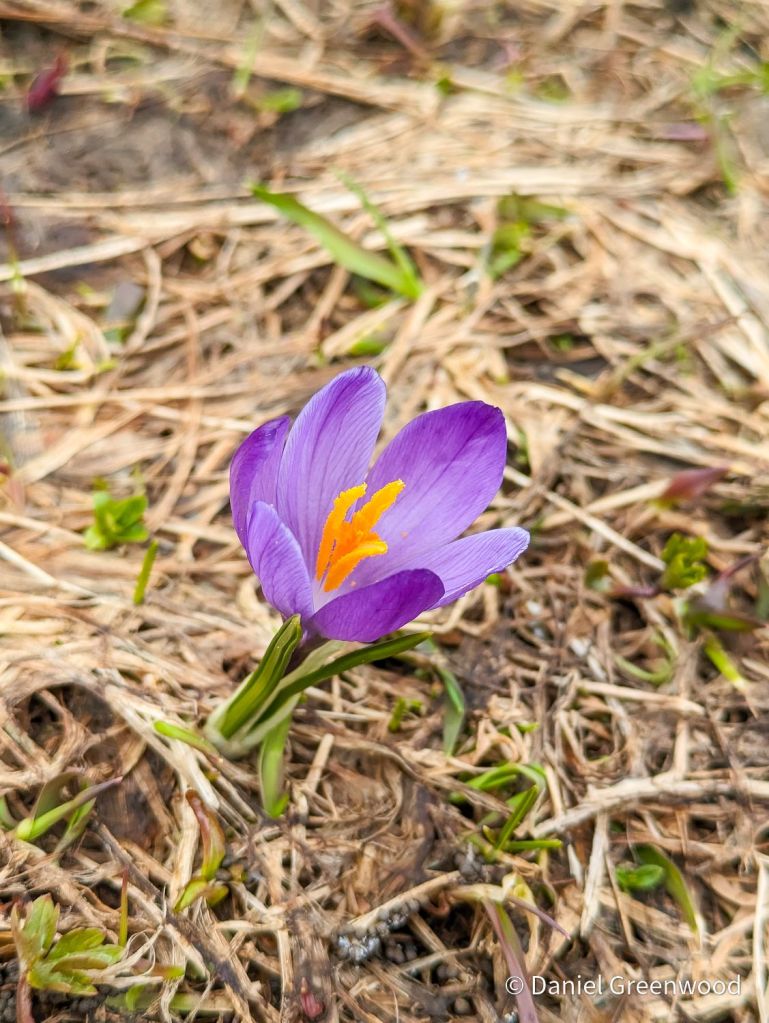
White crocus (Crocus vernus), and a purple variety:
Meadow saffron always come to mind.
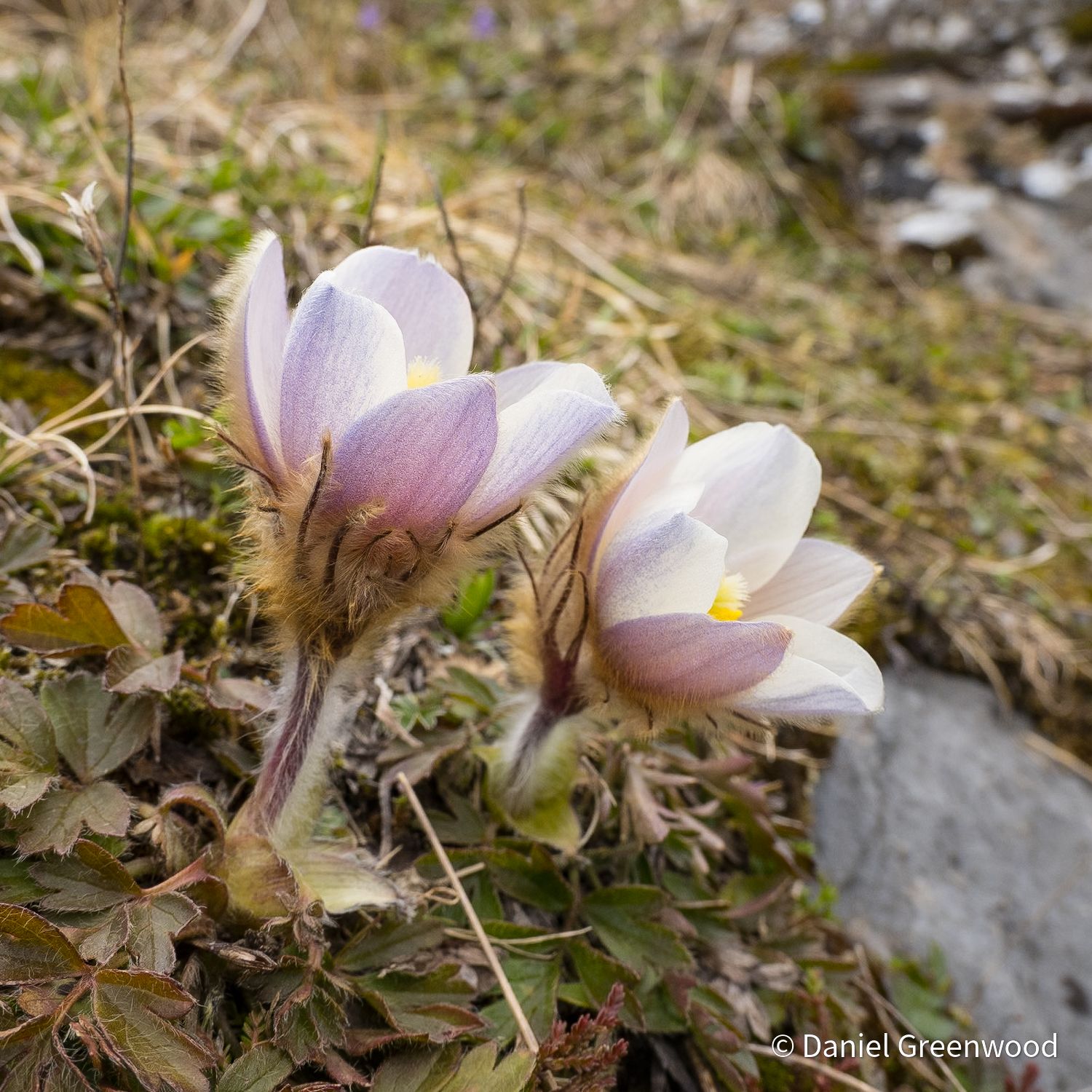
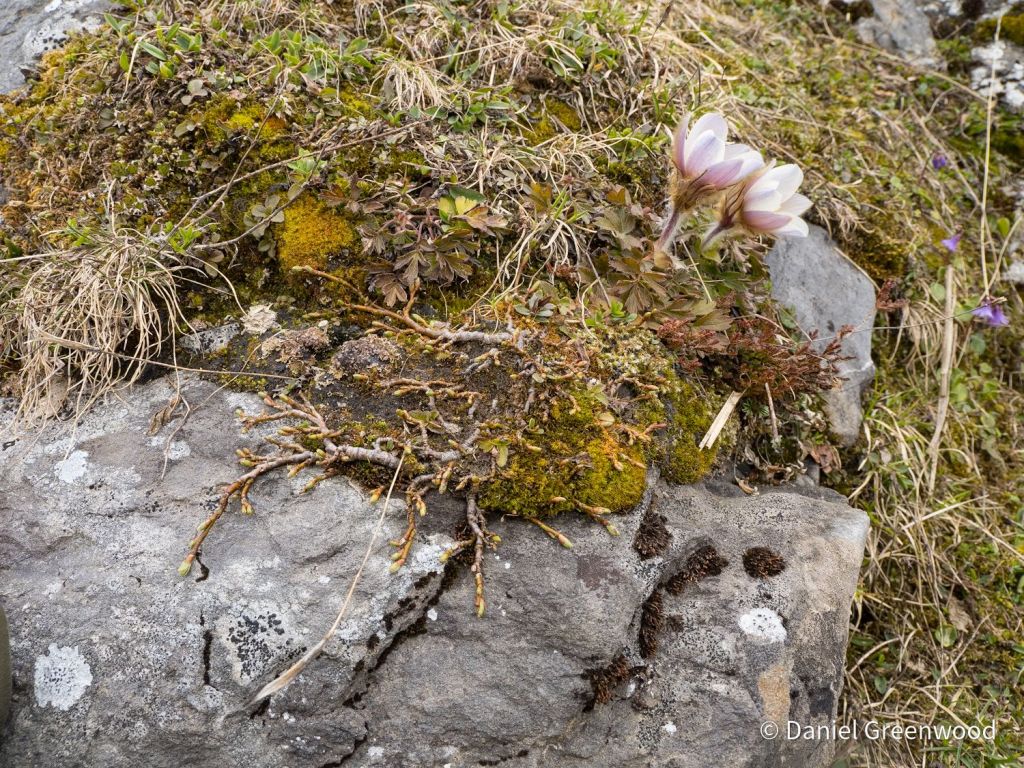
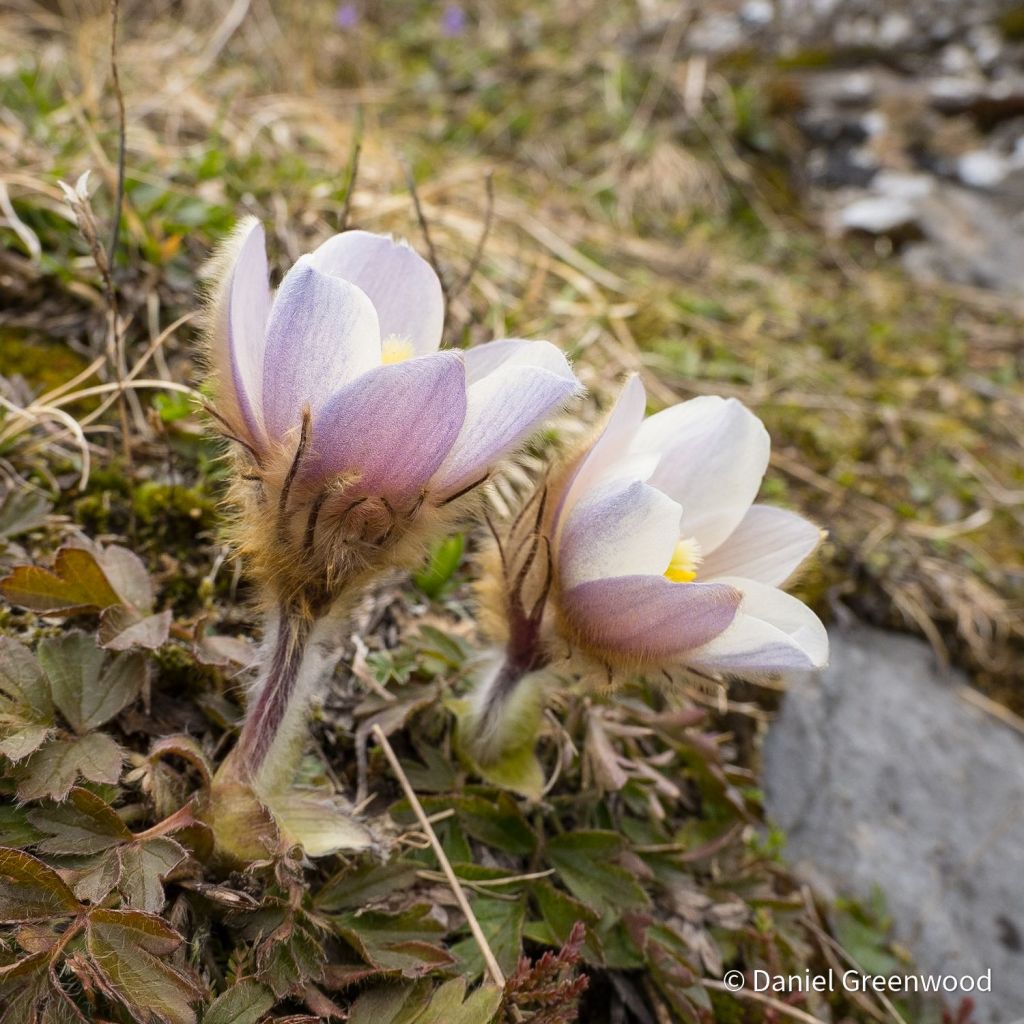
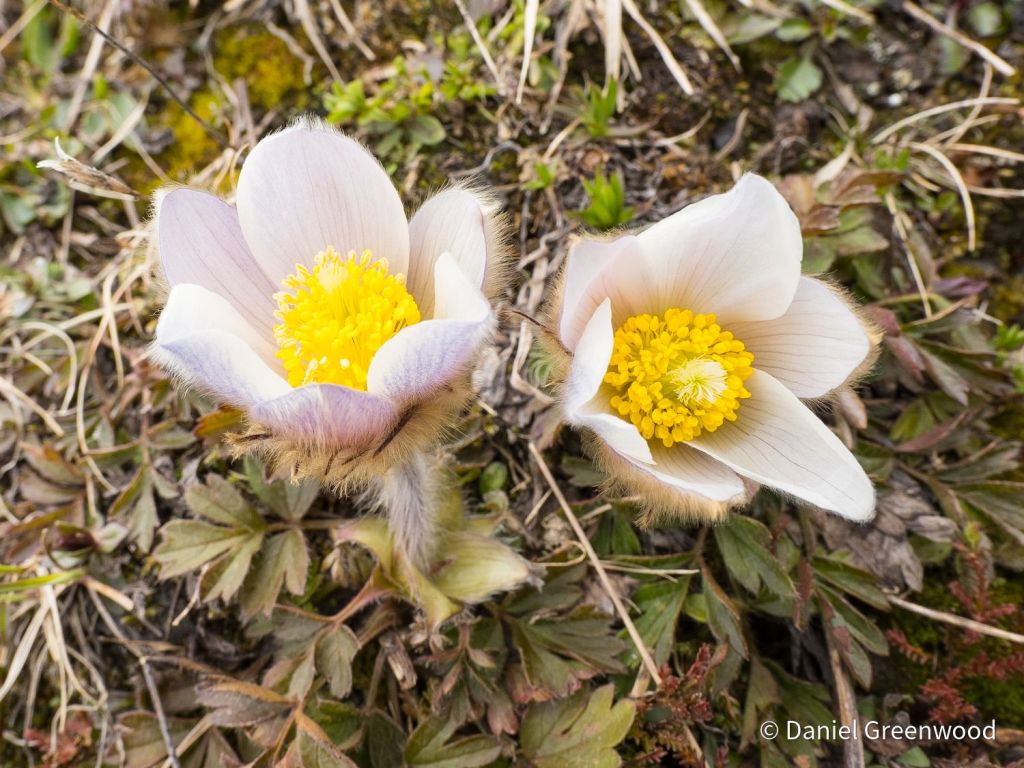
A nice surprise was this spring pasqueflower (Pulsatilla vernalis) close to the top where the first rocks were appearing from the snow.
They are rather hairy.
Pasqueflower is found on chalk and limestone grassland in England, though I’ve never seen it. The Cotswolds is a stronghold.
It’s almost as hairy as a bat, or a tarantula.
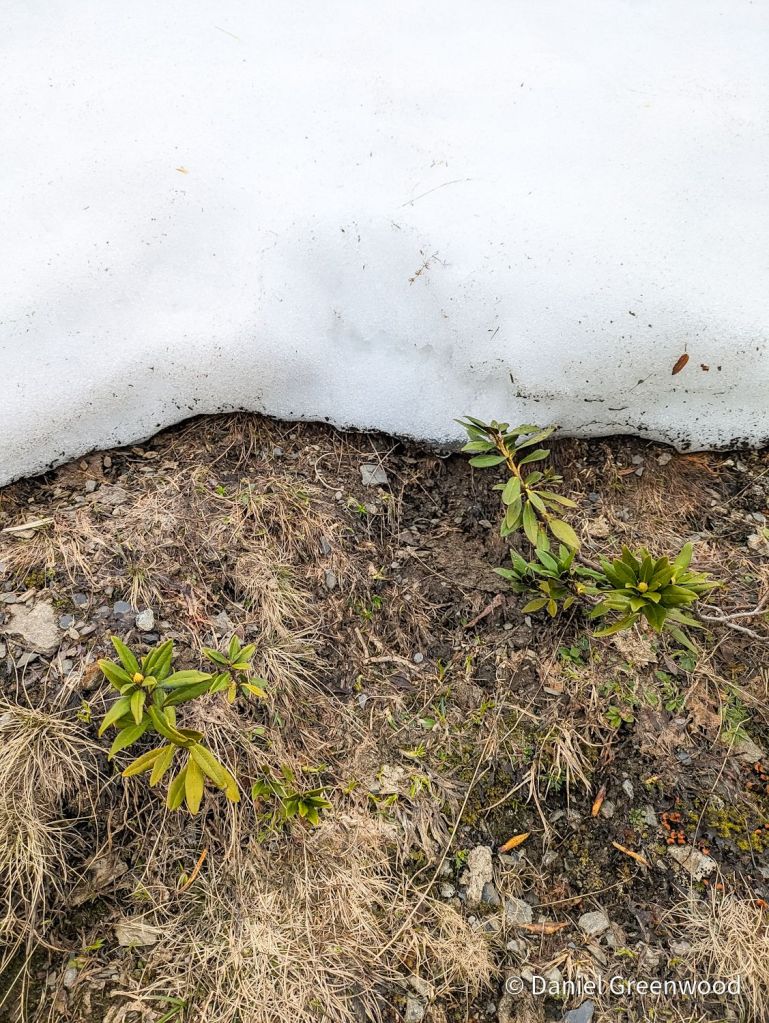
Appearing from the snow was another new plant for me – rusty-leaved alpenrose (Rhododendron ferrugineum).
I’ve never seen any species of rhododendron in their natural habitat. I’m used to seeing the ornamental versions either in gardens or when they escape and cause harm in other habitats.
Snowbell (Soldanella alpina) is a plant I’ve seen in the Bavarian Alps but I’m not there often, so this is a nice thing to see.
The flowers are very ornate, though most flowers are! They look like paper lampshades.
Purple mountain saxifrage (Saxifraga oppositifolia), not well represented in these pics, and probably quite early in its growth.
This is probably mountain everlasting (Antennaria dioica).
Now this has a great name – sweetflower rockjasmine (Androsace chamaejasme). Sounds like a James Taylor song.
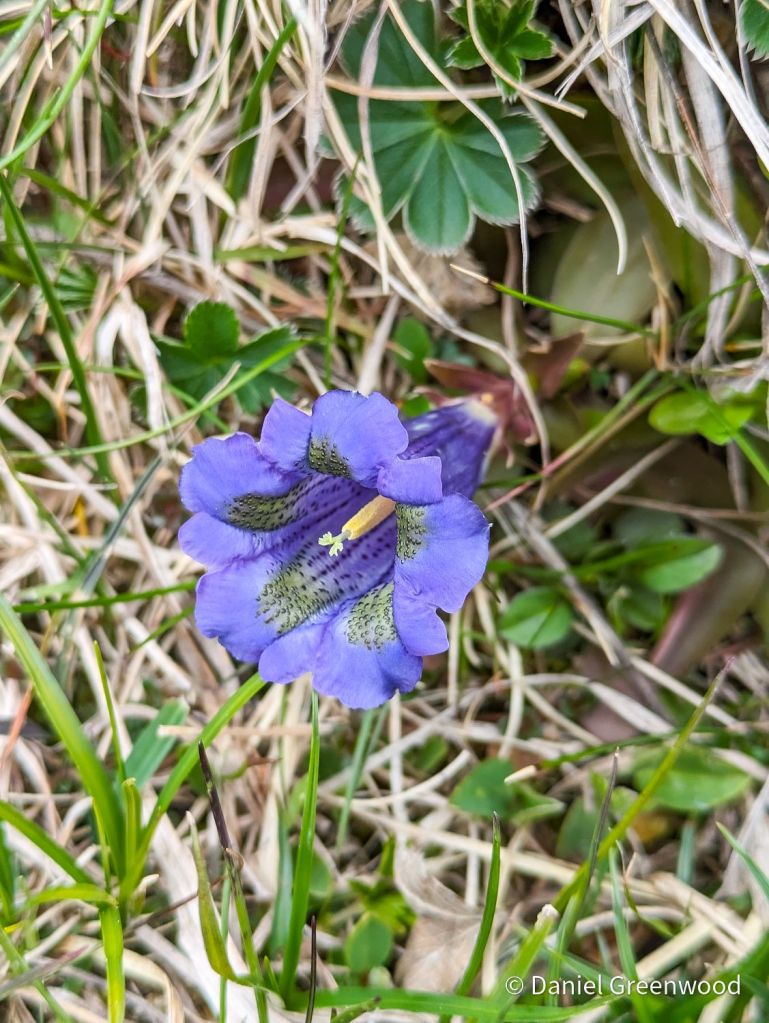
One of the joys of the Alps for us was seeing the range of gentians. They are a stunning blue colour, the kind of vibrancy that only wildlife can muster naturally. This is probably trumpet gentian (Gentiana acaulis).
Birds-eye primrose is a species I’ve only ever seen in the Yorkshire Dales before, near Malham Tarn. The slopes down from Männlichen did have a moorland feel to them, like the Dales does.
Colts foot is one of the first spring flowers and these were very high up. Hardy daisies indeed.
Bright little lion’s manes, though not purely alpine in their habitat preferences.
This is probably cow berry (Vaccinium vitis-idae), a relative of bilberry.
I’m fairly sure this is bilberry.
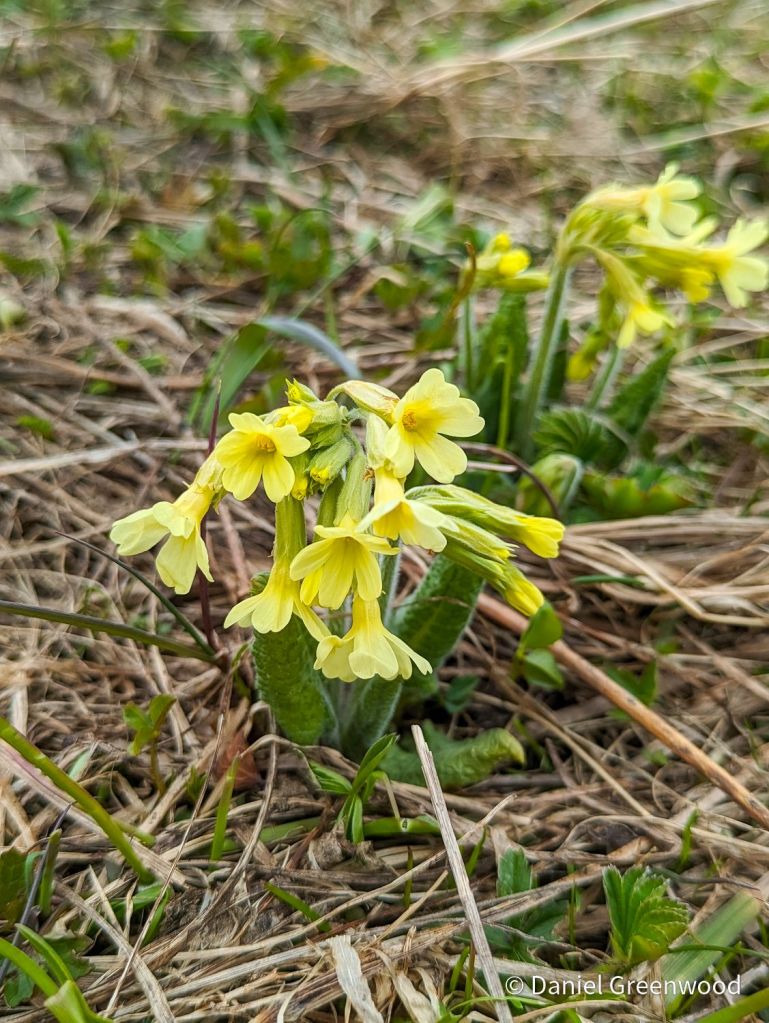
Oxlips are no longer common in England, and I can only ever remember seeing them in Germany or Czechia in spring.
I think these may be oxlips, but their abundance has thrown me. This was near to the middle gondola station on the way down.
Jostling for prominence.
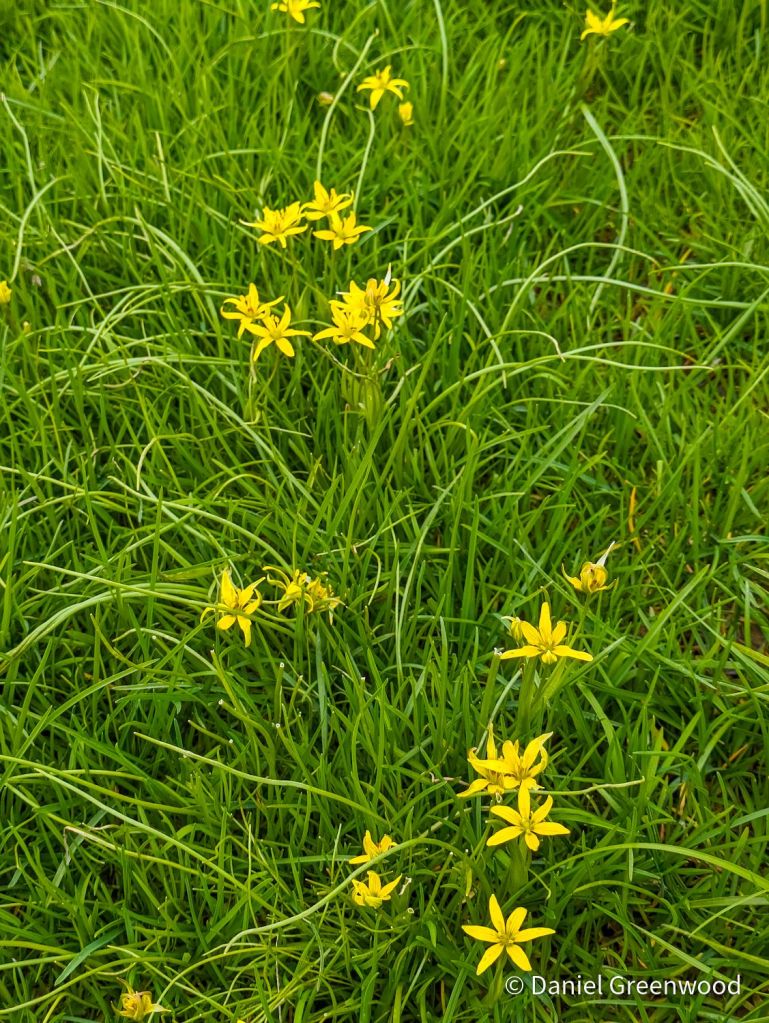
Nearby to them was this lovely plant, yellow star of Bethlehem. If only peace could come to that part of the world today.
Next I’ll be covering more woodland finds around Grindelwald, and later in the mountains around Lake Brienz. Then it will be what everyone seems to navigate to this website for – sycamore content.
Thanks for reading.
I write these blogs in my spare time because I want to raise awareness about the beauty and diversity of our landscapes. If you enjoy reading them you can support my blog here.
In May 2024 my wife and I went on our interrail honeymoon to the Jungfrau region of the Swiss Alps. I am finally ready to post my photos from the trip, starting with some macro photos. I’ve popped in some short videos here to give a bit more texture and sound to bring things to life.
My cat whispering wife
It was an incredible trip, all done by rail there and back. The nostalgia is already with me.
In addition, I’m aiming to post about the spring alpine flowers and the amazing sycamore wood pasture. Hopefully one each week. I posted about the smattering of fungi back in May on Fungi Friday.
On the trip I took only one lens with me, one capable of pretty much any photography between 12-45mm (equivalent to 24-90mm in full frame cameras). That includes excellent close up capabilities. I also had a pocket compact camera and my phone.
The meadows were in full bloom, days from being cut for hay to feed the alpine cattle through the winter months.
Breathtaking alpine meadows
Oxeye daisies with the Wetterhorn (I think) in the background. This pic is taken with my Olympus TG-6 compact.
It was nice to see the variations in the grassland species in the different locations. At about 1200m up these meadows were packed with umbellifers. They make up the wash of white here. This meadow must have been impacted by the snowmelt as it nourishes the foothills in spring.
The typical mix around Grindelwald was one of red clover, scabious, oxeye daisy and hawkbits.
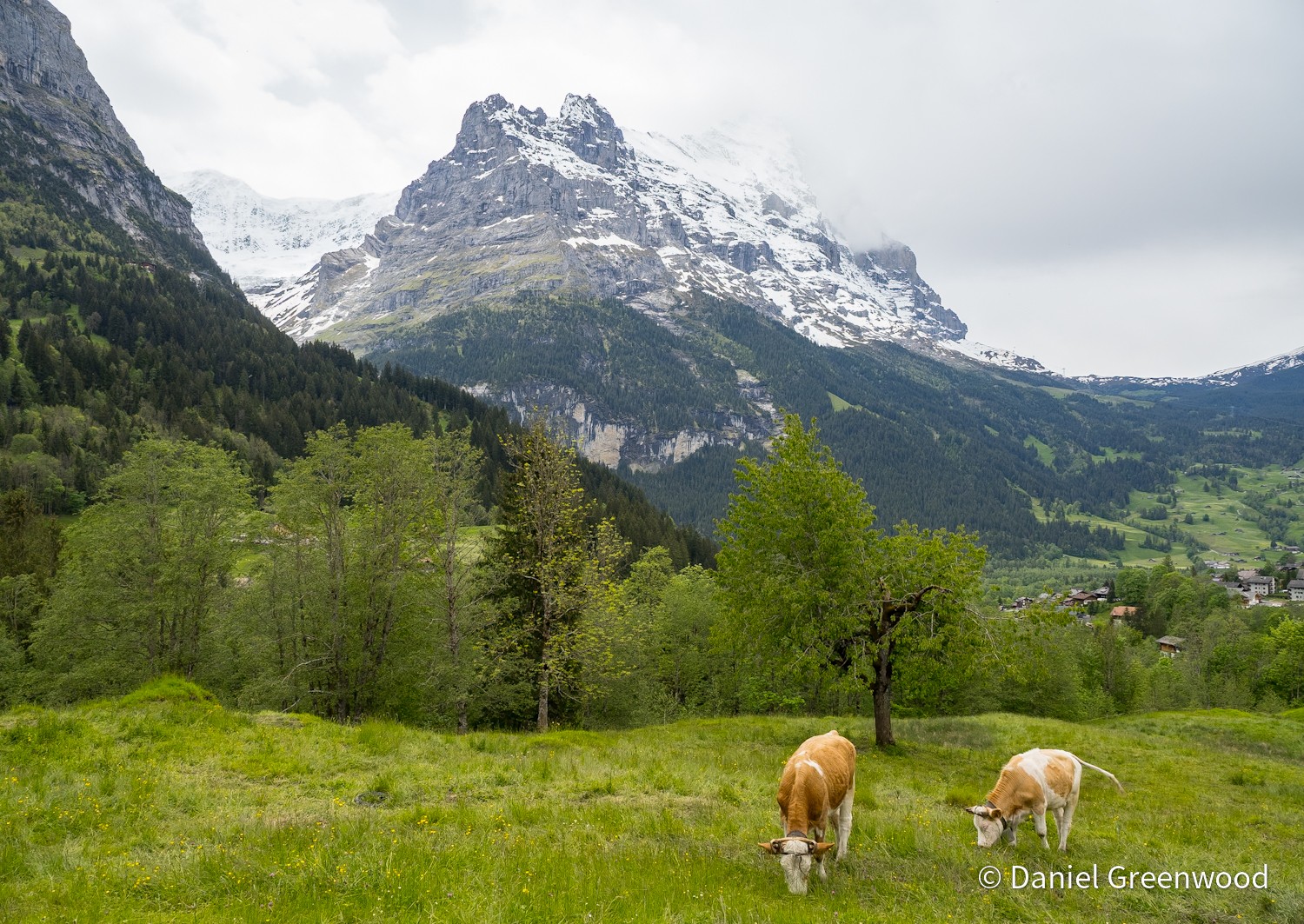
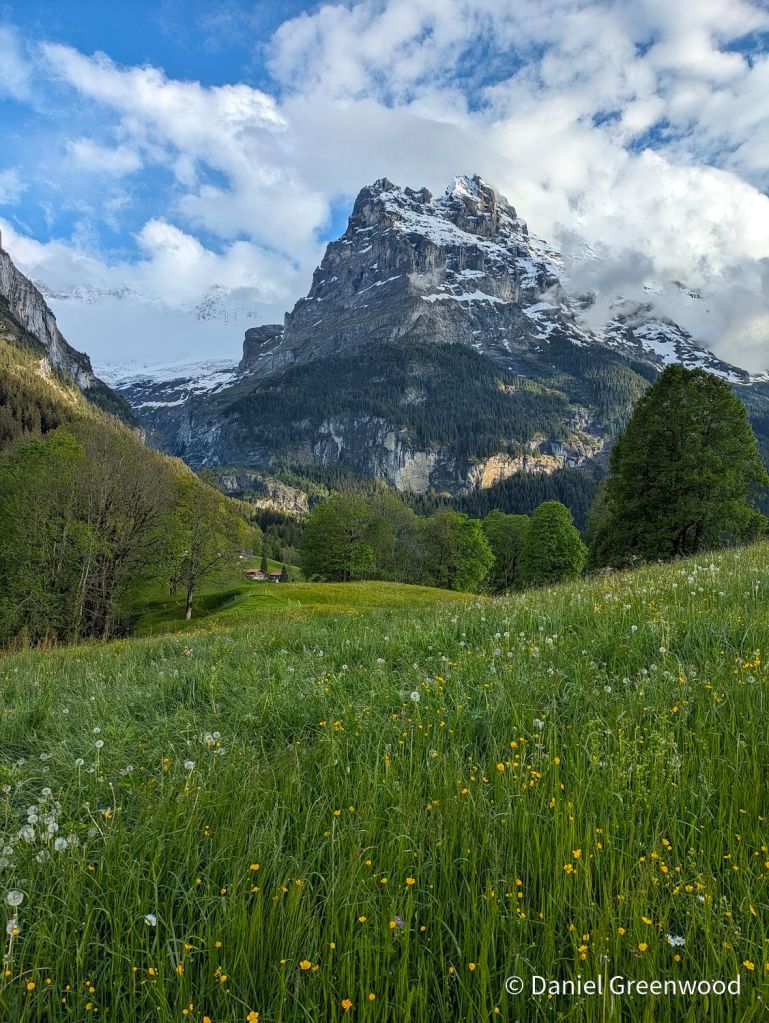
The Eiger looms over chalet homes and rich hay meadows. You can see the allure of Switzerland. High living standards and abundant nature.
It is a breathtaking place, as this beautiful phone pic suggests (as in the phone’s capabilities!). This meadow was one that lacked the diversity of others, with the dandelions being evidence of nutrient enrichment, which encourages more vigorous plants at the expense of others. The most diverse meadows will have lower levels of nutrients in the soil.
The Grindelwald meadows were at a height of around 1000m. They were peaking and very loud at times. Just listen to this:
It was a chorus of crickets, not something that we get in England much anymore. The management of these meadows follows a largely medieval practice of haymaking, though it is now mechanised:
This is probably a family cutting and collecting the hay. This photo was taken from a cable car heading up to Männlichen.
Now onto the invertebrates that lived in the meadows.
Bush crickets
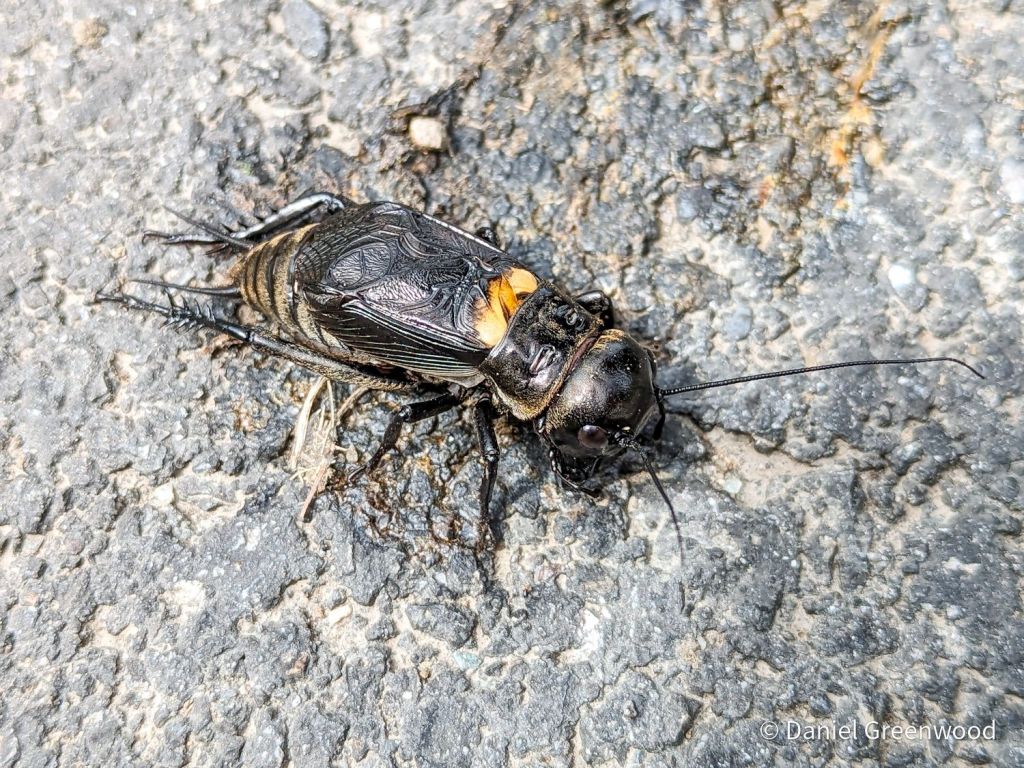
The sound in the meadows was made by the European field cricket, a species that has received support via conservation projects close to me in West Sussex. According to the iNaturalist page it’s flightless, so when it becomes locally extinct it struggles to repopulate lost ground. In the UK it has suffered from the decline in heathland, its favoured habitat. The cricket above was travelling across a lane to reach another meadow. There were a number of them squashed by vehicles. It’s unavoidable.
Moths and butterflies
During a walk in the valley woods at the foot of the mountain this green-veined white butterfly (I think) was on the wing. The main butterfly we saw was the swallowtail, but they were too fast, restless and far away for my lens to reach.
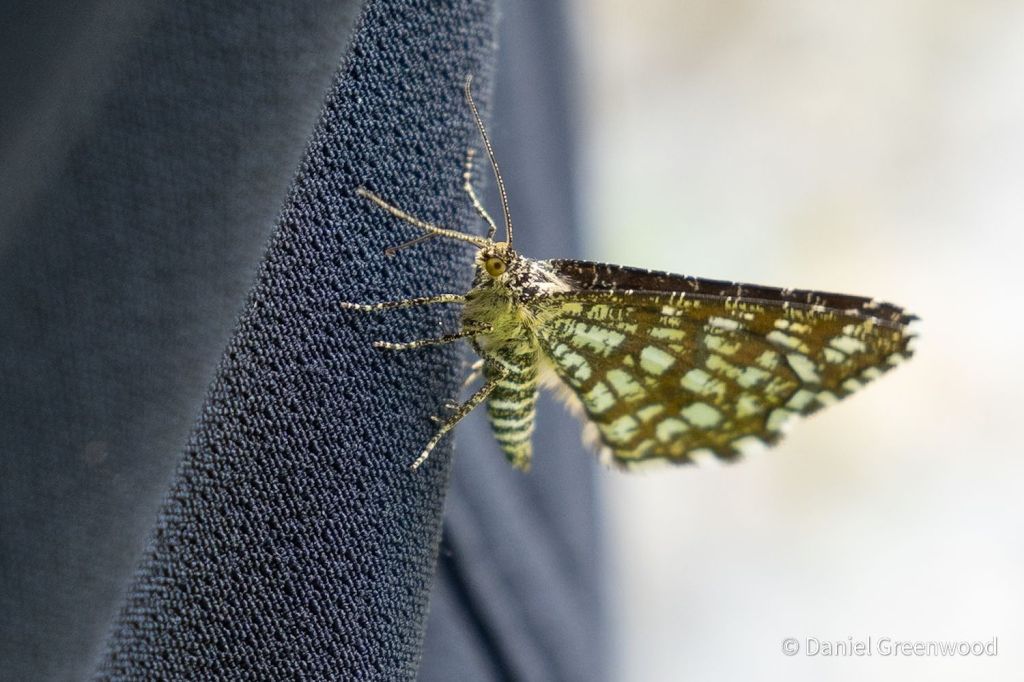
In stark contrast, this latticed heath moth alighted on my actual lens before being coaxed onto my trousers:
This is a species we also have in southern England.
Wasps and sawflies
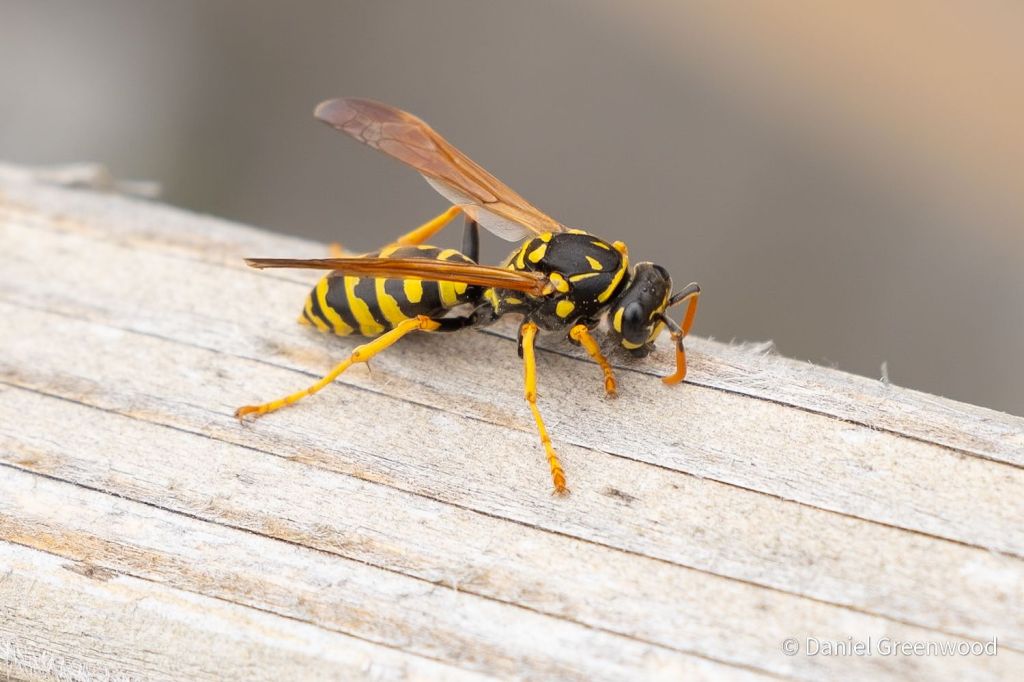
One insect you don’t see in the UK, as far as I know, is the European paper wasp.
They have a lovely orange hue to their antennae, feet and wings. I’ve seen them before in Czechia making nests in residential post boxes. Here you can see one gathering wood shavings for nest building.
Meadow cranesbill was another common flower in the – you guessed it – meadows. I noticed that one area we passed when returning to our accommodation had a number of cranesbills that held sawflies in their flowerheads. The iNaturalist sawfly oracles have decided this is Tenthredo koehleri.
Beetles
Beetles are not my strong point, unless they are from Liverpool. This is a species of click beetle from what I know, visiting an oxeye daisy flower.
Spiders
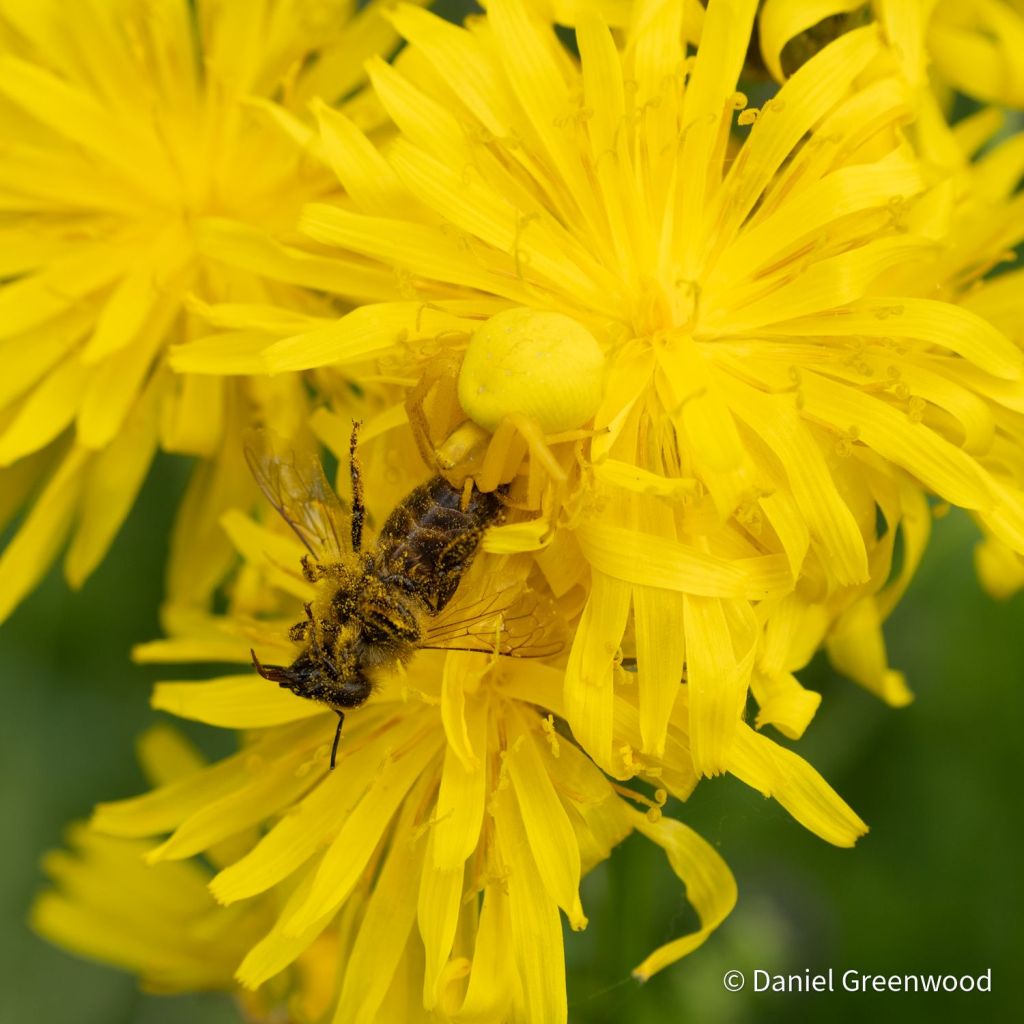
Now, I did mention those beardy daisies the hawkbits, earlier. I’m not up on my ID with these plants, but I did spot a crab spider which had joined in their colouring and caught a honeybee (I think) in one of the flowerheads. This was a statk example of how they can change their complexion to camouflage themselves in certain plants.
That’s all I really managed in the macro photos stakes. There’s much more to come from the Swiss Alps though.
Thanks for reading.
I write these blogs in my spare time because I want to raise awareness about the beauty and diversity of our landscapes. If you enjoy reading themyou can support my blog here.
I had some hours to take one Friday afternoon in August and so headed to my local heathy woodland to seek out some summer fungi.
I found zero mushrooms, but did learn that summer wasn’t quite over.
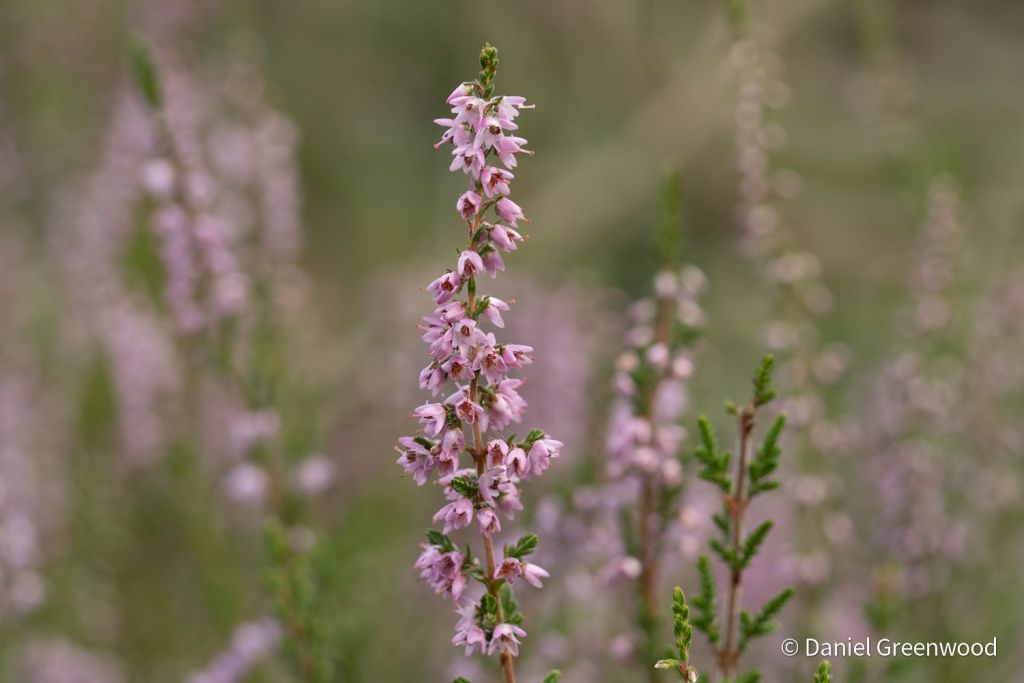
In a clearing created a few years ago by the removal of non-native conifers, a heathland has flourished. Sussex, like other southern counties, once had far more heathland before it was either built on or converted to coniferous forestry (like this particular site).
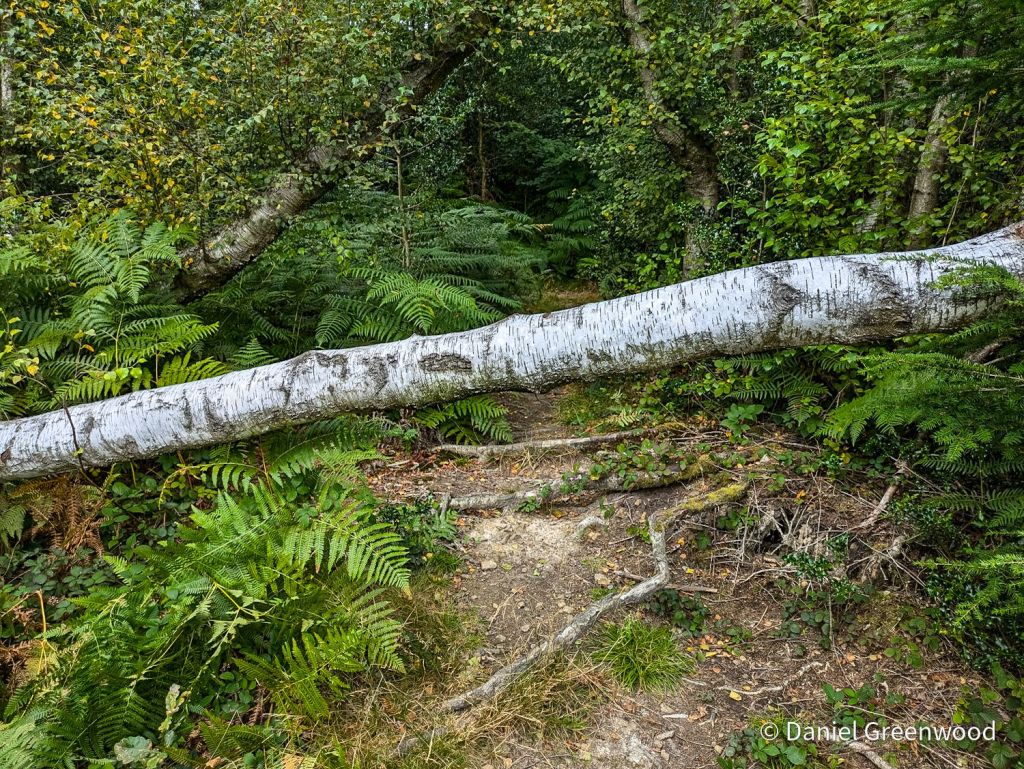
This little patch of restored heathland was zinging with insect life, not least on a fallen birch tree.
Enter: the magic birch tree. Or at least sunbathe on it.
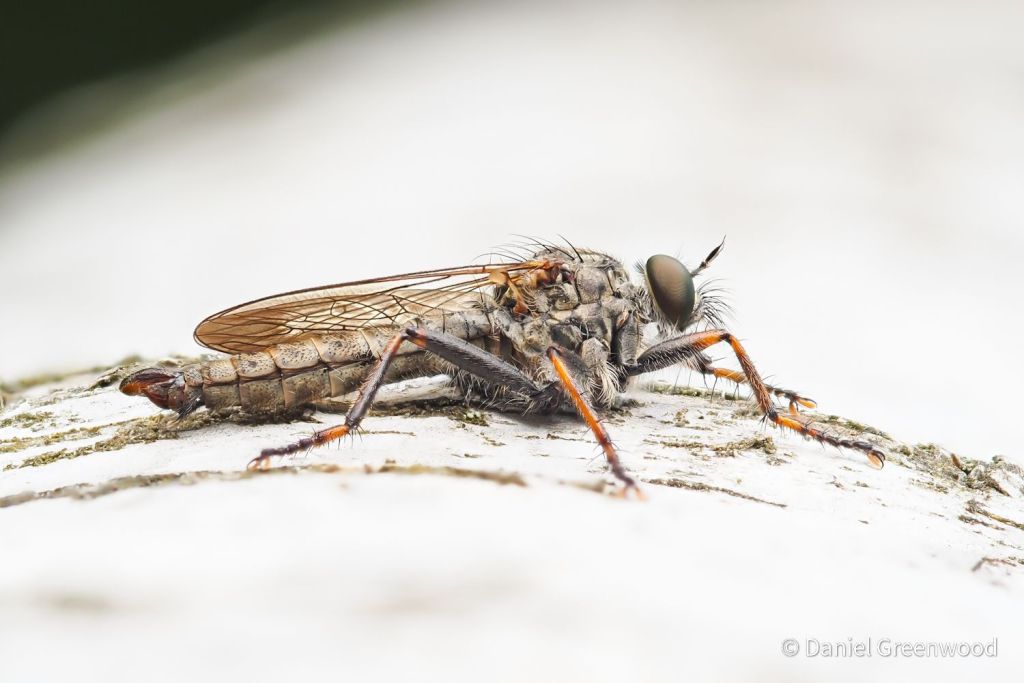
I revered it in such a way because it was providing roosting space for one of my favourite subjects – robberflies!
I managed to get my best ever photos of robberflies here, thanks to the capabilities of my camera, and a little bit of that famous fencepost knowledge.
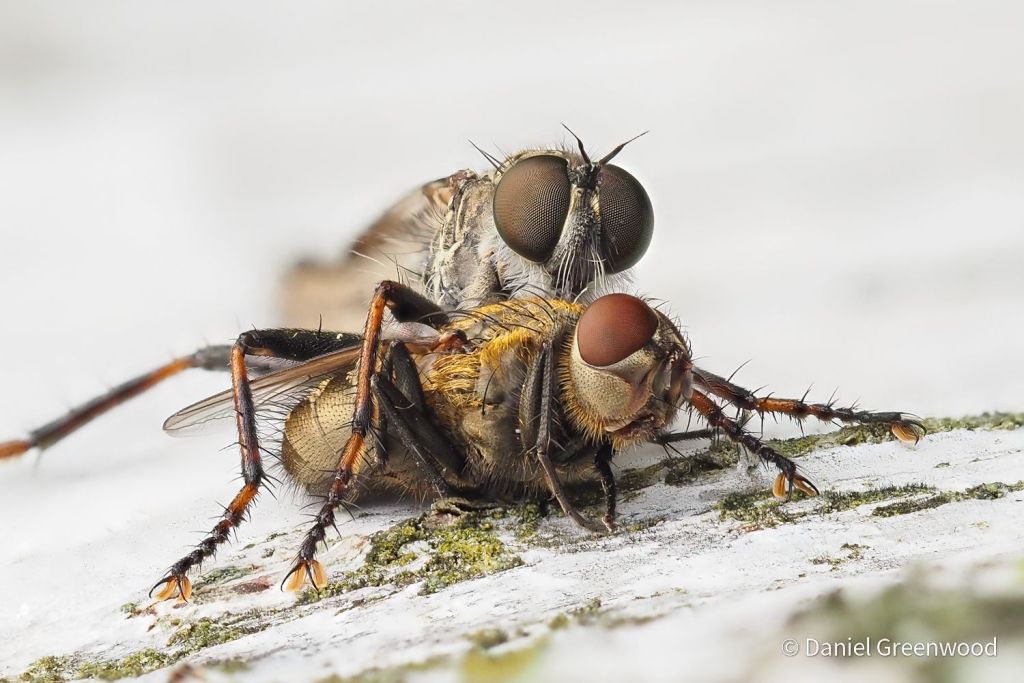
Robberflies are predators of other flies, but also wasps. The photo above was taken using an in-built function of the camera to stack about 15 photos together to create a seamlessly in-focus image. It worked to great effect here.
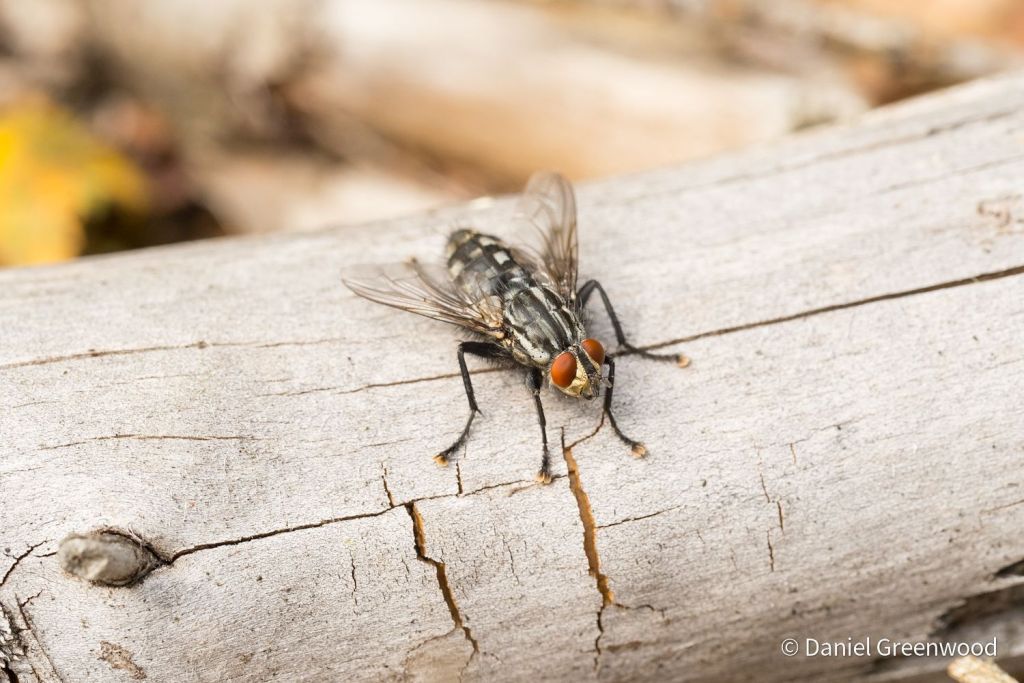
Less dramatic was this flesh-fly, one that is actually quite smart in their black and white get-up with red compound eyes.
On the toe of my shoe a hoverfly that looked like a scuba diver was resting.
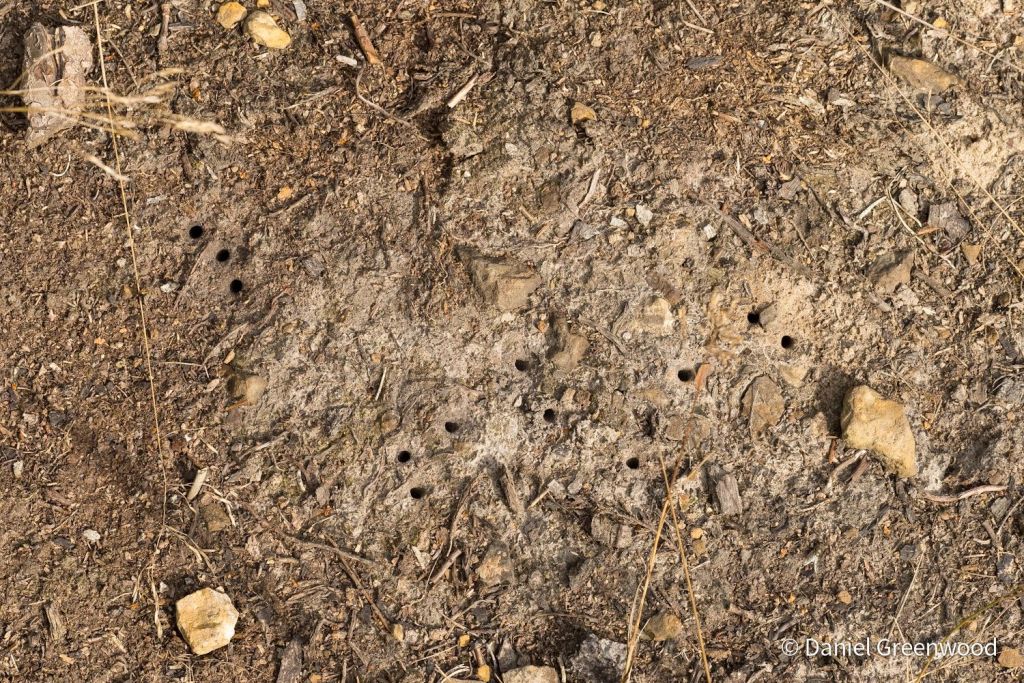
There was plenty of evidence of burrowing insects in the form of these pilot holes.
I didn’t get to see who lived here. Probably solitary wasps or bees.
What this blog can never express is the sheer number of grasshoppers. Every footsteps sent insects like the one above flying for the safety of a grassy tussock.
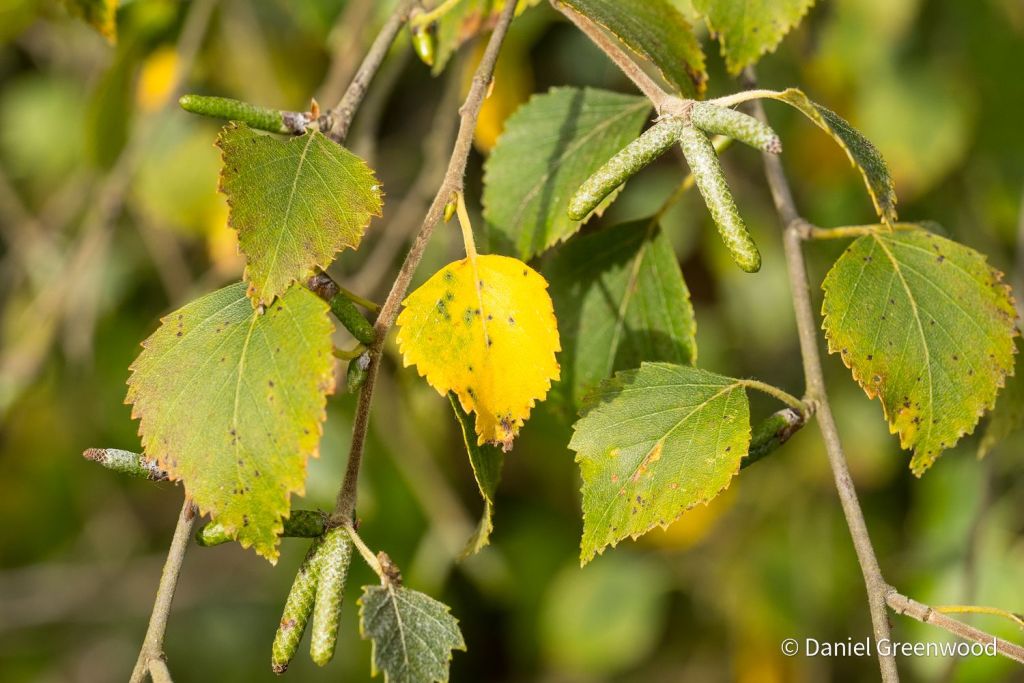
The birches were showing signs of autumn and its inexorable approach.
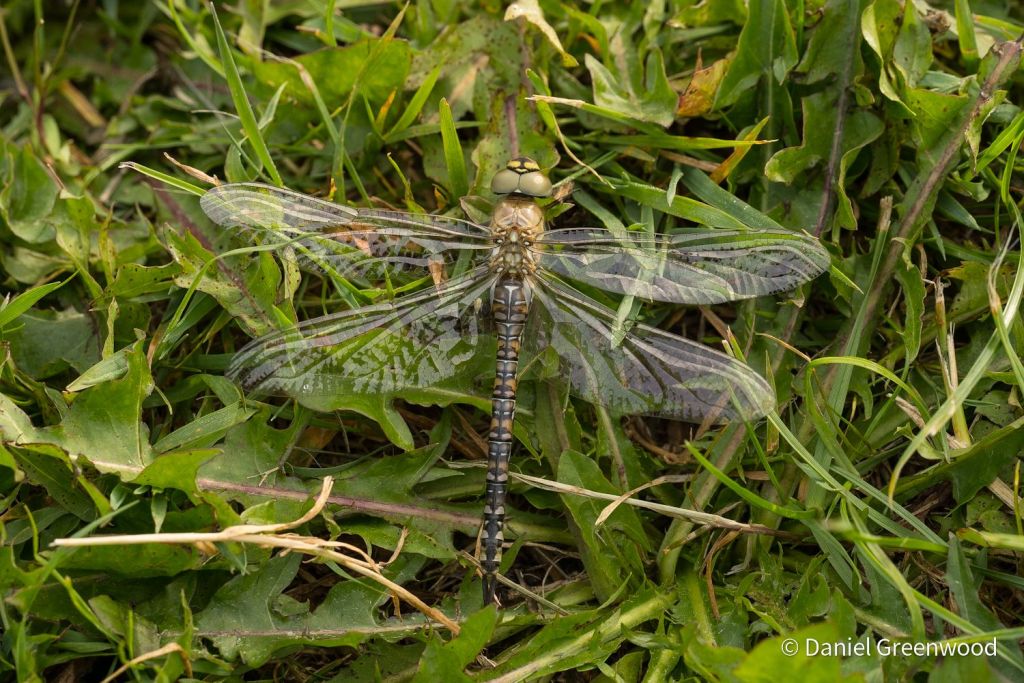
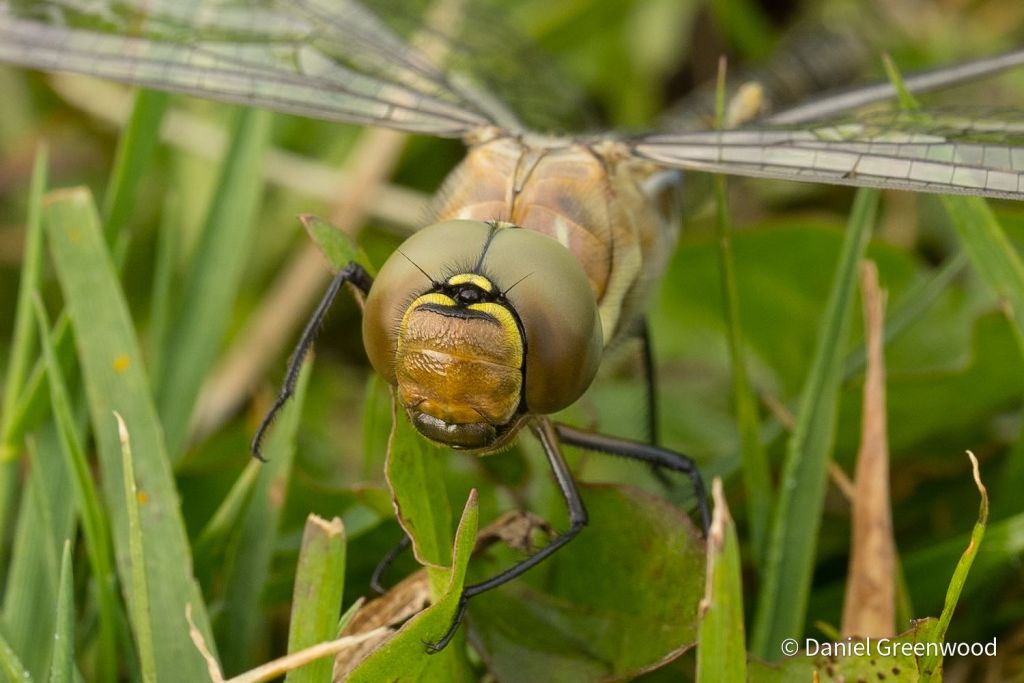
In August I was camping in West Sussex. On the final morning I opened the tent door and nearly stepped on a dragonfly that was resting in the grass outside.
It had been a cloudy night and the ground was very dry compared with the previously dew-laden start.
The dragonfly is probably a migrant hawker (Aeshna mixta) and is known to breed in SE England. As its name suggests it can also migrate to England from southern Europe.
It’s a dream to find a dragonfly in such a restful state, although the insect is vulnerable. It was in the right place however, especially if it wanted its portrait done.
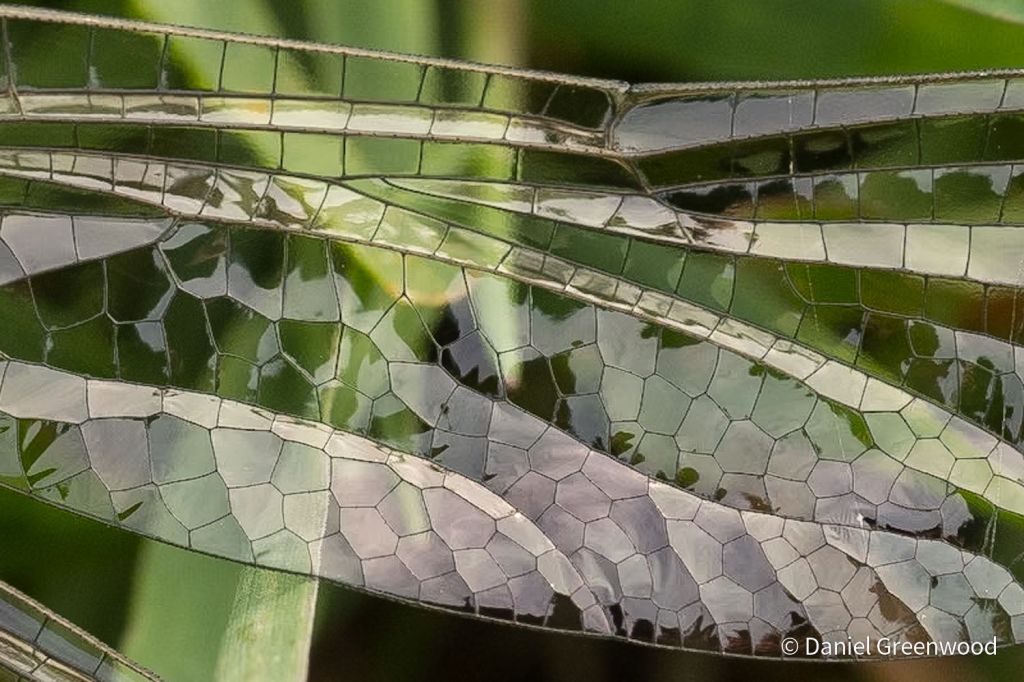
It was an excellent opportunity to look at the wings of the dragonfly close up. They are renowned for their beauty and likeness to stained glass.
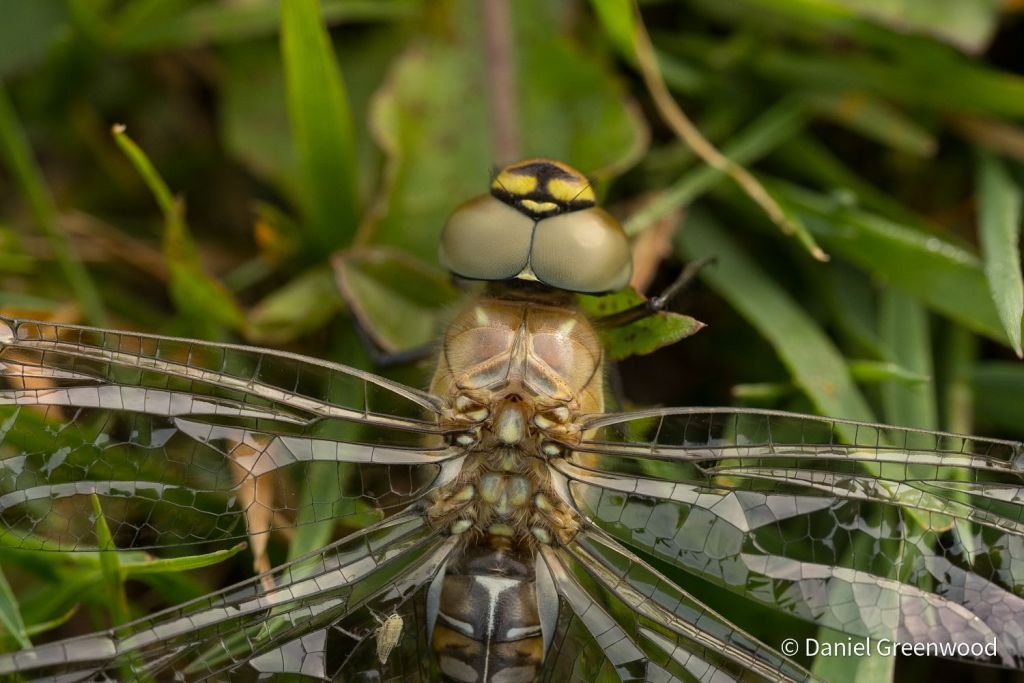
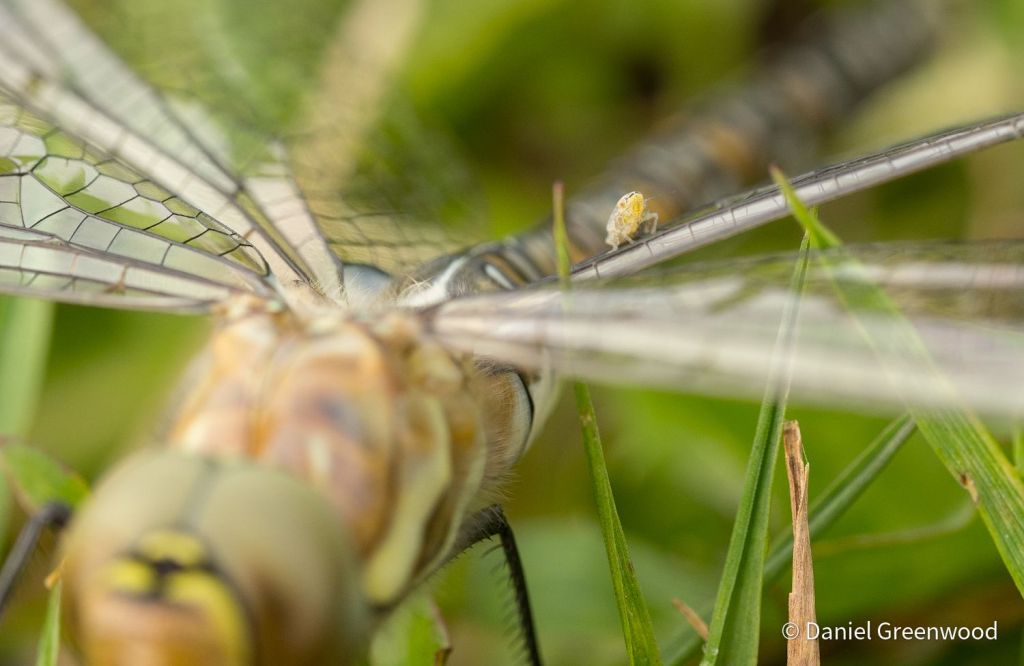
By looking at the wings I noticed that a planthopper bug had leapt aboard the dragonfly.
Here’s a closer view. I’m not sure of the species but it’s one I don’t remember seeing before.
A day earlier we had walked along the River Adur, famous for its connection at Knepp Wildland. It was good to see some more wasps around, with so few of them being reported this year.
The wasp is scrapping a layer of wood from a handrail or fence post to be used in the construction of a nest. You can see the ball below its mandibles above.
What a lot of hard work, worthy of my respect that’s for sure.








































































 Unlocking Landscapes