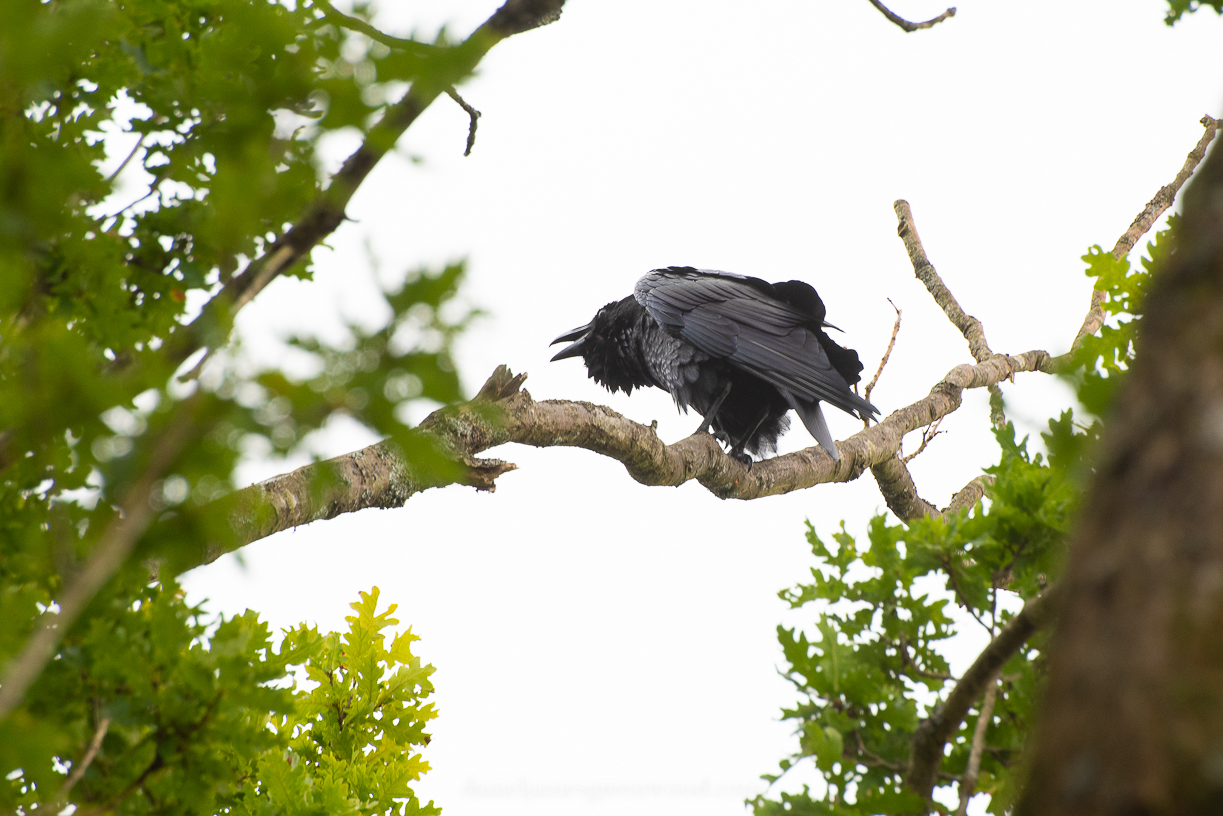
Swiss Alps: mountain woodland flowers at Pfinstegg, Grindelwald🚡

Continuing my series of posts about the landscape of the Jungfrau mountains in Switzerland, here is a look at some of the woodland plants seen above Grindelwald.

Just to say: picking or trampling on wildflowers is not advised, and may be illegal in some locations. The meadows shown here form part of people’s livelihoods as well as being sensitive habitats. Woodlands are extremely sensitive to our footsteps so stick to designated paths where you can. Check the regulations around foraging before you go and show respect for people and wild plants, animals and fungi when you visit. There’s a lot of livestock around, usually behind fences, but they’re so noisy you can’t miss them.

The photos here are a mix of mirrorless camera and phone. The plants photos are mainly taken with my Pixel 7a, the landscape photos with my Olympus EM1 Mark III. All have been lightly processed.

The walk

The walk was a fairly short one in length, mainly due to the altitude and general tiredness from travelling. It would be a good one if you’re visiting from Interlaken on a day when it’s not worth going higher or it’s too early in the season.

The walk is about 2.5 miles and can be done more quickly if you’re not taking photos of plants!

All the high trails, including the Eiger Trail, were closed when we visited. Climate change may be making rockfall more common and therefore the higher trails are more dangerous.

It’s possible you can do this walk and see absolutely no one, but for a farmer or two, after you pass the toboggan run.

We took the Pfinstegg cable car up to the Berghaus restaurant, had some chips, and walked down to the village, past the toboggan run.

What you can’t hear is the sound of middle-class Americans talking about their Adriatic travel plans.
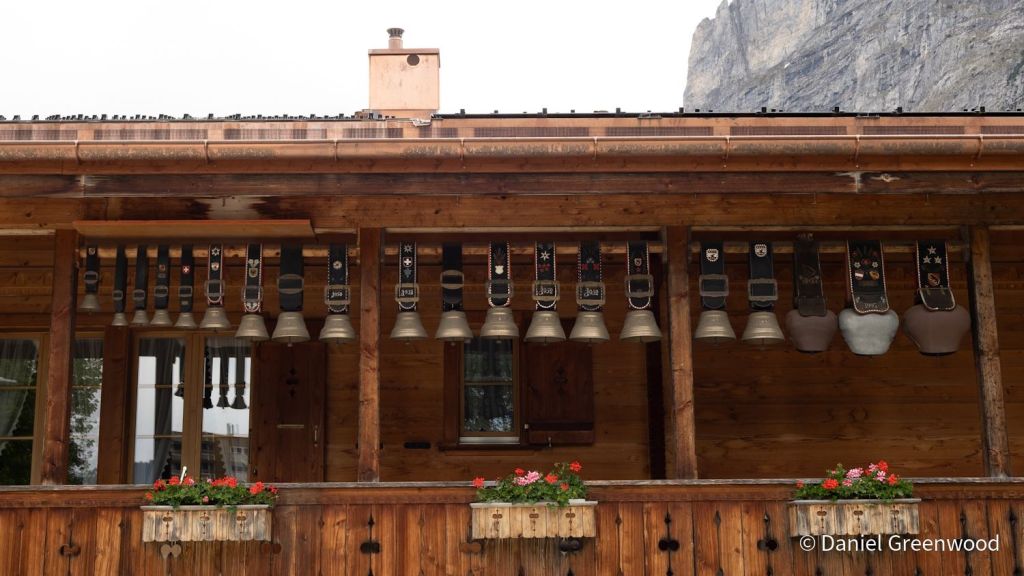
One image I wanted to share was this exhibition of alpine heritage. Here you can see the array of bells used in the Jungfrau for cattle management. The sound of the cowbells is one of the signifiers that you are in the Swiss Alps. Of course the same can be said for many mountain regions, but each one has its cultural differences. That’s a different blog entirely!

Alpine flowers (1300m)
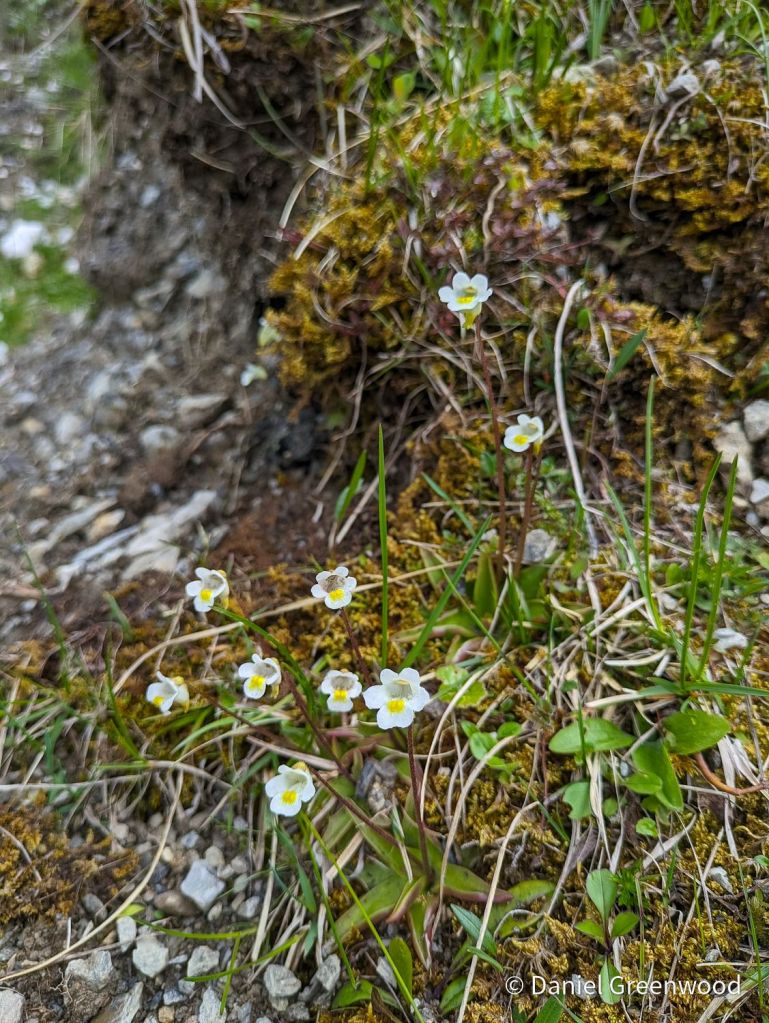
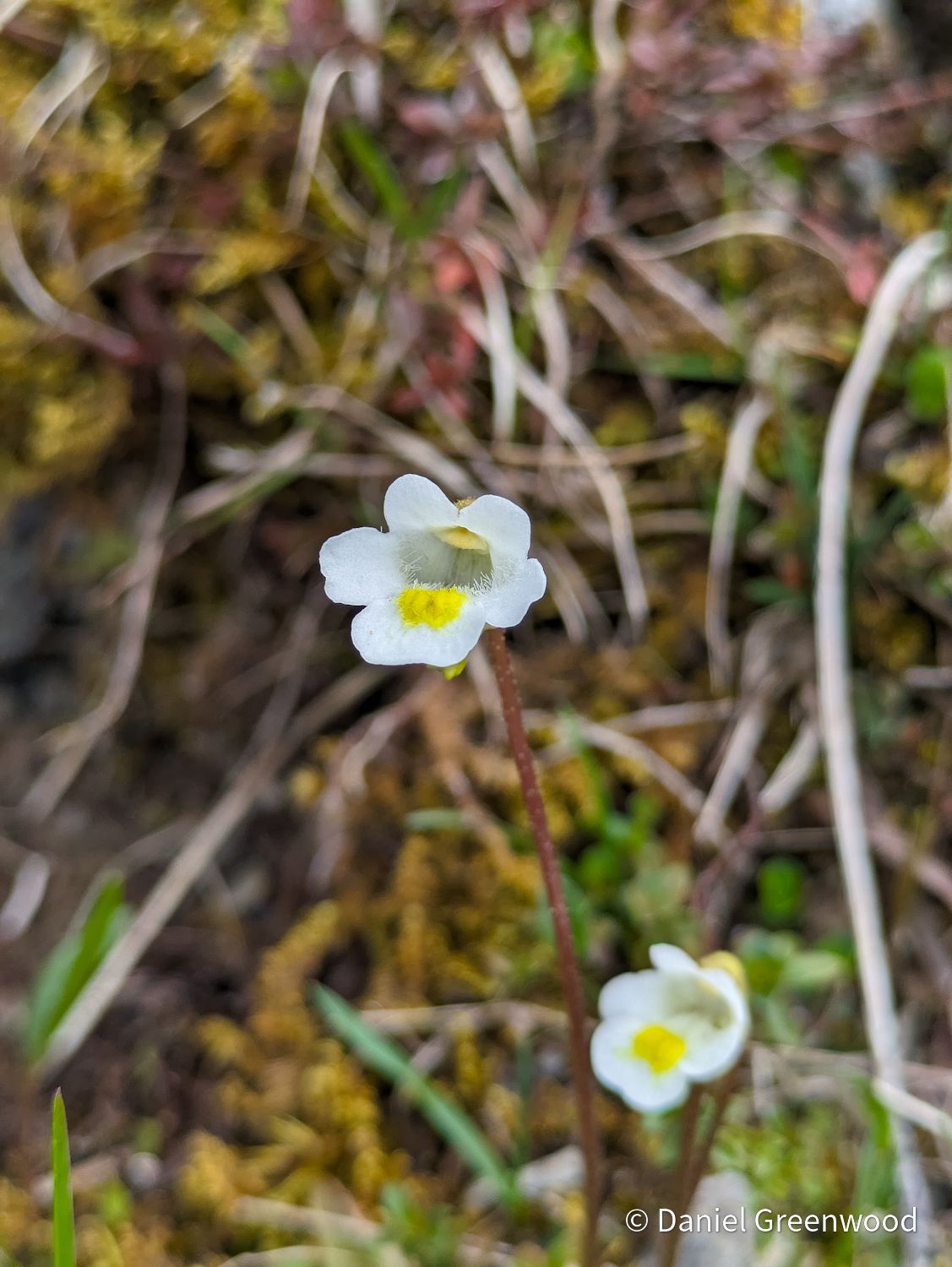
One of the more common sightings in the alpine zone was alpine butterwort, (Pinguicula alpina).

Another common one was shrubby milkwort (Polygaloides chamaebuxus).

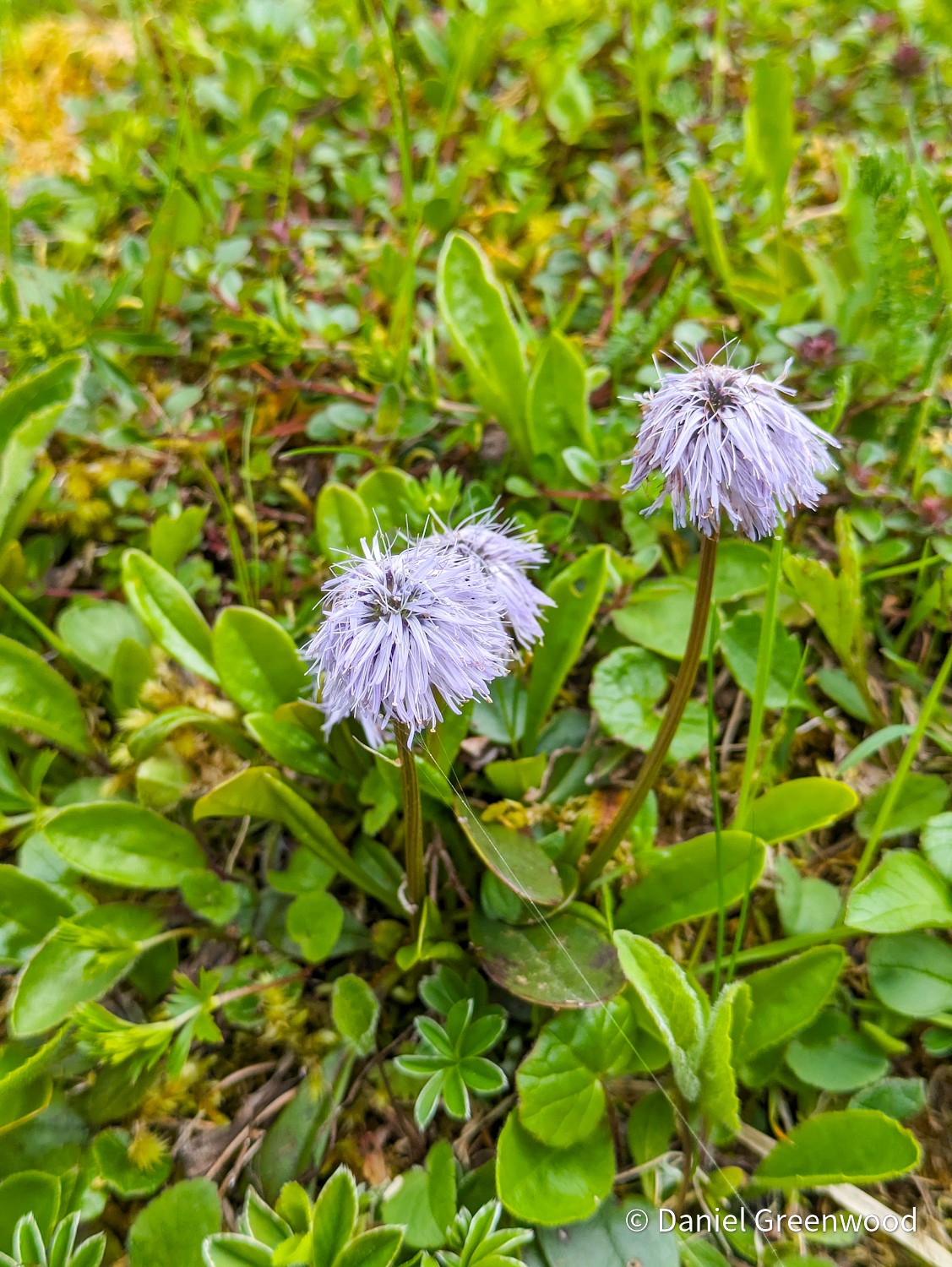
A regular of this habitat was leafless stemmed globularia (Globularia nudicaulis). They look like little lilac mops.

At this point the views of Grindelwald began to be swallowed by the spring woodlands.

In the woods

As you can imagine, the water was crashing down as the snow melted. A lot of work is going into observing the changes in the glaciers in the Swiss Alps, which is happening at an alarming rate here.

You can get views of the Lower Grindelwald Glacier from this walk (though this was taken lower down). This glacier shrunk by over a mile between 1973 and 2015.

I love a new violet species that’s easier to identify than ours at home. This is twoflower violet (Viola biflora) and was only seen in the woods at the edge of lanes.
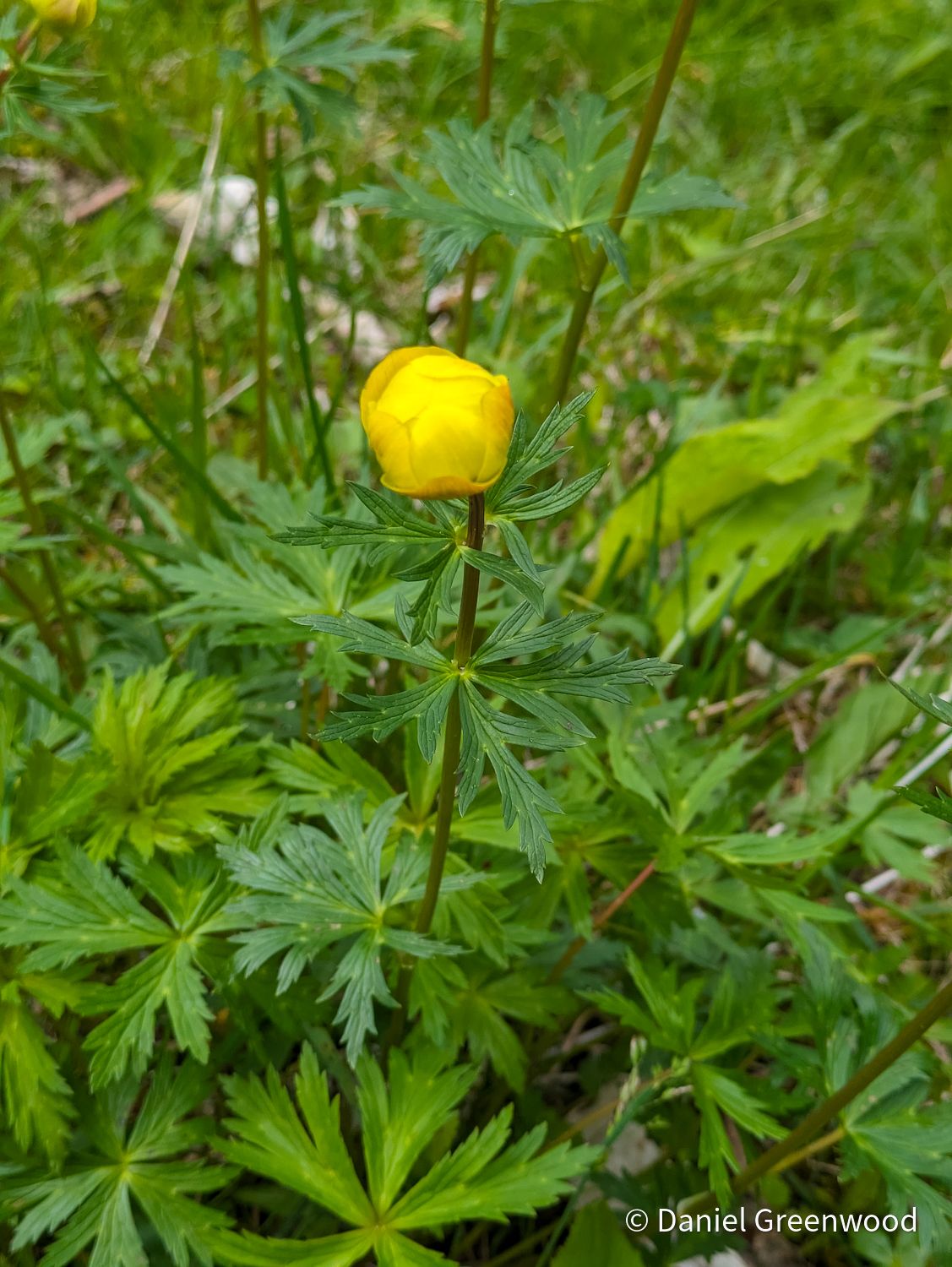
It’s always nice to find globeflower (Trollius europaeus), a species of buttercup.

This was a new species for me – may lily (Maianthemum bifolum). It looks more similar to something like black bryony or bindweed to the untrained eye (this one).

This cranefly was resting on the leaves of yellow archangel, a woodland plant we seem to be losing in the UK.

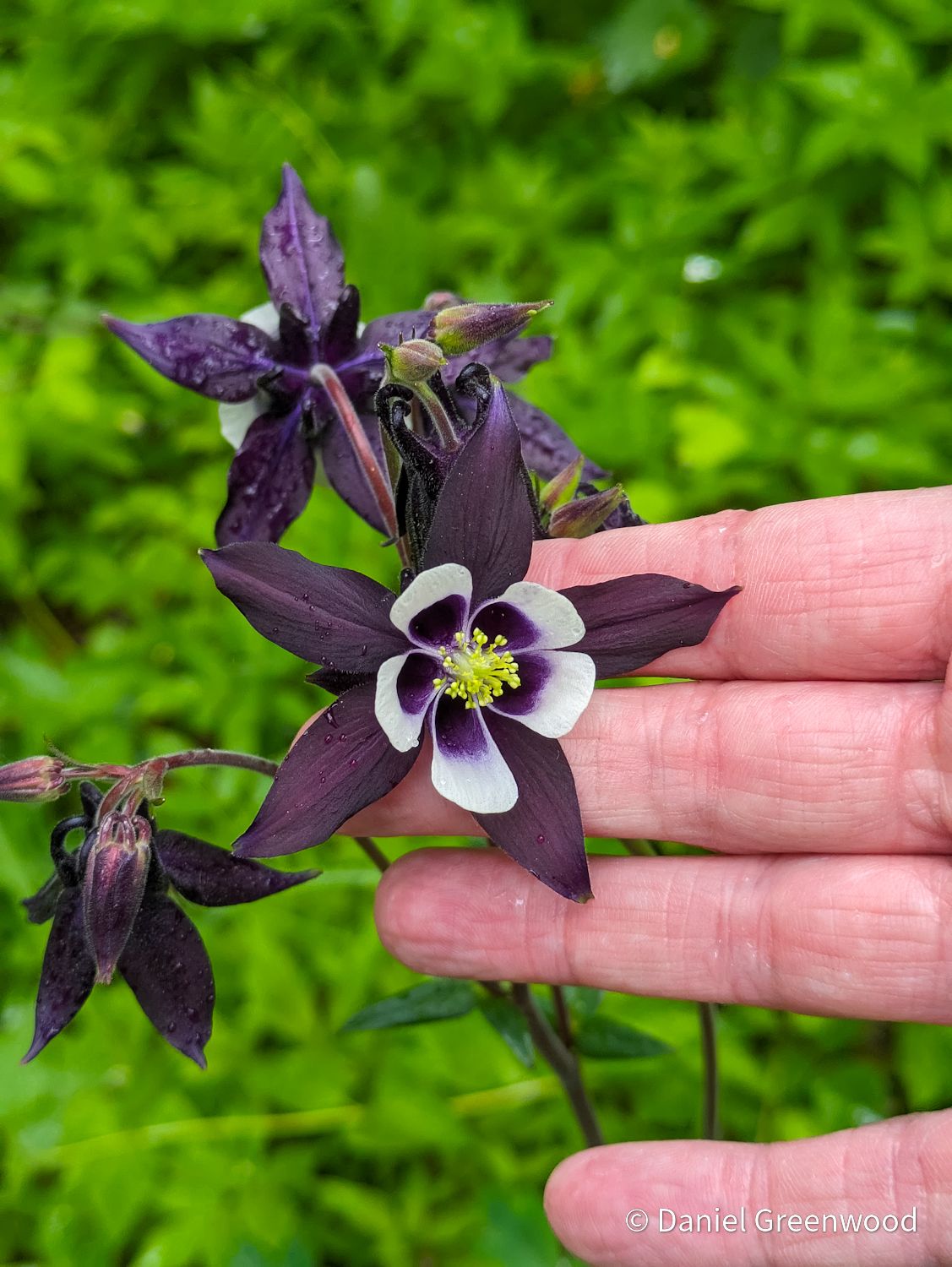
It’s always a joy to encounter herb paris (Paris quadrifolia). I think the columbine (Aquilegia vulgaris) seen here is probably a garden escape, though it is an ancient woodland plant as well, so I may be wrong. I hope it’s the wild one!
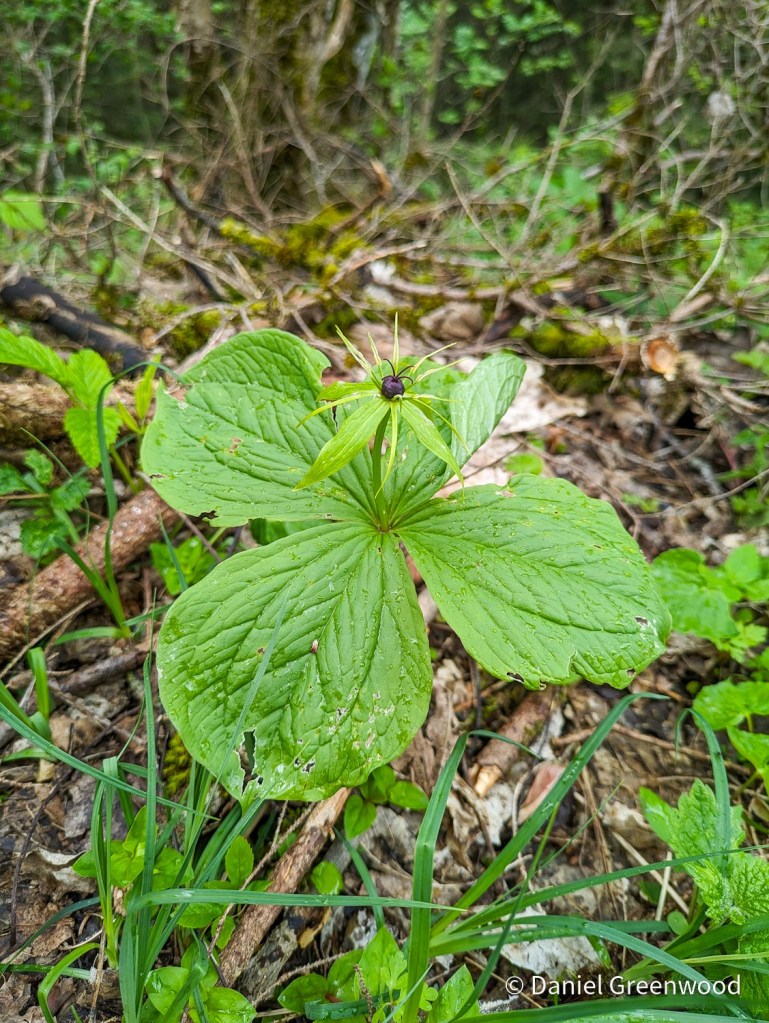
There was more herb paris, but only in the woods.
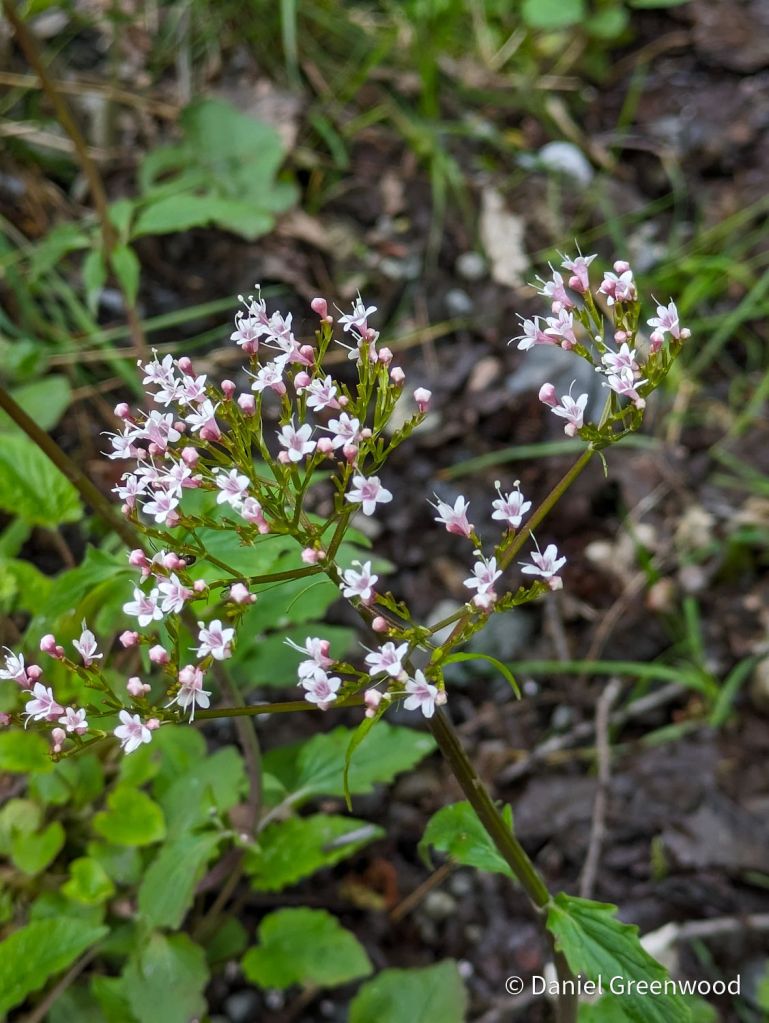
There were a couple of valerians. This one is three-leaved valerian (Valeriana tripteris). It was growing in wet areas.
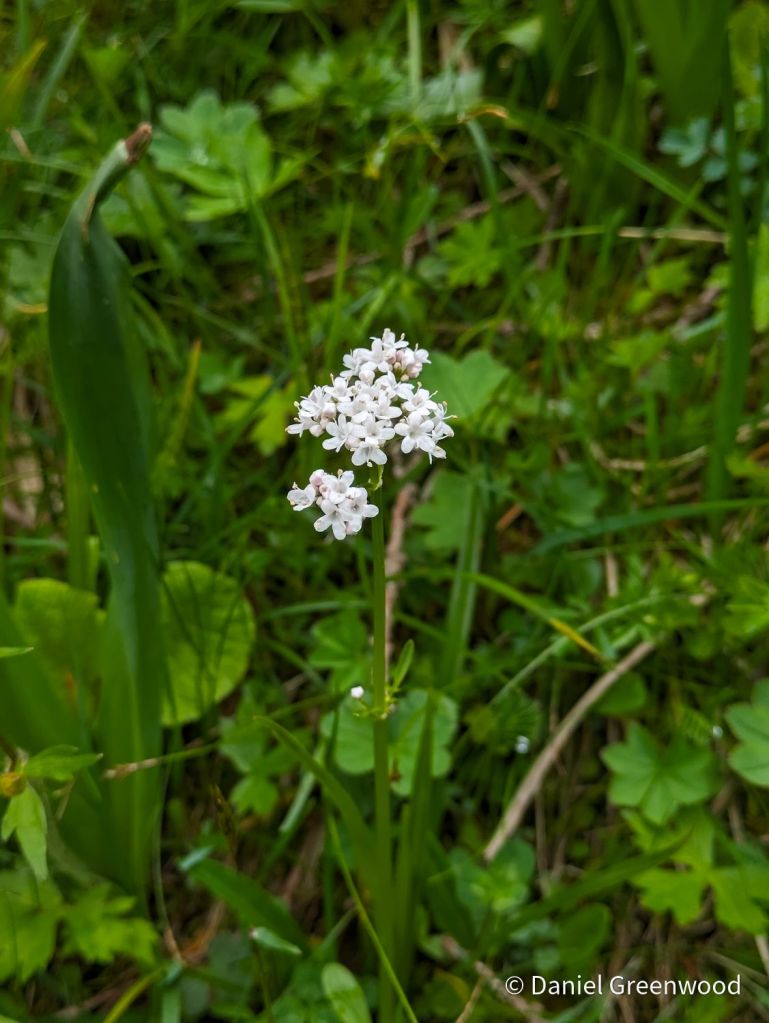
I also saw marsh valerian (Valeriana dioica).

Now, there weren’t a lot of orchids out at the time as it was probably too early in the season. But this is bird-nest orchid (Neottia nidus-avis), which I’ve only really seen in the chalky woods of the North Downs in England.

This is fly honeysuckle (Lonicera xylosteum), a strangely shrubby honeysuckle compared with the climber we have in the UK. It’s been introduced to Britain but I’ve never bumped into it.

Hillside meadows

Let’s just take in the views of the Wetterhorn for a bit…
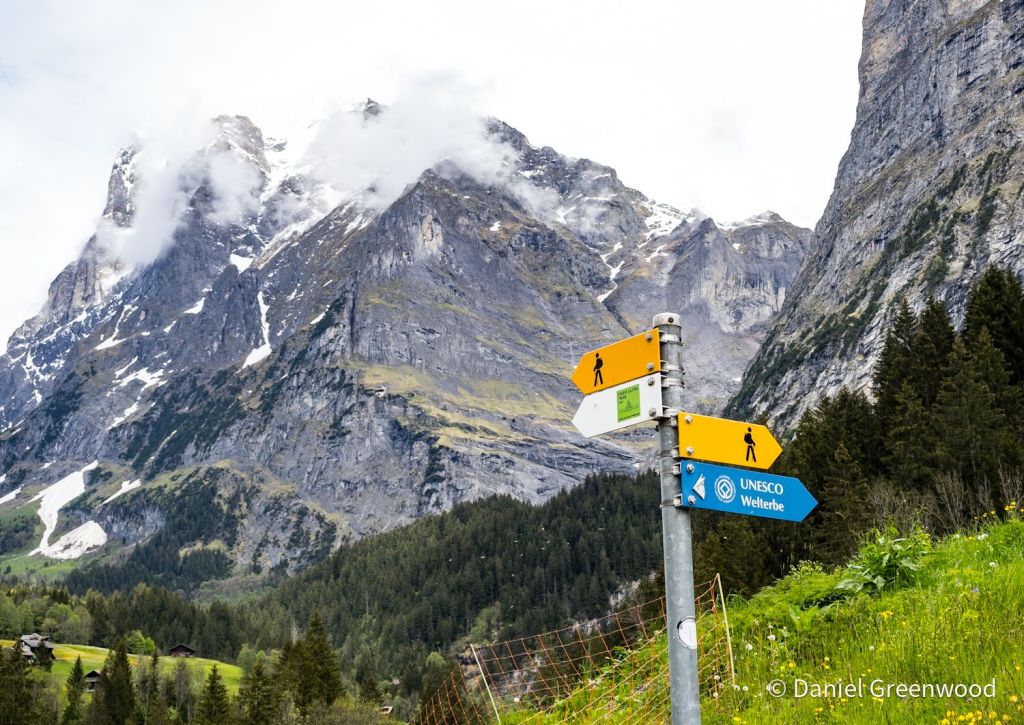
I’d like to be out walking in World Heritage landscapes every week, but alas, it will just have to be once or twice in life.

Looking south-west towards the Eiger.

Mountain sainfoin (Onobrychis montana) was one of the most eye-catching plants, growing at the edges of the lane if I remember rightly.
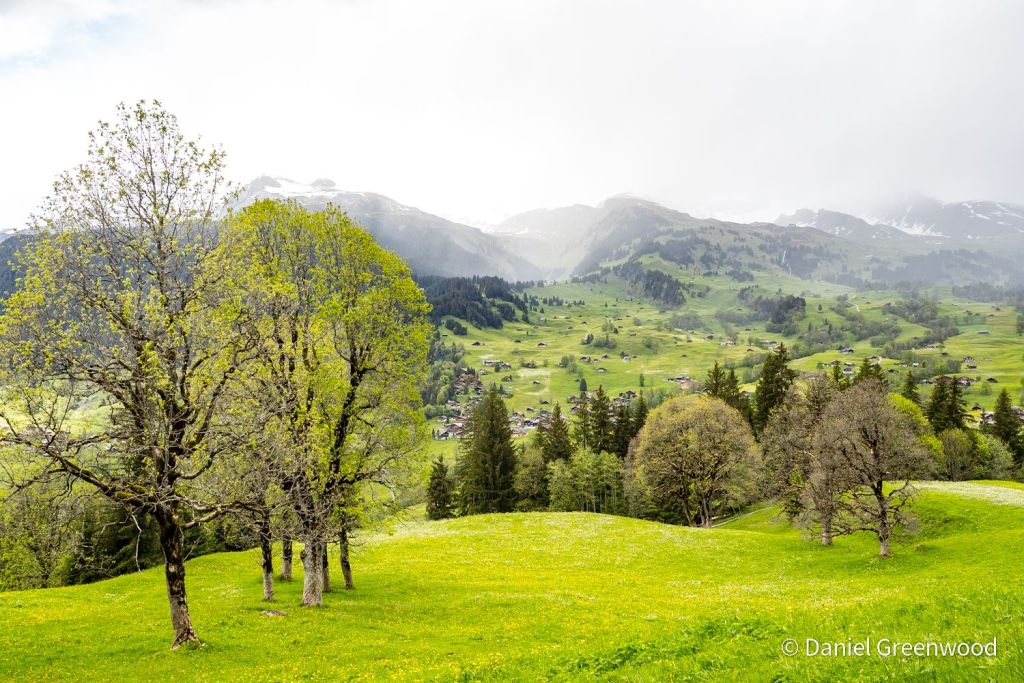
The spring really glows in this image, despite the misty conditions. The sycamores are coming into leaf.
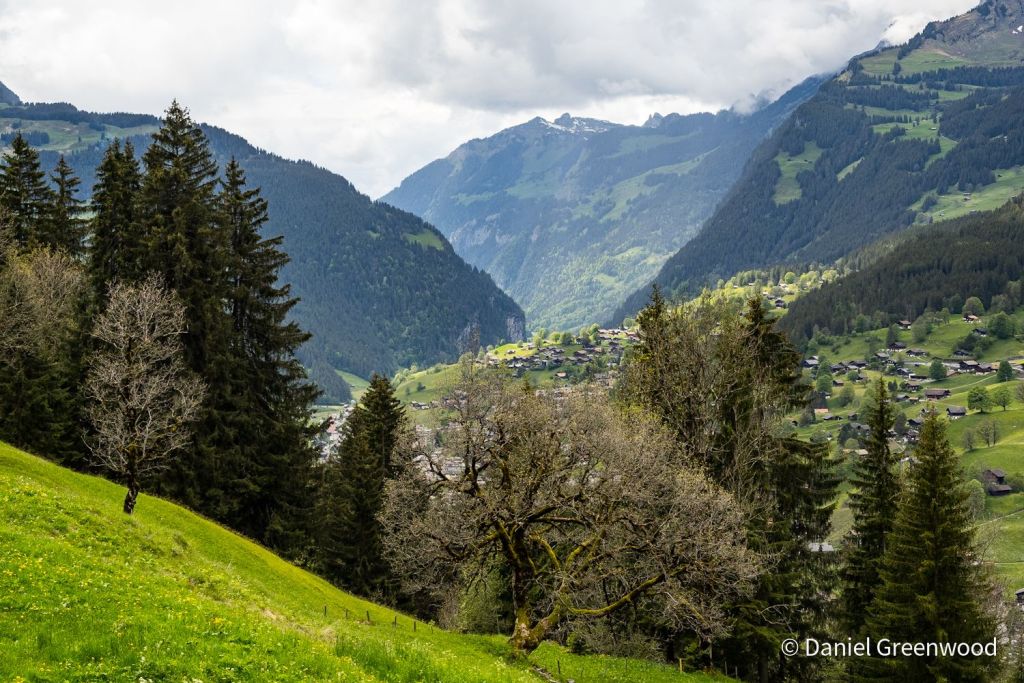
This is a view down the valley where the train returns to Interlaken.
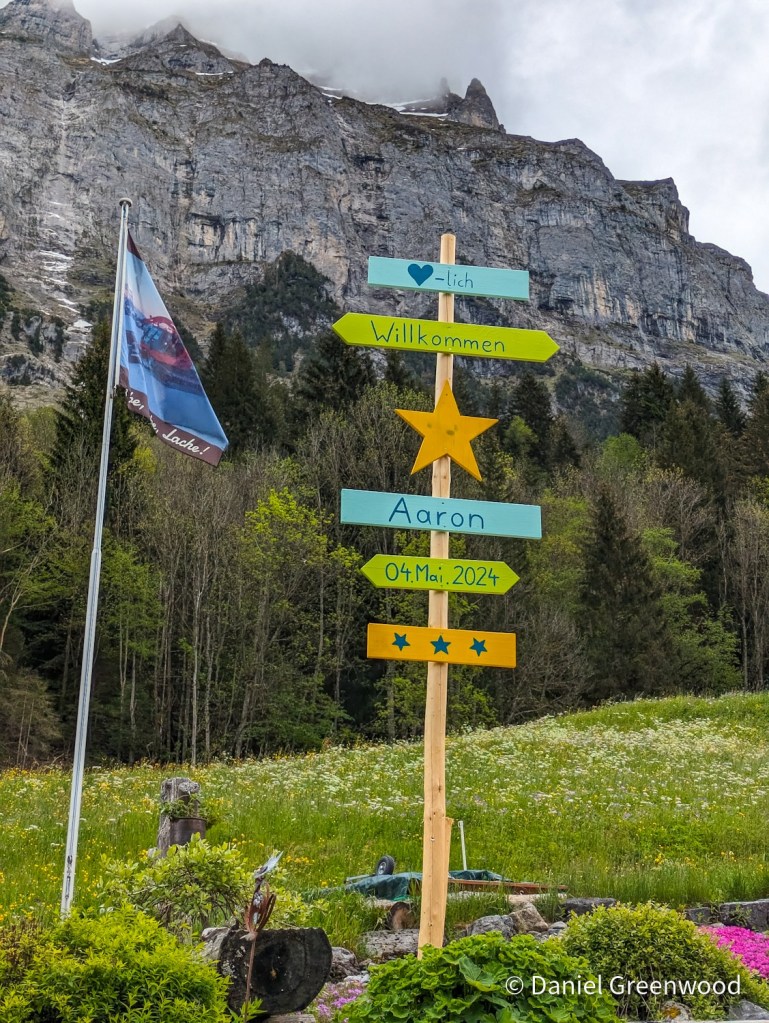
This is something I’d never seen before – a totemic welcome for Aaron who was born on 4th May 2024. Perhaps this is a tradition in this part of Switzerland?
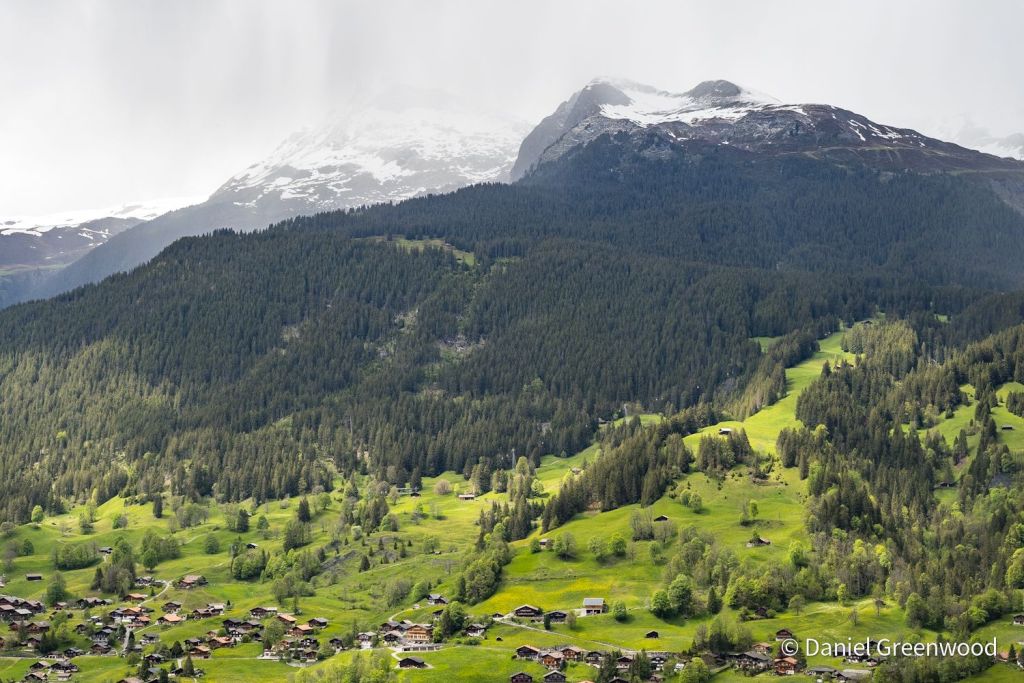
The views across towards Grindelwald First come into view as space opens up on the woods. You can see all of the chalets that dot the meadows.

I was intrigued by these rustic chalets that were more indicative of a rural way of life, compared with the guesthouses in the valley. It looked lived-in or at least used by people who made use of wood products. What a lovely place to be able to escape to in the summer. Of course communities would have developed from these single dwellings across the Alps.

This image looks north towards the other side of the valley. The yellow hue in the meadows is either kidney vetch or birds-foot trefoil.

The lovely spiralling shell of a snail roosting in a tree.

These umbellifer-rich meadows were a joy to behold.
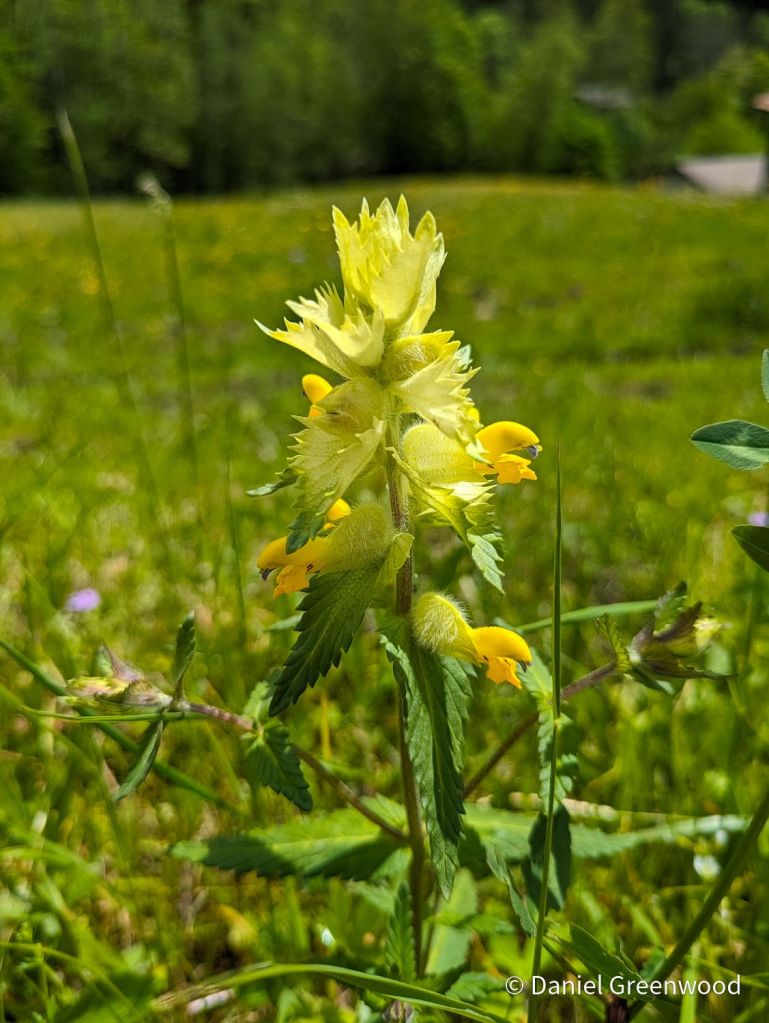
The lower we got (c.1000m) the more abundant yellow rattle become. This is probably Rhianthus serotinus.

This is the Black Lütschine, one of the rivers that flows into Lake Brienz. It was very powerful. Its source is the Lower Grindelward Glacier, pictured earlier in this post.
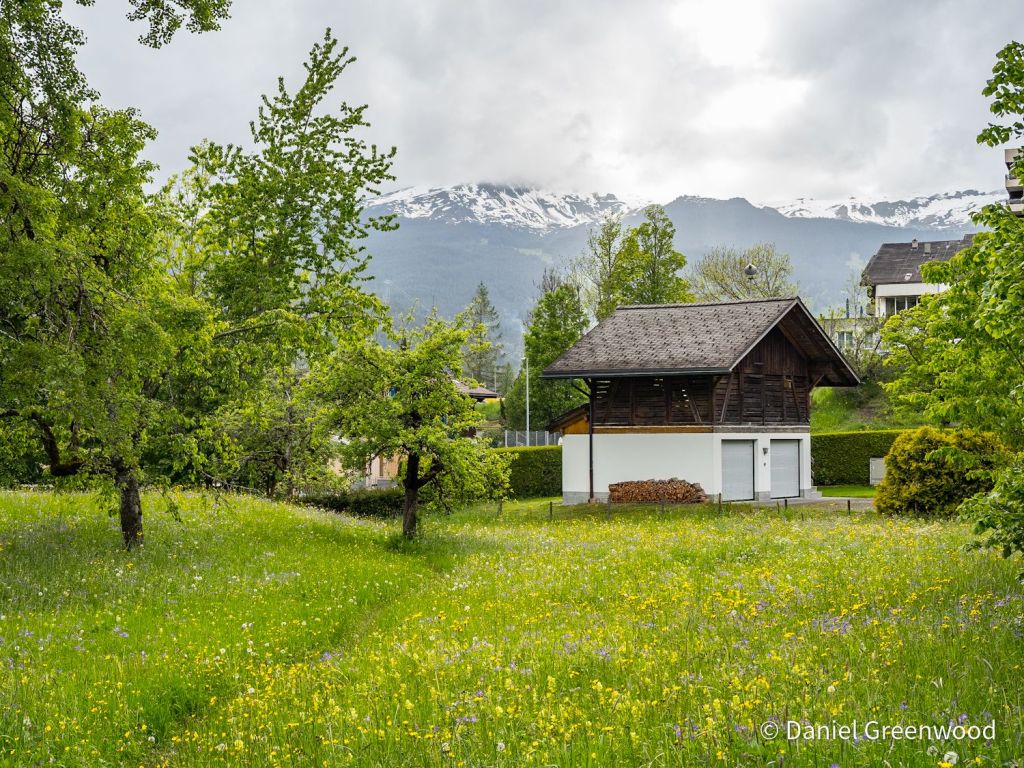
The meadows around people’s houses – this looks like an orchard – were in fine condition.

Thanks for reading.

I write these blogs in my spare time because I want to raise awareness about the beauty and diversity of our landscapes. If you enjoy reading them you can support my blog here.

Can you really ‘transplant’ an ancient woodland?

I was listening to Nicky Campbell’s BBC Radio 5 Live call-in the other day when a comment from one of the guests stopped me in my typing tracks. The subject was whether the government should ditch the midlands/northern leg of High Speed Rail 2 (HS2) from Birmingham to Manchester, which they now have scrapped.

The rail expert said that he had ‘regrown an ancient woodland’ with acorns from a felled or cleared site during the creation of High Speed 1 (HS1), the line that runs from Kent to London St. Pancras International. There was no confirmation of which woodland the man was talking about.

Nicky Campbell did question this clearly unusual comment about ‘ancientness’, but it wasn’t final and the rail expert had the last word. Let’s look at the facts.

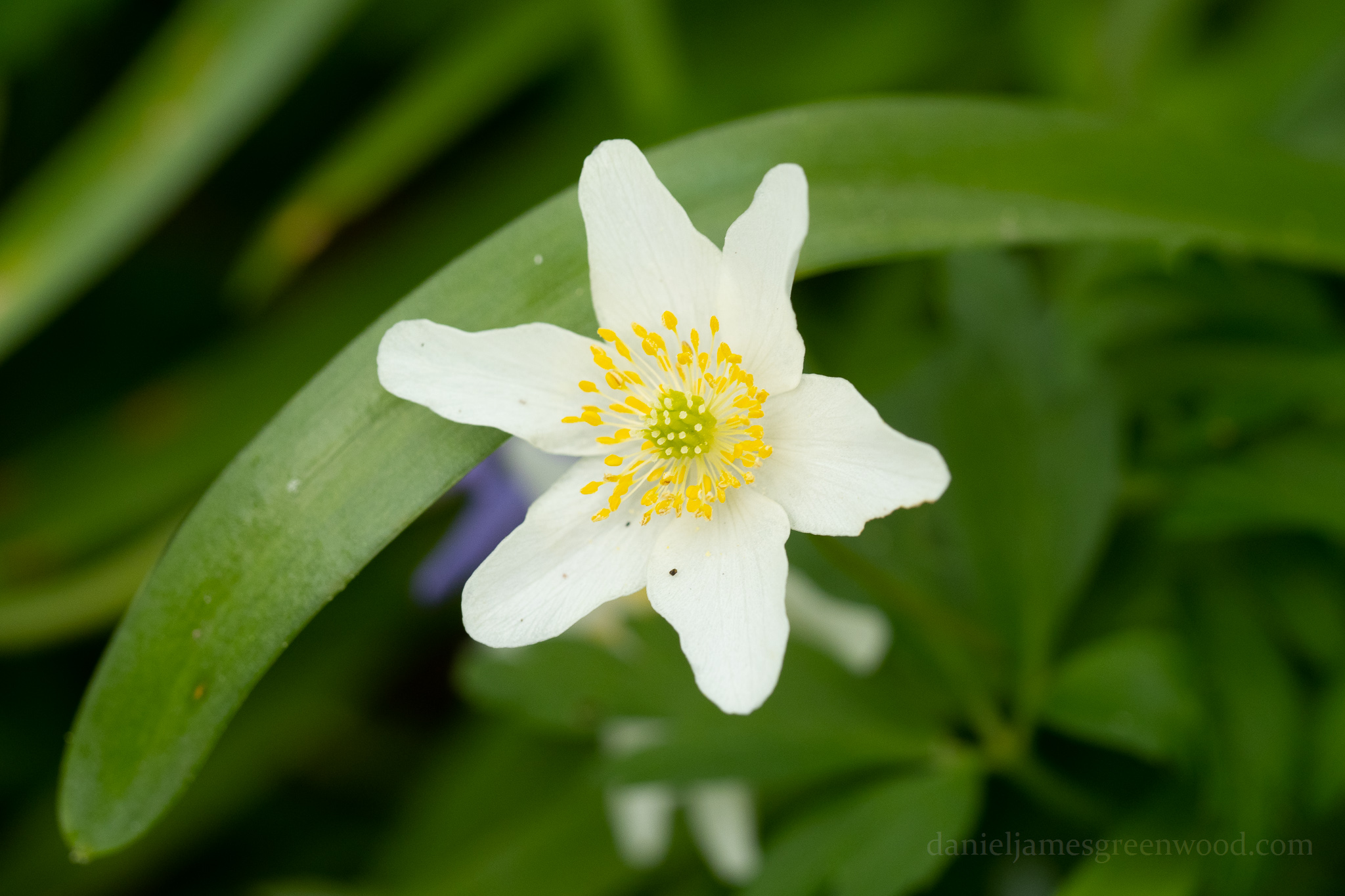
Wood anemone, an ancient woodland indicator plant

Ancient woodlands are wooded landscapes home to assemblages of particular species relevant to their locale (trees and wildflowers, fungi, invertebrates) that have been on maps since the year 1600. Their soils are rich in fungi and invertebrates, ecosystems that have developed over a very long time.

So is it possible to remove this landscape and put it somewhere else?

HS2 has been trying. They have been moving soil and, apparently, in some cases trees. This method says so much about our relationship with landscapes today – we can just move things around like pieces of Lego, and surely everything will be fine?

In my view, the equivalent of this is wheeling a patient out of a hospital and leaving them in the car park. ‘There you go,’ the doctors might say. ‘Consider yourself replanted.’

It’s like taking the Mona Lisa and chucking it into the sea.

To some ecologists it’s just beyond belief.

What is so problematic about this rail expert’s statement, beyond the obvious? It’s greenwashing from people, intentional or not, who profit from development of ancient woodland, or who think their expertise in one area allows them free reign elsewhere. I’m sure there are housebuilders out there lamenting environmentalists who think they are also experts in constructing properties.

This kind of greenwashing is a green light for bad planning, dodgy development and accelerated destruction of England’s already depleted wild and natural places. I think it’s important to challenge it when it does rear its head. Once an ancient woodland and all its wildlife and heritage is gone, it’s not coming back.

Thanks for reading.

Somewhere between a cuckoo and a high speed train

Woods under threat from HS2 – The Woodland Trust

August mushrooms in the New Forest National Park 🐴

New Forest National Park, Hampshire, August 2023

I was in the New Forest National Park camping for a couple of nights in August. The rainy July in southern England gave me great hope of finding some nice shrooms in what is one of England’s mushroom wonderlands. It didn’t disappoint!

Bolete bonanza

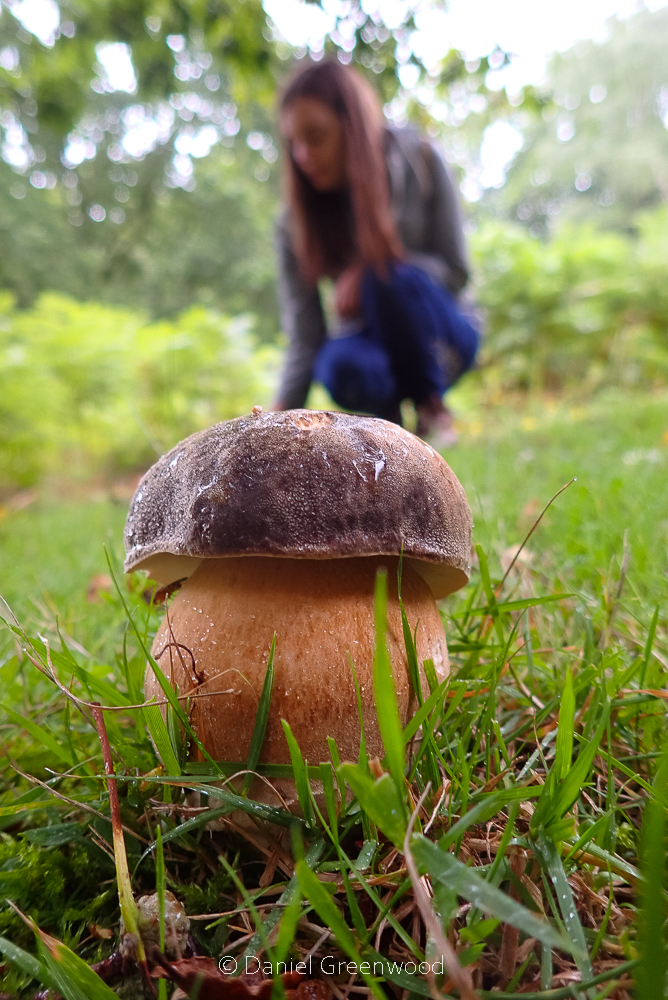
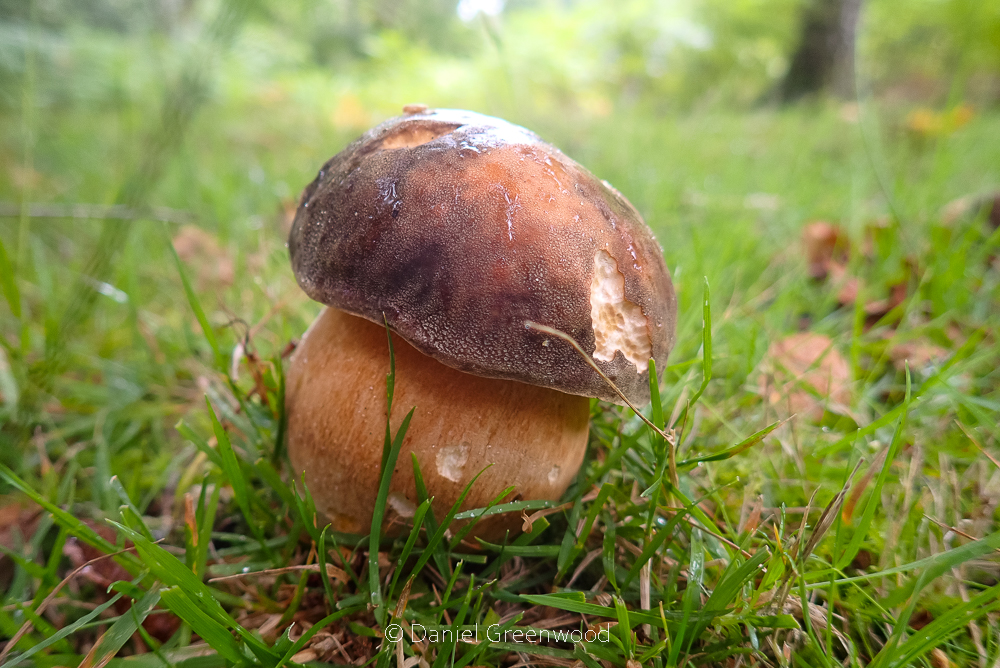
I was so happy to find these boletes, one having already been uprooted. They were the perfect shape and just an absolute joy to see. I have been told these are ceps, but I’m not entirely sure if they’re not another species. I’m unclear on the variety among cep-like boletes, and if the colouring isn’t indicative of another species.

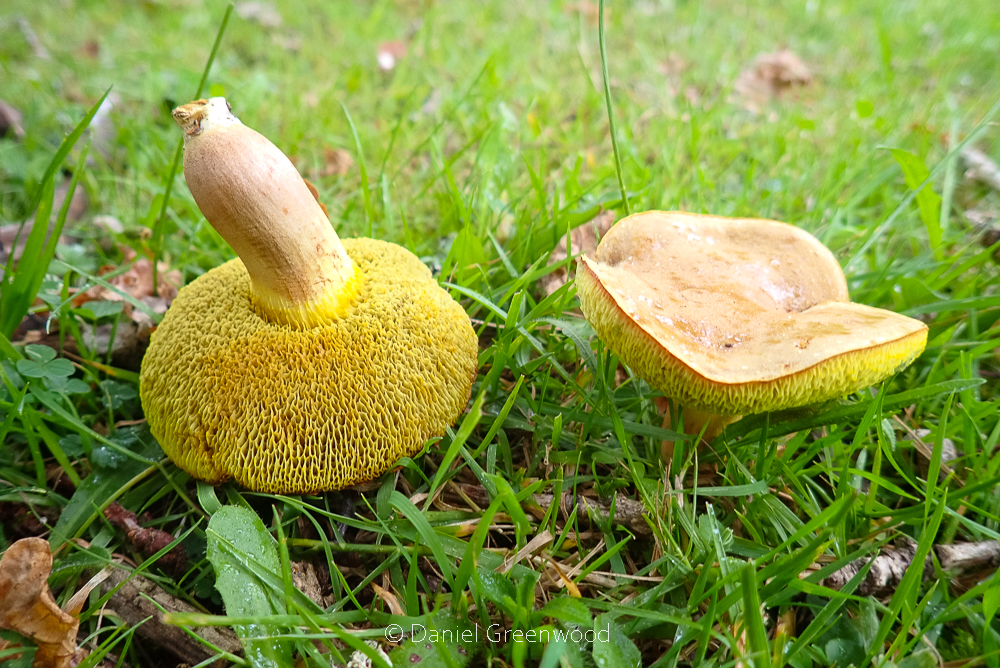
These lovely yellow-pored boletes are in the genus Xerocomus.

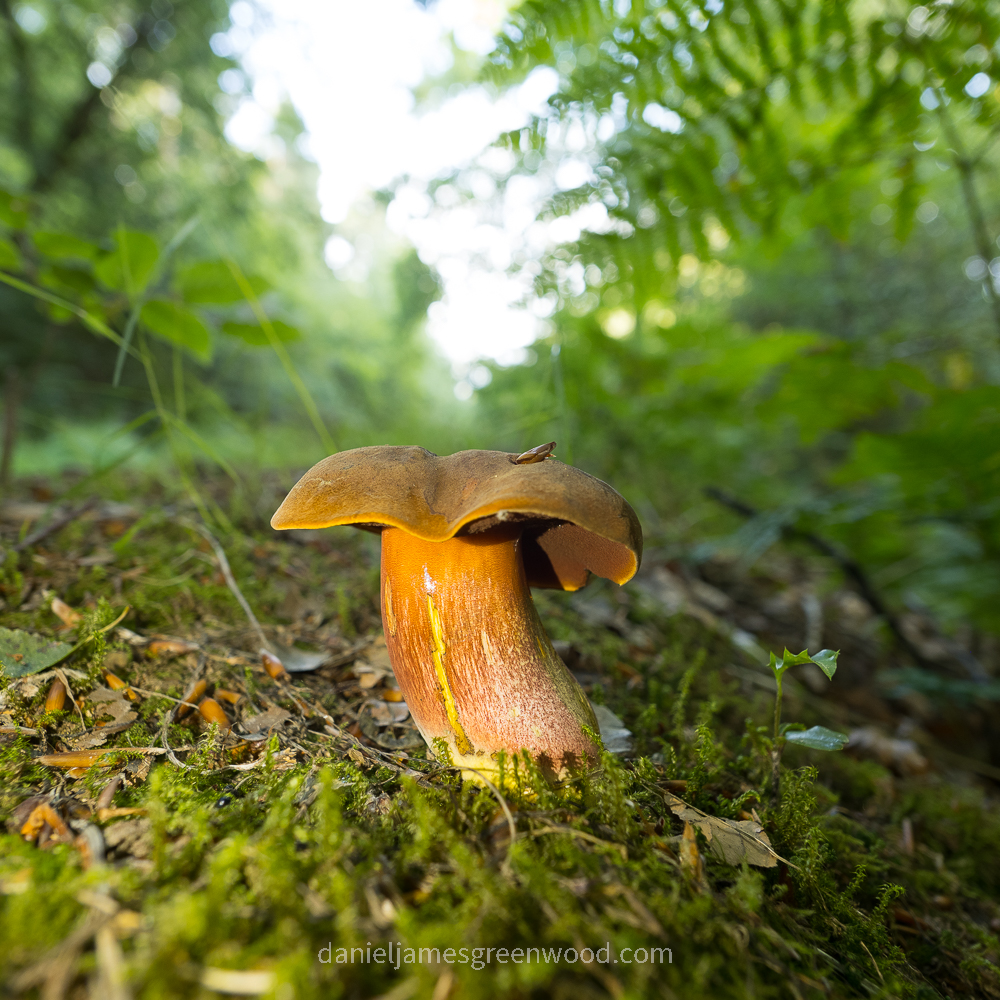
About half a mile or less away we found this beauty sitting alone among the grass and leaf litter. It’s an orange bolete. It doesn’t appear to have a distinct association with one species of tree, but this area was common in oak and birch.

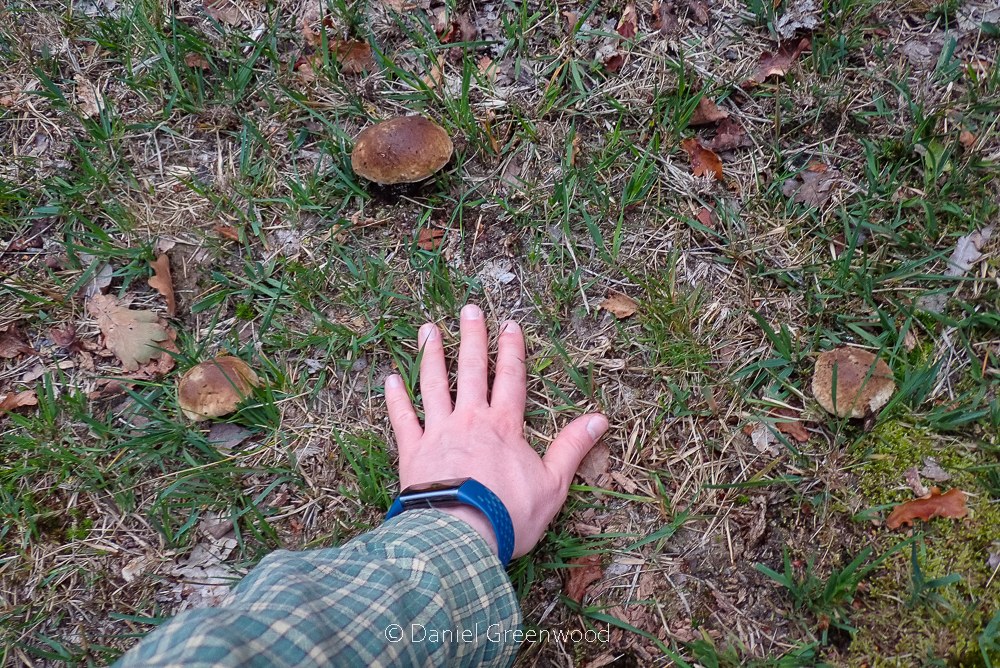
Much later that day, on the return stretch, we found this well-camouflaged group of what I am sure are ceps due to their colouring and other diagnostic features.

You can see the distinctive webbing on the stipe here, and the pennybun cap is all you need really:

As the evening drew in, I found this orange bolete that may have been picked by a deer (there was a herd in the area).

Webcaps

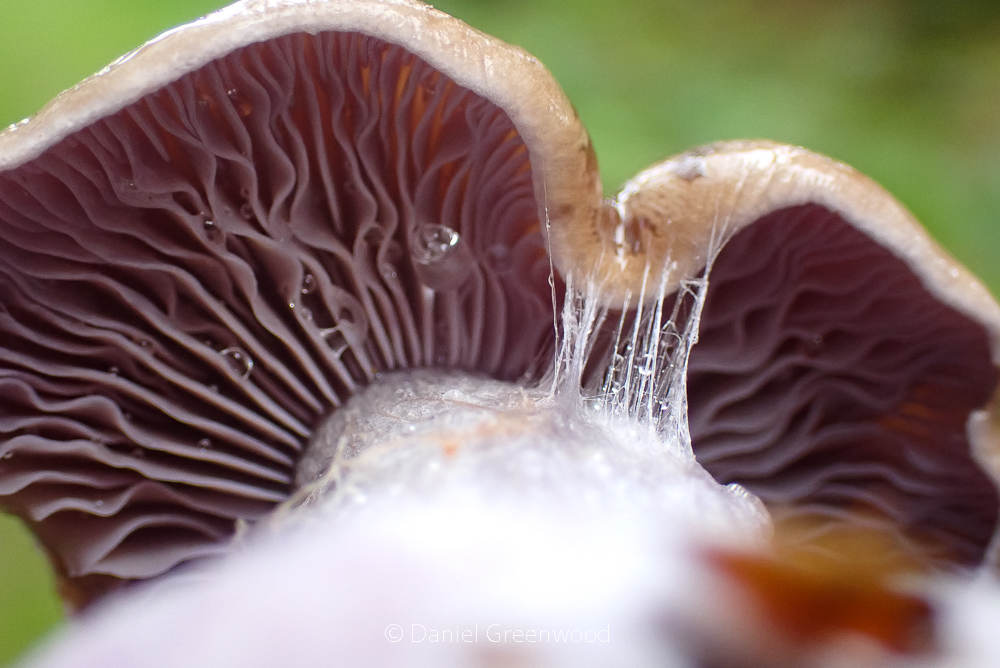
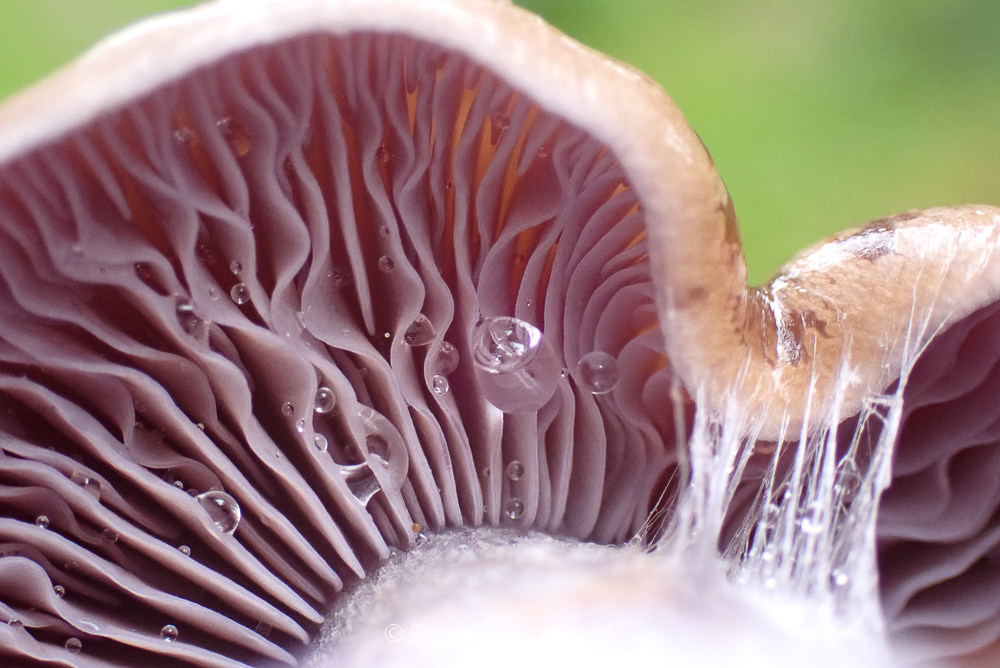
Earlier in the day, while passing between two plantations on a grassy ride, I noticed this uprooted mushroom on the ground. Two bites had been taken from it, probably by deer or a small mammal. The remnants of the veil between the cap and stipe, covering the gills, gave me the thought that this was a webcap. The gills were very beautiful, embellished by the water droplets.

iNaturalist has come back with an ID of webcap subsect ‘Purpurascentes‘. I can’t find any other info on the subgroup distinction.

Rustgills

Rustgills are a group I’m not particularly familiar with. Having developed my fungi knowledge in isolated city woodlands, I didn’t really see rustgills until I moved to Sussex and spent time in larger areas of woodland. This patch was unavoidable. No wonder there is a species known as the spectacular rustgill.

Rustgills are in the genus Gymnophilus. They’re confusable with scalycaps (Stropharia) due to shape and colour.

Chantarelles

And finally some golden chantarelles, already nibbled by slugs and uprooted, probably by deer (as I have said 1000 times in this post!).

The New Forest has a “no pick” policy and there are concerns about illegal, commercial-scale picking for posh restaurants, just FYI. All of these mushrooms had already been “naturally” uprooted (probably by deer).

Thanks for reading.

Fungi

Mushroom, mushroom burning bright 🍄

…in the forest on a warm July afternoon.

It’s been a very busy summer so far for me of working and commuting. I had a free afternoon and so headed to my local dreamspace, but with no mushrooms on the mind – literally or figuratively.

Red admiral (phone pic)

The number of butterflies was remarkable, perhaps the sense of doom about 2023’s poor invertebrate spring had dampened my expectations too much. There were red admirals, skippers, whites of course, and even a white admiral on the sandy track. White admiral is something I don’t see that often, mainly because I lived in London for so long. Then again, it is cropping up in SE London now, which is interesting.

I was enjoying the sense of a butterfly summer, when I nearly spilled my invisible coffee at the sight of a deep red mushroom on the edge of the track.

Mushrooms, so abrupt, unapologetic. They know how welcome they are, even if you don’t realise it yourself at the time.

This was one of the summery, colourful boletes that can be found at this time of year. It’s probably a neoboletus, but my iNaturalist record is without community input and I haven’t had the time to do any research myself. So it remains an unknown jewel.

A few paces away was a more common and typical summer shroom, what I would guess is a blusher.

This short walk on the edge of the High Weald was notable for its green-ness, surely close to peaking as August nears.

We’re lucky over here that we aren’t experiencing the mega burns and record high temperatures of Greece, Italy and Arizona. You have to wonder how some of our fungi will cope with the drought and the impact on our woods. No doubt fungi will outlive humans in the long, long run (they can survive and thrive in nuclear reactors) but the heat can’t be good for the health of our woods which may struggle to adapt to pace and intensity of change.

When are we going to see serious action on climate, rather than flip-flopping by both major political parties? The kind of urgency we saw in crisis-managing COVID-19? Am I destined to see meaningful environmental policy remain as a marginal ideal in my lifetime?

No doubt fungi will rise into conservation thinking beyond the obsession with bringing back questionable, extinct species. But will that be too late as the heat rises and the woods burn?

Fungi, ever-resilient, have been found to benefit from burning in Australia, but of course that is just a handful of species.

It would be foolish no to follow one of the key messages fungi can teach us: don’t forget the present, you never know what might pop up.

Thanks for reading.

Fungi

#FungiFriday: deadwood brings the disco

OLYMPUS DIGITAL CAMERA

Fungi Friday: 24th January 2020

A week of blissful winter sunshine and endless starry skies, cut short by low clouds. What is the point of January, many ask. If fungi asked themselves that question, they probably wouldn’t be here and therefore nor would we. Nature does not disappear completely in winter. The paucity of species can help introduce us to new ones we never knew existed.

OLYMPUS DIGITAL CAMERA

January to me is a good time to find slime moulds. Yes, I suppose this is two straight weeks of cheating after last week’s lichen love-in. But if this is the only way to raise awareness about slime moulds, I don’t think fungi will mind. I had an hour to look through the wooded slopes of an old estate in East Sussex, to find this week’s quarry.

OLYMPUS DIGITAL CAMERA

There was very little fungi of the mushroom kind, in fact, none. But one of the bad funguys had been making itself felt in the wood. Ash trees had been felled after becoming infected with ash dieback. I used to monitor a woodland at the time of ash dieback’s arrival in the UK and have, since about 2014, watched it rocket across the country. In Sussex it is killing lots of ash trees that are under 50 years of age and the landscape of the South Downs is losing a lot of its higher woodland.

OLYMPUS DIGITAL CAMERA

Here you can see the effect of the fungus, though of course many other fungal organisms will be benefitting from the decay caused by the disease. The rot has moved from the outside in through what are the softer layers of waste wood. Had the fungus weakened two thirds of the overall mass, the tree would probably have fallen down. Lots of people walk under these trees, so that’s why they have to be pushed before the wind shoves them.

OLYMPUS DIGITAL CAMERA

I have been exchanging emails with a fellow macro photographer this week who has been spending hours looking for slime moulds. One day this week he looked for four hours and found nothing. I was lucky enough to walk straight outdoors for a few minutes and happened upon this epic spread on the tree above:

OLYMPUS DIGITAL CAMERA

No, slime moulds aren’t fungi, they’re not even moulds, which are another kind of fungus. I still don’t have the slime mould ID book so any help is welcome.

OLYMPUS DIGITAL CAMERA

The thing that amazed me about these slimeys was that you could barely see them, even when I knew they were there. They camouflaged so well with the glowering winter light. The photos here have been taken with a flash.

OLYMPUS DIGITAL CAMERA

I could have spent all day with this spread but only had an hour and my small camera. Up close they look like little black kalamata olives. Nom, nom and nom. Though inedible.

OLYMPUS DIGITAL CAMERA

The land managers had left lots of standing dead trees which is excellent. There is some epic misinformation going around about deadwood in woodlands and their contributions to forest fires. It’s guff aimed to misinform people, appeal to people’s fears (what a surprise) and promote the destruction of these habitats. In Britain our native woods of oak, beech and so on, are far too wet to ever burn like a heath.

OLYMPUS DIGITAL CAMERA

The crevices seen above are the perfect places to find slime moulds in cold weather. This is because they provide microclimates and protection from the elements.

OLYMPUS DIGITAL CAMERA

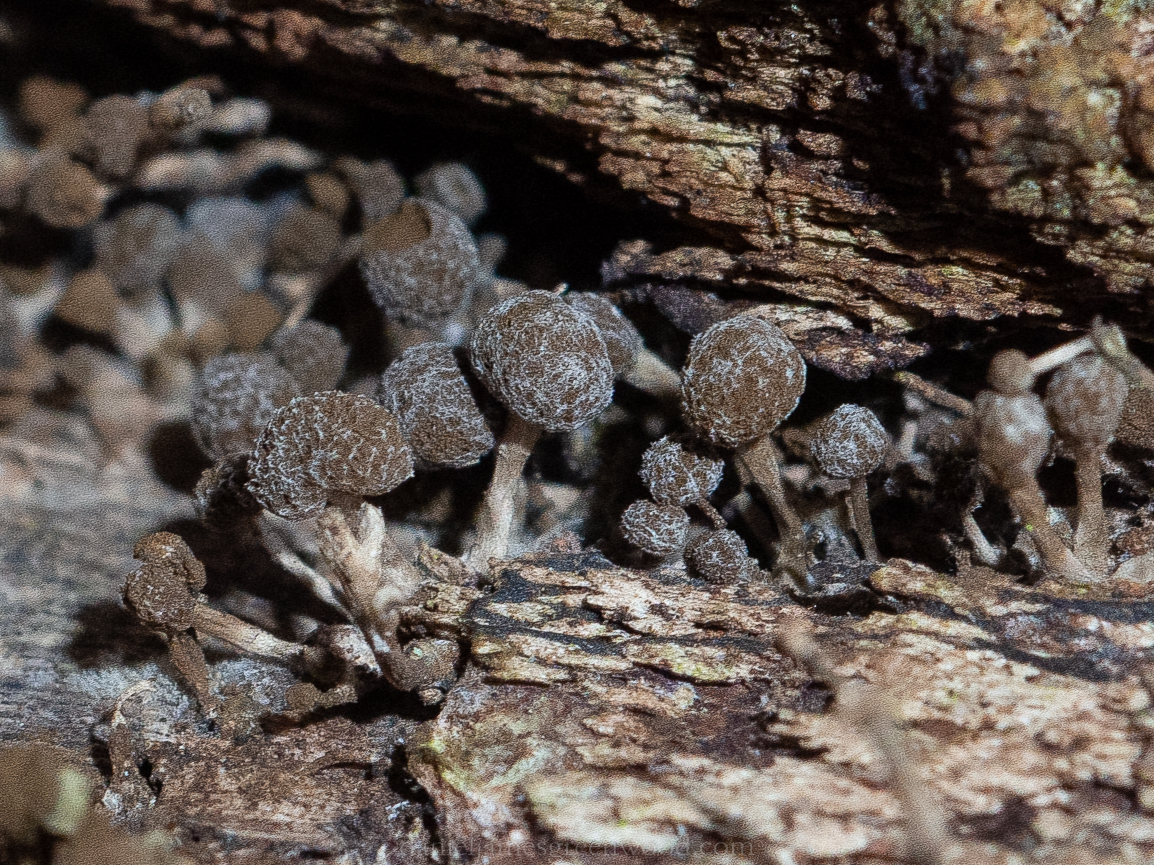
Here I found some old stalkballs which are fungi (or maybe a species of slime mould, am not quite sure), plus the real life of the party:

OLYMPUS DIGITAL CAMERA

DISCO. I’m not sure which species of disco the blue cup fungi are, but the orange fruiting body is definitely a slime mould. They were few and I couldn’t get a good angle on them.

OLYMPUS DIGITAL CAMERA

Thankfully this blue disco brought the party on Fungi Friday.

Please do share your finds this week in the comments below. Also here are some fungi things of interest this week.

Thanks for reading.

First mushrooms appeared earlier than originally thought

More mushrooms


The Tamar Valley: London’s sylvan links with Buckland Abbey

Dartmoor - November 2019 blog-10

Buckland Abbey, Tamar Valley, Devon, November 2019

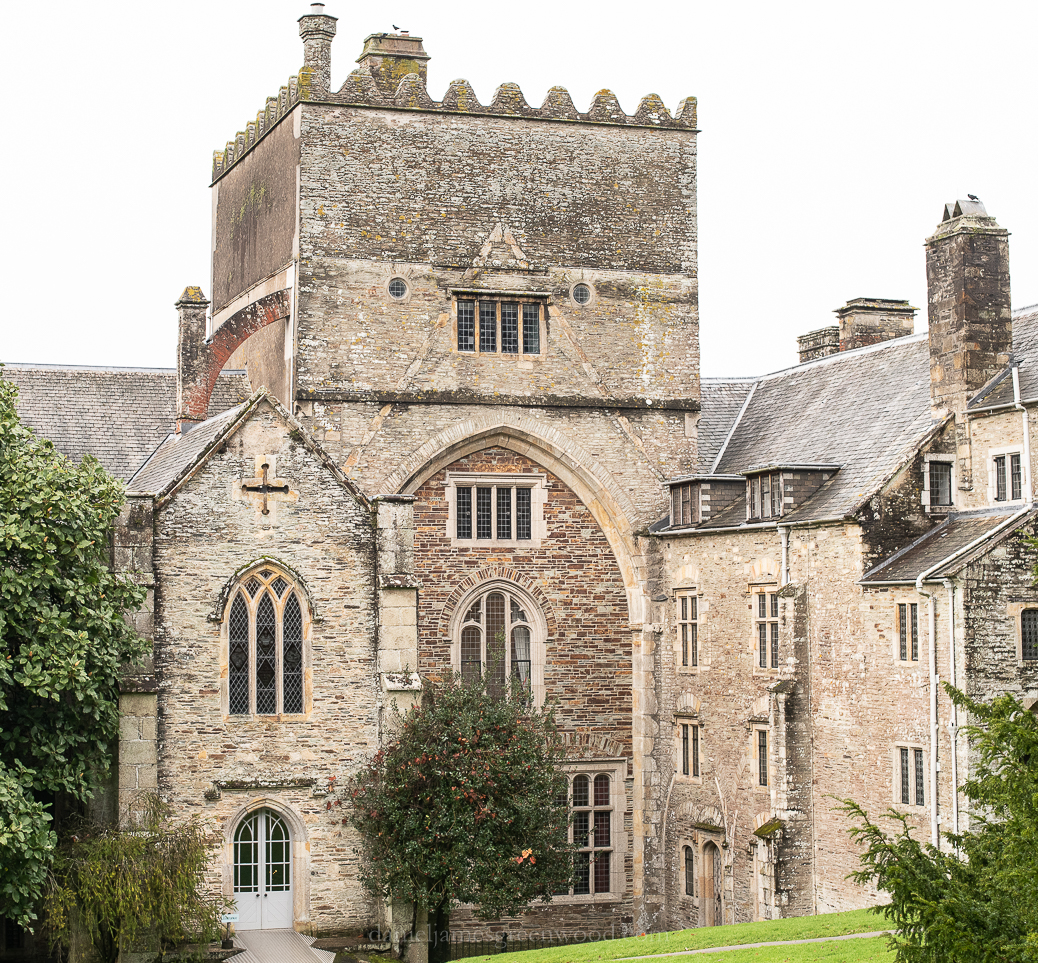
At last the rain has stopped. Buckland Abbey, once home to Sir Frances Drake (1540-1596), climbs out of its nook in the hillside, reflecting the stony skies above. Drake is known for ‘his’ ships which battled the Spanish Armada in the 1500s, for circumnavigating the earth and for his role in the slaughter of civilians on Rathlin Island in 1575.

Buckland Abbey November 2019 blog-1

I first heard about him from spending time in south-east London’s remnant ancient woodland known as Great North Wood. It is said that some oaks grown in the Great North Wood were taken to the docks at Deptford and used in the building of some of Drake’s ships. It has never been verified. One thing that was verified at Deptford was Drake’s knighthood in 1851, on the ship named the Golden Hind, something I only learned at Buckland Abbey.

The fields around the Abbey are pocked by small cream sheep that run like chickens as we pass them on the track. In the distance the dammed River Tavy reflects the sky again, the dark woods flowing across the slopes to where the river enters the Tamar. Looking at the Ordnance Survey map, something stands out. To the north-west is a large woodland named The Great North Wood.

BucklandAbbey_OS
Ordnance Survey © Crown Copyright 2019 and/or database right 2016. Licence number 100043379

Could this be simply because it’s so large, or because of Drake’s links to that area of south London? The name is said only to have been popularised in the Victorian period and could have been given to differentiate the once vast area of woodland to that of the Weald that covered most of south-east England in the Anglo-Saxon period. Perhaps this local wood was also named by residents of the Abbey in the 1800s.

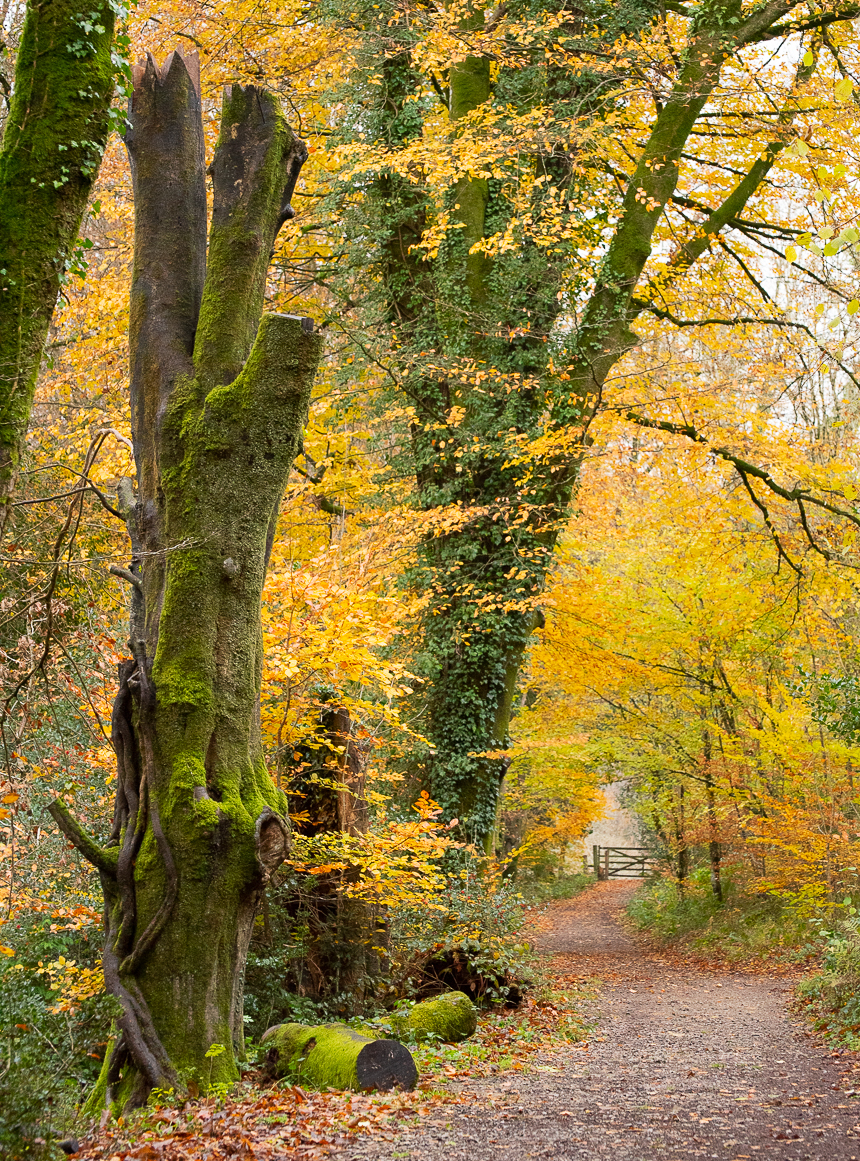
Redwings are established now, flocking in the fields. I hear my first fieldfare chuck-chuck-chucking over the Abbey. Down in the woods beech trees burn even without the aid of sunlight. They brighten the most glowering corners. Hazels are yellowing and even the odd wych elm with its almost bulb-bright leaves. It’s here saying, ‘don’t forget about me.’ Many elms have gone, but wych elm survives.

Dartmoor - November 2019 blog-12

The rain threatens specks again as the light, if you can call it that, dwindles further. In a combe of a field a grey heron flaps its wings, either a slice of Buckland Abbey’s grey exterior breaking free, or a slither of sky lending itself south, to the glassy Tavy for the night.

The Sussex Weald: Riders of the mushroom storm

Owlbeech - 18-10-2019 lo-res-28

St. Leonard’s Forest, West Sussex, October 2019

After a night of stormy weather, the high winds blew through the woods and really I probably shouldn’t have been there. But October is such a special time in the woodland year that any time spent there is to be cherished.

Owlbeech - 18-10-2019 lo-res-3

I walked for three or so hours in the Forest and found lots of species, masses of small brown and grey mushrooms in the leaf litter that don’t make great photos. My first find was a lovely species known as twig parachute.

Owlbeech - 18-10-2019 lo-res-4

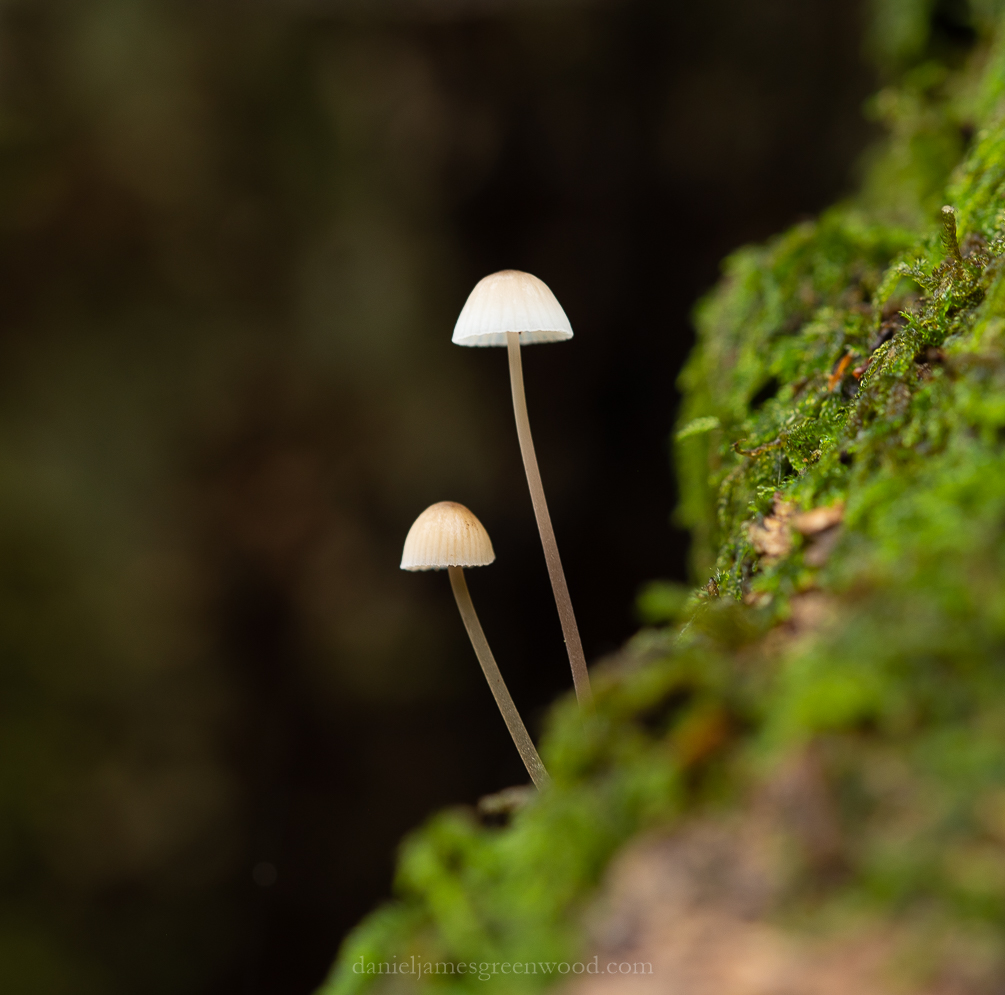
Staying in macro mode these miniscule bonnets were were growing from a bed of moss on the buttress of a tree.

Owlbeech - 18-10-2019 lo-res-6

There is a small clearing I’ve recently found, well hidden from paths but obviously the secret space for other visitors as well. Here a thick humus of leaf litter and, in particular, beech nuts were creating good fruiting ground for mushrooms. This little brittlegill (I always prefer their Latin name of Russula, indicative of their redness) was one of those to benefit.

Owlbeech - 18-10-2019 lo-res-5

A beech tree has dropped a large limb and deadwood fungi have begun to colonise it. This is a splitgill and only really comes to life after prolonged rain. It’s a process of re-hydration. They’re tricky to photograph but always look nice with some bokeh (the baubles of light) in the background.

Owlbeech - 18-10-2019 lo-res-8

In the mosses growing in the dark and wet corners under holly trees, species like what-I-think-is curry milkcap were fruiting. This species is said to have a curry-like taste.

Owlbeech - 18-10-2019 lo-res-14

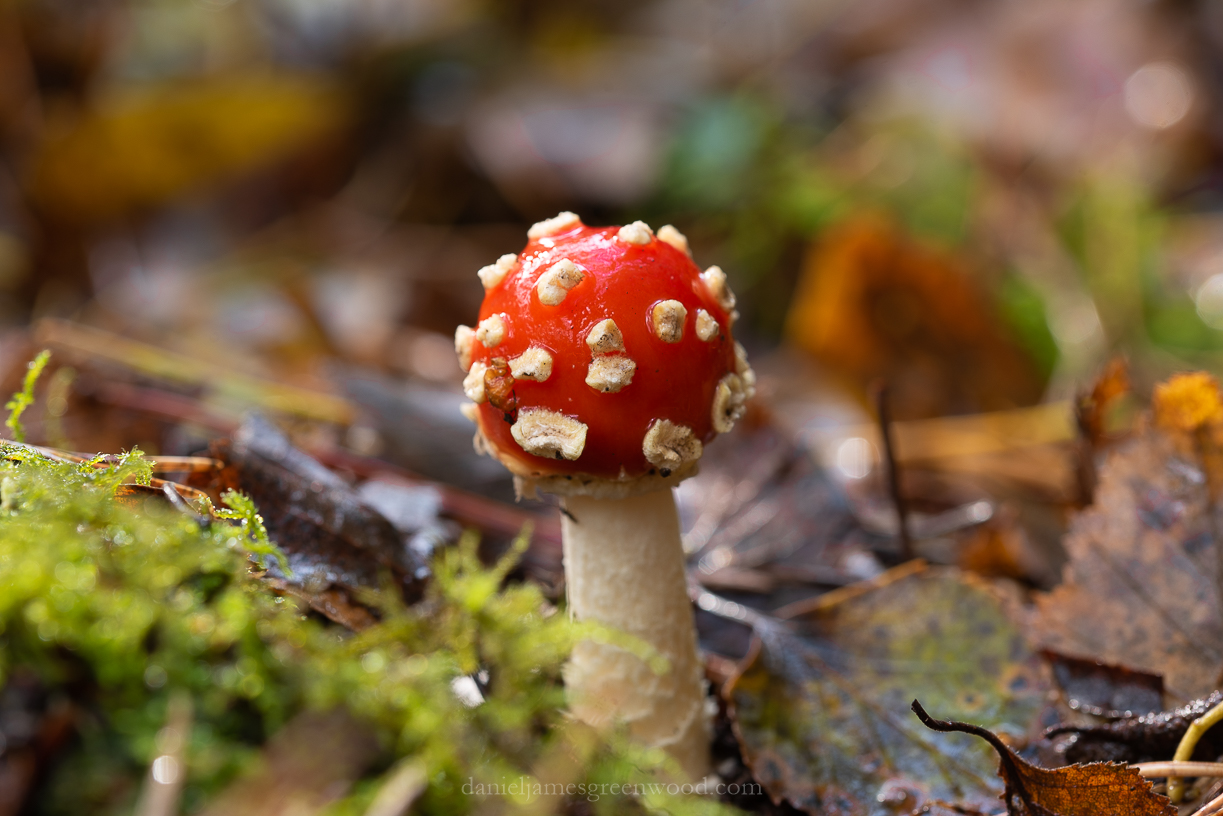
St. Leonard’s Forest sits on the edge of sandy heathland soils and Wealden clay. Passing into the heathy areas which make it a ‘Forest’ (forests were open landscapes used for hunting by the aristocracy, and don’t denote woodland alone) fly agaric suddenly arrived. These shrooms are thought to have given Father Christmas his red and white outfit and provided the hallucinatory impact that gave visions of reindeer flying. I’ll write something about that one day but still, these should be treated as deadly poisonous.

Owlbeech - 18-10-2019 lo-res-39

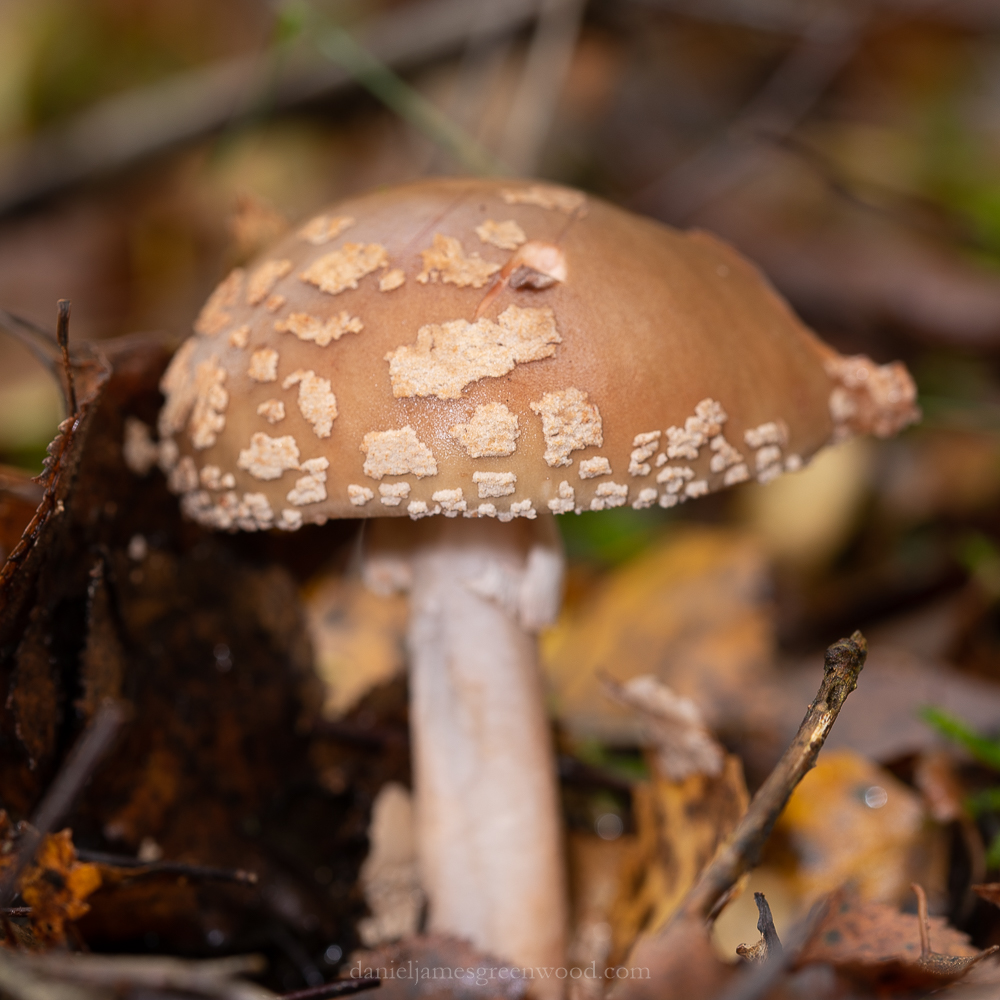
While we’re on deadly shrooms, this relative of fly agaric is panther cap. It’s definitely poisonous and is more photogenic when it’s in its bulbous stage. Again it’s common on sandy heathland soils.

Owlbeech - 18-10-2019 lo-res-25

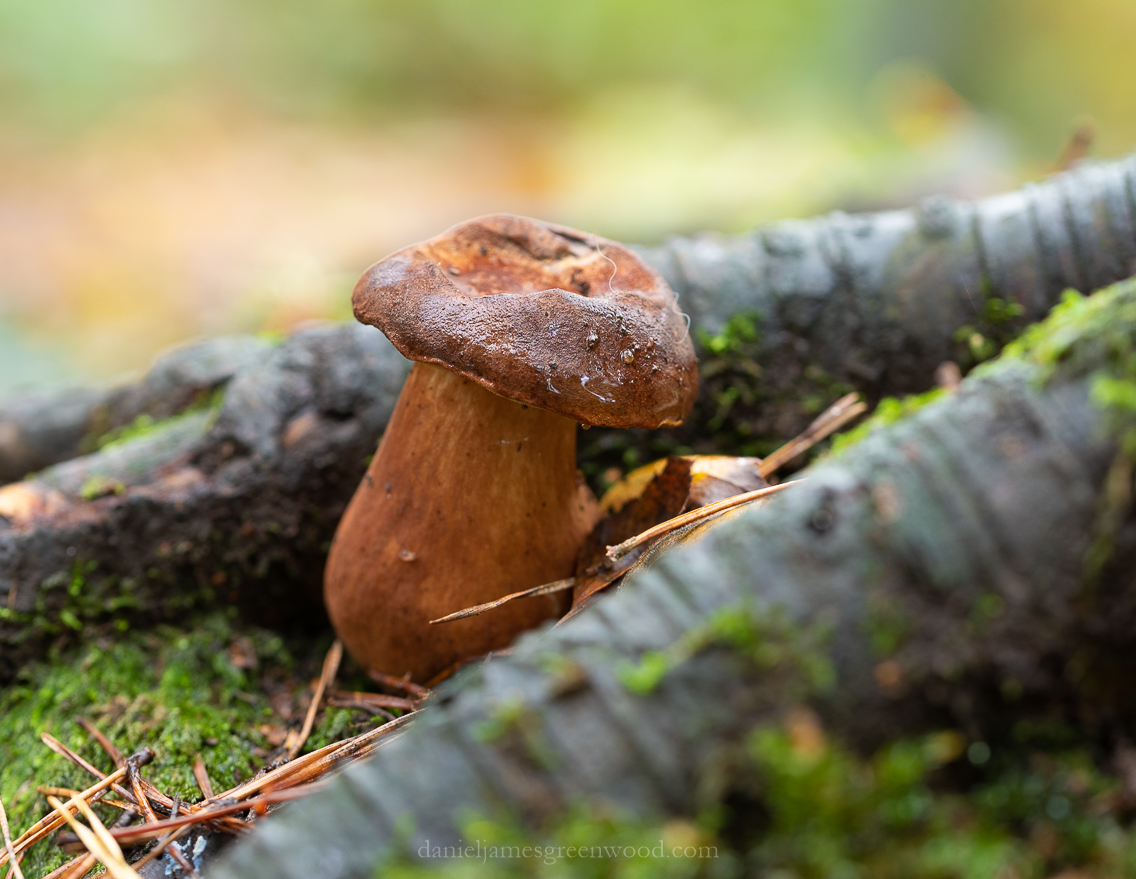
There is some constant pleasure about seeing boletes. Perhaps it’s because the cep/penny bun/porcini is the tastiest. This bolete scares me. Can you see the smiley face and squiggle of hair on the cap?

Owlbeech - 18-10-2019 lo-res-20

Days of cloud were broken up by the storm and it was a relief to see some sunshine. This footbridge runs over a gill that cuts between the clay woods and the heathland on that travels further east into St. Leonard’s Forest and the wider Weald. The gill was as full as I’d seen it because of torrential downpours.

Owlbeech - 18-10-2019 lo-res-51

On my way back home I found a gang of clustered bonnets on a trunk that crossed a path. It had been chainsawed in half so people can still walk through. It’s the perfect height and position for photos.

Owlbeech - 18-10-2019 lo-res-45

Owlbeech - 18-10-2019 lo-res-38

The sun broke through the trees and lit the bonnets where they had squeezed their way out from behind the bark. To me they look a little bit like they’re hiding from something beyond the wood they cower behind.

Read more:

The Sussex Weald

My Wood-Wide-Web


The Sussex Weald: a mushroom cloud rests over West Sussex

Ebernoe - 11-10-2019 djg-3

Ebernoe Common, Sussex Weald, October 2019

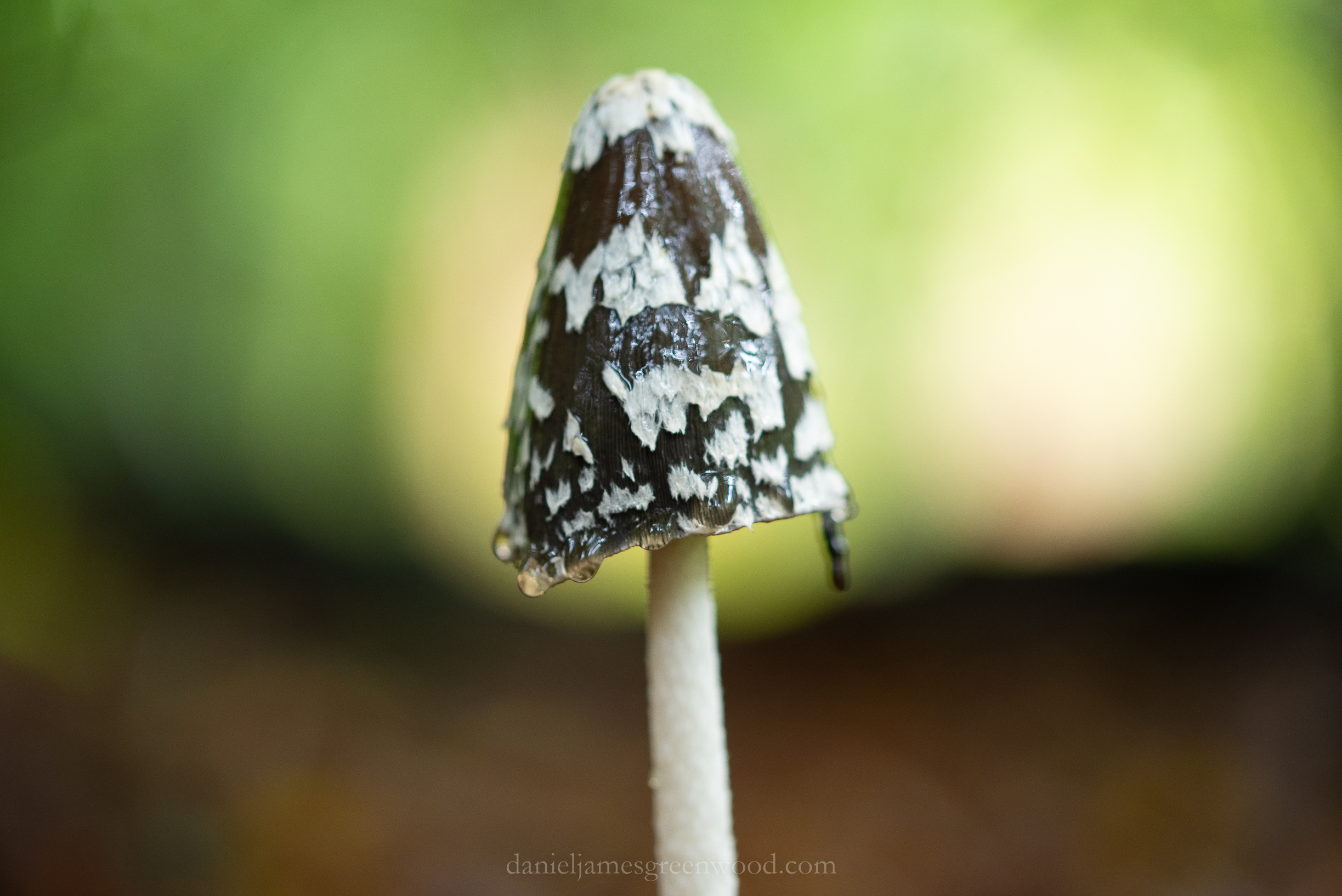
Last week I spent a drizzly and dark afternoon at Ebernoe Common, a National Nature Reserve managed by Sussex Wildlife Trust. It was raining not only water but mushrooms. The first signs of the good times came in the shape of a magpie inkcap. This is something I’ve only seen three times, twice at Ebernoe and once on the North Downs.

Ebernoe - 11-10-2019 djg-1

The word magpie relates to the English phrased ‘pied’ which means black and white. This species goes into the delicious state of deliquesce (an inky kind of melting), just like its relative the shaggy inkcap. Unlike the shaggy inkcap, though, it’s toxic so don’t eat it. The thing I like about this image is the glow of green in the background gradually turning to yellow as autumn progresses. Beech usually provides this kind of backdrop.

Ebernoe - 11-10-2019 djg-4

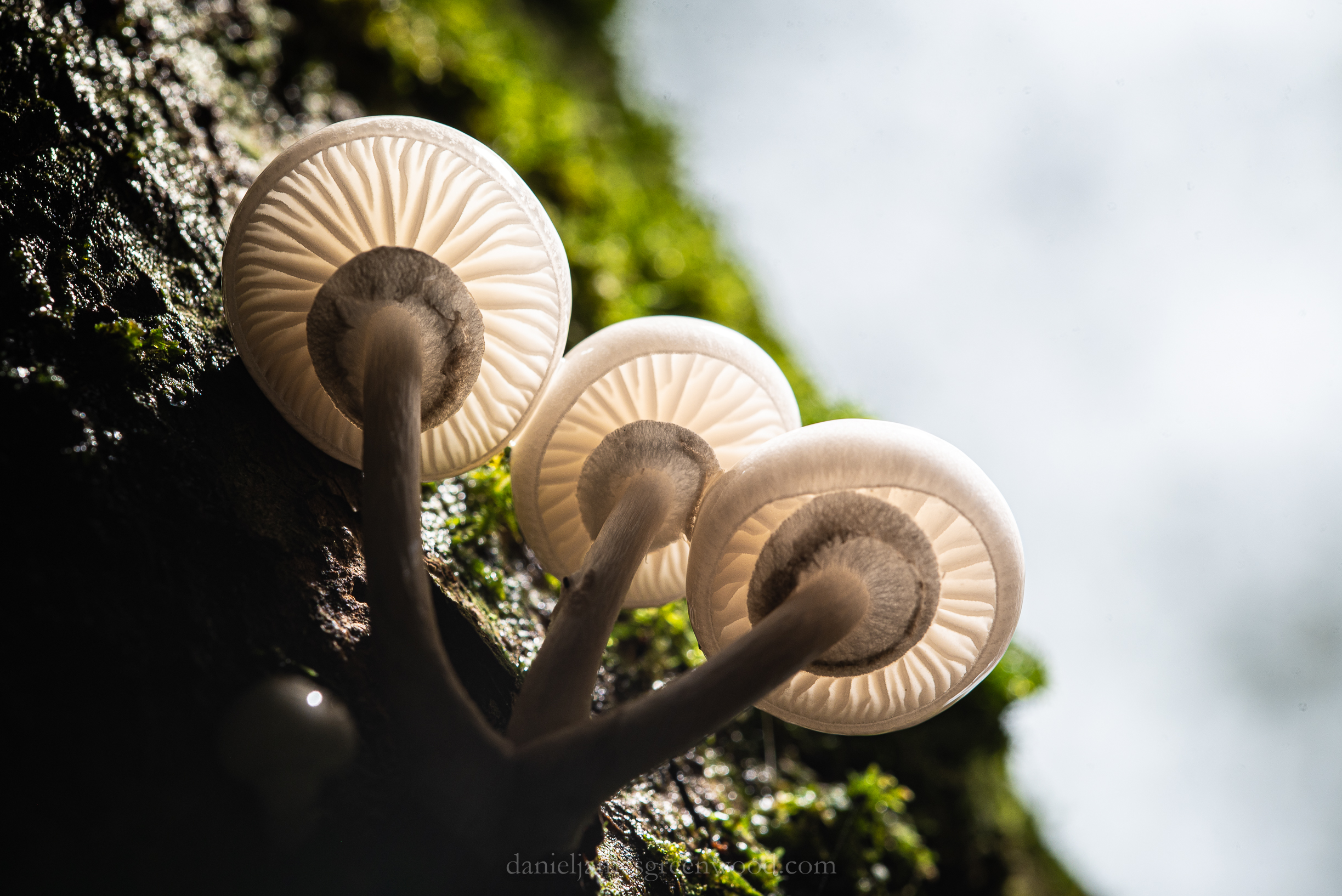
Porcelain fungus is a reliable species. It fruits in the same place, often en masse, each year. It is a beautiful species but the beauty, like so many things, lies underneath.

Ebernoe - 11-10-2019 djg-7

The gloopy glimmer of the cap is photogenic but the gills of porcelain fungus are stunning.

Ebernoe - 11-10-2019 djg-13

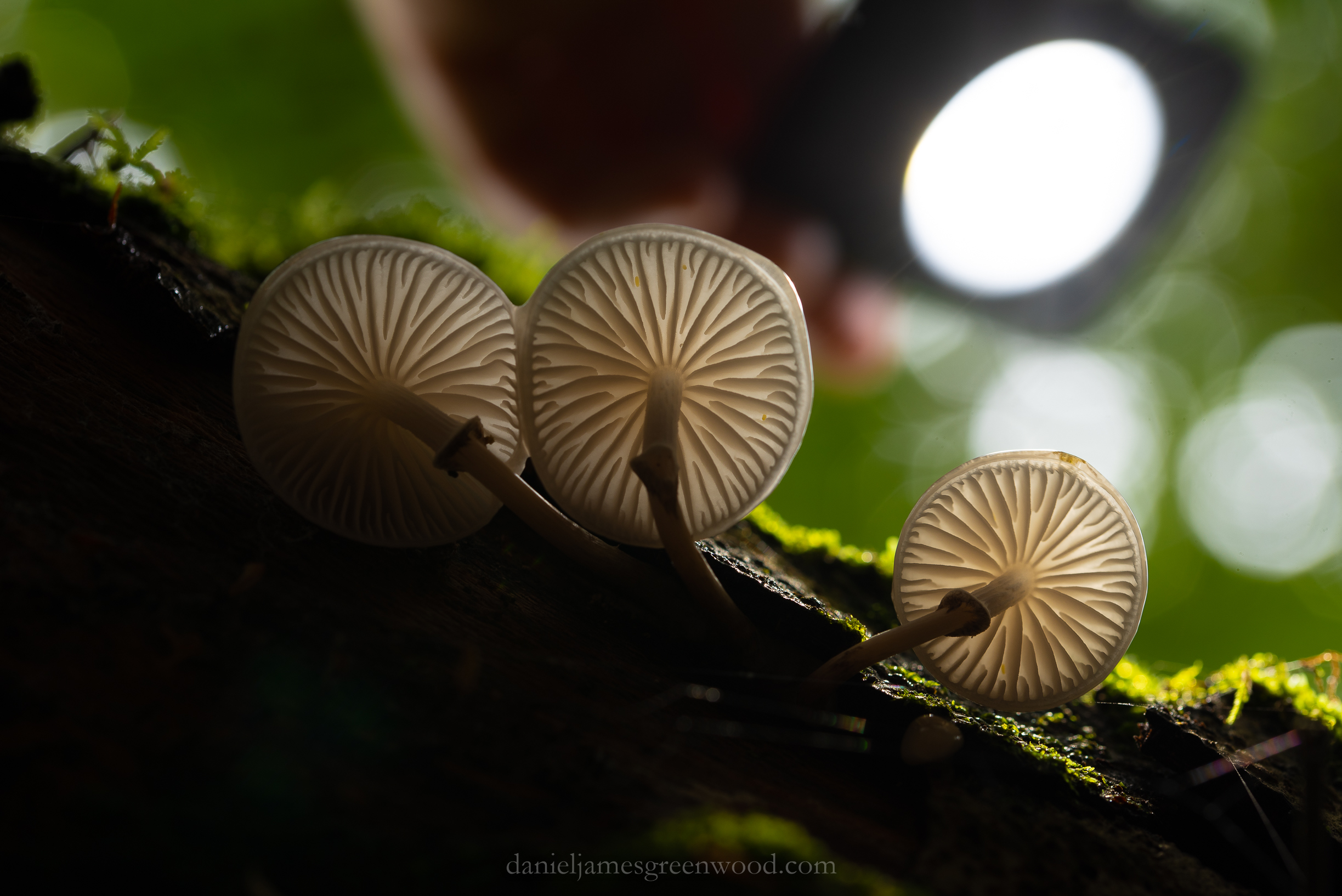
I use a small LED light to illuminate mushrooms in this way. I can’t tell you how much more character this can offer to photos. Actually I can: a lot more.

Ebernoe - 11-10-2019 djg-21

Here you can see my roving light (yes, I meant this!) mixing it with some delicious bokeh in the background. Leaves and branches create lovely bokeh because of the break of light in the gaps.

Ebernoe - 11-10-2019 djg-20

Here is one of ‘the finished images’. I like that the light circles can imitate the caps of mushrooms in photos and offer a deeper layer of resonance and reflection. Who knew.

Ebernoe - 11-10-2019 djg-38

In photography, macro is where the fun happens. There are so many amazing things happening at our feet that our eyes are incapable of seeing without the help of magnification. If you want to have a go at macro, don’t hesitate. Just do it. I call this one ‘Climb every mountain’. The piece of deadwood does have the appearance of a peak in this light. The mushroom is like a protagonist, playing on a theme of mushrooms as individuals or sentient beings throughout human history:

16a9e28079e352a3d6d8ff664898b820-christmas-themes-christmas-cards

5d58176f8caa8c1e9faf25e0ab9f6bc8-picture-postcards-mushrooms

This seems to be particularly prevalent in German culture and Christmas or New Year celebrations. Christmas has evolved from Pagan traditions (Paganism was once considered any religion which was non-Christian) and the place nature has in the human imagination is pretty clear here.

Ebernoe - 11-10-2019 djg-16

Back to life, back to reality. Honey fungus is enjoying its first boom phase and seems to be having a good year.

Ebernoe - 11-10-2019 djg-18

There is a dead veteran beech tree at Ebernoe Common which is basically where all the mushrooms live. This wide angle image shows just how many larger species were making a home within the tree. Here you can see giant polypore (bottom left), honey fungus in the middle and Ganoderma brackets everywhere. This is a stunning tree and of the highest ecological importance because of all the species, not just fungi, it supports. All of these species are contributing to the tree’s decay and recycling into organic matter (soil).

Ebernoe - 11-10-2019 djg-9

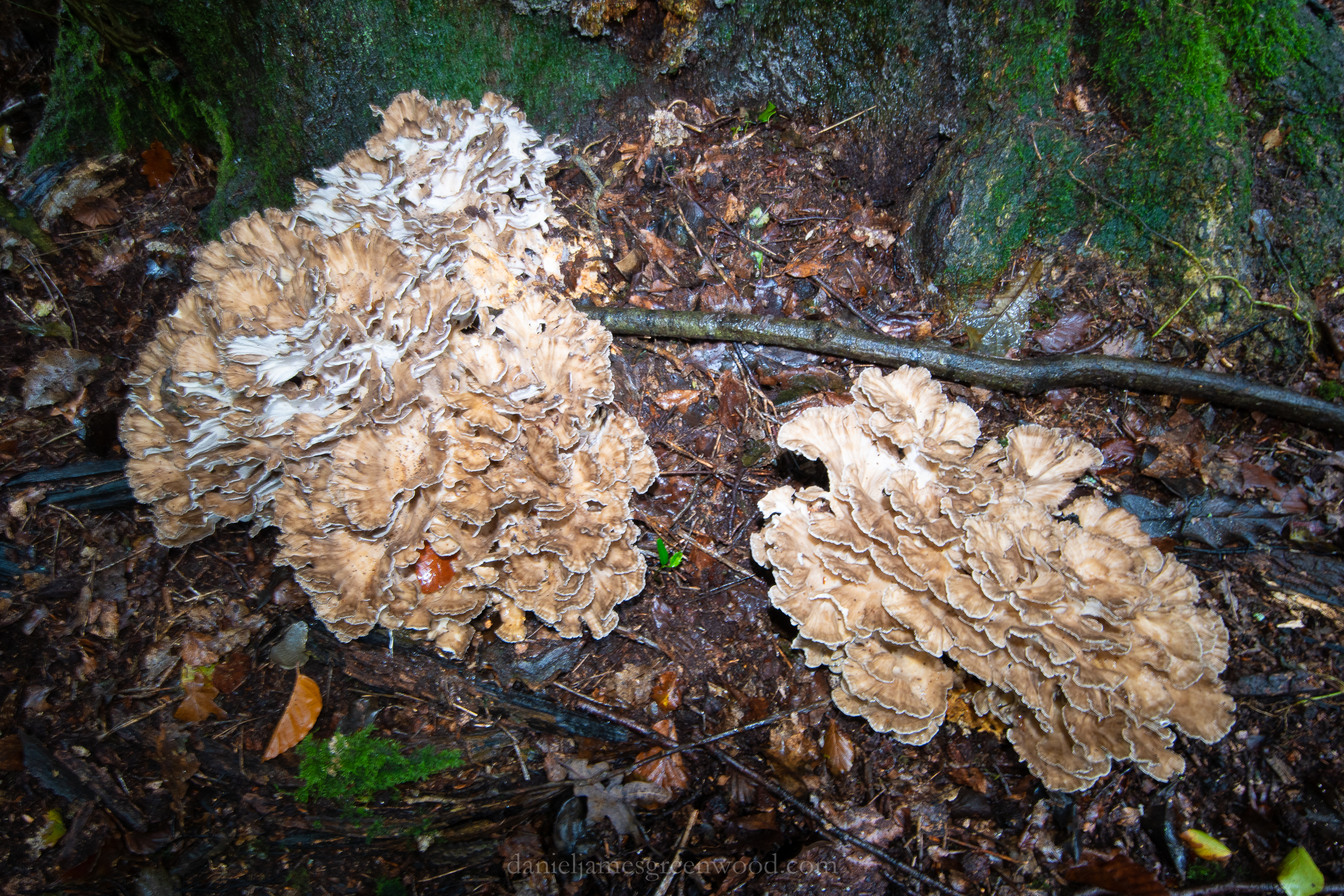
Not far away was a patch of hen-of-the-woods, an aggressive root-rotter (harsh). It’s said to smell like mice (more harsh).

Ebernoe - 11-10-2019 djg-42

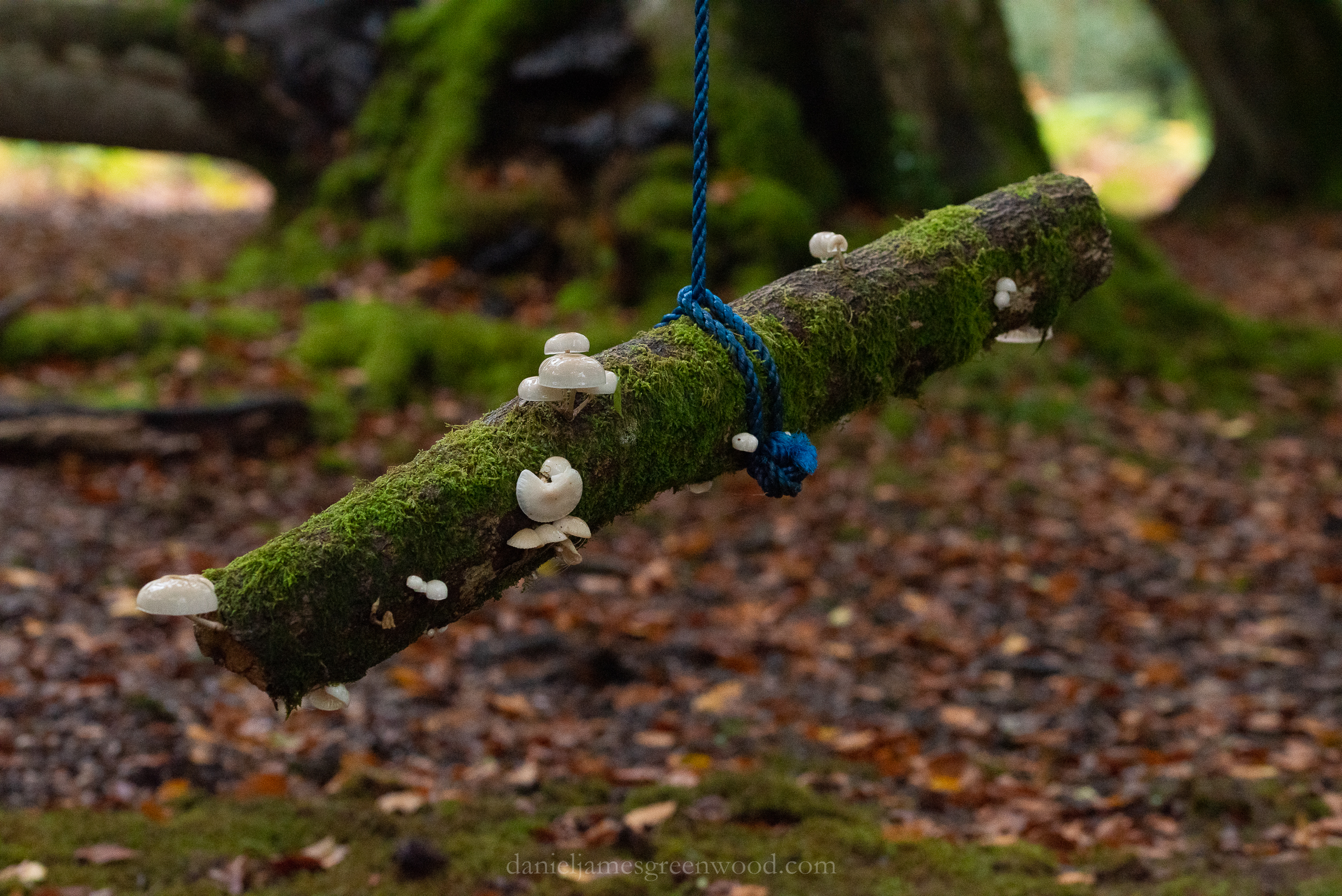
You can imagine how I thought someone was playing a trick when I passed this. A swing made from a beech log that was covered in porcelain fungus. It was embarrassingly hard to photograph well. Thankfully only the mushrooms were looking and they haven’t evolved to use Twitter yet.

Ebernoe - 11-10-2019 djg-47

On my way out I spotted this slurp of fungus low on a log by the path.

Ebernoe - 11-10-2019 djg-50

Looking closely with the macro lens it has the appearance of something you might find in a coral reef. Then that’s the beauty of woodland, it has a depth to it that you have to dive in to experience for yourself.

Thanks for reading.


Read more:

The Sussex Weald

My Wood-Wide-Web


The Sussex Weald: Happy 800th autumn to you, old oak

Cowdray Park - 16-9-2019 djg lo-res-14

Cowdray Park, Sussex Weald, September 2019

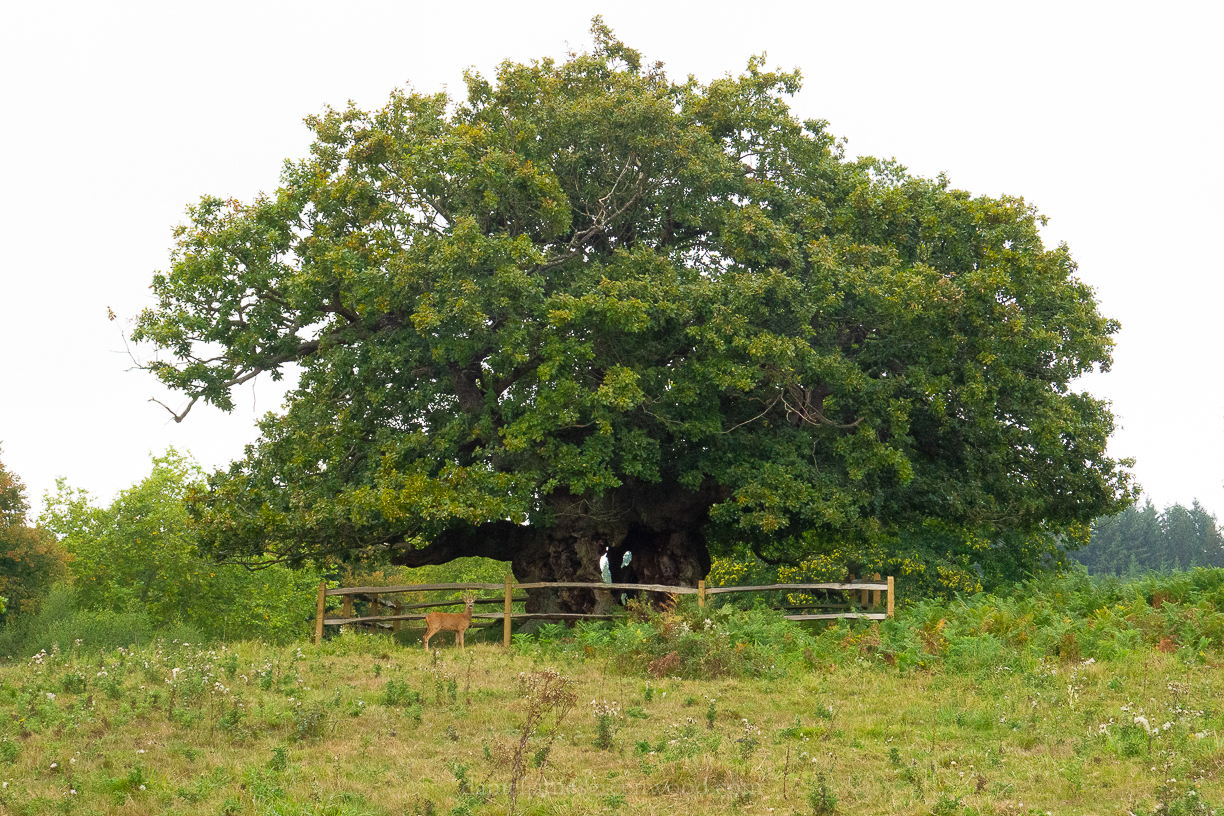
It’s a grey and dark September evening. Robins sing solitary from trees in their autumnal fashion. Cars wash nearby on the A272, to and from the village of Easebourne. The bracken rests in stages of green, yellow and brown. In Cowdray Park a sign warns of the bull in the field, but there are no cattle. The only beasts are the trees sat across the undulating hillside of parkland. Here lives the 1000 year old Queen Elizabeth oak and the Cowdray Colossus, the biggest sweet chestnut in England.

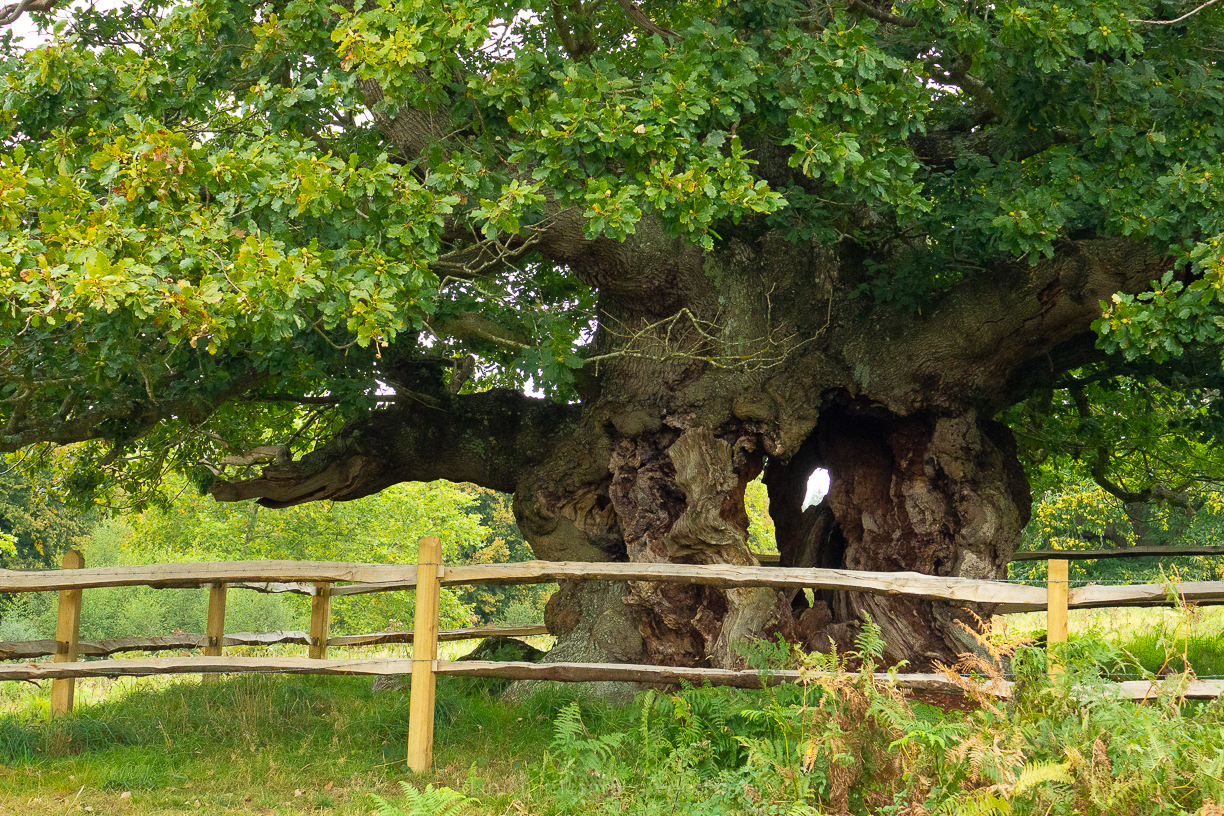
I pass creeping thistle still in flower and others with their leaves thinning to a translucent yellowy green. Walking under one of the ancient oaks, it looks like a rabbit’s head, its heartwood torn out and lying on the ground. An alcove has become of its bark, like a doorway to another place. It’s a fair metaphor, the word oak derives from an old name for door.

Cowdray Park - 16-9-2019 djg lo-res-15

The second oldest oak sits on the hill, its heartwood also lost, mainly trampled out by cattle and people. But now it has a fence around it. In front of the fence stands a roe deer. It watches me in complete stillness. I approach one slow step at a time, taking a photo each time I get closer. Soon it turns on its heels and disappears off behind the tree, springing into the air. I see it rising up and down beyond the fence like a merry-go-round.

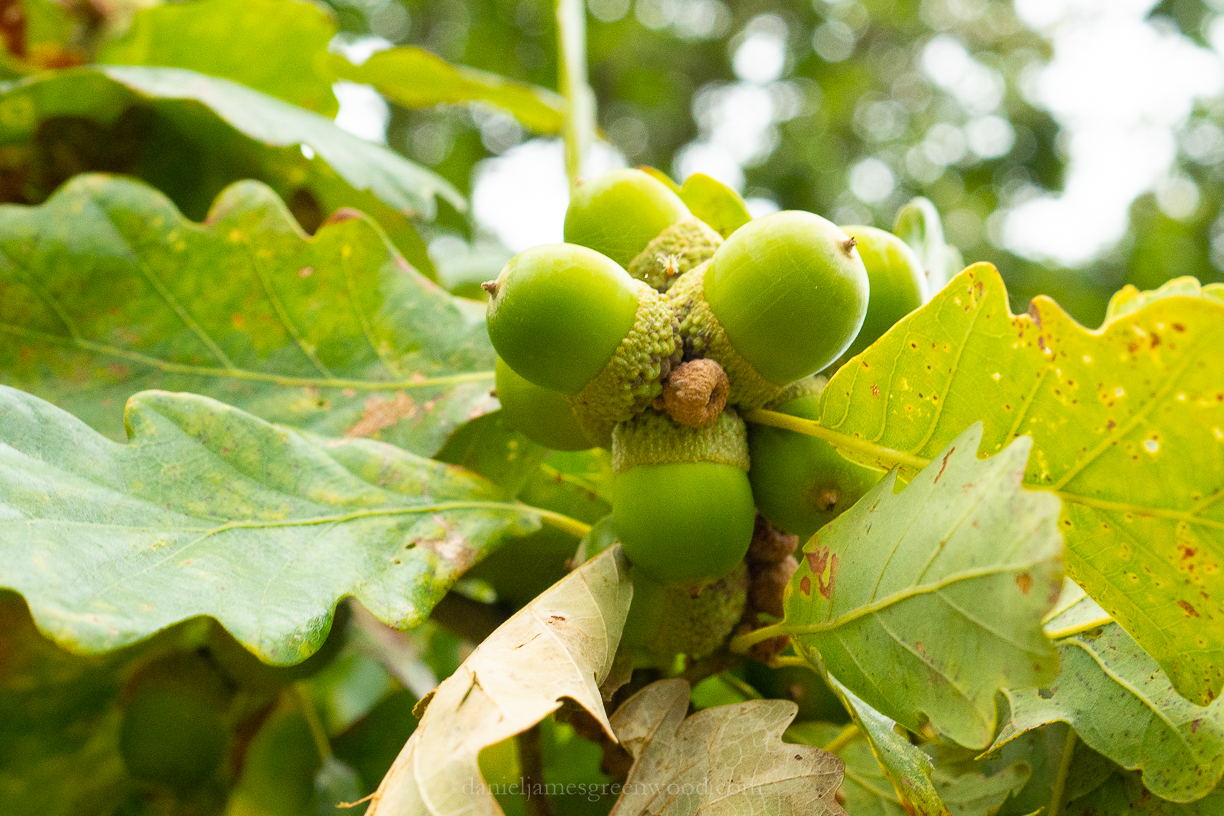
I approach the oak and see it is producing acorns. How many millions of acorns has this sessile oak tree produced in its 800 or so years of life. How many autumns has it lived through? Perhaps as many as 800. Our lives seem so small and precious, fragile in comparison to this natural treasure.

Cowdray Park - 16-9-2019 djg lo-res-16

Explore my Wealden archive

Loch Lomond, where two continents collide

Scotland - September 2019 djg lo-res-37

Loch Lomond, Scotland, September 2019

I am very fortunate to be able to visit relatives at the foot of the Scottish Highlands. It’s a landscape that I first experienced when visiting family in Perthshire and Stirlingshire about 10 years ago. My family haven taken me to visit the dramatic hills north of Perth, places like the Pass of Killicrankie, the ancient Birnam oak and sycamore, and Rob Roy’s grave in Balquhidder. My cousin was married in Pitlochry one Christmas and the misty woods of the southern Scottish Highlands left their mark on my sense of the place: dark, mysterious and forbidding. Little did I know that it was so close to an ancient continental clash, the Highland Boundary Fault:

Around 430 million years ago two small continents, one equating to modern Scandinavia and the other to the eastern seaboard of North America slammed, geologically speaking, into each other throwing up a vast mountain range similar in many respects to the modern Himalayas. At the height of the uplifting phase the peaks may have breached even the 30,000ft ceiling. – via Greg Murray, Scotlandinfo.eu

Those mountains thrown up are the Scottish Highlands, themselves now ground down to the rounded hills they largely present themselves to be. Just imagine, two continents once with their own flora and fauna now fused together.

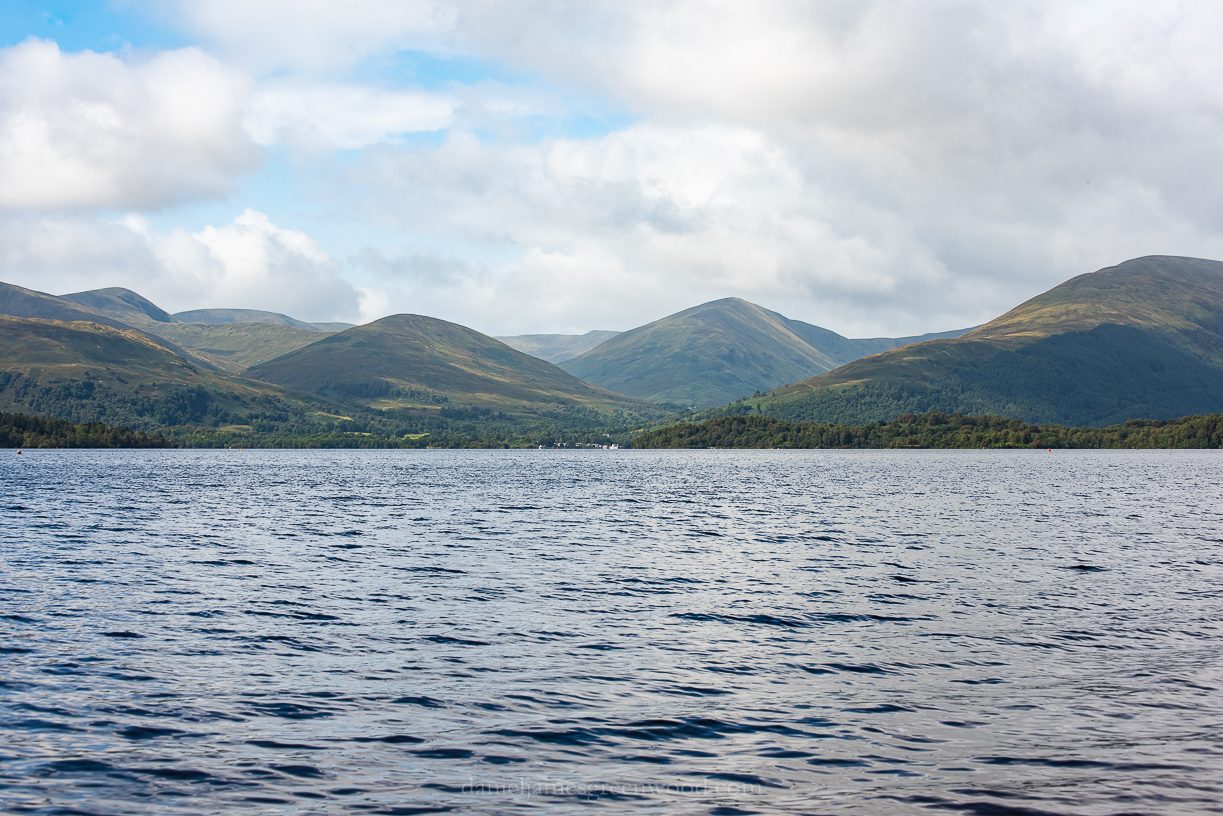
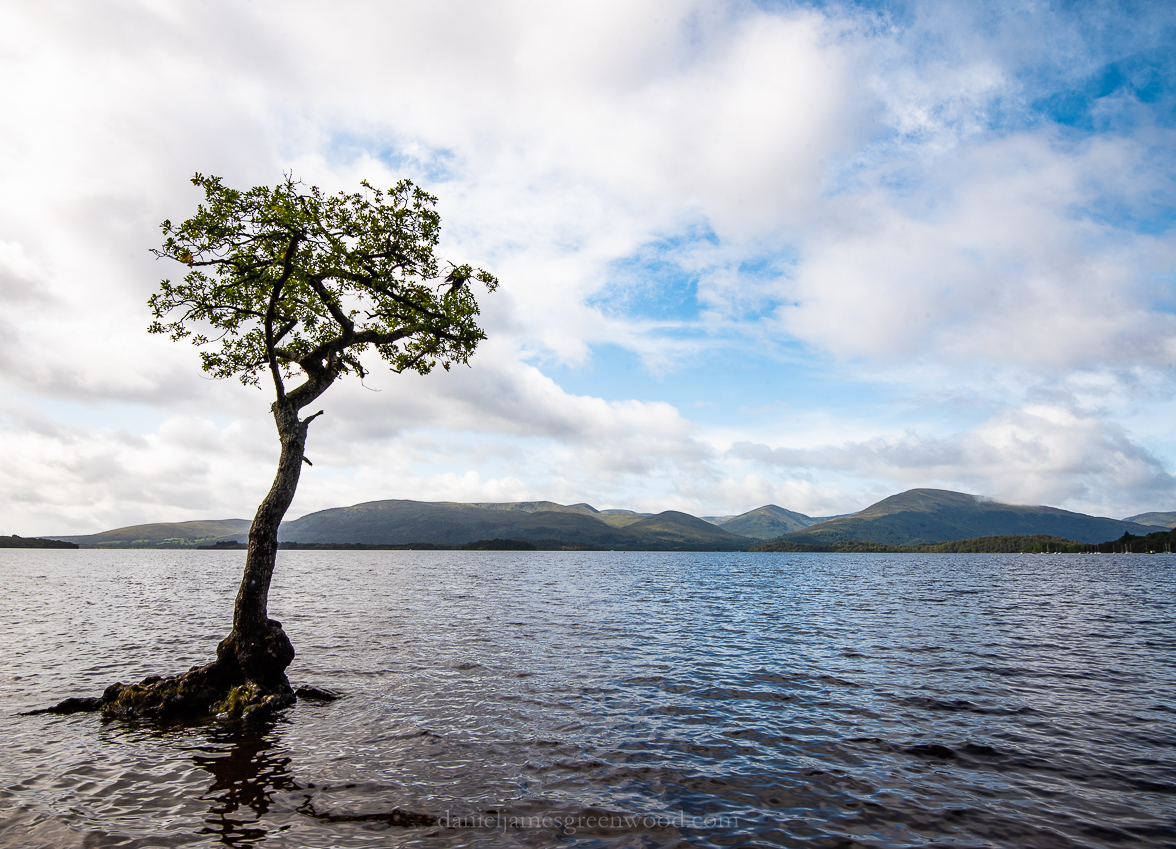
The Highland Boundary Fault actually cuts through the northern part of Loch Lomond. If my geology is correct this picture was taken on the south-eastern side of the fault. Two worlds, long since collided.

Scotland - September 2019 djg lo-res-46

Like so many of the landscapes we hold dear in the UK, Loch Lomond was formed by the retreating glaciers over a period over several hundred thousand years. On the shore this oak tree protruded from an area of soil, still managing to survive with most of its roots probably under water.

Scotland - September 2019 djg lo-res-41

Oaks don’t like it too wet in the UK, unlike willow, aspen or alder, the last of which actually needs flowing water to prosper. Oaks like soil that drains well which makes this one all the more unusual. Like everything in nature, there will be an explanation.

Scotland - September 2019 djg lo-res-55

Loch Lomond is a Site of Special Scientific Interest, made more diverse by the series of islands that are dotted across the surface of the lake. The result of the messy retreat of glaciers, dragging rocks and debris along with them, the ensuing flow of water from the melting ice carving out more of the landscape and filling it with water.

Loch Lomond - September 2019 djg lo-res-1

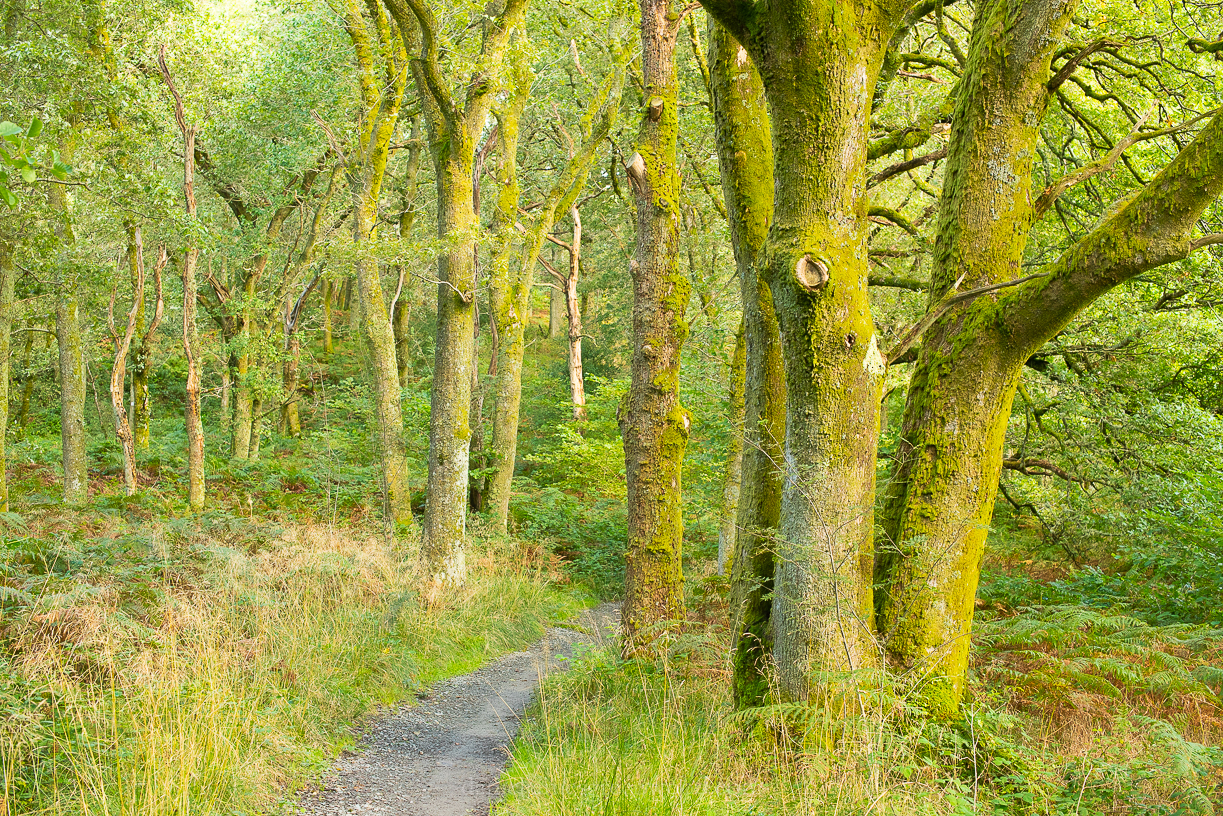
Along the shores of Loch Lomond, Western Atlantic Woodlands grow mossy and wild. More civilised was the flow of walkers along the West Highland Way. Americans, Germans, French, English and indeed Scots were present in a constant flow (bar the pic above). I know this type of woodland as Celtic Rainforest. They are found in the western, wet areas of the British Isles such as here in Scotland, Wales, south-western England and western Ireland. They abound with mosses and liverworts, and they drip with lichens. They get branded as Celtic from the fact they exist in areas where the ancient Celtic-speaking tribes of Britain presided. They consist of oak, birch and hazel in the main.

Scotland - September 2019 djg lo-res-49

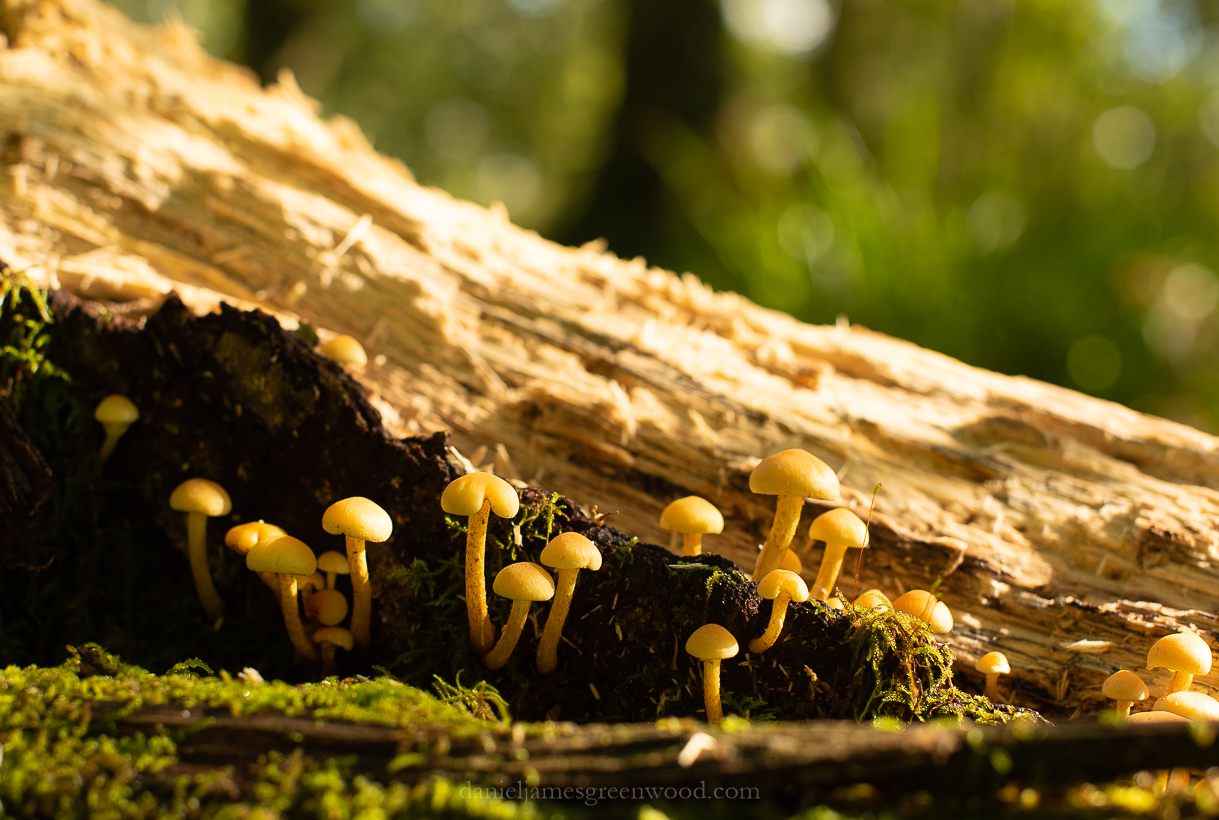
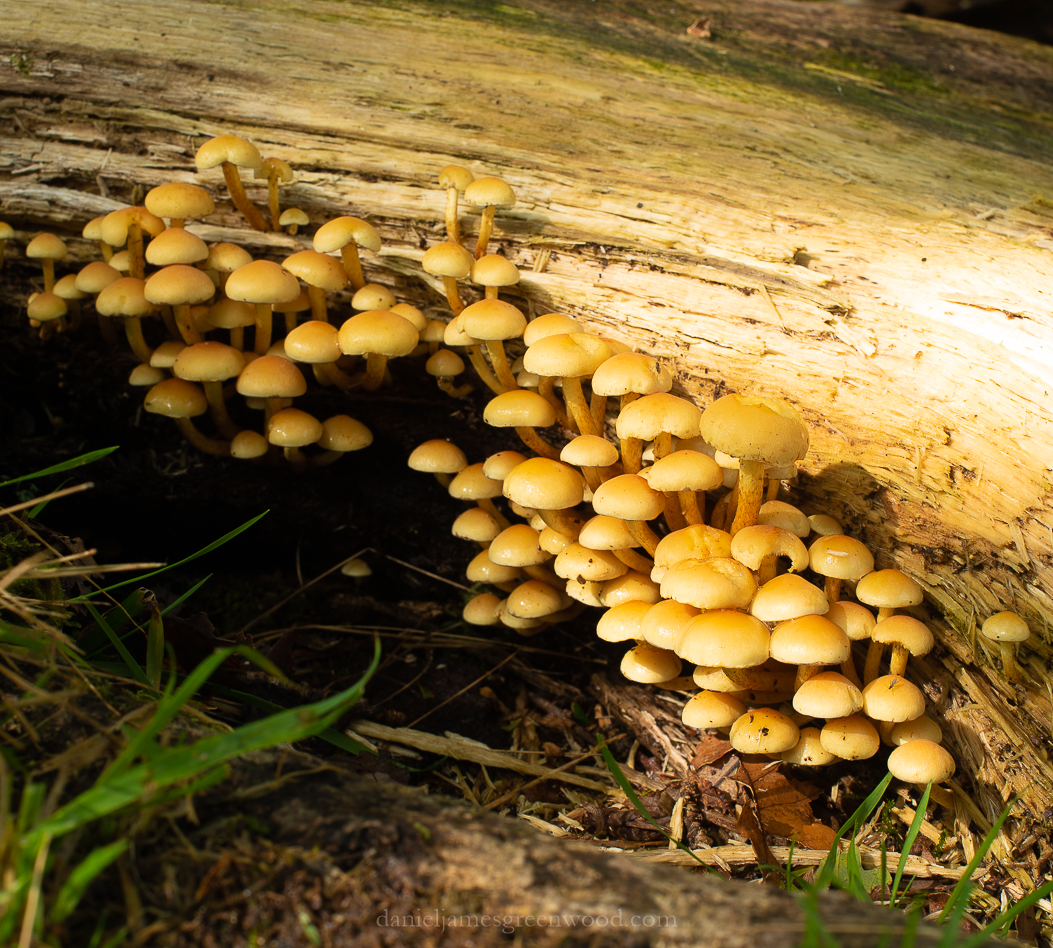
For anyone who has seen this website before it will come as no surprise to read that I was on the lookout for fungi. I found this species of what I reckon might be a kind of honey fungus (Armillaria) and some pleasing spreads of sulphur tuft:

Scotland - September 2019 djg lo-res-50

Scotland - September 2019 djg lo-res-52

These mushrooms were at a part in the West Highland Way where walkers would pause to catch their breath. I heard lots of snapshots of conversations here, like the two Americans remarking that Donald Trump was a conspiracy theorist (no, really?).

I was quizzed by a couple from Yorkshire about what I would do with the fungi photos.

‘Do you print them or put them in an album?’ a woman asked.

‘I put them online, usually,’ I said. ‘But the main thing is to enjoy being out here.’

I was trying to sound virtuous, then again they were the ones who were walking the near-100 miles of the trail in pretty woeful conditions before then. The woman showed me that she had a film camera with her, a passion she had held for decades. More than anything when looking for or photographing mushrooms, the pleasure is in the moment of finding something, be it new, interesting or unusual.

Scotland - September 2019 djg lo-res-60

Before heading back beyond the Highland Fault to visit my family for the evening, I was taken aback to hear a raven low in an oak, belting out its call. I had never seen one so close. It sounded so much like its words were oak, oak, oak!

Scotland - September 2019 djg lo-res-61

Whatever it meant, the raven surely could not have known that its flight across Loch Lomond took in two continents.

Thanks for reading.

View my woodland archive