This week’s encounters with the fungal kingdom (that I know about), are piecemeal. I am still sticking close to home, so no woods or wildernesses, if you even believe in the latter. You might think fungi can only be found in specific places, but we’d all be wrong about that. Let me tell you, fungi are everywhere. We’re the ones who are harder to find.
Stick of the week
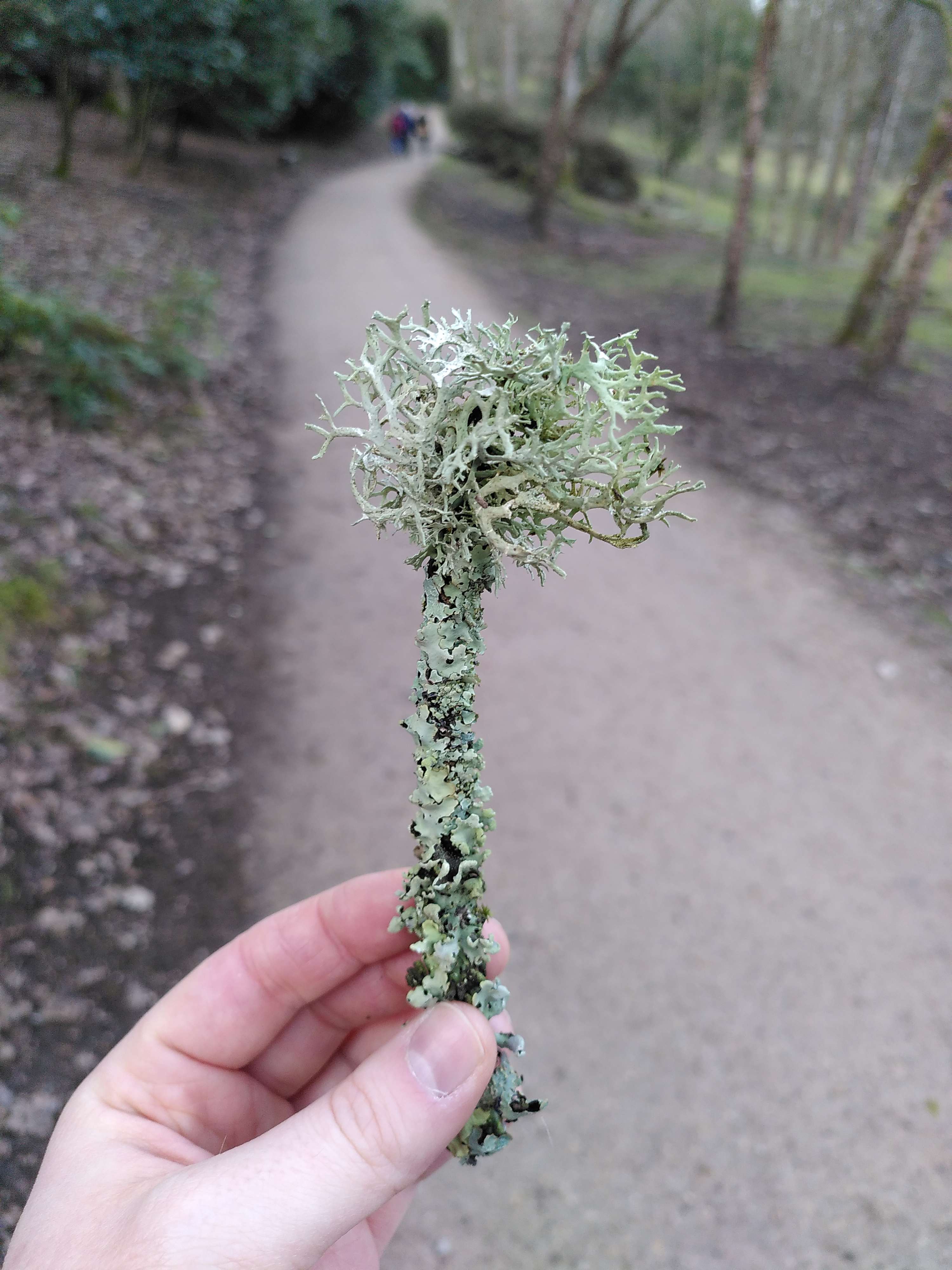
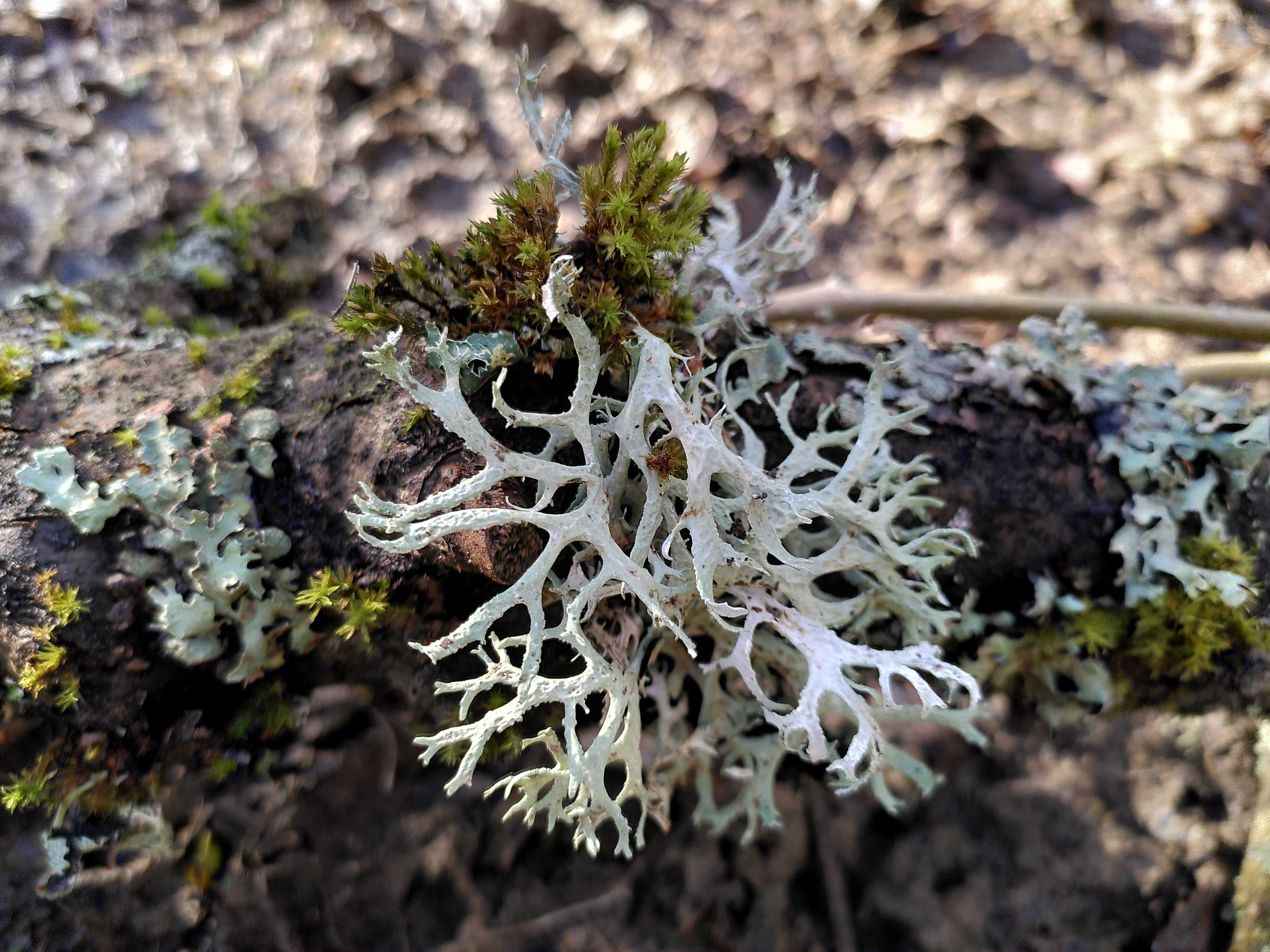
On a walk at a local estate garden in the Sussex Weald, I found and nominated this lichen-encrusted twig for stick of the week. I’m not sure where the hashtag #StickOfTheWeek started but I think it has something to do with the illustrator @Bernoid.
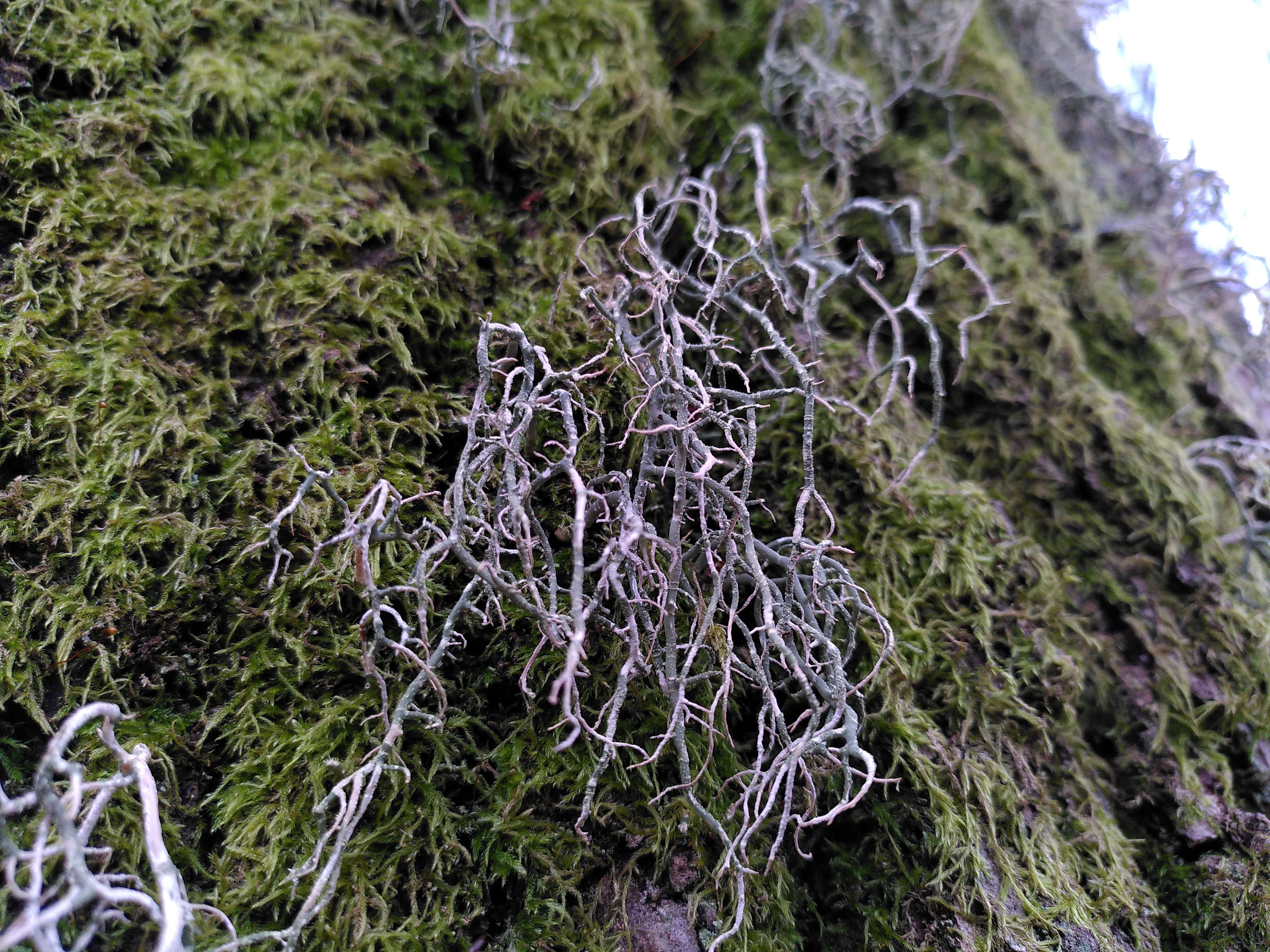
It’s not common that I personally find any unusual lichens in south-east England. Usually you need to go west to Devon, Cornwall, Wales, Ireland or up north to Scotland. This massive oak tree had a sheath of moss growing on its trunk, which was then home to a colony of beard lichens!
I think these are a species of usnea lichen, species I’m more used to seeing in Ireland and on Dartmoor. I learned from a fellow blogger recently that you are supposed to say ‘on Dartmoor’, because ‘in Dartmoor’ means you’re in the prison. I’ve been to the prison museum and have no intention of being ‘in Dartmoor’ no matter how good to lichens are on its doorstep.
Velvet shank
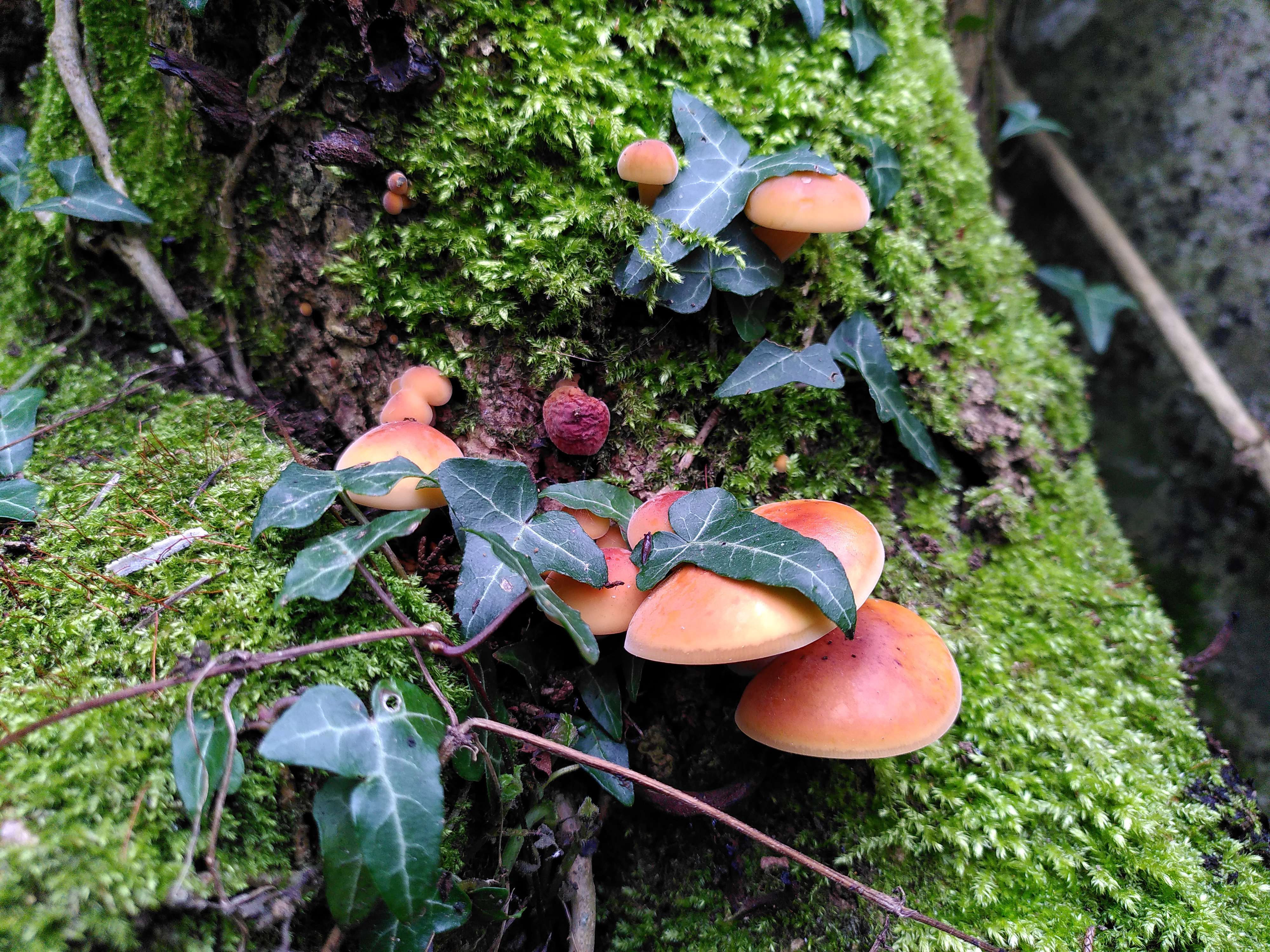
On a lunchtime march from home I re-stumbled upon a gang of velvet shank (Flammulina). I was actually drawn to the site of the first cherry blossom of spring, when I spotted that this churchyard stump was still sprouting shrooms. This is fungus is hard as nails, in terms, because it has toughed it out through the snow and continued to put out fruit. It’s a prime candidate for snowcapped shrooms.
I have some exciting mushroom-related announcements to make in the next couple of weeks. I’m also about to start Merlin Sheldrake’s much anticipated Entangled Life. Have you read it, is it as good as everyone says? Maybe I’ll share some of it in the weeks ahead.
A second wave of Covid has thrown us back into lockdown in England. You can only leave the house for essentials and exercise. Itโs much harder now that the night falls early and the window on experiencing daylight has narrowed. But the days are lengthening and spring is building in small ways.
At night the foxes are making their blood-curdling cries and other social calls. They are breeding, probably just outside the back door each night.
On clear nights I sit on the edge of the bed and, with lights out, can see stars. The three lights of Orionโs Belt shine bright, but not more so than Sirius to the south-east. Itโs the brightest star in the sky.
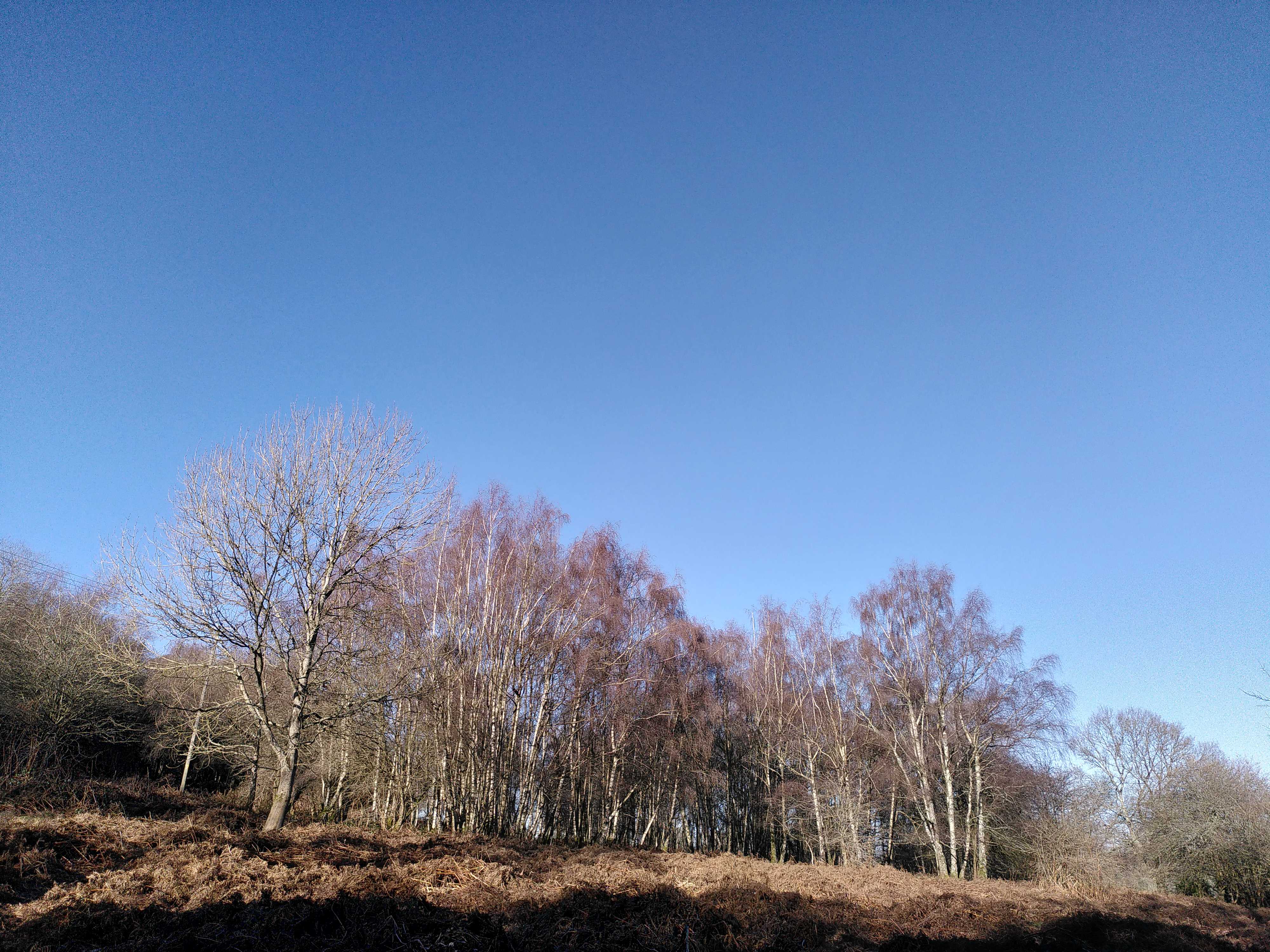
Out on my exercise for the day, I stand in a frosty glade of bracken. Silver birches are clustered at the edges, ash branches have collapsed and fallen to the ground. Their twigs reveal leafy lichens, in some places known as oak moss. There are real mosses too, little green pin cushions with their sporophytes poised.
The birds are foraging for life in this time of scarcity. A jay moves between trees and shrubs, flushing white wing-bars as it flies. Nuthatches are dripping from the tree trunks in both number and sound. Further away the hooting of two tawny owls ruffles out of the trees, half-baked. Are these early territorial warning signs? Spring, indeed.
Alarm calls break across the branches and bare blue sky. It is a beautiful day. Knowing these alarm calls mean something is happening, I look up at the patch of sky over the clearing. From the north-west two birds fly close to one another, on passage. To identify them will take a process of elimination:
Wings too sharp for sparrowhawk
Too small and direct in flight for buzzard
Too big for merlin
Hobbies are holidaying in Africa
Tail too short for kestrel
Theyโre peregrine falcons, stars in a different sky. Perhaps they are returning to the South Downs and an early morning hunting pigeons in the towns. Maybe theyโre a pair getting to know each other and seeking a place to breed. Wherever theyโre going, bit by bit, winter is edging away with them.
A storm has passed through overnight and in the morning the Arun is near flooding. All summer the river has been low, stagnant where managed by mini-dams installed to slow the flow through suburbia. On one footbridge where usually dogs jump in, chemicals and all, the river floods sections of the path, submerging the recently exposed roots of bankside alders. Those roots need to be underwater most of the time, and the storm had righted that wrong.
I speak to a man and a woman, armed with optics, on the footbridge. The riverโs power is cause for relief. Even in 2020 these reminders of natureโs prowess can still be welcomed, even longed-for. They advise me on ways to avoid flooded footpaths, but Iโm heading for higher ground anyway.
On the slopes silver birches stand in their ornamental regiments. They look like a stage set with their white trunks and even size. They bring forward mental images of Russian and other Eurasian art, hunters in the snow, or the main character feeling their way through the woods in an Andrei Tarkovsky movie. Above their white bark itโs blue sky.
Out and across the open parkland, water sits in the grass like mini-marsh. A great spotted woodpecker arrives in the branches of an oak. Quiet, it sits in that semi-diagonal pre-creep. Long-tailed tits pass across the open plain, re-tangling in brambles that shield a private fence and garden.
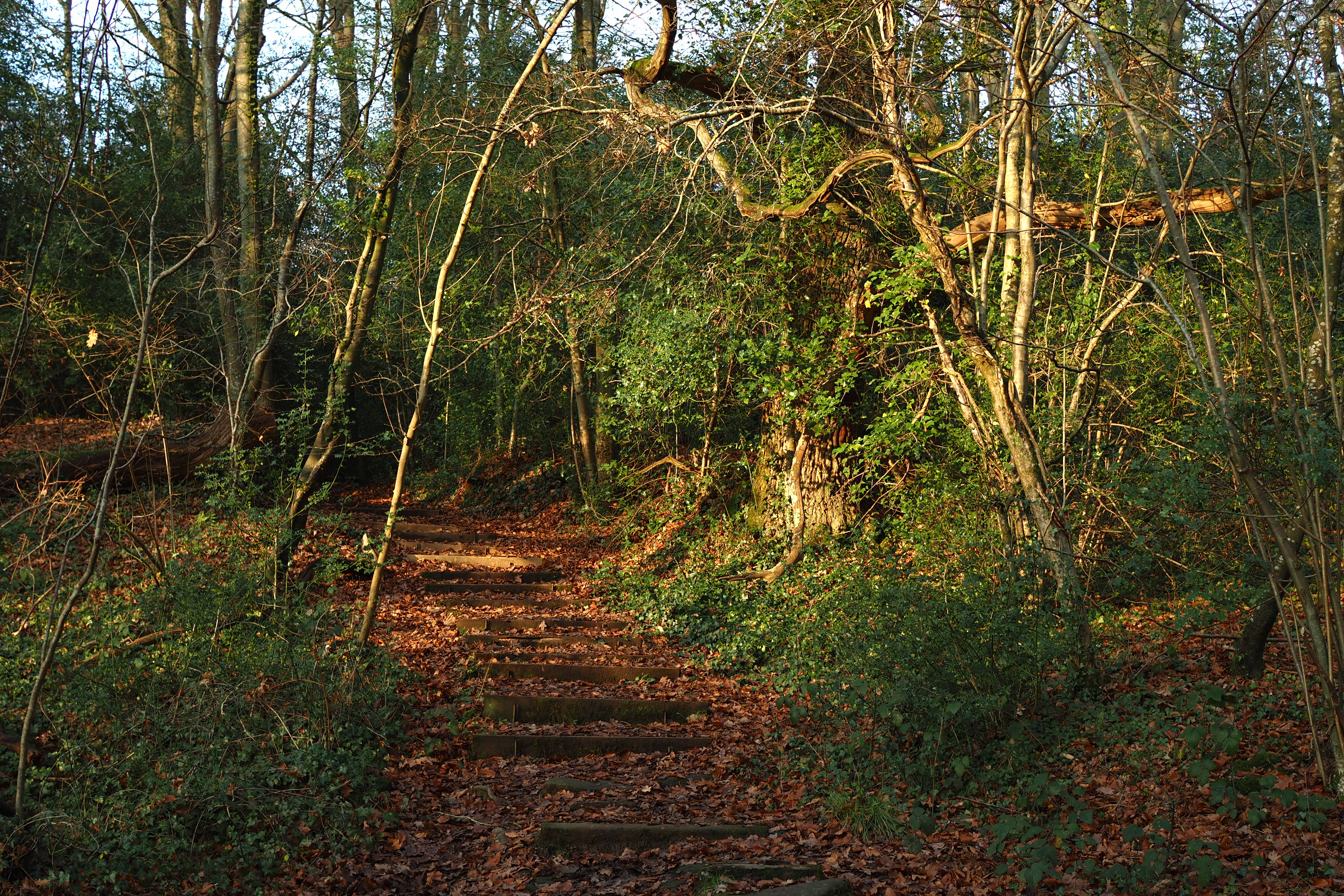
The trees change from oak to dotted limes, a probably ancient sweet chestnut โ where a woman with a dog lingers beside its massive trunk โ and the collapsed limbs of a red horse chestnut. In the spring lockdown, when everything stopped, a workman chainsawed the fallen logs for a man who stood close by with his young son. They were all way too close to the saw and without any protective equipment. Above the noise I could hear the father earmarking the limbs and branches for future firewood. The workman carried on, loading logs onto a small trailer attached to his car.
The red horse chestnut might be ancient but it is most certainly veteran. The fallen limbs are a key part of that. It holds dead and decaying wood, plus the many places wildlife can move into. It has a single limb of young growth that will keep it living for as long as time allows.
Around it the fallen wood is covered in silver-leaf fungus, which is pleasing to look at more because of its purple glow. The fallen branches have created niches of long grass where mossbell mushrooms fruit, as well as a pale brown cup fungus (Peziza) that looks like an ear. I think the man marking up his future firewood lived in the converted mansion house a hundred metres away from the tree. I hope he can come back with his son, witness the fungi, and have a change of heart. These logs provide life for species that need them more than we need firewood.
Across the parkland old furrow lines lead to views of the North Downs, so much woodier than their sisters to the south. Here the hill drops down into a bowl, rising back up again, before dropping once more to where the Arun rocks and rolls.
At the foot of the first decline water floods and I look to jump over the deepest stretch without making a complete idiot of myself. But the pause to make a choice is a blessing. The nearby road roars with surprising levels of traffic, seeing as we are subject to severe restrictions on movement due to the Coronavirus. A higher pitch cuts the drone, however. Looking closer at the water, it is not still, it is bubbling up. Itโs a springline. This is the first one Iโve ever seen in the โwildโ sense. Perhaps the overnight deluge has driven water up through the aquifer to create the rural equivalent of a bubbling sewer. Itโs not something I know much about.
A few metres up the hill another spring pushes from below the surface, calming tremors tickle the surface like moving clouds. Further towards the road and the spring bursts up from a large pool that has formed, bubbles resting in its wake. Without pause, the water spits and splatters like a fountain. The sun falls behind the hill and this winter springline turns an oceanic blue.
I’ve had a burst of American visitors in recent days (to my blog, not my house). So thanks for visiting, y’all, and sorry about the year you’ve had. You may have noticed I’ve slipped to monthly posts on here. Between April and October I posted blogs every Monday without pause, which is a tricky taskโฆ
Here’s my seasonal update of stuff you don’t need to know about, but then welcome to the Internet. What Iโm writing Soon I will be self-publishing my third poetry collection, Foolโs Wood. It’s seven years since my last one and this collection has taken longer because of LIFE. There will be a booklet and alsoโฆ
Here’s another entry in my slow-blogging Oak Timbers series. You can view my galleries and posts archive here. I visited Salisbury in Wiltshire (south-west England) for the first time in 2023 and was really charmed by the place. If you’re interested in this kind of thing, Salisbury is the place for you. Here’s a galleryโฆ
The cold has come to the woods, and with it, the silence of birds. Itโs not all quiet. Rain has fallen overnight and there is a gushing to the hill as it wends its way through the woodland. Looking at the water I see the bare sandstone. The water, over a very long time, has cut through the soils and softer substrates. Walking here over several years I have wondered why the sandier heathlands rest high up and the ancient woodlands of oak, beech, hazel and holly grow only really in the clay gulleys. Itโs here, the answer. The stream has cut through the sand and washed the gravel away to reach the sandstone.
I follow the twisting stream up hill, jumping from bank to bank, where vegetation blocks progress. In a slowed stretch something small and black is moving against the flow on the clay streambed. It’s an invertebrate, what I think is a caddisfly with a pack of debris on its back. It looks to be trying to grab at a small stone or piece of material on the streambed. It could be ready to attach itself to the stone and move to its next stage, the pupa, before becoming an adult insect for a month next year.
Ferns spool out from the freshly leaf-laden banks and the trees are drenched in moss. It dawns on me: this is south-east Englandโs rainforest.
I’m getting into more of a routine of recording and editing audio, so here is the latest episode of Unlocking Landscapes. Listen on Podbean or via the usual platforms. Also via YouTube: https://youtu.be/y1K9Pqx68to?si=B-Fdhf3sdDH35Z8w Following on from July’s rather optimistic fungi walk, I popped back to the same area of ancient Wealden woodland to see ifโฆ
Innsbruck, Tyrol, Austria, June 2025 This is a longer post of the images I captured during a recent visit to Innsbruck in the Austrian Alps. We travelled to Innsbruck on a sleeper train from Amsterdam. It’s such a great experience and is significantly lower in carbon emissions compared with flying. If you consider the factโฆ
I’m back from my annual visit to the west of Ireland. I managed a couple of day trips to forage for photos, which will crystallise later this year into dedicated posts, all being well. Like many people I enjoy the Blind Boy Podcast, none more so when I have the headspace to take in allโฆ
The temperatures have crept up again after a period of freezing cold and foggy mornings. During one of those colder December days I visited a favourite place to find fungi. I was surprised by just how much had managed to fruit, though it was mostly quite small.
My first find was this common puffball mushroom, looking well nibbled and past its pomp. Almost all of the mushrooms I found and spent time trying to photograph were growing in beds of moss. That says to me that the mosses were providing a warmer, wetter platform to fruit from, protecting the mycelium of the fungus from the cold beyond its fronds.
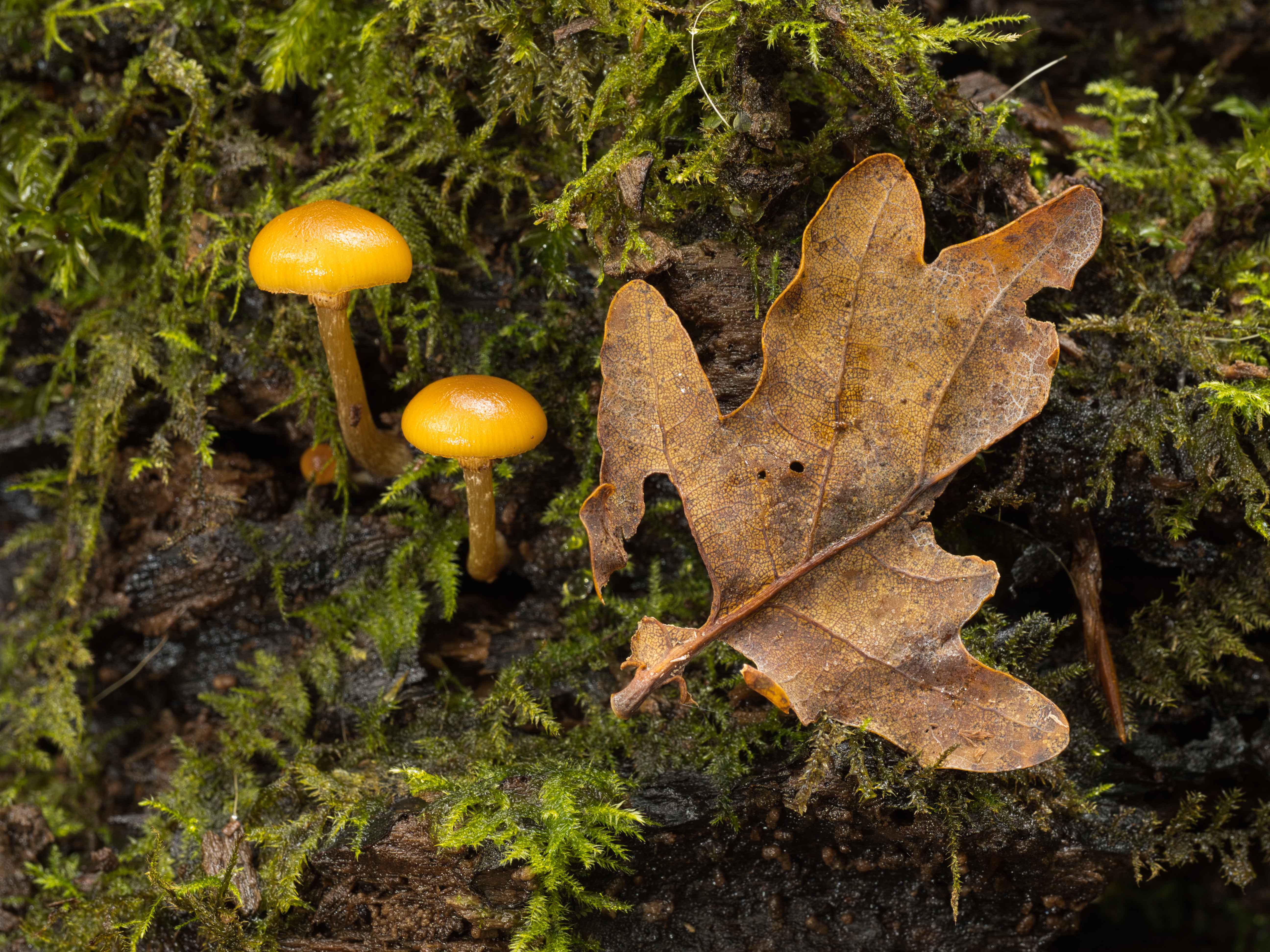
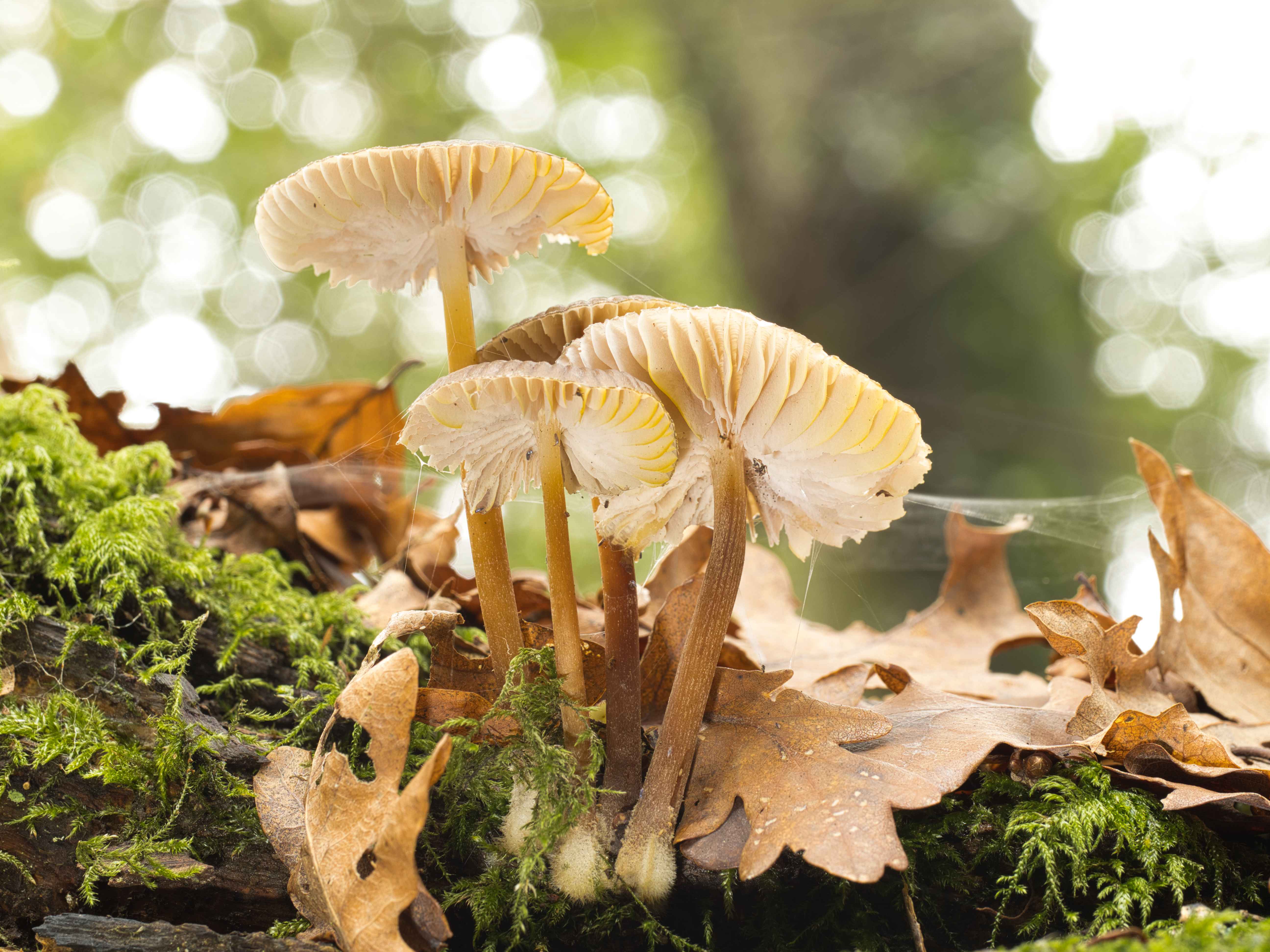
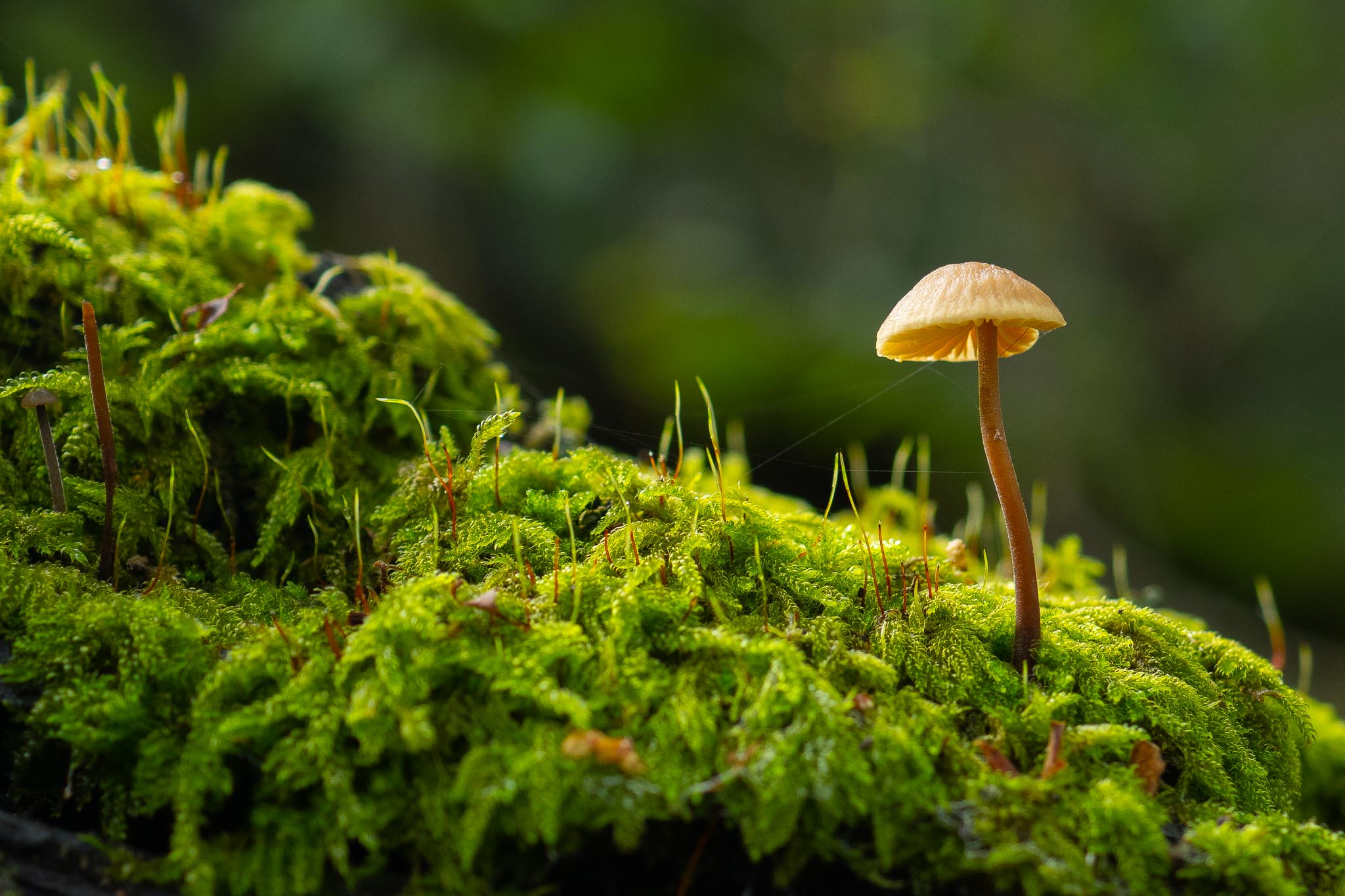
I had a lot of fun photographing galerina mushrooms, otherwise known as moss bells. One of the most famous mushrooms in this family is the funeral bell, for reasons you can probably guess. I am not at a point to identify moss well, but I do know this is common feather moss. And that is an old oak leaf.
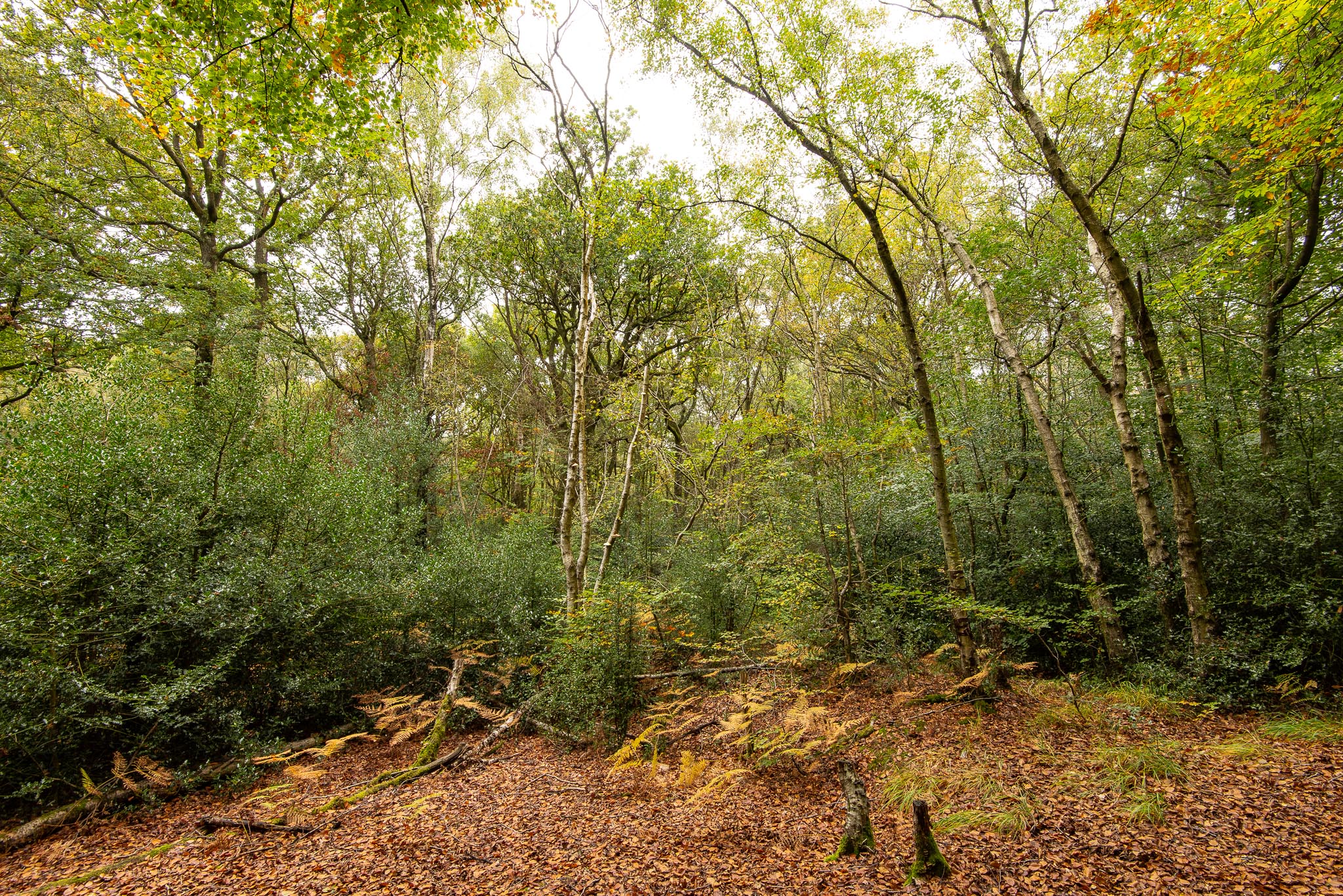
I found some lovely moss bells as I worked my way further into the beech, oak, hazel and holly woodland. In England we don’t have much in the way of wooded ‘wilderness’ that North America or Russia is famed for. But in the south-east of England, the Sussex Weald is perhaps the closest thing we have to a vast woodland area. Woods in England are split up by private ownership and mixed land use, with many small woods cleared for agriculture or building. If you want to see what a fence looks like, come on over. However, the Weald to the east of Sussex is the most wooded area in England, and much of it is ancient, broad-leaved and ‘natural’ woodland.
Moss bells are actually parasitic on mosses, though they evidently do not cause it the kind of bother the word ‘parasite’ brings to mind. The submarine telescopes surrounding the shroom here are moss sporophytes, which release the spores to allow the mosses to reproduce elsewhere. Much like mushrooms!
Have a look on moss growing on fallen trees or on the trunks of trees. You might get lucky and find yourself a moss bell.
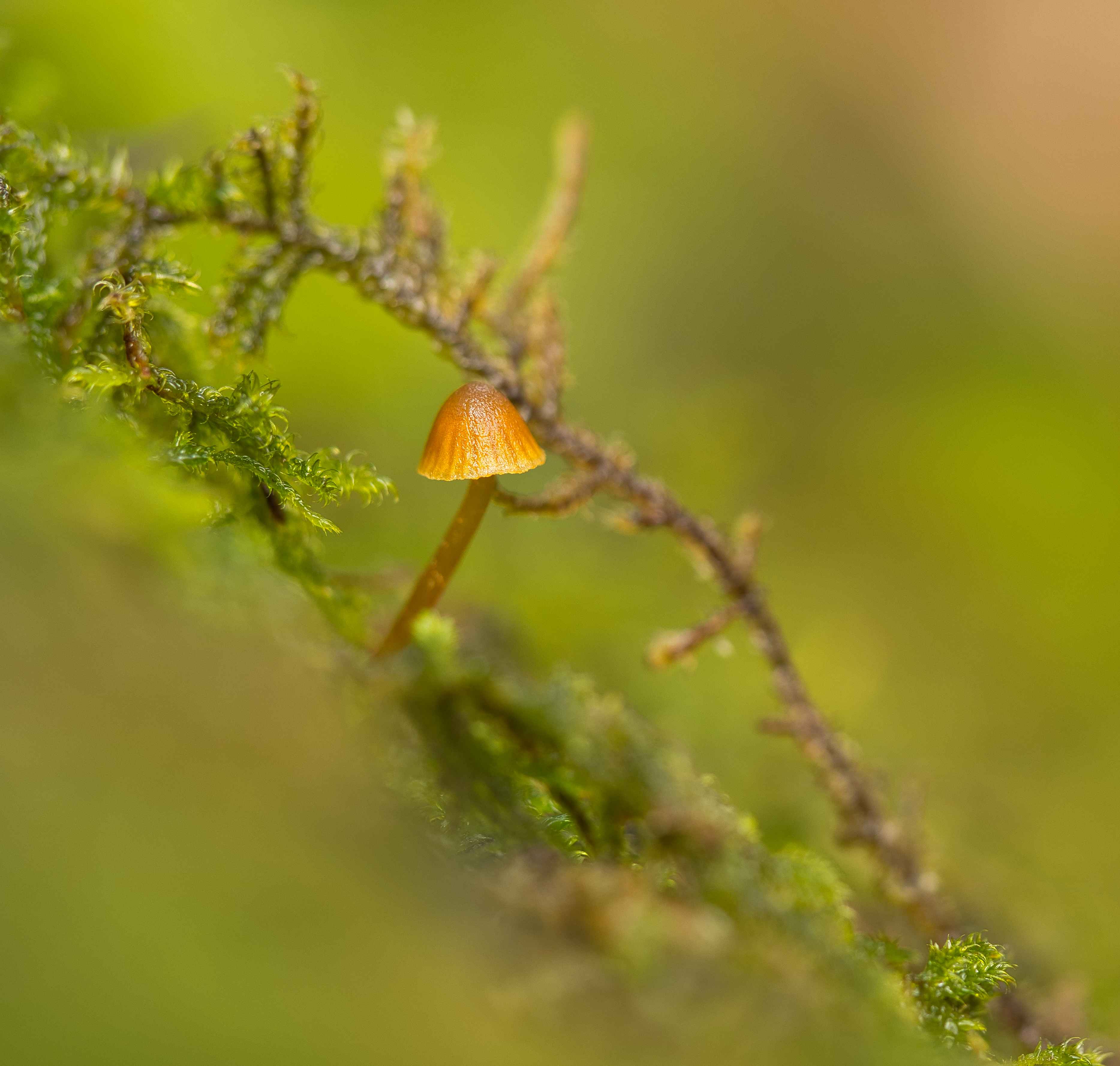
I’m annoyed with myself because I’ve seen this tiny mushroom with its Hellraiser-esque, spiny cap, but I didn’t take the chance to note it and now I’ve forgotten. It was growing in a crevice in a fallen tree. The veins in the decaying oak leaf show just how small it was. That’s the second time it’s made its way onto this blog without a name. Sorry no refunds.
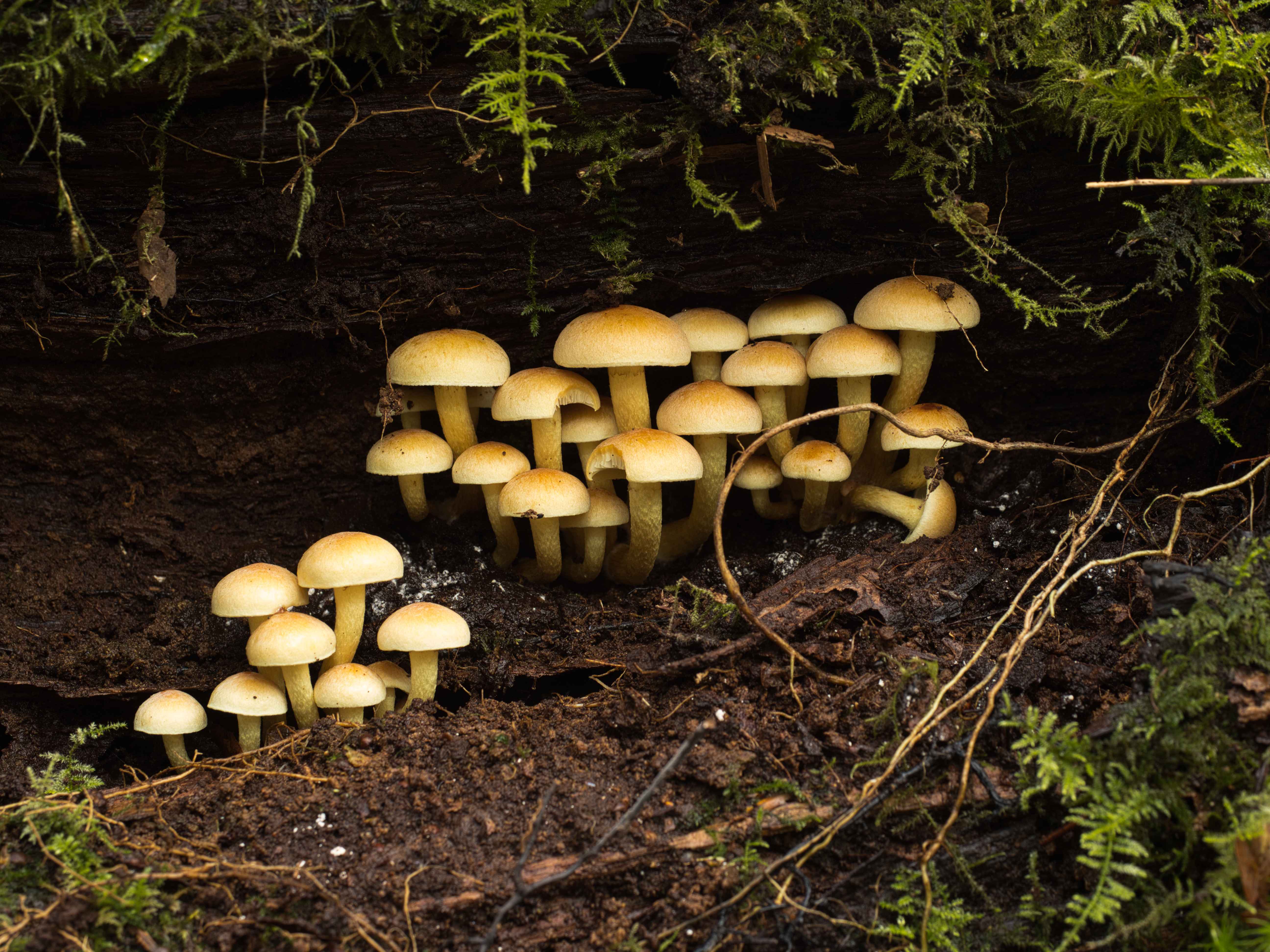
Another fallen tree was covered in mosses, ferns, lichens and, of course, a community of mushrooms. Sulphur tuft is a winter stalwart. So if you’re reading this, sulphur tuft, thank you. There are some other interesting things going on here, with the decaying wood already beginning to turn into something like soil, and the roots of something trailing across and feeding on the substrate. That’s life.
The final species group I found on mossy logs was the bonnets. They also seem able to handle the cold weather in the way that ground-based shrooms can’t.
I always forget that September can be a good month to find fungi, if it’s not too cold. Hopefully this blog, which has now been running for a year, does go to show how many things you can find throughout the year. Autumn is not the only time to find fungi. It’s everywhere, all of the time.
This woodland is quite heavily dominated by holly. For many people in the UK, that’s seen as a bad thing, with the idea that woods should be nothing but light. In the Sussex Weald, holly indicates ancient woodland and holly is a key species. At least one woodland was protected because of its populations of wild holly. I absolutely love it, having worked with it for several years. It coppices very well and the timber is great for small-scale green woodworking like fencing and posts. Of course at Christmas it makes lovely wreaths.
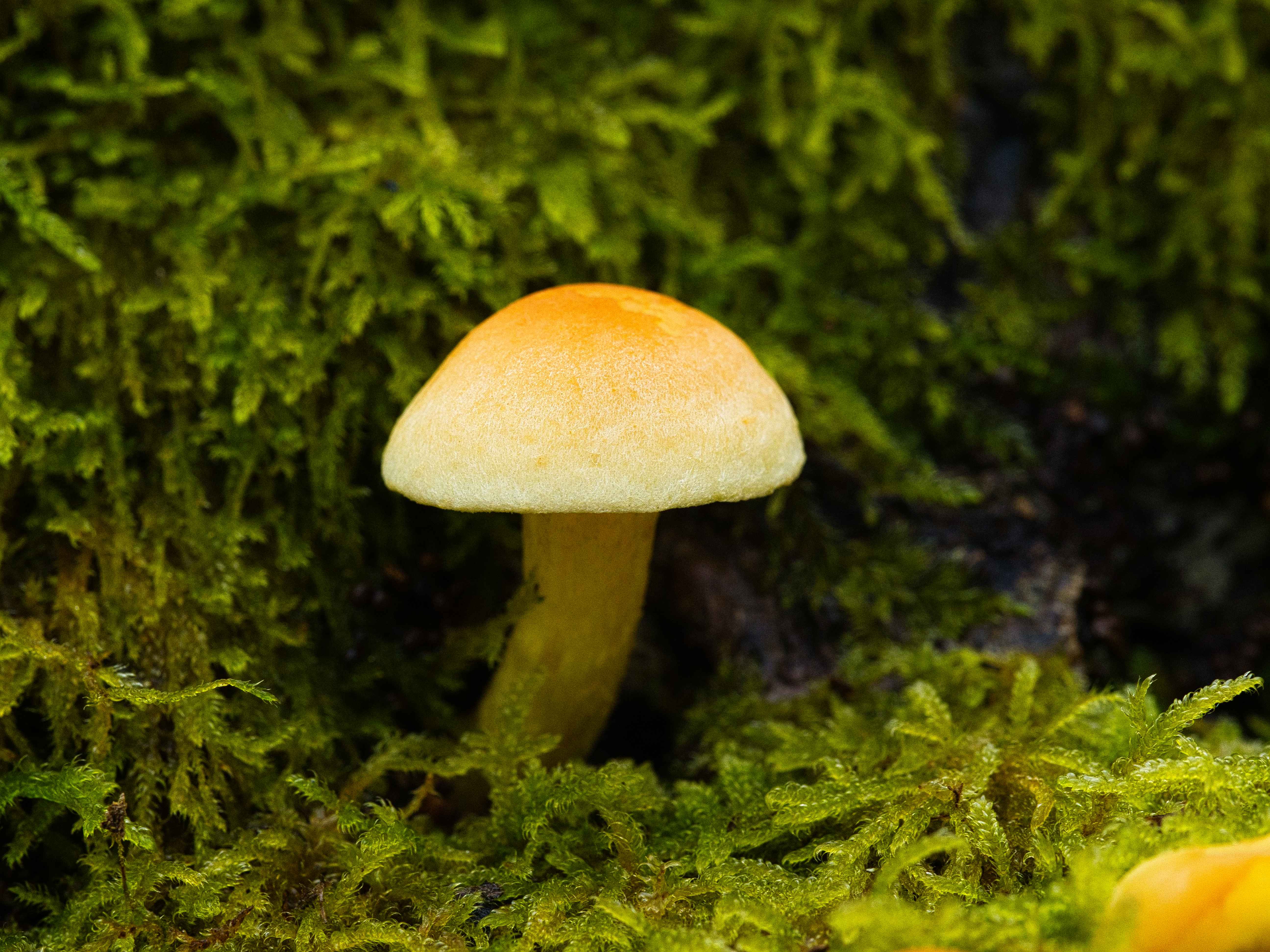
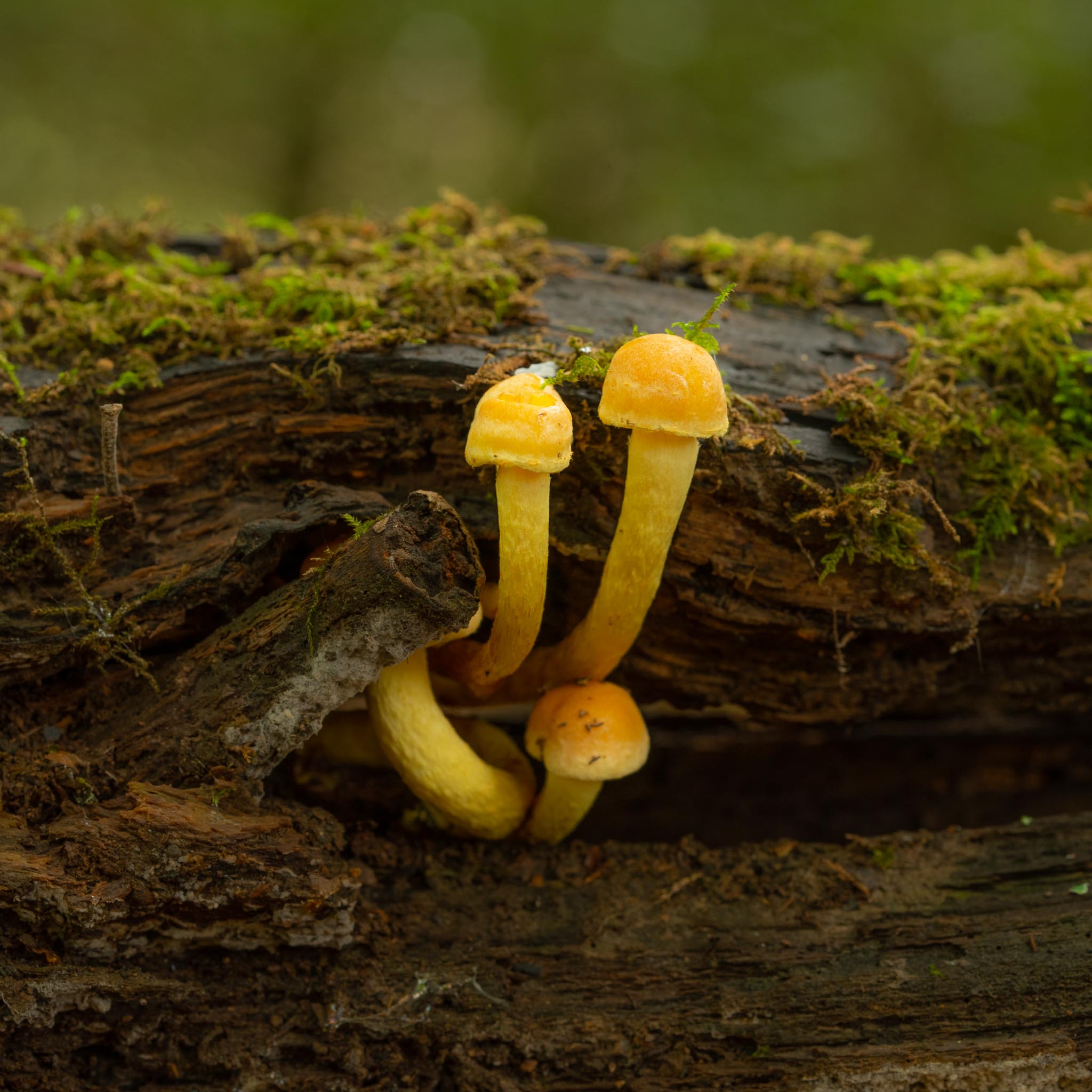
The holly was providing protection for areas of the woodland floor that seemed to be very rich in smaller fungi. This bizarre thing is a yellow club fungus. It was part of a community of many more.
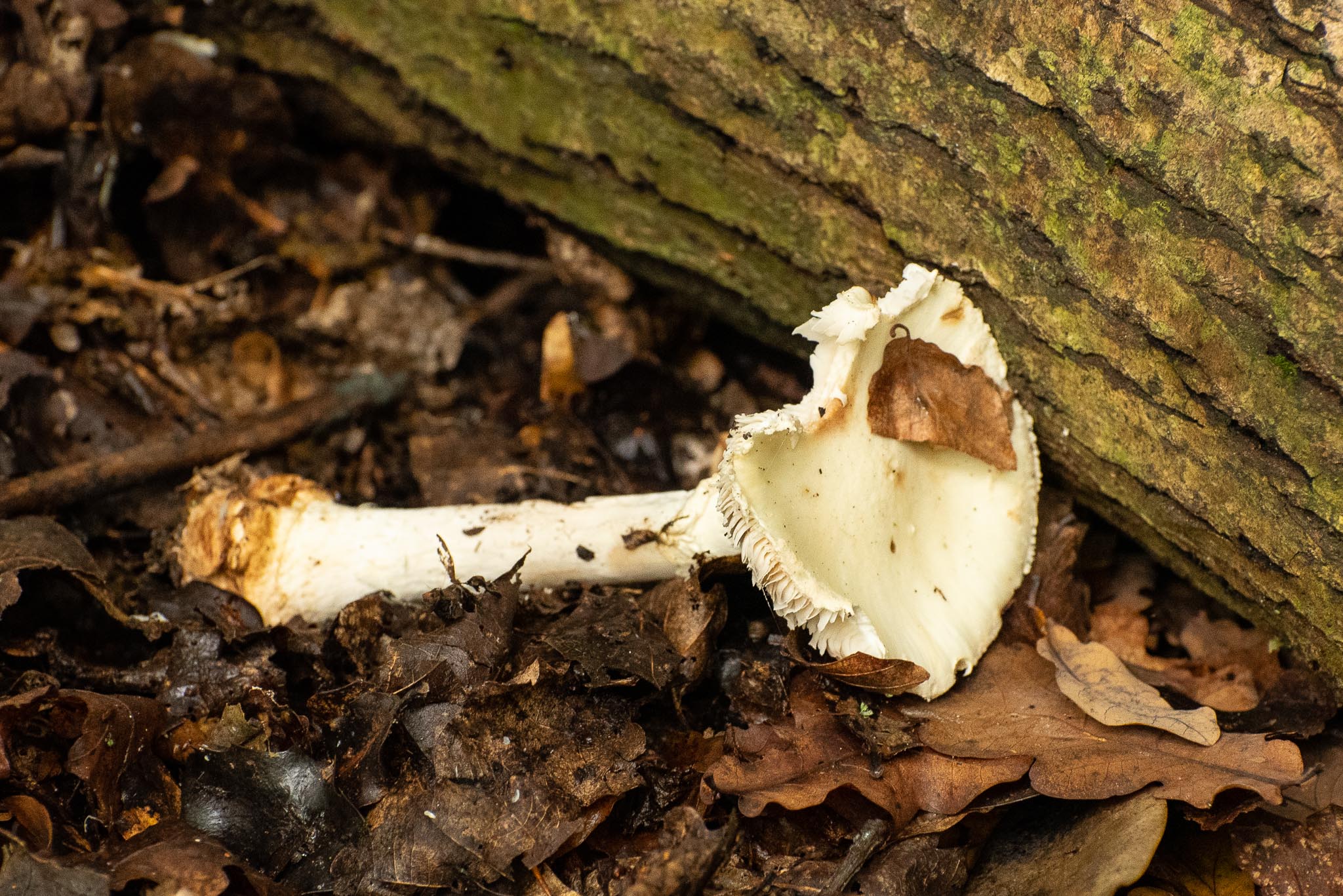
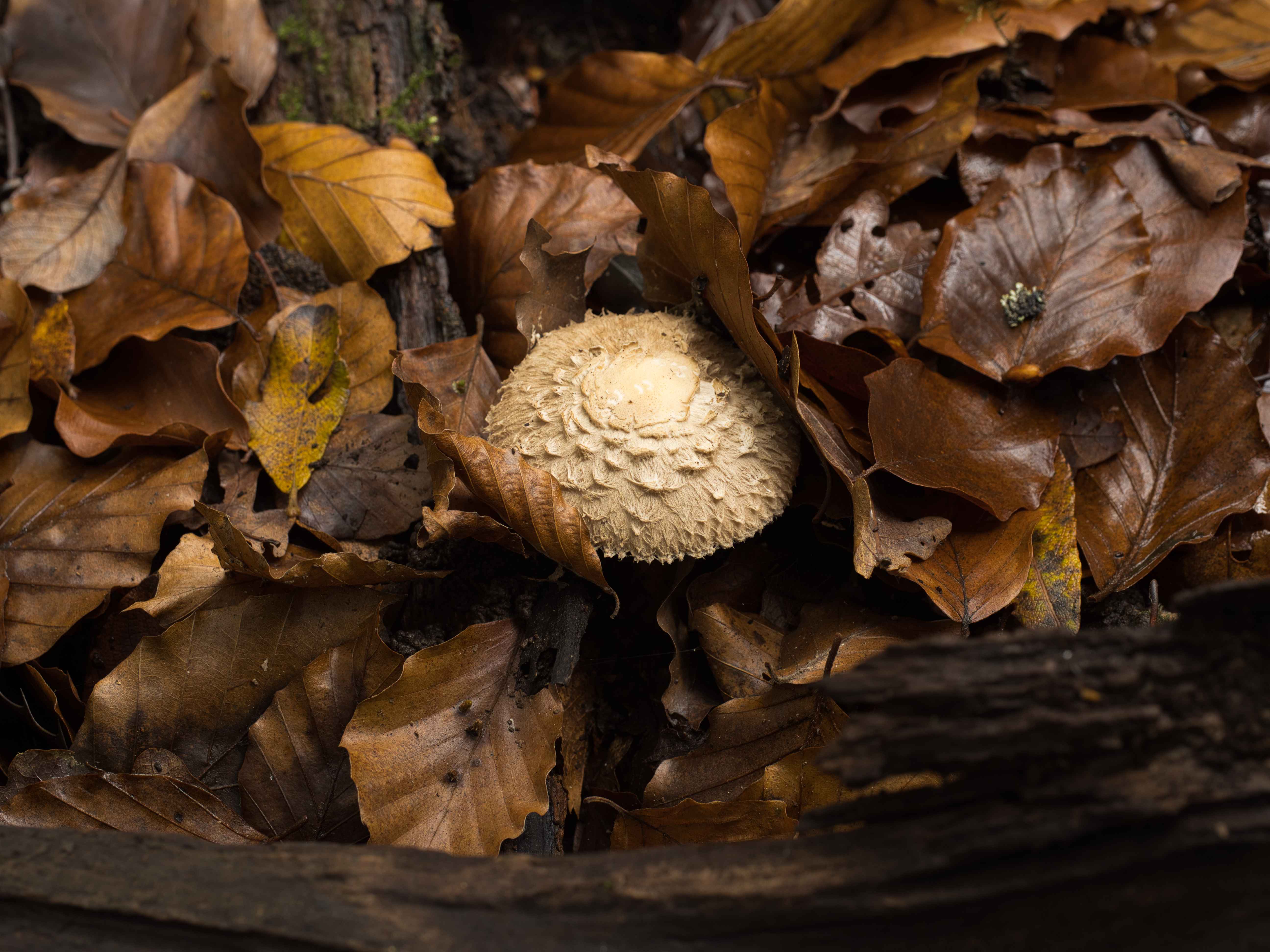
Though I’m not quite sure what this species is, probably a parasol relative of some kind, it was a surprise to see it. I wonder if the newly fallen beech leaves were providing a layer of warmth which protected the fungal mycelia in the soil from frost, allowing them to produce mushroom fruiting bodies?
I’ll end this week’s post with perhaps the most strange thing I found, down in the leaf litter again (but not without moss). Having looked at my massive fungus tome, I think this is a species of clavulina, which is not far away from a coral fungus. These fungi are ectomycohrizzal which means they have a symbiotic relationship with a plant. That means they have been able to agree a trade deal of things that they could not otherwise gain as standalone species. I hope the British and European toadstools in Brussels can take some inspiration. Though the trade between plant and fungus might have taken several million years to agree. Uh oh.
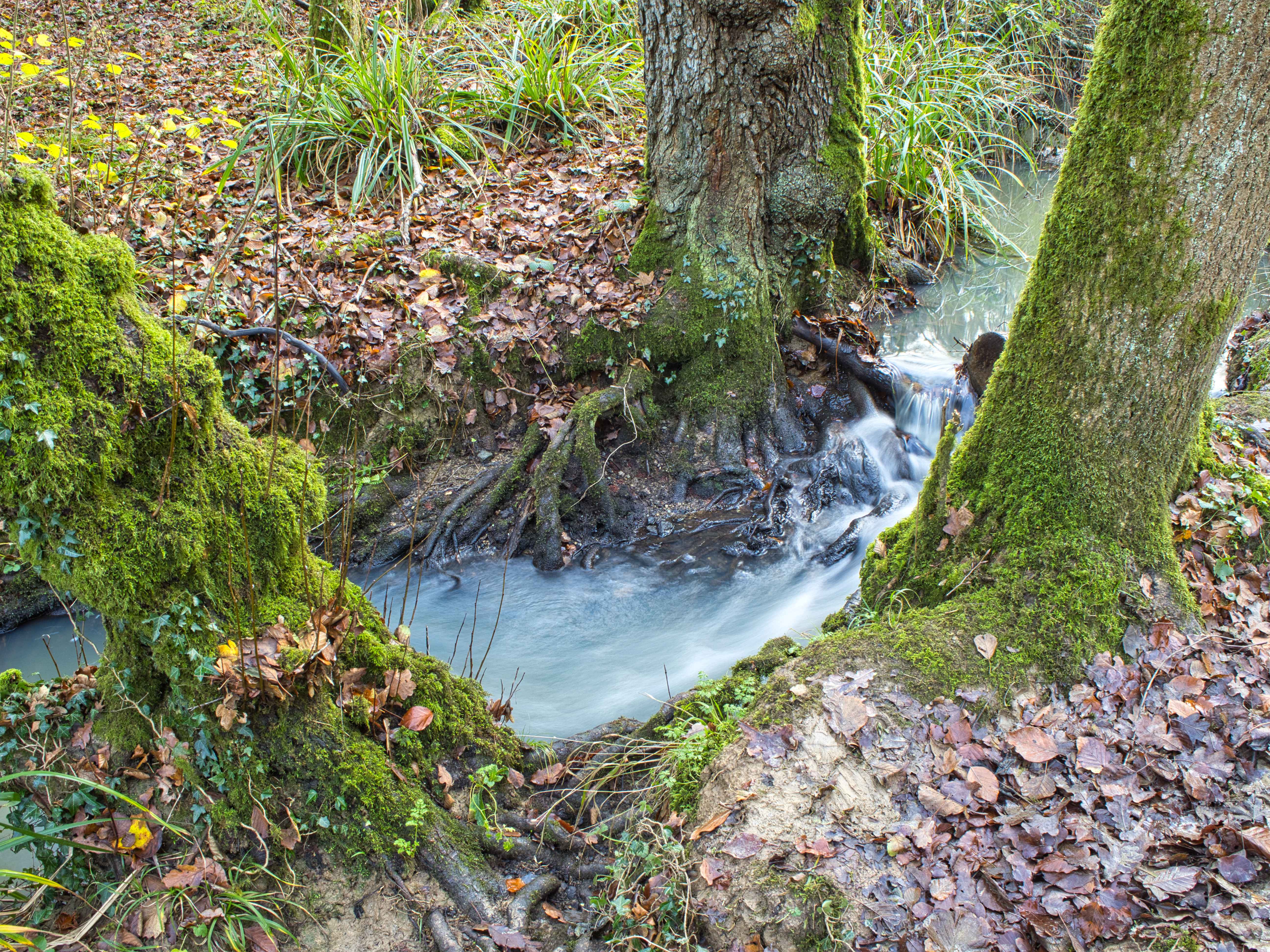
There is something special about woodlands in December. For wildlife, they can be a forbidding and barren place, which is why so many birds now move to warmer urban areas for food and shelter at this time of year. I’ve spent a good amount of time in woodland recently and the amount of fungi was a pleasant surprise. The gills in the Sussex Weald (a local name for a stream, plural) were gushing after lots of rain. They kept good company on their edges – mushrooms.
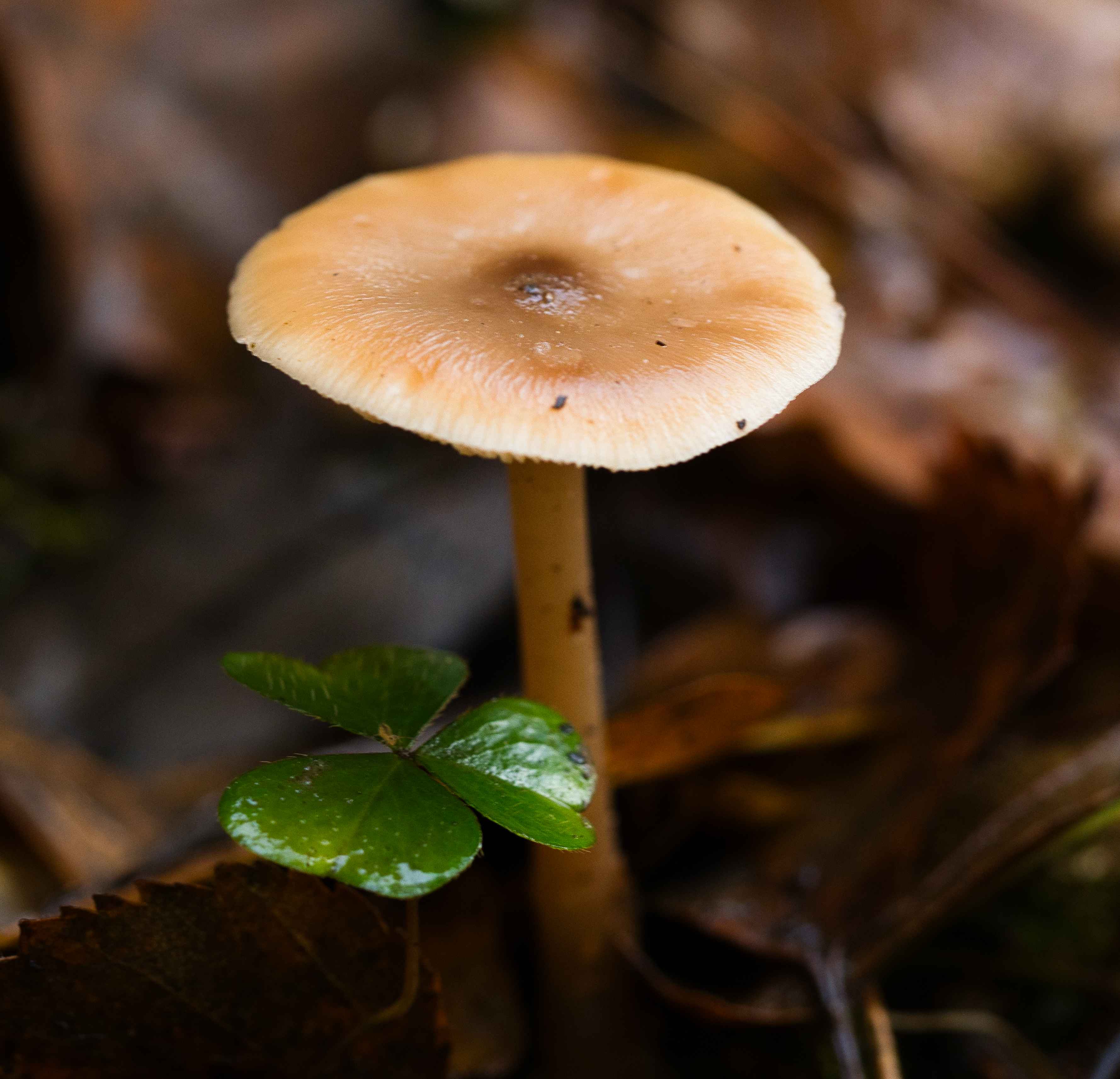
I spent a couple of hours following the edge of a network of Wealden gills. I found a number of smaller mushrooms along the edges of the gushing gills, like this very dapper looking mushroom with a wood sorrel bowtie. You may also notice a tiny springtail on the plant! The word gill is also used in Scotland and northern England, where it’s often spelled ‘ghyll’.
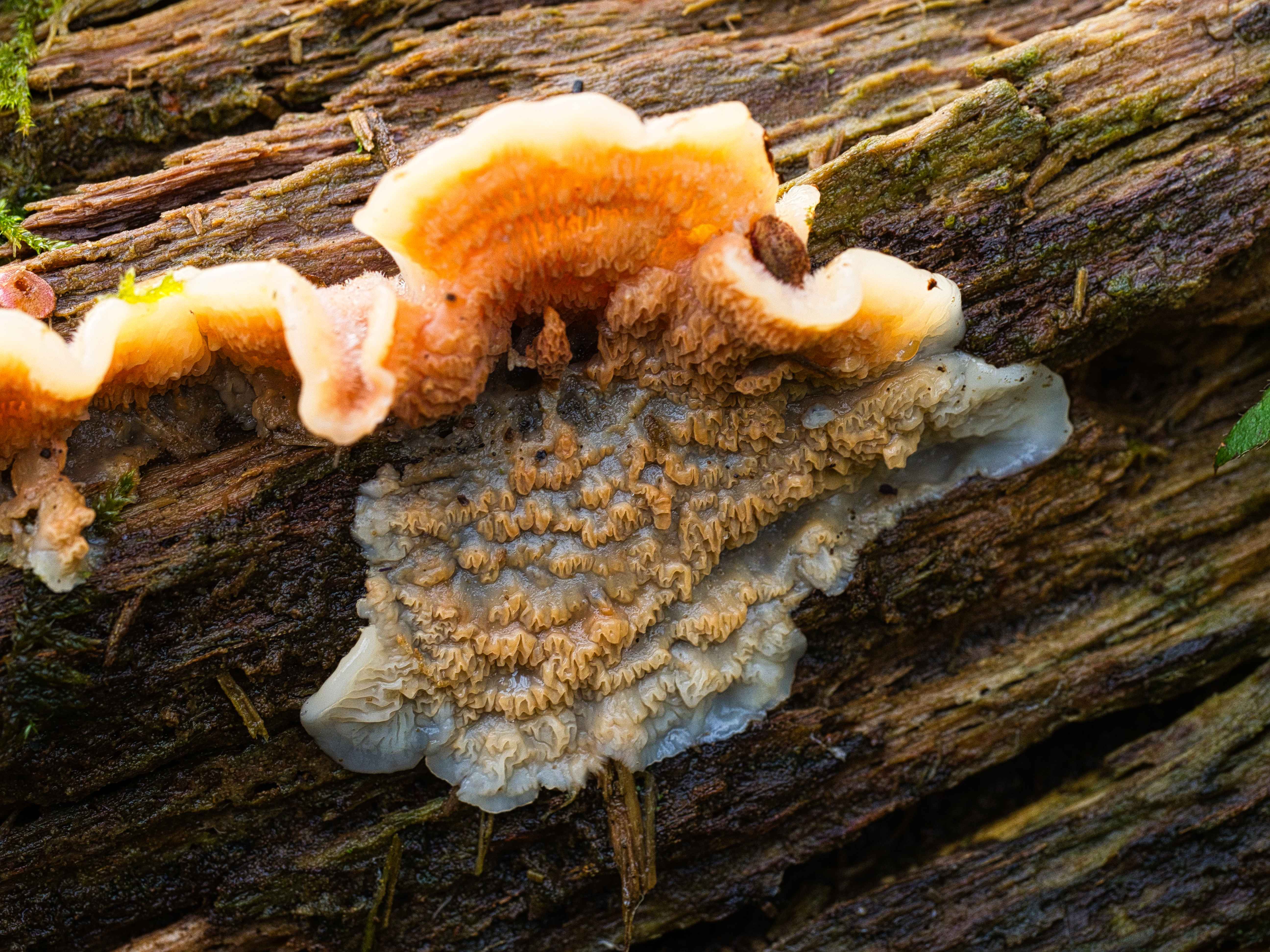
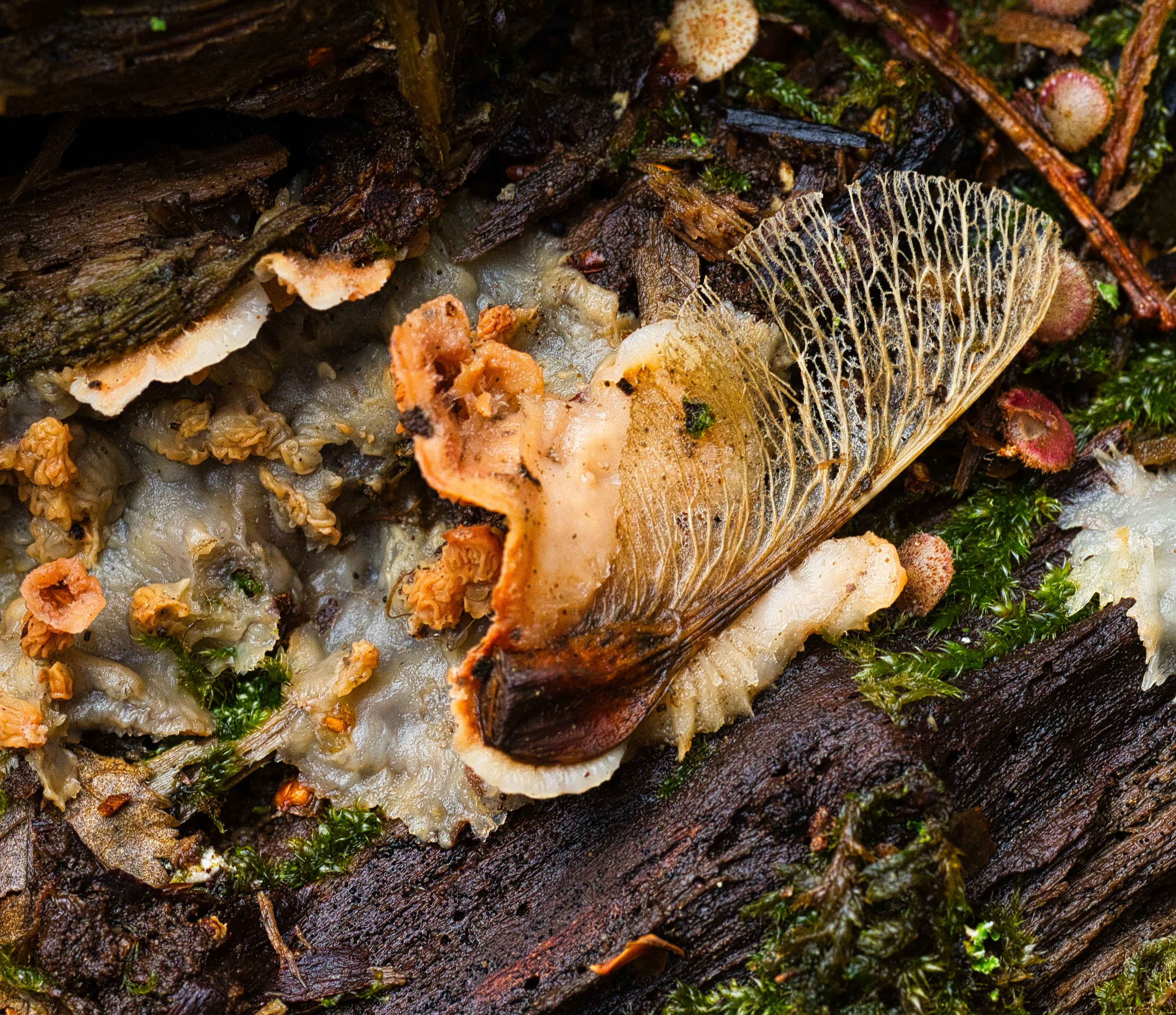
Something that really caught my eye was the work of this wrinkled crust fungus, which is its actual name.
Fungi’s main function (fungtion?) in a woodland is to break down organic matter into soil and other minerals and nutrients which can support other species. It was fascinating to see this fungus ingesting (perhaps) organic waste material in its path. In this case it was consuming a sycamore seed.
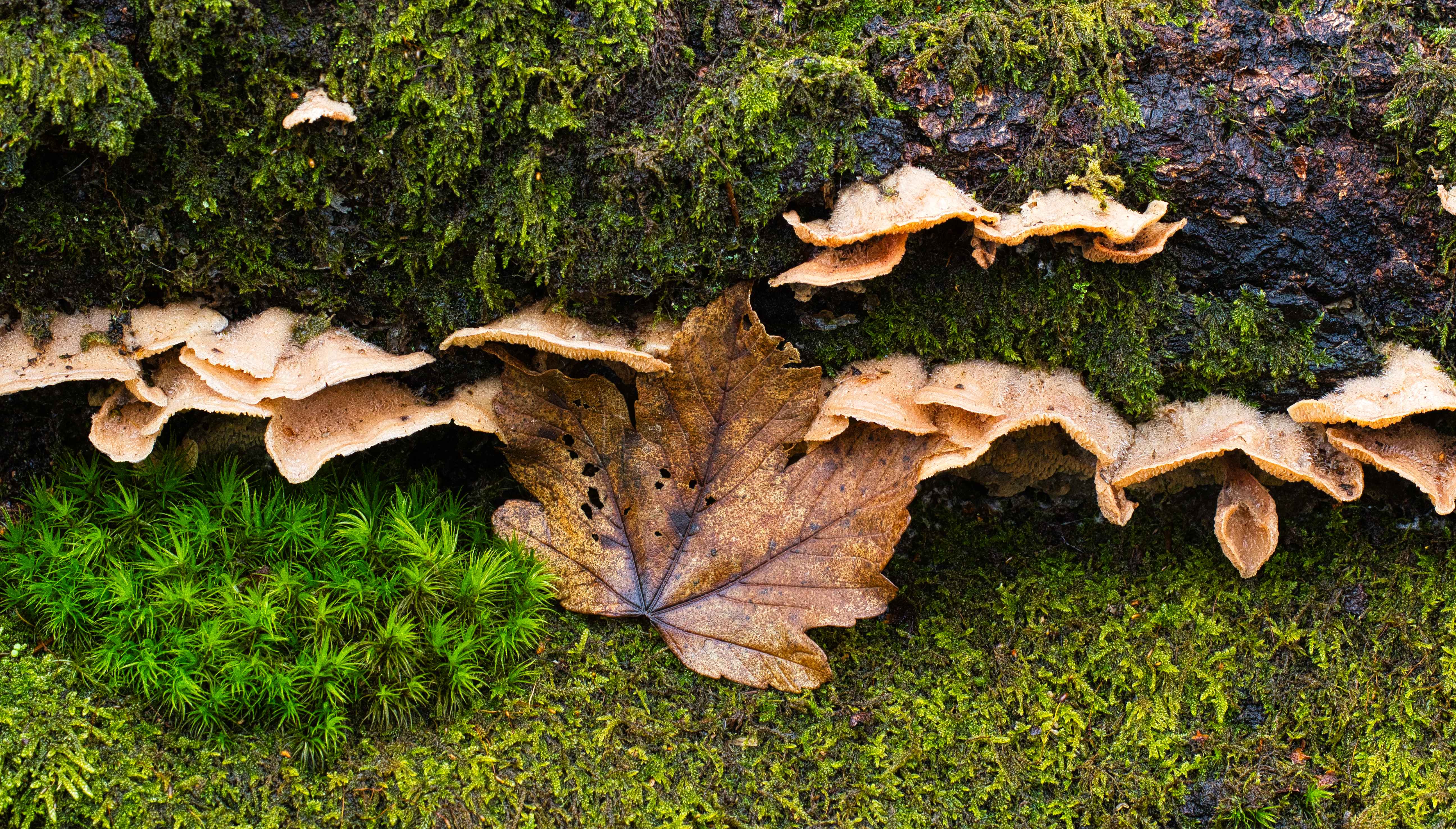
Nearby, another specimen of the fungus was getting to work on a sycamore leaf.
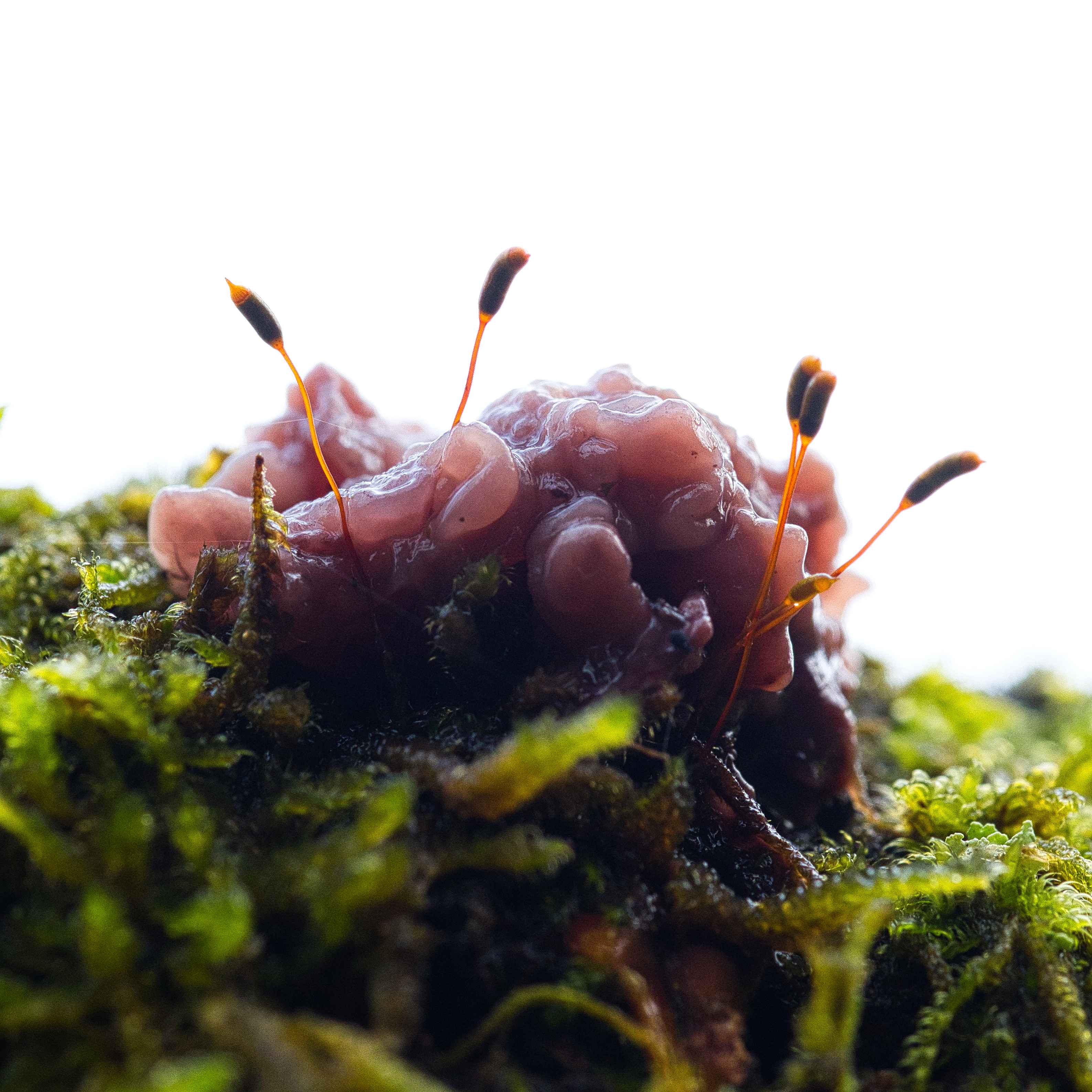
On a tree growing over the gill, this purply jellydisc looked like something out of a 1950s b-movie horror film. I think it’s the moss’s sporophytes that make it look so low-budget sci-fi.
I think you probably get what I mean.
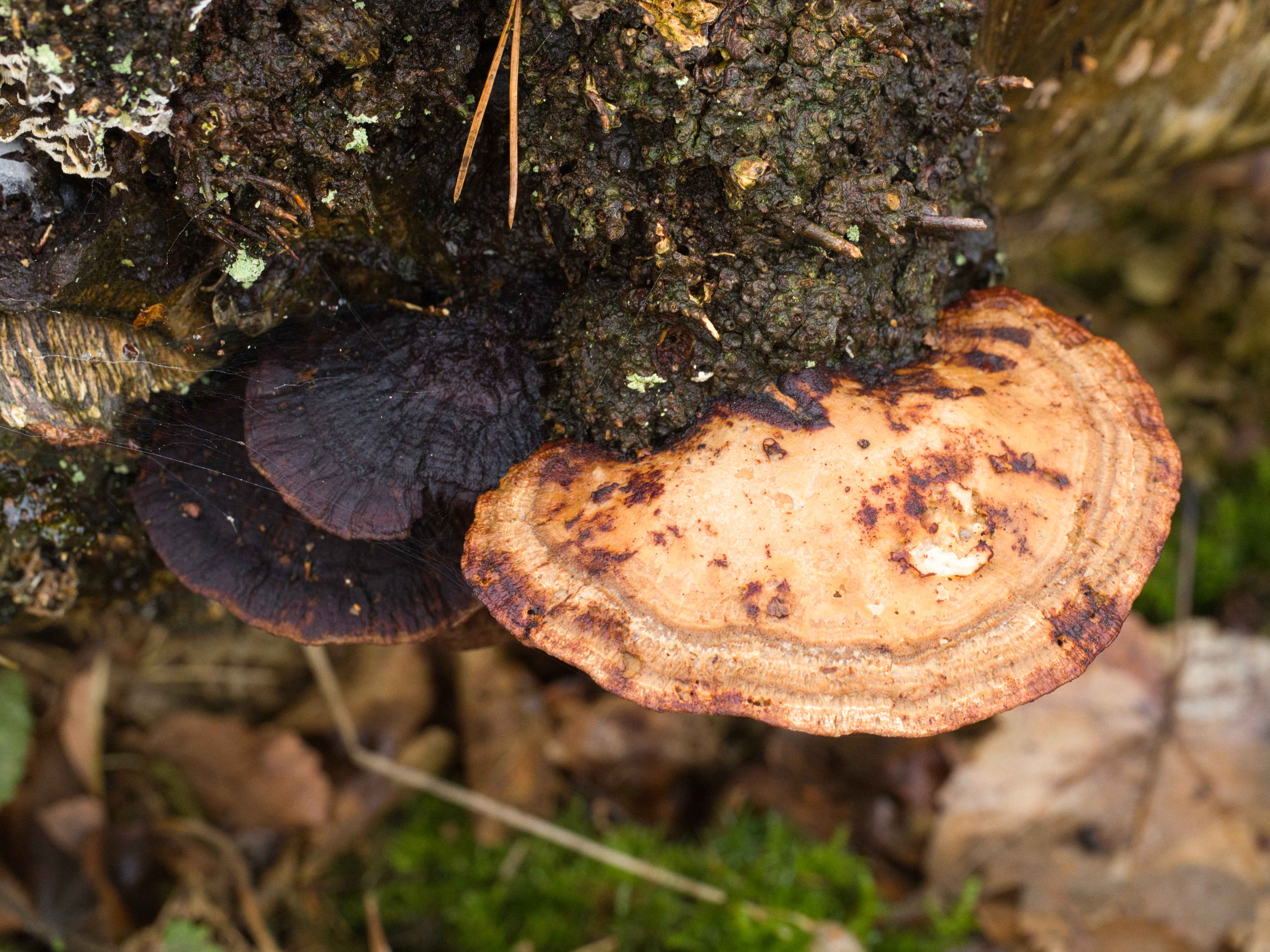
I had my binoculars with me for this walk and they were very useful in, unsurprisingly, spotting things from a distance. Without them I would have missed a fallen birch tree that was covered in many species of fungi, as well as slime moulds and mosses. Above is a species of either trametes or stereum, two kinds of smaller polypore.
There was a helpful illustration of blushing bracket’s lifecycle, moving from a pale coloured fruiting body, to red and then something much darker. That’s a long blush.
Sulphur tuft is a very common species which seems able to tough it out through the colder months. I have seen so much of it recently.
Though it may look nice, it’s a toxic fungus, so don’t get any ideas.
Take nothing but photographs, in this instance. Give nothing but likes and nice comments.
A few weeks ago I visited a favourite Sussex woodland renowned for its fungal life. Mushrooms were to be found everywhere. I was blown away.
I’m writing this a month later, having been taken out of the loop by illness for two of them (not Covid, thankfully) and now a national lockdown in England (Covid). Judging from a wintry woodland walk yesterday, I expect the trip will be my experience of the mushroom peak of 2020. So here’s how it went:
I knew it was going to be a fruitful visit when I turned into the reserve and saw mushrooms on either side of the lane. This amazing family of shaggy inkcaps provided a perfect autumn image. You can see the larger specimens heading into their state of deliquesce where the ink begins to form and drop, spreading the spores.
Across the lane these younger shaggies were just appearing from the soil.
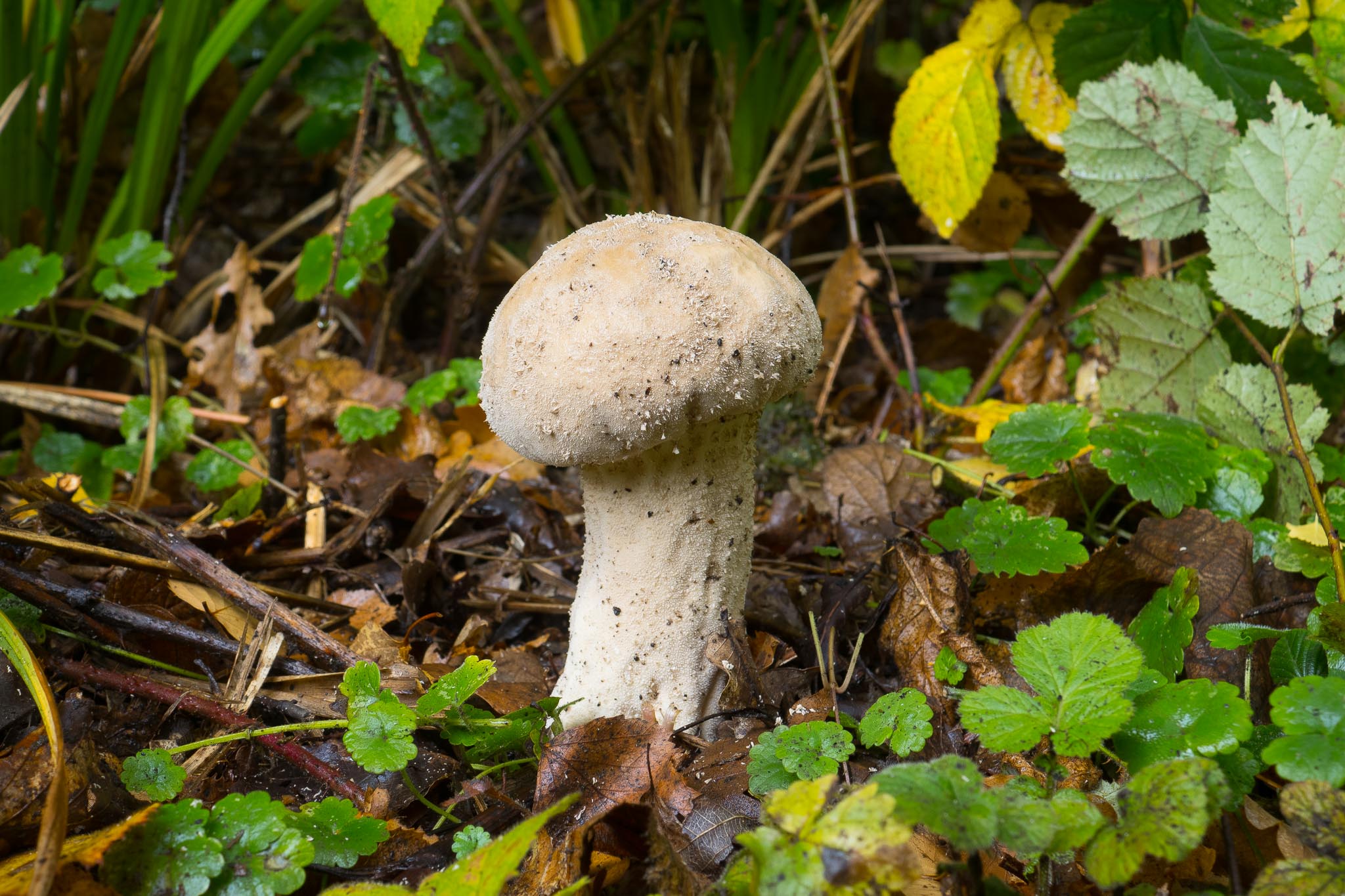
There were puffballs in close attendance, including this very large pestle puffball. It appears that someone had been clearing the vegetation around it to get a better photo. That’s a bit of a no-no.
A more modest puffball was growing close by. I was testing out a new camera bought after trading in some underused camera equipment. I was using an Olympus E-M5 Mark 3. It’s a micro four thirds mirrorless camera, much smaller and lighter than my usual full-frame Nikon equipment. It passed the mushroom test with flying colours.
I have been thinking a lot recently about how photography may at times get in the way of my experiencing the outdoors. If you become weighed down with equipment, or perhaps distracted by other things, likewise with people, problems or other plans, it can hamper your ability to enjoy the moment. That was becoming an issue for me with photography. Taking photos required a lot of kit and much of it heavy. I have begun to question if it’s really worth it. Hence trying to lighten up both my equipment and my mentality.
In October there were a huge number of magpie inkcap images on social media. It has clearly had a good year. I wonder if in future that kind of data can be harnessed to understand the prevalence of certain species. A bit like open source investigate journalism.
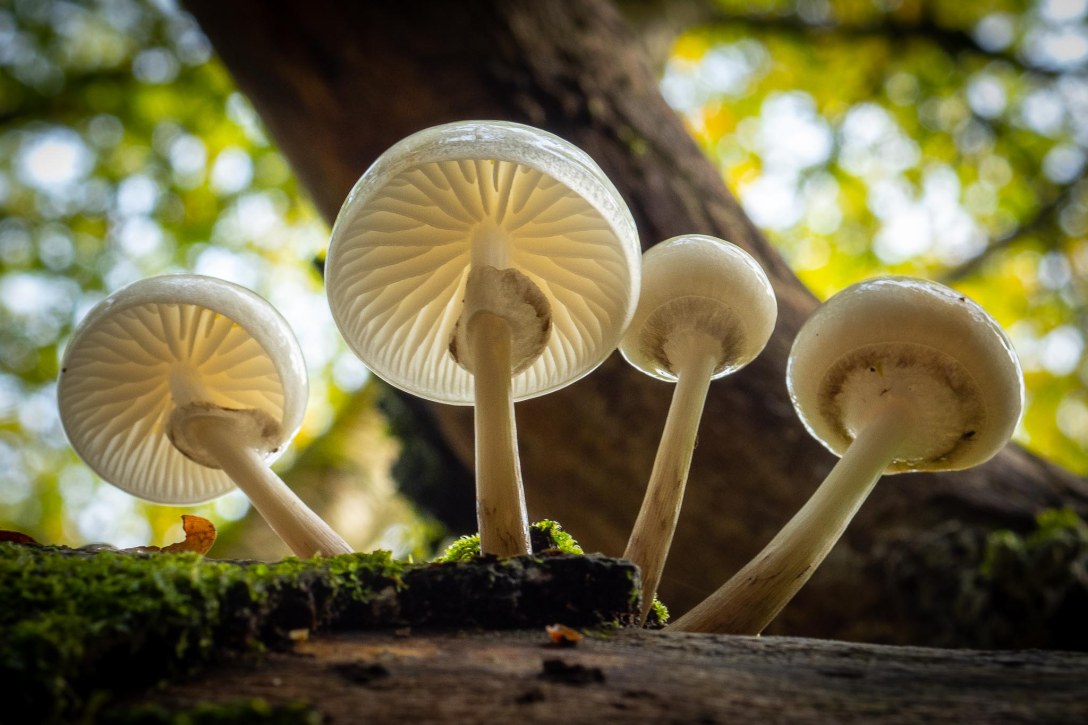
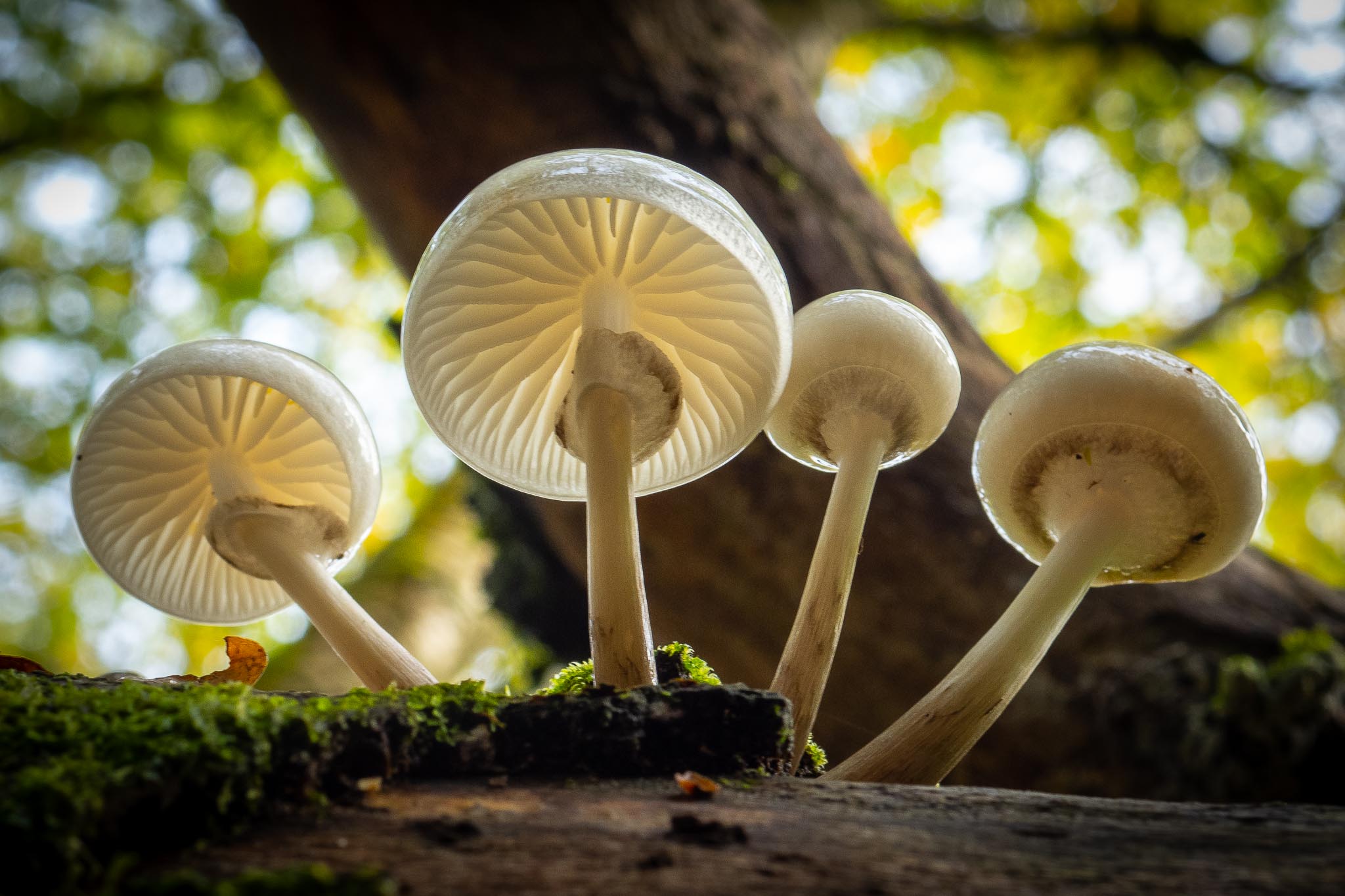
Porcelian fungus has also had another solid year. There is one tree I head to, a semi-collapsed beech tree that is always home to these beauties in autumn. I like to photograph this fungus from below, sometimes using a light to illuminate the gills.
Porcelain fungus is translucent and glossy, so that helps it look even better in photos.
On the same log I found this mushroom, probably a bonnet. It was only later that I noticed the thread of silk running from the gills to the moss. That’s the beauty of macro photography, you don’t see everything straight away. It goes to show how poor our eyesight really is and how much we miss.
Further into the woodland I found this lovely cluster of shaggy scalycap mushrooms, just peaking and perhaps beyond their best. Here I used a tripod and an external LED to light them from underneath. I used a zoom lens and once again the camera was a winner.
There were mushrooms absolutely everywhere. It was probably the most mushrooms I have ever encountered in a single day. This stinkhorn is only the second I’ve ever found. Interestingly I had passed it earlier in the day and the black sludge that covers the top of the fungus had disappeared by about an hour or so later. I believe that is eaten by the insects you can see here, in order to spread the spores. It’s a gross fungus but utterly fascinating.
I know a pile of logs alongside the path that is always good in autumn for coral fungus. I was not to be disappointed. This could be a scene from The Little Mermaid or perhaps the ruins of some Bavarian mega-castle.
There were many fly agarics to be found, probably in the hundreds. One patch was in incredible condition. When I find scenes like this, it gives me an adrenaline rush, knowing I have a limited amount of time and opportunity to get the photo. You can see why I don’t take photos of birds or rare mammals, I would get far too excitable and probably drop the camera.
This fly agaric was untouchable. It’s the kind of thing I dream of all the year round. I love the way the leaves have been pushed up but still clamour at the stipe of the fungus. It was a perfect specimen. It’s the only place to end. I will be going looking for mushrooms this weekend but after weeks of torrential rain, I fear they may have been washed away. With colder temperatures coming soon with December’s arrival, it could be the end for our fungal friends. I’ll keep you posted.
A jay swoops through the trees in silence, landing on an oak branch, an acorn held in its bill. A friend and I have a running gag. Wherever we see a jay we send a text or voice recording to eachother:
โJay.โ
It originates from a trip to the White Carpathians mountains in Czechia one September. The bird we saw again and again was the jay. Always travelling around with or for acorns. As is now commonly known now, jays scatter-hoard thousands of acorns every year. They have helped pioneer Europeโs great oak woodlands along with squirrels and other smaller caching mammals.
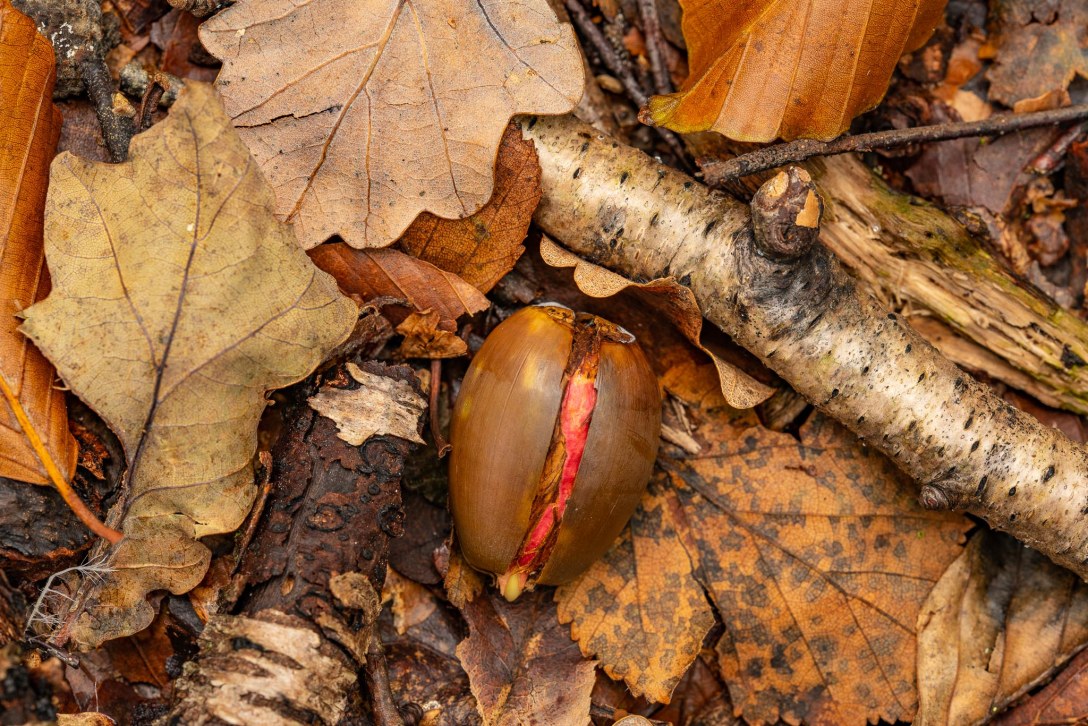
Here in the Sussex Weald I find a fallen acorn split down its centre. The tannin red catches my eye. The shell is cracked because the acorn is shooting, seeking soil to establish itself in.
Iโm tracing an old ditch or woodbank looking for fungi to photograph. There is an almost comical halt to the woodland where the heathland and its diminishing ranks of pine begin and the broadleaf oaks end. Marking that edge is an astonishing beech tree. Let me explain.
Part of the treeโs root plate has lifted. The lignified roots have become hardened like a drystone wall. They have developed into a lattice-work of branches, their function forever entangled by their appearance above ground.
The tree must have fallen about fifty years ago. But it has not died. Where the old trunk hit the other bank of the ditch it has made a sharp turn towards the sky to grow anew. Trees can teach us that to fall is rarely to fail.
I want to start by saying thank you to everyone who stopped by last week to read my click-bait post about honey fungus. The post had nearly 200 views in one day, which is a huge amount for this blog and broke the single day record. My blog could have nearly twice the number of visitors as in 2019, probably due to the fact I have had more time to walk locally taking photos and to spend time writing these posts. Otherwise I would be stuck in a car driving to and from an office I probably didn’t even need to visit so often.
I think the fact more people are working from home could be key to protecting local green spaces going forward. In the UK ‘lockdown’, as the period of late-March and most of April and May 2020 are known, millions of people discovered their local green spaces. If people value something close to home, they will learn about it and in their stewardship, nurture and defend it. I discovered fungi close to home, and I’ve sought it closer and closer ever since.
This is black bulgar, a rather odd species that seems to explode in October on large fallen branches. The first time I saw this, it had appeared on the fallen limb of a massive oak tree which had come down that summer.
This rather unsightly mushroom did get my heart racing at first. I thought it was perhaps my first local deathcap, but really I think it’s the false deathcap. It has the classic Amanita bulb at the base. I think the colouring of the cap is wrong for deathcap and it has some of the brownish scales of the false deathcap, on the cap.
When the ground isn’t producing the shrooms needed at this time of year, I look to the moss growing on tree trunks. You can often find very small mushrooms there, perhaps bonnets (mycena) or galerinas. The moss holds on to the rainfall for longer, meaning fungi, some of which are parasitic on moss, can prosper. Let’s call them… mosshrooms!
This lovely little mosshroom had actually snapped but I rotated the image for effect.
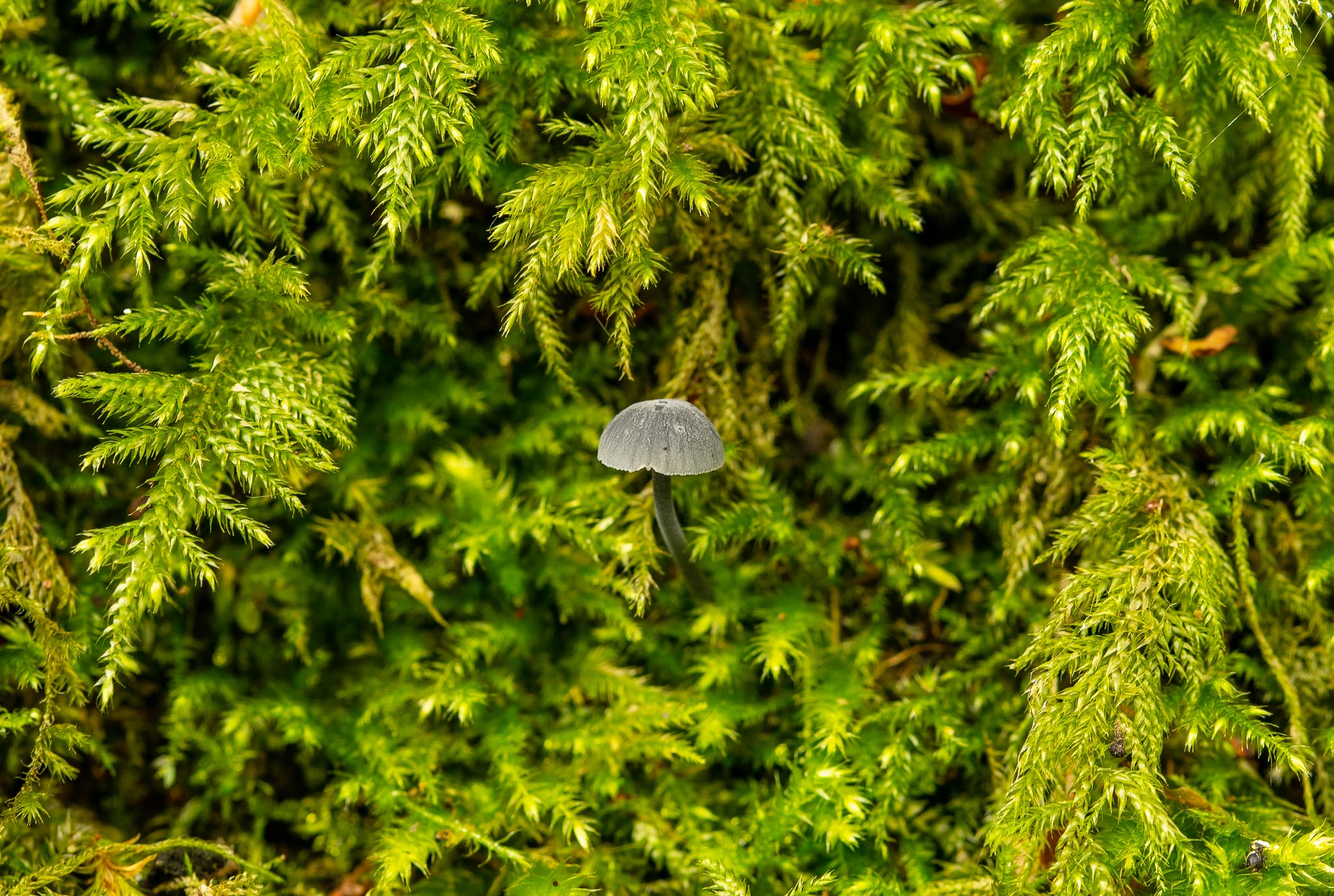
This beautiful little grey-blue mushroom epitomises the mossy shroomlet. As you can see from the moss fronds, it was very small indeed.
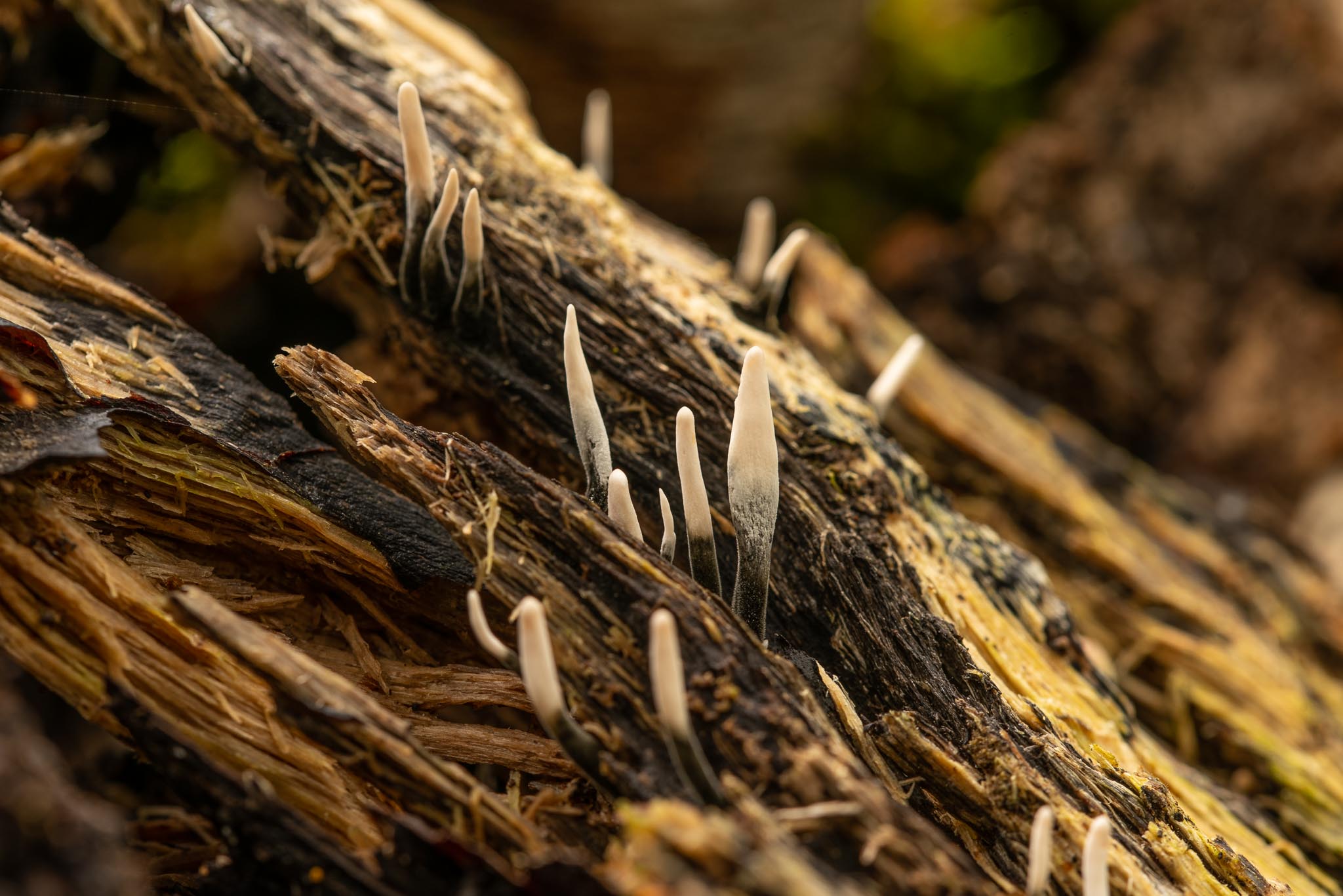
One of my first #FungiFriday blogs was about candlesnuff fungus. It looks quite neat at the stage seen above, when it is first beginning to fruit. In dry conditions you can flick the white ‘wick’ and the spores appear as smoke from a snuffed candle.
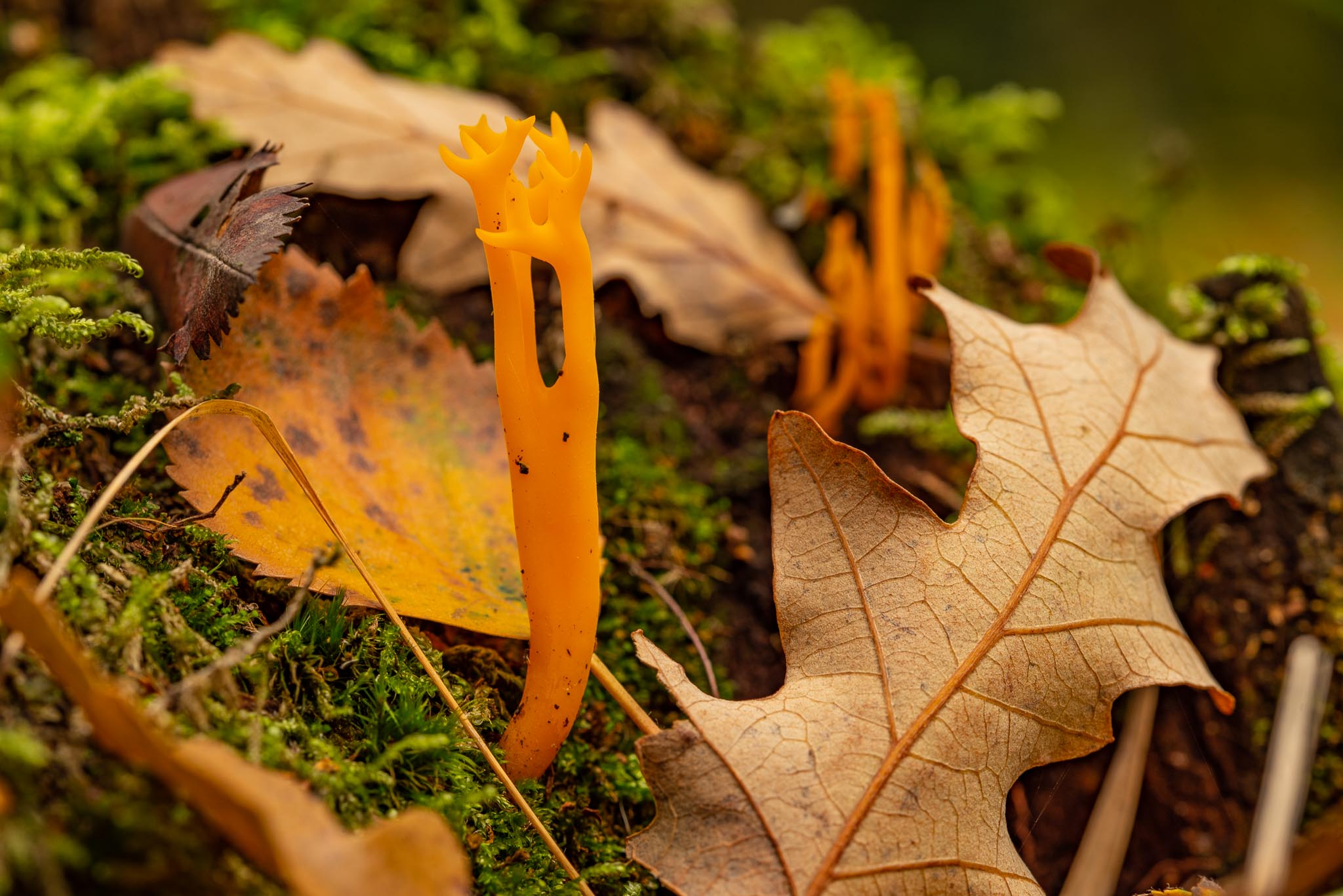
A similar type of fungus was this yellow staghorn, a common species. It was growing down on a mossed-over stump on the woodland floor. That oak leaf on the right (I think Turkey oak, Quercus cerris) is so beautiful.
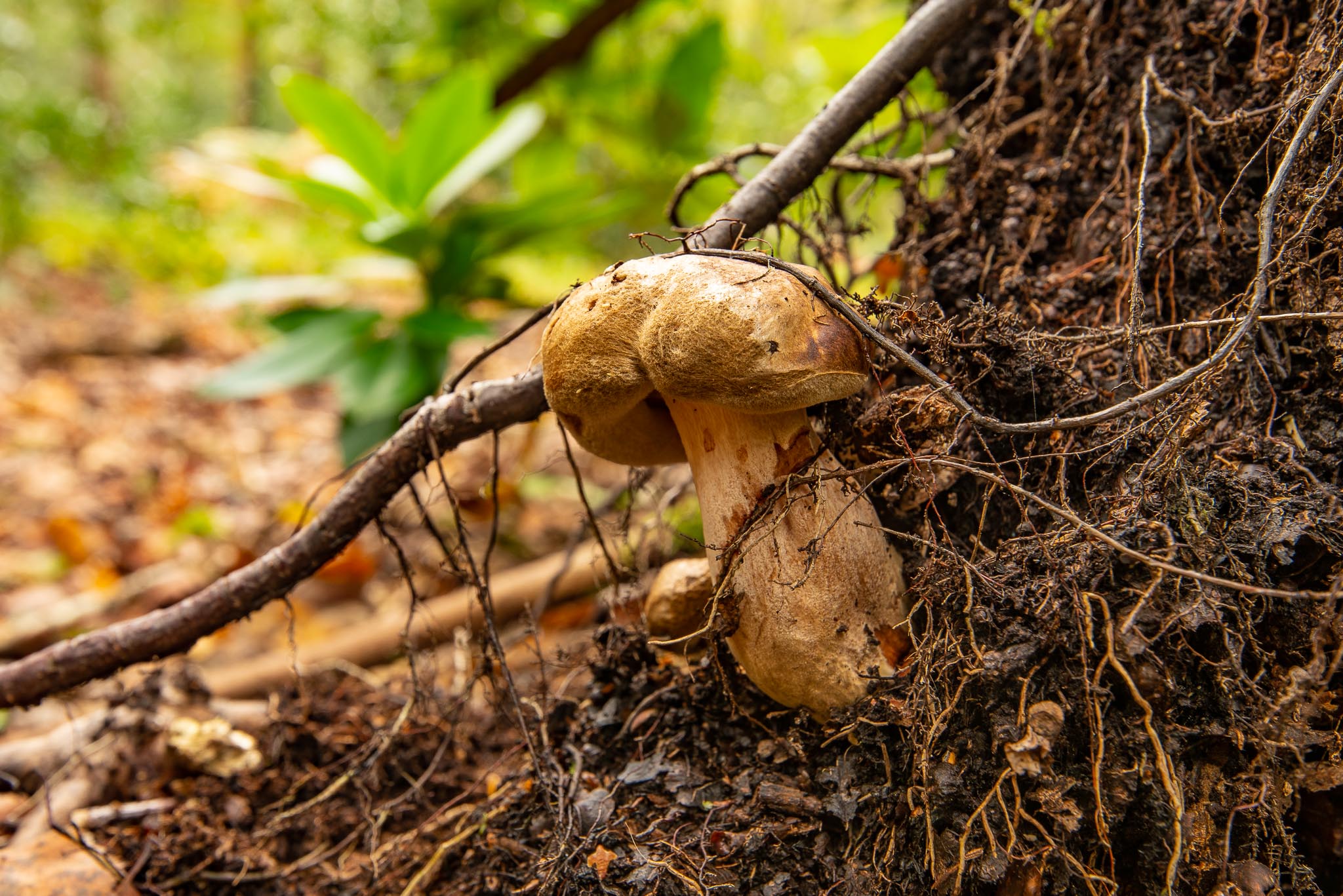
The most unusual find was in the raised rootplate of a rhododendron. From above they looked like potatoes. I am fairly confident this is a cep, Boletus edulis. It is, of course, also known as porcini and is one of the most sought after edible mushrooms. Foraging is not something I do commonly, so I left it there to grow on its merry way.
This scraggly crew are a common but no less beautiful mushroom – amethyst deceiver. They are easy to identify due to their colour and size and are a very common species in the UK. I do find that they are happier in older, more stable woodland. Aren’t we all?
The summer’s September siege has broken and autumn has washed in with cut-price temperatures and heavy rain. The fruits of this sudden shift will not be felt fully for a few weeks yet, so here is what I have found in the last of the warm September days.
Last week I visited a favourite nature reserve in West Sussex, managed by Sussex Wildlife Trust. It was the first time I’d manage to get there in perhaps a year, due to the pandemic and the remoteness of the site. It is one of the only places I know locally where you find such an abundance of moss and lichen on trees, suggesting excellent air quality. This is the kind of thing you see in the New Forest, as well as more highland landscapes.
I found porcelain fungus, this time hiding high up in a tree.
It is a reminder to me that if you see signs of smaller mushrooms, it can mean there are much more in other places that you may not have checked.
Rooting shank is a common summer mushroom which grows on wood submerged in soil. It gets its name from the root-like growth which attaches it deep into the soil. I almost always find it at the base of a tree.
Above is a species that is one of the earliest mushrooms to fruit, spindleshank. I find them most often along the lines of roots near the butresses of oaks. It is symptomatic of root trouble, usually with oak trees. In this blog, there is no trouble, as fungi get a free ride here and no anthropomorphic view of their world. That said, I won’t be focusing on fungal pathogens anytime soon. Awkward.
Later in the week I made a visit to another Sussex Wildlife Trust gem, Ebernoe Common. It was a hot day and the fungi were few.
This lovely scene is one of Ebernoe’s more open habitats, where trees like willow and crab apple are more dominant. It harks back to how wooded landscapes in Britain and Europe once appeared. These areas would have been grazed and kept open by livestock, allowing more light-loving tree species like crab apple and hawthorn to come to the fore. Here I found some blushing brackets hovering like UFOs on a fallen tree.
Fallen trees were the only place I found any fungi at all. This lovely turkeytail was growing on some birch trunks at the side of a path. This may be a varience on the more common turkeytail found. I love the progression in colours towards the tip.
This is a pretty rad example of a variant species, again growing at the side of a path on some fallen wood. Stunning.
There were signs of what is to come over the next two months. This is probably shaggy scalycap (Pholiota), pushing its way through the bark of a fallen tree like Wotsits, a cheesey wheat snack. With the rain that’s washing in at the time of writing, we should all be getting ready for mushroom season!