Due to Christmas hols I’m a couple of days late to Fungi Friday on my blog, morphing instead to Mushroom Monday!
A couple of weeks ago I spent some time at Lullington Heath in the South Downs National Park. Lullington Heath is a National Nature Reserve with the super rare habitat chalk heath. It had lots of little waxcaps fruiting at the time.
As you can see Lullington Heath is dominated by gorse which affects the diversity of plants and fungi that can prosper there.
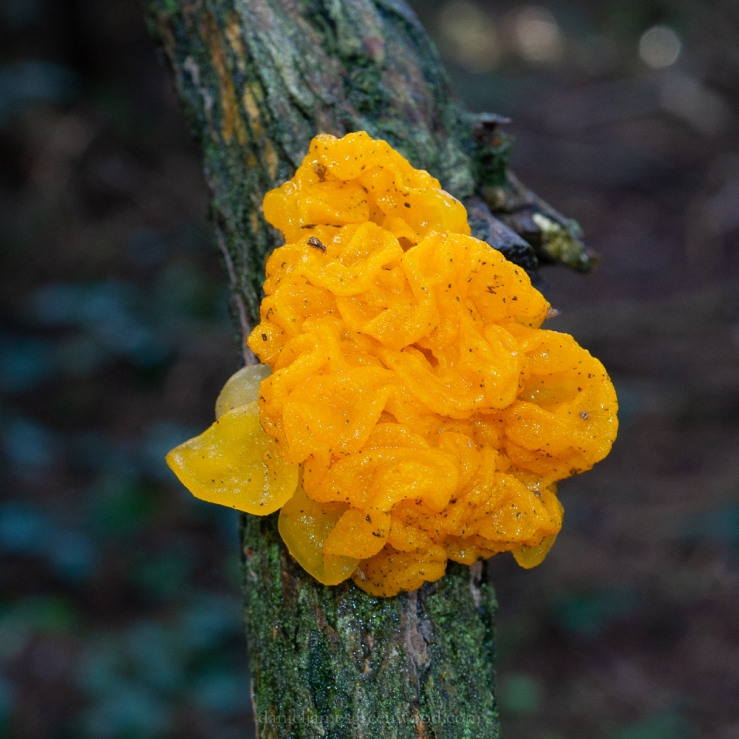
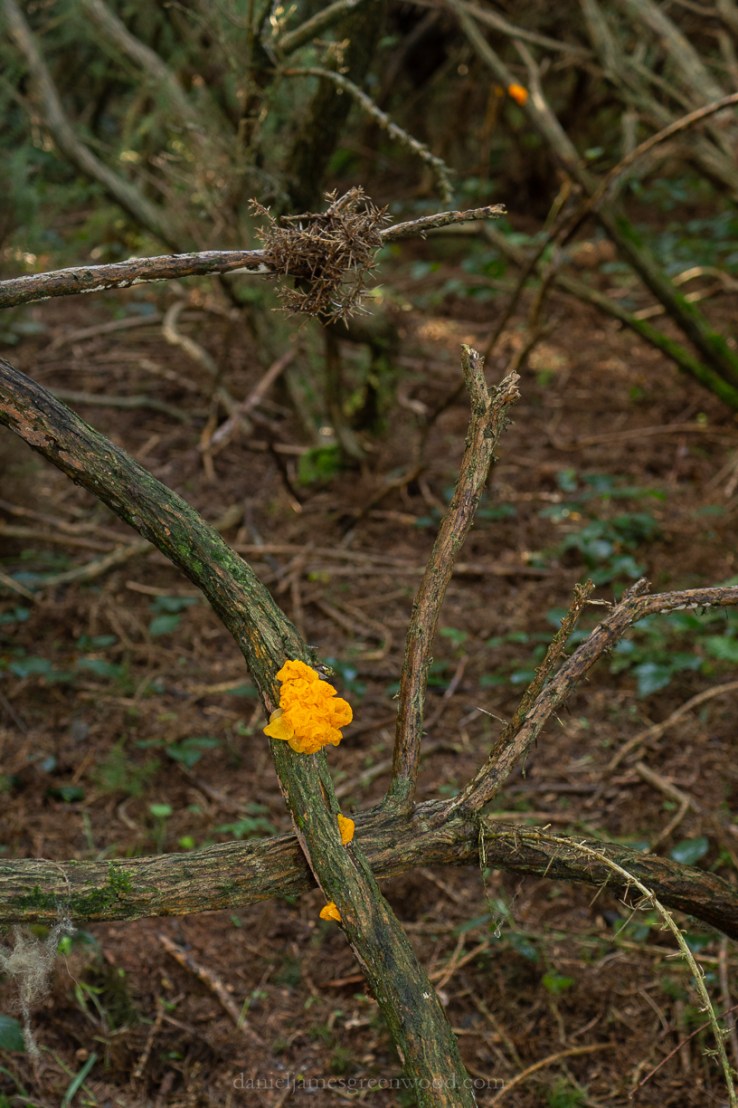
The gorse forms a scrubby woodland and provides ample habitat for one of the most striking species of fungus: yellow brain. It’s also known as witches’ butter, a lovely colloquial name that hints at the role fungi has in British folklore.
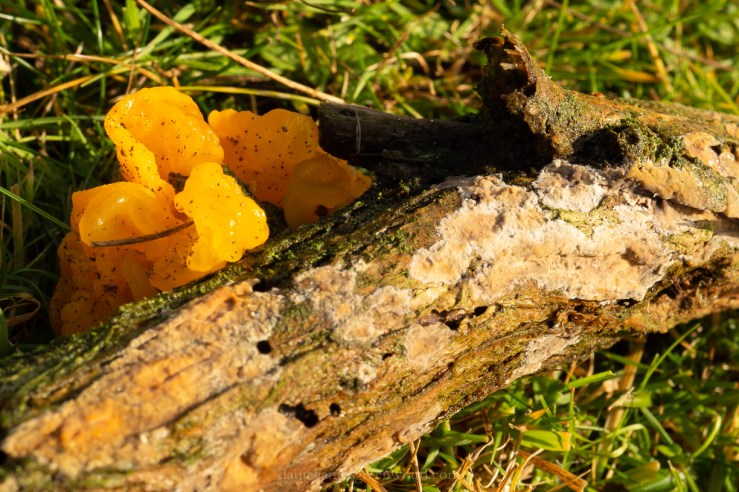
This is the yellow brain from the pics above. I cut it out before it was cleared and brought it into the sun. I hid it further away in the gorse afterwards.
It’s actually parasitic on crust fungi which you can see on the right hand side here.
Keep an eye out for my fungal year 2019, an account of things I found and photographed this year, which I’ll be hoping to post in January.
Merry Christmas to all the funguys and gals out there!
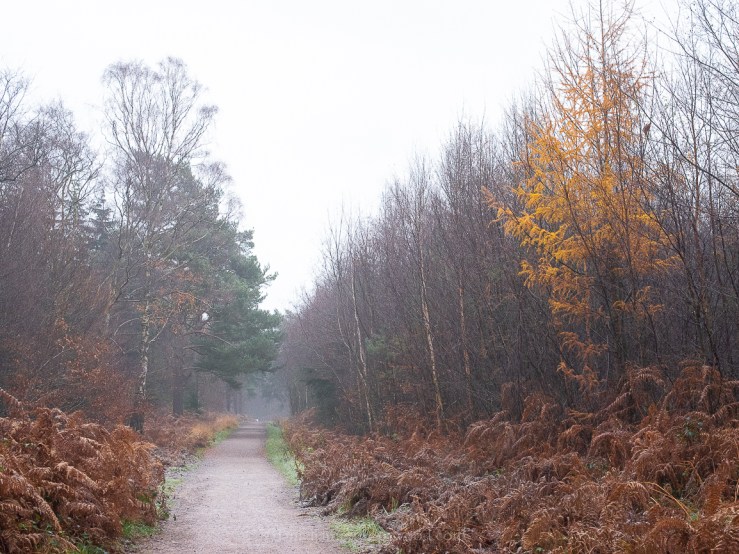
The path slopes up between ranks of birch, beech and oak. On the banks bracken is encrusted with frost and the addition of oak and beech leaves. I love the sight of a silver-lined oak leaf and December is the month to find them.
It’s about 9am. Mist lingers up ahead like the faint hang of smoke from a campfire. All around I can hear the falling of droplets of water. Looking at my sleeves there is no sign of rain. Then I realise it’s the frost melting in the tops of the trees. Water only falls from their crowns.
In among the trees small birds flock and feed. These mixed groups of species have been building since September. A trio of bullfinch slip away from me in birch branches and bracken. Their fluty calls are faint and sweet. A white bib on their backs marks them out as they escape deeper into the dripping woods.
St. Leonard’s Forest was once more open than this. You can find huge beech trees dotted around from when they had the freedom to grow uninhibited. Now many more trees compete with them for light in the sky, good and water in the ground. One of the beeches has been damaged in a storm. A third of its trunk has fallen, splitting in two directions. Its summer leaves are still held by the fallen branches, shielding the scene of its collapse.
This is not a catastrophe. It could result in the tree living centuries longer. Looking more closely the trunk glows green with moss and algae. It raises one limb still high into the air. This is its lifeline. Its heartwood is now exposed and soon more insects and fungi will move in. This is not a symptom of human error or mistreatment. Its is the true wildness of a tree stepping into the realm of the ancient.
When temperatures touch freezing, it spells the end for the mushroom season. This is because fungal fruiting bodies are largely made of water and most species simply can’t excel if they’re frozen stiff. But temperatures in Sussex have been mild at times this week.
A good 6 mile walk in the High Weald produced almost no soil-based fungi. That is except for these tiny Russulas, otherwise known as brittlegills. This family of mushrooms is very big and beyond identifying them to that level, I find that doing the same to species level (especially with a photograph) is not really possible. These specimens had already been uprooted and had a pinkish cap to go with their Kendal mint cake white stipe. I would guess it is birch brittlegill (Russula betularum) due to the colouring and the fact it was under birch trees.
You can see from the comparison with my thumb just how small but perfectly formed this mushroom was. They are a family of mushrooms to see in late summer when autumn’s cogs are beginning to turn and all the way through to the season’s close.
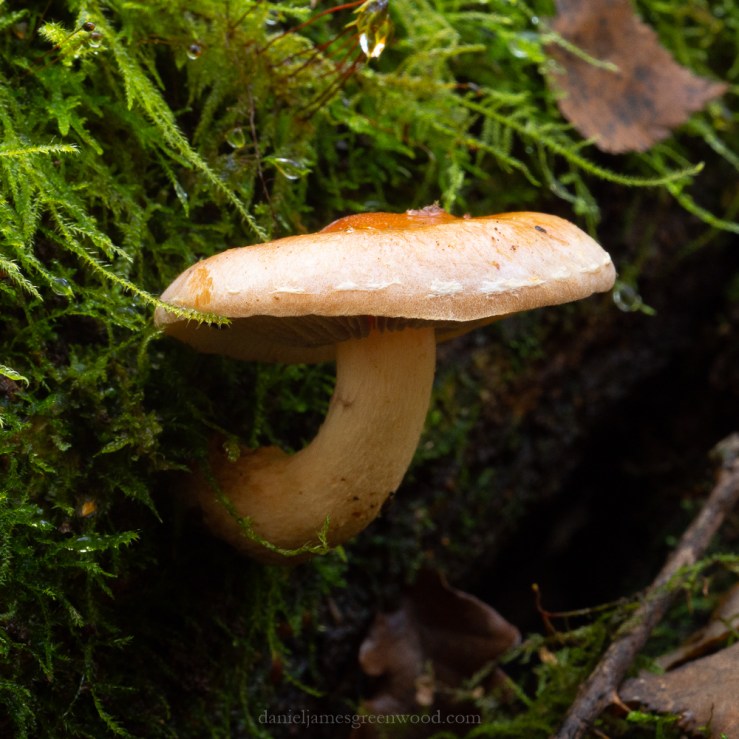
On a mossy log I found this staunch shroom growing. The faint white remnants of a veil on the edges of the cap made me wonder if it was a webcap (Cortinarius). The webcaps are a huge family of mushrooms.
You know you’re getting desperate when you’re photographing mushrooms in the condition above. This is an oyster mushroom growing from a dead birch tree alongside a stream.
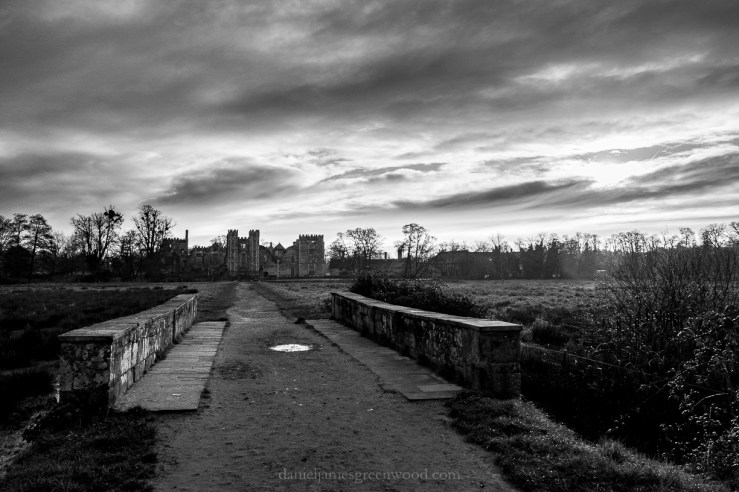
The cloud bares blue sky wounds above the Cowdray Ruins, as mist rises from the Rother. The sun breaks from the cover and melts the frosty rushes, droplets glimmer in brambles. Bull rushes thaw like over-frozen choc ices emerging from the bottom of the freezer.
A song thrush sings from the woods nearby and it has little competition. Except for a couple shouting at their dog as it flashes through the low rushes. Imagine if a song thursh was actually just saying ‘kids, go to school’, ‘where’s my breakfast’, ‘what’s the time-what’s the time-what’s the time’. Its beauty would shrivel away and it would become an annoyance. The mystery gives it life.
The dog runs free through the rushes, its paws sloshing as it seeks the scent at the end of its nose. Its owners’ cries grow louder, angry, fear creeping in. With it a small bird, a wader, bursts from the rushes and arrows out towards the town. It has a white breast and a long, thin bill, curving as it reaches the tip. Its wings are sharp like a modern fighter jet. I’m sure it’s a snipe.
The bird will have been roosting over night in the rushes and now will seek more wet grasslands, probably where the Rother snakes behind Midhurst and where there are less people. Not that there are really so many here. On spring evenings they perform an otherworldly song flight, something that I first heard over reedbeds in Poland a few years ago.
They sing in a bizarre, electronic kind of way, but also like someone skilled at blowing through a large blade of grass. That evening I watched it soar and swoop over the reeds and river. Birds hold such potential for us, the promise of their weird songs, in these dark winter months, offers hope.
You may have seen my attempts to photograph a mushroom every week on Twitter. I have hundreds of fungi images that I want to share so I’m now going to start posting a species each week (or one I’ve seen in that week). I’m not a forager and have never cooked or picked wild mushrooms to eat. I prefer taking pics and leaving shrooms for others to see.
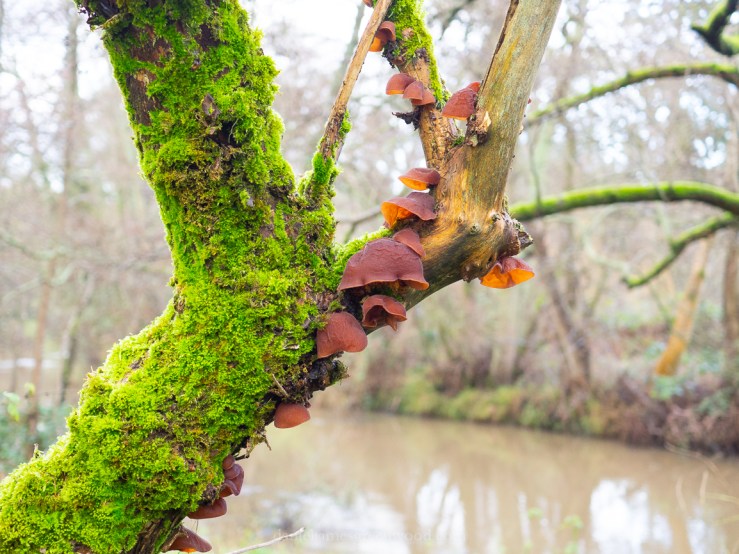
To kick things off, this week I photographed jelly ear. This is a common species that, like in the image above, can be found growing on elder trees. It stays on a branch all year round and goes through a process of de- and rehydration. It seems happy in the winter months.
Jelly ear once had a more derogatory or racist name. This is largely because of the Latin name (Auricularia auricula-judae) which relates to Judas Escariot and the species’s association with elder. Judas is said to have died from hanging in an elder tree but that is almost certainly impossible because it is a very soft wood. The ears are said to be a remnant of his spirit. I call it jelly ear, as do all up to date field guides.
The last day of autumn. The final patches of beech, oak, hazel and birch leaves are all that resist the darkest greens and browns of a winter wood. The green leaflets of an elder dangle out across the path, the only ones left on the entire tree.
Grey squirrels round the trees in small groups, like people wrapping a maypole in its ribbons. They are elf-like in a place where little else moves. I stop to take a photo of a biscuit-brown pine tree and a woman waits alongside me.
‘I thought you’d seen an animal,’ she says when I look, her dog carrying on ahead of her.
‘Just squirrels,’ I say.
She laughs: ‘Oh, yes. Plenty of those!’
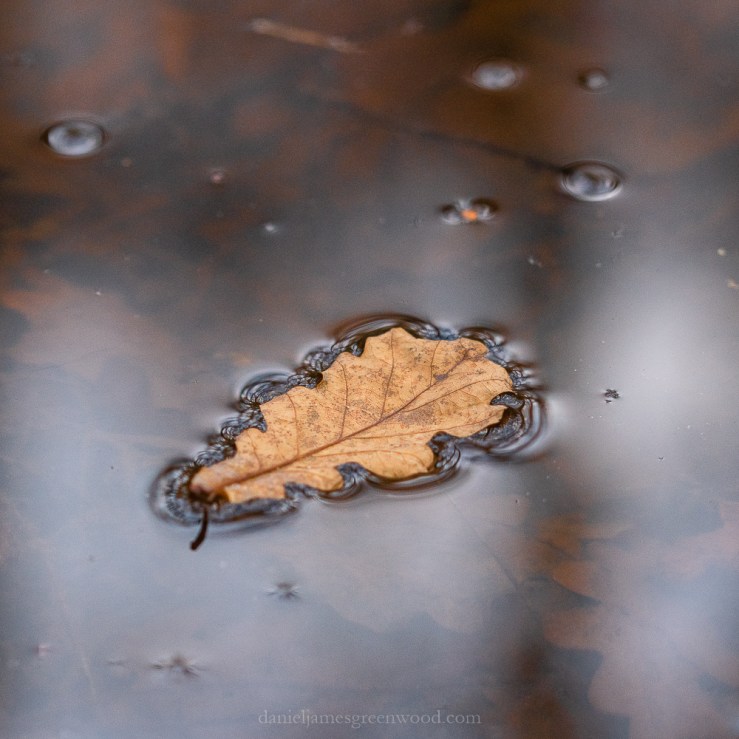
The gill is full as it slaloms down through the woods. In a pond at the edge of the path fallen oak leaves rest in perfect stillness.
At the foot of the heath, golden mushrooms grow in the soil amidst the remains of bracken. They are so easy to miss. They’re trumpet chanterelles, a species as edible as the original. Like all the mushrooms I photograph, I’m not here to pick or eat them. Their trumpets curve out like gramophones, their stipes sinuous, yellow and tapering like a birch trunk.
These are autumn’s final moments. The frosts are creeping in, our breaths stolen away on the air as they leave our lips.
Buckland Abbey, Tamar Valley, Devon, November 2019
At last the rain has stopped. Buckland Abbey, once home to Sir Frances Drake (1540-1596), climbs out of its nook in the hillside, reflecting the stony skies above. Drake is known for ‘his’ ships which battled the Spanish Armada in the 1500s, for circumnavigating the earth and for his role in the slaughter of civilians on Rathlin Island in 1575.
I first heard about him from spending time in south-east London’s remnant ancient woodland known as Great North Wood. It is said that some oaks grown in the Great North Wood were taken to the docks at Deptford and used in the building of some of Drake’s ships. It has never been verified. One thing that was verified at Deptford was Drake’s knighthood in 1851, on the ship named the Golden Hind, something I only learned at Buckland Abbey.
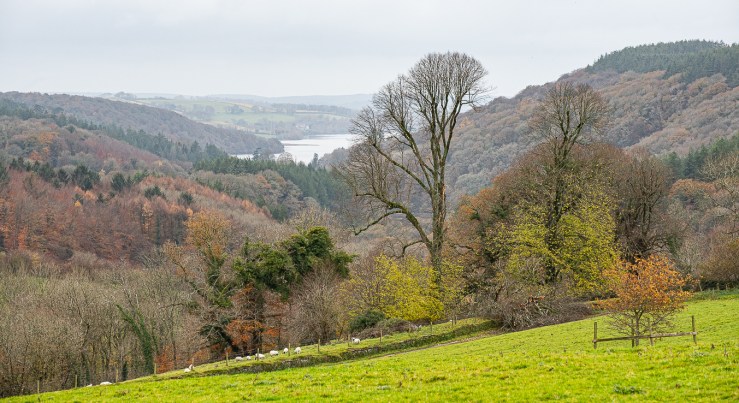
The fields around the Abbey are pocked by small cream sheep that run like chickens as we pass them on the track. In the distance the dammed River Tavy reflects the sky again, the dark woods flowing across the slopes to where the river enters the Tamar. Looking at the Ordnance Survey map, something stands out. To the north-west is a large woodland named The Great North Wood.
Could this be simply because it’s so large, or because of Drake’s links to that area of south London? The name is said only to have been popularised in the Victorian period and could have been given to differentiate the once vast area of woodland to that of the Weald that covered most of south-east England in the Anglo-Saxon period. Perhaps this local wood was also named by residents of the Abbey in the 1800s.
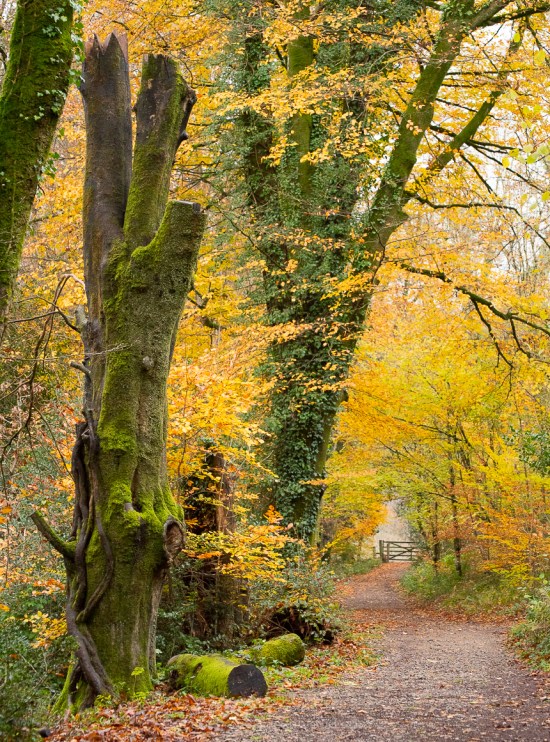
Redwings are established now, flocking in the fields. I hear my first fieldfare chuck-chuck-chucking over the Abbey. Down in the woods beech trees burn even without the aid of sunlight. They brighten the most glowering corners. Hazels are yellowing and even the odd wych elm with its almost bulb-bright leaves. It’s here saying, ‘don’t forget about me.’ Many elms have gone, but wych elm survives.
The rain threatens specks again as the light, if you can call it that, dwindles further. In a combe of a field a grey heron flaps its wings, either a slice of Buckland Abbey’s grey exterior breaking free, or a slither of sky lending itself south, to the glassy Tavy for the night.
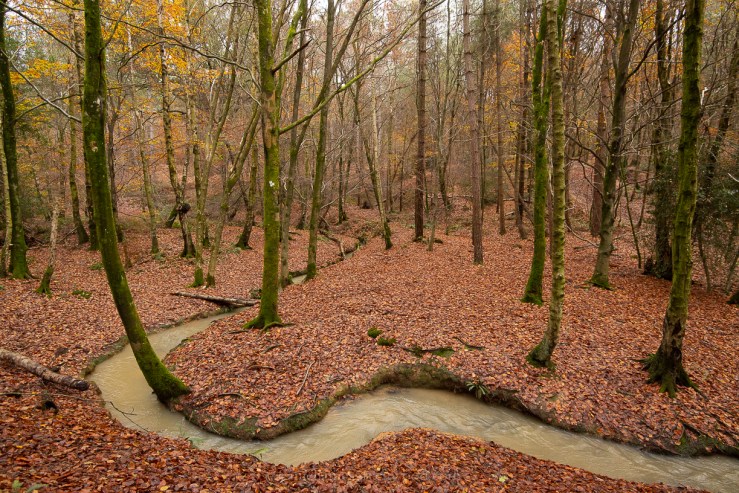
After so much recent rain, the water flows fast through the s-shaped streambed of Sheepwash Gill. Clouds have consumed a sunny morning, Wealden clay clogs under foot. I’m trying to cross the gill by treading across the buffed sandstone which is usually above water. This is no ‘Robert Macfarlane climbing a mountain up a stream in his pants’ kind of effort. The water runs ankle-high against my boots. On the other side a dog bounds down off the leaf-littered slope and barks at me, stopping my crossing. It’s big. It jumps around at the water’s edge in that ‘I’m trying to pretend I’m going to eat you’ kind of way. Its owner calls it back and I find another way to cross.
A girl watches me as I find a short gap to hop over. The dog is her family’s. They’re gathered around dens made from branches and logs on the banks of the gill. The eldest man is grappling with a thirty-foot long birch tree that’s hung up in another tree. He’s getting advice from his young son on how to get it down. The man is wearing brown leather safety boots, a sure sign of a construction worker enjoying a Sunday with his family in the woods.
The birch won’t move much and he gives up. St. Leonard’s Forest is covered in birch. It’s the most westerly point of the High Weald’s heaths, much of which is covered by wild birch and gorse, or otherwise planted up with conifers for forestry. Birch is seen as an enemy or nuisance but it is a special tree that has benefited our species in our evolution. Its wood makes excellent spoons, its bark can be used as fire lighter, its sap tapped for syrup, its branches make brooms. Its Latin name ‘betula’ means ‘to beat’. Getting walloped by birch branches was once a recognised punishment, sometimes in public.
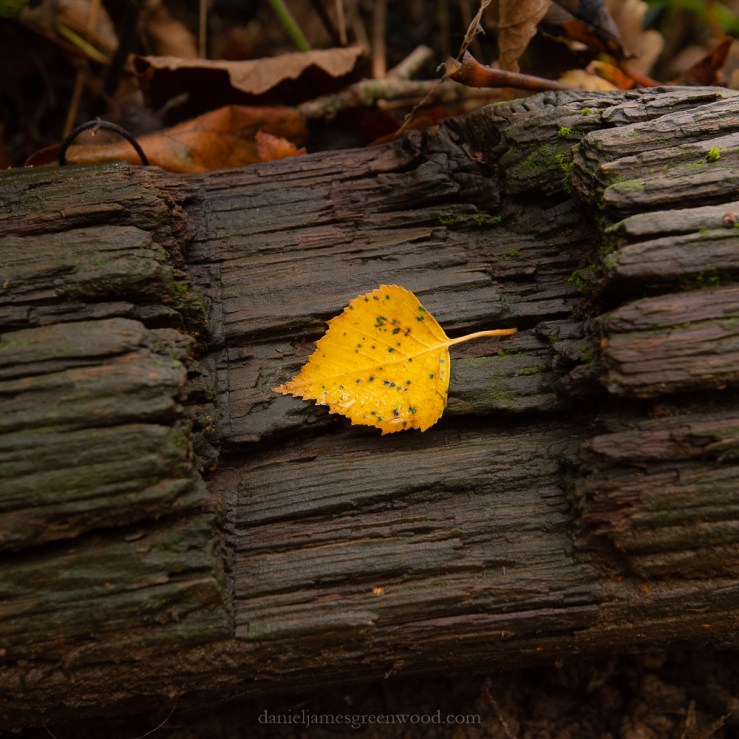
The birches are all yellowing and dropping now, turning to their deep, purple and leafless phase. The small yellow leaves catch by the petioles in mosses and on the splintered fibres of broken heartwood. In the dark pine plantations of St. Leonard’s Forest they fizz and spark.











 Unlocking Landscapes