The emptied mast

Dog stinkhorn Coulsdon, London, November 2014

In Devilsden Wood we tiptoe around fallen beech logs, slipping at times on beech leaves and clay, and the emptied mast. The nuts will have been eaten by hungry jays and squirrels. Over the past few weeks I’ve crouched down around these logs photographing their fungi: beech jellydisc with its almost caucasian flesh, purple jellydisc creeping out by the week from wisps of moss. Most startling for a layman like me was the glaring eye of dog stinkhorn, named after its canine stench. Lodged in a piece of black deadwood it had the appearance of a fox or wolf skull looking up at me. The long, finger-like stems that it had produced had collapsed, orange tips like finger nails. As Julian Hoffman has written recently, referring to the poet Rilke, we are surrounded by a world that beckons us to perceive it, to engage with it, to look and to touch. To me the fingers of the stinkhorn could be pointers to something worth seeing. Today only the jellydiscs remain, as well as a brown mushroom that reflects the white break of cloud between the trees above in its glossy cap. My friend Philip is searching for something behind me and as I look up the sharp dark shape of a sparrowhawk slices between us in silence. If we were little woodland birds we would not have seen a thing.

© Daniel James Greenwood 2014

A thousand years

Parrot waxcap

Farthing Downs, London, November 2014

Blue smoke plumes from the dreary Downs, the crack of piled ash trees cuts through the distant wash of the M25, and now the noise of chainsaws. This work is good fun. How many people panic at the sound of this machine, waking to find that their favourite tree is gone from the frame of their bedroom window. In the town I am always suspicious when their itch carries. But this is the restoration of the chalky meadows swallowed by the incoming of woods. We as a species have been trying to halt the loss of woods but at the same time deny new ones for thousands of years. This is a thousand-year-old view, the only change the exchange of machines for the pop of axes on heartwood.

Against a view of near leafless beech, a green woodpecker rises from the anthills, its flight reminiscent of a puppet tugged at intervals as it passes. Robins sing, gulls create the aura of the Sussex coast, and rain specks add a pinch of cool. In the now flattened meadows fungi can be found: a parrot waxcap plucked and left, yellow gills that ripple like flames around its stem. Puffballs are scattered across the path, little footballs deflated and unwanted. I press my toe into one, flattened and leathery grey, its brown spores puffing out like effluent. I definitely take them with me.

© Daniel James Greenwood 2014

This is it

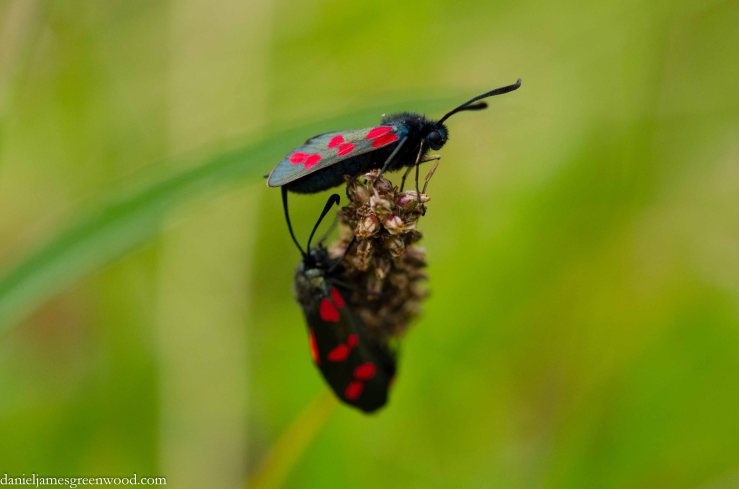
Six-spot burnet moth

Farthing Downs, London, July 2014

We leave the chalky, wooded hollow and appear in an ocean of field scabious. The sun setting in the west catches the pale, lilac petals of these daisies. In the other meadows across on New Hill and in Happy Valley greater knapweed has begun to flower, that deep purple gives me the sense of summer’s final movements, splayed florets that say: this is it. The meadows, too, abound with the motorised flight of burnet moths that were not here two weeks ago. Many of them are mating, one pursued by a pair of skippers unwilling to share a flowerhead. I wonder, what harm could a butterfly do a moth? Anthropomorphism excused, their quarrel does have the feel of a playground spat. That landscape is behind us now as we return along the crown of Farthing Downs. The sky is split in half to the west, smears of rain hurrying our return to the urban landscape. The liquid song of the skylark pours from the sky and we search for its shape. After giving in and then locating it I see it some forty-feet up in the sky. My companion can’t quite believe how clearly its song comes yet from so high. We stand, our exit delayed, the two forces of incoming weather and skylark display gluing us to the soft turf of Farthing Downs.

© Daniel James Greenwood 2014

The cascading orchid

Click through for full album

Farthing Downs and New Hill, London, June 2014

In the towns swallowed by London’s urban lurch, summer is flowering knotweed, rosebay willowherb and lupins, all non-native, all bold and blooming along Victorian railway sidings. At Farthing Downs summer strikes out in meadows of yellow rattle, dropwort, field scabious, hawkbit, ribwort plantain and sheeps sorrel. The first meadow browns, ringlets and small heaths take flight, the latter locked in a pair, mating, flying as one away from my lens. Stopping to take in these grassy Downs, the sheer number of butterflies is clear.

But the birds have not retired just yet. I hear a cry from the blue sky and see a buzzard tucking in its wings and bombing towards Coulsdon. This is the first I’ve seen here, and its arrowing for London is without doubt. This is now officially the most common bird of prey in the UK. I also hear the songs of linnet, song thrush and chiffchaff. Spring and summer have clashed in a frenzy of yellow, green and the common blue butterfly. On New Hill pyramidal orchids cascade across the slope, the leaves of spring cowslips now tucked in under the shade of orchids, rough hawkbit and yellow rattle. The bed of marjoram bounces, its fragrance only felt when touched with the fingers. On the other hillside jackdaws flock with two sheep grazing, their medieval world clattering along with their calls, like bullets ricocheting. The sheep go about their tasting, the meadows purpler still.

© Daniel James Greenwood 2014

A neon waltz

FD may blog-2

Farthing Downs, London, May 2014

I sit on a path new and slight, pressed into the grasses. Last year I sat in a spot close by under the shade of ash trees watching a willow warbler make return visits to a nest down in the brambles. Now the brink of a small copse of trees has gone, the bird, perhaps returning, may have decided this was no longer a place to raise young. In the absence of willow warblers, brimstone butterflies, perhaps reaching double figures, mark the new space of downland that has been reopened from the folds of trees. The piles of logs and branches stacked in the iron beds are still here, yet to be burned or hedged. I like that slowness, that I can come back some months later and no one has felt too pushed to tidy the place up.

A male and female brimstone fly together and then fall down amongst the twigs and low, woody brambles. I’m interested to see what they’re doing so I get up and have a look. They’re mating, bodies bent round, facing away from each other. They part. High in the sky, against the blue and its herring and lesser black-backed gulls circling on thermals, a huge flock. I wonder why, I wonder what for. Down here with me the female brimstone is again on the wing, met by a band of battling males. They pass her and are turned immediately onto her, each forgetting their quarrel and targeting the paler female. This is the perfect reflection of the adult butterfly’s life: the males seek as many females as they can; the female, having mated, defends herself from latecomers as she strives to find the right plant for egg-laying. The males attack her, but she breaks free, up into the sky. She is not free of them. The four males cloud her, their colours so close as they gain height that all sense of defence has disappeared into a neon waltz. They go up, up and over my head to the world of gulls and warm air rising.

© Daniel James Greenwood 2014

A careless act

Gull

Farthing Downs, London, January 2014

From the hawthorn trees comes the sparkling sound of thrush and finch chatter. All around the landscape is weighed down by weeks of rain, the sodden grey and blackness, but this conversation lightens the scene. A flock of goldfinch burst into the sky, skipping through the air in their piecemeal flock. Their yellow wingbars flash against black feathers like miniature human warning signs. I train my binoculars on the thorns and see a redwing sat in the branches, contributing to the bird discussion. As I step towards them it ends instantly and so I turn and take a path to leave them.

The stumps of ash trees glow resinous on the hillside, the felled trunks lie supine beside them, the bark darkened by rain, the green and blue lichens thrive without a care for the tree’s demise. The brash has been piled and burned in elevated corrugated iron beds, and to many people this would seem like a careless act of deforestation. But it’s not. Farthing Downs sits on a bed of chalk and is home to a vast array of wildlflowers which are disappearing from the English countryside. The City of London Corporation are here engaging in a battle of restoration. Further along the path a black-headed gull skates low over the lane – I’ve not seen them so close to the grasslands here – propelling itself up and into the wind. Its relationship to winds so cold and blustery seem uneasy, and against this vista of meadows and woods, all the more unique.

The shock of the heartwood

Farthing Downs

Full set of photographs here on Flickr

Farthing Downs, London, January 2014

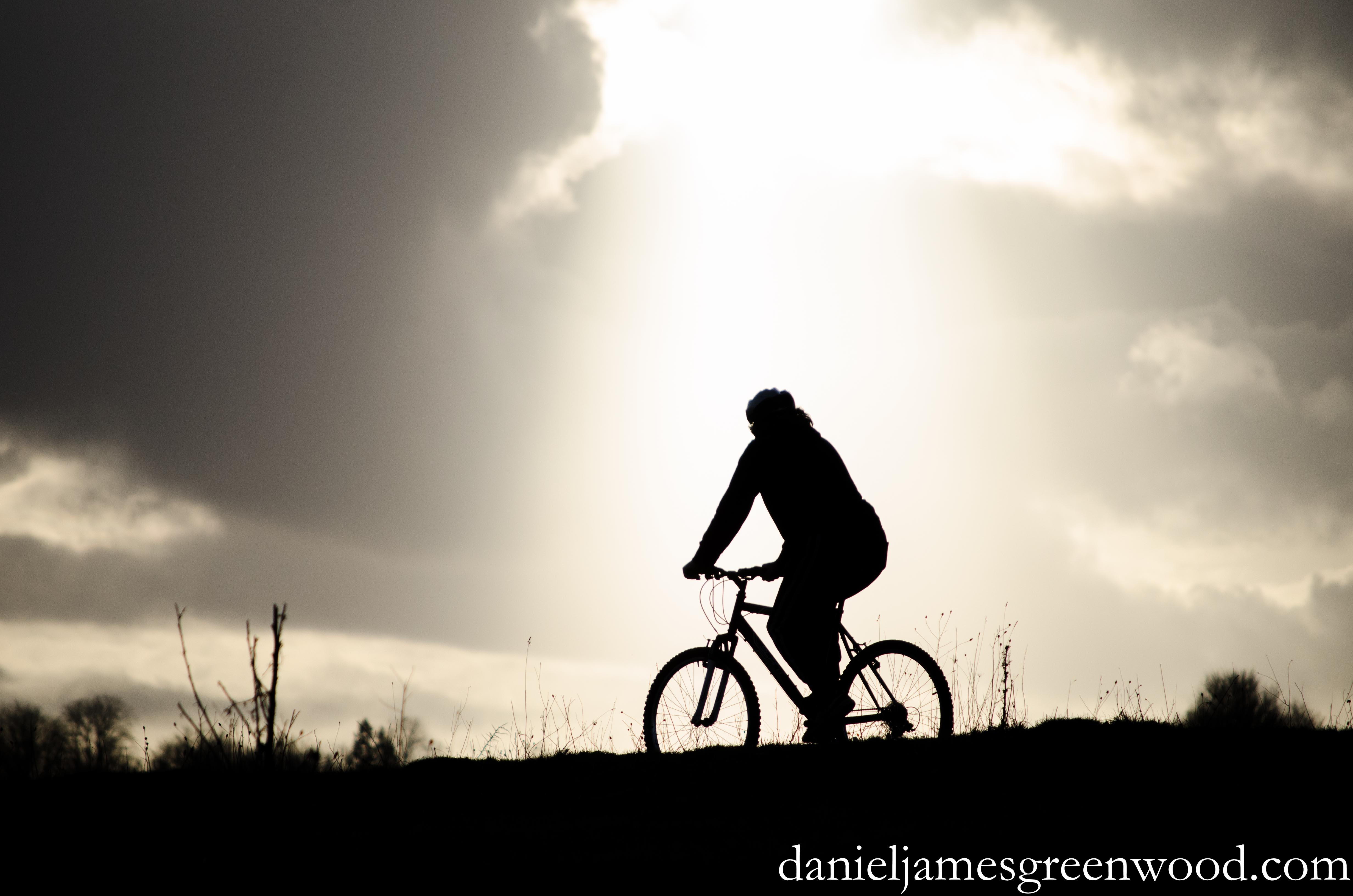
The long shadow of a jogger crosses me and at first I think it’s someone approaching. A peek over my shoulder shows the silhouette of a toiling woman, but is it new resolution or good habit? She is followed over time by a trail of cars, parents clutching the hands of young children, and finally the huffing shape of a cyclist rolling past. The world of the Downs reminds me again that the earth is something of a cauldron, everything is always changing. Groups of people walk along the lane, shadows breaking and reforming, pausing to watch something, perhaps a bird, perhaps the view of houses creeping up the hill, or views of a distant, spiralling city.

Jackdaws dot the horizon in the east, their indentations against the sky encourage the play of human language. They are a slow swarm of insects, embers from a smokeless blaze, or simply jackdaws doing their winter dance. Woodpigeons pass them in the foreground, redwing, too. I sit and watch. On New Hill, the land beneath the jackdaws, the small ash trees are indeed like matchsticks, or else the stiff hairs of a broad and worn broom. More have been felled, chopped and piled, and against the brown wash of wood and winter grasses the shock of the heartwood is telling.

The sun slips down to me, the ant hills like boulders at the edge of a lake, dropping chunky shadows from the daylight. Squirrels cavort, their music one of scratched syllables, like little huffing corvids. We regard them with equal disdain, forgetting their own intelligence and desires. They feel a dislike for their kind, too, sometimes. A helicopter careers overhead, a primitive design still, but how long until tiny drones trail through these skies, how long before they snag in the branches of oaks or the tangle of hawthorn? Who will collect them and what will be done with them. The helicopter is navy blue and white, it heads south-west towards the North Downs as vulnerable as flesh and feathers.

North Downs diary: the endless scene

Sweet chestnut coppice

King’s Wood, Kent, December 2012

The piles of birch trunks tell us that this chalky fringe of King’s Wood has recently been coppiced. The heartwood glows golden against the black, brown and grey of a winter’s afternoon. The paths are boggy, holding the tracks of boots and the tyre marks of cyclists and scramblers. Large ditches appear at intervals, home to trees and dead wood. A Soakham Downs poster a little way back identified these as chalk pits dug in old times to extract the chalk from the soil. The chalk was then spread in the fields – what once would have been woodland – to fertilise the soil, left to weather under sun and rain.

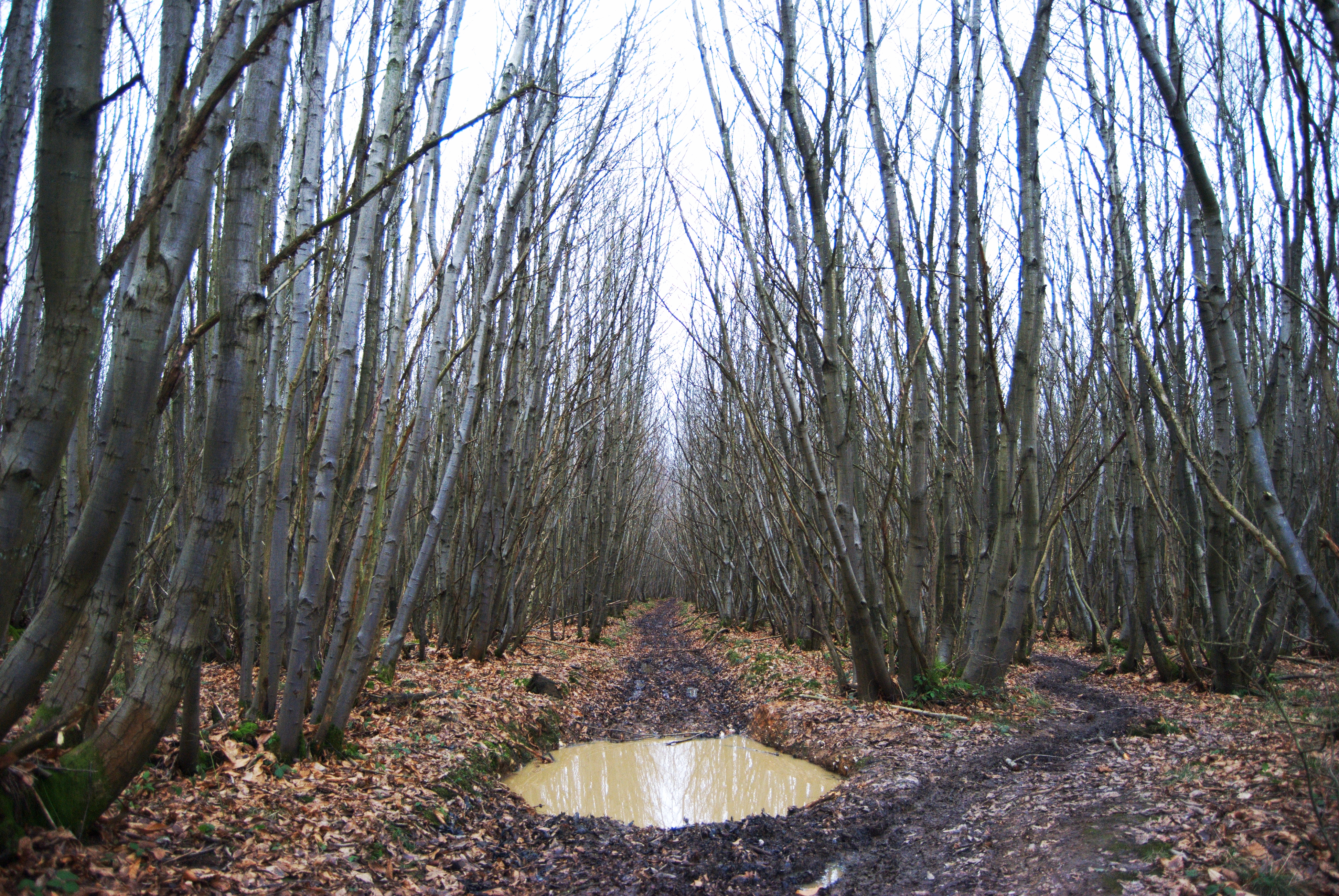
Further ahead the woodland opens in earnest, endless tracts of sweet chestnut coppice climbing into the sky. A brown puddle reflects the bare branches. Sweet chestnut provides the nuts we like to roast at Christmas, as well as forming the most economically viable form of coppicing in today’s market. The poles are cut after about five or six years and split down the middle to make chestnut paling, a type of fencing used in parks and nature reserves up and down the country. It’s another aspect of the Roman’s botanical legacy – they brought it along with them. The vertical slant of the branches is interrupted by a movement of four legged animals crossing our path in the distance. Our talking pauses as we watch an endless trail of deer move from right to left, disappearing into the trees. One of them was all white and it sticks in my mind like a puncture. We make our way towards Chilham, stopping briefly to search amongst these overgrown trees for walking sticks. We listen to the multiple stems tapping together as the wind steals through, some trees creaking. This a sound that in the endless scene of coppiced trees we mistake for shrill and distant calls of people.

The fabric of time

Devilsden Wood

Farthing Downs, London, September 2013

Standing on the track leading into Devilsden Wood I look to the ground for dryness, somewhere that hasn’t been soaked by this perpetual rainfall. I see fallen ivy leaves that appear like cuts of leather when really they are crisp under foot. Dog shit, too, the new waybread for the modern ancient footway. I hate the stuff. My waterproof sheds its load onto my jeans and it’s wait and become cold or move and receive woodland raindrops, some chucked from the canopy of mature yew, ash and beech, some fifty feet up. When they get behind glasses, these droplets shock the senses.

It’s fungi season, the signpost of falling temperatures, not too cold but a shift from the sultry summer. I gawp at log piles with an explosion of mushroom caps, marked by striping and shapes that would define them to those who understood them. But still, I spy an oysterling appearing from a rotting trunk and feel that in two years of woodland obsession I have at least learned something about this magical animal that appears so fleetingly it could almost be through the fabric of time, a monitor on how we’re doing. Checking the sole of my boot again, we’re crap. I wipe it off in a mud puddle. The rain has not lessened. I head back out from the dark, autumn-beckoning woodland and onto the wet warfare of the Downs. The change in mind is clear, the atmosphere of a woodland changes you. It is not like the open land, so much a canvas for human experimentation, our impact on woodlands is never so clear as the plough’s to the open landscape. A woodland to all but a minority could have been in that state for millenia, before human time. The wood is a wild city, with nature’s social housing, swimming pools and fast food. It was our home once, too. There is the semblance of a summer out here, yellow rattle not yet rattling, knapweed funked-out in pinkish purple, even a bit of scabious. These wildflowers have something of January’s left over Christmas decorations about them. A car passes along the lane. Woodpigeons are striking through the rainy sky, turning their wings and bodies at an angle – to avoid the direction of the rain? – always as individuals. These birds cut several different figures in a year – hurried, panicked on the wing, or else male birds cutting arcs out of the sky as they display to females long into the summer recesses. Now they could be migrating, they could be hunted. Mostly they are gorging on elderberries outside my bedroom window.

On the Downs a flock of goldfinch are startled into the sky like pieces of a broken vase put back, its smash rewound and fixed. They sit in a small hawthorn bush and I look more closely. On the end of a branch, clear and possibly not so fearful of man is a juvenile, all grey on the head, interested in looking but unaware of the perils of being watched. My advances fracture them once more and I’m left with a snapshot of their escape into the landscape captured on my camera.

Something new

Fly orchid 4

Farthing Downs & New Hill, London, July 2013

On the Downs the butterflies are immediately evident, the week old broods of meadow brown ferry amongst the long grasses, rarely stopping to feed on flowers. Breeding season is ending but still the song of skylarks comes from over the slope, some ancient language remembered, its translation lost. Greater yellow rattle blooms now, the spring buttercups lost to a swathe of Yorkshire fog and other grasses I don’t know. The suntan lotion on my arms acts as an adhesive, my skin covered with seeds. The grasshoppers are conjuring up their rickety, wooden percussion. I am hopeless in finding them, except for one that hops between seed heads, a micro Tarzan in this meadow jungle. But where are the people? A man drives a BMW sports car along the lane, revving its engine. I know where I’d rather be. Men in England are bare chested at the slightest chance and here a couple stroll along the lane drinking from big bottles of water. The tattoo stamped on the man’s back stands out in this simple landscape of slopes and flowers.

Lovers

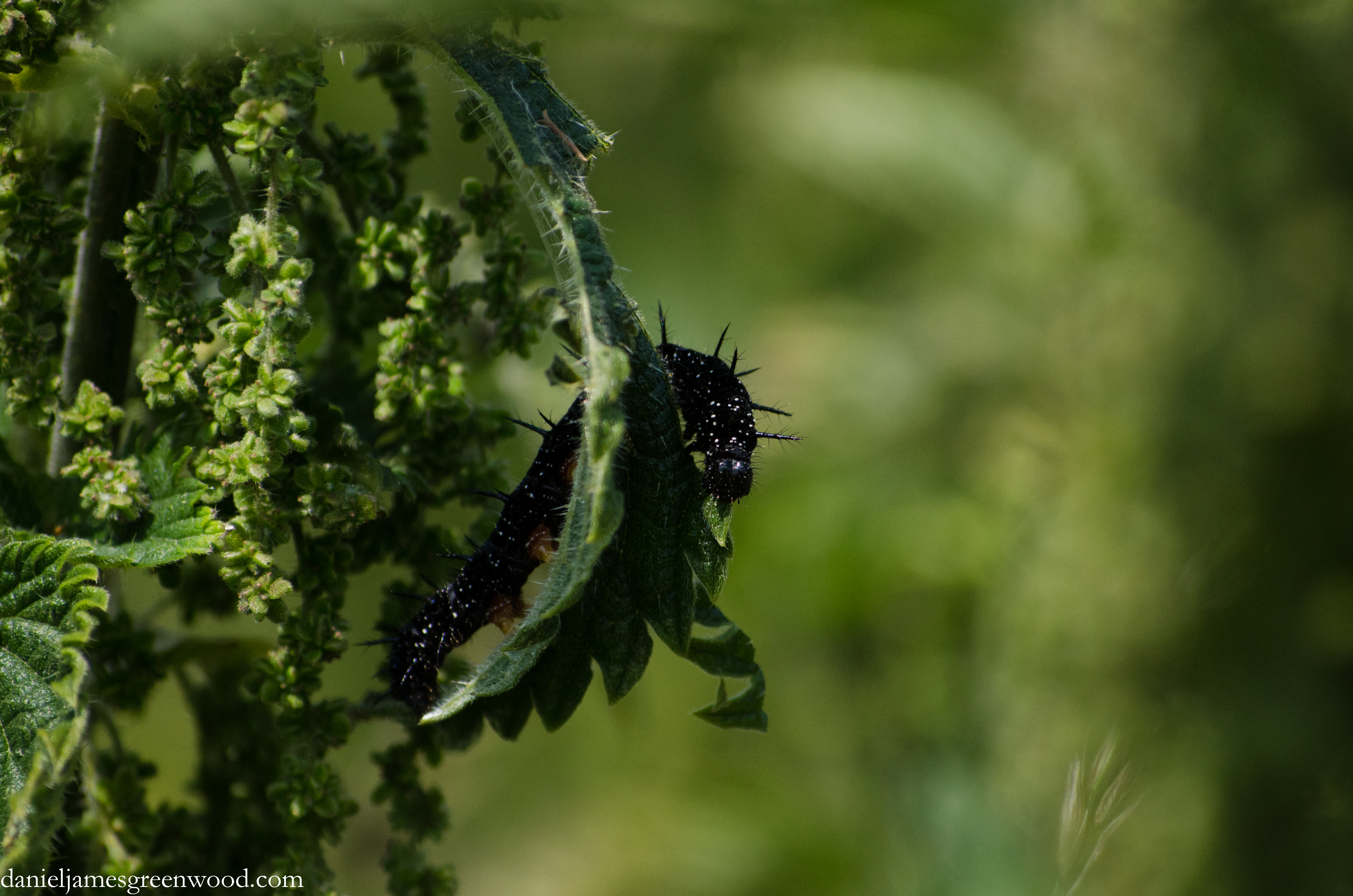
Ghostly day-flying moths spread at my every step through the long grass. Bumblebees forage on clovers, dropwort and yellow rattle, small heath butterflies appear again, two fly together, eager to fulfil their short lives with as much fornication as is possible. I cut back on to the path I know best. A chiffchaff sings in the hedgeline at the bottom of the hill, a single blackbird and a whitethroat, too. There’s no sign of spring’s willow warblers or their clutch of young. A crowd of peacock caterpillars munch through nettle leaves, leaving only the dreadlocks of flowers. A yellowhammer appears from across the lane, landing in a small hawthorn bush, its strong yellow plumage brighter than dandelions, a South American yellow, and at its brightest here. I take a few photos. Along with skylarks, this is a bird I have to travel to see, when once, before my time, you might have woken to it flocking in the hedges and fields.

Peackock caterpillar

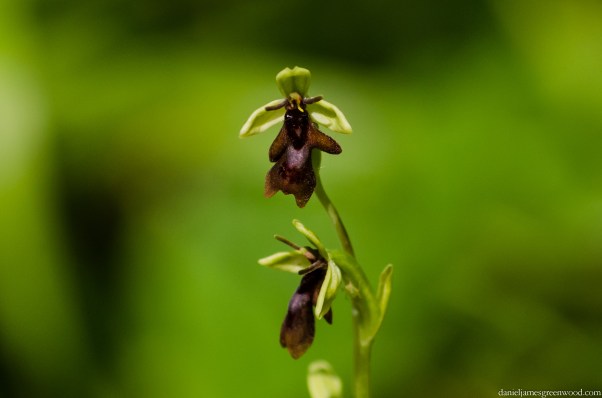
Leaving the Downs I enter the chalky wooded hollows at the bottom of the slope, with tor grass growing along the track, an indicator of the calcareous soil. My sweat cools with the breeze that slips through here. In the dappled shade I scan the path edges for orchids, black bryony creeping out from the darkened hedges. And there it is: the fly orchid. I change lenses and struggle to get the image right, sweat dripping, bringing lotion down my face. But it’s beautiful to look at – a bit like a bumblebee pinned and proffered by the long spike, with its little eyes and short antennae. A family are passing behind the hedge, discussing how to control the dog.

‘She’s pulling me down into these weird places,’ says the mother.

‘Just let her off the lead, let her off the lead,’ the dad says.

They arrive on the path heading down hill. Their daughter warns the dog to stay with them. I only see the mother, she’s dressed in an apricot coloured dress and heeled shoes. She’s young and glamorous, so fitting with the array of flowers bursting from the hillside.

‘Who needs Box Hill when you can come here, eh?’ says the dad. They disappear down towards Happy Valley.
Speckled wood egg crop 1

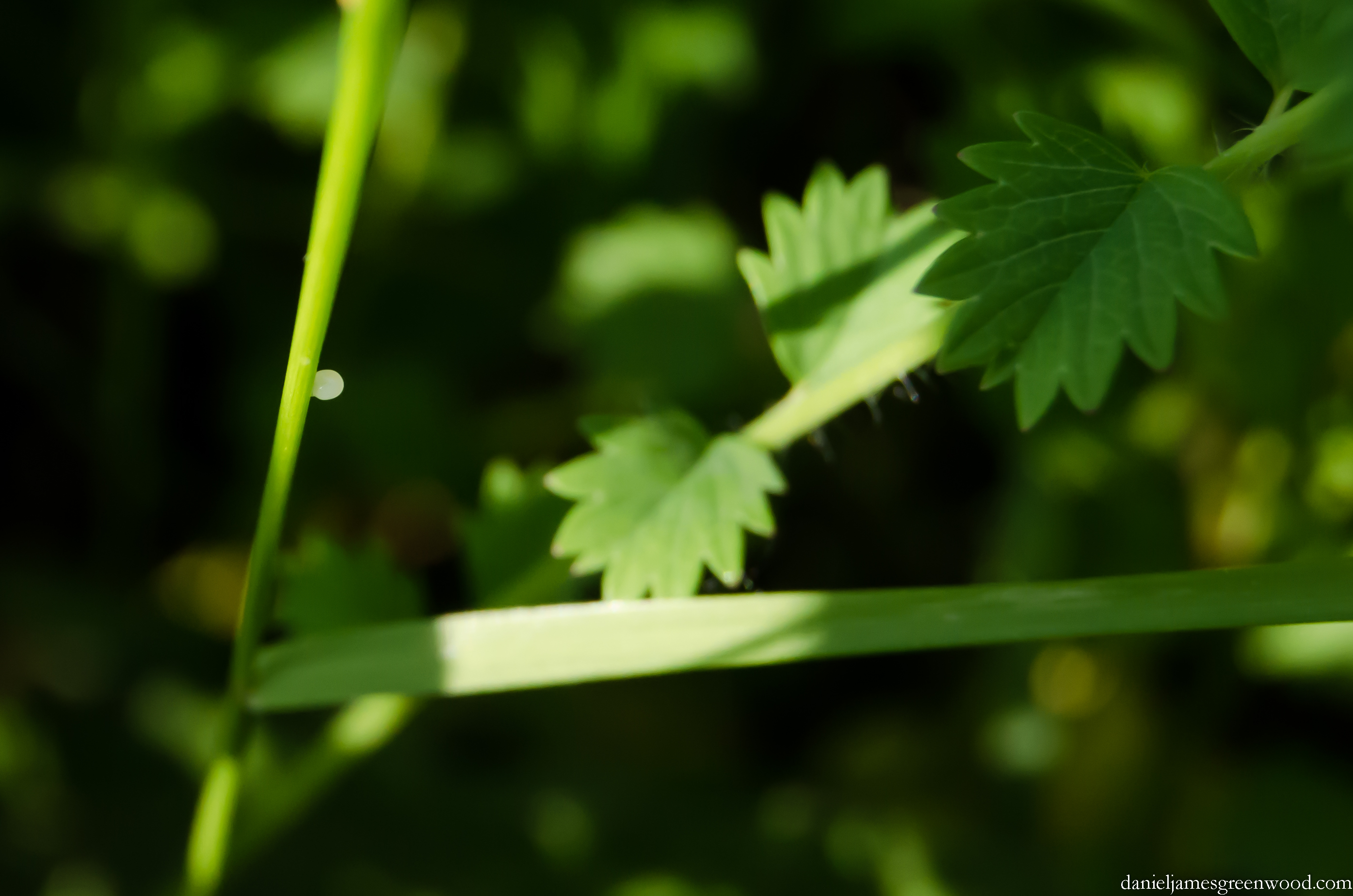
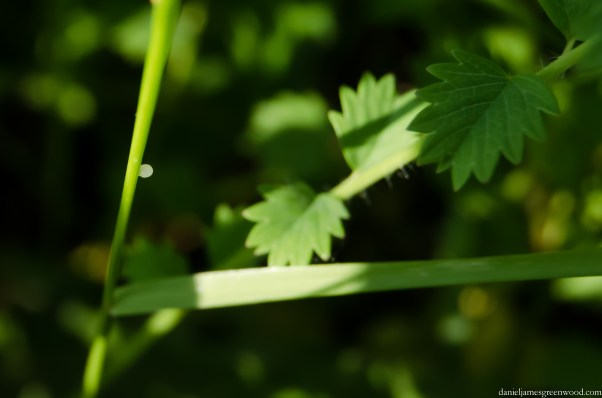
I carry on along the ridge and settle on the desire line drawn down the hill and through the flowers. Ringlets move through the meadow, the first I’ve seen this year. They move at the same time and, stitched together, they are a tapestry of flickering wings. In my silence and stillness wildlife begins to move around me, perhaps more trusting. I see more plants now: twayblades, common spotted orchid, salad burnet, marjoram, ox eye daisy, rough hawkbit and bladder campion with its inflated, balloon like calyx-tubes. The wind blows through the trees. A speckled wood butterfly flaps about me, its wings audible as it hits my khaki shorts and leaf stalks. It clasps hold of a spear-like grass stem and curves its abdomen, laying a tiny pearl of an egg. This, for me, is something new.