A lady with a crutch and white hair slipping from a woollen hat stops me in the road. She saw me photographing the upturned soil and root plate of a gigantic spruce. Her accent suggests she has moved here from England:
‘I’ve seen about half a dozen deer in the woods just up there,’ she says. ‘If you’re quiet you might see them.’
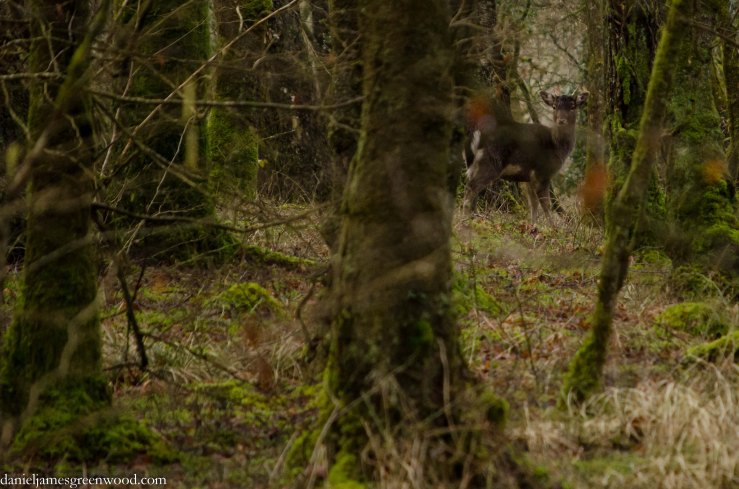
I thank her and take my camera from the bag, pulling my hood up to shade out my face. The day is bright, sunny and warm. Beyond the dry stone wall the woodland begins, a line of evergreens creating a dense bank of shade along the wall, before the characteristically decrepit and mossy trees of an old Scotch wood. I look into shadows and see that a deer is watching me. It’s a sika deer, the first one I’ve ever seen. It doesn’t seem frightened. It turns to me, then away again, grazing behind the line of dark trees. I follow it along, it doesn’t gallop or run. Its path leads me to two more animals, one of them a stag, new antlers primitive but still impressive. It stares at me behind the wall – there’s a good twenty-metres between us. I’ve been photographing them the entire time. I think back to the venison sausages I had at the Galloway Arms, the conversation I had with the bar man:
‘Everyone thinks they’re all cute and cuddly, like Bambi,’ he’d said. ‘No one wants to kill them.’
‘But not everyone knows what they do to woodlands,’ I’d said, thinking aloud.
‘Well, exactly!’ he’d affirmed in his thick Scotch accent.
I know their numbers are at their highest in the United Kingdom since the last Ice Age 10,000 years ago (so are ours, by the way). I know the link between the nightingale’s sudden decline in England and deer overgrazing woods, not that the nightingale makes it up here to Scotland. But I could not kill one of these animals. I’d rather leave that to the lynx, or even the wolf. I put my camera away and make my way along the empty road.
From the hawthorn trees comes the sparkling sound of thrush and finch chatter. All around the landscape is weighed down by weeks of rain, the sodden grey and blackness, but this conversation lightens the scene. A flock of goldfinch burst into the sky, skipping through the air in their piecemeal flock. Their yellow wingbars flash against black feathers like miniature human warning signs. I train my binoculars on the thorns and see a redwing sat in the branches, contributing to the bird discussion. As I step towards them it ends instantly and so I turn and take a path to leave them.
The stumps of ash trees glow resinous on the hillside, the felled trunks lie supine beside them, the bark darkened by rain, the green and blue lichens thrive without a care for the tree’s demise. The brash has been piled and burned in elevated corrugated iron beds, and to many people this would seem like a careless act of deforestation. But it’s not. Farthing Downs sits on a bed of chalk and is home to a vast array of wildlflowers which are disappearing from the English countryside. The City of London Corporation are here engaging in a battle of restoration. Further along the path a black-headed gull skates low over the lane – I’ve not seen them so close to the grasslands here – propelling itself up and into the wind. Its relationship to winds so cold and blustery seem uneasy, and against this vista of meadows and woods, all the more unique.
Carrbridge, The Cairngorms, Scotland, October 2013
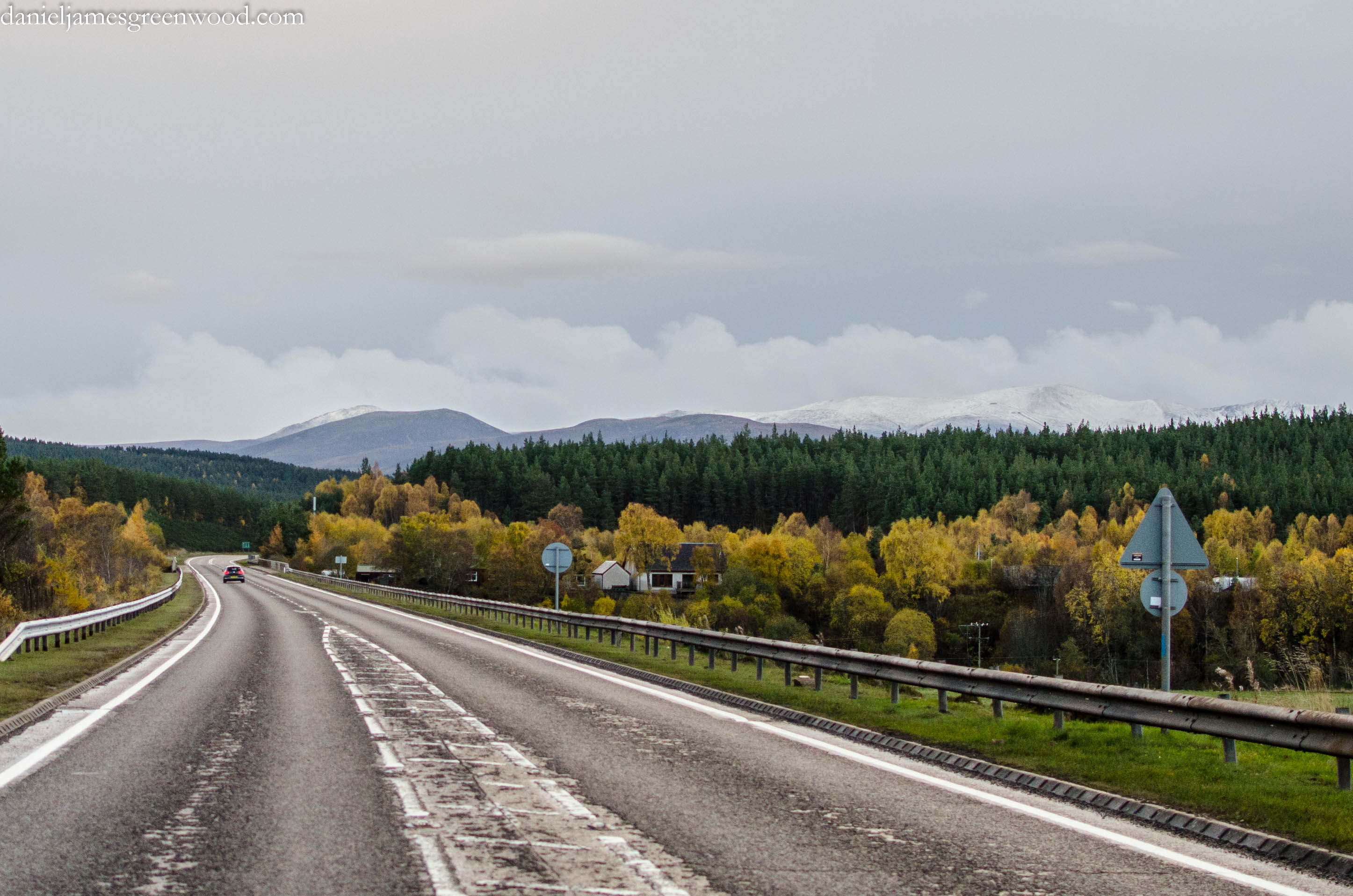
Arriving in the fields, the lichen frosted pinewood in our wake, I admire an old alder tree coppiced and growing by a brook. The landscape unfolds, the Cairngorms rising in the east, fringed in all corners by the yellow of birch leaves. We look to the hill where we had observed this scene only two hours ago, from a spot where a sheep skull hung from a piece of standing wood. We follow the River Dulnain as it runs east, the sound of traffic returning along the A-road. A buzzard floats over a line of trees, calling out, the sound severing the reminder of motor vehicles. We egg it on – ‘go on, my son!’ – and approaching a small farmstead we find a rabbit freshly mutilated, its neck bone protruding, eyes gone. Was this the buzzard’s work, or perhaps a mustelid. We cross a tributary of the Dulnain and a goosander bursts from underneath the footbridge. This saw-billed creature is one I had never seen before now. It steers itself upstream into the dusky light reflected by the water. We continue past a dilapidated cottage and fiery beech tree, watching as sheep leap and bounce away from a row of cabbages they had been eating in a neighbouring field. We meet the main road and wait patiently for our chance. Having crossed, we train our binoculars on the summit of Cairn Gorm, the restaurant and funicular railway car scratched into its slopes. All is dressed in a layer of snow.
Glen Einach, Cairngorms National Park, Scotland, October 2013
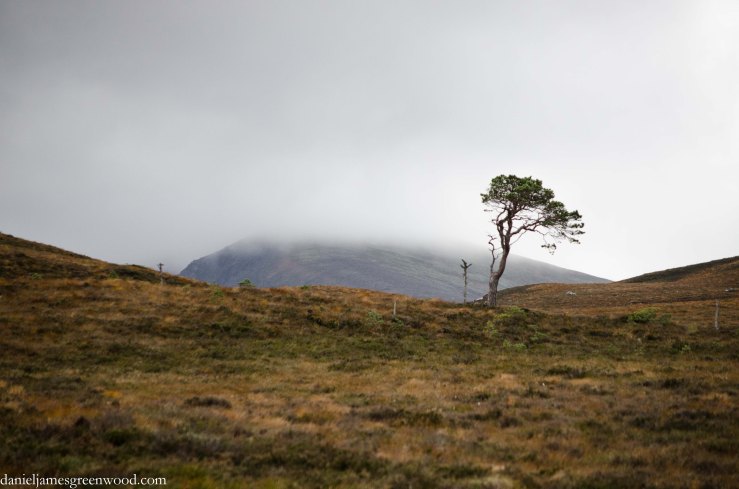
Lying on the grass where the road forks up and into the wind I watch the redwing and fieldfare slip across the grey sky. Down below us the River Am Beanaidh flows with great force. My friend has finished in his attempts to separate map from wind and joins me on the gravelly soil, rolling himself a cigarette. A few minutes ago we watched redwing appearing from the heather like particles drawn, magnetised to the scots pine. Some remained in the heather for a time, before using the air and their wings to join with the trees. My smug little siesta is embellished further by a reward received a few minutes earlier: the sight of a crested tit mixing with its coal tit cousins and picking at the sticks and lichens. I have felt the tiredness and tenseness that comes from a lack of proper rest since summer’s end but this landscape reinvigorates me like no other that I have set foot upon. Listening to the quickening wind dashing through the medium of pine needles, my friend calls an end to our pause.
We head up over the top path, the wind bursting through. It’s much cooler, a hint of ice. I automatically reach into my coat pockets seeking woollen gloves. It’s reported to feel like -11 on the peaks today and here blows the clue as we climb to 450m. Trudging along, a shape appears in the distance, passing over the pinewoods, across the river and the slopes of Cairn Eilrig:
‘Big, big bird,’ I shout, into the strength of the wind. My friend stops.
It passes across our view, a cloak caught by a gale. The thought process begins: buzzard… raven… its dark, primary wing feathers like digits. Its wings catch a slither of sun, a golden sheen. It’s the eagle. It disappears behind the trees, appearing again, coasting and now lost to the pines. My friend and I have both leapt up onto a lichen and heather-covered bank of soil. We jump back down, carried back by the wind by an inch or two. We hit a gloved high five, hard and true.
I live in an area of London that was once covered by a stretch of woodlands, commons, meadows and wood pasture that was called the Great North Wood. It was not the continuous wildwood which some argue had covered parts of England totally after the melting of the ice 10,000 years ago, before humans began to cut the trees down. It was known as the Great North Wood because it sat north of Croydon, a large market town fringed by chalk downlands which are not so hospitable to the kind of woodlands dominating the land to the north on London clay, namely hornbeam and sessile oak. On London’s open downlands livestock grazed and rabbits were bred for their fur and flesh. The wild but manipulated landscape of the Great North Wood would have stretched all the way north to the Thames at Deptford (where timber could be exported on ships or turned into ships), cutting off at Penge (Celt for ‘the end of the wood’) and slithering down a little like the continent of South America to Selhurst. Many of the placenames in the locality echo the woodland past, the history of its woodspeople, or the woodsman (which Ben Law neatly points out means ‘wood hand’ rather than excluding women). This can be seen most clearly by Norwood, derived from the name of the landscape itself, as well as Brockley which could describe a human settlement where badgers were notable. The ending of ‘ley’ generally means a clearing or settlement next to woodland. Honor Oak is a pointer to the Oak of Arnon Wood, a slab of probable millennia-old woodland which is now embellished by the Local Nature Reserve One Tree Hill, where the Oak of Honor stands in the form of an English oak replanted some 100 years ago after the site was saved as a public open space by dissenting locals in 1896. The lack of a ‘u’ shows that this is of the old English spelling for honour, the language taken to the Americas by settlers some centuries ago and now seeming somewhat alien or incorrect.
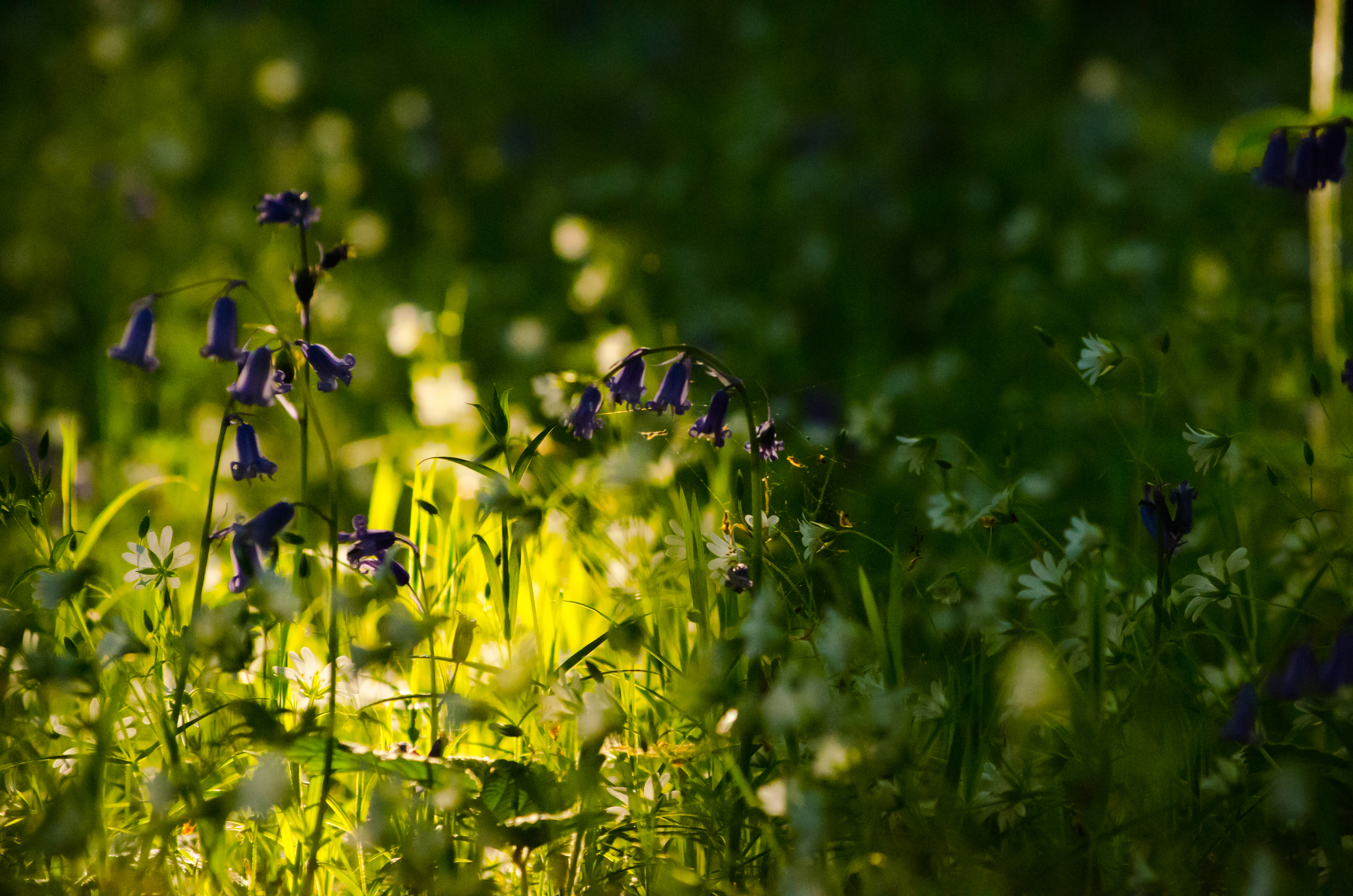
The Great North Wood was not merely one of endless woodlands or of wildwood, it was a landscape that humans were a part of and dependent on for their livelihoods. Some of the woodlands which remain today such as One Tree Hill and Sydenham Hill Wood, have shown that they were at times more open, that larger trees stood singularly with commoners grazing their livestock on the grasses and herbaceous plants underneath the shade of trees like elm, oak, hornbeam and ash. This before the advent of the enclosures when commoners had their rights removed through an Act of Parliament, a series of events which define the landscape of my hometown to this day. As recently as the 1950’s one of the Great North Wood’s most unaffected remainders, Dulwich Wood, was grassier and more open whereas today it is darkened by holly and an array of other trees such as hornbeam, ash, hazel and rowan. Still, the ancient remnants of the Great North Wood hold colonies of wood anemone, dog violets, wild garlic and other plants which indicate continuous woodland for at least 400 years.
Wood anemone indicates 400 years of continuous woodland
One of the main ways that people would have earned a living was by inhabiting the woodlands. Charcoal burning was one of the most common sights and vocations in the Great North Wood. They were known as the colliers, their presence indicated by Collier’s Wood in Wandsworth, beyond the western fringes of the catchment. Hornbeam was ‘coppiced’ on a cycle of 10 or so years, the trees cut at about 20-30cm, a vigorous regrowth the next year created multiple stems and thus an eventual greater crop to be burned and sold to blacksmiths and those needing intense heat to fire their craft. Other trees coppiced were hazel and ash, with hazel especially important for its usages for fencing and walking sticks. Sessile oaks were allowed to grow tall and true for their timber and the tannin residing in the bark. But coppicing is not necessarily as destructive or exploitative as it may sound, as when coppicing was more common – before the advent of coal and the increase in imports of cheaper fossil fuels from abroad – the Great North Wood’s coppices were home to populations of nightingales and nightjars, not least at Penge Common (now covering the famous Crystal Palace Park and the town of Anerley) where locals were said to visit at night to listen to the nightingale song, and there is some anecdotal evidence that the nocturnal music fuelled an increased birth rate. Coppicing allowed light into woods, enriching the herb layer of these woodlands, giving life to wildflowers such as dog violet which then supported the silver washed and dark green fritillary butterflies, as well as beloved primroses, now diminishing from the English landscape as ancient woodlands and hedgerows have been grubbed out and poisoned over time, feverishly in the latter part of the twentieth century.
A renewed interest in coppicing has given a new sense of purpose to our woodlands
This brings me to the issue of woodlands and biodiversity offsetting, a scheme mooted by the Department for Environment Food and Rural Affairs (Defra) as a way to mitigate losses to wildlife from development. In recent times the former Transport Secretary Justine Greening advocated the ‘transplanting’ of ancient woodlands which are in the way of the proposed High Speed Rail 2 line intended to travel from London to Birmingham and then north to Manchester and Leeds in a final ‘Y’ section. More recently Environment Secretary Owen Paterson has confirmed his liking for proposals to clear ancient woodlands and plant 100 trees for every ancient tree that is lost. Both of these proposals fall flat after only a little research or, dare I say it, consideration. As Oliver Rackham puts it in his totemic ‘Woodlands’, ancient woodlands are not the place to look for ancient trees. Paterson is mistaken. What he is looking for might be something like Penge Common, or one of the other commons now gone from the Great North Wood. It is now only really in wood pasture or ancient hedge lines that you can find ancient trees. In ancient woodlands it is the landscape and ecosystem which is ancient. Paterson sells himself as a man in-tune with nature and the countryside, posing by fence posts and boasting of keeping badgers as childhood pets. His rhetoric suggests he is out of his depth.
Ancient woodlands are not the place to look for ancient trees.
Today ancient trees are loved, most in estates or arboretums where they are prized for their age and ‘wisdom’. In ancient woods, such is the diversity of life, many trees succumb to fungal infection, because fungi is another aspect of an ancient woodland. The life of fungi is in the soil, the mycelium, to be exact. The mycelium is, in some ways, the life force of woodland, passing nutrients back and forth between trees and soil, a little like the information superhighway I am using to publish this article. Fungi is as vital to human existence as trees, often described as ‘the third force’ after animal and plant life. So too are certain species of wildflower, insect, mammal and bird depend on ancient woodland ecosystems. We are talking about an environment that takes many hundreds of years to develop. This is why HS2 Limited’s desire to dig up the ancient woodlands (33 ancient woodlands are directly affected according to the Woodland Trust) and transplant them elsewhere is the thinking of people who should not be entrusted to decide on infrastructure projects that endanger ancient woods or natural landscapes. ‘Moving’ a woodland would not mean a big family moving from a big house to another. It would be the same as a city removing its hospitals and replacing them elsewhere without foundations or power to run the building and its infrastructure. The real point is that ancient woodlands, biodiversity, nature, these are hindrances to short-term economic gain, and in many ways, to this government’s ideological assault on the environmental sector. Biodiversity offsetting, on this level, is something those of us who love trees, woodlands and nature cannot accept or allow to occur.
One Tree Hill’s Golden Jubilee beacon attracted 600 people in 2012
But what does this have to do with the Great North Wood, or of woodlands that were not necessarily valued for their biodiversity and wildlife but instead for their produce? The failure of biodiversity offsetting is its inability to recognise the need that human beings have for woodlands int he environmental sense, the importance of access to green and ‘natural’ spaces. It fails to see the importance of place, let alone wildlife or biodiversity. Worst of all it is a signifier of our failure, not just that of politicians, to see that woodlands present an opportunity for a more simple and healthier existence than the one presented to many in England today. In Ben Law’s ‘The Woodland Way’, he outlines just how far the English have moved away from their ‘forest dweller’ existence, an era that would have dated back to the Great North Wood. Woodlands offer us sanctuary, food, the resources for infrastructure, a place for real learning – wood carving, coppicing, construction, food growing, fencing, tool use – and countless creative industries. Many people express the sense of belonging offered by time spent in woodlands. The woodland sell-off plans panned (but possibly remodeled to fit biodiversity offsetting) caused outrage in the UK and led to a 500,000 strong petition being delivered to the Prime Minister David Cameron. This was a worrying time – we learned then that this government do not hold the best interest of our woodlands at heart – but the public were able to send a unified message. The sell-off was not acceptable.
Biodiversity offsetting fails to acknowledge the importance of place
The Great North Wood is a case in point for people standing up for their woodlands in the shape of One Tree Hill, saved from enclosure by ‘the great agitation’, as it is known locally, when thousands rioted to protect it from enclosure. And then there is Sydenham Hill Wood, saved twice by local people, London Wildlife Trust and the Horniman Museum from plans for it to be developed for housing. I wonder how the battles would have gone if biodiversity offsetting was in place in those, both very different, times. Our woodlands are only safe when they are loved, ‘used’ and valued by local people. Sadly, it would appear that our woodlands are not merely under threat from invasive species and disease, but also from the short-termism, bravado and lack of thought from authority figures like Paterson. Though some woodlands have been around for more than 1000 years, even in a place like urban south London their national fate is at the whim of individuals looking only as far as 12 months into the future. But that is only the case if people do not speak out and challenge the ecological illiteracy of ancient woodland offsetting. Consider that the next time you walk through a wood in spring, when its wildflowers, birds and insects are flourishing around you. That place is only safe because you and the community value its sense of place.
The long shadow of a jogger crosses me and at first I think it’s someone approaching. A peek over my shoulder shows the silhouette of a toiling woman, but is it new resolution or good habit? She is followed over time by a trail of cars, parents clutching the hands of young children, and finally the huffing shape of a cyclist rolling past. The world of the Downs reminds me again that the earth is something of a cauldron, everything is always changing. Groups of people walk along the lane, shadows breaking and reforming, pausing to watch something, perhaps a bird, perhaps the view of houses creeping up the hill, or views of a distant, spiralling city.
Jackdaws dot the horizon in the east, their indentations against the sky encourage the play of human language. They are a slow swarm of insects, embers from a smokeless blaze, or simply jackdaws doing their winter dance. Woodpigeons pass them in the foreground, redwing, too. I sit and watch. On New Hill, the land beneath the jackdaws, the small ash trees are indeed like matchsticks, or else the stiff hairs of a broad and worn broom. More have been felled, chopped and piled, and against the brown wash of wood and winter grasses the shock of the heartwood is telling.
The sun slips down to me, the ant hills like boulders at the edge of a lake, dropping chunky shadows from the daylight. Squirrels cavort, their music one of scratched syllables, like little huffing corvids. We regard them with equal disdain, forgetting their own intelligence and desires. They feel a dislike for their kind, too, sometimes. A helicopter careers overhead, a primitive design still, but how long until tiny drones trail through these skies, how long before they snag in the branches of oaks or the tangle of hawthorn? Who will collect them and what will be done with them. The helicopter is navy blue and white, it heads south-west towards the North Downs as vulnerable as flesh and feathers.
The piles of birch trunks tell us that this chalky fringe of King’s Wood has recently been coppiced. The heartwood glows golden against the black, brown and grey of a winter’s afternoon. The paths are boggy, holding the tracks of boots and the tyre marks of cyclists and scramblers. Large ditches appear at intervals, home to trees and dead wood. A Soakham Downs poster a little way back identified these as chalk pits dug in old times to extract the chalk from the soil. The chalk was then spread in the fields – what once would have been woodland – to fertilise the soil, left to weather under sun and rain.
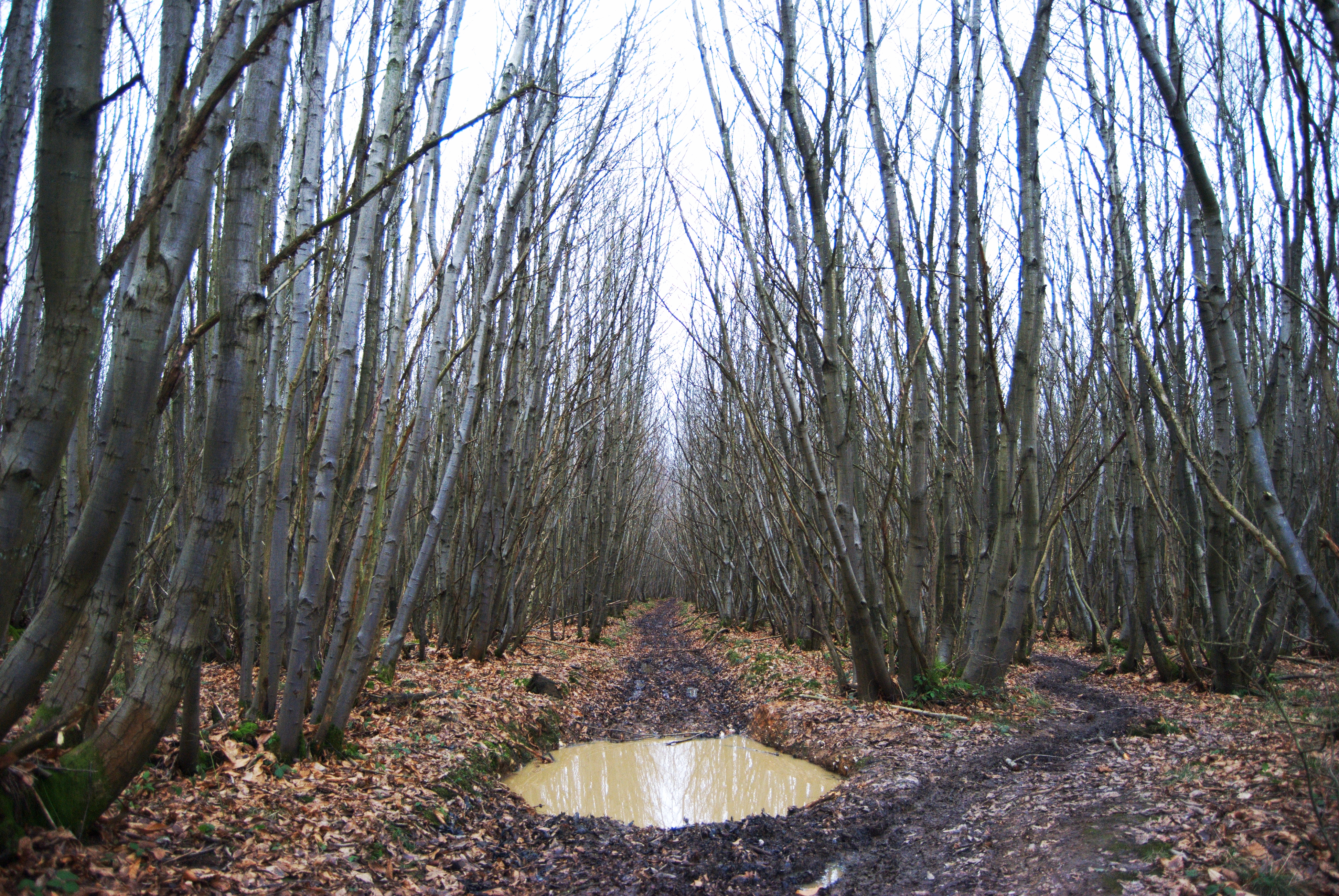
Further ahead the woodland opens in earnest, endless tracts of sweet chestnut coppice climbing into the sky. A brown puddle reflects the bare branches. Sweet chestnut provides the nuts we like to roast at Christmas, as well as forming the most economically viable form of coppicing in today’s market. The poles are cut after about five or six years and split down the middle to make chestnut paling, a type of fencing used in parks and nature reserves up and down the country. It’s another aspect of the Roman’s botanical legacy – they brought it along with them. The vertical slant of the branches is interrupted by a movement of four legged animals crossing our path in the distance. Our talking pauses as we watch an endless trail of deer move from right to left, disappearing into the trees. One of them was all white and it sticks in my mind like a puncture. We make our way towards Chilham, stopping briefly to search amongst these overgrown trees for walking sticks. We listen to the multiple stems tapping together as the wind steals through, some trees creaking. This a sound that in the endless scene of coppiced trees we mistake for shrill and distant calls of people.
Standing on the track leading into Devilsden Wood I look to the ground for dryness, somewhere that hasn’t been soaked by this perpetual rainfall. I see fallen ivy leaves that appear like cuts of leather when really they are crisp under foot. Dog shit, too, the new waybread for the modern ancient footway. I hate the stuff. My waterproof sheds its load onto my jeans and it’s wait and become cold or move and receive woodland raindrops, some chucked from the canopy of mature yew, ash and beech, some fifty feet up. When they get behind glasses, these droplets shock the senses.
It’s fungi season, the signpost of falling temperatures, not too cold but a shift from the sultry summer. I gawp at log piles with an explosion of mushroom caps, marked by striping and shapes that would define them to those who understood them. But still, I spy an oysterling appearing from a rotting trunk and feel that in two years of woodland obsession I have at least learned something about this magical animal that appears so fleetingly it could almost be through the fabric of time, a monitor on how we’re doing. Checking the sole of my boot again, we’re crap. I wipe it off in a mud puddle. The rain has not lessened. I head back out from the dark, autumn-beckoning woodland and onto the wet warfare of the Downs. The change in mind is clear, the atmosphere of a woodland changes you. It is not like the open land, so much a canvas for human experimentation, our impact on woodlands is never so clear as the plough’s to the open landscape. A woodland to all but a minority could have been in that state for millenia, before human time. The wood is a wild city, with nature’s social housing, swimming pools and fast food. It was our home once, too. There is the semblance of a summer out here, yellow rattle not yet rattling, knapweed funked-out in pinkish purple, even a bit of scabious. These wildflowers have something of January’s left over Christmas decorations about them. A car passes along the lane. Woodpigeons are striking through the rainy sky, turning their wings and bodies at an angle – to avoid the direction of the rain? – always as individuals. These birds cut several different figures in a year – hurried, panicked on the wing, or else male birds cutting arcs out of the sky as they display to females long into the summer recesses. Now they could be migrating, they could be hunted. Mostly they are gorging on elderberries outside my bedroom window.
On the Downs a flock of goldfinch are startled into the sky like pieces of a broken vase put back, its smash rewound and fixed. They sit in a small hawthorn bush and I look more closely. On the end of a branch, clear and possibly not so fearful of man is a juvenile, all grey on the head, interested in looking but unaware of the perils of being watched. My advances fracture them once more and I’m left with a snapshot of their escape into the landscape captured on my camera.
It dawned on me a few months ago, when a cull looked to be too stupid and ugly a prospect, that we can show no real mettle in the battle to stop the slaughter of wildlife overseas if we are seen to be slaying it without scientific basis.
I have spent time recently with Andrew Lynch, an MSc student who is voraciously charting the former range of badgers in an area of London from which they disappeared in the 1990s. A few weeks ago we entered a wood of ancient origins that is closed to the public armed with a rusty key and the permission of the landowner. We crunched through leaf litter rarely trodden by humans, through spider webs, brambles and holly. There were no paths. We discovered two specimens of Solomon’s seal, an ancient woodland plant that was surviving here in the deep shade of an unmanaged but very old and undisturbed woodland. The next day Andrew discovered a crumbled badger sett, its former inhabitants long gone. Why did they go? It’s hard to say, but that’s the point of Andrew’s work. In my view it is probably because the human population rose and the local environment felt the eventual impact of the post-war development of open fields and other pockets of woodland. They were most likely cut off from badgers living on London’s periphery. This is an animal that likes to create new colonies and does not like inbreeding. The badgers were reintroduced but their roaming nature led them to their deaths on main roads a few miles away. Amazingly we have recently had a record of badgers returning to one of the woods that is open to the public and well used. It was a moment of immense satisfaction and gave us hope for this network of dysfunctional woodlands. To think that badgers could be returning to woodlands which suffered disturbance in the Victorian times but still makes a home for owls, bats and other woodland animals, feels like a crowning moment. They will not have a sett in this area of London for many, many years, but to think that they have been by is, in part, a conservation triumph for the local community.
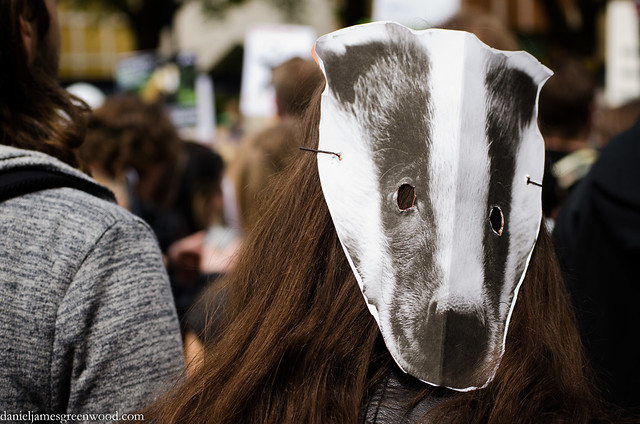
I find it difficult to respond to the fact that the Department for Environment, Food and Rural Affairs (DEFRA) are contracting the slaughter of badgers in Somerset and Gloucestershire with anything other than anger. The cull is wrong, expensive, bloodthirsty, unscientific, barbaric and worst of all, it is happening. It angers me like nothing else that afflicts our environment. For British wildlife conservation today it’s worse than the Lydd Airport trump, the shameful Oaken Wood debacle, the threat to privatise the public woodland estate, the idea of 50 ancient woodlands lost to HS2, and far more sinister than the threat of ash dieback disease or oak processionary moth. I feel a deep seated sense of injustice. A cull has already been done and proved ineffective in reducing bovine TB (bTB) in any meaningful way. I believe the National Farmer’s Union and DEFRA should take greater responsibility for biosecurity and that badgers and cattle should be vaccinated, that the government should show a greater willingness to invest in this rather than focusing solely on political gains for 2015. They have, however, turned more than 300,000 people against them, perhaps for good. I am convinced, from what I’ve read and heard from all involved that it is based on political ideology – much like the government’s attempts to downgrade Lewisham A&E (deemed unlawful by the High Court) – and is purely to accrue political support from the farming lobby at the next election. I feel there is a bloodthirsty element to the cull, just like the killing of hen harriers to the point of extinction in England, the poisoning of buzzards and golden eagles in Scotland. With the badger cull we are in the throes of a witch hunt. It has the hint of Chairman Mao’s communist war on tree sparrows which backfired completely. This is the very thing we as leaders of the global conservation effort are attempting to halt overseas and now, it seems, at home.
Life and people have moved on from the days of the hunt, when the aristocracy took to the countryside to chase foxes on horseback. Wildlife is valued for more than its fur and flesh, many people in the UK have come to value the need for a connection with the natural world, and science has taught us the need for humans to maintain the environment and to repair degraded ecosystems. The repair takes on many different forms – the work of the Great Bustard Group, reintroducing this charismatic and iconic bird to Wiltshire after it was hunted to extinction in the UK; the resurgence of otters, another animal ‘clashing’ with humans where it forages from commercial fish ponds, but a welcome sign of healthier rivers in England; and then there’s the crane, a bird that was slaughtered in its thousands and now returning, like the spoonbill, to breed for the first time in over 400 years. It’s hard to say why the crane is back, but it could be because larger areas of land are being set aside for wildlife, larger reserves rather than pockets. These are great moments in the history of British wildlife conservation and are not all because of human action. Another great thing is the thriving badger population in England, of which there is no set figure. However, one thing that the badger cull reminds us is that whenever wildlife does well – foxes and cormorants being examples – it is treated with disdain and someone, often on the right wing of government, will call for a cull. Take Boris Johnson’s recent attack on London’s foxes. It is an instinctive, atavistic response, rooted in a love for slaughter that is abhorred by more modern attitudes towards animal welfare and the environment. Most pertinently it is a human failing, an inability to look at the impact we have on species and ecosystems we believe ourselves to be free from and above. When it comes to natural resources no species is more invasive and damaging than we and yet no other species has the ability to think and reflect over how we might improve our behaviour, to evolve, and improve the health of the environment not merely for ourselves.
Perhaps my lifestyle is implicated somewhere in the decline of the hedgehog but the badger is not to blame.
For me, the beauty of badgers is their very nocturnal nature, something which has inspired artists, scientists, conservationists and authors down the centuries. The image of a twilight woodland is one of the most magical, with badgers beginning their nightly forage for worms (and yes, even hedgehogs sometimes), moths taking to the wing with the moon as their guide, and tawny owls calling from the canopy, their prey of mice and voles scrabbling around in the leaf litter. If I were to talk like this to many people who are for a badger cull, I would be labelled as emotional and naïve or worse, only against a cull because I think badgers are sweet. I know that badgers predate hedgehogs but I don’t blame them for the decline in their prey. It’s an excuse used by individuals who have no scientific grounds to defend the cull. Perhaps my lifestyle is implicated somewhere in the decline of the hedgehog but the badger is not to blame. The blame for that can firmly remain with human impacts on the landscape, the lack of suitable habitat, a loss of food sources after the tidying up and poisoning of the English landscape through mass expansion of intensive agriculture after the Second World War (note that in modern times Owen Paterson went against the will of the people when voting to continue with neonicotinoid-laced systemic pesticides that kill wild pollinators and ruin the soil).
It dawned on me a few months ago, when a cull looked to be too stupid and ugly a prospect, that we can show no real mettle in the battle to stop the slaughter of wildlife overseas – migrating birds in Malta and Cyprus, lions in Africa, tigers in India – if we are seen to be slaying wildlife without any scientific basis. England is just as bad as everyone else. In the same way that we are looking to destroy our own version of the rainforests through development, we cannot truly argue with deforestation in the Amazon, the Congo and Eastern Europe when we are championing the very same thing at home. Overseas these people are barbarians, at home they are ‘doing the right thing’. And as we look for badgers in a landscape that has lost them, the loss feels peculiar with the government’s mindless slaughter of this beautiful and vital wild animal echoing in the background. I just hope that in twenty years people in Somerset and Gloucestershire will not be retracing old setts mindful of the senseless brutality that was inflicted in the past. Looking at the state of things it appears a distinct possibility.
An ancient woodland in Wiltshire, England (by D. Greenwood)
“The very considerable need for both crushed rock aggregates and dimension stone, together with the eventual biodiversity improvements, and the ongoing socioeconomic benefits, would clearly outweigh the loss of the ancient woodland and the other adverse effects of the development in this case.” – Eric Pickles, July 2013
When Eric Pickles described ‘the eventual biodiversity improvements’ in destroying Oaken Wood in Kent, an ancient woodland sat conveniently on a bed of limestone and next to a commercial aggregates mine, it may have been the final call for a phrase that has come to mean so little. By this I mean ‘biodiversity’, a phrase that attempts to describe the diversity of non-human life. It’s now a word sucked into planning regulation and the corporate tongue that blankets all meaning – it is impossible to put into one word or describe the immense variety of wild animals, plants, fungi and other living organisms that make their home on planet earth today. In the case of Oaken Wood it is a saddening instance, where a kind of Orwellian newspeak is being used to make people feel better about the largest loss of ancient woodland in England in decades, and purely for economic, short term benefits. Note also the phrase ‘the ongoing socio-economic benefits’, hinting that the government’s stance on the environment is improving the economy and getting people ‘back into work’ where they belong.
In the case of Eric Pickle’s ecology lesson, he should note that an ancient woodland takes 400 years to mature and establish, for the soil conditions to be right for the species of plants, lichen and fungi (yes, wildflowers and mushrooms, not just trees) that will make it a unique and stable ecology for the insects that will pollinate it and act as food for the bats and birds that give ancient woods their star turns and top predators. We can only hope that in 400 years no one will have heard of Eric Pickles but sadly people might have no idea that an oak woodland once grew in that part of Maidstone, nor might they enjoy Pickles’ ‘biodiversity improvements’, which sounds like a London landscaping company. There will be no benefit to wildlife in comparison to how things are now, just disruption, local extinction, desecration and, for the species of birds and migratory insects that might manage to return on the wing after the aggregates gurus have had their way with the landscape, pollution.
It is perhaps now time to point out that if woodlands and other wild places are not treated with their ecological and natural importance in mind that there will be wider and wider declines in species depending on ancient woodlands, meaning that in 400 years there will not be the diversity of wild creatures to even enjoy a renewed woodland. In short, biological life will be far less diverse. Unfortunately this horrendous government do not understand the impacts of their decisions. Just like Justine Greening thinks the 50 ancient woodlands that HS2 Ltd have in their sights could be ‘moved’, Eric Pickles thinks a woodland can be put back where it was, like a rug pulled up from the floor, swept under and replaced. The characters mentioned here are not fit to make these decisions, just like Owen Paterson’s failure to listen to the people and the science over both a badger cull and bee pesticides make him ethically unsuitable for his post as Environment Secretary.
If we can’t use ‘biodiversity’, what can we say? I always go for ‘wildlife’, it’s not perfect, but it indicates the living creatures which do not have a voice, which haven’t been domesticated like dogs or cats and refers even to urban ‘horrors’ like the brown rat or ring necked parakeet. It also rouses our sense of the wild, of freedom from human strictures and civilisation, of the world that we came from and that underpins all our activities, for which we depend on for nourishment, energy, mental and physical well being. It also uses that vital word – ‘life’ – which ‘biodiversity’ fails to point to at all. The loss of a wild place means a lot of death and, in Oaken Wood’s case, purely for human greed. Isn’t that what society was developed to put an end to? Biodiversity is a scientist’s term and for all the incredible scientists out there more often than not many fail to describe things simply or to capture people’s interest and passion for nature. Smartphones wouldn’t be as popular if they were marketed by the geniuses who developed them.
I remember listening to a park keeper talking about doing things for ‘the biodiversity’, to attract ‘the biodiversity’. I have no doubt this phrase had filtered down from talking to bureaucrats in the council, the same language drenched all over planning documents and used in this sense to mask the fact the speaker didn’t know or really care about how the land was being managed to benefit the environment. It’s also used by politicians to appease conservation charities, to make them feel they’re being listened to. It’s the new ‘green’. When people hinge their argument or point on the word ‘biodiversity’ is it possible it could be to hide the fact they don’t know or care about what they’re saying? Perhaps not always but at times it is resoundingly true. All we can do is be clear when arguing the case for preserving and enhancing our natural heritage both for wildlife but also ourselves and those yet to be conceived who deserve and need to see, experience and live alongside wildlife. For those trying to champion the diversity of natural organisms, our language has been compromised and used against the very thing it’s intended to support.




 Unlocking Landscapes