Here are my recent astro photos from Mayo’s International Dark Sky Park. County Mayo is of course in the north-west of the Republic of Ireland.
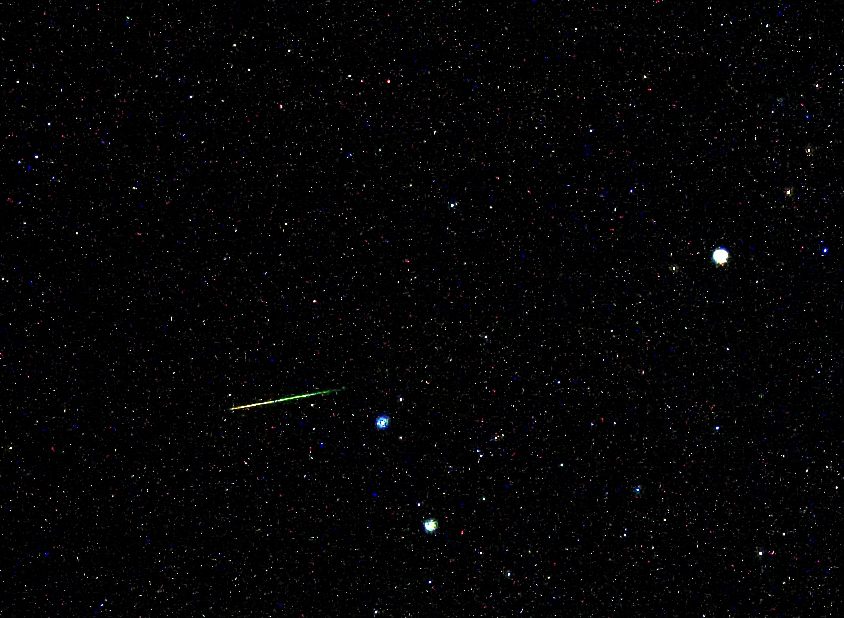
During this short period of skywatching I saw a meteor streak across the sky. It was amazing.
The weather on this trip was typical August in Ireland – rainy! Luckily there was a couple of clear hours one night, and the Milky Way was clear to the naked eye.
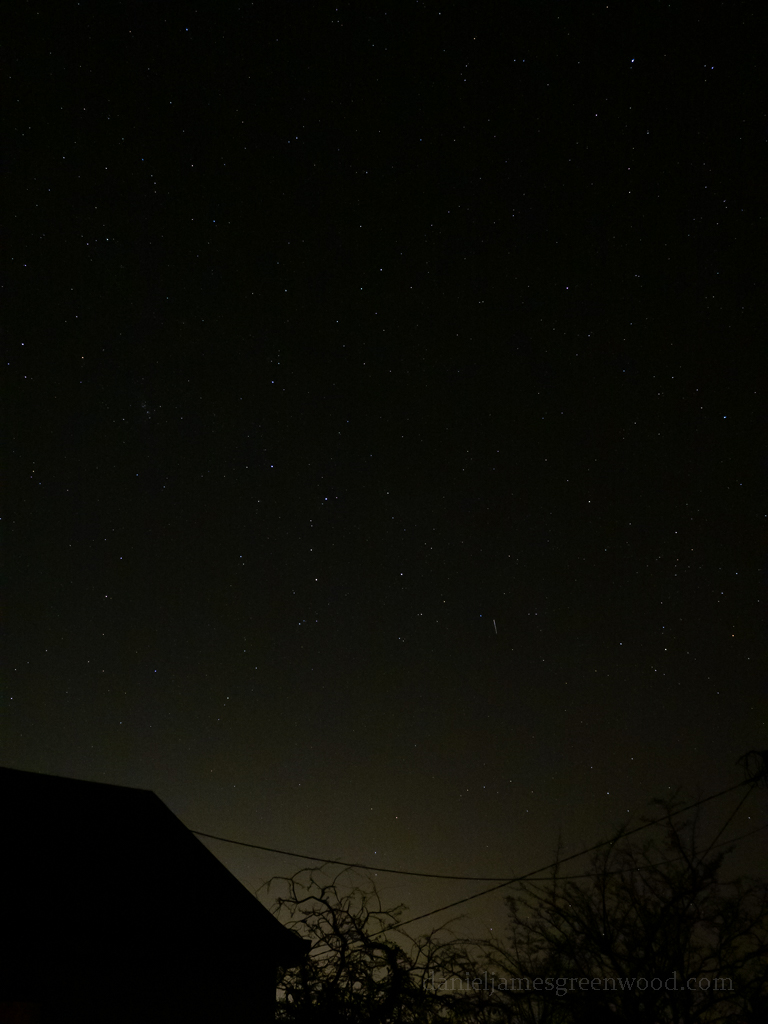
Here’s the view south with the Milky Way stretching across the sky. The shapes at the base of the photo are a conifer plantation. The light pollution is coming from the direction of Foxford.
I love the images of a glowing window with stars above. Here you can see the plough (Ursa major) over the rooftop.
On Sunday 30th October I was admiring Jupiter in Dartmoor’s pitch black skies when what looked like a satellite skimmed above the tower of the illuminated church (header photo only viewable in browser).
At first thought it was a satellite due to its steady glide, but then satellites don’t usually burn up in the atmosphere, which is what this object did.
It later turned out that the trail of light was part of the Orionid meteor shower. Above is a photo kindly donated to Wikimedia Commons to illustrate it.
This Orionid was seen outside the peak for this shower. It was even more lucky because the weather surrounding those nights had been pretty much torrential rain and the night sky had been tucked away behind cloud.
The Orionids aren’t anything to do with the constellation of Orion directly, but are so named because they appear nearby and their naming helps people (like me) to locate them. These meteors are actually fragments of Hally’s Comet, which you may have heard of.
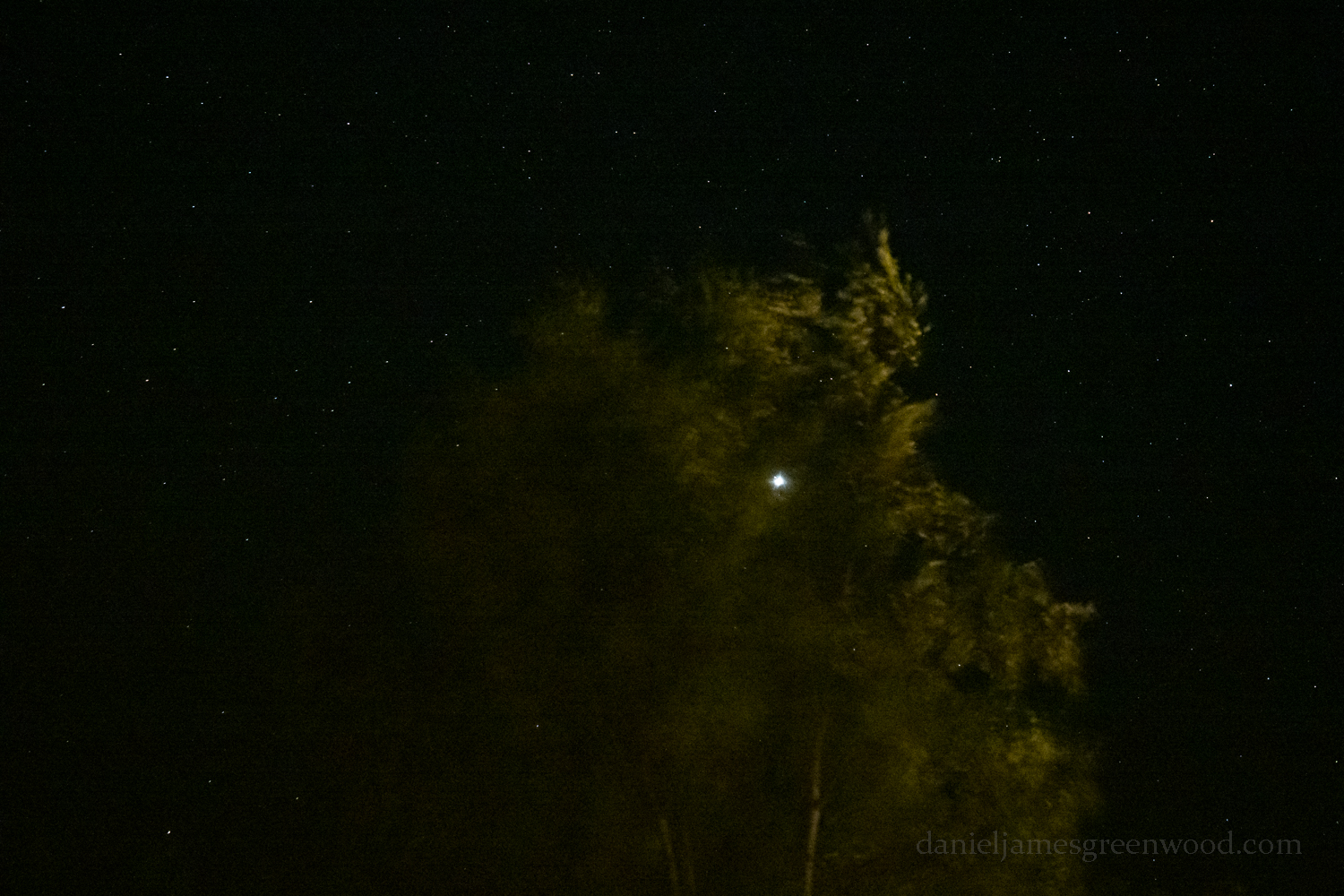
Jupiter seen through the leaves of a silver birch tree (Dartmoor, November 2022)
This is a great time to observe the night sky and take in all the night has to offer. Redwings are arriving in their thousands and can be heard even over the most built-up and light-polluted parts of the UK. While the Orionid meteor flashed across the sky, redwings were covering the night sky in their own, invisible but audible way.
A few nights later the skies cleared after days of heavy rain and high winds. This gave a good chance to look at Orion, which was fixed perfectly from the back of where I was staying at the time of viewing:
The constellation of Orion: Dartmoor November 2022
Cropping a bit closer you can see the fierce glow of the Orion Nebula in the bottom right-hand part of the image:
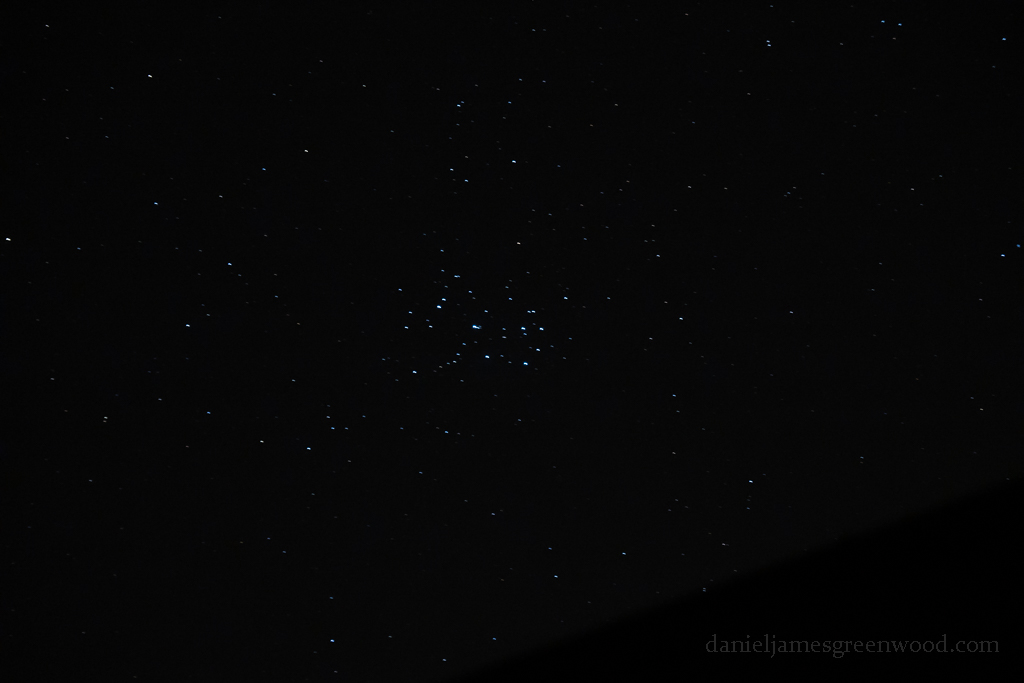
Also prominent and not too far from Orion was the Pleiades:
The Pleiades: Dartmoor, November 2022
I’m using a new camera (Olympus EM-1 MIII) at the moment which has the ability to autofocus stars with a special feature. It didn’t actually work that well for me, though I was taking these photos handheld and may have had the settings wrong. It was a spur of the moment kind of thing, as much as my astrophotography attempts are to be honest!
I was really drawn to this large bright star to the left-hand side(!) of Orion. I need to be better at noting the locations of stars in relation to other constellations. Looking at Stellarium I think it’s either Mars or Betelgeuse.
Mayo is Ireland’s only dark sky park, internationally recognised for its low levels of light pollution. Basically it’s super starry. Here are a few images from the front door (the only door) of my family’s cottage in northern Mayo.
The PleiadesOrionCassiopeiaThe Pleiades and Auriga
On the evening of Wednesday 19th January at about 21:00, I spent some time photographing the winter night sky. I was in my West Sussex garden, where there is a surprisingly good clarity of starlight despite the nearby town and railways, etc.
A few nights before when it was a bit cloudier I spent the time just looking through binoculars at the stars. As someone new to stargazing, I was amazed by the gains made from looking through glass. In among the cloud were hundreds of tiny stars where nothing appeared to the eye. This will sound quite dim to more seasoned observers, but the difference made was a joy.
One little cluster I had my eyes on was the Pleiades. This appears to the naked eye like a dusting of light, to the east of Orion. Looking through binoculars gives much greater clarity. On Wednesday night I used my camera to get some images, later cropped and edited a bit in Lightroom.
The Pleiades, from West Sussex, approx. 21:30, 19-1-2022 (Olympus E-M5 MIII + 45mm f1.8 lens(cropped)
The Pleiades is made up of seven larger stars, giving it another name of the ‘Seven Sisters’. That’s the third time that name is used, to my knowledge, in place-naming alongside the Seven Sisters cliffs near Eastbourne in Sussex, and the main road in north-east London. The Seven Sisters road is named after elm trees which are no longer there.
The above photo by Carlos Budassi is obviously not as good as my attempts (JOKE). It does, however, help to illustrate this star cluster beautifully. I’m not sure of the camera, lens, settings or editing required to produce this image but it is of astonishing quality. Also, how good of Carlos to share this image with Wikimedia Commons so people can use it. Thank you, Carlos.
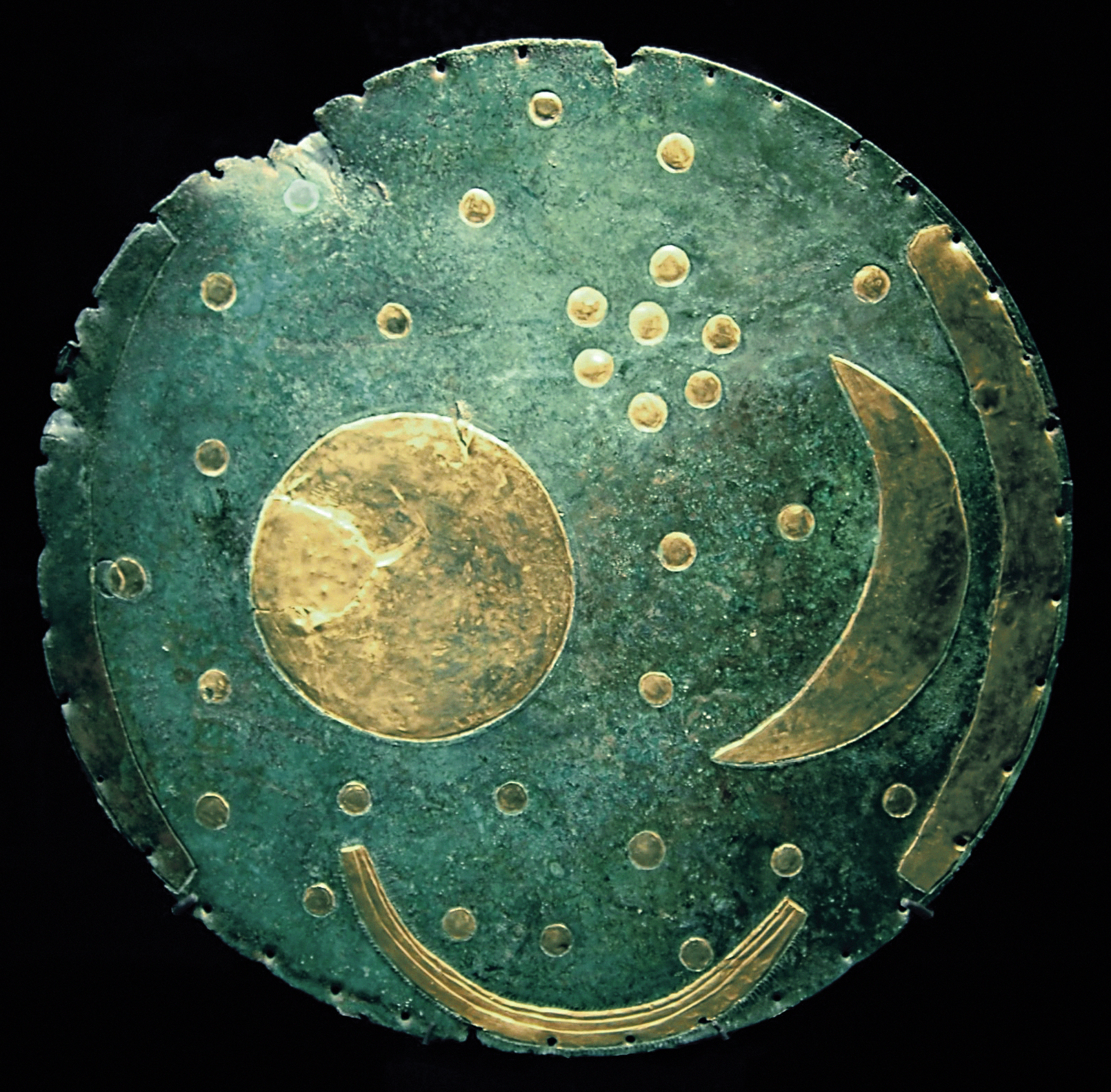
The first known depiction of the Pleiades comes from the Bronze Age as seen in the image above. Wikipedia titles the image: “The Nebra sky disk, dated circa 1600 BC. The cluster of dots in the upper right portion of the disk is believed to be the Pleiades.” Indeed, there are seven of them.
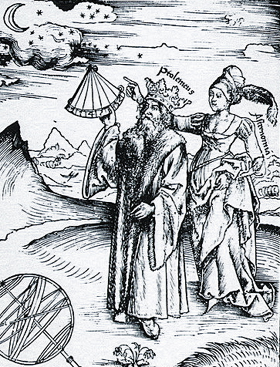
Ptolemy, Public domain, via Wikimedia Commons
The name ‘Pleiades’ is said to come from the Ancient Greek and is related to sea-faring rather than the Seven Sisters.
I’ve had a burst of American visitors in recent days (to my blog, not my house). So thanks for visiting, y’all, and sorry about the year you’ve had. You may have noticed I’ve slipped to monthly posts on here. Between April and October I posted blogs every Monday without pause, which is a tricky task…
Cowdray Park, West Sussex, South Downs National Park, February 2019
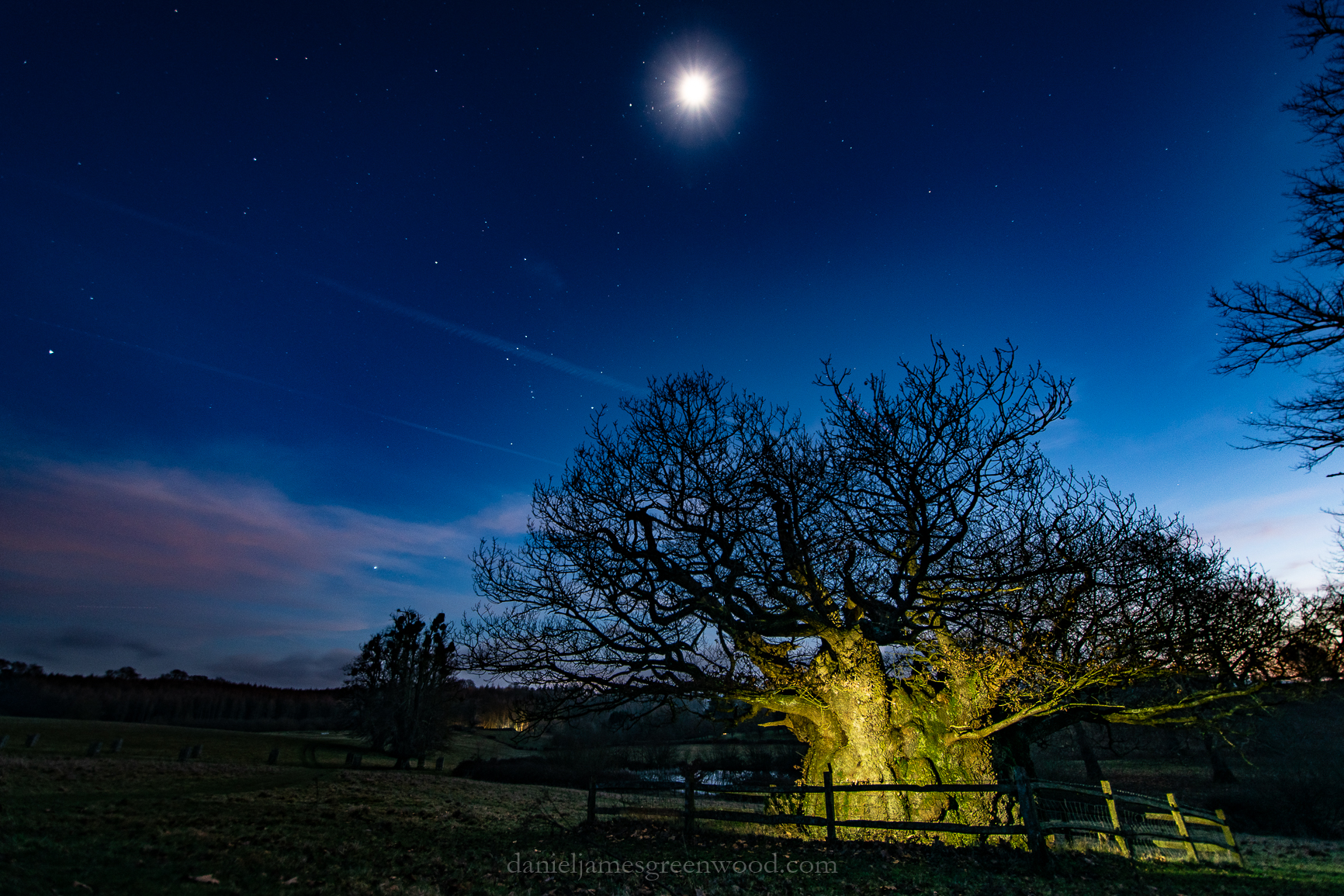
Leaving work at five o’clock in the dark is never nice but it depends how you look at it. Inspired by the Dark Night Skies initiative, I made a stop off on my way home to see some stars. I have been photographing trees in the dark since about 2008, mainly of trees under street lamps in south London. It was something to do in those long, drawn out winter evenings. Since then I have started photographing trees in the daylight, too. Having had the chance to volunteer and work in woodland conservation has taught me a lot about trees and their ecology. Having moved away from practical woodland conservation in the day-to-day sense, though still leading the odd tree walk, I am reveling in photographing some of the trees that are found throughout Sussex. One of the trees I have had the pleasure of spending some time with is the Queen Elizabeth I sessile oak in the South Downs National Park. This tree is completely hollow and has perhaps been around for 1000 years.
Photographing the same tree again and again isn’t always interesting for you or other people. A recent interest in the night sky (the fact I can now see it, being away from a city, rather than knowing anything beyond the moon and the plough) gave me the idea to use the early nightfall to try and photograph this amazingly old tree under the stars.
The photos were taken with a wide angle lens and a tripod. I used my mobile phone torch to light the tree. The bright light above is the moon, something that plays havoc with night photography due to the fact it outshines many of the stars.
The problem with my phone torch is that it goes off after a while so I had to trot back and forth to keep the light on. In this light the tree looks fleshy and bulbous, quite animal-like I think.
When the mobile phone torch light did go out, this is how it looked. I like how the branches reach out to the stars and the astronomically-illiterate thought that they might get snagged in them.
There are many ancient trees at Cowdray Park in West Sussex near Midhurst. It is almost a point of pilgrimage for people who love old trees and feel some kind of emotional connection to the eldest we have left. This oak has lost almost all of its heartwood and has sinewy remnants decaying inside the bark. I love the purple hue in this photo and the way the distortion of the 10mm wide angle lens warps the trees in the background. I love the rawness of the tree in itself and the stars touching the outstretched twigs.










 Unlocking Landscapes