2020 has been a challenge for all three of us fungi photographers down here in southern England. But we are starting to see a change in the weather. Therefore, something is stirring in the Kingdom of Fungi. On a side note, did you know that the fungi was only given its rightful place, taxonomically distinct from plants in 1969? 1billion years on Earth and they were only just recognised as being separate from plants 51 years ago! Obviously scientific study hasn’t been going for a billion years.
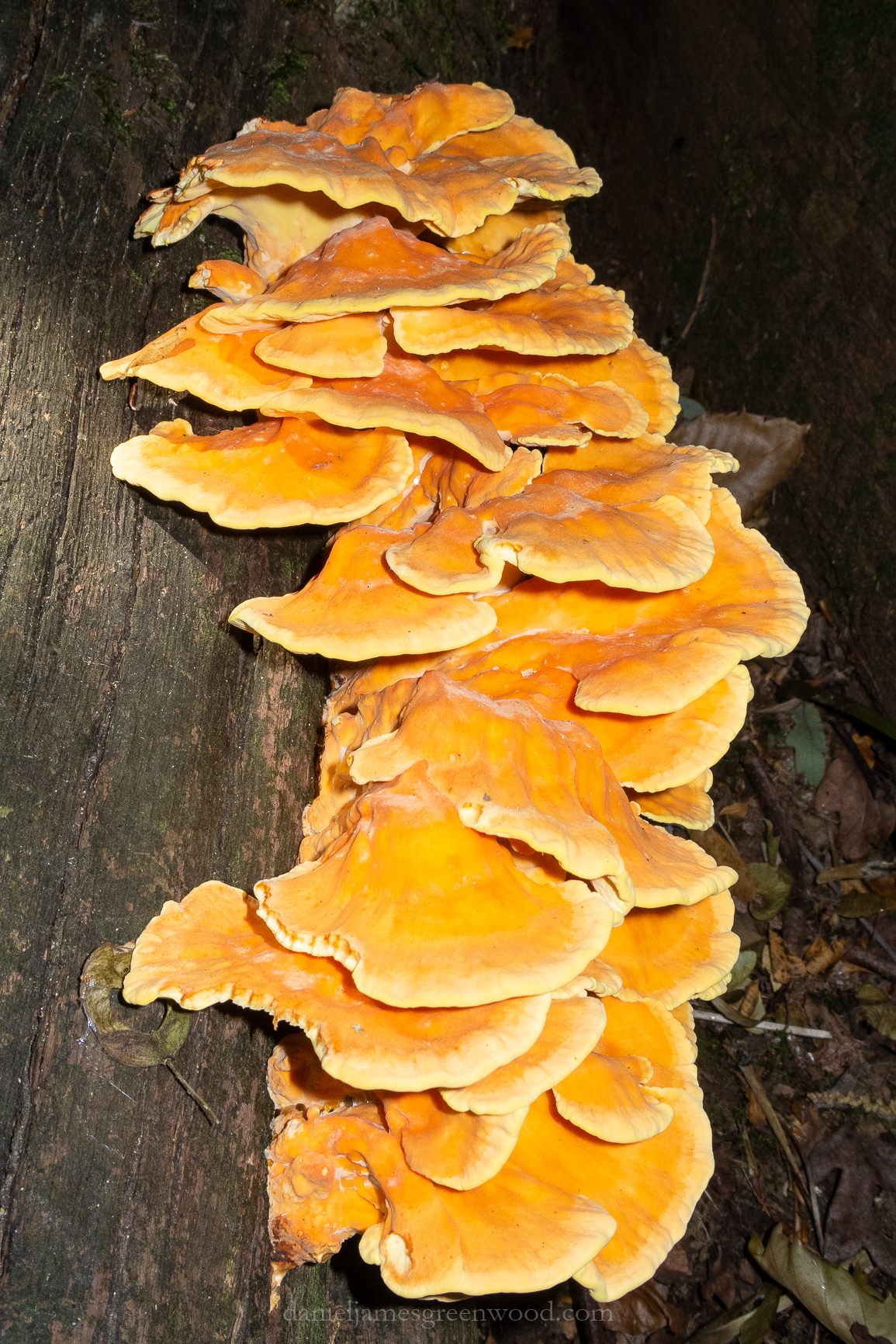
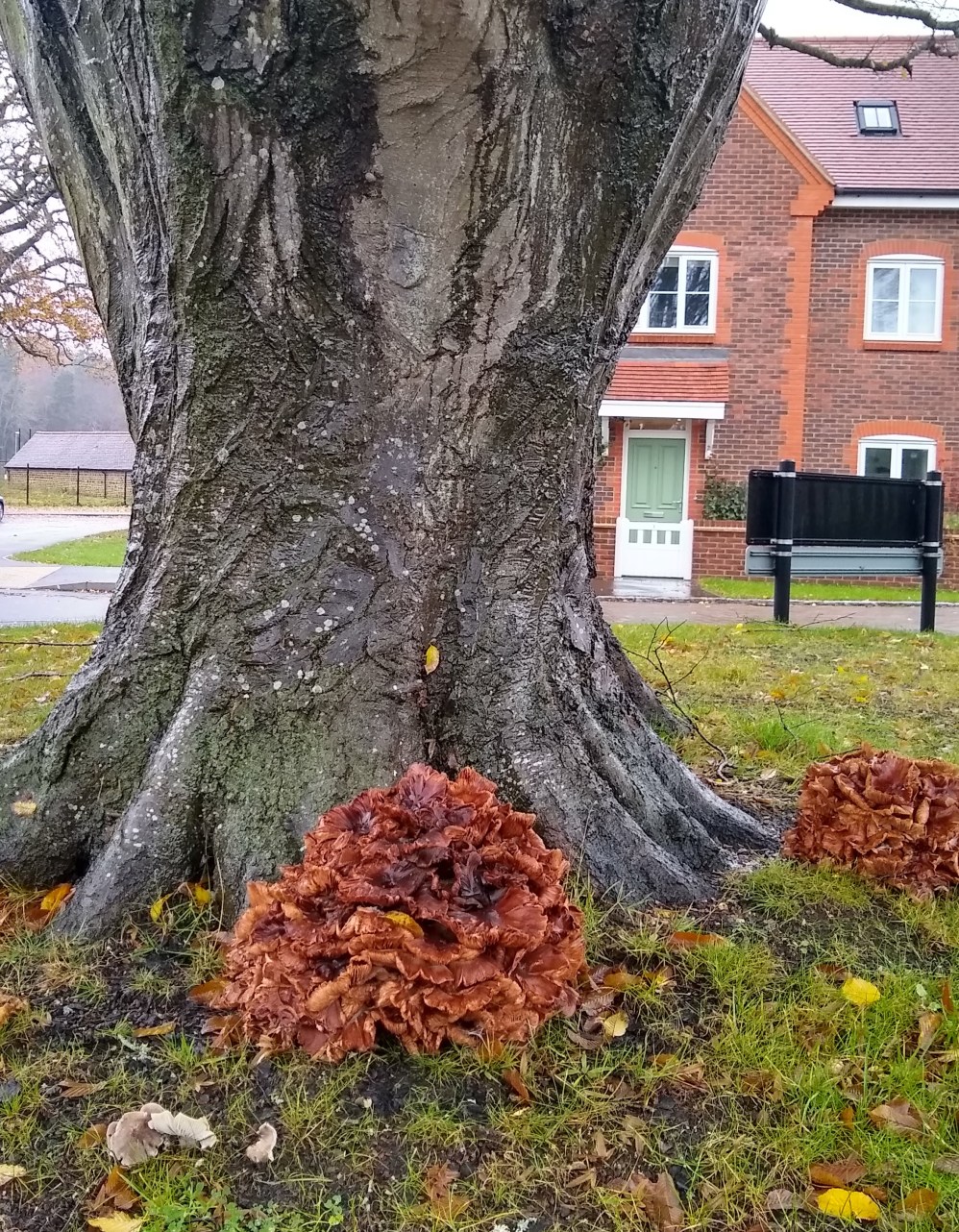
One species which has appeared after recent rain is chicken of the woods. I’ve seen it in two different places, but the same habitat which means the species is responding to wider atmospheric change, not localised. You will see better shows from this pretty outrageous fungus, the rain had actually made it more like scrambled eggs.
As so often with chicken of the woods, it was growing on a fallen tree trunk, sweet chestnut in this case, and its orange colour flashed into the corner of my eye from the deep shade where it was growing.
My second major recent sighting drew me back to where I first found an interest in fungi: trees. Storm Francis has thrown their toys out of the pram in recent days and I was pretty astonished to see that some sycamore trees, young ones, had lost their leaves already. I am guessing there is a link between a lack of spring/summer rain and an earlier autumn, in terms of trees shedding leaves. That’s based on observation only.
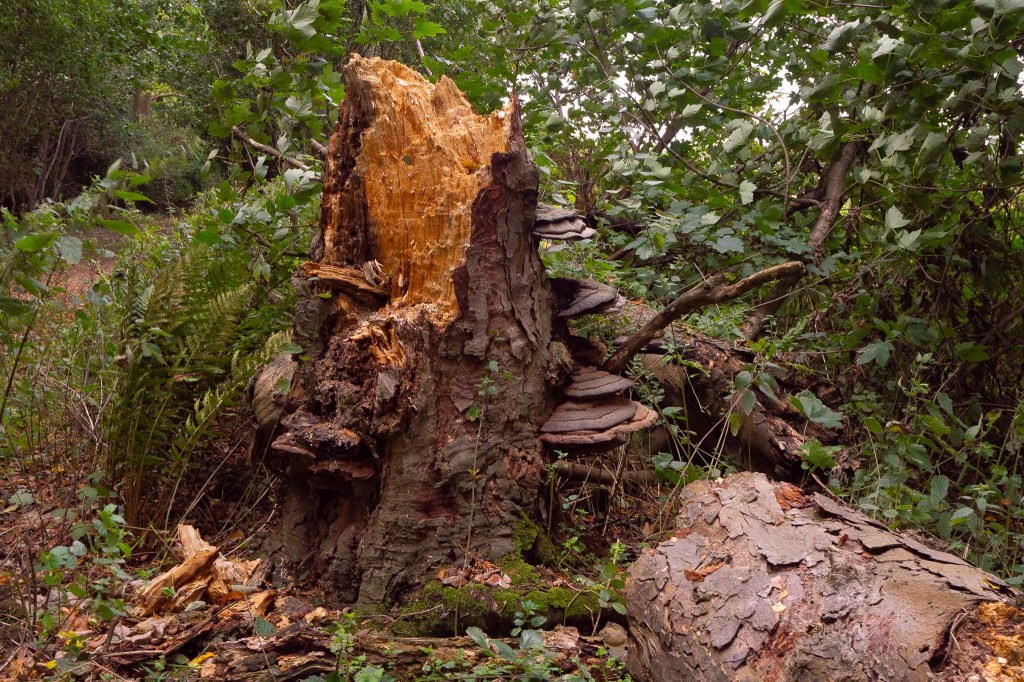
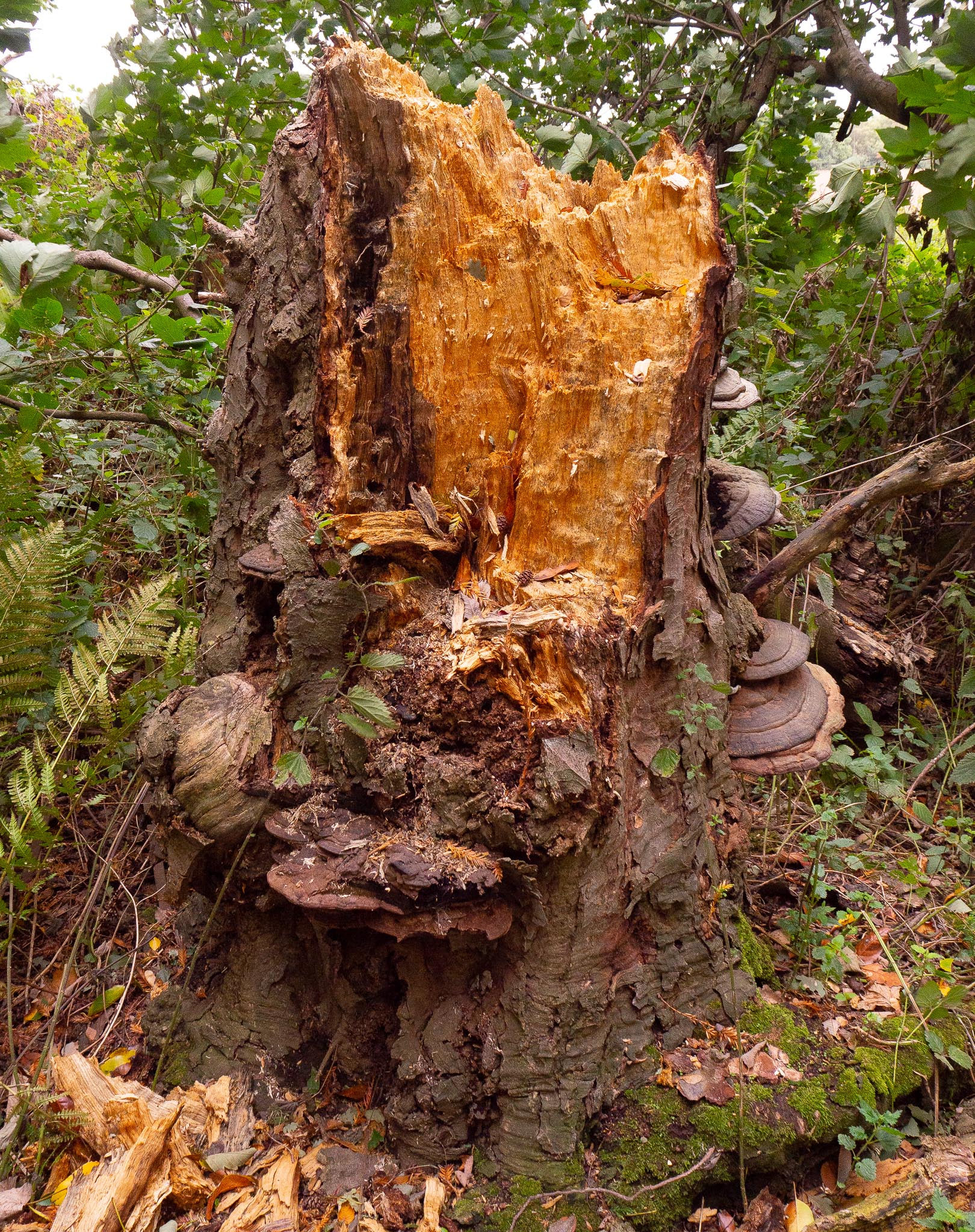
I don’t know if this is Francis’s work, but this standing dead horse chestnut has been brought down in the past week. It has some huge bracket fungi growing from one side, which will have softened the wood further. It’s important to remember that it’s rarely fungi that fell a tree, but the wind. Fungi just put in the groundwork. Great job.
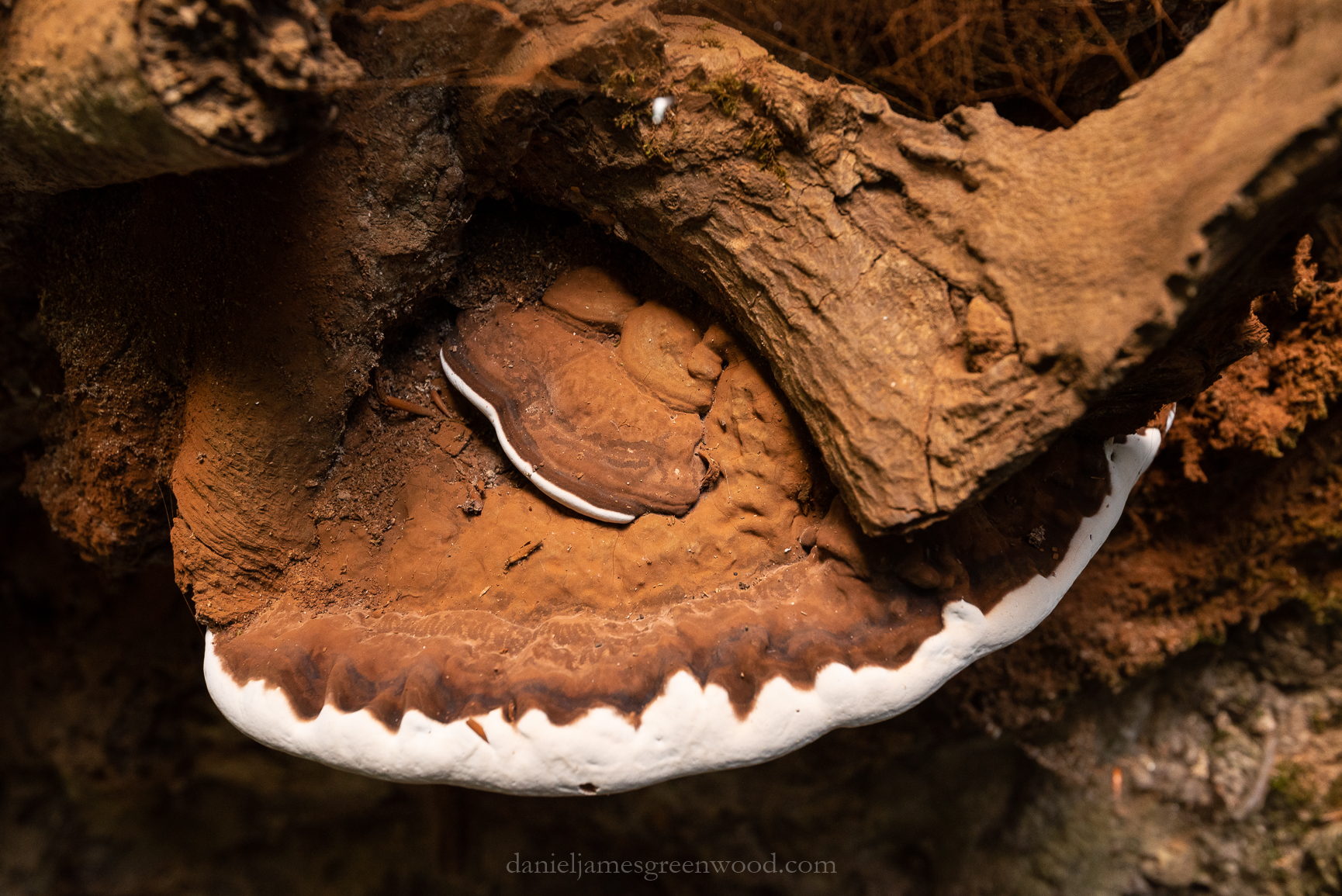
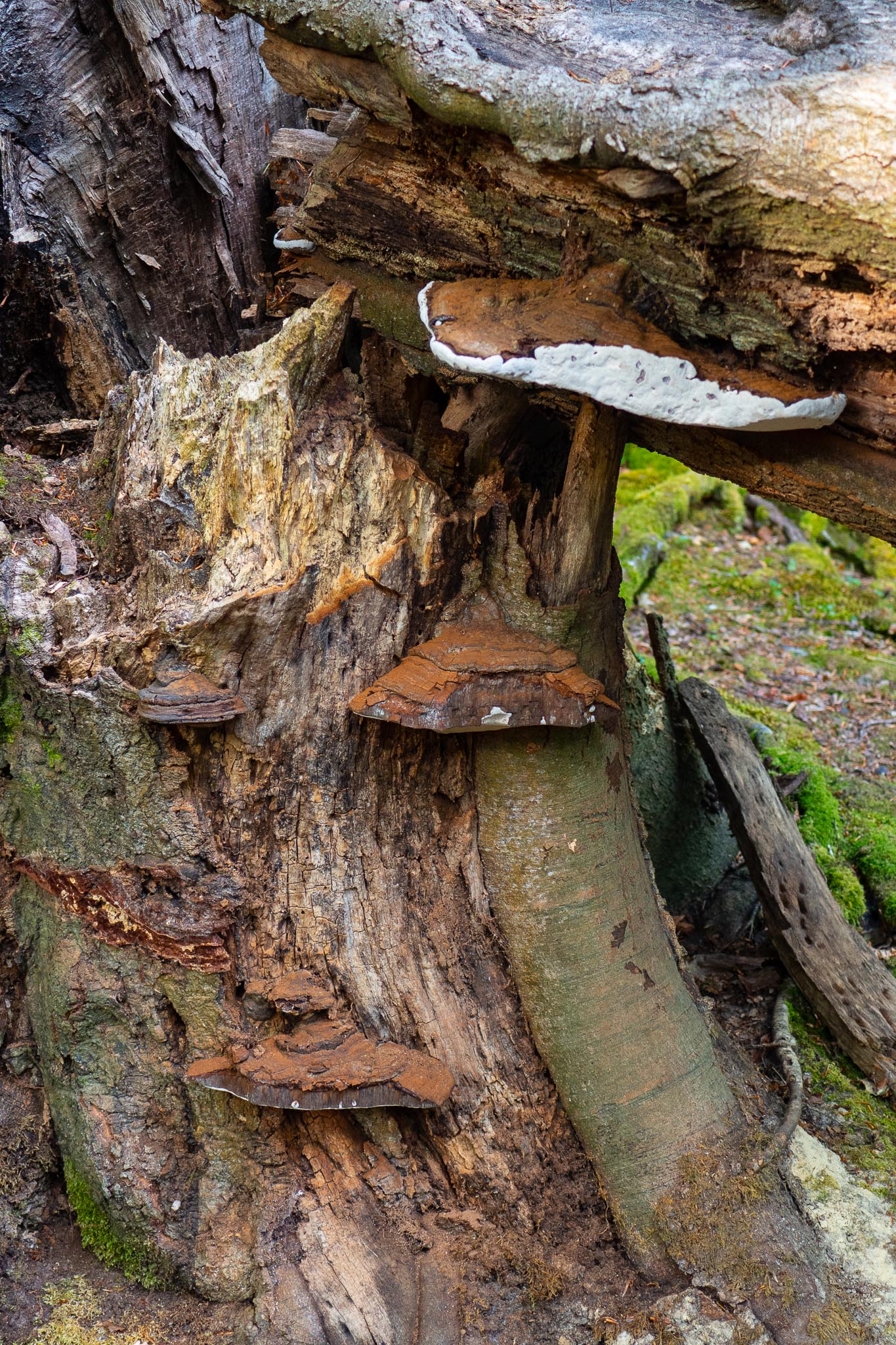
I am sure this is a species of Ganoderma bracket fungus but I’m not sure which kind. I cycle past this every couple of weeks nowadays and always stop to feast my eyes on these gigantic fungi. If this is one single fungus, it could be 15 to 20 years old.
There probably won’t be a #FungiFriday for me next week as I’ll be on holiday. Don’t fret, autumn is afoot (ashroom?) now, so get ready for the good stuff!
This week I thought I would write a post answering the most common question regarding fungi – which ones can you eat?
Disclaimer: I am not encouraging you to forage without following a code of respect for nature, wildlife, habitats and the environment. Your desire to eat wild food is not more important than the thing you are trying to forage or the habitats those species depend on to exist. Learn your foraging rights and exercise them with restraint. Respect habitats and know what you are picking.
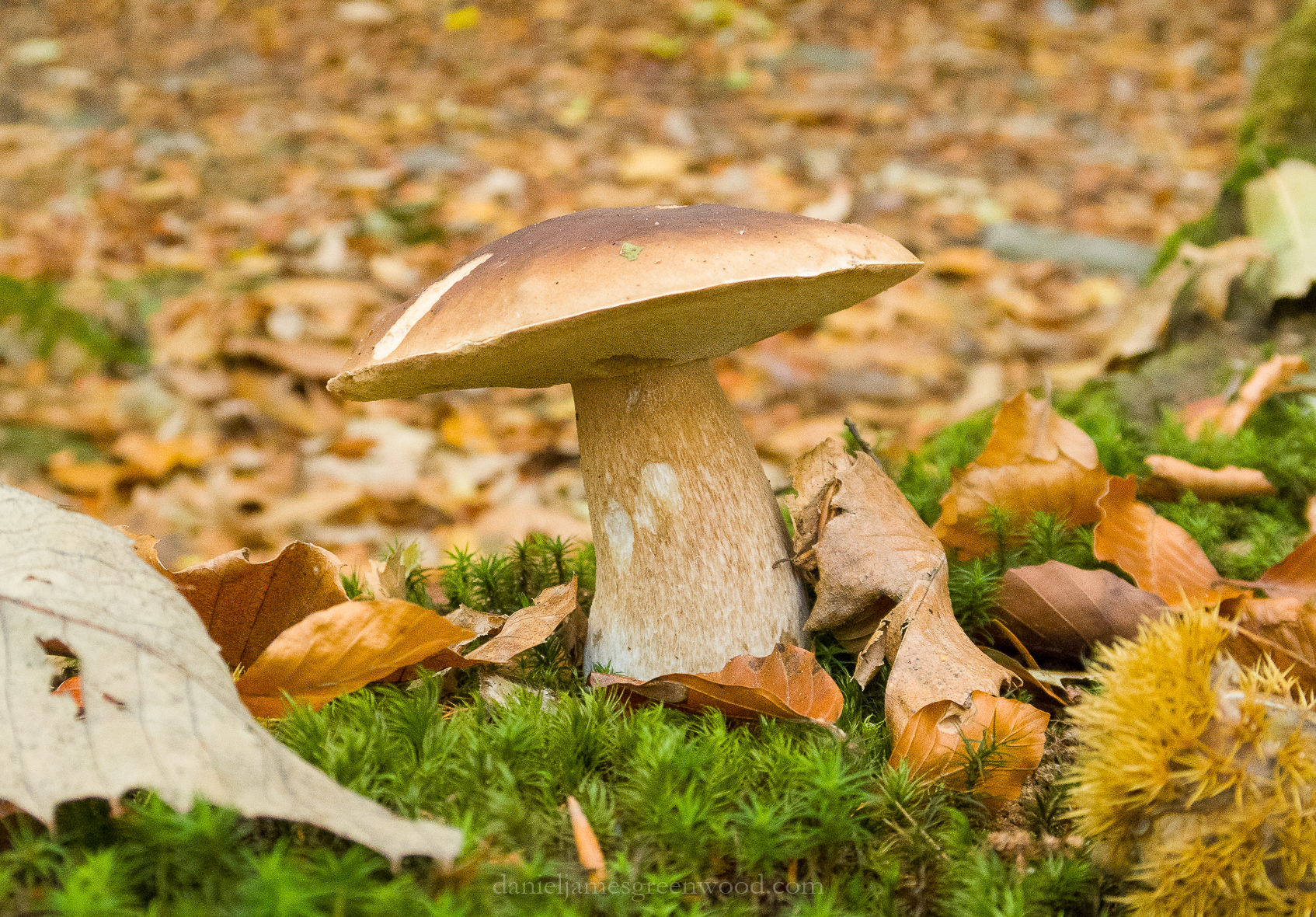
There are few other places to start with edible mushrooms. This mushrooms is known in Italy as porcini, America as king bolete, France as cep and England as pennybun. When finding ceps you’ll need to ensure they haven’t been eaten through by larvae from the ground up. This is done by cutting the mushroom where it’s attached to the soil and looking at the condition of the stipe. Ceps can be eaten raw in salads and are also good in risotto. I’ve only ever eaten them in restaurants. They grow in woodlands, plantations and on heathlands.
Chantarelles are a species I’ve only ever seen twice in the wild and I’ve never eaten one. I’ve eaten horn of plenty but they were a gift from Spain. This is the time of year to be looking for chantarelles (August-September). They are a yellowy-orange colour and look a bit like splattered egg yolk from above. People who reliably find chantarelles often have a patch that they return to each year. Not to be confused with false chantarelle. Later in the autumn trumpet chantarelles are another edible relative (that is a phrase you don’t hear often). I’ve found them growing on heathland.
Chicken of the woods (Laetiporus sulphureus)
I saw a couple of specimens of chicken of the woods this week, but the best time to find them is May-June. This is an easy to identify fungus which grows mostly on oak, but also on sweet chestnut and even yew. Often it grows on fallen tree trunks. Never, ever, eat this if it grows on yew. Yews are poisonous and the fungus will absorb the toxins. It’s important to know that some fungi absorb pollution, so be careful where you are picking things. They are best eaten when younger. This species is important for invertebrates so don’t hoover everything up. That should be the consideration at all times.
Amethyst deceiver (Laccaria amethystina)
This is a very small, common mushroom in woodland. Sometimes they are so small you completely miss them down in leaf litter. In 2019 on a single visit to a favourite woodland I found thousands of them growing. They are a beautifully photogenic species and when in good light they have a lovely amethyst glow. They can be found from August to November. They have to be picked in larger numbers to be worth cooking.
Giant puffballs are famous for the their unusual size and the fact you can, well, eat them. A smaller cousin of the giant puffball is the common puffball. This species grows on the woodland floor and can be found throughout the autumn. I often find them at the edges of footpaths, which are not great places to find anything you ever want to eat. I think common puffballs look like submarine bread rolls with their speckled caps.
For a while I’ve wanted to draw attention to the amazing relationship Slavic people have with fungi, to shine a light on the troubles we have in the UK, especially in England. In ‘Slavic’ I include Russia, Ukraine, Poland and Czechia. Mycophilia (a love of fungi) also extends through more central European countries like Germany, France and further south to Italy.
Bear with me on this one, it’s quite a complex topic which I am trying to understand more about. Even though this blog is a long one, I intend to do more work on it in future.
Zuzana Veverkova with baby Riza in Czechia
The only mushroom I’ve ever eaten was picked for me in Czechia by my friend and conservationist Zuzana Veverkova in a huge area of woodland known as Chriby. Zuzka covered it in breadcrumbs and fried it in butter. I don’t know what species it was, probably a parasol or an Agaricus species (like the larger white mushrooms you get in the supermarker), but it was absolutely delicious.
When she picked it I asked her if it was safe to do so. She glared at me:
“I have been picking this for my entire life!”
In England, there is an overriding sense of mycophobia, a fear of fungi. We also have a knee-jerk reaction to foraging, usually translated by right-wing tabloids as an eastern European criminal underworld stealing English mushrooms. It has been the case that people from other countries have been harrassed for foraging mushrooms in English parks, woods and the countryside.
In England we live in a nature-depleted country and people are disconnected from more natural landscapes and the wild plants, animals and, indeed, mushrooms that inhabit them. Could it also be that in Britain, higher standards of living have (in theory) been maintained due to a lack of war inland (1066 was the last land invasion) and we have not been subjected to the economic boom and bust resulting from the shifting between revolutionary communist and capitalist systems. What I mean by this is that our supplies of food have been industrialised and well-maintained without a dependency on foraged food. Then again, the impact Covid-19 has had in Britain suggests poverty is far more widespread than people realise, or Government would like to admit.
I know someone who is in their mid-80s and is fluent in Russian, a veritable Russophile. When they learned that I had an interest in fungi, they showed me a copy of a Russian medical book they own. Beyond pretty grisly images of physical ailments are pages of both edible and toxic fungi. Another thing people commonly have told me on public fungi walks I’ve led, is that you can go to pharmacies in countries like Italy and get an identification of a mushroom.
In England, you will never get anything of the kind. I wonder why that is. One of the main reasons could be that Slavic nations enjoy far greater woodland cover. In England we have 13% woodland cover, while nearly half of Russia’s vast landmass is covered by woodland.
Look at this graph and you’ll see how wood-depleted Britain is. I appreciate it’s complicated.
The Transylvanian Carpathians, Romania
In Britain our lack of reliance on foraging has led to a plummet in nature knowledge and species awareness, something which is improving. In Romania you will find some of the highest levels of plant ID knowledge among local communities, especially ethnic-Hungarians in Transylvania. This is because Transylvanian hay meadows, the botanically richest grasslands in Europe, if not the world, are managed by hand, cut with scythes and have been for a very long time. Knowledge is passed down from generation to generation.
My link to family who lived in a similar way goes back to my Irish grandfather who grew up on a farm in the 1920s in the West of Ireland. On the English side, it’s probably the 1800s when my family were sheep farmers near Hebden Bridge in Yorkshire.
I knew my Irish grandfather and I spent time with him in Ireland. But his generation moved beyond that old way of living without any whiff of nostalgia in later life, and he did not pass on farming or plant knowledge to me. Why would he? I lived in London and he spent most of his life working in construction. We didn’t talk about fungi, because he had dementia by the time I was involved with woodlands and he didn’t quite get what conservation was, more for cultural reasons of how he saw the land.
Some of the only people I know in Britain who have said they once ate mushrooms in a way that could be tied to a way of life, rather than a newly inspired, 21st century interest in nature, remember foraging mushrooms as children in fields. One of those people had an Irish mother who taught them how to forage!
Could a lack of knowledge be what drives that fear of fungi, like so many issues. If you have a basic level of species ID then you would know what is toxic and the uncertainty can be controlled. That fear also masks what is in fact a deep fascination, which is beginning to reignite in Britain just as we are perhaps losing our grip in the face of the climate and biodiversity emergencies.
Fungi don’t just appear in Russian medical books. I was astonished to see a thread on Twitter recently that showed a book by a Ukrainian illustrator Ohrim Sudomora entitled ‘War between fungi and beetles’.
The thread was published by Anton Savchenko:
As Savchenko notes in his thread, the species representation in the book is impressive. Looking at the illustrations I could identify milkcaps, boletes, brittlegills, chantarelles, morels and, of course, fly agaric. You can enjoy the book here. Unfortunately I’m not yet able to get a translation of the folk tale, but the pictures speak for themselves.
Savchenko points out that the illustrator, Sudomora, was interred in a gulag by Stalin, possibly because of these drawings! I studied Russian film at university which naturally led into literature. I know that the poet Osip Mandelstam died in the gulag after writing a poem describing Stalin’s ‘cockroach’ moustache. Likewise, Isaac Babel, one of the greatest short stories writers you’ve never heard of, also Jewish, was murdered by Stalin. He killed around 40,000,000 people.
Returning to the English distrust of fungi, two people have written an entire book about this issue and the contrast with Slavic cultures: Mushrooms, Russia and History. Interestingly, could the word ‘toadstool’ help to understand the Anglo-Saxon worries about fungi?
If ‘toad’ descends etymologically to us from toxicum, then in English as in the Breton tongue a ‘toadstool’ in its ultimate meaning is a ‘poison stool’, and the idea of poison, rather than the toad, may have been dominant in the minds of those who first applied this term to the wild fungi in the Anglo-Saxon world.
The Anglo-Saxons ruled England after the Romans left around AD 500. The Germanic tribes of the Angols and the Saxons arrived as pagan cultures, later becoming Christianised. It’s interesting that cultures that will have worshipped nature may also be the root of a deep-seated fear of fungi. To an Anglo-Irishman, it kind of makes sense.
Since March I have owned a bicycle. Living in Sussex, you are largely dependent on a car to get around. My bike is the first one I’ve ever owned, and I’m in my 30s. Growing up on a hill, it never seemed like something I’d need. For the first time this year I drove further to visit a special nature reserve in the Low Weald of Sussex: Ebernoe Common.
Ebernoe is a National Nature Reserve belonging to Sussex Wildlife Trust (SWT). It’s a very special place for bats and is rich in all kinds of fungi. It’s ancient wood pasture, with large meadowy areas dotted with trees. SWT don’t allow foraging on their nature reserves (from what I know) and so people should respect that. When I visited, the woods were very dry, as they were in the Wealden woods reachable by bike near where I live.
There were some mushrooms on the ground but most had dried up and split in the heat. I think the one above (a phone pic) is something like rooting shank. If it doesn’t make it past my phone, that’s a sign it’s not in great shape.
Something I wish I’d spent more time looking at and getting more than a phone pic of, was this fungal map of the world. This is a beech tree that had fallen over a footpath and been chainsawed across to re-open the path. This fungal effect on timber is quite desireable commerically, where it’s known as ‘spalting’. What you can see here are the zones of a fungal mycelium within the heartwood of the dead tree. It looks like a map of a country, perhaps the north-eastern corner of a nation like Sweden with its archipeligos. I’ve heard these patches referred to as ‘war zones’. They are certainly competing for territory.
Like so many weeks over the summer stages of this blog, I found lots of bracket fungi. These were almost only Ganoderma species. The fruiting bodies were sticking out of the old rootplates of fallen trees like trainers or ‘sneakers’.
I visited a heroic veteran beech tree that holds a gigantic bracket of the same species as above. This is a tree I visit in the autumn, when a huge number of species can be seen on it, as below:
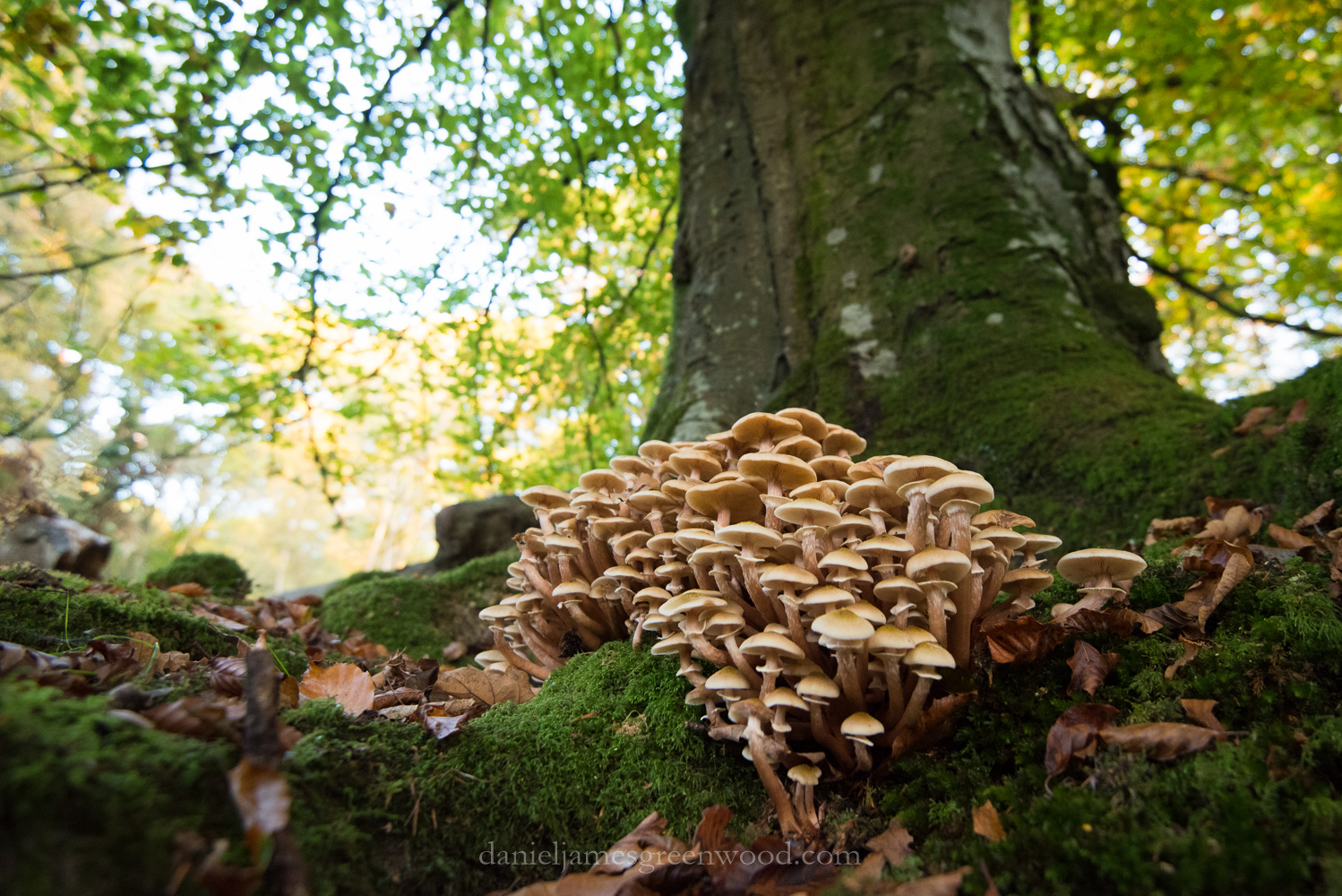
Here I can see giant polypore on the bottom left, honey fungus in the middle and lots of Ganoderma on different levels. The softening of the tree’s remaining wood will provide habitat for a huge range of invertebrates and other life. This is a habitat we have lost so much of over the past 70 years, as woods have been tidied and aforested for commercial production. That seems to be changing.
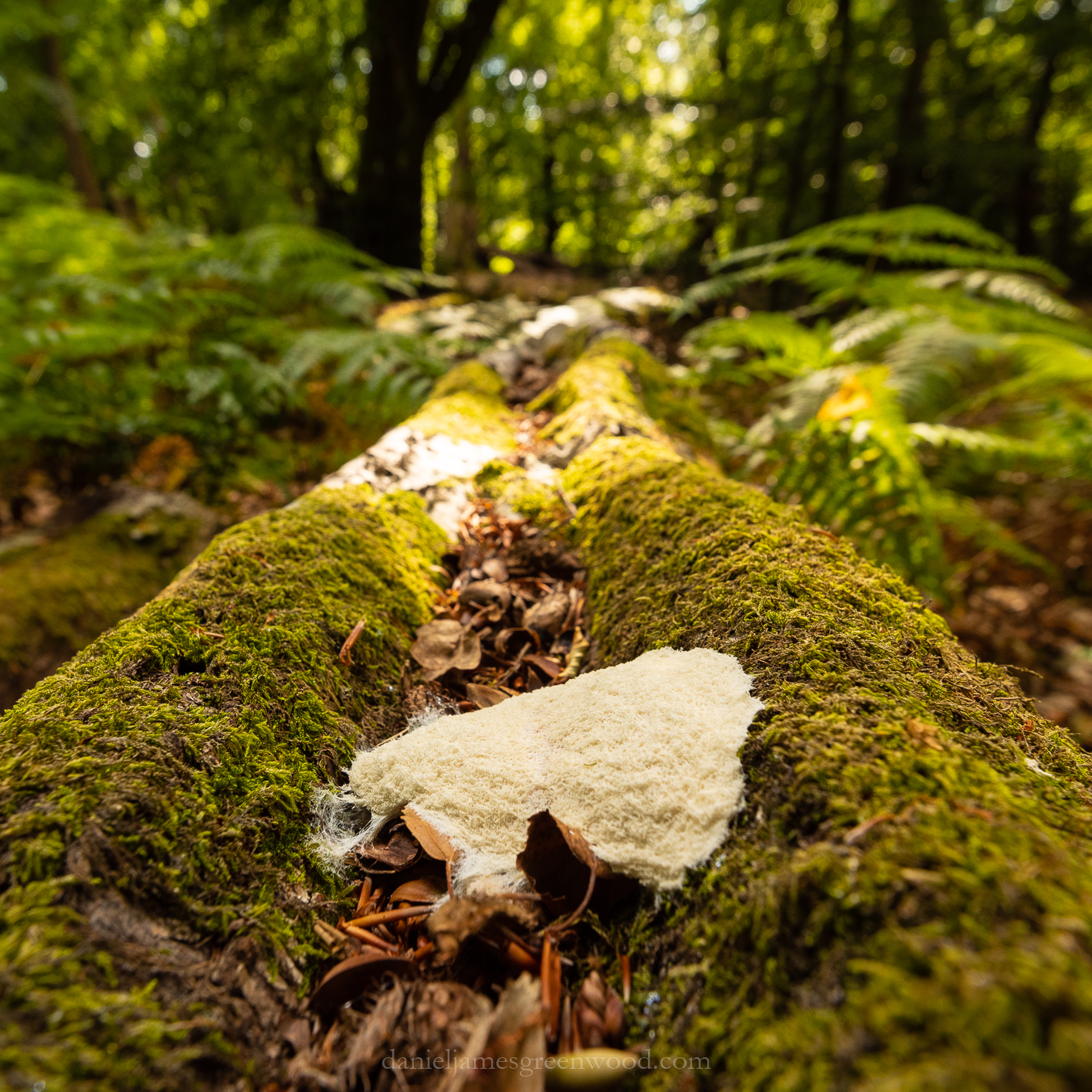
Beyond fungi, into a different species group but one that behaves in a similar fashion, I found a few slime moulds. This patch was splotched like someone’s old melted sandwich on a mossy log. Slime moulds are not in the fungal family. I learned recently that fungi were only separated from plants in 1969! Well done humans, literally a billion years later.
Here was an older specimen of the previous slime mould. It had been broken into by something that was probably eating it. It looks like a meringue, to my eyes. Also looks like an eye.
It was nice to head out further afield to seek out some ‘shrooms. But I have become so used to cycling or walking to the woods that it felt weird driving. It’s not lost on me that nitrogen dioxide, emitted by cars, is driving declines in fungal life as it alters the chemical make up of the soil. This is also impacted by air travel. I will make an effort to keep my emissions as low as possible. In terms of finding fungi, one of the problems with driving is that you cut yourself off completely from the world. When you’re walking or cycling somewhere, you’re immersed. I think I know what I prefer.
Welcome to one of those weeks that is little more than a lament at how dry southern England is. This week I’ve been in two different woods and the story is the same – the recent rain in Sussex has not given much of a boost to fungi. I managed to zoom round a local woodland one lunchtime and found a couple of things.
To give a sense of the impact of warm dry weather, even in the space of about ten days, check out the difference here. What is now a very dehydrated piece of birch wood was previously alive with slime moulds and all kinds of other life.
It is mainly a matter of rehydration, however, and when the temperatures drop and more rain arrives, the show can go on.
This is a species of Ganoderma bracket fungus growing on fallen wood. I only later noticed that a snail is hidden away in a nook of the fruiting body! You can tell I was in a rush. I wrote a lot more about brackets recently.
This is smoky bracket, not an omlette. I have seen this small community of brackets growing over the past few weeks. Again, it was only later that I noticed the other life, in this case a resting fly.
I was pretty disappointed in this mushroom hunt but then it was somewhere between 25-30 degrees (Celsius). The area which I’ve mentioned before, that has been opened up, is now experiencing more trampling, including mountain bikes coming through. From my experience of woodland management, that was predictable.
But some management that was really positive was the creation of dead hedges of logs and branches in a well-shaded area. This was where the mushrooms were hiding! I found a nice patch of oysters that were swamped/protected by brambles. This is a nice edible mushroom, not that I’m picking.
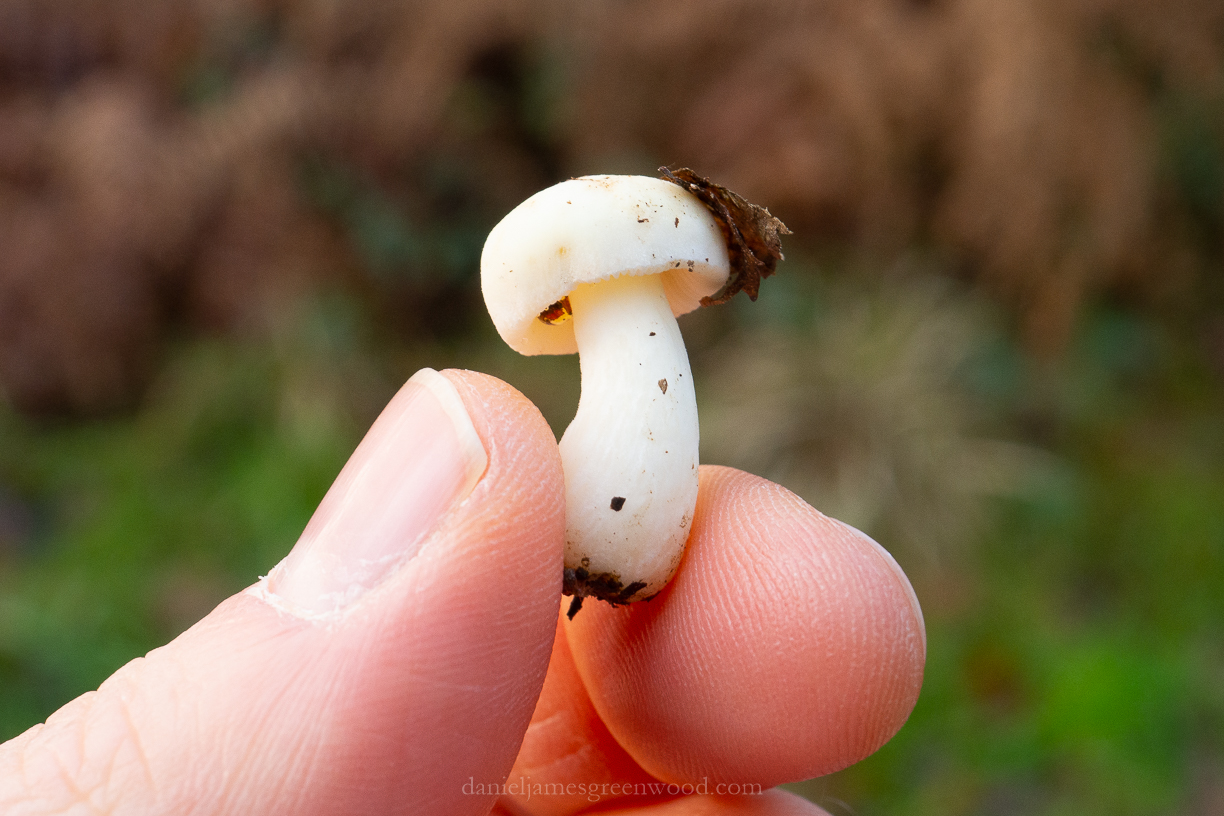
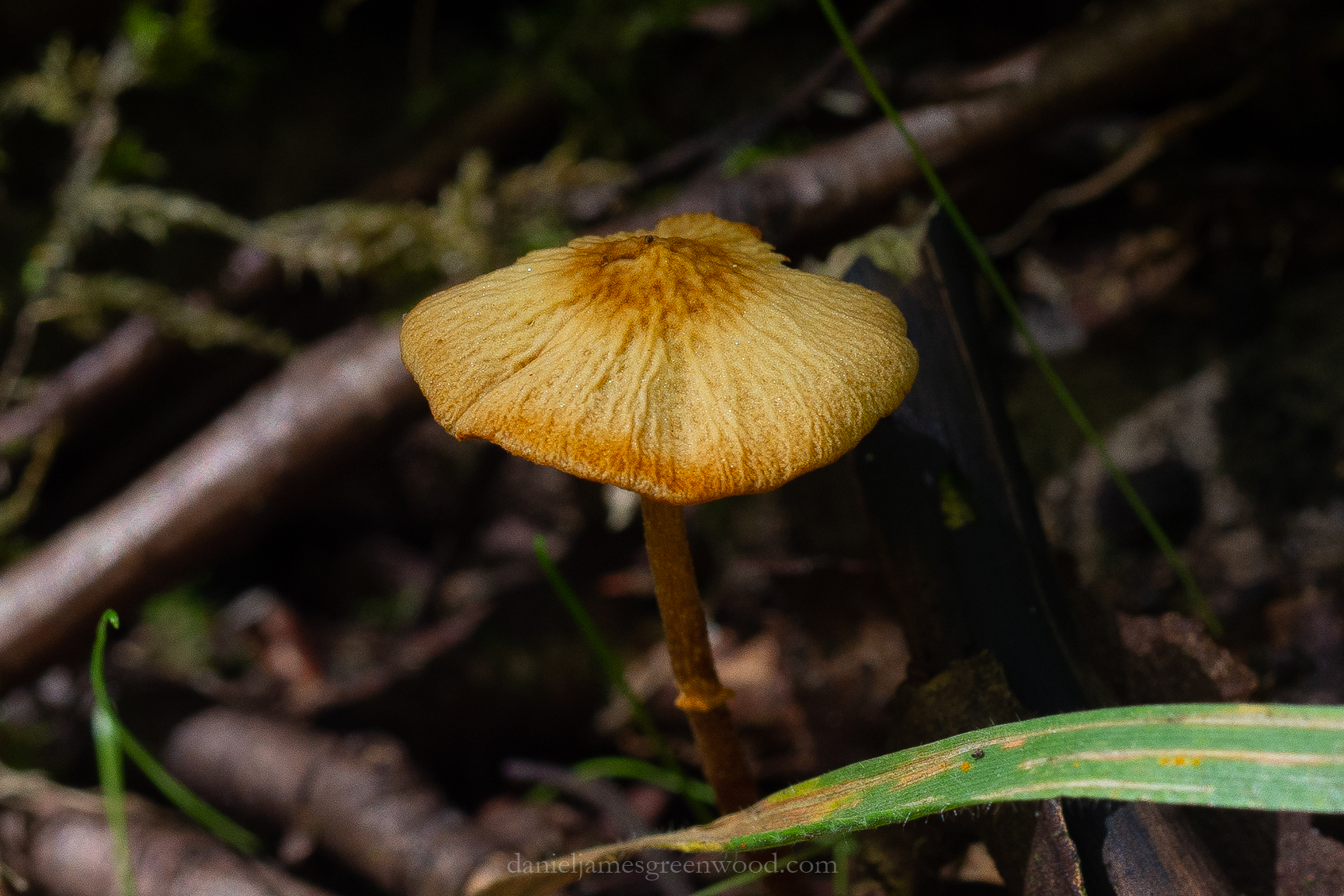
I also spotted this small mushroom, such a joy to find something. I like its veiny-cap and the reddishness. I’m not sure of the species.
Dry times such as these make alternative topics a pressing need. At the moment I’m researching an article on fungi and Chernobyl, so stay tuned for that.
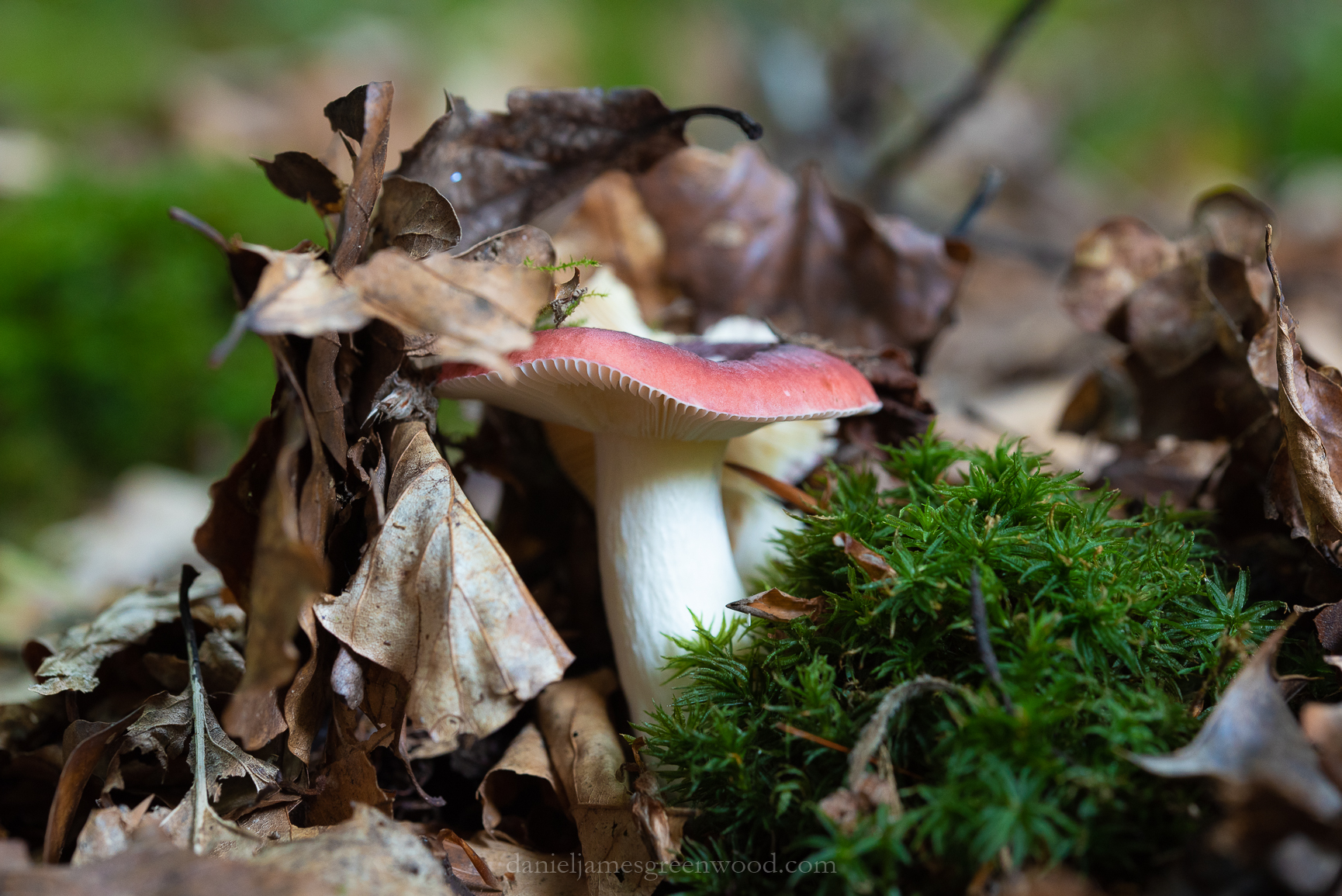
It’s a great relief to be able to share some fungi from the Wood Wide Web this week. There has been steady rainfall in recent weeks which gave the sense that some summer shrooms might be ready to appear. At this time of year I’m looking for the early indicators of autumn’s fungal moment, which appear in the form of brittlegills or Russulas, in scientific language.
A mixed secondary/ancient woodland in the Sussex High Weald
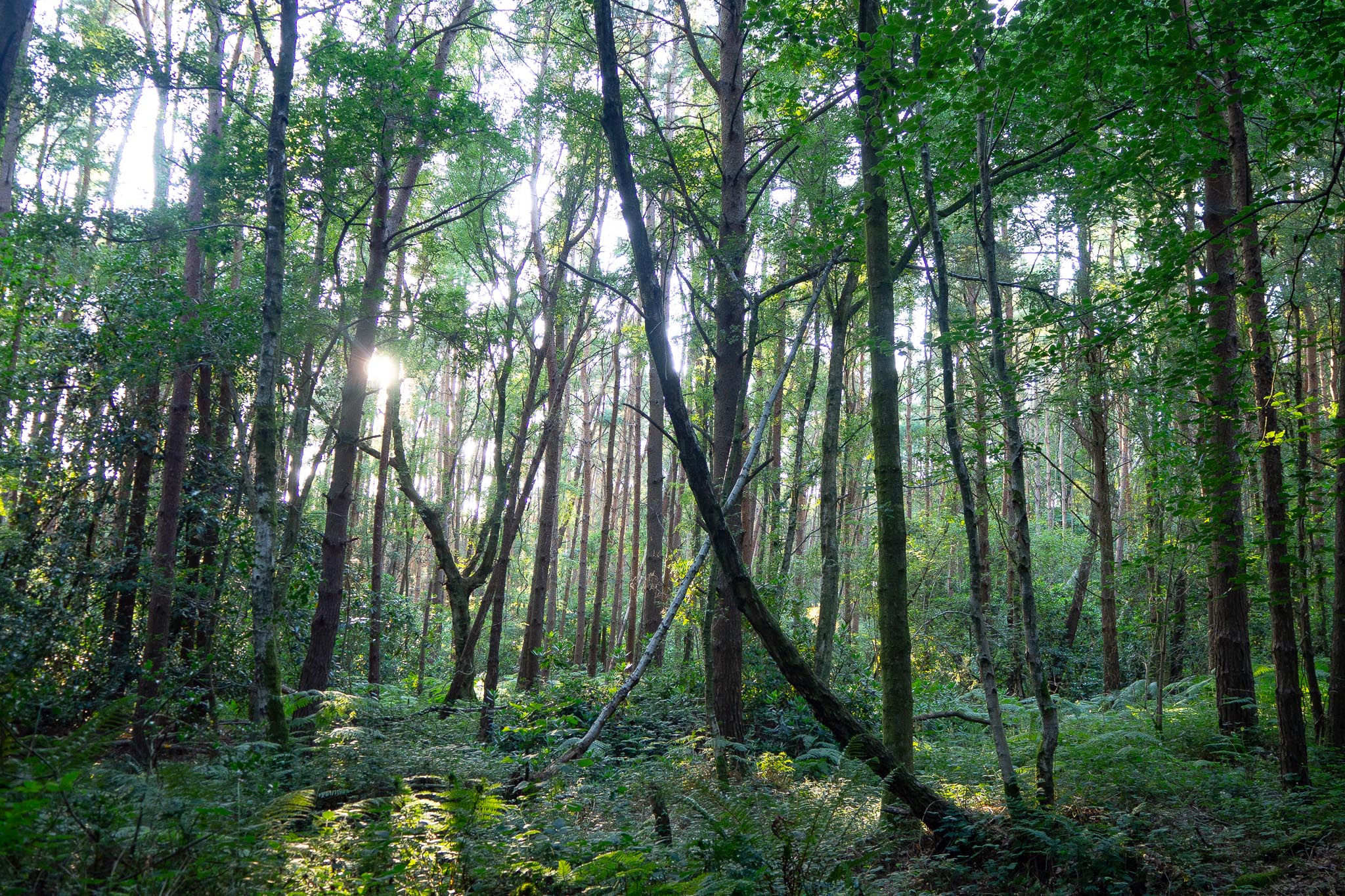
The fungi described this week are garnered from two walks in the woods of the Sussex Weald in West Sussex. The first walk was a short evening wander to a mixed woodland with signs of ancient woodland flowers like bluebell, but with lots of birch, hazel and some oak. It then pretty abruptly turned to pine, which happens quite often in the Weald because of the arrival of sandier soils where the Weald clay ends, and the prevalence of forestry.
It was much more dry than I had hoped but mushrooms are tenacious things. This nicely illustrated a new fungal phrase I learned in Robin Wall Kimmerer’s book Braiding Sweet Grass (p.112 in the ebook). You can listen to an interesting podcast with the authorabout mosses.Tthe Native American language of the Anishinaabe describes “the force which causes mushrooms to push up from the earth overnight” as ‘Puhpowee’. And so was this very small brittlegill pushing through the leaf litter.
I have never really tried to identify brittlegills to species level because they are so numerous and similar. I would guess this species is the charcoal burner. But I could be wrong about that.
This is one of the red brittlegills from August 2018 in the Weald, something to expect in August through to September.
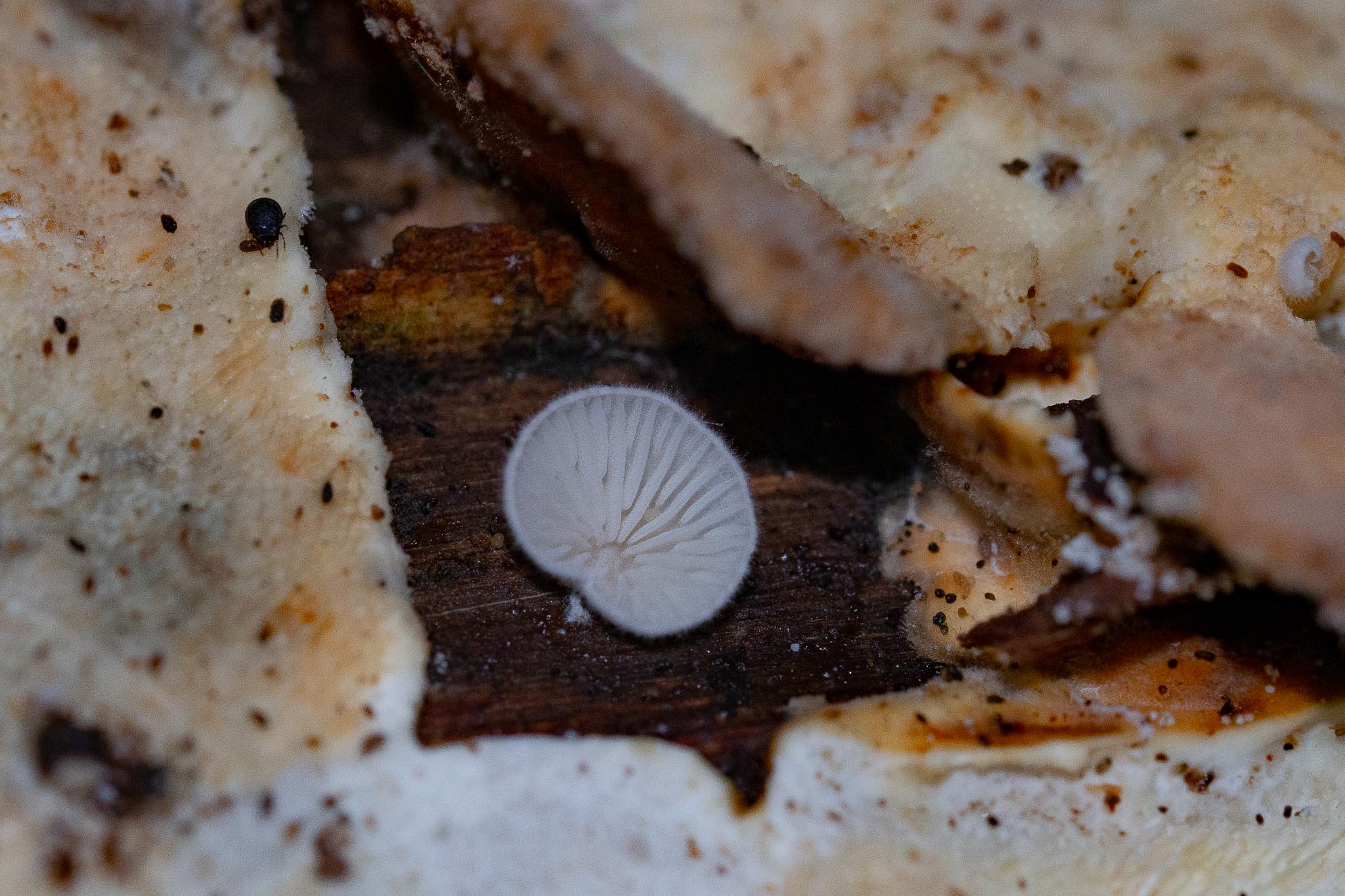
It’s a very dim view due to the light but my companion found this fungus within a fungus. It’s a species of oysterling. You can see a black springtail (or maybe even a tick?) on the left hand side for scale.
The second walk was in the afternoon at another Wealden woodland I am getting to know quite well. I recorded an Instagram story guided walk of this experience which you can see here. If you have the Gram.
Again it was well-nibbled brittlegills that could be found. This is probably the work of a small mammal with some input from a slug. I’ve seen grey squirrels pick these mushrooms, and spin them around by the stem and nibble down the gills. That interested me because grey squirrels are an American species. Brittlegills are also found in North America, so perhaps they are just returning to their roots. Does belittle the idea that grey squirrels don’t belong in European landscapes, the evidently do. Yes, I know about red squirrels.
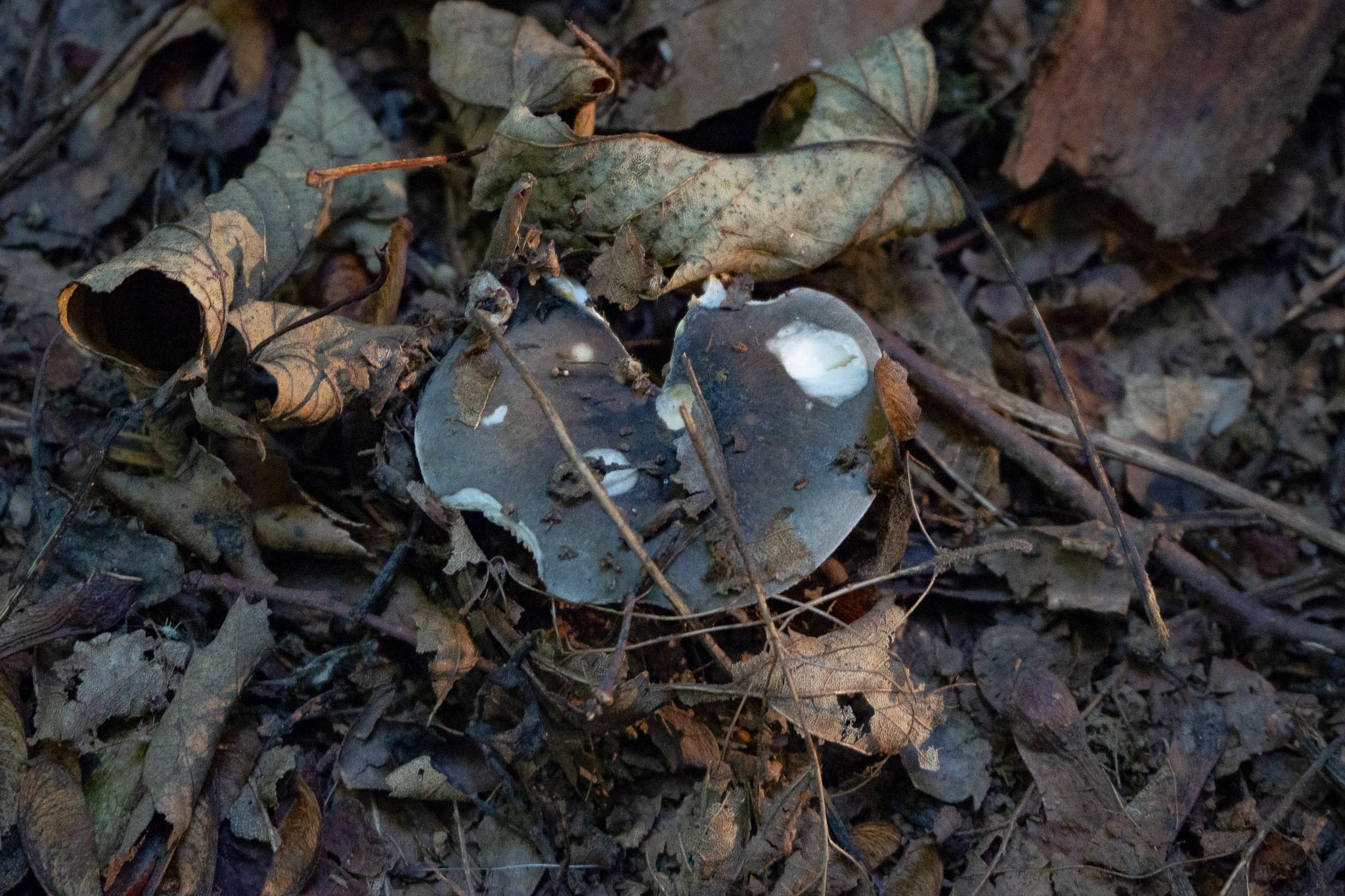
I’m sure these species are not in any way appetising for the reader. This is probably one of the green brittlegills. It looks a bit ghoulish but I was pleased to find it. All these finds were just at the edge of footpaths.
A common summer mushroom is rooting shank, one of the toughshanks. ‘Shank’ has a pretty dark meaning in modern language, particularly in London, but it’s an old name for leg. That’s where the names of red or greenshank come from in the bird world. Americans call similar species ‘yellowlegs’. I prefer the olde Englishe names.
Rooting shank is quite an abrupt shroom, it just shows up where it likes. You can find it from now through to September from the woodland floor to stumps and buttresses of trees. This dream of a shroom was in the White Carpathian mountains in the borders of Czechia/Slovakia but I first saw it in urban south-east London.
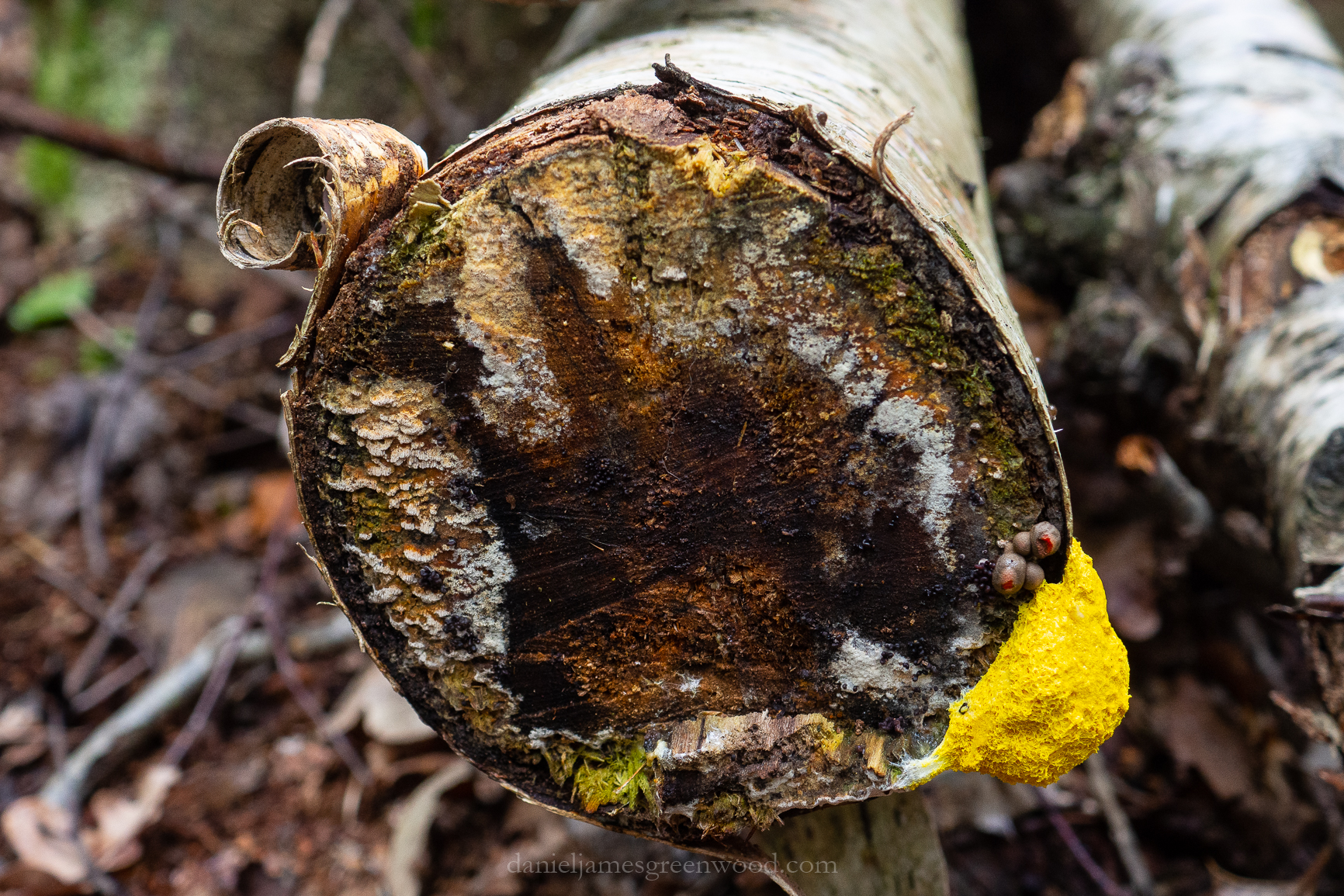
It’s not a fungus, but this dog vomit slime mould was a lovely find (believe it or not). This amazing video gives a much better explanation of what this slime mould is up to:
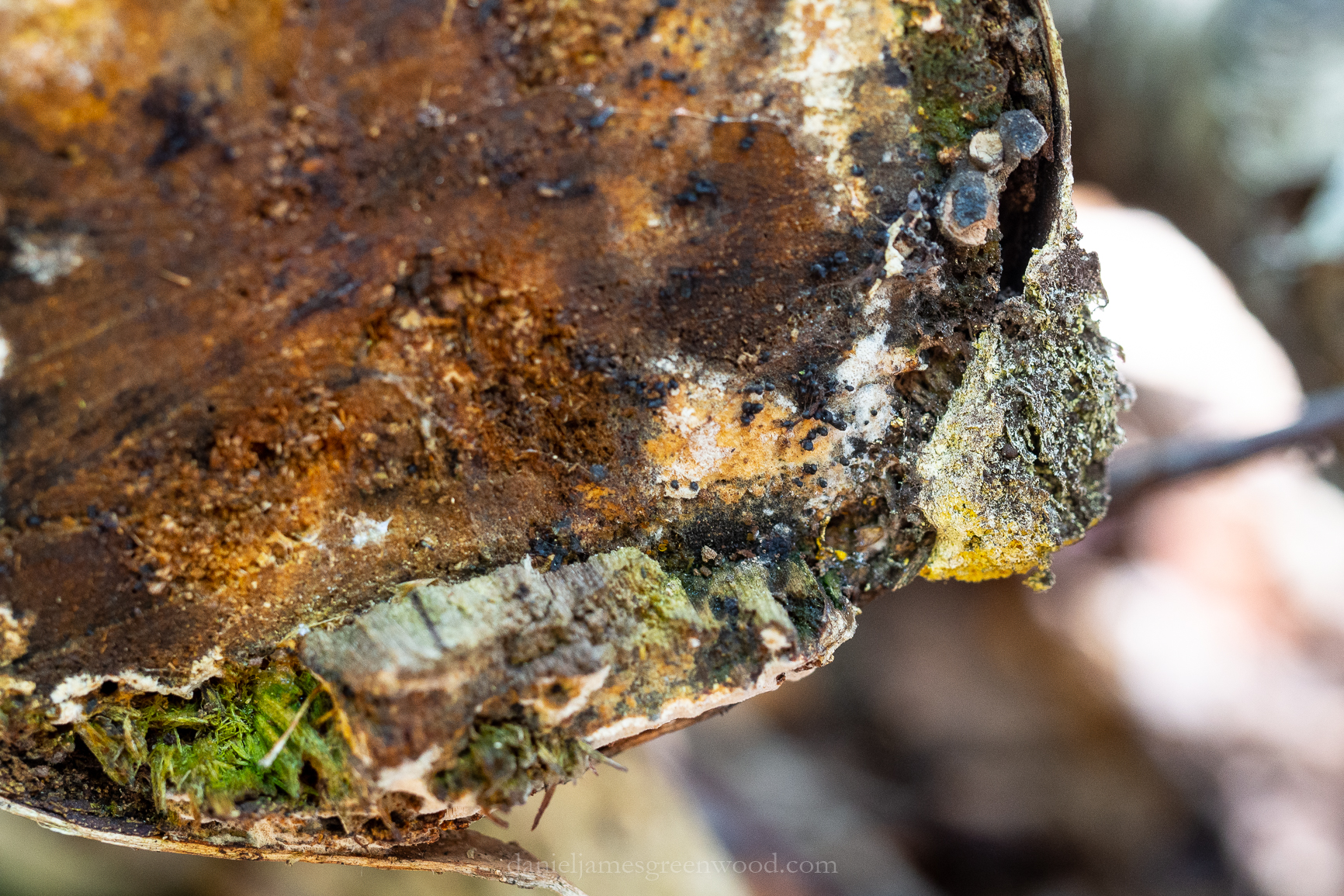
It was only after taking this photo of the slime mould’s birch log that I realised how much was happening. You can see the early stages of small polypore fungi moving in from the outer edge as the wood degrades. I think the greyish blobs next to the slime mould may be Lycogola species, sometimes known as wolf’s milk. Lyco means wolf. The puffballs, Lycoperdon mean ‘wolf’s fart’. Oh dear. And we don’t even have wolves in the UK anymore, just in Downing Street, LOL!
At last the rain has arrived. But did it bring a deluge of the mushroom kind? On a lovely clear evening after work I went to the woods to find out.
Even in dry times there is one fungus that will not desert you. Artist’s bracket is a bracket fungus in the family Ganoderma. It gets its common name from the fact you can draw on the sporey underside of the fungus, usually something like noughts and crosses. I’ve seen these fungi get to be huge but in most places they are usually broken off by human hands.
They have the ability to renew themselves, though, as this one above has begun to do. I read somewhere that this fungus produces 30billion spores an hour. Suppose I’ve taken a few home with me then.
After rain like we’ve had in the past week in southern England, you don’t dream of bracket fungi. Or do you?
Walking along a path in an area of open woodland my eyes nearly popped out of my head when I saw this massive dryad’s saddle sprouting from a dead sycamore tree. This area has been hammered by the combination of no rain and heavy footfall impacting after clearance work of sycamore has taken place, so I wasn’t considering the possibility of fungi being present.
This is a fungus to find at this time of year. Due to its size, it will often find you. It’s an edible species but probably not at this stage. I’m writing this rather bleary eyed because I’ve spent the past couple of days researching the cultural heritage of oak trees for a talk I gave this week. Little did I know that dryad actually means ‘oak tree nypmh’, rather than simply ‘wood nymph’. The idea is that a nymph, or woodland sprite, or fairy, would sit on this bracket and hurl abuse at passers-by.
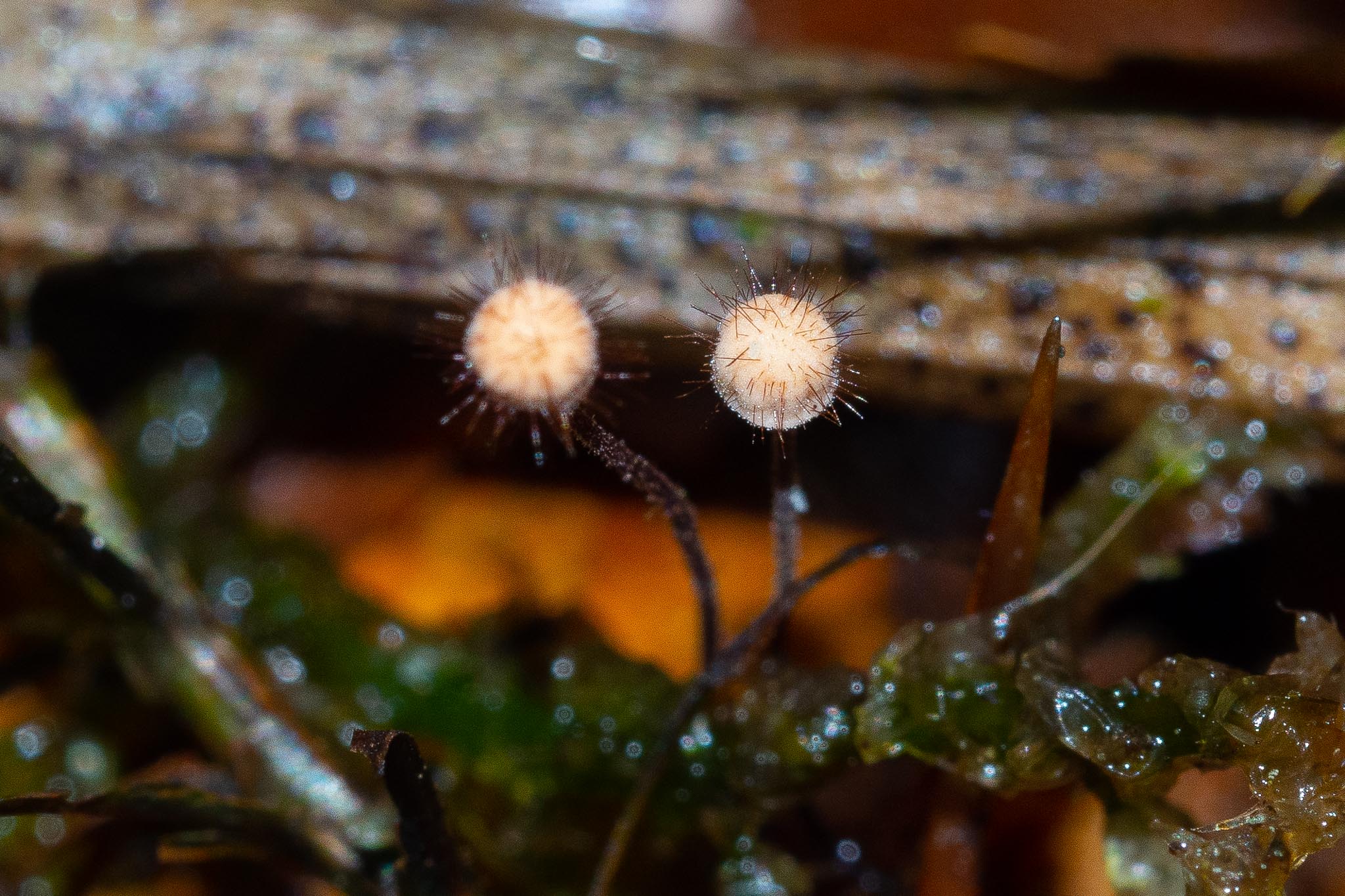
I was looking down at some moss on the woodland floor when I discovered these baffling, miniscule mushrooms. They were about the size of a grain of rough sea salt. On their caps were these spikes, at first thought perhaps another fungus or mould growing on top.
It just made me realise how much we can miss, these were some of the smallest fruiting bodies I’ve ever seen. I have no idea what they are.
Next door was something a little larger, probably a bonnet of some kind. I don’t have the knowledge to get any closer than that. Again, this wasn’t much bigger than the weird fruiting dudes alongside it.
After a good couple of hours searching, it was time to head home. Dramatic clouds built over the heath, perhaps with more rain to feed the fungi. We shall see.
For some reason I decided to write a weekly Fungi Friday blog in 2020. It might have been the worst possible year to attempt this. It’s true that fungi peaks in the autumn but some of the more gentle, milder and wetter months of the year can give fungi an earlier chance. Not so in 2020, as this blog has complained for the past few weeks, it’s been very dry in southern England.
I could blame a global pandemic for the difficulty in finding fungi this spring and summer, but the dryness has been the main problem.
There are only so many dry (literally) blogs you can write about the lack of the thing you want to write about. This week I thought it would be a chance to cover a species that is one of the best known in the world and actually forms the largest organism on Earth. It’s also ‘feared/hated by gardeners’. I seem to use that phrase a lot in this line of unpaid work. What’s the species? It’s honey fungus.
The mycelium of honey fungus
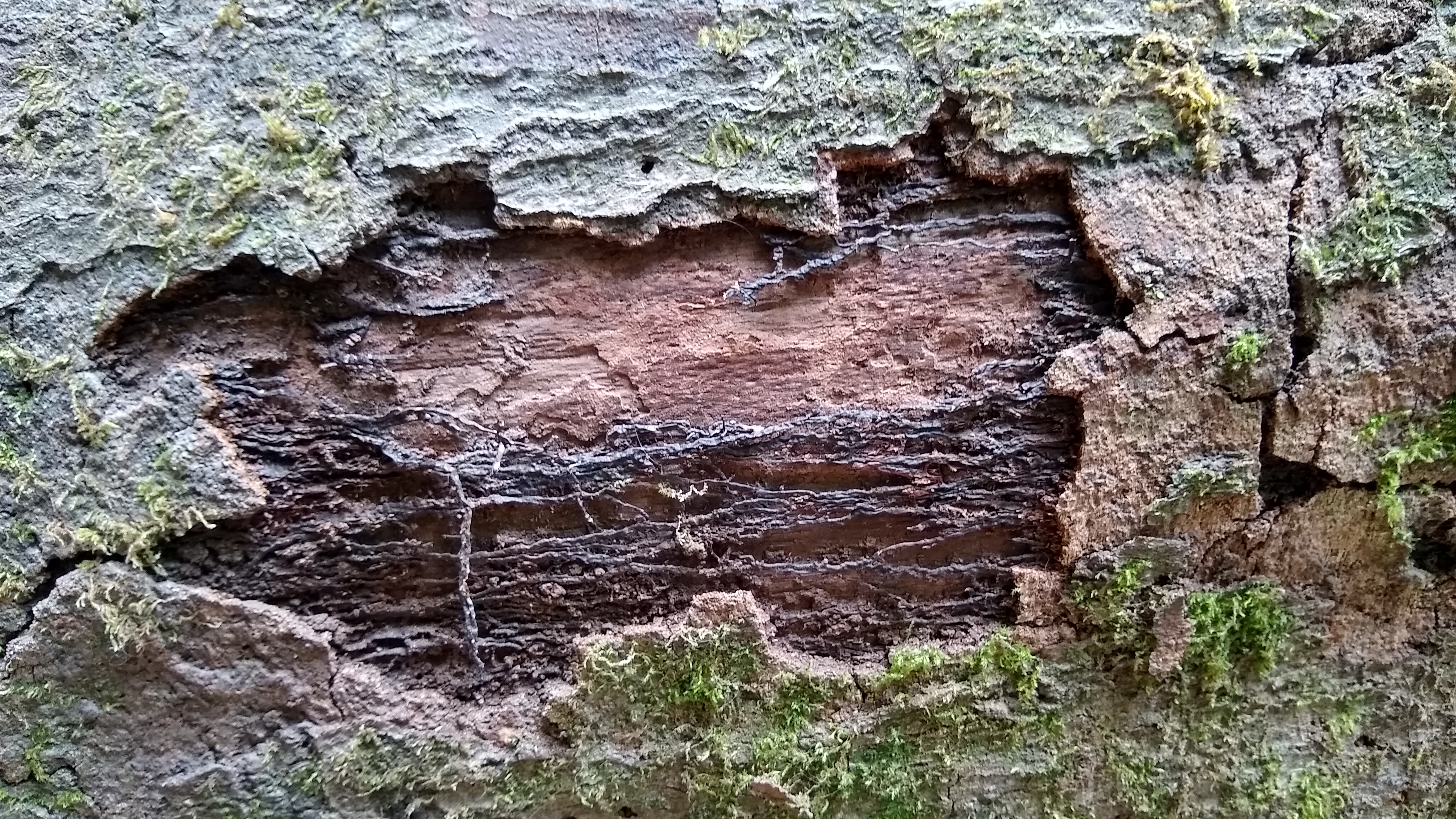
Every time I take a photo of these ‘boot laces’, I always intend to file it somewhere easy to find. That never happens so above is a low-res phone pic of a honey fungus mycelium (the fungal network of hyphae, a root-like structure that forms the living, physical structure of the organism). This can often be found underneath the bark of a tree that has fallen down or that has died due to the impact of honey fungus. These ‘boot laces’ are also what represent the largest life form on Earth. That’s a humongous fungus, some 2384 acres in size.
An Armillaria oystayae specimen is the biggest organism in the world (not this one)
That species is Armillaria oystayae but it’s not the case of a mushroom or toadstool over 2000 acres in size – can you imagine how much that would stink when it began to decay? Because that is only the apple on the tree, whereas the mycelium is the living and breathing fungus itself. The fungi above had moved in on a tree that had been harmed by development, with likely damage to the roots, making the tree vulnerable. No one described the developers as pests in that instance. One suggestion was for the tree to be felled just because the fungus was present. That’s a terrible idea.
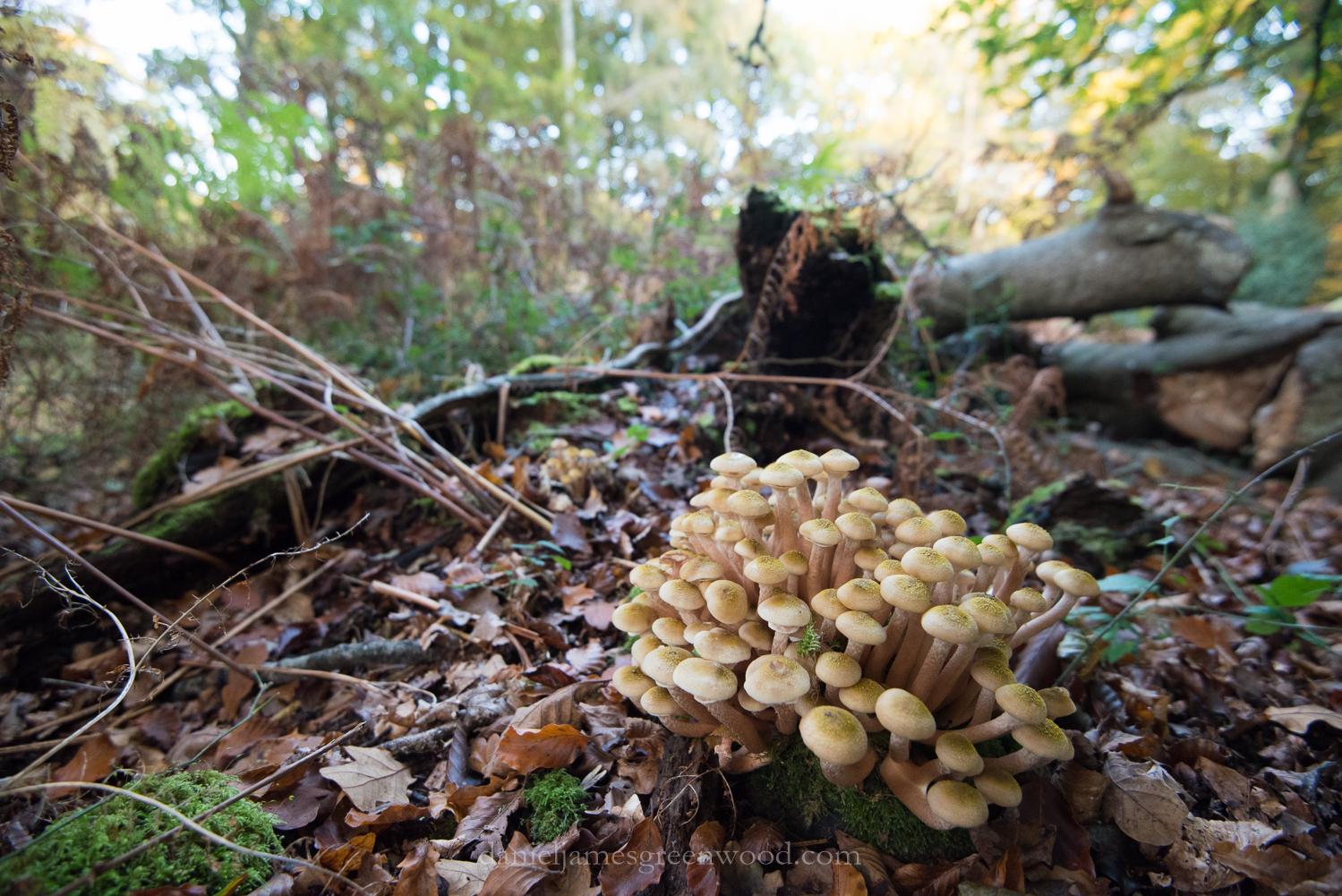
Fresh fruiting bodies of honey fungus on an ash stump
Honey fungus is renowned for its parasitic potential. Armillaria oystayae is a ‘pest’ for foresters. I would argue that honey fungus, and other species like it, is simply living in a nature-depleted world where ‘naturally-occuring’ species diversity has been destroyed by industrial monocultures in farming and forestry, and development that does not take account of the landscape it is replacing. They are also just trying to survive and taking advantage of niches which are presented to them.
A plantation cleared on a hillside in Czechia – soil will be lost to erosion as the roots of the trees die and tension is lost
If fungi have been on Earth for 1billion years, they have evolved in a much more species-rich biosphere, rather than one we dominate now, which, in the case of Western Europe, is suffering from a loss of ancient semi-natural woodland and the associated habitat mosaics and species. In this case I mean there are fewer trees and less dead and decaying wood, the latter of which is a vital ingredient in a functioning and biodiverse ecosystem. Honey fungus, just like us humans, needs food and somewhere to live. It just so happens that honey fungi eat where they live and what they live on. Sometimes they also kill it. Sound familiar? Just ask Planet Earth.
Honey fungus on the raised rootplate of a fallen tree
The most common species of honey fungus that occurs in Britain is Armillaria mellea. In actual fact it’s an indicator of ancient woodland, which means that people can’t use xenophobic language around ‘alien invasion’ to explain why it could be a problem. An ancient woodland indicator is used to show us that it is over 400 years old in Britain and Europe. In my view, this is just another species which highlights our own ignorance – we think we can control nature and that anything which doesn’t stick to the script must be destroyed or is a pest. Covid-19 is teaching us in a tragic fashion that we were wrong about that.
It’s true that honey fungus has parasitic tendencies and therefore can kill trees through a process of starving it of nutrients, rather than the supportive biological process of providing the tree with things it can’t get (a mycorrhizal relationship). But as a tree inspection professional once said, trees are not a safety issue until we show up.
Young fruiting bodies of honey fungus in the ancient woodland landscape of the New Forest
One thing that appears to work in honey fungus’s favour is its edibility. However, from what I know it’s only something that can be eaten in moderation and it does cause stomach upsets in some people. It’s definitely not a way of ‘getting rid of it’ from your garden, because the mycelium is there as well. And no one defeated an apple tree by eating all its fruit.
What can you do if you find it at the bottom of a tree? The only advice I have is not to panic and do something that causes more damage. The next step is to learn to love fungi and appreciate that trees die too, and fungi is there to help create space for more life. Beyond the loss of a much-loved tree, the main problem is our own rigid views of how the landscape lives and dies.
I headed to the woods again this week to see how the Amanita from last week’s post was faring. There had been almost no rain again until that point. The woodland floor was crunchy and dry. It never feels good seeing a woodland like that.
I was surprised to see that the mushroom hadn’t advanced. It was still encased in its bone-dry veil. I had a closer look to see if it even was a mushroom and found that it was actually attached to the soil through fungal roots. It was a learning point – I thought that even without water a mushroom can advance. Evidently it’s very difficult and sometimes they can’t.
It’s worth saying that fungal fruiting bodies (usually ‘mushrooms’) are 90% water. The photo above shows a woodland stream (‘gill’ in the Weald). It has been an exceptionally dry spring.
A good indicator of how much potential there is to find fungi can be seen in bracket or polypores on trees. This is probably hairy curtain crust which is looking as sorry as you’ll find it.
Despite the super-dry conditions I did find more fungi. It was one of the most common species in the UK – sulphur tuft.
These are places where fungi can fruit in these conditions. The inside of a decaying oak tree stays cool and damp, especially with holly surrounding to create shade and thus cool.
You can see how hungry the local slugs are. To humans this is a poisonous species, so don’t be a slug. Even though these had been heavily munched, it’s nice to see a shroom. Rain has come in the past 24 hours, so it will be interesting to see how things might change in the next few days.
At last, this week some rain arrived. I headed to my local woodland to see if any mushrooms had taken the bait. I went there with a slender hope of seeing anything because it has been so dry this spring.
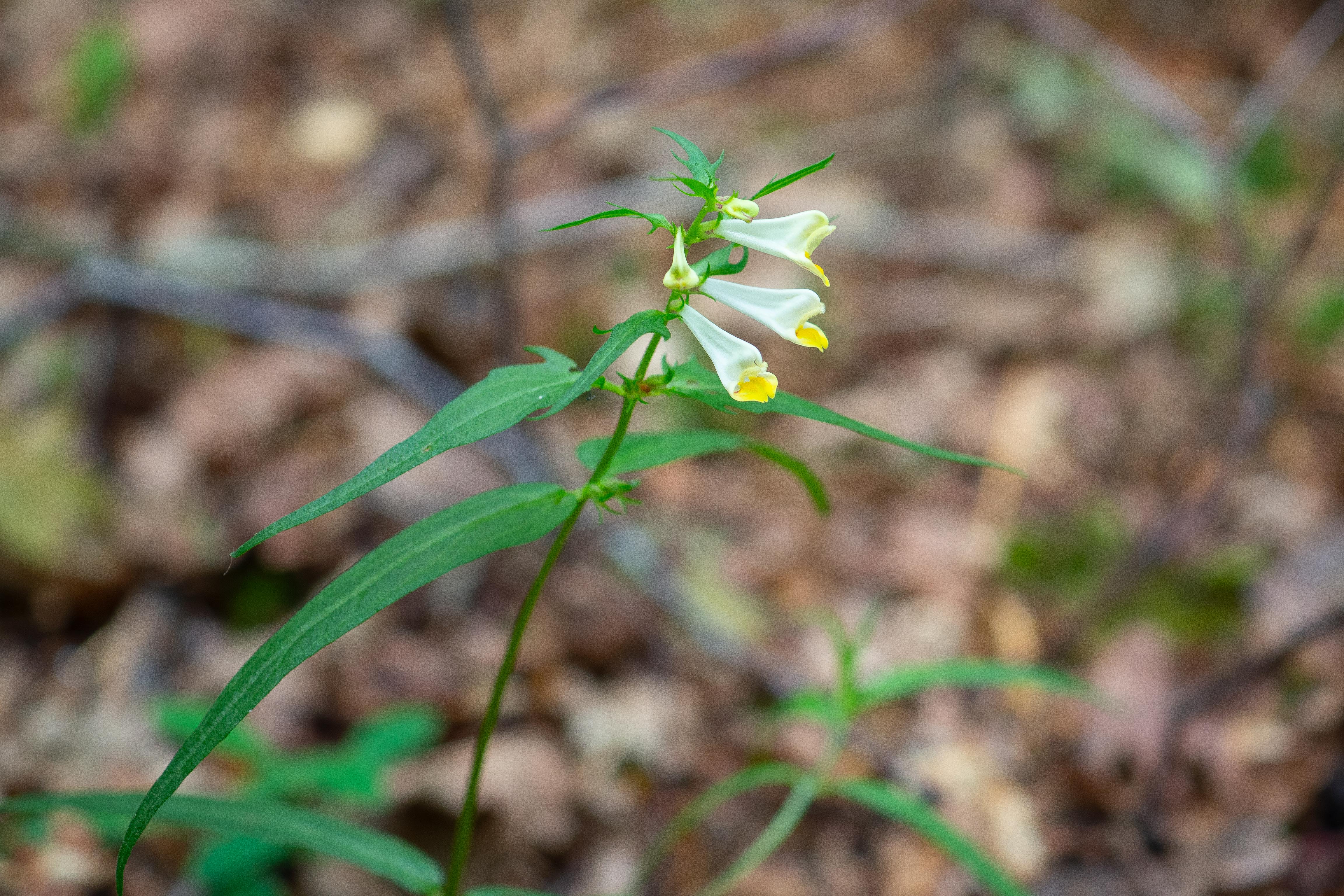
Common cow wheat
It was pleasing to see special woodland plants such as common cow wheat, another of those species which is not actually so common anymore.
Juniper haircap moss
The bryophytes also looked more lush and watered after a day of rain in the past week.
This stunning drinker moth caterpillar was chilling (literally) on a boardwalk. I moved my fellow redhead to safety before it got squished by evening strollers.
My special summer patch was free of fungi, it may be another month before anything comes up there.
The mycelium of green elfcup
Just like last week, green elfcup was evident in those beautiful blue-green stains on bits of fallen wood.
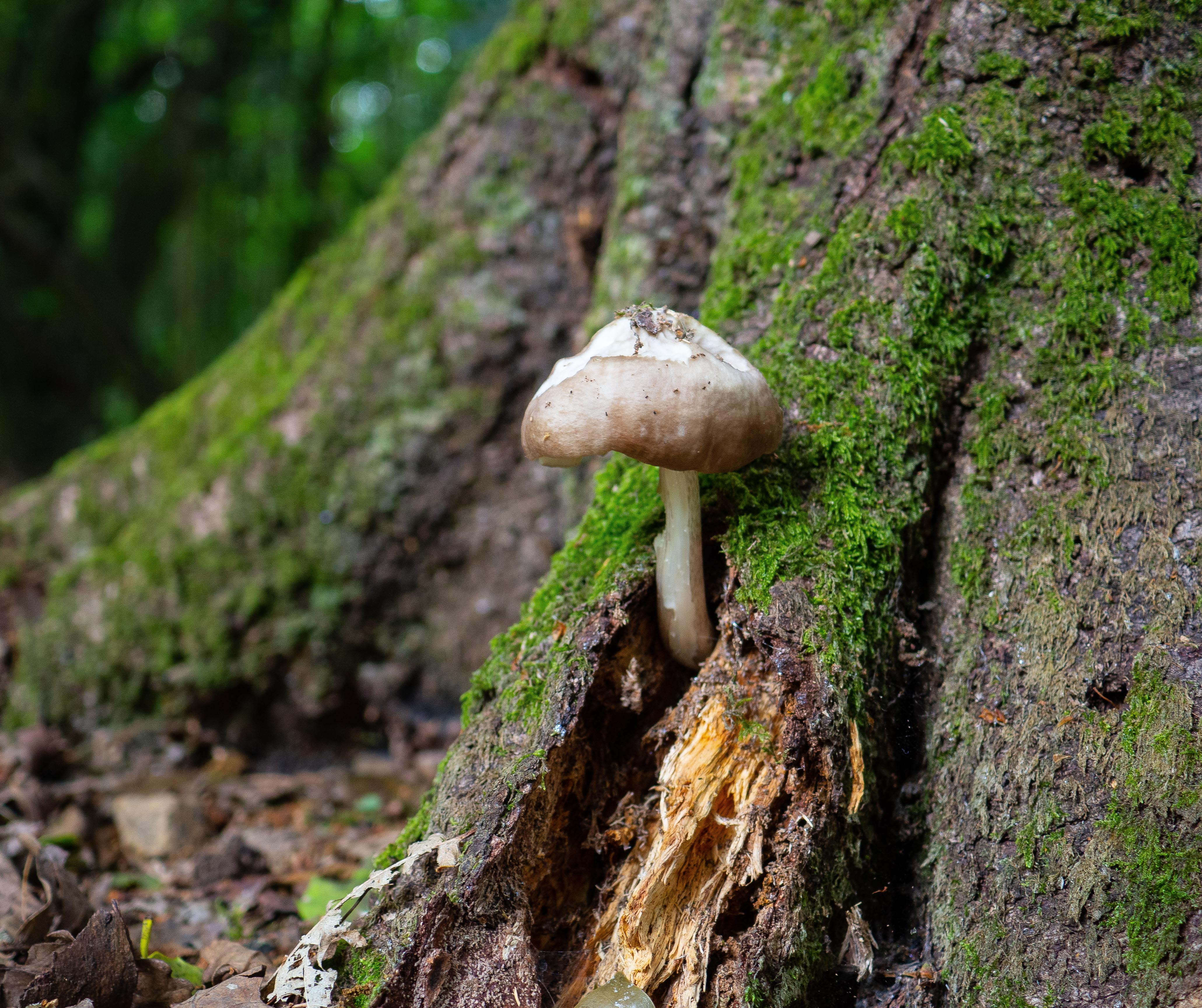
I was quite startled to spot this growing out of the buttress of a tree. I think this might be rooting shank, a species which is often found at this time of year. It’s a signal of summer.
The slugs are obviously hungry at the moment because much of the fungus had already been eaten. The slime trails below are the smoking gun.
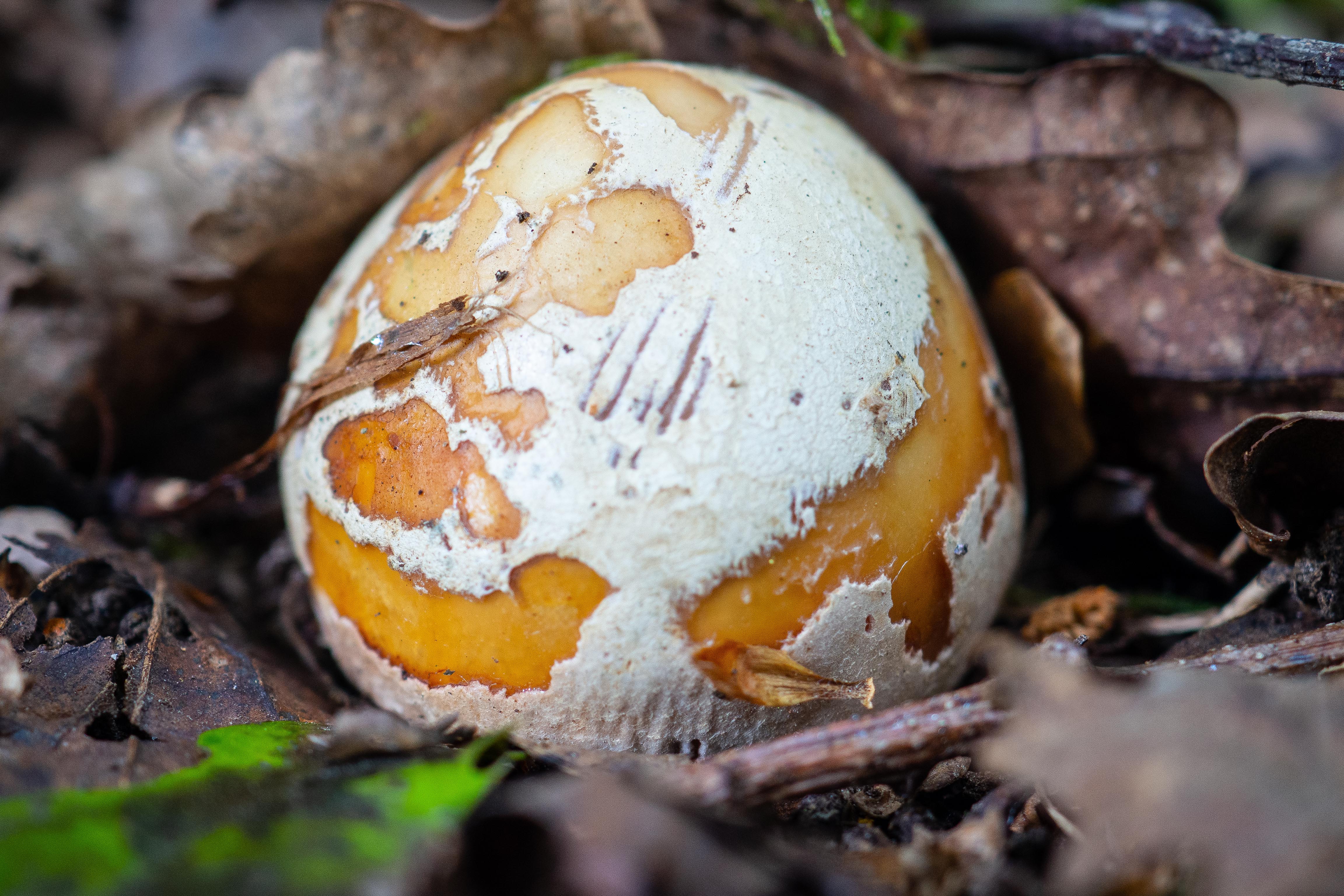
Nearby I saw what I thought was an old tennis ball. Upon closer inspection it was in fact a mushroom making its way up into the world.
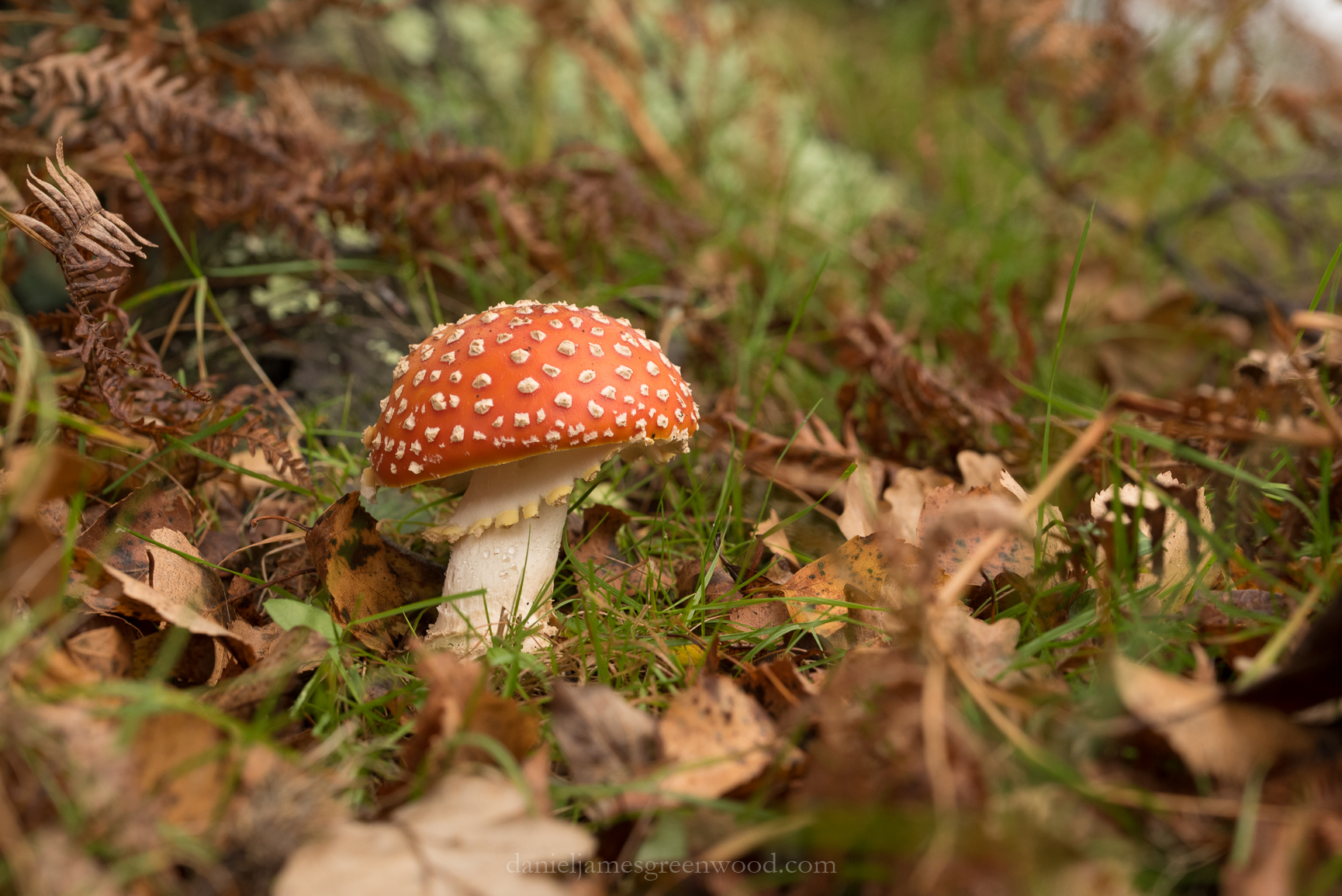
This is almost certainly a member of the Amanita family, home to fly agaric and the death cap. It could be tawny grisette. You can see it is appearing from a veil. There is the typical Amanita patchiness to the remnants of the veil. I did wonder if this might even be Caeser’s mushroom. I will try and check back in a few days if it can last that long.



































 Unlocking Landscapes