The violet webcap returns 💜

As seen on 11th October 2022

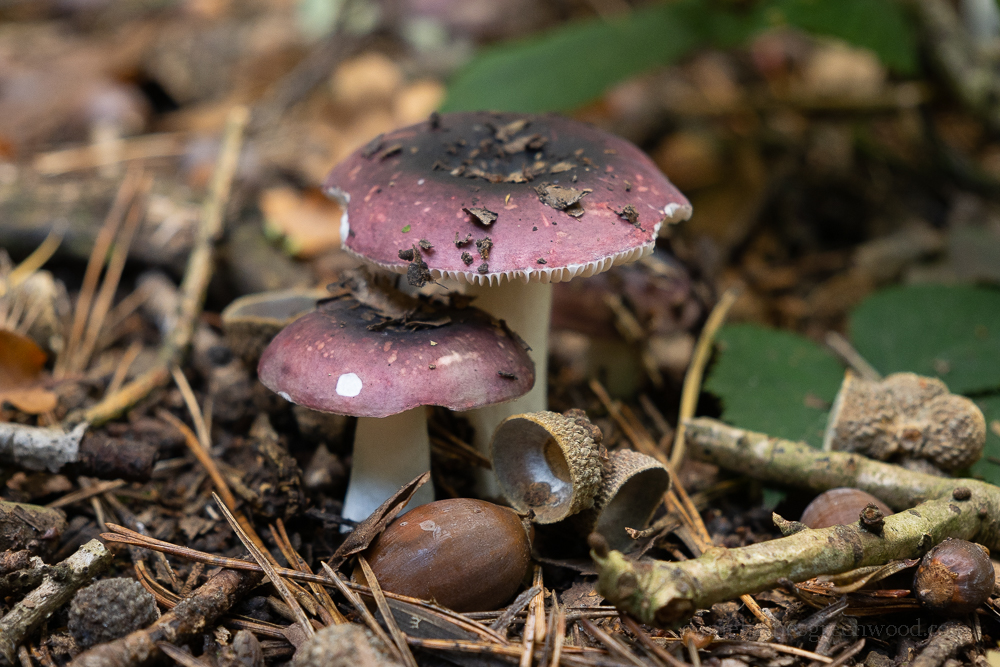
On a recent visit to a local woodland, I accidentally stumbled into teletubbyland. I don’t mean some bizarre, super-rich person’s eco village, simply that I had bumped into one of the characters from this incredibly weird but very popular childrens TV programme.

Violet webcap

Of course I’m not actually seriously saying that some giant purple baby thing with an antenna on its head was hanging out in the woods – wouldn’t surprise you though, really – but something in its image. I’m talking about a violet webcap (Cortinarius violacious).
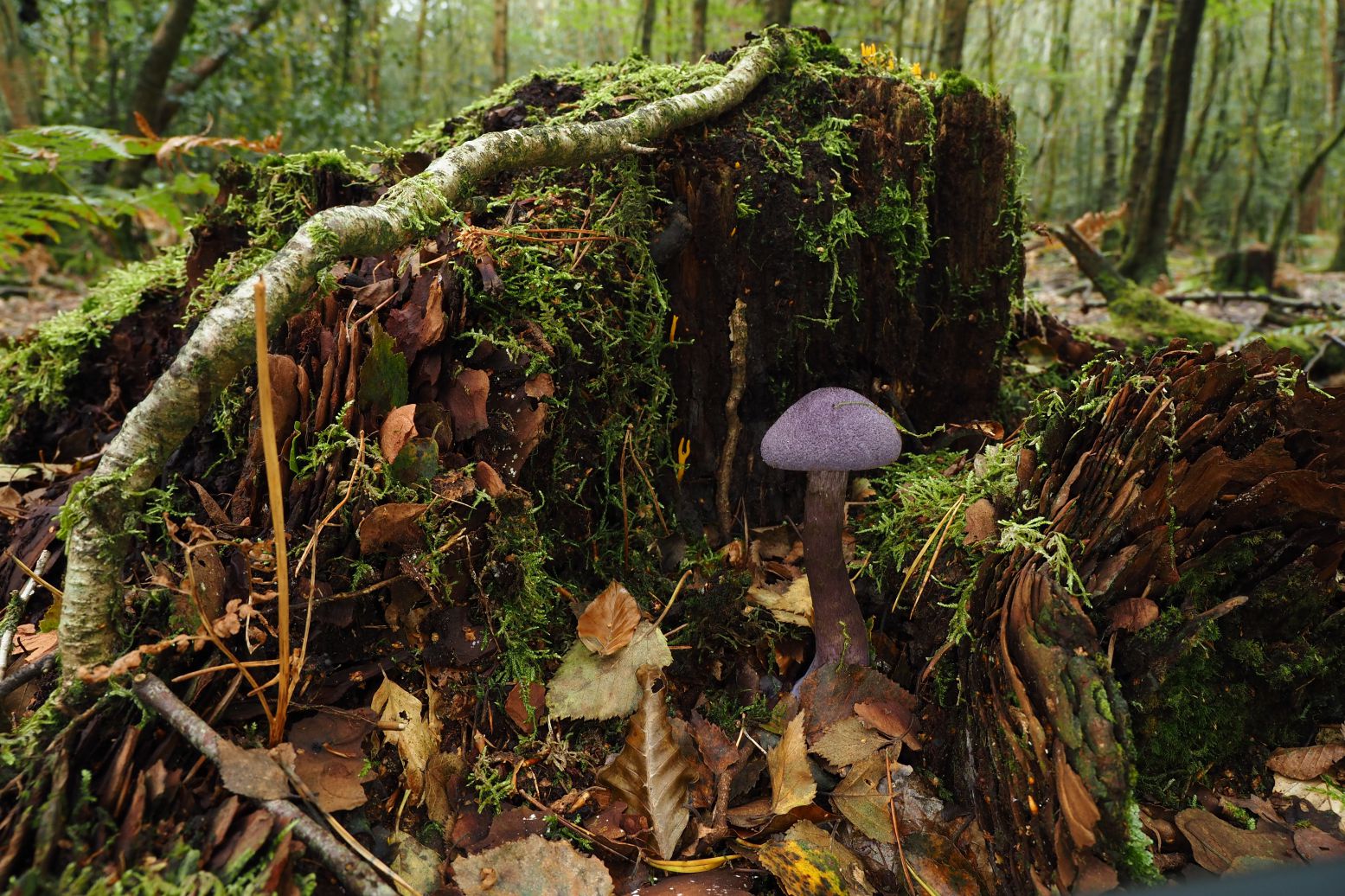
This is a species that I saw for the first time last autumn in nearly the exact same spot, almost a year to the day (above, in mature form).

Bay bolete

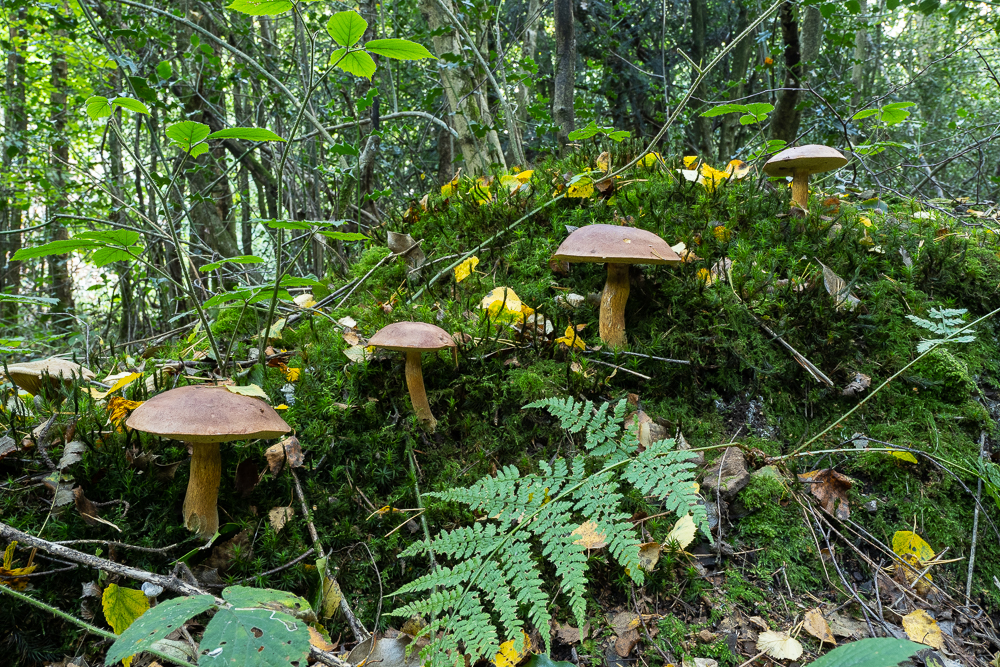
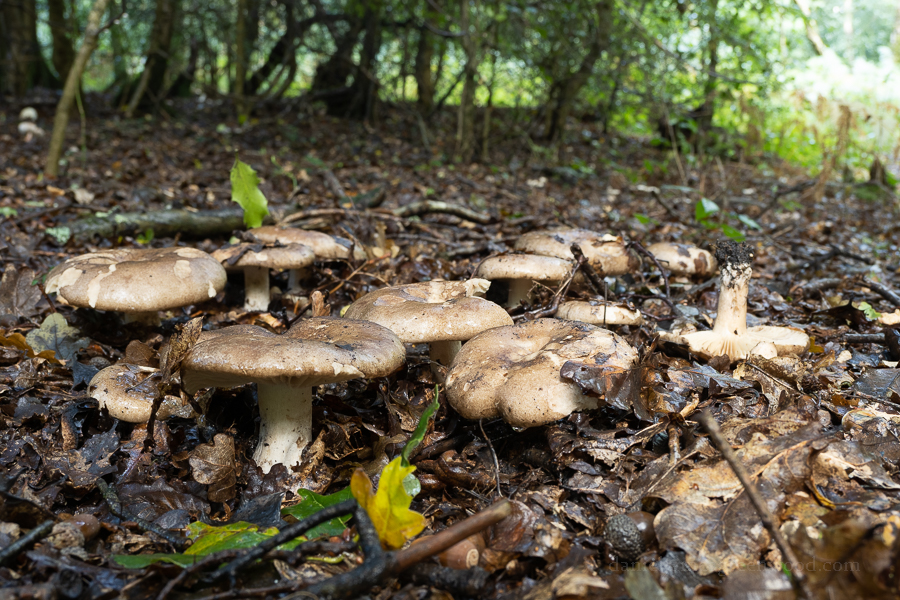
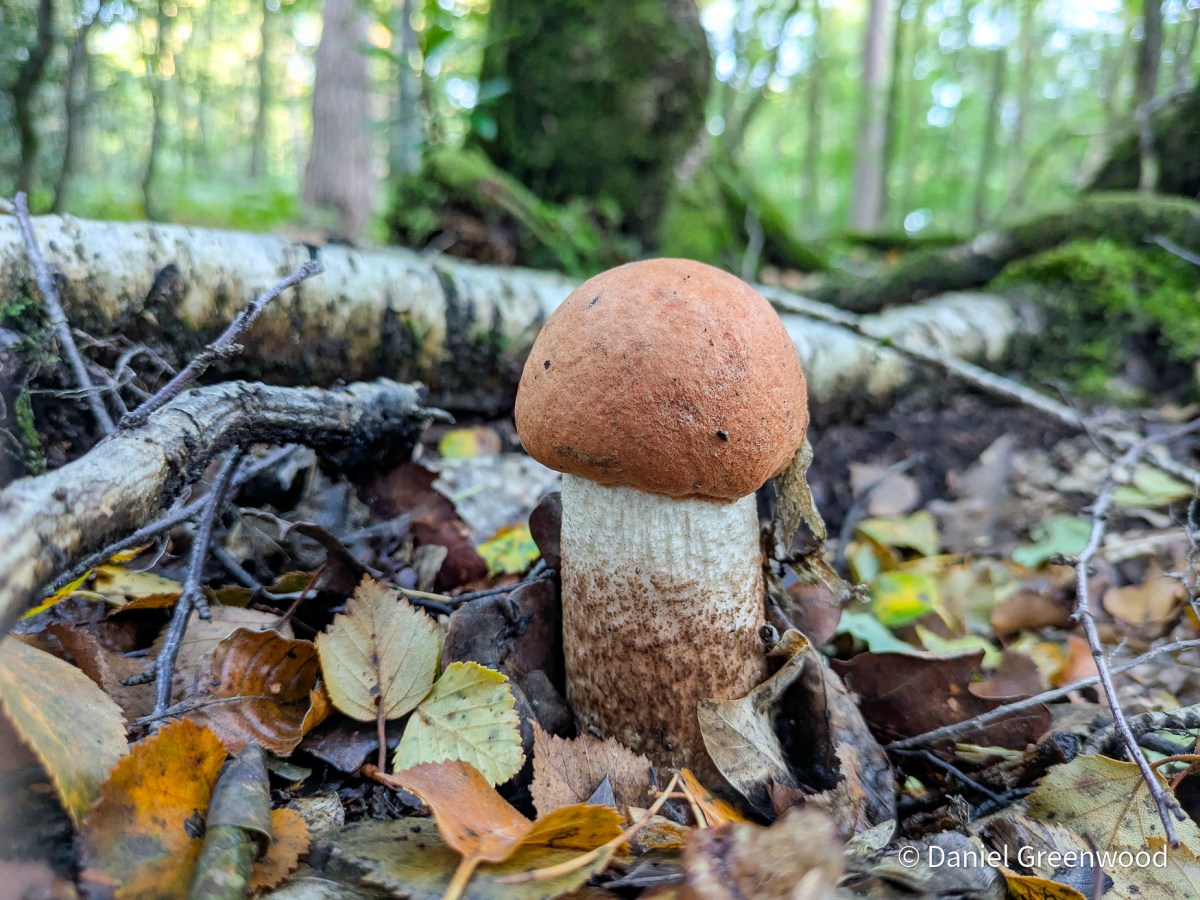
Moving to less colourful characters, in the same area I found a large community of bolete mushrooms, a mix of bay bolete (Imlera badia) and ceps (Boletus edulis). I didn’t pick any if you were wondering, but I did take some pictures!

This is a rather tellytubby-esque bolete, with its friends in the background. There were huge numbers of fungi here, a lovely thing to see. I posted about these recently.

Fly agaric

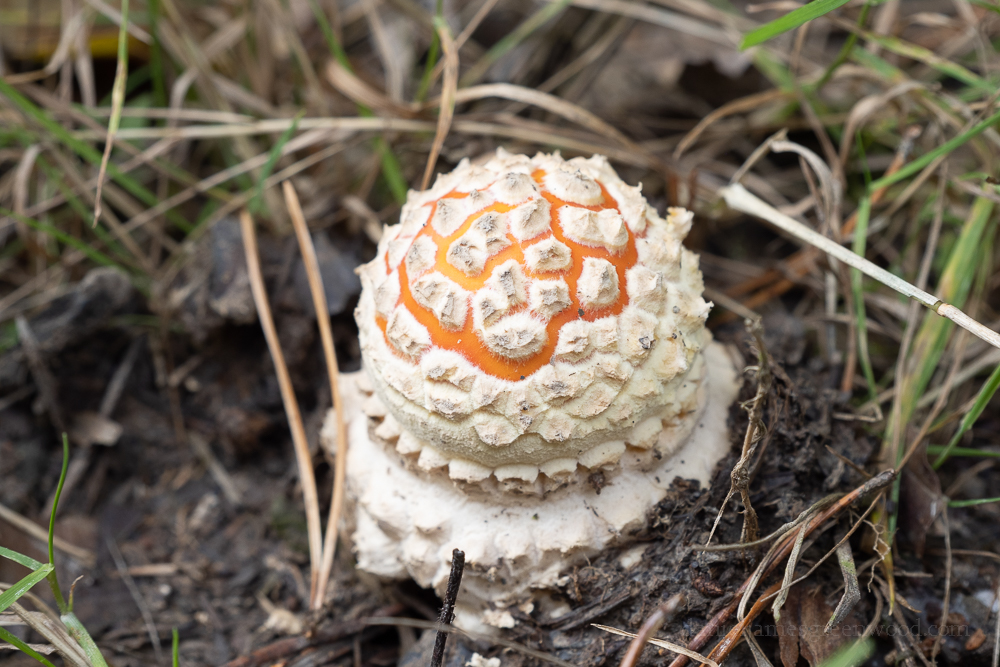
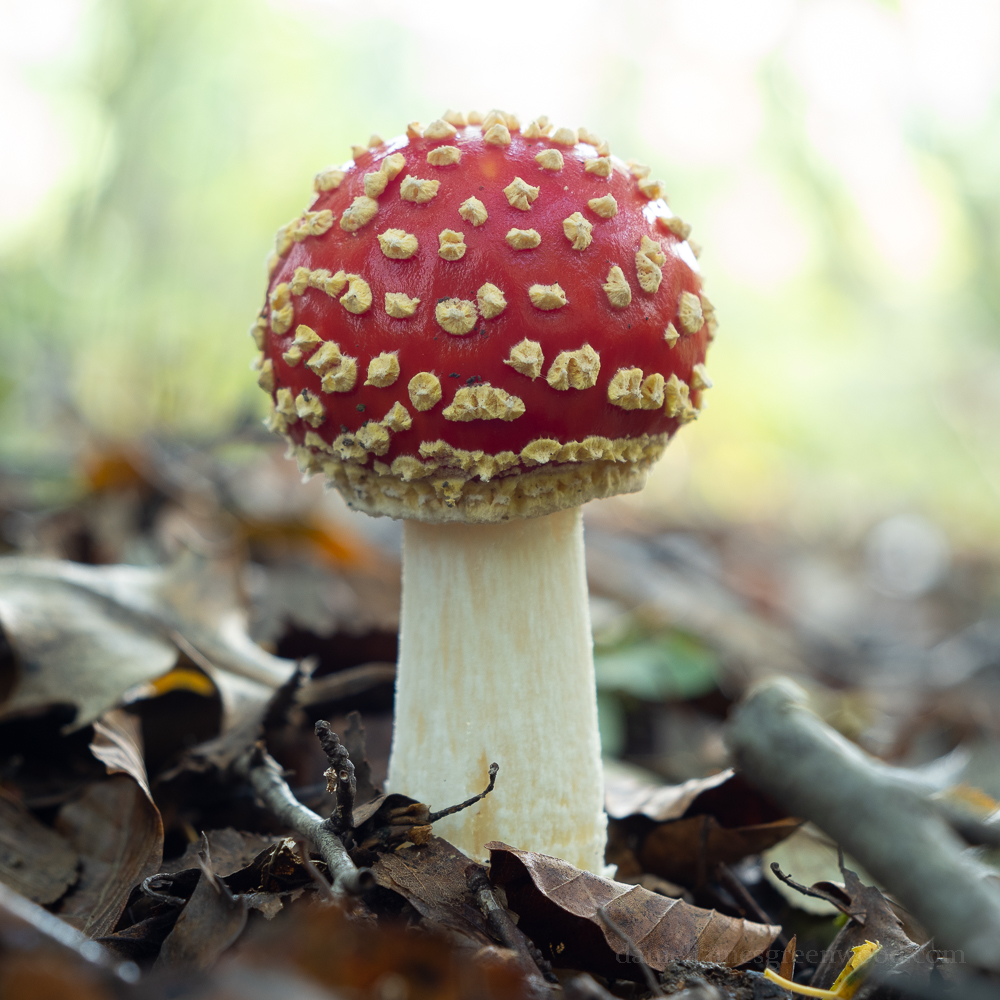
Of course it would be wrong to leave the wild emojis out of this post, which appear to be having a very good year indeed.

I was doing the rather annoying thing of using two cameras for this walk, which meant having hands full but trying to crouch down and not tumble downhill at the same time. I used my wider angle zoom lens for this lovely little russula. The sunlight touched its cap at the perfcet moment to create some very nice highlighting. More and more I think I prefer images where the mushroom can be seen within its habitat.

Here’s some more interesting perspective. I couldn’t work out what this bracket fungus was from afar. It was growing in the barkless section of a beech tree that had part collapsed.

This illustrates it a bit better. I’ve not done any work to try and identify it just yet so am not sure of the species. As ever, if you do know please pop me a comment below.

I struggled to get a picture I was entirely happy with here. This is a false deathcap (Amanita citrina), a common species in oak and beech woodlands. This one was in perfect condition. The light from the sun in the background was quite harsh. I used my phone torch to highlight the gills and stipe.

Here’s the mushroom again from above. You can see the veil remnants on the cap, which have become attached after it broke through from the ‘egg’ seen at the base of the stipe. Looking at the iNaturalist page it says this species is about to be broken up, taxonomically, into several species!

There were many fine Russula mushrooms to be found, and many not so fine. They were perhaps at every couple of footsteps in this part of the woodland. I’m not sure of the species exactly but I like the droplets and the colour of the cap. Russulas also have lovely clean stipes when they first arrive. Doesn’t last though!

I took some mushrooms that had been naturally uprooted home to identify them. I was quite interested in this little group and picked one to take back for ID. Looking through my books and using iNaturalist, I think they are a species of chanterelle. Probably Craterellus cinereus or Craterellus cornucopioides.

Moving even further away from the more typical gilled fungi, I found a nice little grouping of coral fungi. The above look to me like little white fires in the moss. I’m not sure of the species.
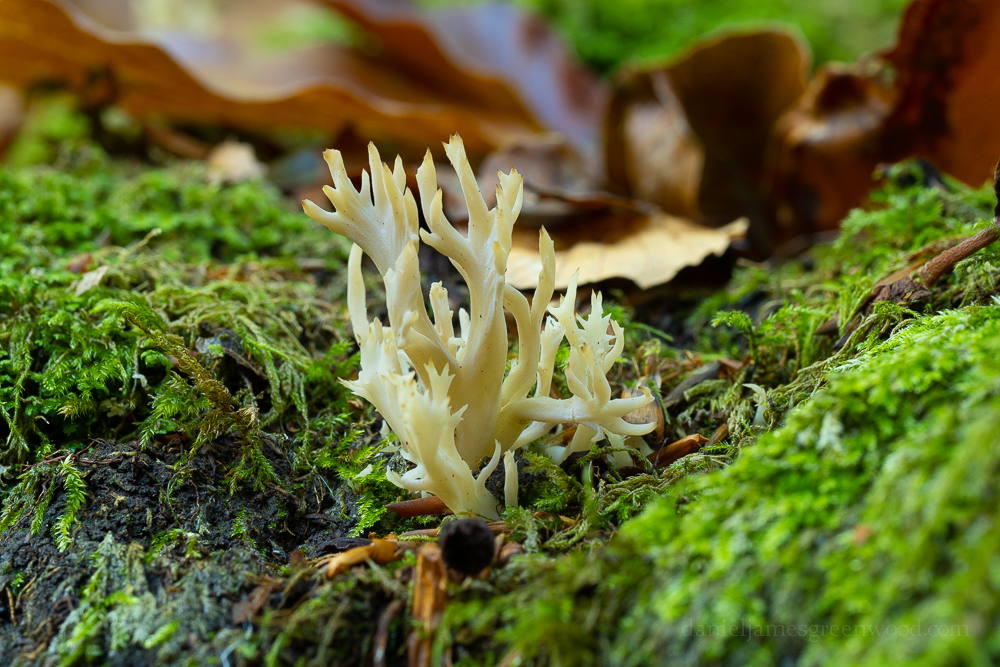
These are about as far away from teletubbyland as you’re going to get in this blogpost, so a good place to end.

Thanks for reading.

Further reading: Fungi | The Sussex Weald

Enjoyed what you saw here? If so, please support my work: https://ko-fi.com/djgwild

Latest from the Blog
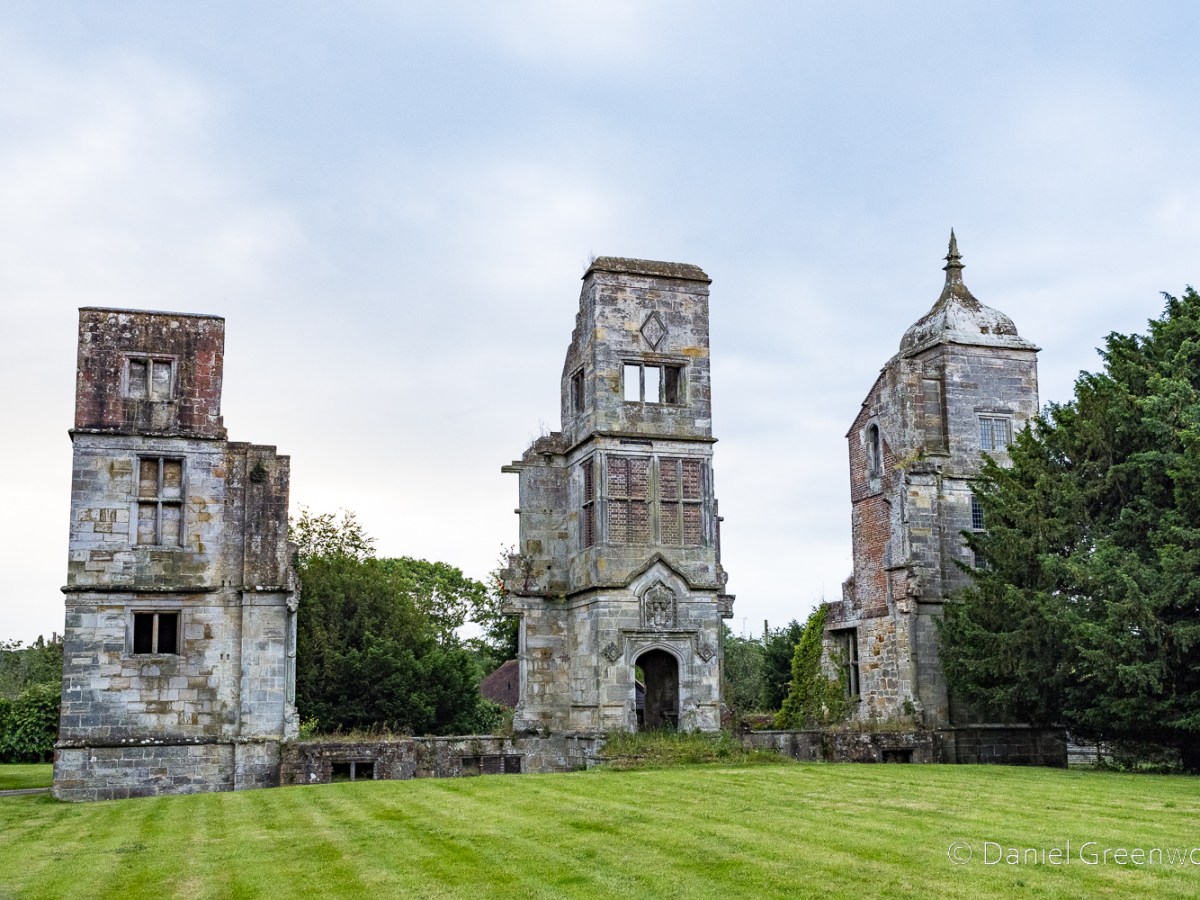
The ruins of Brambletye

A walk from Forest Row to the Brambletye ruins in Ashdown Forest, with some ancient woodland and rocky outcrops scattered along the way.
The fungus in need of a piggyback 🐷

Plus other things seen on 7th October 2022

From over a decade of speaking to (often random) people about nature, wildlife, landscape, etc., I’ve noticed that one of the things that really surprises or troubles people is when things grow on/in other things.

On this list I would include trees, insects and fungi.

It’s messy out there – a West Sussex heathland, October 2022

The understanding that insects grew inside other insects was enough for Charles Darwin to doubt his own faith. The idea that cuckoo hatchlings are hard-wired to chuck out the eggs of the dunnocks, wrens, pipits or warblers it shares a nest with, is also deeply disturbing to people.

Imagine how you’re going to feel about mushrooms that grow from other mushrooms. Prepare yourself.

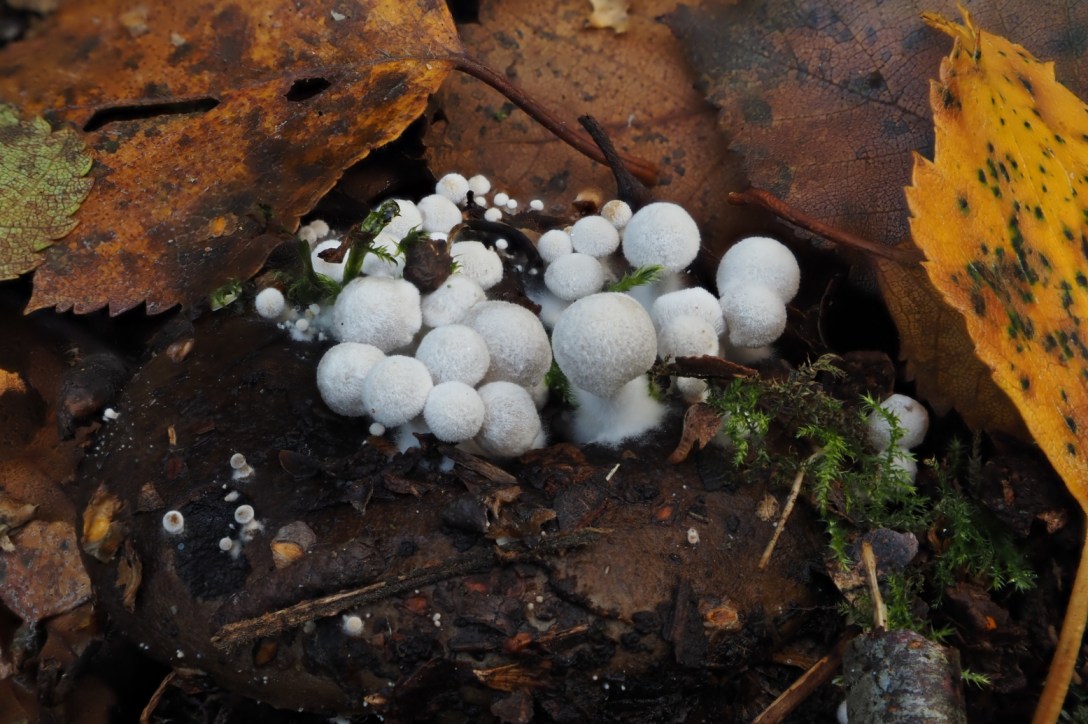
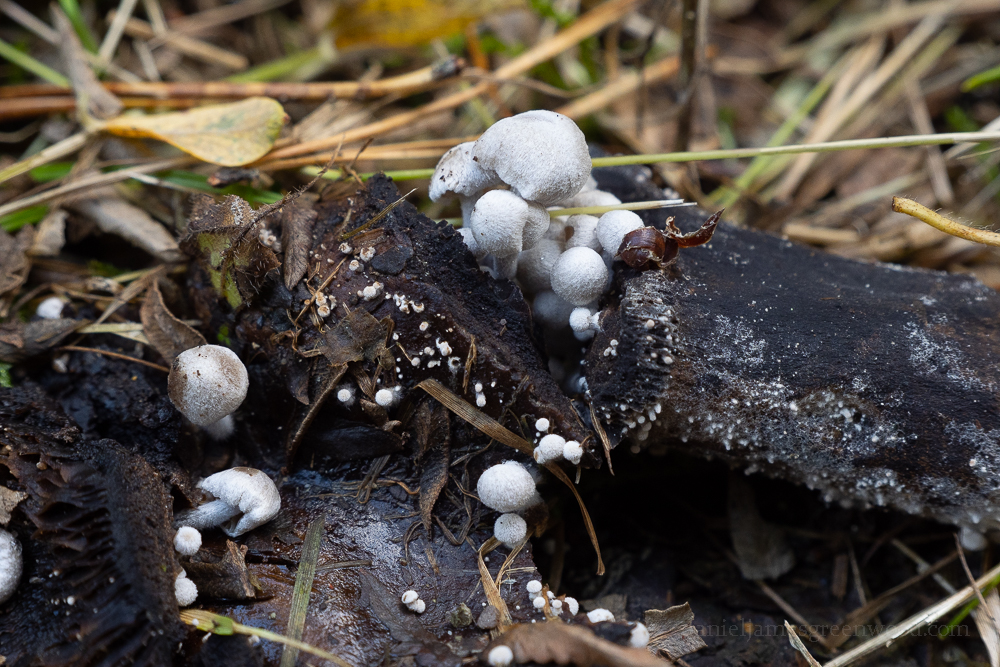
At least twice now I’ve found a white fungus growing from black mushrooms in the woodlands of the Sussex Weald. The first time was a few years ago on a National Trust property, on what turned out to be powdery piggyback fungus (Asterophora lycoperdoides) growing on the caps of blackening brittlegill (Russula nigricans).

The image above was taken on what may well be that species, but I’ve not done any work on identifying either of them. From the images I would guess it was more likely to be silky piggyback (Asterophora parasitica) which has a nice write-up here.

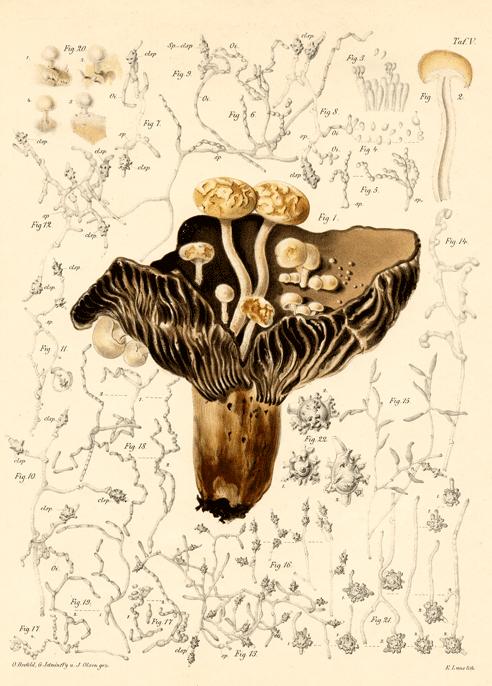
“The classic Asterophora picture is probably plate 5 in part 8 of Oscar Brefeld’s Untersuchungen aus dem Gesammtgebiete der Mykologie, published in 1889″ (via Australian National Herbarium)

Piggyback fungi are parasitic due to the fact that they ‘invade’ the tissue of mushroom fruiting bodies. It should be obvious, due to the prevalence of fungi in our world, that fungi grows on just about everything. But it’s rarely illustrated in such an elfin manner. Mould on a mushroom doesn’t have the same allure as ‘little mushroom guys’.

Elsewhere on this walk I spotted two common species gracing us with their presence for the first time this season. One of those was another parasitic species, but this one is much more well known and seemingly reviled in some quarters.

This is one of the honey fungi (Armillaria) which only this weekend (15th October ’22) was described as ‘the most destructive fungal disease in the UK’ by the Royal Horticultural Society. That, to my understanding, is not true. The only way to deal with that is in another blog post so we can crown the actual most destructive fungal disease in the UK. If you can’t wait for that, one of the most viewed blogs on this website is this one about honey fungus which I wrote previously.

Don’t worry though, this website is not a greatest hits archives just yet!

The Most Destructive Fungal Disease in the UK is quite beautiful when it appears in its natural habitat of ancient oak woodland.

Another fungus that decided to show its face is the common puffball (Lycoperdon perlatum). This is an edible species that I usually find alongside footpaths but is also often presented deeper into woodlands (sounds like a Yo La Tengo song). It always reminds me of the submarine rolls my parents would buy me from M&S as a kid during Saturday trips to the shopping centre.

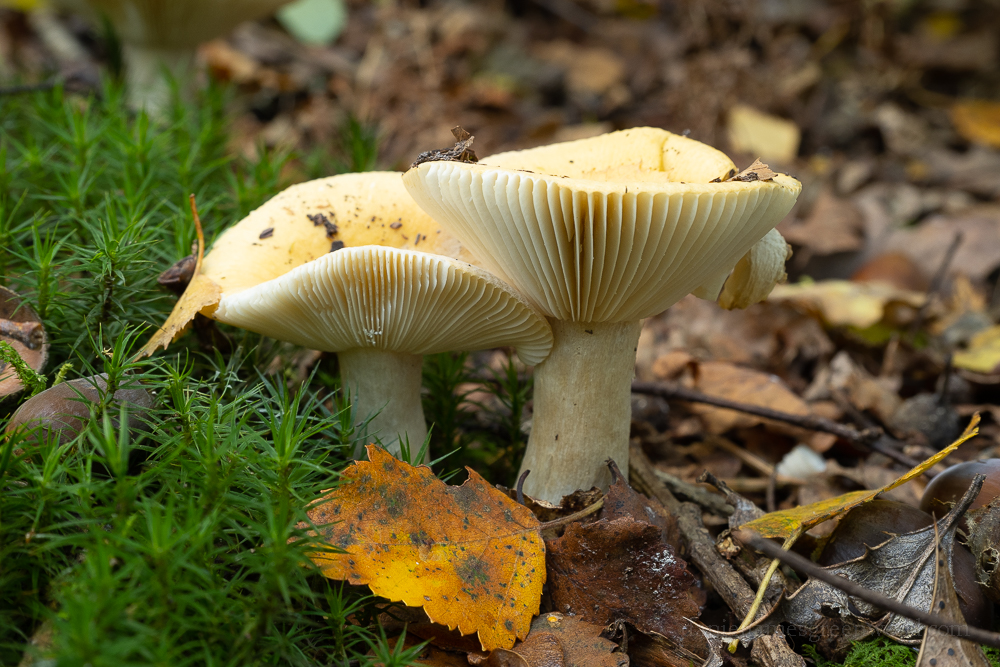
Russulas have already made an appearance in this post with the shrooms they’re giving a piggyback to. I would say it’s been a strong year for this group of difficult to identify fungi, but they are often out in good numbers. This is a family that can be found with a clean, white stipe and white, brittle gills.

To finish, I went to check in on the stairway to mushroom heaven that I posted about last week. It was quite amazing to see that these edible stepping stones remained. Evidently the foragers in this particular woodland are few and far between, be they human or squirrel.

Thanks for reading.

Further reading: Fungi | The Sussex Weald

Enjoyed what you saw here? If so, please support my work: https://ko-fi.com/djgwild

Latest from the Blog

November 2025: beware of pity

I’ve had a burst of American visitors in recent days (to my blog, not my house). So thanks for visiting, y’all, and sorry about the year you’ve had. You may have noticed I’ve slipped to monthly posts on here. Between April and October I posted blogs every Monday without pause, which is a tricky task…

Where the wild emojis are 🍄

This is your annual fly agaric appreciation post featuring some special guests.

It was so good in the woods on the 2nd October that I went out again the following day, what turned out to be the 3rd October. I encountered my first fly agarics of the season. I’ve written about the cultural ‘theories’ around this fungus before which you might be interested to read. Apparently they aren’t the reason that Father Christmas dresses in red and white or that reindeer fly, but I just want it to be true.

I’d seen lots of excited posts on Twitter showing fly agaric popping up across the UK. It was pretty clear that it would also be the same story locally to me. Fly agarics seem to fruit in waves, with September being a surprisingly good month for them.

One path I often follow may as well be signposted as mushroom alley, as each autumn it is studded with species like fly agaric and other Amanitas. Though something has eaten bits of this specimen, it’s important to remember it’s a pretty toxic mushroom that comes from a bad family. Fly agaric’s sinister uncles and aunts include destroying angel and deathcap. Panthercap is the cousin who you don’t hear about for a while but who is definitely not good news. Joking aside, these mushrooms are benign to look at, it’s just when you try and eat them that there might be a problem.

That said, they are by far one of the most beautiful mushrooms around. You have to wonder what someone who doesn’t know this thing exists must think when they see them pop up. They’re found in lots of different habitats (and may actually be invasive outside their native range) so that surprise encounter will surely touch someone.

“OMG, they have wild emojis here!”

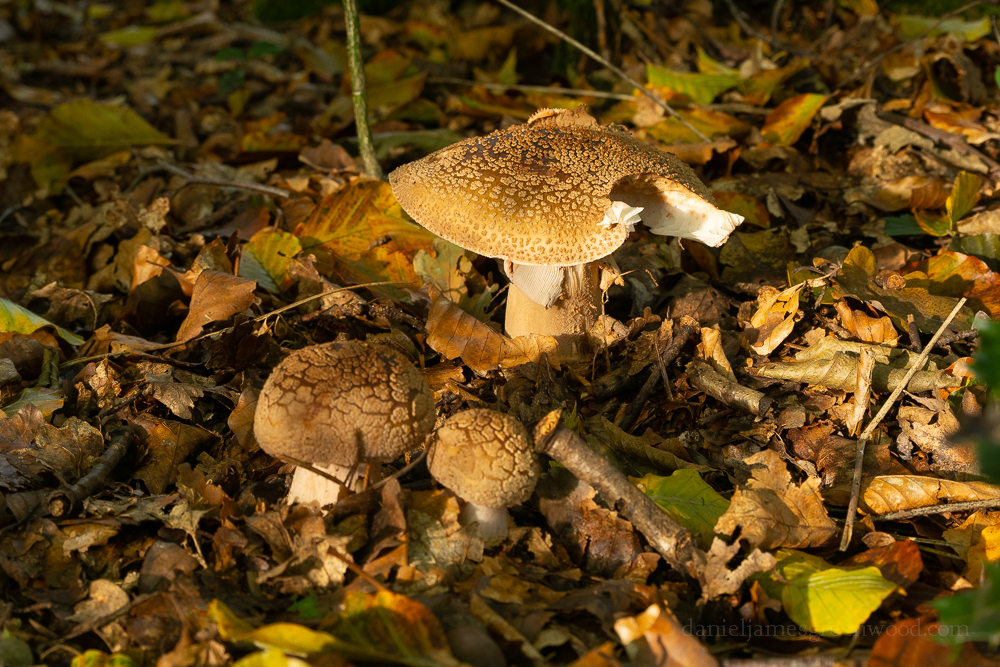
Nearby were yet more untrustwothy Amanitas, such as this grey-spotted amanita or panther cap. You decide. It’s definitely not a blusher because its stipe isn’t rosy…

Here’s some good parenting, taking the kids out for an evening walk. Whether these are blusher or grey-spotted amanita is the accomplished mycologist’s guess.

Not too far away from that was a grisette, kindly showing off its wings from which it appears but is unable to adapt to flight. Perhaps it’s only a matter of time. That said, fungi do fly due to their spores being pretty much everywhere.

Soothing tree image to allow a moment of calm…

Another narcissist of the fungal kingdom was on fine fruiting form. Porcelain fungus is one-that-almost-always-grows-on-beech-trees. It seems like a lot of the big old beech trees near to me keep collapsing which allows to you to get nice clearance underneath a family of this photogenic fungus. What I mean here is that the limbs are raised off the ground. The situation with the beech trees actually isn’t good, because they’re significant ancient/veteran trees and would take hundreds of years to replace. I just don’t have that sort of time at the moment.

Have I written about this beautifully mucusy fungus before? Well I should have done. It’s actually edible from what I’ve read though you’d need to remove the viscidy stuff on the cap. They’re related to velvet shank, an absolute babe of the mushroom world, hence their photogenicity. I’ve never used that word before.

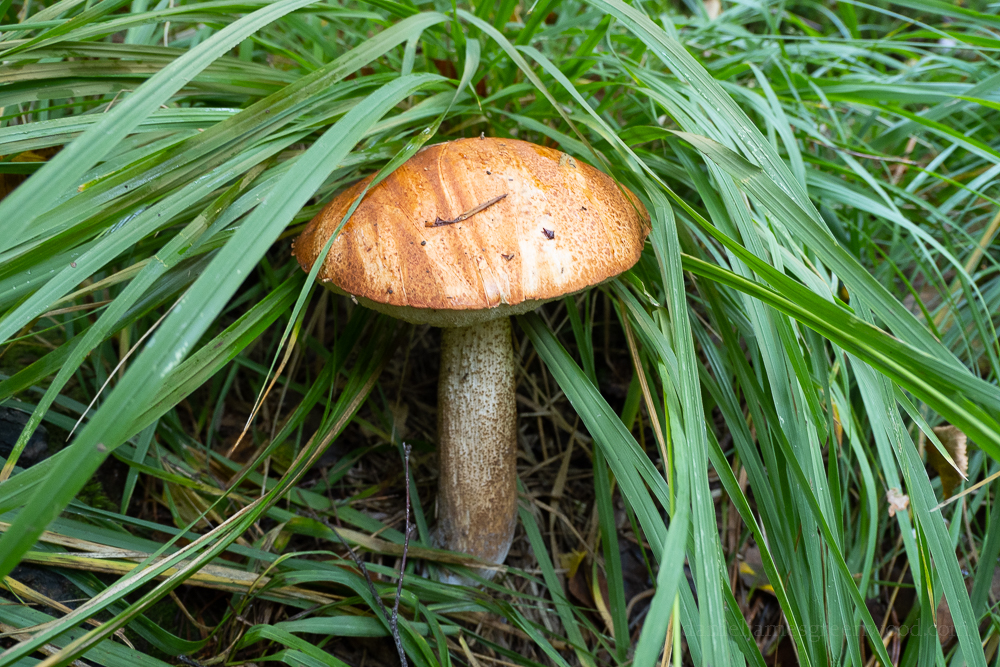
I’ve been seeing a lot of birch boletes this autumn, but they’re never in good condition. This orange birch bolete was growing under some lush grass growth. As all boletes do, it has pores not gills. At this point you realise how much impact you can have with-three-words.

This is how most of these boletes appear to me, nothing like the baskets that people show off on Instagram from countries like R****a or Poland.

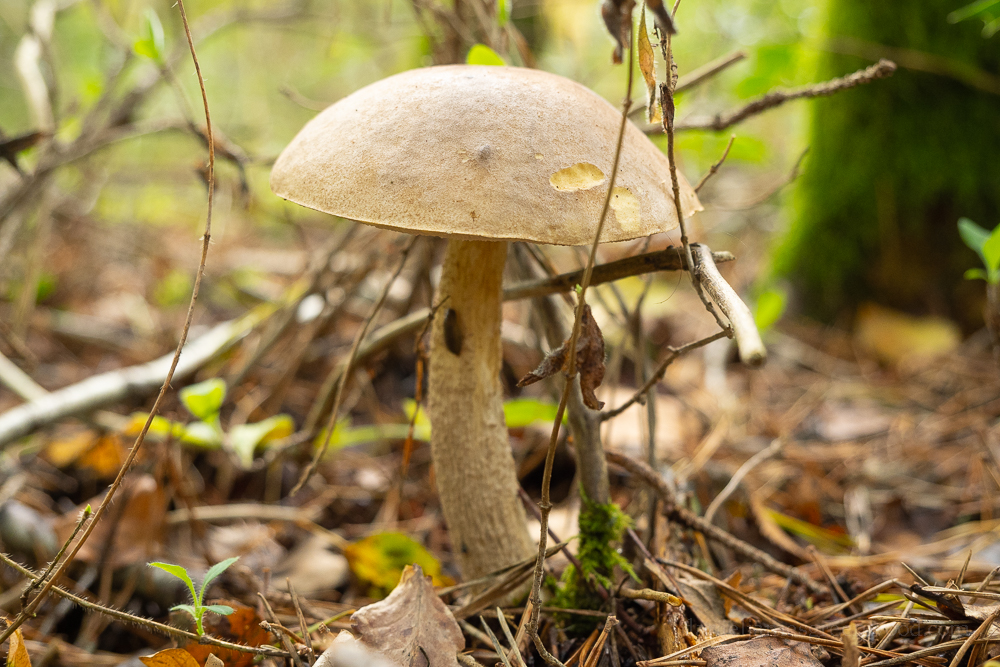
Here we have brown birch bolete, one that always has a disappointment in store when you look under the bonnet. It doesn’t scream “nom, nom, nom” to me. I don’t think that out of focus slug minds too much, though.

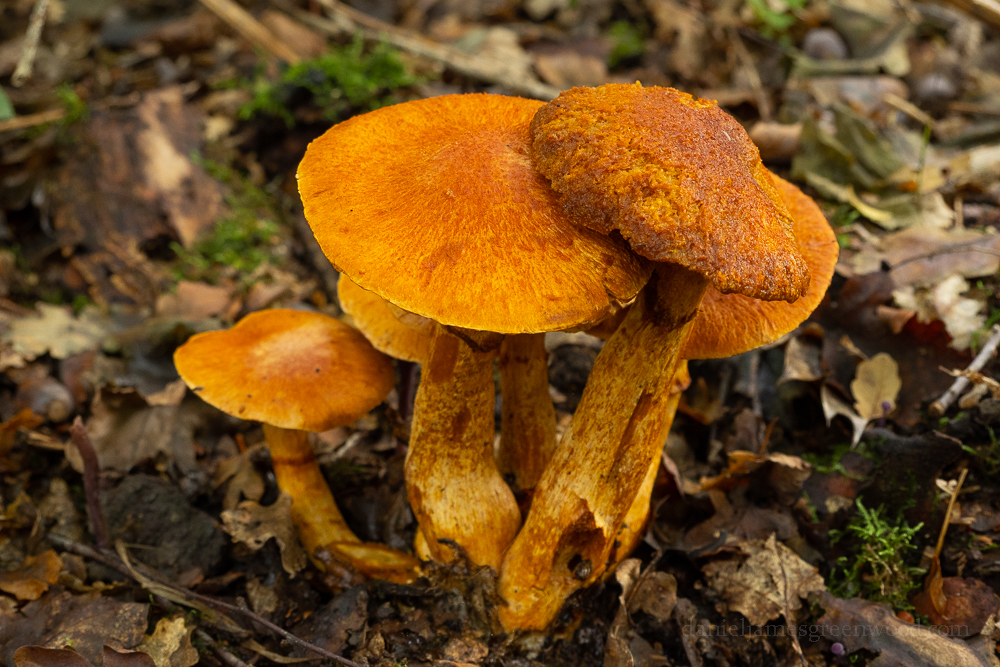
In almost the same spot last year I found some nice tangerine-coloured mushrooms like this. I think they’re probably gymno-something or other, but I don’t encounter them often enough to peg their ID down properly.

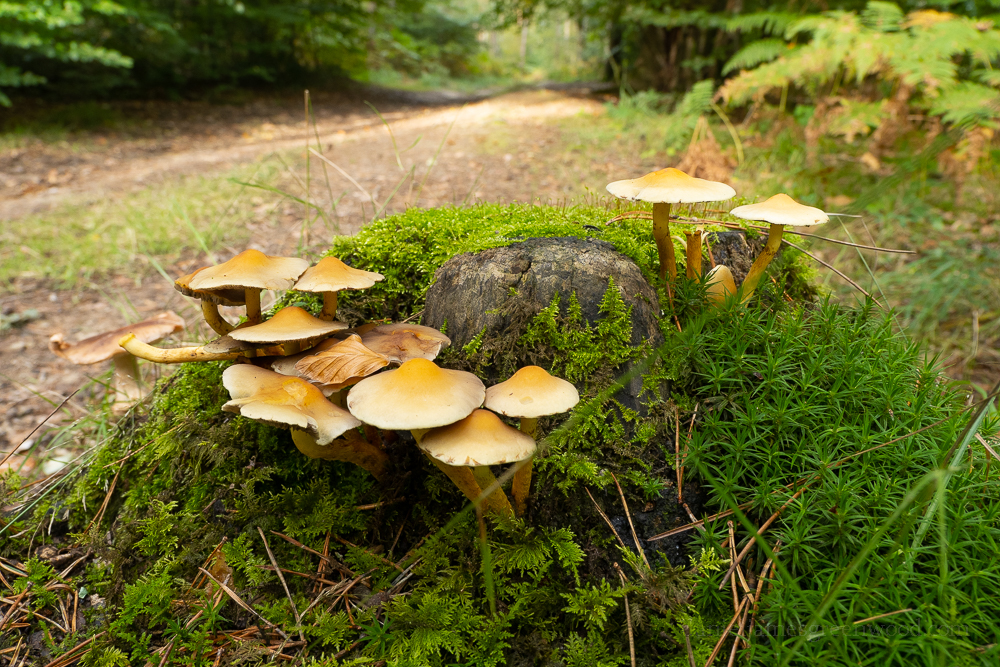
This is a good place to end, where the world will probably end: surrounded by sulphur tuft. This species is having a good year, and it knows it.

Thanks for reading.

Further reading: Fungi | The Sussex Weald

Enjoyed what you saw here? If so, please support my work: https://ko-fi.com/djgwild

The stairway to mushroom heaven 🍄

I was visiting a local and very popular woodland on 2nd October when I discovered an incredible scene, like something out of a folk tale. To the side of the path were four bay bolete mushrooms (Imleria badia) growing on the mossy mound created by a fallen tree. They were aligned in some hilariously synchronised arc from the bottom left to the top right.

Bay bolete

I couldn’t believe that no one else had noticed this display, seeing as it was so close to the footpath and there were lots of families in the area. I suppose it makes a difference that I was actively looking for this sort of thing. This species is bay bolete, an edible mushroom in that most famous of families, which I have found before in Sussex but never in such a photogenic state. I didn’t pick the mushrooms.

Another important way to identify boletes and their relatives (or allies, as they are oddly known), is to look for pores rather than gills under the cap, as can be seen above.

They really were a joy to find! These kinds of encounters are what make this time of year so special.

Sheathed woodtuft, lit with my phone camera torch

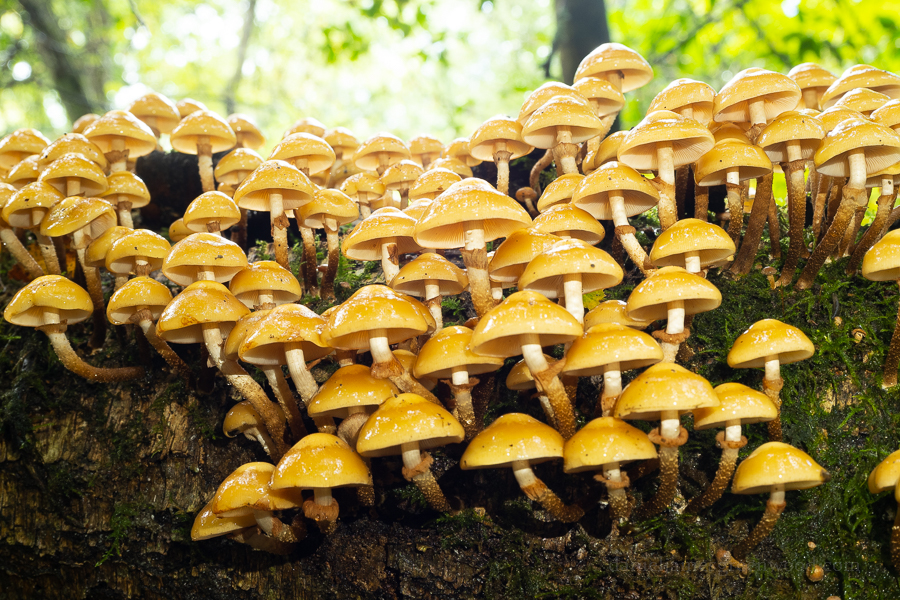
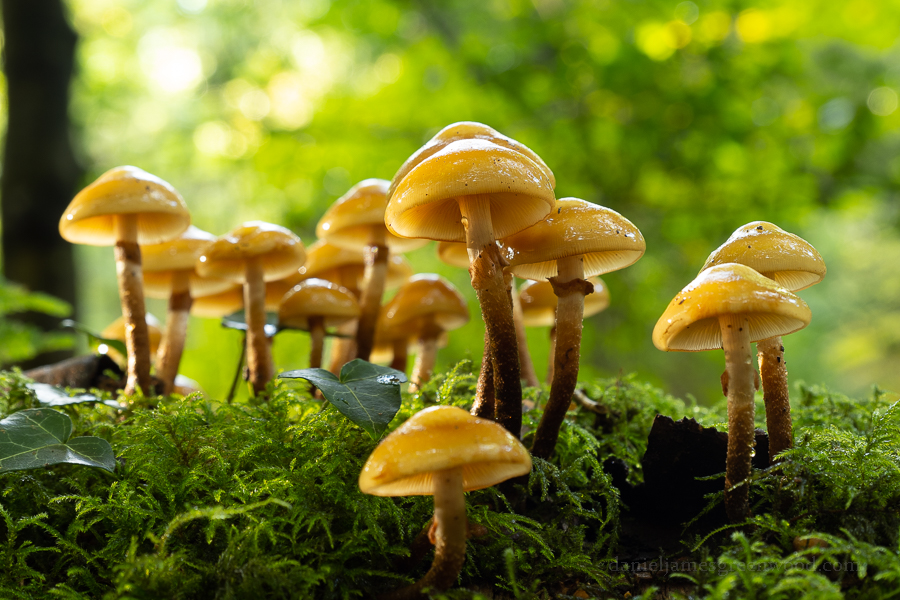
There were more great mushrooms sightings to be found during this walk, what will probably go down as one of the best days of the season for me. This is a gathering of sheathed woodtuft (Kuehneromyces mutabilis) on a fallen tree. This is known to be edible but can be confused with the drop-dead poisonous funeral bell (Galerina marginata).

The lighting and recent wash of rain made the mushrooms lovely to look at. Once again you can see where the idea for lampshades probably came from.

Behind the scenes of my mushroom photo – I use a ‘gorilla pod’ mini tripod and a mirrorless camera, usually with a slow shutterspeed, low ISO and ‘small’ aperture (around f8-11)

I got into an interesting conversation with a man who approached me when he saw I was taking photos of this patch. He said he had been taking photos of mushrooms for years with his phone, and that this would be a very good year because ‘the rollrims were out’.

Potential rollrim (Paxillus) mushrooms

I think the mushrooms above are rollrims, a group that are renowned for their inedibility and toxicity. The man I spoke to was convinced that their abundance was a pointer to a strong showing to come from the mushrooms. That’s new information for me, and something I will consider as the season progresses.

I judge the potential of a mushroom season by the amount of rain. For example, the woods now (10th October) look as dry as summer only days after heavy downpours. I would put this down to drought in the local area and the lack of deeper levels of water that trees can draw up and provide to the fungi around them or the wider ecosystem. Trees are known to trade water with mushrooms in return for certain minerals and things they can’t capture alone. The rain had swelled some of the gills (streams, as they’re known in Sussex) that had remained dry throughout the summer.

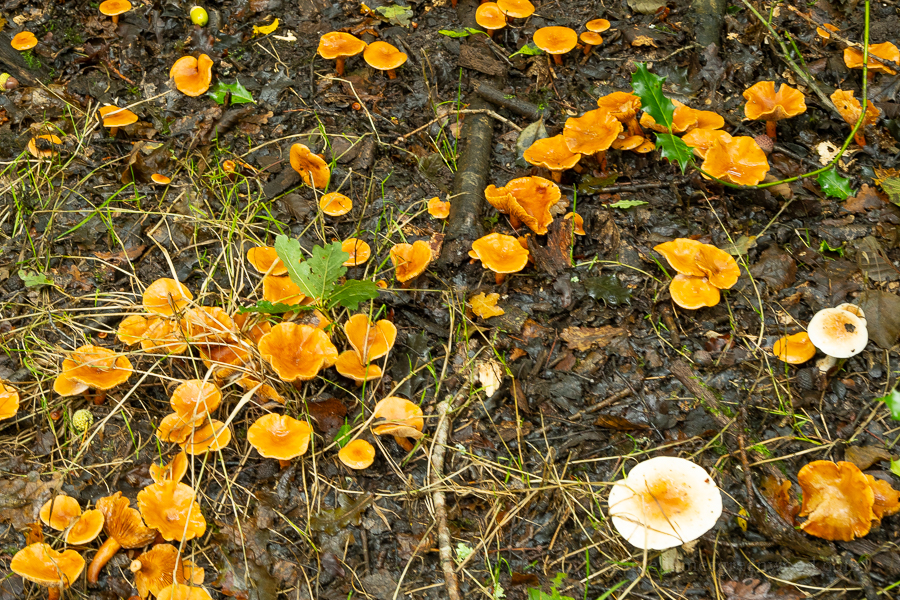
I found one rather boggy area to be covered in thousands of an orange species which I’m not able to identify.

Here’s a closer view for anyone who may have an idea – please let me know in the comments!

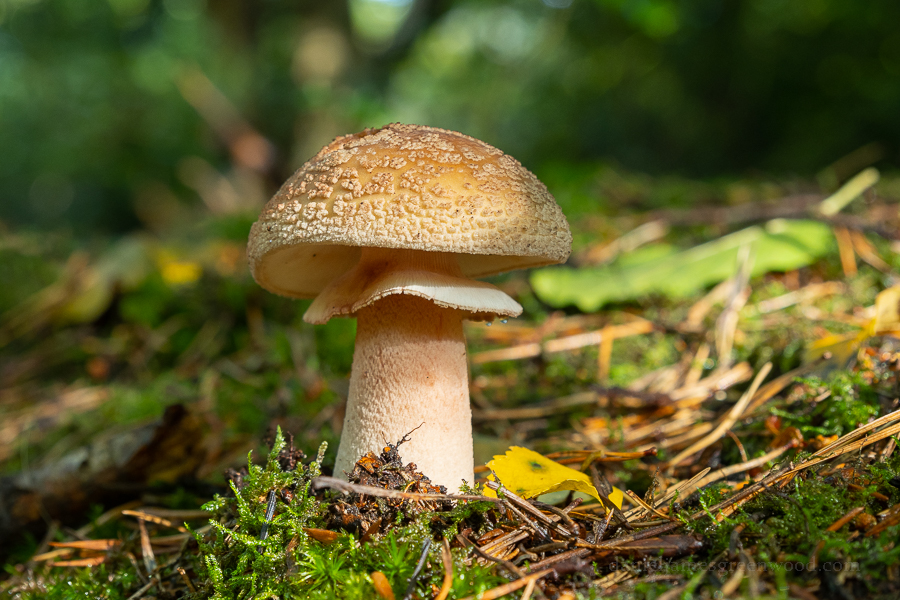
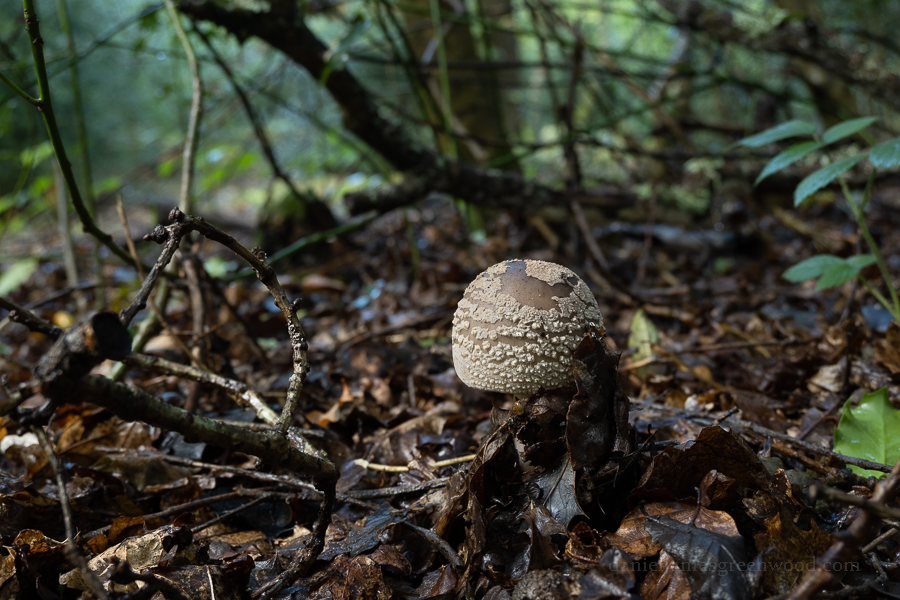
Blushers (Amanita rubescens) were out in force, with some really beautiful specimens to be found. This very nicely set mushroom caught the late afternoon light from its position in moss. I would consider this a portfolio mushroom image!

Another nice species to find is porcelain fungus (Oudemansiella mucida) which almost always occurs on dead beech wood (Fagus sylvatica). Nice images of these mushrooms can be achieved when you focus your lens on the underside of the cap to see the dramatic gills.

These days when mushrooms dominate the woodland floor are a reminder that you need to keep pushing yourself to learn more, and not just about the colourful and common species. The better quality leaf litter was, well, littered with grey and brown-capped fungi that I am unable to identify. The photo above gives a good example. I’m not sure if these are Russula or something else.

Under the hollies there were lots of Amanitas appearing, with this potentially being a grey-spotted amanita (Amanita excelsa var. spissa).

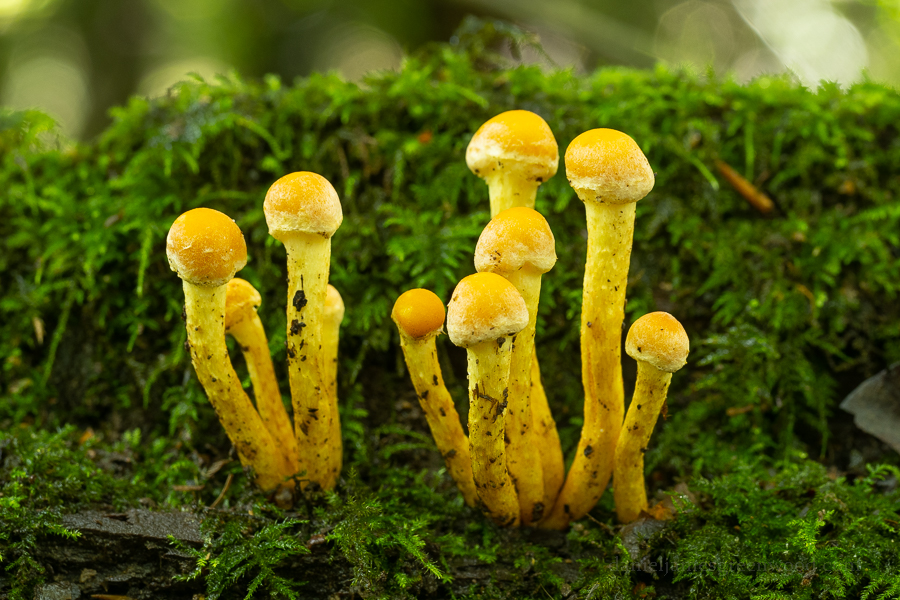
Sulphur tuft (Hypholoma fasciculare) was as common as it usually is, probably making up about 15% of all sightings. It’s a very nice species to photograph due to its colour and the shapes of the mushrooms when young.

These bonnets (Mycena) were a nice find, very hard to miss alongside a main path on a mossy branch. The one on the left really does look like an alien spacecraft.

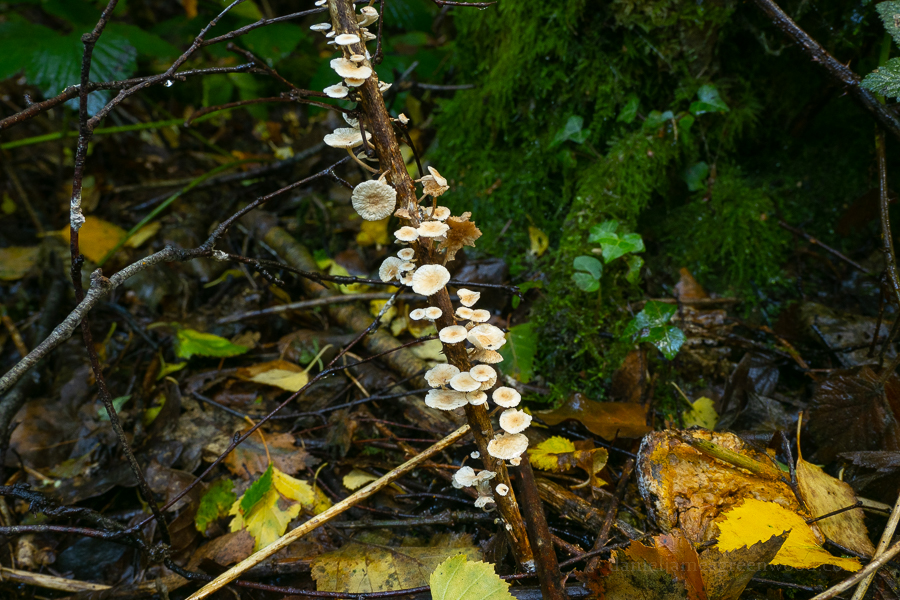
To finish, one of my favourite things to see at this time of year is the twig parachute (Collybiopsis ramealis). You can potentially take some incredible images with this species, as it sprouts along twigs and other bits of wood.

I didn’t do that on this occasion(!), but the most important thing is to get out there and experience this fleeting time of year. The mushrooms are calling.

Thanks for reading.

Further reading: Fungi | The Sussex Weald

Enjoyed what you saw here? If so, please support my work: https://ko-fi.com/djgwild

Latest from the Blog

Summer-autumn 2025: unveiling the sun

Here’s my seasonal update of stuff you don’t need to know about, but then welcome to the Internet. What I’m writing Soon I will be self-publishing my third poetry collection, Fool’s Wood. It’s seven years since my last one and this collection has taken longer because of LIFE. There will be a booklet and also…

Salisbury’s oak timbers

Here’s another entry in my slow-blogging Oak Timbers series. You can view my galleries and posts archive here. I visited Salisbury in Wiltshire (south-west England) for the first time in 2023 and was really charmed by the place. If you’re interested in this kind of thing, Salisbury is the place for you. Here’s a gallery…

Podcast: September fungi walk 🍄

I’m getting into more of a routine of recording and editing audio, so here is the latest episode of Unlocking Landscapes. Listen on Podbean or via the usual platforms. Also via YouTube: https://youtu.be/y1K9Pqx68to?si=B-Fdhf3sdDH35Z8w Following on from July’s rather optimistic fungi walk, I popped back to the same area of ancient Wealden woodland to see if…

Unlocking Landscapes podcast: the Weald of Kent with author Zoe Gilbert 🎤

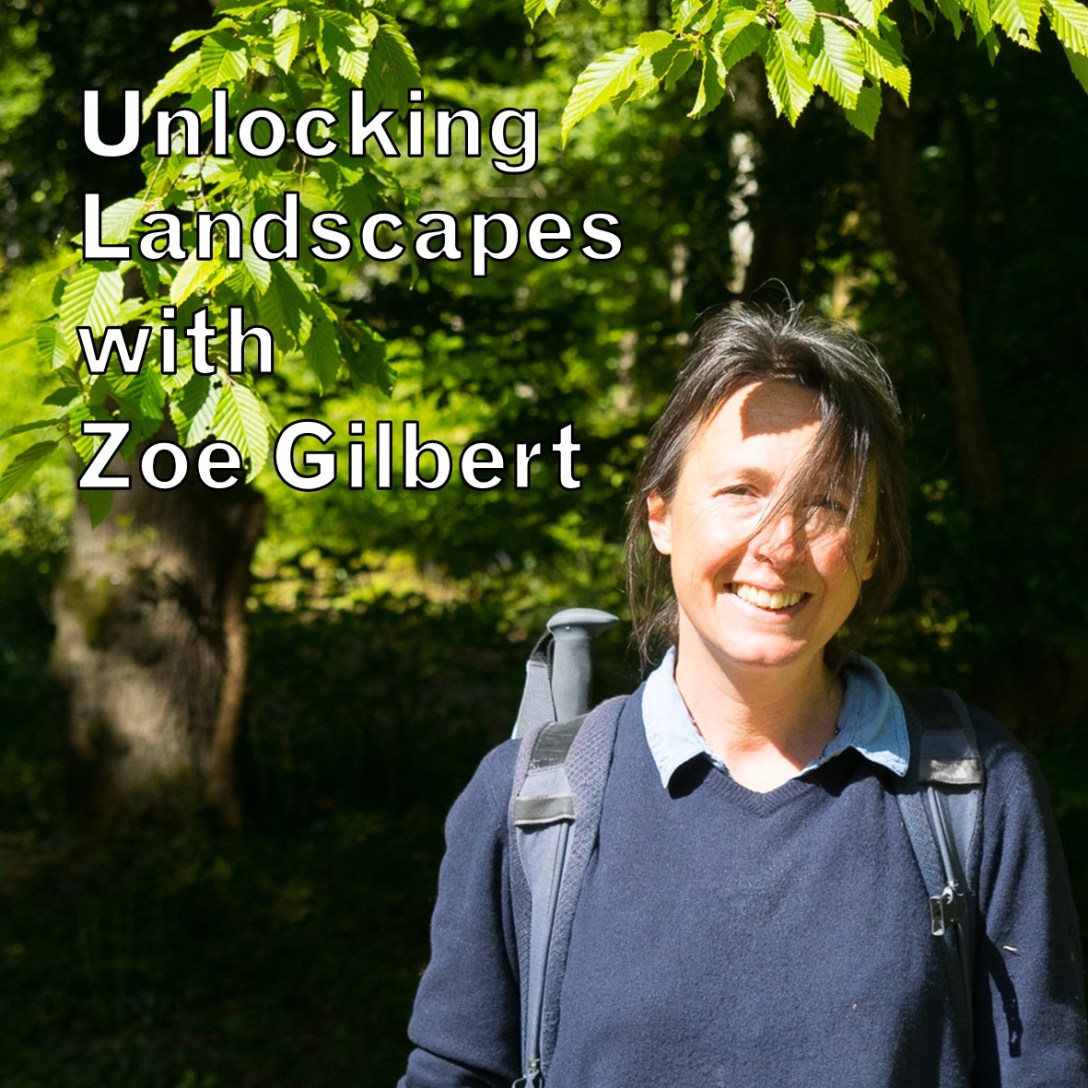
Unlocking Landscapes is back! In May 2022 I met with author Zoe Gilbert in Ham Street Woods National Nature Reserve on the Kent/Sussex border. Zoe is an award winning writer and she sounds very much at home in the woods. It was a real pleasure to spend the day with her and I’m very grateful for her time.

Listen here:

In March 2022 Zoe published her latest book, Mischief Acts (you can buy it here). The book is inspired by an historic wooded landscape in south London known as the Great North Wood. It’s been covered in a couple of other podcasts for Unlocking Landscape so please see the links below. I love the book and as a consumer of books and someone who knows parts of the landscape she has focused on, I can say for sure that I think she has nailed it!

In this episode we cover a lot of ground:

  • What inspires Zoe to visit woods and write fiction
  • Public access to woodlands in the pandemic
  • The complications around public perceptions of woodlands
  • Mischief in the woods and National Parks
  • ‘Pics or it didn’t happen’: The importance not being observed all the time (social media)
  • Contiguousness of woodland
  • Bison being reintroduced to English woods
  • The future of woodlands
  • Prioritising the conservation of woodlands in a time of extremes
  • The importance of local landscapes

Links to things we mentioned for more info:

Thanks for reading/listening.

Unlocking Landscapes podcast

Giant polypore and more in the New Forest 🐎

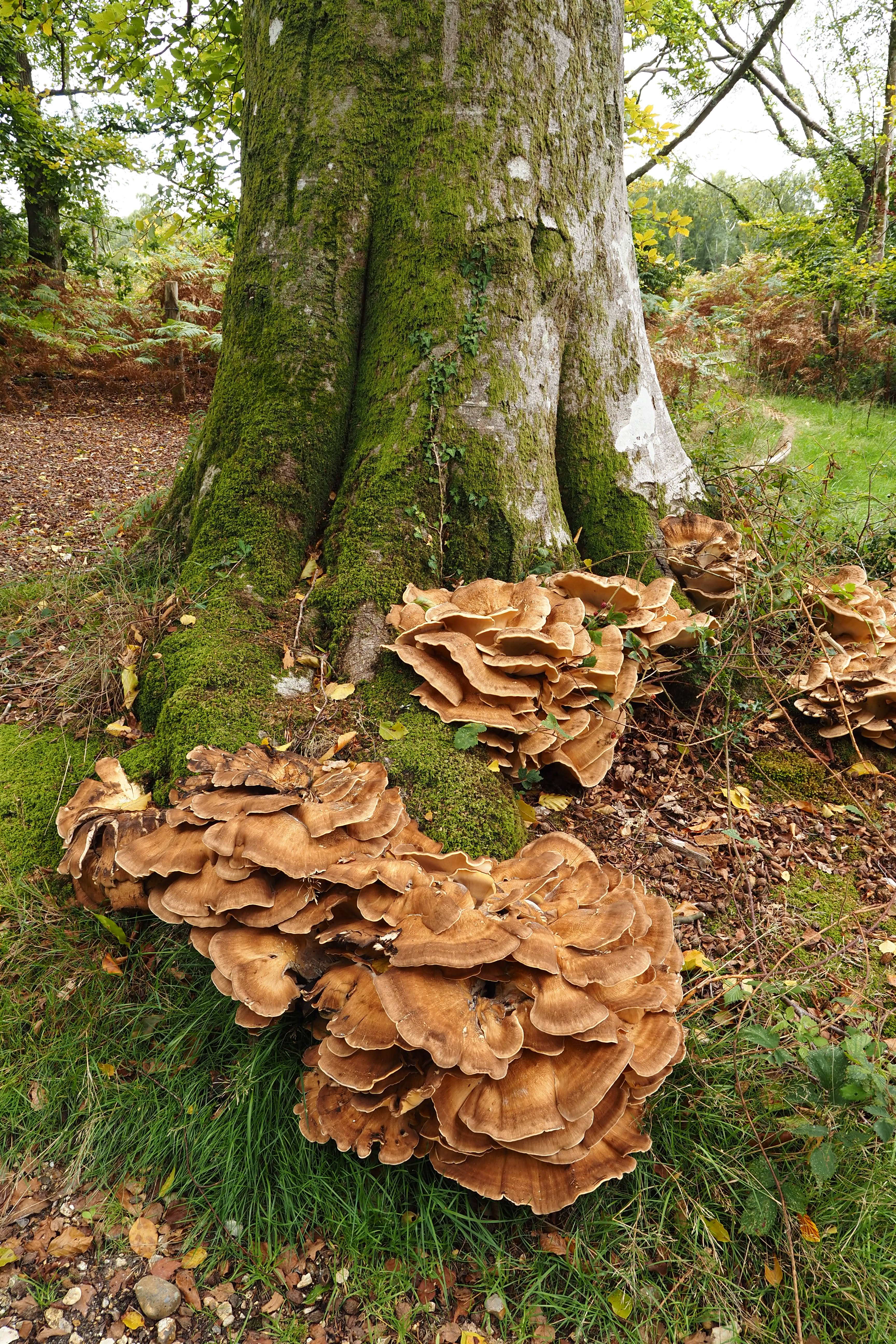
There are certain species of fungi that are relevant to particular professions. Some medical experts may be aware of certain species of fungi that cause lung problems, or cheese growers may want a particular mould to improve their cheeses, for example. In the tree management world, there are several that keep people awake at night. One of those is giant polypore. Just like Jeff Goldblum witnessing a sublimly terrifying, carnivorous dinosaur appearing before him in Jurassic Park, a tree officer may look at giant polypore growing at the base of a tree and whisper the words, “Meripulus”. That’s its scientific name.

During a recent ramble in the New Forest, I was blown away by the sight of a large number of fruiting bodies of giant polypore (also known as black-staining polypore, but perhaps in America) alongside a footpath. Now, I’d seen giant polypore along this path before, where a number of beech trees grow, but I had never seen anything of this size and scale.

The image above reflects the spread of the fungus in the soil, or else along the roots of the tree. This is a fungus that decays roots, and from what I know it is a case of managed decline for the tree. Of course, we should remember that this is perfectly natural and it’s something that has been occurring for millions of years in woodlands. It’s a key process of renewal upon which biodiverse ecosystems depend.

I don’t know for sure who owns this small parcel of the New Forest, but I think it may be the Wildlife Trust. The great thing about having conservation charities as landowners is that they will make sensitive decisions around tree management more often than others, whilst always considering public safety. I say this as a Wildlife Trust employee with a woodland focus currently, and previously for a longer period!

This tree will go down at some point in the next few years, I would guess, either by natural course or by being reduced by the landowner, which is highly possible if there is resource available. Retaining standing deadwood is always preferable but not always possible.

But that is just one species, so let’s look at what else I found on this 9 mile wander in one of Europe’s most important woodland landscapes.

My first sighting of porcelain fungus usually takes place as early as June, but in 2022 it was late September. That to me is evidence of how dry it’s been this summer, with the hottest temperatutes on record in the UK. There should be more to come from this very photogenic species in the weeks ahead.

In south-east London’s oak woodlands it is proving a bumper year for beefsteak fungus (Fistulina hepatica). 75% of mature oak trees in one woodland had beefsteak in some form on the trunk. In the New Forest I found this wonderful example of the fungus, in what was the ideal state for eating. It looks so much like actual meat, it is very disturbing. This was growing on a large oak stump at the edge of a path.

This image doesn’t demonstrate spindle shank (Gymnopus fusipes) that well but they are fruiting in large numbers on oak at the moment. This is a root-rotter on a smaller scale to giant polypore, and it has a very potent aroma. It’s not unpleasant at all but is quite dominant if you know the smell.

I’ve written about boletes recently but this remnant cep (Boletus edulis) really confused me for a while. My guess here is that one of the nearby ponies or perhaps pigs munched the top off what would have been a sizeable mushroom. I identified it by the webbing of sorts on the rounded stipe. I didn’t see any others on the day. The livestock must eat quite a few of the mushrooms actually.

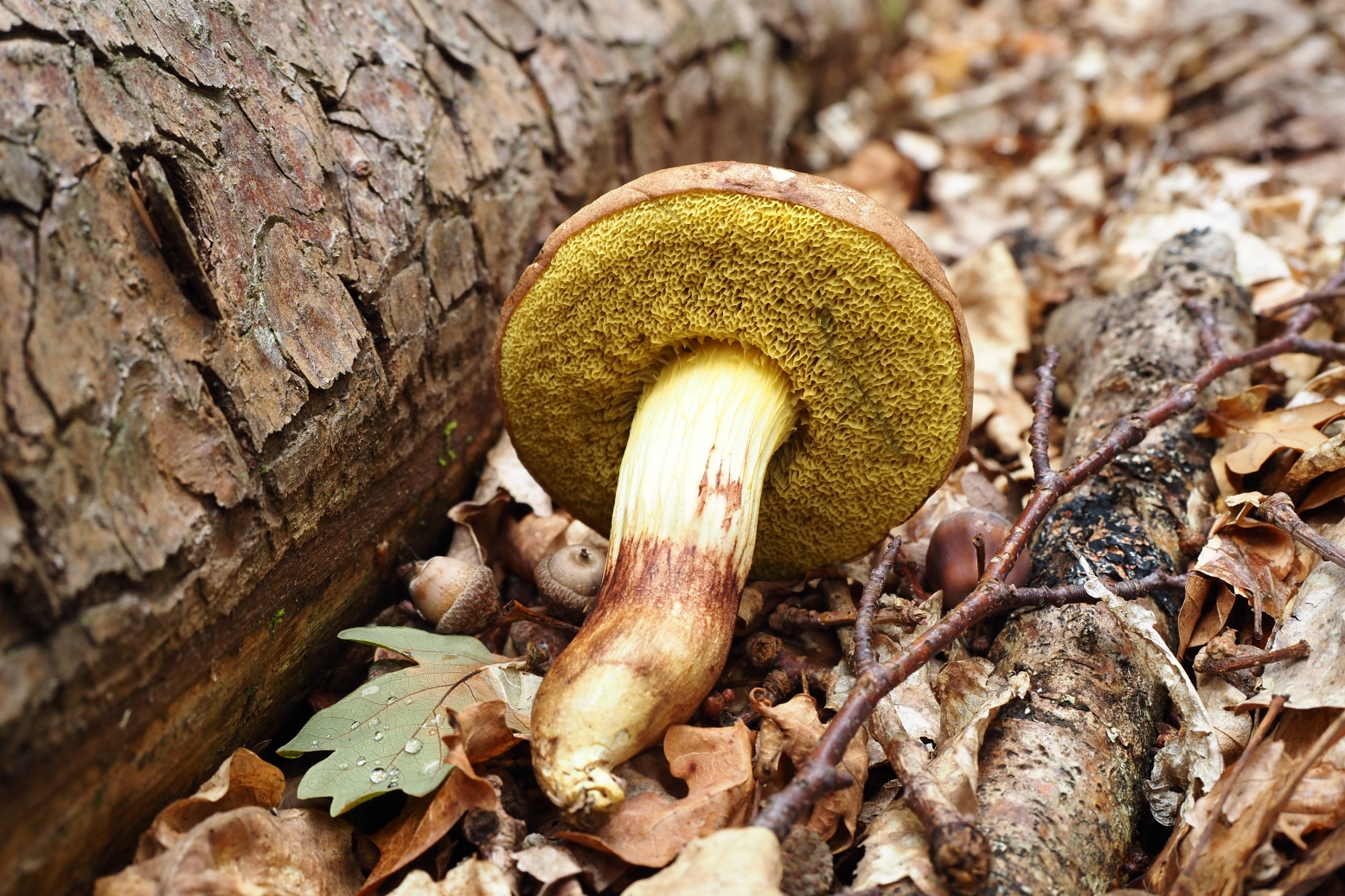
Elsewhere in bolete world I found a beautiful smaller species with very strong yellow pores. Here you can see that boletes and their relatives don’t have typical gills but instead pores. My guess here would be suede bolete, one of the Xerocomus species which is often found in this part of the season.

Here’s a closer look at those lovely pores. I tested them with my fingernail and they didn’t bruise blue, which you may be able to see in the top left of the photo.

Towards the end of the walk, my final find was this typical Agaricus-looking field mushroom that had been uprooted, probably by one of the cattle grazing the lawns. I am a bit indifferent to these grassland species and am wary in general of white mushrooms due to some toxic species like destroying angel, not that it would be found in the open normally.

In general, and following up on my long walk in the Forest in April, or comparing to September 2020, the landscape still looks very dry indeed. That will no doubt have slowed any mushroom fruiting. I’m hoping to return in October or November for the peak period to see how things are.

Thanks for reading.

Further reading: Fungi | The New Forest

Enjoyed what you saw here? If so, please support my work: https://ko-fi.com/djgwild

  • The ruins of Brambletye

    The ruins of Brambletye

    A walk from Forest Row to the Brambletye ruins in Ashdown Forest, with some ancient woodland and rocky outcrops scattered along the way.… Continue reading The ruins of Brambletye →

  • Winter-spring 2026: the loud lie

    Winter-spring 2026: the loud lie

    What I am experiencing culturally in this rather wet winter of 2025-26 … Continue reading Winter-spring 2026: the loud lie →
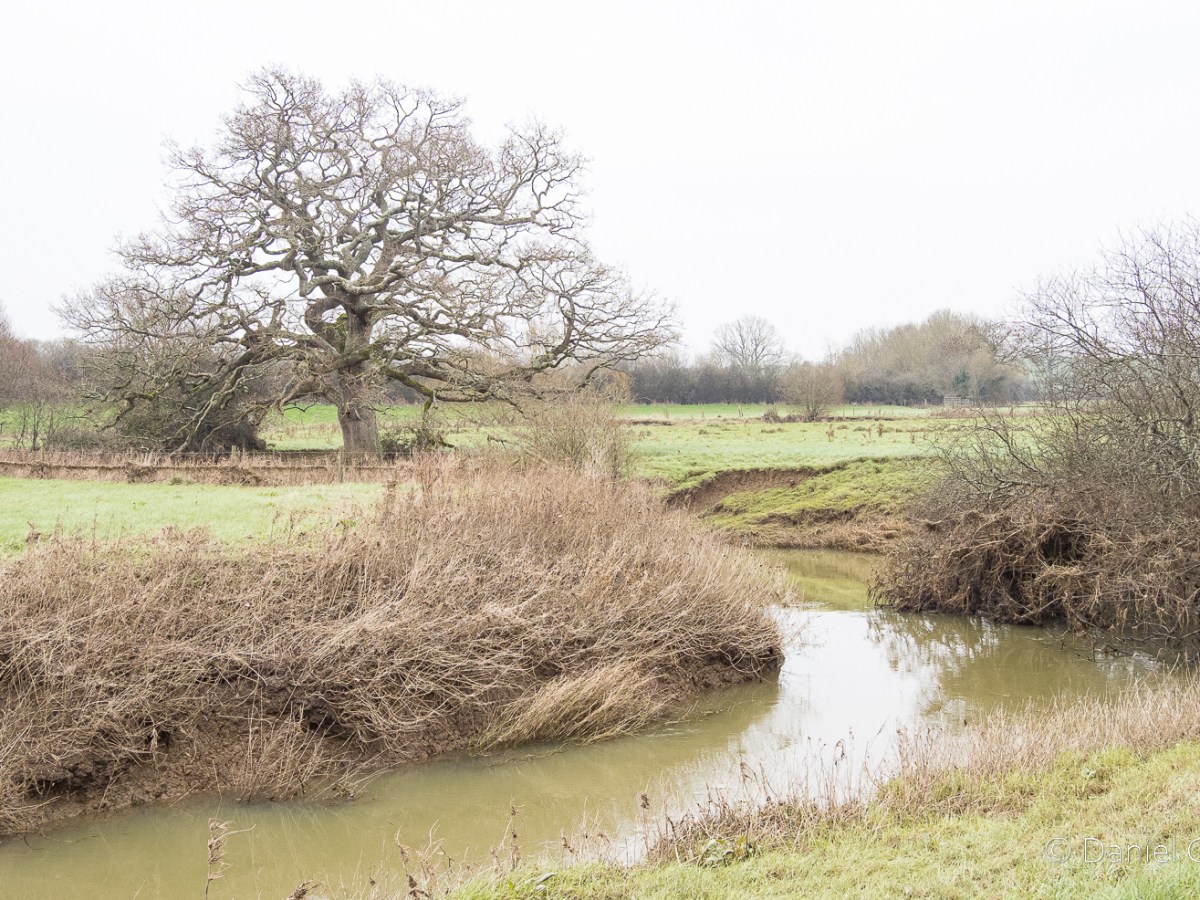
  • Arun valley oaks around Billingshurst

    Arun valley oaks around Billingshurst

    A long ramble (in both senses) around the oaken landscapes of Billingshurst, including the Wey & Arun Canal… Continue reading Arun valley oaks around Billingshurst →

Cep-tember: reflections on foraging in England 🍄

In the early weeks of September, the first autumn mushroom boom hit. This was after a number of stormy downpours finally gave up some of the long-held rain to the land below, where us humans are most of the time.

I visited a local Sussex woodland in the second week of the month and was astonished by the change the rain had brought about. I have never seen so many blusher mushrooms (Amanita), which were honestly as common as muck, as the English saying goes. It’s also the start of the Russula season, with the first explosion of the brittle-gilled, uniformly white mushrooms. They are spectacularly beautiful to look at before the squirrels, deer, or slugs get to them, as they should.

Blusher mushroom

I was on my way out of the woodland when I was stopped in my tracks by the sight of a perfect mushroom. It was perfect in appearance and is thought of as perfect for its culinary quality. At the edge of the shady path, under the branches of a young holly tree, was a cep (Boletus edulis).

Recently I’ve read a book about mushrooms and foraging that really got me thinking. It challenged my perceptions of whether we have it wrong about mushroom foraging in this country in terms of tone, and whether everything I thought I knew about what a woodland’s state would mean for its fungi.

More on that in a bit. You may have guessed that I picked this mushroom, took it home and ate it. I lived to tell the tale and it was indeed very tasty.

In recent weeks there have been Instagram posts showcasing hundreds of ceps in France and Russia and it’s made me realise something. One of the best times to pick edible mushrooms is in August and September before leaf fall and when there is still drier weather to be had. Wet weather also allows detritivores like slugs to feast on mushrooms.

Cep (Boletus edulis) also known as penny bun or porcini

Ceps in particular seem to be more likely to be free of decay and of insect encroachment into the stipe in drier months, which forms the core of the mushroom’s edibility.

For the past ten years I have remained fairly sniffy about mushroom foraging and only really ever eat wild mushrooms as a one off to see what they’re like. Part of this comes from working as a woodland warden for 6 years in an ecologically sensitive but hugely popular nature reserve. In my view and experience, I still don’t think foraging is sustainable in small city woodlands where the impact of footfall can degrade a habitat’s viability. There is also the fundamental fact that access to certain places has its controls, which are legal requirements in some cases. It’s also a sad reflection of the state of the English landscape which is said to be one of the most nature-depleted in the world.

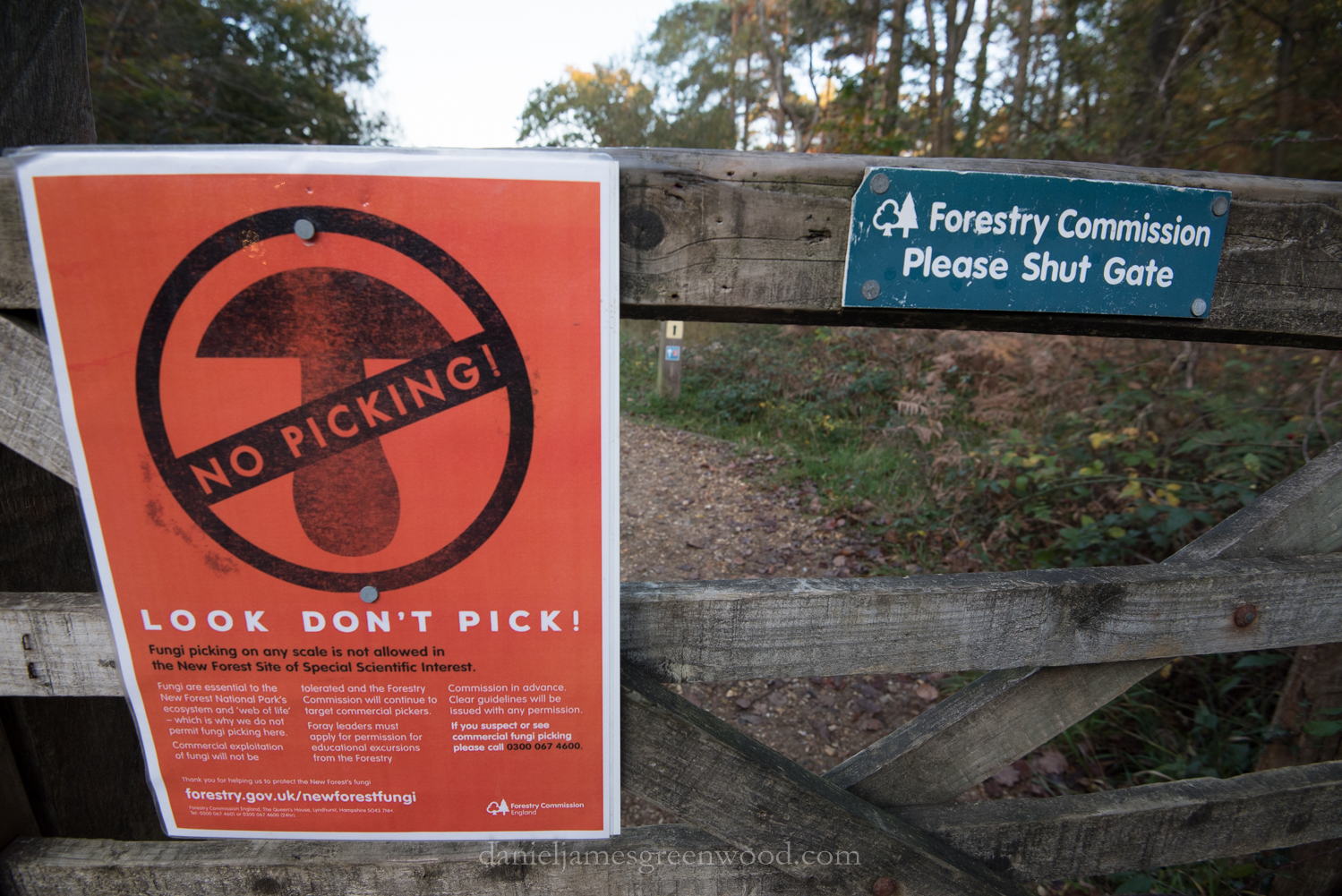
Reading The Mushroom at the End of the World by Anna Lowenhaupt Tsing made me appreciate just how nature-depleted we are in the UK, and how this is a cultural as well as ecological issue. I’ve written before about mushrooms in the Slavic world. Mushrooms seem like such a rare thing now that their picking is treated in numerous places as an offence, and this still with no solid evidence that picking mushrooms reduces an ecosystem’s viability or biodiversity. It does seem to come down more to commercial ‘theft’ than anything else, which you can understand if ‘organised’ groups are technically asset-stripping public lands. Mushrooms like ceps have a market value, something Tsing covers in greater detail.

As mentioned earlier, in small urban woodlands I think large-scale foraging could be harmful in that it can introduce lots of feet to healthy areas of woodland soil and seal it up, blocking the vital movements of gases like oxygen and CO2, fungal and invertebrate life, resulting in tree death. Soil is, after all, a living thing. It’s another reminder that woodlands with high visitor numbers do need to be managed for their long-term health.

Bradfield Woods

But disturbance of a different variety may not be so bad. It may even help to promote mushroom dispersal. Tsing’s book shows that disturbed landscapes seem somehow ‘better’ for matsutake in America, with landscapes damaged to a degree by industry actually being reawakened to different communities of fungal life. We are of course talking about wooded landscapes of much greater scale than most that are found in the UK. That’s a key element to consider.

Two years ago I visited Bradfield Woods, a managed coppice-with-standards woodland in Suffolk that also happens to be a National Nature Reserve. It was absolutely chock-full with boletes and many other species of fungi, including stinkhorns! Bradfield Woods is coppiced regularly for its hazel wood and its mature oaks are felled for timber (hazel = coppice, oak = standards). It was one of the most fungally-rich woodlands I have ever visited in central or southern England, again this was early September.
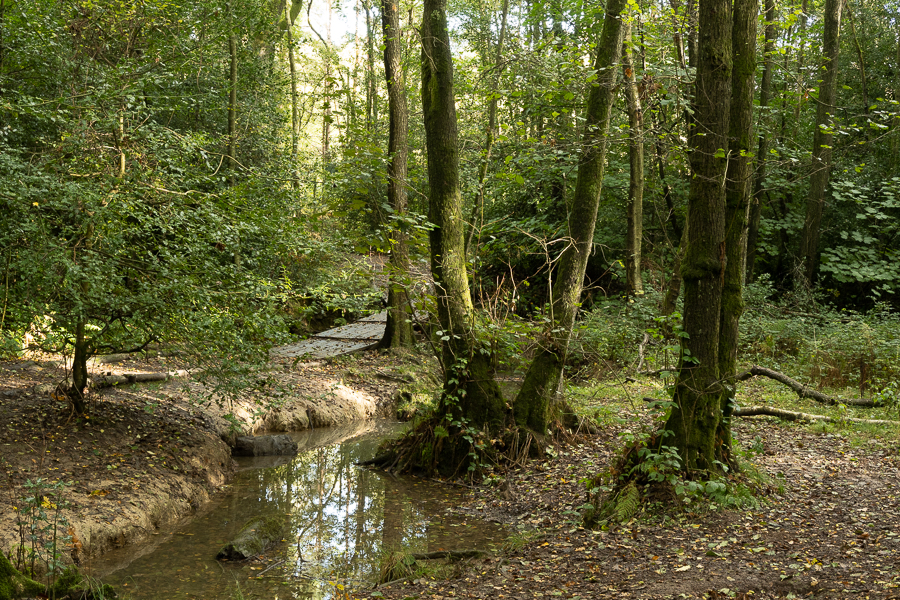
The management by the Wildlife Trust at Bradfield Woods is sensitive and sustainable, unlike most plantations where an entire woodland is effectively created from scratch (or from an ancient woodland, similar to how rainforest turns over to palm oil monoculture) and managed aggressively with large machinery that damages the topsoil. Then again, Bradfield Woods is not needing to produce toilet paper and other goodies for 60million people. It’s important to remember that that’s why plantations are managed as they are, for products we all depend on in our daily lives. This is probably an issue of globalisation.

The Mushroom at the End of the World has a lot to say about globalisation, focusing on the matsutske mushroom, one of the most economically important species in the world. Tsing covers the (human) immigrant communities in Oregan, USA and how their livelihoods depend on picking. It reminded me that the anti-foraging arguments in a lot of the UK media are along xenophobic lines, which Tsing does cover in regard to white supremacy in the United States. One English video lingers in my mind, of East Asian women picking mushrooms in a London park and being accosted by a local volunteer who is also filming them. Without pretending to be an expert or to define an entire region of diverse peoples, picking mushrooms appears to be a perfectly normal activity in East Asian countries.

Tawny grisette

There is also the interchangeability of the phrases ‘gang of foragers’ with ‘gangs of foreigners’, which I very embarrasingly said by accident in challenging the very concept at a guided walk once. This kind of language is far more easily accessed in certain British newspapers, which are hostile to immigration and refugees more generally and seek material to boost their propaganda. As you may have seen, a lot of people continue to express racist or xenophobic views in 2022, and sometimes people don’t realise how those ideas can surface in the most unlikely of places – a love of the nature deemed to be ‘ours’ and under ‘our protection’. These are issues and messages here that need to be considered carefully.

Perhaps the fears about foraging harm wildlife because our disconnection from these places has contributed to ecological decline. Perhaps it’s also that we need to accept our failure of stewardship – have we done enough to champion the positive use of our woods and their wildlife or have we not broached the topic meaningfully enough out of fear?

The last few days has shown that UK conservation charities have had enough of the Government’s total failure to secure environmental protections, at a time when access to nature and a rich ecological environment is crucial to societal wellbeing.

If sustainable foraging can allow people to connect more deeply with suitable green spaces, and to understand their ecology and improve their management, surely that has to be a good thing?

Thanks for reading.

More mushrooms

Enjoyed what you saw here? If so, please support my work: https://ko-fi.com/djgwild

Entangled Life: the book fungi have been waiting for 🍄

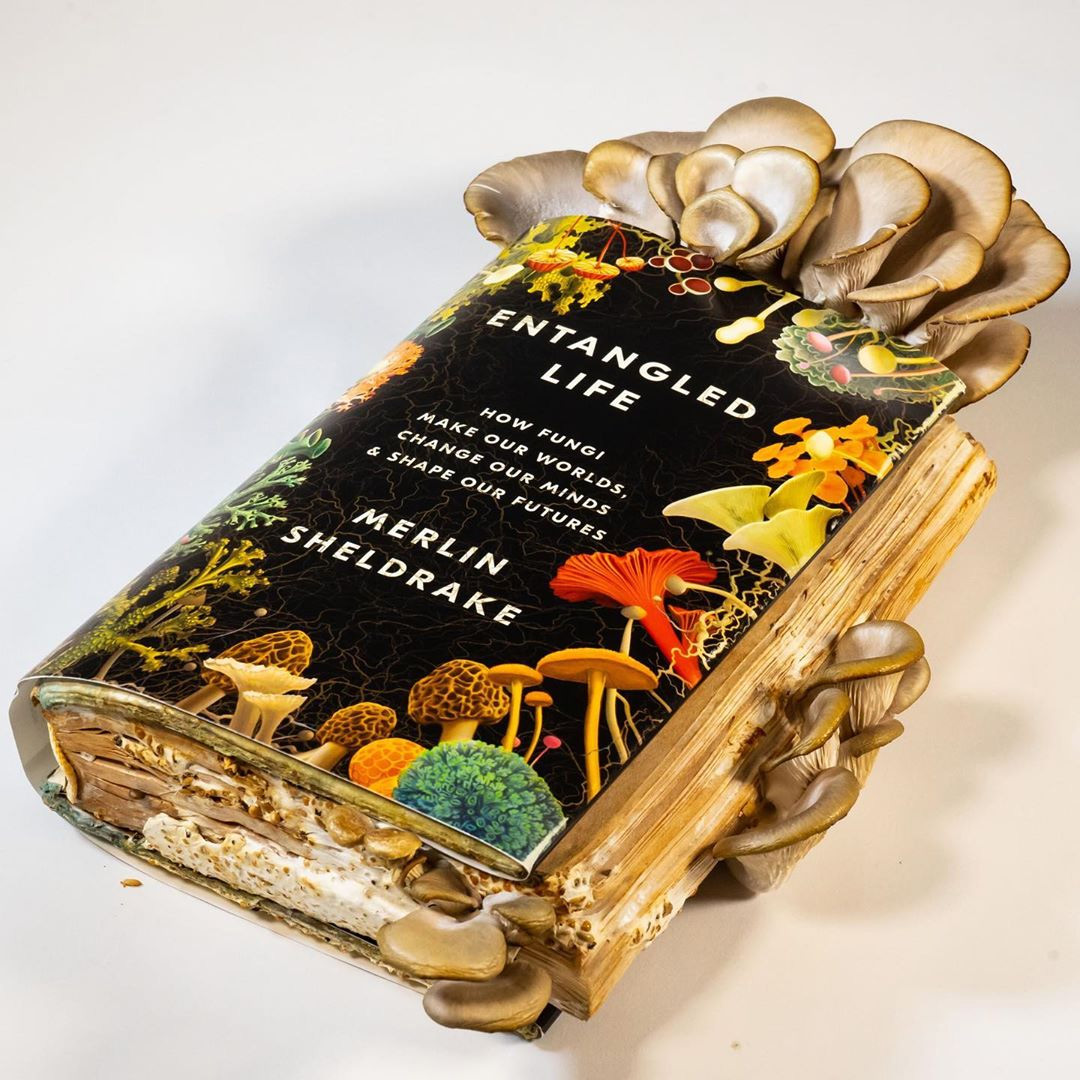
Merlin Sheldrake’s Entangled Life has been sitting on my bookshelf for well over a year. It might even be two years. It almost certainly has fungal spores on it, probably mould.

I knew it was going to be an excellent book that contains huge amounts of fascinating info about the fungal kingdom because I’d read the first 50 pages. Alas, I couldn’t find the mental space to take it all in. The reviews have also been almost universally positive, from a broad cross section of readers. This includes people new to the study of fungi and those who are more experienced.

Recently I have had a bit more of that required mental space, after a year of being swamped. I’ve now read the book and It. Does. Not. Disappoint. You get the impression that Sheldrake could write books for the rest of his days focusing on one of the themes chaptered each time, such is the depth of each subject.

It’s the kind of book fungi have been waiting for to tell their stories, as the meme below so totes hilariously illustrates:

I read it with the sense that Sheldrake was using his extensive knowledge and research into fungi to campaign for a better appreciation before it is too late. That said, there isn’t the overarching doom narrative of a lot of nature conservation messaging, more a sense of awe regarding how little we know and have the potential to uncover. This is a book about hope and new possibilities, while understanding some of our planet’s oldest secrets.

It becomes clear halfway through the book that fungi are not an add-on to plants, they are the reason that we even have those bright green things as they are today. It’s a point I often labour at public events and to people not yet convinced by the importance of wilder, species-rich landscapes – without fungi we would not exist.

Suzanne Simard is namechecked as the founder of the ‘Wood Wide Web’, showing that plants actually behave far more communally and that fungi are the lifeblood of the mineral and resource exchange that builds the world we have evolved in. Sheldrake also features several other female academics, a welcome move in a community dominated by middle-class, white male perspectives and privileges. Simard’s book, Finding the Mother Tree is an absolute must-read and is included as a hugely important character in this narrative.

🍄

The more I read about fungi, especially in Sheldrake’s writing, it just makes me think how little we know about anything. We spend a lot of time warring with one another during such short windows of life, we should be using that time to learn more about the incredible world we live in. For example, fungi were only given their own kingdom in 1969, previously just lumped in with plants or as flora. Now there are calls to speak of flora, fauna and funga. Cowafunga, dudes!

Perhaps because most fungi are almost all out of sight (endophytes live within the tissue of plants, rather than producing charismatic fruiting bodies like fly agaric, above ground). Endophytes thus remain forever out of mind. In this sense, our innate human biases (sight) are restricting our ability to conserve vital biodiversity in the form of fungal diversity in soils and other ecosystems. There is evidence about how more charismatic wildlife receive the majority of conservation funding.

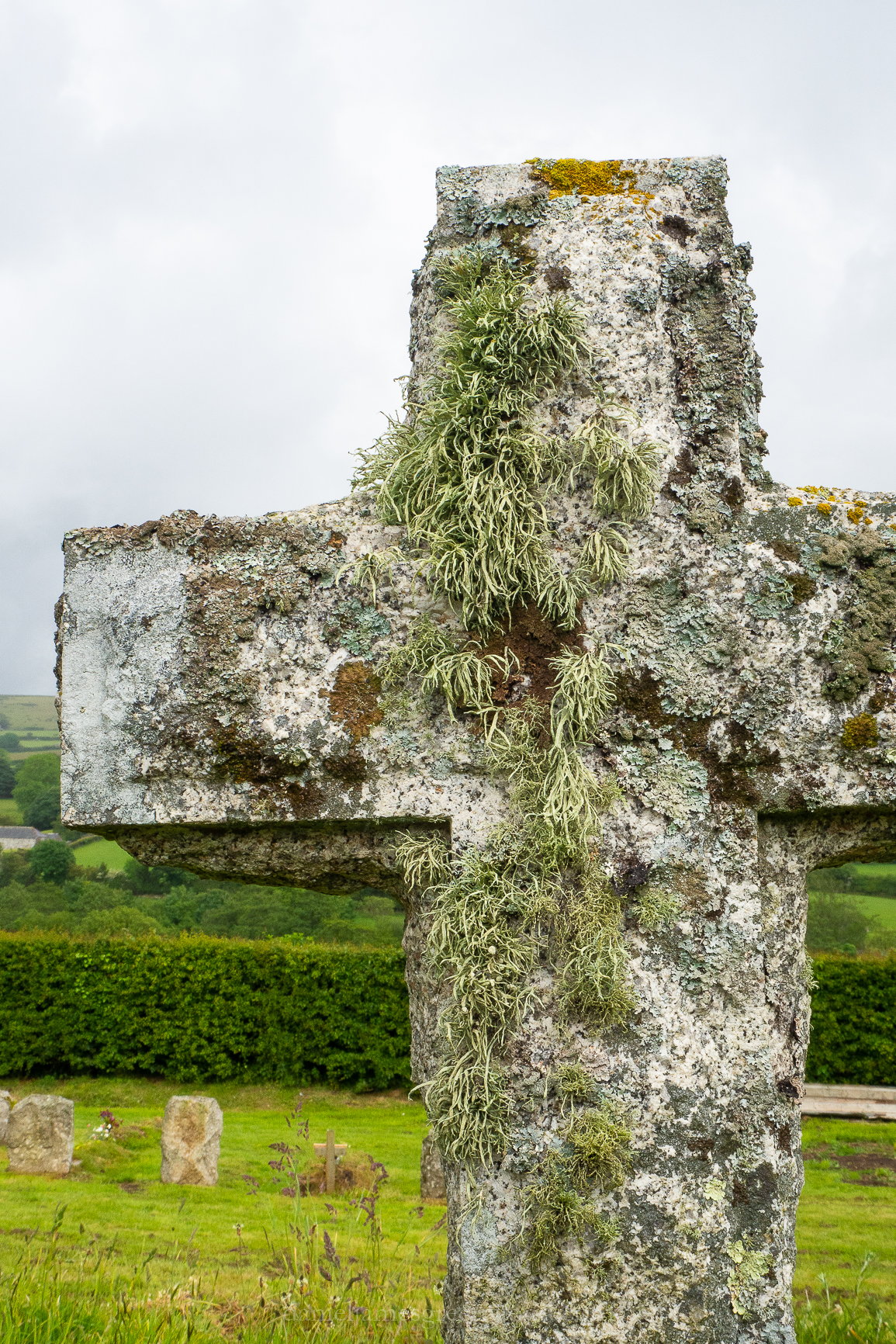
Some of the facts on display in Entagled Life will blow you away. Consider that lichens may not be what we think they are, and that some fungi used to ‘lichenise’ but no longer do. The relationships between plants, fungi, algae and bacteria are not necessarily fundamental but more opportunistic. Tree species that are more ‘promiscuous’ are more likely to have found greater dominance over larger areas because they can link up with fungi as they go. The connections trees have with fungi have shaped the landscapes of today.

Further to this, fungi are so biologically complex that it may not be possible to truly name them scientifically as distinct species!

Fungi are able to break down rocks, as they will have done hundreds of millions of years ago to create the first soils and thus stable ecosystems for us humans to evolve in.

Then there are the theories that humans developed complex languages through the brain development spurred on by the ingestion of psylocibin (the hallucinogenic chemical found in some fungi) and other ‘magic’ mushrooms. That remains unproven, as Sheldrake responsibly underlines. But the idea is brilliant and makes life seem so random.

I also was unaware that LSD is derived from the fungus ergot, and ergot infection of people back in mediaeval times may be the reason they ‘danced for days’. Now certain Berlin 24-hour nightclubs make more sense, though they’re way past my bedtime.


Fungamentally this is a book that everyone, from fungi enthusiast to someone just looking to know a little bit more, can get a lot from. It’s written in a very lucid and engaging way, though bear in mind it does take a scientific and methodical approach to its subjects. After the glut of recent nature writing where man-encounters-divine-nature-for-the-first-time, usually in search of one species, that may be just what the mycologist ordered. That said, do species even exist? You have to wonder what Sheldrake will do next with the information he has to share.

Thanks for reading.

More mushrooms


Latest from the Blog

Austrian Alps: Innsbruck by sleeper train

Innsbruck, Tyrol, Austria, June 2025 This is a longer post of the images I captured during a recent visit to Innsbruck in the Austrian Alps. We travelled to Innsbruck on a sleeper train from Amsterdam. It’s such a great experience and is significantly lower in carbon emissions compared with flying. If you consider the fact…

Postcards from Western Ireland, September 2025 🇮🇪

I’m back from my annual visit to the west of Ireland. I managed a couple of day trips to forage for photos, which will crystallise later this year into dedicated posts, all being well. Like many people I enjoy the Blind Boy Podcast, none more so when I have the headspace to take in all…

Mushrooms in England

This is the first of a series of posts I’ve been working on covering national relationships with mushrooms. It’s just a bit of fun, but there’s definitely some interesting stuff to share.

Dulwich Park fungi walk in October

Hi everyone,

I’m pleased to announce that I’m leading a fungi walk in Dulwich Park (SE London) on Sunday 23rd October 2022:

The meeting point is near the cafe at 11am. The walk will last around 90 minutes. The walk is free to attend and is funded by the Dulwich Society.

It’s been such a dry spring and summer but hopefully the stock of old trees and sensitive management that takes place in parts of the park will mean a decent array of fungi can be found. If not, there are always plenty of strange anecdotes about fungi to share.

We’re likely to find common species like inkcaps (above), jelly ear, turkeytail, Ganoderma brackets and brittlestems.

While it’s not a culinary or foraging walk, I can share general information regarding edibility of some common species.

This will be the first walk I’m leading as a freelance guided walks leader (having led walks since 2012). You can find more information about that on my new bookings page.

Thanks for reading.

The Arun valley: gateway to the unknowable Downs

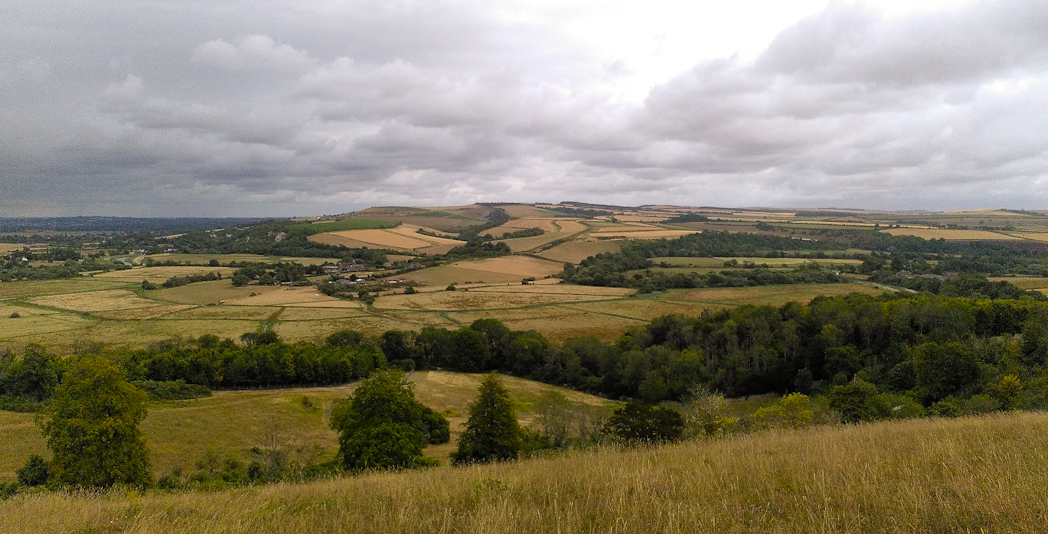
A couple of weeks ago I spent some time in the Arun valley, my local access point to the South Downs. At last some rain came and we watched it shift across the Downs, all the way over to the Greensand Hills in Surrey.

I remember looking at this view in April 2021 after a year of lockdowns and computer screens. I honestly did not believe it was real. Perhaps it was the veil of mist, or perhaps I had developed some mental or neurological disorder from so much time stuck at home.

The Arun valley around Amberley is a crossing point (or perhaps washing point) of the Weald and Downs – where the river that rises in the High Weald’s most westerly point cuts a course through the chalk hills. It has wetlands of international significance in Amberley Wildbrooks and nearby Pulborough Brooks.

Arun at North Stoke, page 71 Book about the Highways and Byways of Co. Sussex, England

Like the nearby Adur, probably better known to people because it passes through the very fashionable Knepp Estate, it used to be a much wilder and freer river.

Along the Arun is the village of Bury, likely to originally have been a defensive point preventing easy Viking access from the coast, up the Arun and towards London, a key trading point (obviously). I recently read a book about Anglo-Saxon England that included some information about King Alfred’s development of ‘boroughs’. These were defensive outposts alongside rivers designed to protect from Viking invasion, which happened so regularly and to great effect in Alfred’s time.

The churchspire of Bury village can be seen among the trees on the banks of the Arun (2020)

The boroughs were an effective means of defence, for a time at least. I can think of so many placenames that include a borough of somekind: Pulborough, Bury (Lancashire, too), Borough (on the banks of the Thames) and Middlesbrough being the first that come to mind.

The Arun valley at Amberley is a place I first visited through working in the South Downs National Park. My relationship to it is about to change as my time with the National Park comes to an end, but that mixture of professional connection and personal fondness has always been an uneasy one.

It’s the place you can get a train to, which is rare in the South Downs, and enjoy some of the most accessible downland walking. There are views to the North Downs and then south to the coast. The Amberley Downs have glow worms, junipers, barn owls, ravens and rare butterflies like the duke of bergundy. It’s also home to vast monocultures of ‘improved’ grassland that were once rich in communities of now rare plants.

A lone hawthorn on the Downs with the Arun snaking away in the background (2019).
Much of its floodplain has become grazing land

The South Downs was first floated as a National Park contender in 1929 but the devastation to its chalk grasslands from the need to plough it up for crops in the Second World War left it a poor relation to the seemingly untouchable Lake District, Yorkshire Dales and Peak District. It only got full ratification as one of the final acts of the outgoing Labour Government in 2010. The Conservatives who followed have begun to cut National Park budgets through flat cash settlements, despite the effect this might have on such a strongly conservative social make-up (‘the shires’ or ‘blue wall’).

The pre-war Downs were sold as one reason to fight for Britain’s sovereignty from Nazi Invasion in the Second World War. How ironic that they ended up being denuded by the very same need to survive. Once the Downs would have been roamed by shepherds grazing large expanses of chalk downland. Today the South Downs feels in some places like an outdoor factory of intensive agriculture, with miles and miles of fences. It is not a wild place in the way that people imagine American National Parks, which in themselves were not necessarily ‘wildernesses’ either due to prior Native American presence. But it is still an incredible place to witness England’s wildlife and geology,

Your Britain – fight for it now (Imperial War Museum/Frank Newbould 1942) – this is not geographically accurate, with the landscape being a splicing together of different parts of the Downs for artistic effect

In Rebirding, a sort of bird conservation polemic, Benedict Macdonald questions the designation of the South Downs as a National Park because of its rolling hills and chalk grasslands, having read this on the website. Ironically the South Downs is one of the most wooded in its tracts of the ancient Low Weald, and home to internationally significant wetlands like those along the Arun at Pulborough. Chalk grassland is also one of the rarest habitats in Europe. It is an astonishing range of habitats, with the dry lowland heath now very rare after the Victorian and 20th-century devastation of the ‘wastes’.

The whole 100 miles of the South Downs, from Eastbourne in East Sussex, to Winchester in Hampshire, has been in my thoughts most days for the past 4 years. The Arun valley now becomes for me that gateway that exists for so many people who don’t have to consider a National Park in its entirety, a psychological doorway into somewhere freer, better and more ‘wild’.

Looking east along the Downs from Chantry Hill, June 2020

In reality it is far more complicated than that.

Thanks for reading.

The South Downs