The flickering of panic

Cairnsmore of Fleet

Cairnsmore of Fleet, Galloway, Scotland, February 2014

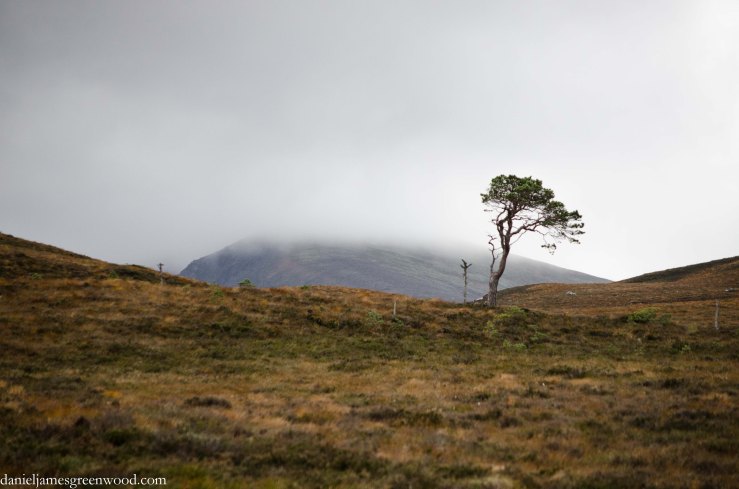
A wading bird bursts from the bog. I watch its sharp wings cut into the wall of mist and descending treeline. I put my binoculars to my eyes and the bird is lost. The world has been reduced. All terrestrial life but for water, a few lichens, heather and wintry moor grasses has escaped. I have left behind oak woods overcome by rhododendron and cherry laurel, and Cairnsmore Burn choked by the former, its water crashing from the shadows. It was not right. Snowdrops still managed to create small rugs of white flowers and winter green leaves. Bluebells peeked through the leaf litter amongst them. Behold the denizens of Galloway’s oldest woods. Up here those are images in the mind. The life in the lap of the Cree estuary – the buses, postman, trees and gentle flowering plants are mere memory. The cover of Glenure Forest’s regimental spruce is the last notion of protection. It’s now up to willpower, my body and clothing. The path leads clear from 20 metres, visibility coming and going with cloud.

Snowdrops

I climb over a wooden ladder and the landscape ascends suddenly from 400m towards the 711 that marks Cairnsmore of Fleet’s summit. I have not seen a single person since snowdrops. Why would anyone want to be here? I come for the brutal solitude, even if I wanted to see another person I couldn’t. I come because I know that people once had no choice but to walk this path, a path that zigzags and climbs, an uncomfortable choice of jutting rock or slippery grasses. I attempt to find a rhythm on stone. The path curves east and the winds propel me on. I see boulders and mistake them for cairns – this is not the summit. My thighs are soaked, woollen gloves, too. I took my jumper off some miles back and now need it. It’s sodden and looped around the strap of my bag. The winds are harder, colder and the rain splatters against me. What the guidebook called a nice introduction to Galloway’s hiker’s paradise has the makings of a minor ordeal. Water streams down the rocky path as I step up and through it. The music of the running water cuts through the wind, it’s almost all I hear, but for my own mutterings. I can say what I want now, no one can hear me. There will be no repercussions. I cherish that.

Cree estuary

The false sense of the summit has given me energy. I’m so hungry. I begin to see my breakfast as vital, I value it differently, as something I was fortunate to have. I see the first cairn of the summit approach and slump down behind it onto wet stone, moss and crustose lichens, barely protected from the gelid gusts. I push some cheese into a crusty bread roll and swallow it. I feel the onset, the flickering of panic. The wind and rain has thrashed me, and I didn’t realise it had or that it might. Visibility is now down to 10m, I put my gloves back on, the cold hammering without, almost burning. I think of real mountains and feel stupid. Hills aren’t to be taken for granted, either. My glasses are blotted by rain on both sides, I recall my friend’s maxim that the descent is worse than the climb. There is no notion of friendship here. The supposedly fine views of the estuary are not on my mind just now. I tread blindly back the way I came, finally removing my glasses. The path of rock, the fog, the bog, it’s all clear. There is no need for detail. I tread in hope and long to see the cloud drift and for the undetectable sound of the wind dropping. The spruce trees appear again, black and warming, even a glimpse of the Cree. From the bog two grouse explode into the air and I leap in surprise. It’s the start of a world I can live with.

A careless act

Gull

Farthing Downs, London, January 2014

From the hawthorn trees comes the sparkling sound of thrush and finch chatter. All around the landscape is weighed down by weeks of rain, the sodden grey and blackness, but this conversation lightens the scene. A flock of goldfinch burst into the sky, skipping through the air in their piecemeal flock. Their yellow wingbars flash against black feathers like miniature human warning signs. I train my binoculars on the thorns and see a redwing sat in the branches, contributing to the bird discussion. As I step towards them it ends instantly and so I turn and take a path to leave them.

The stumps of ash trees glow resinous on the hillside, the felled trunks lie supine beside them, the bark darkened by rain, the green and blue lichens thrive without a care for the tree’s demise. The brash has been piled and burned in elevated corrugated iron beds, and to many people this would seem like a careless act of deforestation. But it’s not. Farthing Downs sits on a bed of chalk and is home to a vast array of wildlflowers which are disappearing from the English countryside. The City of London Corporation are here engaging in a battle of restoration. Further along the path a black-headed gull skates low over the lane – I’ve not seen them so close to the grasslands here – propelling itself up and into the wind. Its relationship to winds so cold and blustery seem uneasy, and against this vista of meadows and woods, all the more unique.

A layer of snow

A layer of snow

Carrbridge, The Cairngorms, Scotland, October 2013

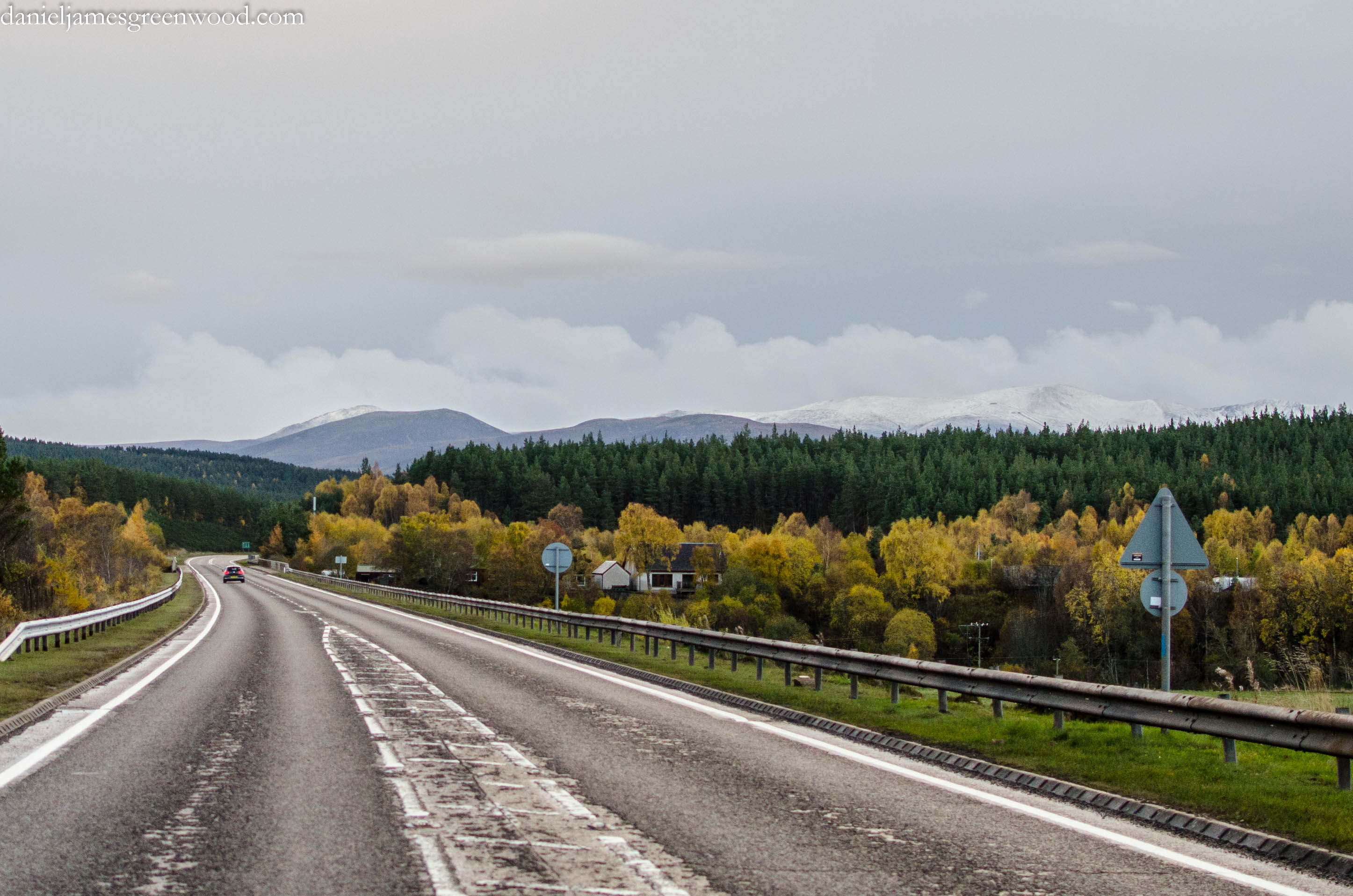
Arriving in the fields, the lichen frosted pinewood in our wake, I admire an old alder tree coppiced and growing by a brook. The landscape unfolds, the Cairngorms rising in the east, fringed in all corners by the yellow of birch leaves. We look to the hill where we had observed this scene only two hours ago, from a spot where a sheep skull hung from a piece of standing wood. We follow the River Dulnain as it runs east, the sound of traffic returning along the A-road. A buzzard floats over a line of trees, calling out, the sound severing the reminder of motor vehicles. We egg it on – ‘go on, my son!’ – and approaching a small farmstead we find a rabbit freshly mutilated, its neck bone protruding, eyes gone. Was this the buzzard’s work, or perhaps a mustelid. We cross a tributary of the Dulnain and a goosander bursts from underneath the footbridge. This saw-billed creature is one I had never seen before now. It steers itself upstream into the dusky light reflected by the water. We continue past a dilapidated cottage and fiery beech tree, watching as sheep leap and bounce away from a row of cabbages they had been eating in a neighbouring field. We meet the main road and wait patiently for our chance. Having crossed, we train our binoculars on the summit of Cairn Gorm, the restaurant and funicular railway car scratched into its slopes. All is dressed in a layer of snow.

© Daniel James Greenwood 2014

It’s the eagle

Glen Einach

Glen Einach, Cairngorms National Park, Scotland, October 2013

Lying on the grass where the road forks up and into the wind I watch the redwing and fieldfare slip across the grey sky. Down below us the River Am Beanaidh flows with great force. My friend has finished in his attempts to separate map from wind and joins me on the gravelly soil, rolling himself a cigarette. A few minutes ago we watched redwing appearing from the heather like particles drawn, magnetised to the scots pine. Some remained in the heather for a time, before using the air and their wings to join with the trees. My smug little siesta is embellished further by a reward received a few minutes earlier: the sight of a crested tit mixing with its coal tit cousins and picking at the sticks and lichens. I have felt the tiredness and tenseness that comes from a lack of proper rest since summer’s end but this landscape reinvigorates me like no other that I have set foot upon. Listening to the quickening wind dashing through the medium of pine needles, my friend calls an end to our pause.

We head up over the top path, the wind bursting through. It’s much cooler, a hint of ice. I automatically reach into my coat pockets seeking woollen gloves. It’s reported to feel like -11 on the peaks today and here blows the clue as we climb to 450m. Trudging along, a shape appears in the distance, passing over the pinewoods, across the river and the slopes of Cairn Eilrig:

‘Big, big bird,’ I shout, into the strength of the wind. My friend stops.

It passes across our view, a cloak caught by a gale. The thought process begins: buzzard… raven… its dark, primary wing feathers like digits. Its wings catch a slither of sun, a golden sheen. It’s the eagle. It disappears behind the trees, appearing again, coasting and now lost to the pines. My friend and I have both leapt up onto a lichen and heather-covered bank of soil. We jump back down, carried back by the wind by an inch or two. We hit a gloved high five, hard and true.

The shock of the heartwood

Farthing Downs

Full set of photographs here on Flickr

Farthing Downs, London, January 2014

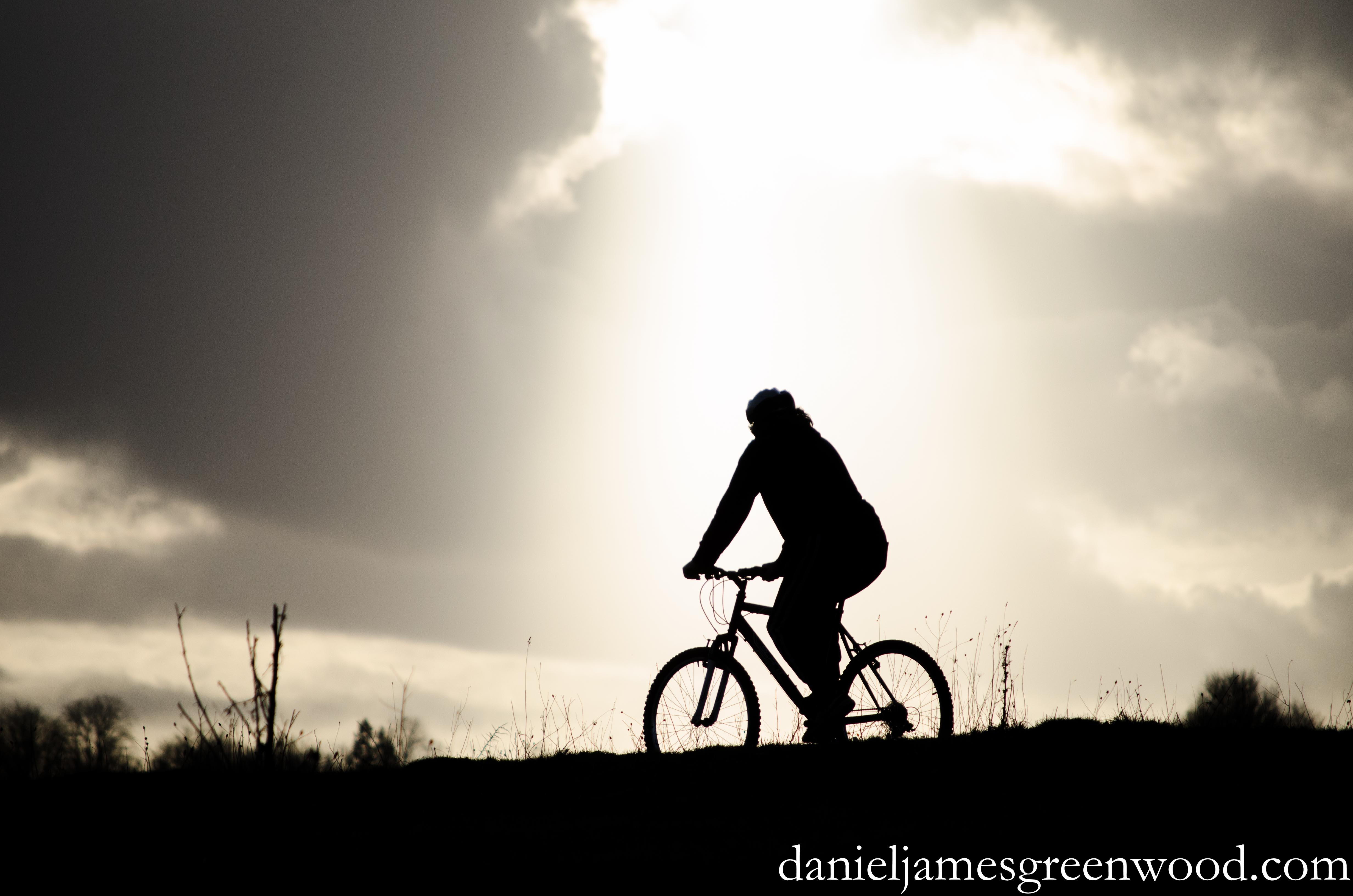
The long shadow of a jogger crosses me and at first I think it’s someone approaching. A peek over my shoulder shows the silhouette of a toiling woman, but is it new resolution or good habit? She is followed over time by a trail of cars, parents clutching the hands of young children, and finally the huffing shape of a cyclist rolling past. The world of the Downs reminds me again that the earth is something of a cauldron, everything is always changing. Groups of people walk along the lane, shadows breaking and reforming, pausing to watch something, perhaps a bird, perhaps the view of houses creeping up the hill, or views of a distant, spiralling city.

Jackdaws dot the horizon in the east, their indentations against the sky encourage the play of human language. They are a slow swarm of insects, embers from a smokeless blaze, or simply jackdaws doing their winter dance. Woodpigeons pass them in the foreground, redwing, too. I sit and watch. On New Hill, the land beneath the jackdaws, the small ash trees are indeed like matchsticks, or else the stiff hairs of a broad and worn broom. More have been felled, chopped and piled, and against the brown wash of wood and winter grasses the shock of the heartwood is telling.

The sun slips down to me, the ant hills like boulders at the edge of a lake, dropping chunky shadows from the daylight. Squirrels cavort, their music one of scratched syllables, like little huffing corvids. We regard them with equal disdain, forgetting their own intelligence and desires. They feel a dislike for their kind, too, sometimes. A helicopter careers overhead, a primitive design still, but how long until tiny drones trail through these skies, how long before they snag in the branches of oaks or the tangle of hawthorn? Who will collect them and what will be done with them. The helicopter is navy blue and white, it heads south-west towards the North Downs as vulnerable as flesh and feathers.

North Downs diary: the endless scene

Sweet chestnut coppice

King’s Wood, Kent, December 2012

The piles of birch trunks tell us that this chalky fringe of King’s Wood has recently been coppiced. The heartwood glows golden against the black, brown and grey of a winter’s afternoon. The paths are boggy, holding the tracks of boots and the tyre marks of cyclists and scramblers. Large ditches appear at intervals, home to trees and dead wood. A Soakham Downs poster a little way back identified these as chalk pits dug in old times to extract the chalk from the soil. The chalk was then spread in the fields – what once would have been woodland – to fertilise the soil, left to weather under sun and rain.

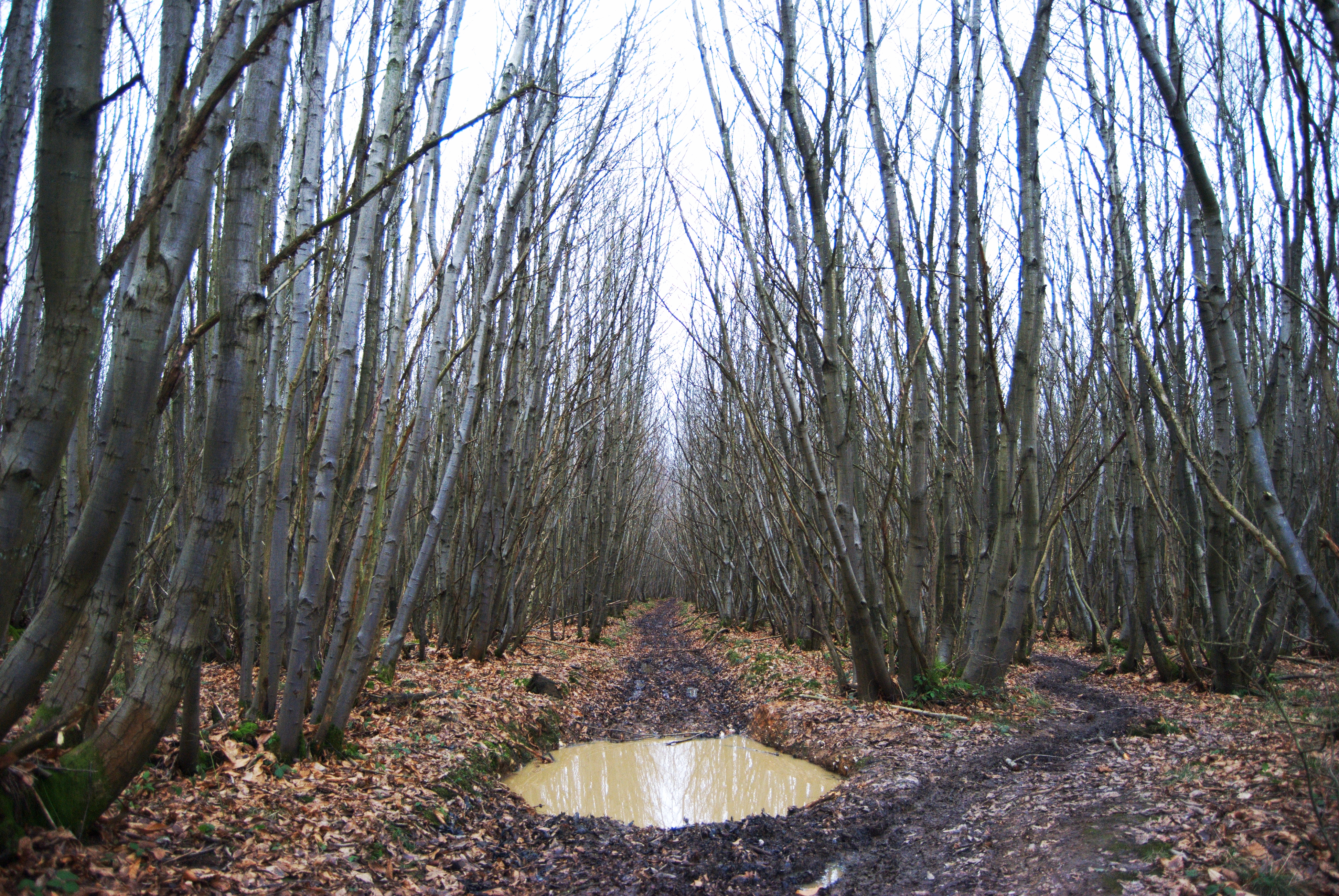
Further ahead the woodland opens in earnest, endless tracts of sweet chestnut coppice climbing into the sky. A brown puddle reflects the bare branches. Sweet chestnut provides the nuts we like to roast at Christmas, as well as forming the most economically viable form of coppicing in today’s market. The poles are cut after about five or six years and split down the middle to make chestnut paling, a type of fencing used in parks and nature reserves up and down the country. It’s another aspect of the Roman’s botanical legacy – they brought it along with them. The vertical slant of the branches is interrupted by a movement of four legged animals crossing our path in the distance. Our talking pauses as we watch an endless trail of deer move from right to left, disappearing into the trees. One of them was all white and it sticks in my mind like a puncture. We make our way towards Chilham, stopping briefly to search amongst these overgrown trees for walking sticks. We listen to the multiple stems tapping together as the wind steals through, some trees creaking. This a sound that in the endless scene of coppiced trees we mistake for shrill and distant calls of people.

The fabric of time

Devilsden Wood

Farthing Downs, London, September 2013

Standing on the track leading into Devilsden Wood I look to the ground for dryness, somewhere that hasn’t been soaked by this perpetual rainfall. I see fallen ivy leaves that appear like cuts of leather when really they are crisp under foot. Dog shit, too, the new waybread for the modern ancient footway. I hate the stuff. My waterproof sheds its load onto my jeans and it’s wait and become cold or move and receive woodland raindrops, some chucked from the canopy of mature yew, ash and beech, some fifty feet up. When they get behind glasses, these droplets shock the senses.

It’s fungi season, the signpost of falling temperatures, not too cold but a shift from the sultry summer. I gawp at log piles with an explosion of mushroom caps, marked by striping and shapes that would define them to those who understood them. But still, I spy an oysterling appearing from a rotting trunk and feel that in two years of woodland obsession I have at least learned something about this magical animal that appears so fleetingly it could almost be through the fabric of time, a monitor on how we’re doing. Checking the sole of my boot again, we’re crap. I wipe it off in a mud puddle. The rain has not lessened. I head back out from the dark, autumn-beckoning woodland and onto the wet warfare of the Downs. The change in mind is clear, the atmosphere of a woodland changes you. It is not like the open land, so much a canvas for human experimentation, our impact on woodlands is never so clear as the plough’s to the open landscape. A woodland to all but a minority could have been in that state for millenia, before human time. The wood is a wild city, with nature’s social housing, swimming pools and fast food. It was our home once, too. There is the semblance of a summer out here, yellow rattle not yet rattling, knapweed funked-out in pinkish purple, even a bit of scabious. These wildflowers have something of January’s left over Christmas decorations about them. A car passes along the lane. Woodpigeons are striking through the rainy sky, turning their wings and bodies at an angle – to avoid the direction of the rain? – always as individuals. These birds cut several different figures in a year – hurried, panicked on the wing, or else male birds cutting arcs out of the sky as they display to females long into the summer recesses. Now they could be migrating, they could be hunted. Mostly they are gorging on elderberries outside my bedroom window.

On the Downs a flock of goldfinch are startled into the sky like pieces of a broken vase put back, its smash rewound and fixed. They sit in a small hawthorn bush and I look more closely. On the end of a branch, clear and possibly not so fearful of man is a juvenile, all grey on the head, interested in looking but unaware of the perils of being watched. My advances fracture them once more and I’m left with a snapshot of their escape into the landscape captured on my camera.

Something new

Fly orchid 4

Farthing Downs & New Hill, London, July 2013

On the Downs the butterflies are immediately evident, the week old broods of meadow brown ferry amongst the long grasses, rarely stopping to feed on flowers. Breeding season is ending but still the song of skylarks comes from over the slope, some ancient language remembered, its translation lost. Greater yellow rattle blooms now, the spring buttercups lost to a swathe of Yorkshire fog and other grasses I don’t know. The suntan lotion on my arms acts as an adhesive, my skin covered with seeds. The grasshoppers are conjuring up their rickety, wooden percussion. I am hopeless in finding them, except for one that hops between seed heads, a micro Tarzan in this meadow jungle. But where are the people? A man drives a BMW sports car along the lane, revving its engine. I know where I’d rather be. Men in England are bare chested at the slightest chance and here a couple stroll along the lane drinking from big bottles of water. The tattoo stamped on the man’s back stands out in this simple landscape of slopes and flowers.

Lovers

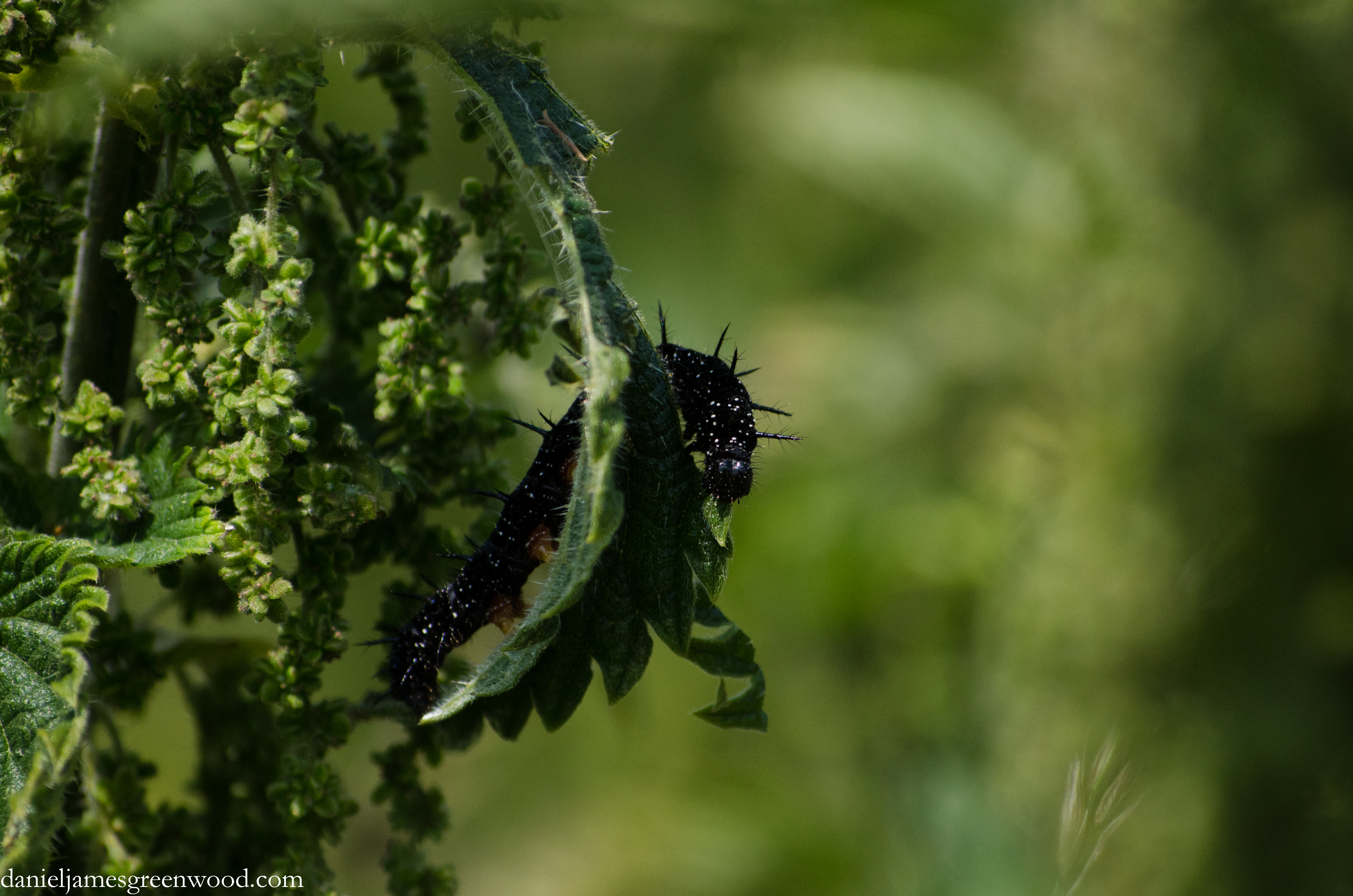
Ghostly day-flying moths spread at my every step through the long grass. Bumblebees forage on clovers, dropwort and yellow rattle, small heath butterflies appear again, two fly together, eager to fulfil their short lives with as much fornication as is possible. I cut back on to the path I know best. A chiffchaff sings in the hedgeline at the bottom of the hill, a single blackbird and a whitethroat, too. There’s no sign of spring’s willow warblers or their clutch of young. A crowd of peacock caterpillars munch through nettle leaves, leaving only the dreadlocks of flowers. A yellowhammer appears from across the lane, landing in a small hawthorn bush, its strong yellow plumage brighter than dandelions, a South American yellow, and at its brightest here. I take a few photos. Along with skylarks, this is a bird I have to travel to see, when once, before my time, you might have woken to it flocking in the hedges and fields.

Peackock caterpillar

Leaving the Downs I enter the chalky wooded hollows at the bottom of the slope, with tor grass growing along the track, an indicator of the calcareous soil. My sweat cools with the breeze that slips through here. In the dappled shade I scan the path edges for orchids, black bryony creeping out from the darkened hedges. And there it is: the fly orchid. I change lenses and struggle to get the image right, sweat dripping, bringing lotion down my face. But it’s beautiful to look at – a bit like a bumblebee pinned and proffered by the long spike, with its little eyes and short antennae. A family are passing behind the hedge, discussing how to control the dog.

‘She’s pulling me down into these weird places,’ says the mother.

‘Just let her off the lead, let her off the lead,’ the dad says.

They arrive on the path heading down hill. Their daughter warns the dog to stay with them. I only see the mother, she’s dressed in an apricot coloured dress and heeled shoes. She’s young and glamorous, so fitting with the array of flowers bursting from the hillside.

‘Who needs Box Hill when you can come here, eh?’ says the dad. They disappear down towards Happy Valley.

Speckled wood egg crop 1

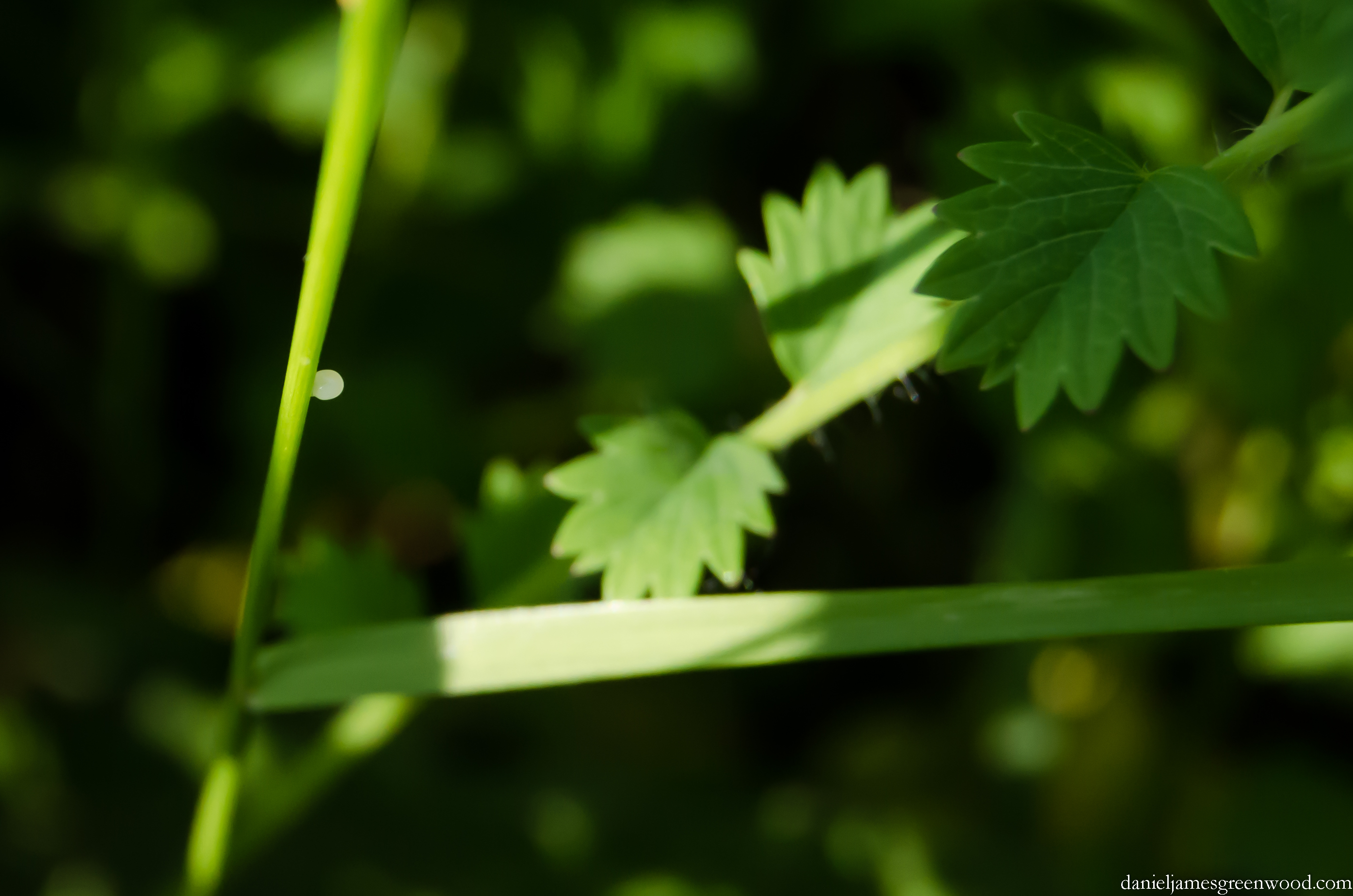
I carry on along the ridge and settle on the desire line drawn down the hill and through the flowers. Ringlets move through the meadow, the first I’ve seen this year. They move at the same time and, stitched together, they are a tapestry of flickering wings. In my silence and stillness wildlife begins to move around me, perhaps more trusting. I see more plants now: twayblades, common spotted orchid, salad burnet, marjoram, ox eye daisy, rough hawkbit and bladder campion with its inflated, balloon like calyx-tubes. The wind blows through the trees. A speckled wood butterfly flaps about me, its wings audible as it hits my khaki shorts and leaf stalks. It clasps hold of a spear-like grass stem and curves its abdomen, laying a tiny pearl of an egg. This, for me, is something new.

A profusion of buttercups

Meadow buttercups
Meadow buttercup

Farthing Downs, London, June 2013

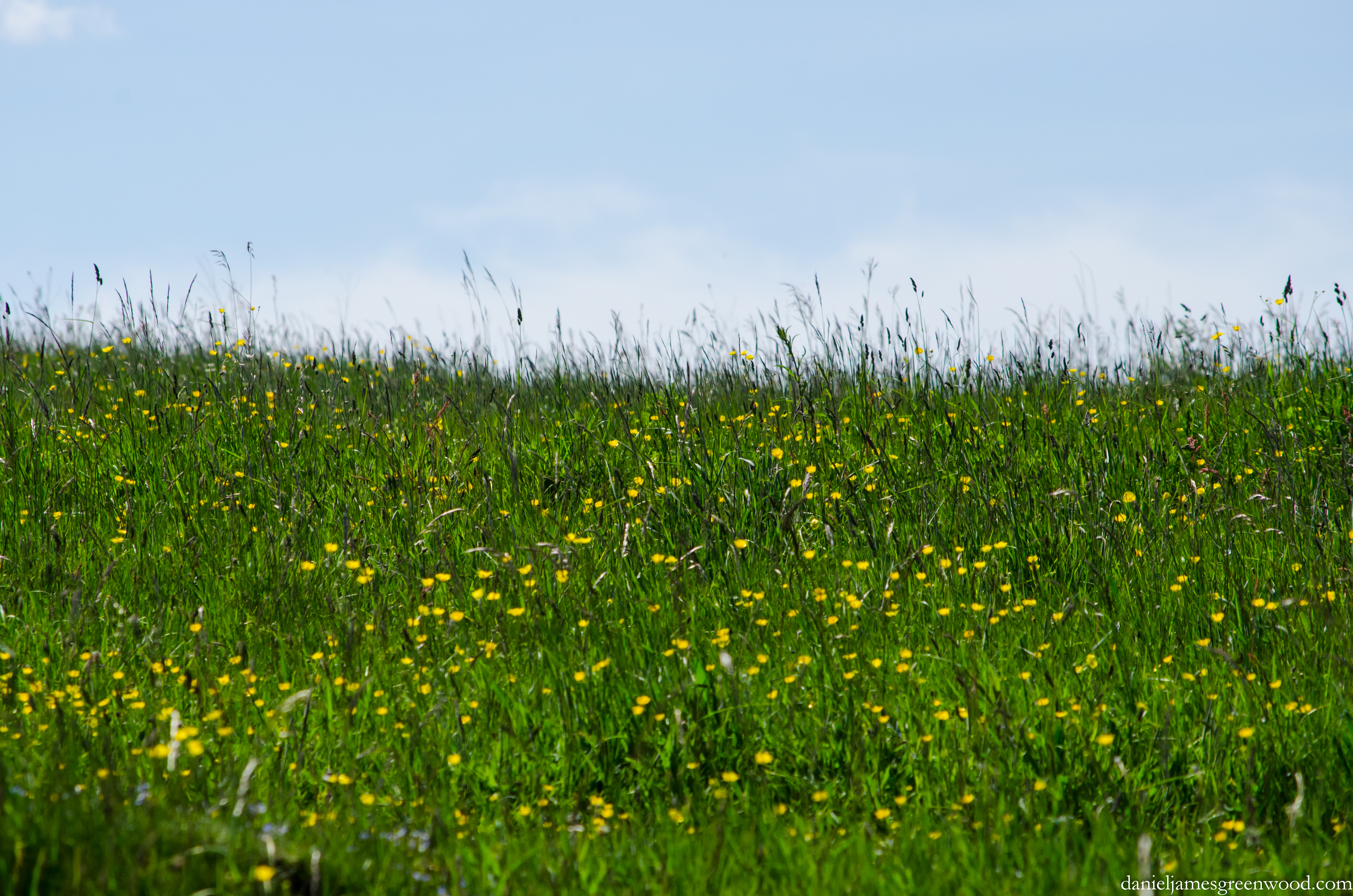
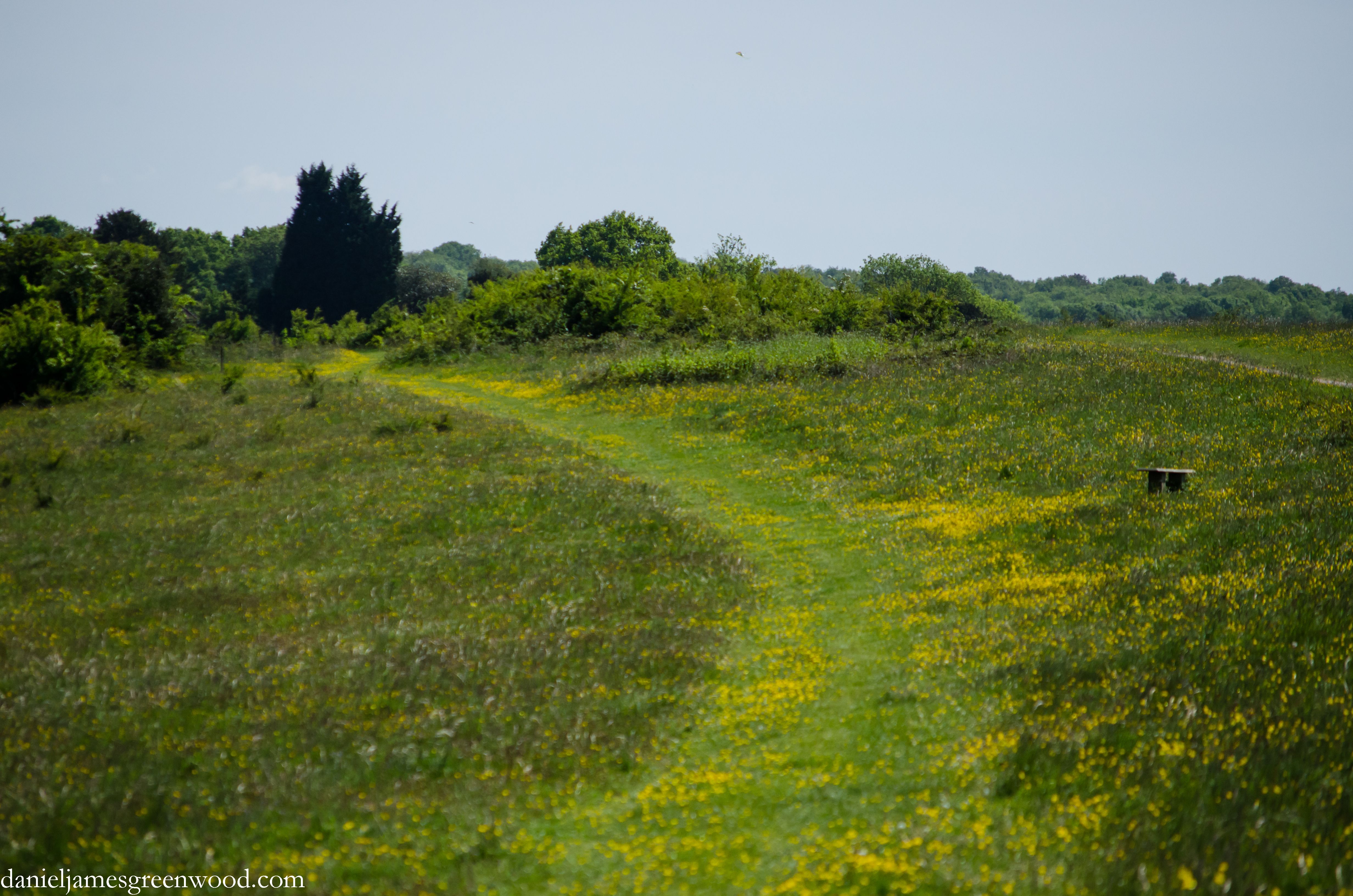
Stepping on to the Downs, a marked change has taken place in the two weeks since I’ve been here. The grass has lost its wintry edge and there grows a profusion of meadow buttercups. On the woody margins white butterflies steer themselves through the day, the slight of a cool breeze will no doubt register with them. A man is sitting on a bench taking pronounced drags from a spliff. I imagine ushering him to the gate as does someone wanting to be in a room alone. What is that link with landscape and human solitude.

A holly blue flutters about in a restless fashion, unwilling to perch, itself ushering me away, perhaps. I take the hint. The jackdaws are still here, so faithful to this place, much more so than me. This is why wildlife is so deserving of the land, perhaps more so than we. It doesn’t have a choice. Last time I watched them in a snowy sky but now they move through the ankle high wildflowers like shadows. They call out and burst free into the air when I enter into their field of vision.

Willow warbler crop 1
Willow warbler

I walk into the scrubby chunk of woodland that the path cuts through. I am struck by the change, the green, the lividness of the living. A woody, leafless hawthorn reminds me that both states remain all year round. Chiffchaffs are calling to each other up ahead, followed by the only slightly different voice of a willow warbler, a bird almost identical to the others. I sit in the shade on the edge of the path and listen. A willow warbler appears from the bush and lands on the branch of a young hazel tree. It has some insects in its bill and it whistles incessantly, huuu-eet. I take a picture and sit still. After a short wait a green woodpecker yaffles and the willow warbler dives into the long grass and bramble. Two weeks ago this bird did the same but without food in its bill. Now it’s feeding silent young down there in the thorns and tussocks. A couple pass me where I sit.

‘Are you looking for a lesser spotted whatever-it-is?’ the lady asks.

I explain the situation, pleased they don’t think I’m up to no good. Her partner turns to me: ‘I know you.’

‘And I know you.’

We remind ourselves of when and where from. We both agree things have improved since then. They leave happily, I get up and carry on through Farthing Downs.

Farthing Downs in June 1
Farthing Downs

The year’s first brood of small heath butterflies have hatched on the Downs. A pair rest on separate patches of bare soil created by livestock, conducting the heat of the sun. They live as adults for as little as seven days and I admire their freedom, their lolling and landing, they circle me, perhaps jittery when I move but not much bothered. They are orange smudges against the green downland. I sit with them. A soldier beetle clambers up a blade of grass and wrestles with its own weight, a clumsy, dim creature, it straddles the seed head, whirs its antennae and unleashes its wings from its black backpack, struggling into the air.

Soldier beetle
Soldier beetle

Chasing butterflies down stairs in Italy

Positano
Forest fire above Positano

Positano, Italy, September 2011

I’m sitting out on the terrace of the pensione, complaining aloud in the full sun. Last night I’d peered over the ledge at the lemon and olive trees, the tiled terraces and bright white roofs. The faint voice of a thrush had caught my ear, and the familiar dark, scuttling figure of a blackbird darted across a building about twenty-five-feet below. But there was something unusual about the blackbird. The light was low and so darker tones fell to black. However, this was not a wholly black bird and I entertained the thought – could it be a blue rock thrush? I was unprepared for it, so unrefined is my knowledge of anything non-British and unfamiliar. From the viewpoint of our pensione, the houses, hotels, gardens and restaurants, immaculately packed together, are built like steps to the sky with the sweeping curve of the only road in the town cutting through them, linking Positano to Naples and Sorrento to the north and Amalfi in the south. Above all this stands dry, steep and rocky mountains with deep green woodlands below the peaks. Helicopters are taking turns to pour water from the ocean onto a forest fire that has erupted in the southern peaks. It has been going on all night, the choppers roaring, their sound unbearably loud in this mid-30 degree heat. On the terrace I watch the heat rise as the morning nears noon, the choppers ferrying water from ocean to mountain. From beneath me a butterfly emerges, and it’s the beast of European butterflies, the swallowtail, flitting between the railings like a twenty-pound note.

*

Having had the shadow of a swallowtail pass over me, down into the depths of the gardens where the mystery bird had scampered, I decide to investigate its flight path. I’m here for my uncle’s wedding. It’s a big family holiday and so I have relatives scattered around all corners of the town. Had they all been ornithologists or lepidopterists things might be easier for me. There’s the rumour of a path or set of stairs that runs for nearly half a mile from our pensione down to the beach. My uncle, the groom, tried it and nearly died, apparently. My sister, fresh from travels in India, walked it the other day and says there are ‘loads of butterflies’. She mentioned colours which don’t even appear in my rubbish field guide. The image in my mind is of clouds of blues dancing amid the nu-rave hue of Mediterranean wildflowers.

Wall lizard

The temperature touches 35 degrees by 2 or 3pm, and so it becomes a time of hibernation. It feels too hot even to think, to speak. The steps down to the beach, some 400 or so, begin by a chapel outside the pensione. A black priest enters through the old wooden doors, sending an SMS with his mobile as he walks, never looking up. The stairs aren’t uniform, they dip and swerve, the height of an individual slab varying and inducing vertiginous feelings. Streaming between old, old walls the path echoes with the slap of thin, rubbery footwear and suddenly a burst of pink lanterns, bougainvillea flowers which are so evident, climbing across the blistering walls of Positano. It’s September so some are turning to seed, they appear tea-stained. The stairs descend past the front doors of people’s houses and iron gates which offer tantalising visions of Italian ornamental gardens. On the rough surface of the waist high walls either side, lizards rest and escape. They give themselves away quite easily – the sound of brittle leaves dislodged in the cavity of a wall, by neither wind nor gravity. Ants channel the iron handrails. The sun is so hot and so high, my legs tremble when I look up.

The steps snake round and flatten into a slope, I sit down in the shade of an olive tree and waft my hat about my face. A woman and a young man, probably her son, are climbing up the steps. She is visibly sweating, I smile at her and attempt a universal gesture for overheating. She’s a typical Italian mama, portly with dark hair and a cloth dress. She’s out of breath and looks at me like the stranger that I am. A man is watering his garden behind the iron railings. I sit and wait for butterflies. The olive trees pool at their bases, as if they’ve been melted by the sun. The larger oliver groves have nets tied around their trunks, ready to be rolled out in season to catch the falling fruit. It’s not time yet. In the sun of the path’s slope, a lemon tree dangles over from a garden, plump with yellow fruits. Great umbrellas of fennel grow on the perilous bank beyond the wall and a white butterfly lands to feed on one plant. I photograph it and zoom in on the crop. Positano is home to white butterflies as London is to pigeons, mostly the small white, Europe’s most common butterfly. The one I’ve pictured isn’t a small white, however. It has dark markings on the wings, a little like a marbled white, but more like a bath white. In my head I swiftly establish this perilous walkway as Positano’s first wildlife conservation area. Peering over the wall at the olives and dry grasses, there is the usual sign of plastic bottles and bags discarded. This, however, doesn’t compare with the crap around Naples airport.

Positano's first wildlife conservation corridor/stairwell
Positano’s first wildlife conservation corridor/stairwell

The heat is getting too much for me, I glance at the steep steps back up to the hotel. I let in the murmurings of hot panic. From the lemon tree garden the gigantic shape of a swallowtail soars down onto the path and over the wall, just like it passed over our terrace. I rush out to try and get a photo but it’s too quick and I’m too far from it. Against the rocky wall a brimstone glides, a flash of orange on its outer wing. This is no normal brimstone. I look at my field guide. It’s Cleopatra’s. The sun pulsates. I dive back into the shade. The Mediterranean glimmers blue in between the olive branches holding ripening fruits, Tunisia and Algeria beyond the horizon. People have been passing me, comfortable with the sun rays, on their way down to the beach. It’s 1:30pm, the hottest part of the day. I guzzle from my water bottle and make my way back up the steps to hide.

© Daniel James Greenwood 2013