Welcome to one of those weeks that is little more than a lament at how dry southern England is. This week I’ve been in two different woods and the story is the same – the recent rain in Sussex has not given much of a boost to fungi. I managed to zoom round a local woodland one lunchtime and found a couple of things.
To give a sense of the impact of warm dry weather, even in the space of about ten days, check out the difference here. What is now a very dehydrated piece of birch wood was previously alive with slime moulds and all kinds of other life.
It is mainly a matter of rehydration, however, and when the temperatures drop and more rain arrives, the show can go on.
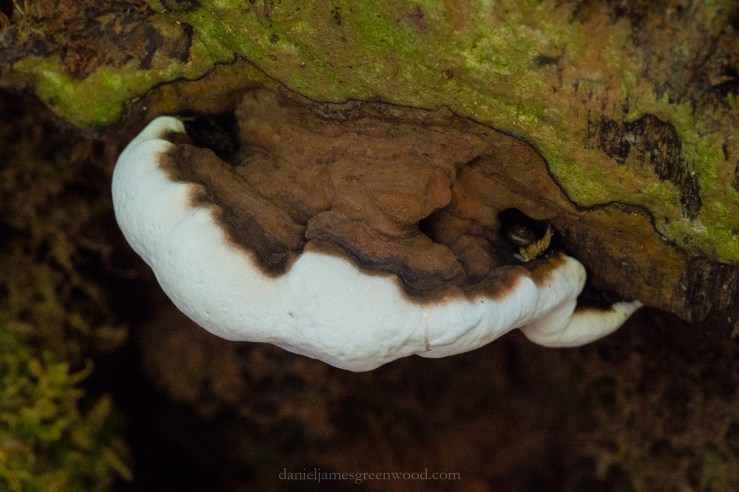
This is a species of Ganoderma bracket fungus growing on fallen wood. I only later noticed that a snail is hidden away in a nook of the fruiting body! You can tell I was in a rush. I wrote a lot more about brackets recently.
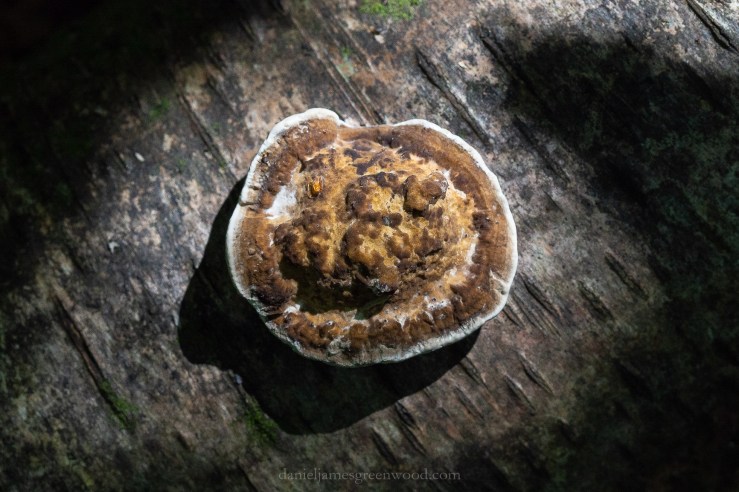
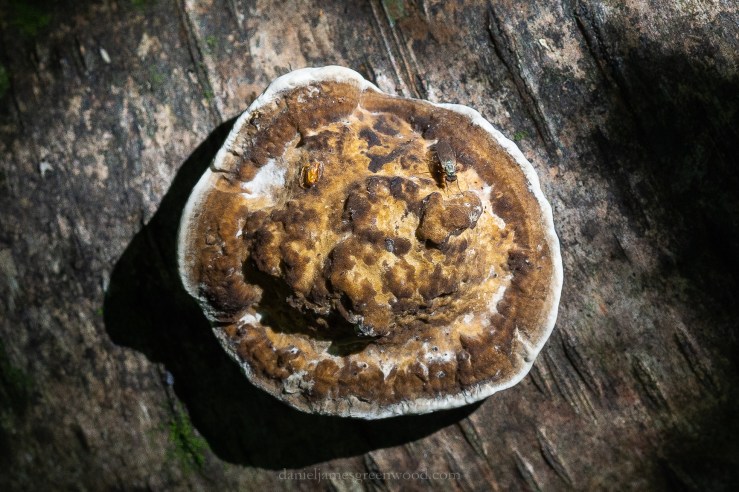
This is smoky bracket, not an omlette. I have seen this small community of brackets growing over the past few weeks. Again, it was only later that I noticed the other life, in this case a resting fly.
I was pretty disappointed in this mushroom hunt but then it was somewhere between 25-30 degrees (Celsius). The area which I’ve mentioned before, that has been opened up, is now experiencing more trampling, including mountain bikes coming through. From my experience of woodland management, that was predictable.
But some management that was really positive was the creation of dead hedges of logs and branches in a well-shaded area. This was where the mushrooms were hiding! I found a nice patch of oysters that were swamped/protected by brambles. This is a nice edible mushroom, not that I’m picking.
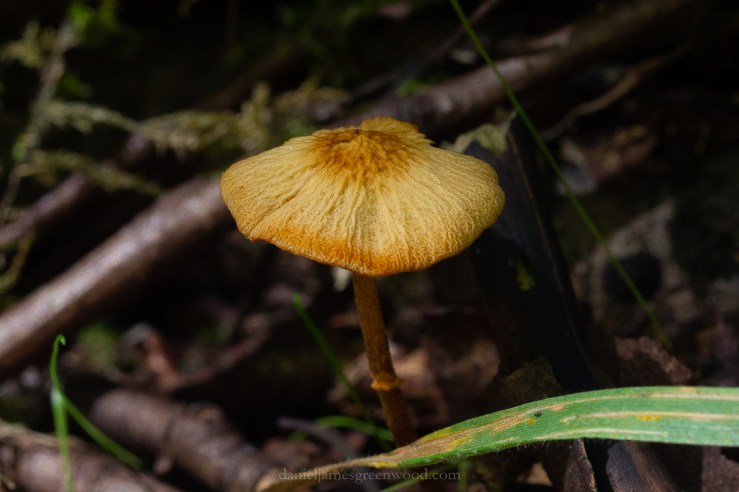
I also spotted this small mushroom, such a joy to find something. I like its veiny-cap and the reddishness. I’m not sure of the species.
Dry times such as these make alternative topics a pressing need. At the moment I’m researching an article on fungi and Chernobyl, so stay tuned for that.
Evening. The sun kindles embers in dangling birch leaves. The songs of birds have gone, spring is a memory. I think of autumn: the cool that grows where the sun can no longer reach. My footsteps crunch and snap in the dry, leaf-littered banks beside the gill. This stream was dammed centuries ago for the Wealden iron industry. But it still runs, just not now. The hammer pond it’s been forced to feed is now the realm of private fishing.
The beeches twist and turn on the slopes, in this light you might have thought they’re creeping up behind your back. It is so quiet that any sound feels like a warning. I hear the first faint murmur of a tawny owl.
The bracken is high and it’s hard to see around the bend of this winding desire line. On the hill the sun lends the ranks of pines some splendour. But it’s the heather battling down in the bracken that holds most promise. Men have stolen the sun from this heath with forestry, but the pines have been forgotten. Nature lies in wait, its disruptive forces breaking rank in a way so slow it’s not known until it’s done. This place will not be the same in decades to come.
Blackbirds and thrushes shuffle song-less in the shrub layer. The dryness amplifies the sound of their size to large mammal. That old fear ticks and tocks in me. A barometer I forgot I had.
Out on the woodland ride the ditches promise an explosion of new flowers: fleabane, ragwort, valerian, hogweed, and hemp agrimony where small cream moths nectar. One is held aloft, frozen in mid-air. Peering round, I see the camouflage of a crab spider hidden among the florets.
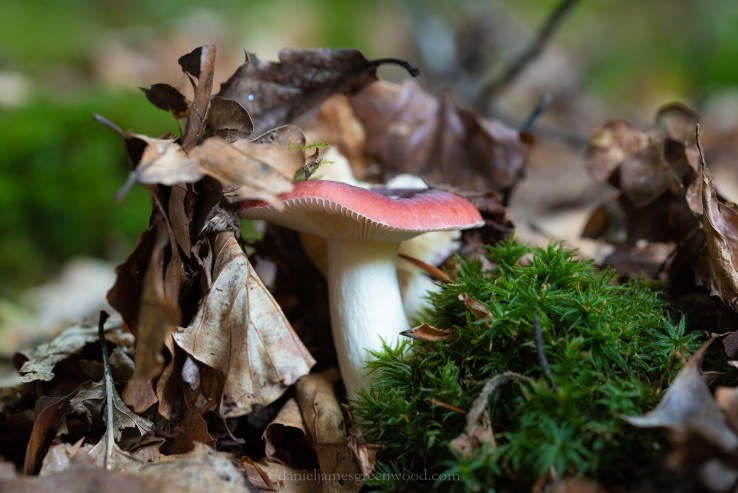
It’s a great relief to be able to share some fungi from the Wood Wide Web this week. There has been steady rainfall in recent weeks which gave the sense that some summer shrooms might be ready to appear. At this time of year I’m looking for the early indicators of autumn’s fungal moment, which appear in the form of brittlegills or Russulas, in scientific language.
A mixed secondary/ancient woodland in the Sussex High Weald
The fungi described this week are garnered from two walks in the woods of the Sussex Weald in West Sussex. The first walk was a short evening wander to a mixed woodland with signs of ancient woodland flowers like bluebell, but with lots of birch, hazel and some oak. It then pretty abruptly turned to pine, which happens quite often in the Weald because of the arrival of sandier soils where the Weald clay ends, and the prevalence of forestry.
It was much more dry than I had hoped but mushrooms are tenacious things. This nicely illustrated a new fungal phrase I learned in Robin Wall Kimmerer’s book Braiding Sweet Grass (p.112 in the ebook). You can listen to an interesting podcast with the authorabout mosses.Tthe Native American language of the Anishinaabe describes “the force which causes mushrooms to push up from the earth overnight” as ‘Puhpowee’. And so was this very small brittlegill pushing through the leaf litter.
I have never really tried to identify brittlegills to species level because they are so numerous and similar. I would guess this species is the charcoal burner. But I could be wrong about that.
This is one of the red brittlegills from August 2018 in the Weald, something to expect in August through to September.
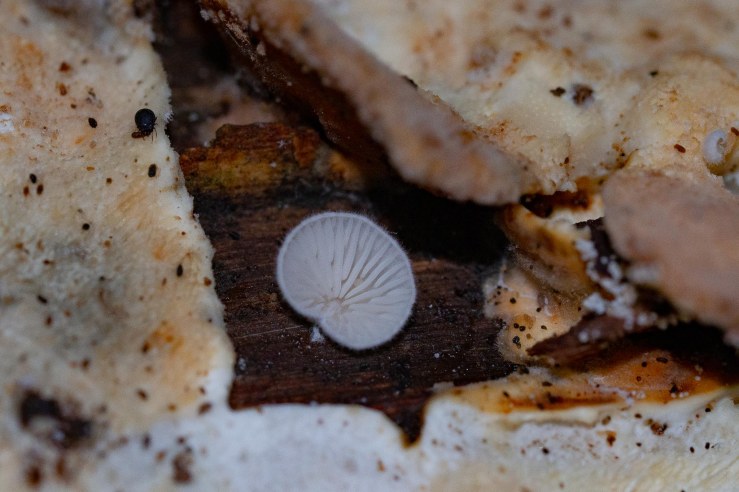
It’s a very dim view due to the light but my companion found this fungus within a fungus. It’s a species of oysterling. You can see a black springtail (or maybe even a tick?) on the left hand side for scale.
The second walk was in the afternoon at another Wealden woodland I am getting to know quite well. I recorded an Instagram story guided walk of this experience which you can see here. If you have the Gram.
Again it was well-nibbled brittlegills that could be found. This is probably the work of a small mammal with some input from a slug. I’ve seen grey squirrels pick these mushrooms, and spin them around by the stem and nibble down the gills. That interested me because grey squirrels are an American species. Brittlegills are also found in North America, so perhaps they are just returning to their roots. Does belittle the idea that grey squirrels don’t belong in European landscapes, the evidently do. Yes, I know about red squirrels.
I’m sure these species are not in any way appetising for the reader. This is probably one of the green brittlegills. It looks a bit ghoulish but I was pleased to find it. All these finds were just at the edge of footpaths.
A common summer mushroom is rooting shank, one of the toughshanks. ‘Shank’ has a pretty dark meaning in modern language, particularly in London, but it’s an old name for leg. That’s where the names of red or greenshank come from in the bird world. Americans call similar species ‘yellowlegs’. I prefer the olde Englishe names.
Rooting shank is quite an abrupt shroom, it just shows up where it likes. You can find it from now through to September from the woodland floor to stumps and buttresses of trees. This dream of a shroom was in the White Carpathian mountains in the borders of Czechia/Slovakia but I first saw it in urban south-east London.
It’s not a fungus, but this dog vomit slime mould was a lovely find (believe it or not). This amazing video gives a much better explanation of what this slime mould is up to:
It was only after taking this photo of the slime mould’s birch log that I realised how much was happening. You can see the early stages of small polypore fungi moving in from the outer edge as the wood degrades. I think the greyish blobs next to the slime mould may be Lycogola species, sometimes known as wolf’s milk. Lyco means wolf. The puffballs, Lycoperdon mean ‘wolf’s fart’. Oh dear. And we don’t even have wolves in the UK anymore, just in Downing Street, LOL!
It’s the blue hour and already birdsong rises from the woods: an unbreakable wall of blackbird and song thrush. The thrush pierces through with repetition as the blackbirds pause. Chiffchaff, robin, wren, the cascading song of a willow warbler.
Straight away, the hoot of a tawny owl in the echoing micro-valleys of gills flowing through the woods. Over time new owl sound-posts arise in distant corners of the landscape.
5am comes. In the birchy patches roe deer crash away through old bracken. Their sheer weight can be heard. A roe barks a warning – we have been seen.
The owls’ calls grow with the onset of dawn. The darkness still sits in the beech, oak and birch woodland. Pine, forever green, holds it that bit longer.
A sound from far away, slipping over the owl and deeper into the Weald. The cuckoo, master messenger of spring. We heard him here last year and wonder if he is the same bird back from the Congolese rainforest where he spent the winter. Whoever he is his life has been richer than any human’s could ever be. And the female cuckoo, she too will be hidden away somewhere in silence, listening.
We meet the crescendo of the dawn chorus now. Owls hooting on the crest of song thrush and blackbird. Cuckoo rising over everything. Crows begin the first administrative duties of the day, checking outposts of their web and marking party lines. The owls will not be lost on them.
Down a sunken track enclosed by holly, we notice the shapes of bats hawking. It’s the path we need to take. On approach they disappear, as if they were never there. The mosquitoes landing on our foreheads are glad we’ve moved them on. I’d love to tell them, the bats will be back.
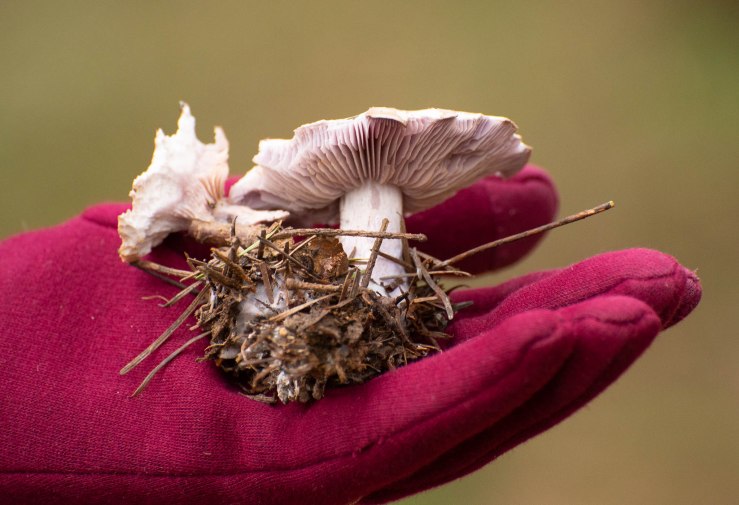
Happy Spring Equinox! Yesterday was a special day, the first proper mushrooms of 2020 made an appearance in Sussex, to me at least. Problem was I completely missed this mushroom, blewit! Wood blewit, that is (sorry). Thankfully it was pointed out to me and I had a glove model on hand (lol) to show it off.
This has been an incredibly difficult week for people and it’s hard not to talk about it here. Heading out to see which birds are now singing or which mushrooms might be fruiting is a massive tonic to the social frenzy which is hitting pretty much everywhere at the moment. This week I heard my first singing chiffchaff of the year, a rubberstamp of ecological spring. This female great tit may soon become a mum.
We have to look to nature now as spring arrives. It puts you back in your place and gives a picture of the longer term. The wild life will go on. But we should also consider that the problems we are now facing are linked to our awful devastation of the natural world, the abuse of its wildlife and ecosystems. Seriously people, we have to consider what we are doing to wildlife and their habitats first hand and also by our consumption of unsustainable products like beef from Brazil or chocolate from companies with poor ethical standards. I really hope that people can find a love of nature now that makes us slow down, consume less and see that our impact has to change forever before nature changes us more abruptly. After this, there can be no going back.
As I say quite often on this website, I’m not a forager of edible plants and mushrooms, though I know a fair number that I could eat. By that I mean plants and mushrooms, not actual foragers. I have never lived in a place where the foraging of anything beyond blackberries is sustainable. Some foragers must have been banking on this moment of temporarily empty supermarket shelves. Though our numbers are too great and nature’s larder probably too diminished to sustain our diets now. Shame that the toilet roll you find in the woods ain’t ripe yet.
Most of the fungi I saw yesterday was not edible, either because of its species or just generally because something else had already eaten it. The Coronavirus situation should remind us that there are millions of other species with lifestyles that are far more sustainable than ours, and we are vulnerable to pandemics, especially as we force our way ever deeper into untouched ecosystems that have been intact for millions of years or disturb people who have lived in harmony with those landscapes for a long time. The fungus above is probably shaggy bracket or Inonotus hispidus, one you usually find in bits on the floor having dropped off from higher up. I learned this species conducting tree health surveys with tree inspectors.
A common mushroom popping up now is glistening inkcap. The ‘record shot’ above is enough to show you how few mushrooms I’ve seen recently. The standards should get better as winter diminishes in the rearview mirror.
Some fungi need a bit more before they’re ready to go on stage. Here we have a splitgill fungus, which I covered a few weeks ago. Still this snowy white shroomster was a pleasant sight against the blackened rings of this log.
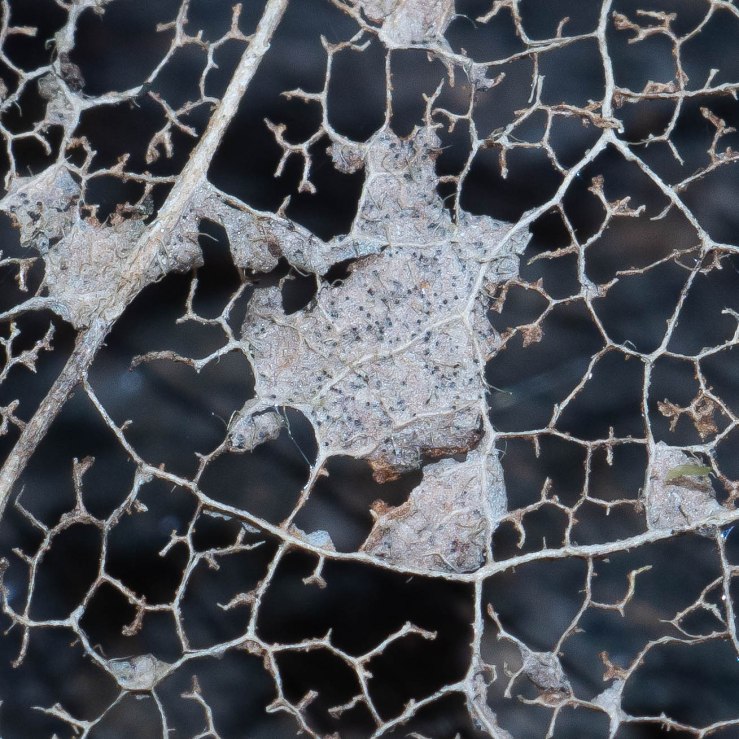
I am getting mentally ready to spend a lot of time in my garden this spring. I am very privileged to have a garden and, having eventually got to this point, I will never take it for granted. During one of this week’s WFH lunch breaks, I found this miniscule fungus frowing on the remains of a magnolia leaf. I wasn’t even looking for it, I saw it later when editing the RAW file on the computer.
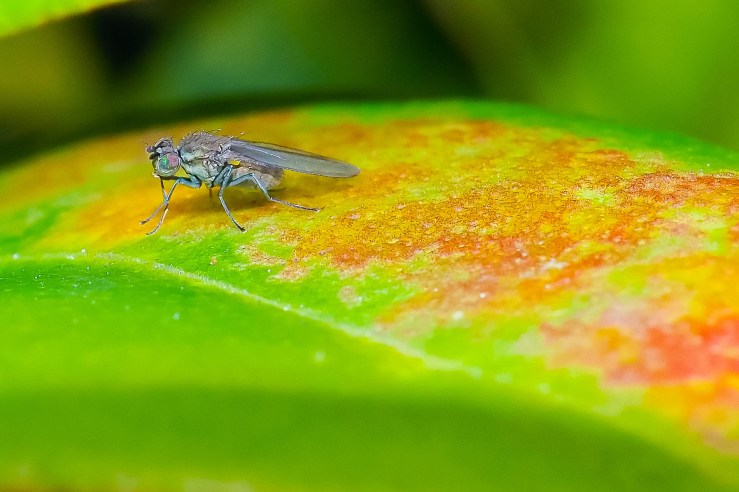
This very tiny fly was resting on a patch of fungus in the pigment of this leaf. I’d like to learn more about these types of fungi but one of the more recognisable ones is that which grows on bilberry (blaeberry, blueberry) leaves.
I owe lichens for getting this #FungiFriday blog close to completing its third month. Let’s hope that Fungi Friday can help us adapt to the life changes we are all experiencing just now. I plan to do a virtual Fungi Friday guided walk if we’re still allowed out, in a couple of weeks. Stay tuned for that, but most of all stay tuned to the season rather than your news app on your smartphone. It will help you when you need it.
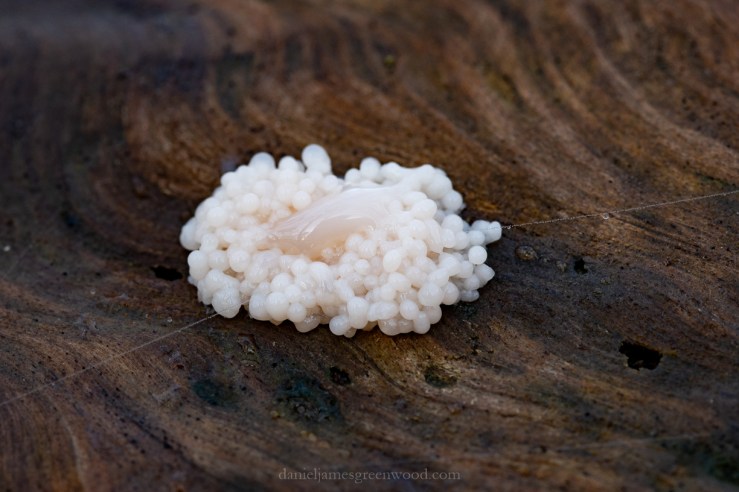
The winter sun floods the dark stands of birch, oak and sweet chestnut. It glitters in the frost as it melts away from crowds of moss. Steam rises from the soil as the sun warms the ground between oak trees, where nuthatches pipe and skip through their upper reaches. I scan a fallen pine tree for small things, fungi, moss, and find an incongruous clump of slime mould. The mould is like an emptied basket of boiled eggs resting in the swirling heartwood of the pine, smoothed by rain and people sitting.
The slime mould has a rope of spider silk crossing it and it has begun to melt in the centre like poached eggs that haven’t cooked for long enough. I set up my tripod as a man and his two black Labradors exercise themselves nearby. He stares at them, hidden behind a tree. I thought he had gone and left them until I stepped back and his monolithic profile appeared.
Mud squelches grey and beige under foot, still on the Wealden clay, with the sandy soils of the High Weald sitting only across the gill. Speaking of the stream, I can hear it gushing down below. The rain has fallen heavily all week, with the Arun and the Rother both bursting their banks and swallowing fields whole. This feels like the first sunny day of the year.
A song thrush scampers across under holly, with redwing dotting the branches overhead. Their contact call is a bit like a hiccough. A stock dove’s wings beat in a way that sounds to me like the gentle yaffling of a green woodpecker, stopping abruptly as they land on a branch. A real woodpecker, my first of this year, hammers in the top of an oak. Robins rise up onto waist-high branches and sing their songs. Spring is building in the winter wood.
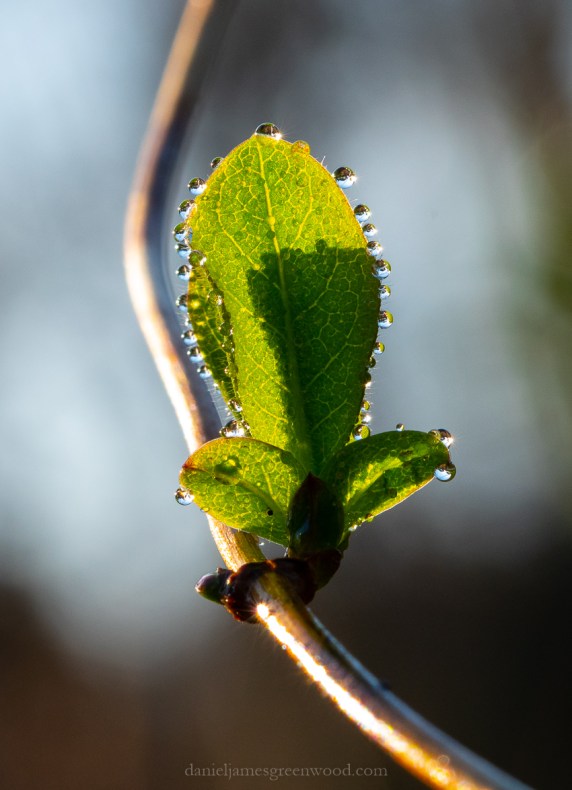
At the foot of the High Weald’s heathland, where the clay comes to an end, frost looks to have crashed down over night onto the bracken. The fences that protect the heath are topped with barbed wire, itself entwined in honeysuckle. The warm weather (eleven degrees on Thursday) have given the green light for some plants to grow. The honeysuckle spurts small green tongues, its leaves hold the water beads of melted frost. In the droplets the shape of pines, sky and open heath glow, in a world turned upside down.
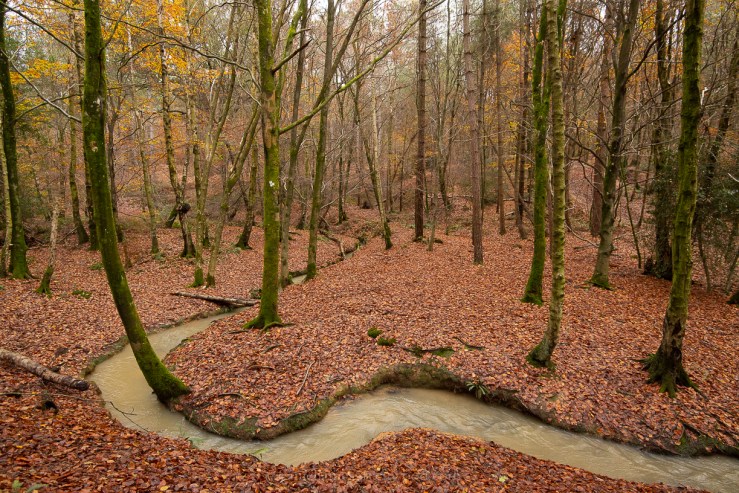
After so much recent rain, the water flows fast through the s-shaped streambed of Sheepwash Gill. Clouds have consumed a sunny morning, Wealden clay clogs under foot. I’m trying to cross the gill by treading across the buffed sandstone which is usually above water. This is no ‘Robert Macfarlane climbing a mountain up a stream in his pants’ kind of effort. The water runs ankle-high against my boots. On the other side a dog bounds down off the leaf-littered slope and barks at me, stopping my crossing. It’s big. It jumps around at the water’s edge in that ‘I’m trying to pretend I’m going to eat you’ kind of way. Its owner calls it back and I find another way to cross.
A girl watches me as I find a short gap to hop over. The dog is her family’s. They’re gathered around dens made from branches and logs on the banks of the gill. The eldest man is grappling with a thirty-foot long birch tree that’s hung up in another tree. He’s getting advice from his young son on how to get it down. The man is wearing brown leather safety boots, a sure sign of a construction worker enjoying a Sunday with his family in the woods.
The birch won’t move much and he gives up. St. Leonard’s Forest is covered in birch. It’s the most westerly point of the High Weald’s heaths, much of which is covered by wild birch and gorse, or otherwise planted up with conifers for forestry. Birch is seen as an enemy or nuisance but it is a special tree that has benefited our species in our evolution. Its wood makes excellent spoons, its bark can be used as fire lighter, its sap tapped for syrup, its branches make brooms. Its Latin name ‘betula’ means ‘to beat’. Getting walloped by birch branches was once a recognised punishment, sometimes in public.
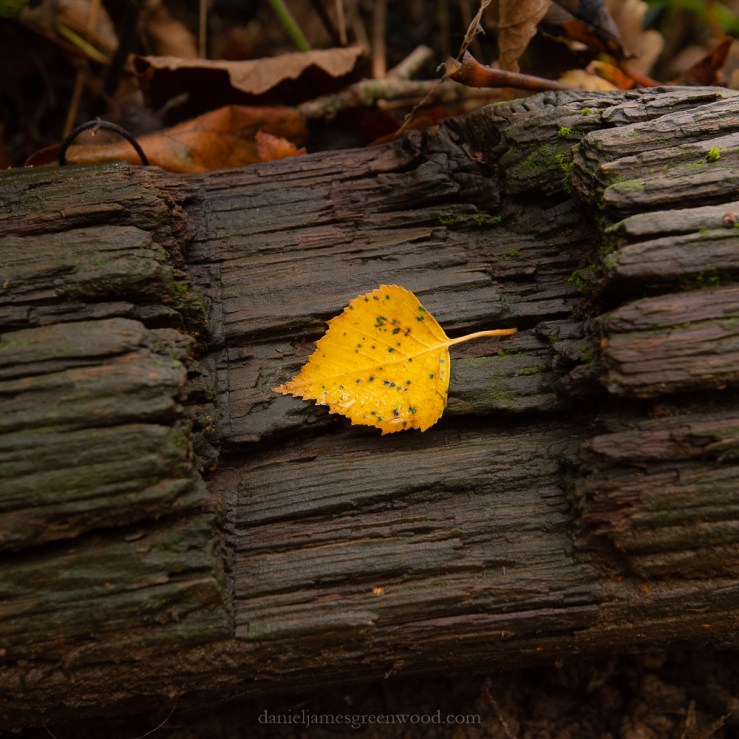
The birches are all yellowing and dropping now, turning to their deep, purple and leafless phase. The small yellow leaves catch by the petioles in mosses and on the splintered fibres of broken heartwood. In the dark pine plantations of St. Leonard’s Forest they fizz and spark.












 Unlocking Landscapes