It’s the blue hour and already birdsong rises from the woods: an unbreakable wall of blackbird and song thrush. The thrush pierces through with repetition as the blackbirds pause. Chiffchaff, robin, wren, the cascading song of a willow warbler.
Straight away, the hoot of a tawny owl in the echoing micro-valleys of gills flowing through the woods. Over time new owl sound-posts arise in distant corners of the landscape.
5am comes. In the birchy patches roe deer crash away through old bracken. Their sheer weight can be heard. A roe barks a warning – we have been seen.
The owls’ calls grow with the onset of dawn. The darkness still sits in the beech, oak and birch woodland. Pine, forever green, holds it that bit longer.
A sound from far away, slipping over the owl and deeper into the Weald. The cuckoo, master messenger of spring. We heard him here last year and wonder if he is the same bird back from the Congolese rainforest where he spent the winter. Whoever he is his life has been richer than any human’s could ever be. And the female cuckoo, she too will be hidden away somewhere in silence, listening.
We meet the crescendo of the dawn chorus now. Owls hooting on the crest of song thrush and blackbird. Cuckoo rising over everything. Crows begin the first administrative duties of the day, checking outposts of their web and marking party lines. The owls will not be lost on them.
Down a sunken track enclosed by holly, we notice the shapes of bats hawking. It’s the path we need to take. On approach they disappear, as if they were never there. The mosquitoes landing on our foreheads are glad we’ve moved them on. I’d love to tell them, the bats will be back.
We climb the hill on a winding, muddy path through woodland. The trees are sprawling yew, rotten beech and broken holly. On the thick, black soil holly leaves have fallen. We listen to the spinning coins of a goldcrest’s song as it moves close over our heads in the twigs of a yew. These tiny birds weigh little more than a 20p piece and must eat 90% of their body weight each day to survive in winter.
The light at the top of the hill comes through the branches. Woodland becomes heath of gorse, bilberry and birch. The voices of a walking group echo down as we step up through sandier soils now. A screen of crooked birches are splayed across the view, desperate to keep its secret. Their birchen secret is out.
From up here, the highest point in the South Downs National Park, the Sussex Weald opens out. Soft brush woods are broken by fields where individual oaks express themselves as they once would have, in landscapes kept open by now extinct herbivores like aurochs and wild horses.
Then there are the folding Downs catching in a spill of light from the west. The beechen clump of Chanctonbury Ring, with the heavy metal orchids of Truleigh Hill further east.
A woman is here with her son and his girlfriend, walking the dog. She tells them in a faintly Irish accent that you can see the Isle of Wight on a good day. This is not one of those days.
The families and walkers are dissipating and the view is now ours for a moment. Just as the last person leaves, a call rings out from the woodland we crept up through.
One call, and then the truncated follow-up. A tawny owl, calling from the rafters of the Weald at 3pm on a Saturday afternoon.
The Weald holds so many future Fungi Fridays. It’s an ancient wooded landscape that stretches across Sussex, parts of Surrey and into Kent. It covers the most wooded part of the UK in East Sussex. Once it will have connected with the New Forest, forming much of England’s post-glacial ‘wildwood’. I am very privileged to live within rambling distance of the Weald. I write about walks in it once a month, check that out if you will.
I managed to sneak ninety minutes in locally last week and found plenty of interesting things. As well as the ‘dark side’ of fungi, a reminder that a fungus giveth, and it taketh away.
We have had two storms in two weeks in Sussex and the winter streams are tickling through the woodland understory. Above, a tree was resting in a winterborne. This means a stream that only flows in winter when rainfall is higher. In Ireland, lakes (or loughs) that appear in winter are known as ‘turloughs’. Got plenty of those right now in Brexit-land.
The log was covered in some nice looking turkeytail, a very common polypore that is said have anti-carcinogenic properties. It was a nice way to start.
Then I happened upon these absolute corkers growing on a dead birch tree. These are blushing bracket in their mature stage. This area of the woodland is very wet, with mosses like sphagnum attempting to recolonise more places. It is set in amongst mature beech trees at the edge of heath-ier habitats, largely consumed by pines that were planted, rank and file, by the Forestry Commission in the 20th Century. It’s very wet and many birches are succumbing there. This is natural.
This is a standalone dead birch tree with birch polypore, also known as razorstrop fungus. It’s a tough bracket fungus that people probably once used to sharpen their razors. It naturally controls birch trees and breaks them down for other organisms to devour, and therefore new soils to be created.
Here’s a quick macro of one of the mosses from the work of the razorstrop, looking much like a cedar or a fern.
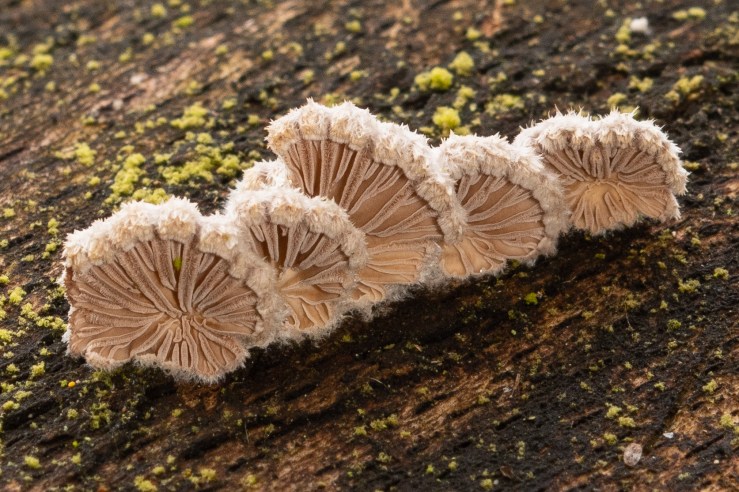
I found some split gills looking rather shaggy, in a good way. If you look at the yellow smatterings around, I think that’s a slime mould making its way across the surface of the bark.
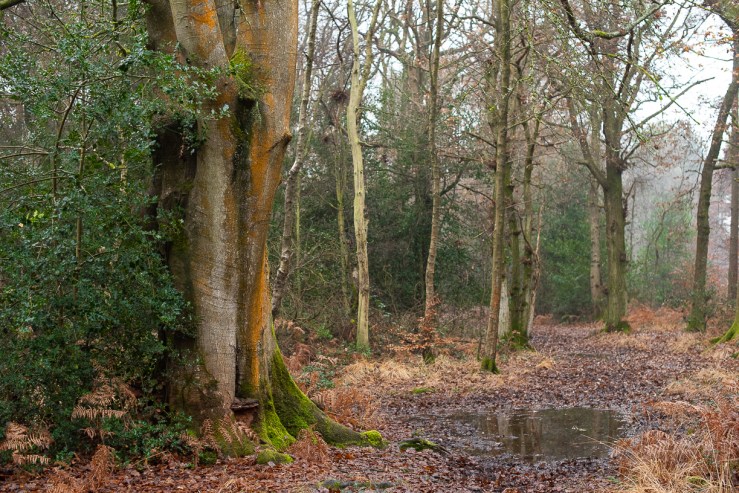
Rewind to May in this area, when the first leaves were appearing on the trees and the ground was far drier. This is one of my favourite trees to photograph in this woodland because of the orange algae and the beautiful buttresses at the tree’s base.
Here it is in December, the ground much more wet, the leaves all gone. Can you see the bracket fungus at its base? It has been damaged, probably by a visitor testing its strength.
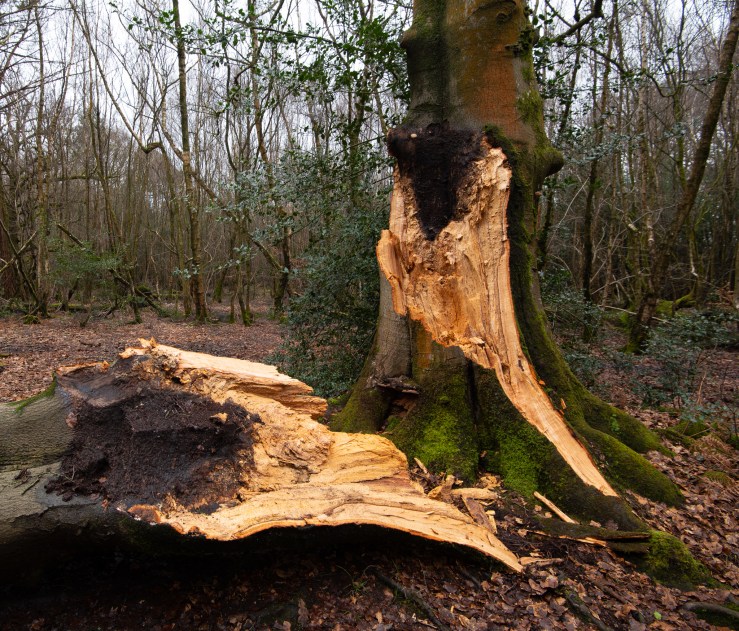
And here it was last week. Evidently the tree has been destabilised by the decay which has been accelerated by the fungus. This has softened the heartwood which leaves the tree vulnerable to storm damage.
But this veteran beech tree still lives, it has only lost one of its three trunks. I hope it can remain where it is and continue down its veteran path into the realm of the ancients.
It’s just another reminder that fungi has its own way in the world and there is no sentimentality involved. It’s there to break down organic matter. Trees were not a safety concern until we started walking underneath them everyday.
Some species share what they can find, others take, take, take. It’s in their nature. But in the end fungi are contributing to vital processes of organic recycling and renewal. Without the ecological role of fungi our species would not exist writing blogs, taking photos, hurling abuse at passers by, or walking under veteran trees in the woods.
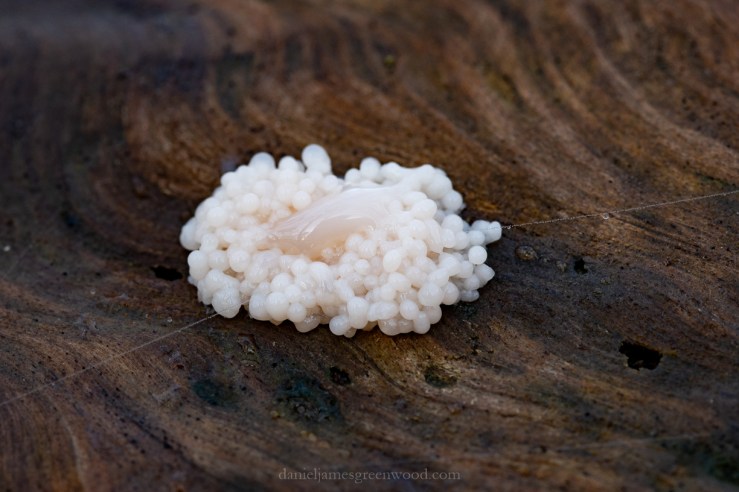
The winter sun floods the dark stands of birch, oak and sweet chestnut. It glitters in the frost as it melts away from crowds of moss. Steam rises from the soil as the sun warms the ground between oak trees, where nuthatches pipe and skip through their upper reaches. I scan a fallen pine tree for small things, fungi, moss, and find an incongruous clump of slime mould. The mould is like an emptied basket of boiled eggs resting in the swirling heartwood of the pine, smoothed by rain and people sitting.
The slime mould has a rope of spider silk crossing it and it has begun to melt in the centre like poached eggs that haven’t cooked for long enough. I set up my tripod as a man and his two black Labradors exercise themselves nearby. He stares at them, hidden behind a tree. I thought he had gone and left them until I stepped back and his monolithic profile appeared.
Mud squelches grey and beige under foot, still on the Wealden clay, with the sandy soils of the High Weald sitting only across the gill. Speaking of the stream, I can hear it gushing down below. The rain has fallen heavily all week, with the Arun and the Rother both bursting their banks and swallowing fields whole. This feels like the first sunny day of the year.
A song thrush scampers across under holly, with redwing dotting the branches overhead. Their contact call is a bit like a hiccough. A stock dove’s wings beat in a way that sounds to me like the gentle yaffling of a green woodpecker, stopping abruptly as they land on a branch. A real woodpecker, my first of this year, hammers in the top of an oak. Robins rise up onto waist-high branches and sing their songs. Spring is building in the winter wood.
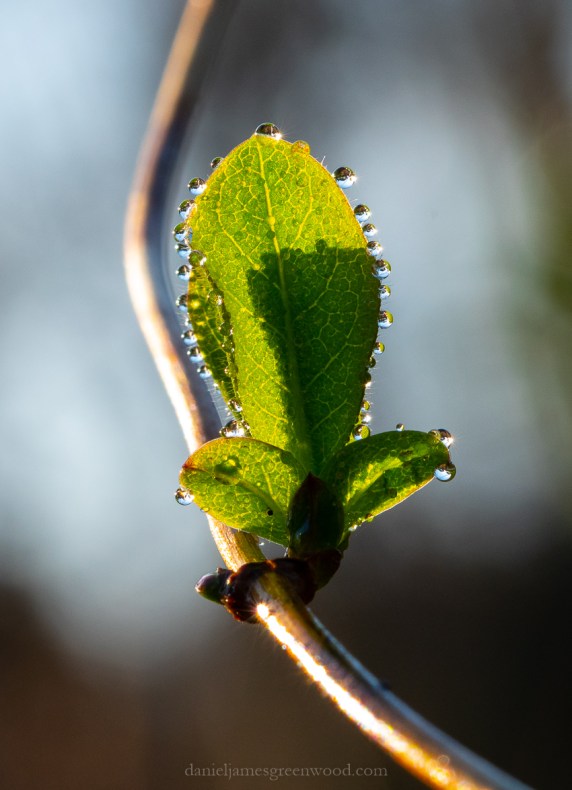
At the foot of the High Weald’s heathland, where the clay comes to an end, frost looks to have crashed down over night onto the bracken. The fences that protect the heath are topped with barbed wire, itself entwined in honeysuckle. The warm weather (eleven degrees on Thursday) have given the green light for some plants to grow. The honeysuckle spurts small green tongues, its leaves hold the water beads of melted frost. In the droplets the shape of pines, sky and open heath glow, in a world turned upside down.
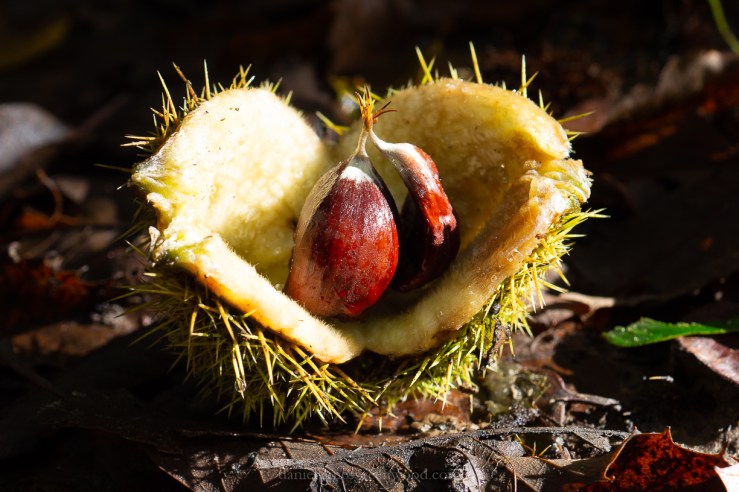
The Rother wends its way around the foot of St. Ann’s Hill, the site of a motte-and-bailey-castle probably built by the Normans in the 11th century. The water is high and brown after heavy rain that has fallen for several days. Atop the hill the ground is carpeted by the spiky cases of sweet chestnuts, freshly fallen from the huge trees that dominate the hill. The sun, shining on what feels a rare occasion, lights the open shells, their chestnut fruits glimmering where they lie.
Away from the hilltop I follow a path that whips back across the prow of the hill. Here dead oaks lie on either side of the path. Angel’s bonnet mushrooms grow in a cluster from crevices in the sinewy wood, their white caps used as a post by a dung fly. Under one mushroom cap I notice another fly’s head poking out as it rests on the stem.
I hear the loud clopping of a dog coming towards me on the path. In my stillness it doesn’t know I’m here. As it comes closer and closer into view, its legs are in fact long and thin. It’s a roe deer, young and carefree. It sees me at a distance of ten feet and splashes through ivy, hazel and brambles down to the safety of the winding Rother.
It’s so warm in the sun. Dragonflies touch the edge of the boardwalk as they mate in heavy flight. The sun glistens in the water. Flocks of tits have formed as winter approaches. I wait for one group to appear from shadowy alder carr but they keep their distance. Long-tailed tits chirrup and bounce between branches well beyond the boardwalk and space of water that separates us.
A couple of weeks ago we were shown harvest mice nests in the reeds and willows by a local ecologist. One of them is still here, the small bundle of grasses and leaves. Not much bigger than a cricket ball. I turn again to the alder woodland and a willow has crashed and fallen in the water. Its trunk has split, creating an entrance into its rotten core. The sun floods this wet woodland and the light brightens the dark glut of trees.
The broken willow again:
a movement in the shadows.
Whiskers and a pink nose.
Brown fur and paws.
It exits a hole where the heartwood used to be and slips back inside, down to water level. Out again it reveals itself on the willow bark with two paws spread out like furry stars, a white throat and breast. It turns its head to one side and sniffs the air. It dances back inside and disappears.
A couple approach me with caution. Aware I am now kneeling on the boardwalk I stand up and turn to them:
The footpath runs off Countryman Lane behind a deer-proof gate. In this case it’s keeping them in. On the gate a sign welcomes visitors to the Knepp Wildland Project. A woman with three dogs holds the gate open for us. I’m here with friends visiting for the day from London, where the Knepp narrative of rewilding lowland England and its successes for wildlife are influential. We’ve come for a circular walk on the public footpaths that cross the Knepp Estate.
Knepp is an ancient deer park that, with investment from government and the landowner’s private wealth, is attempting to prove that farming can be done in a way that is much more sustainable and beneficial for wildlife. Critics say that most farmers lack the personal finances of the Knepp Estate and government investment to sustain the same, low-intensity measures to remain in business. Some people just don’t like change. Many farmers in Sussex are tenant farmers, not landowners, meaning they don’t possess the same money to set up a rewilding project in the first place. Many proponents of rewilding argue that farming shouldn’t happen anyway and the land should be allowed to re-establish natural states of woodland, grassland and wetland.
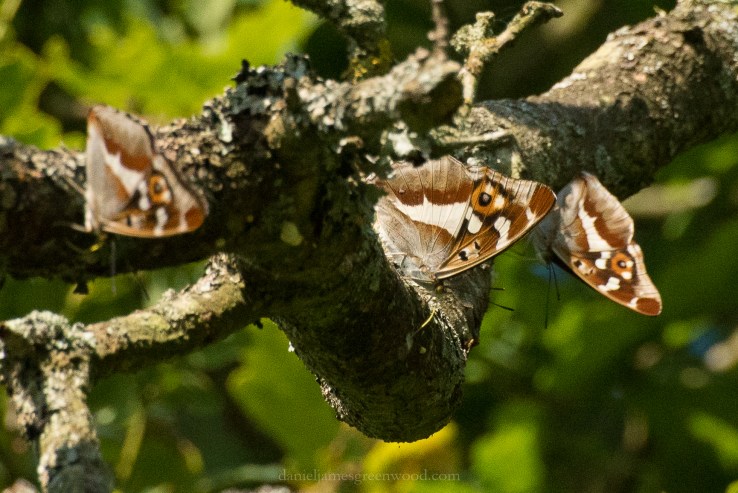
The footpath is lined with stringy hedges growing to a state of woodland. Large oak trees thrust up from the Wealden clay every few metres, the pillars that hold the Low Weald together. Trees like these run all the way west to the New Forest. In one of the hedges a bike has been locked up, purple ribbons are tied to hedge trees at intervals. It’s an indicator: we have arrived in purple emperor butterfly high season. A man with a large telephoto lens marches towards us, his tripod legs splayed like a broken umbrella. He sees that we’re looking up at an oak, where the emperors fly high. He sets his kit up, eyes open wide in anticipation, mouth gaping. He barely acknowledges us.
We carry on, purple emperors flying lower and in pairs, the white markings on their wings translucent in the light as they pass over our heads. Behind a hedge where people are warned not to go, a couple with their dog asleep in the grass watch with craning necks yet more of these superstar butterflies. The man with the tripod reappears on the horizon, spotting the small group, he homes in again like an insect-seeking missile. Further ahead two vehicles are parked on the track, a group of men are standing around a film camera pointed up at the canopy of an oak. One of the men squints into the viewfinder and grips the equipment, ready to shift it when its subject moves. Another man stands back smoking a cigarette, possibly the film’s producer.
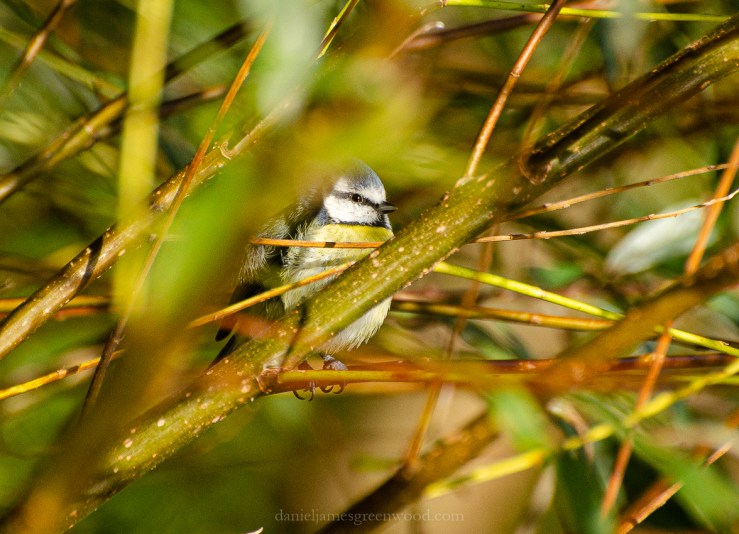
‘Seen a blue tit?’ I say.
The smoking man offers a wry smile in response. The camera man takes his eye away from the camera and grins.
Leaving the oaken lane and continuing along the public footpath, we follow a circuit around and meet a couple tuning in to a turtle dove singing beyond the crown of an oak. My friend has just heard her first ever turtle dove in the UK, in six decades of living here, and she’s touched by its turring. This is a bird on the edge of extinction in our great nation. The couple tell us they’re camping and that it’s disappointing to hear the nearby A24. Their expectations of Knepp didn’t include the sound of the combustion engine.
The man says a spotted flycatcher is hunting around the corner from a branch, and so it is, along with a juvenile. This is the first fledged juvenile spotted flycatcher that I have ever seen in the UK, and the first flycatcher in southern England. Like the nightingale and turtle dove, they seem at home here, indeed they have made this piece of the Sussex Weald just that. There is so much chin-scratching, speculation and opinion in nature conservation. When you see results such as these, it’s hard to disagree with the state of a place.
Gentle rain falls as dog walkers share tales in the car park. Squirrels saved from their pet’s jaws giving thanks with a bite of their own. Birdsong swells from the understorey, perhaps five song thrush sing to sure up territories. Either side of the track is a wall of green, from the shrubs to the canopy of oak, birch and beech.
There is a feeling of a deeply wooded landscape here, the continuity of the Weald stretching away east to Kent. Of course it has now been broken, so many times, but there is a sense of the wilderness that faced the Romans and later the Saxons upon their respective invasions of Britain. It is thought St. Leonard’s Forest was part of a wooded landscape that stretched all the way to the New Forest, as recently as a thousand years ago.
The rain has drawn me out here. It is such a relief that this June is one of mini-monsoons, compared to last year’s heatwave hell. The nearby South Downs were rendered brown for months. At the side of the path, under the darkness of a beech, mushrooms glow. They sprout peach-coloured, or maybe apricots on sticks, from a tree stump. They are sulphur tuft, one of the most common species but very photogenic.
Further into the forest chiffchaff sing from the pines, a distant willow warbler’s melody decaying in the darkening evening air. There is a scale to this landscape that feels expansive. Woods challenge our human senses of depth and time. Moving along the footpaths the woodland shifts from clay where beech and oak prevail, to the pine and birch dominated sands where heathland once was kept open by local people expressing their rights of common.
Down a track through birch and holly a single flute-like note comes from the trees above my head: a bullfinch. It calls over and again. It’s a beautiful sound.
Returning round through dark areas of oaks and veteran beeches, I find a small toadstool uprooted at the edge of the footpath. It’s an amanita of some kind, a ring around its neck like Shakespeare or a ruff, patches of white webbing still on its grey-brown cap. Amanitas are a fearful family of mushrooms, being home to the deathcap and destroying angel, to name but the most potent. But I’m not here to eat these marvels of nature, so I take my photos, capturing memories to take back to the town, to ease the sense of dislocation from this ancient wooded landscape, its bullfinches and mushrooms.
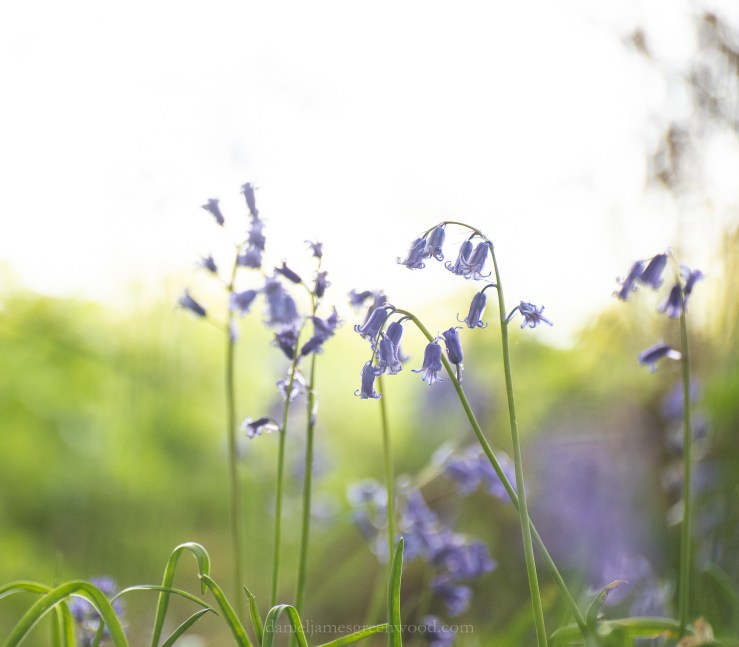
I visited a small woodland in the Sussex Weald after work to make the most of a break in the showers. My aim was to catch the bluebells in the early evening light when I think they look best. The forecast was for cloud but it was windy enough for some sunlight to break through. This woodland is coppiced and was where I photographed the wood anemones last month. It is the bluest bluebell woodland I’ve ever seen. My friend always tells me, ‘no, it’s purple!’. He’s right.
Bluebells are a huge draw for anyone who has a camera (so that’s everyone). It’s part of the traditional spring experience to go to a bluebell wood, in most places that still have them. That’s something that shouldn’t be taken for granted, ancient woodlands like those in the Sussex Weald are being lost, despite the fact that they are irreplaceable habitats. Their species diversity has evolved over thousands of years. At a coppiced wood like this, their ecosystems have coalesced with our management of them for wood products. The oak above might be a coppice, but it could also be three oak saplings fused together.
Something felt quite gentle and warming about this oak plugged in amongst bluebells. Perhaps it’s the slight lean, it’s almost an invitation to pass by. The mental and physical benefits of spending time in woodland are great.
I’ve noticed the flush of new green oak leaves and how quickly that freshness is lost to the stiff darker shade.
Take these two oaks in the High Weald from a week earlier. Their new green is incredibly fresh but will now have darkened. You have to enjoy every moment of spring before it goes.
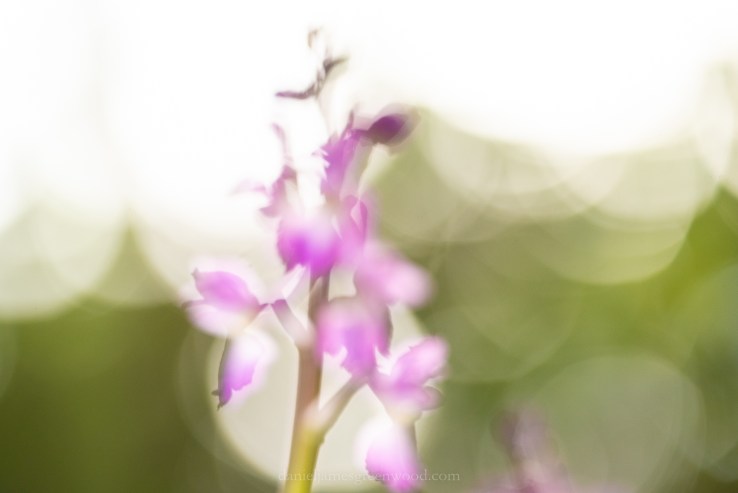
Back to the wildflowers. Before visiting the wood I spoke to a colleague whose job it is to survey woods. He said he’d seen very few early purple orchids this year, possibly due to the colder than average January and then sudden heatwave in February. I said I would report back on my findings. I discovered a patch of about 10 flowering on the wood’s edge with plenty of other spotted leaves yet to produce flowers. I had seen them in the same patch a couple of years ago so knew where to go.
I find orchids that grow in woods to be twice as exciting as those out in the open landscape. It’s a personal thing, because the diversity is far greater out there. There’s something about woodland versions of other species, birds or butterflies for example. There is something so interesting about the fact some species have made a niche for themselves in certain types of woodland only. Don’t get me started on firecrests. It’s even more interesting when these species, especially the wildflowers, escape out into the surrounding landscape.
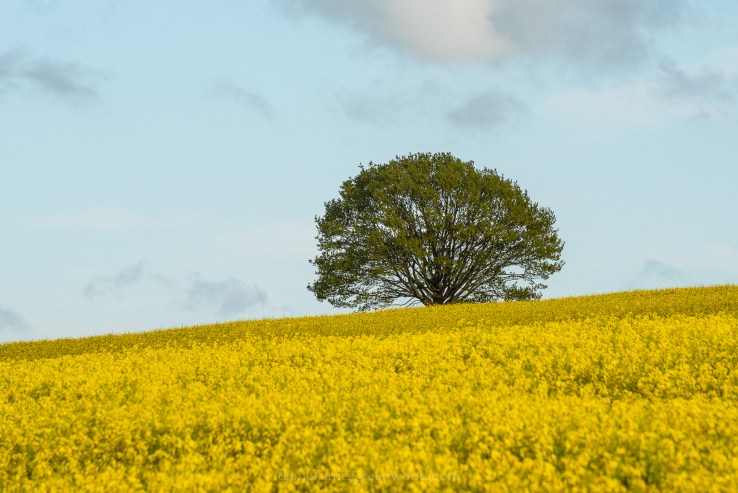
It’s not possible for the flowers to do much of that in this slither of the Sussex Weald because it’s surrounded by a monoculture of oilseed rape. On the contrary the farm is making its way into the woodland through the run off of fertiliser and water being piped in. You can see where the wildflowers are being pushed further into the woodland, away from the polluted areas. It’s something happening to almost every small woodland in England in one way or another.
Photographing the orchids was tricky because it was windy, dull and the plants were small. I used a telephoto lens and tried to maximise the bokeh around the flower. These flowers are beautiful even when out of focus.
The woodland flowers felt as if they were at their peak. Elsewhere yellow archangel spread amongst bluebells.
The details of a wood at this time of year are incredible. If you look closely it’s not just the bluebells that will attract you, the fronds of bracken unfurling are worth investigating. These primitive plants reproduce through spores and pre-date flowering plants like bluebells by millions of years. It’s a tough plant and can be a bit invasive. Oliver Rackham reckoned it was the most common plant across the whole of the UK.
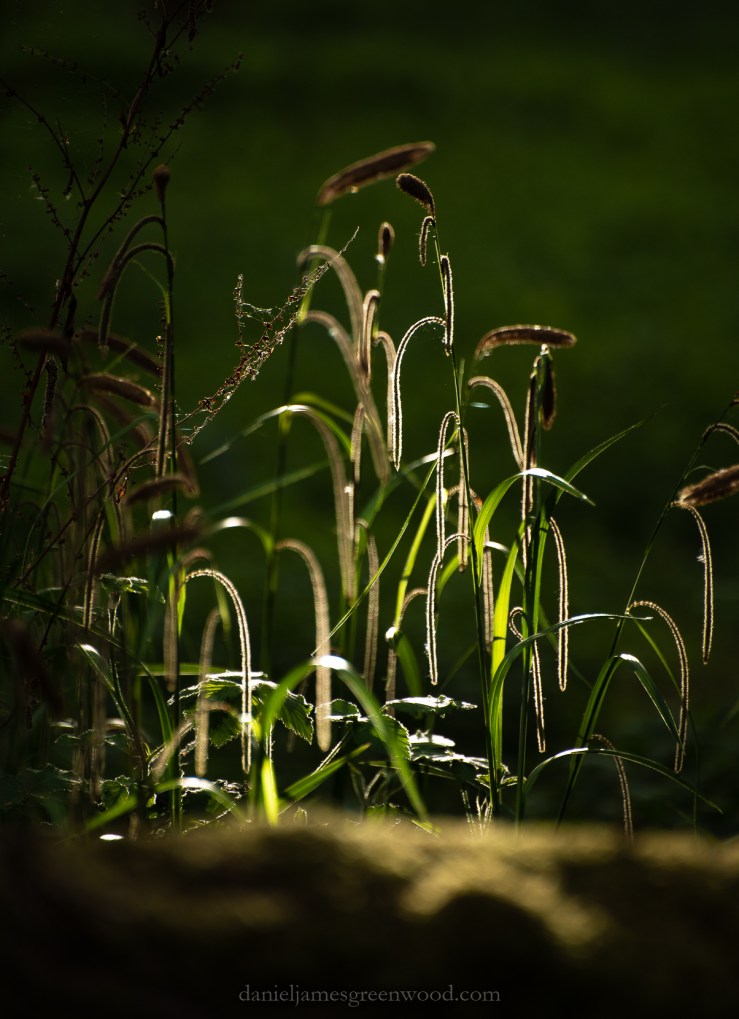
People often say they spend a lot of time trying to remove pendulous sedge from their gardens. It gets around. It’s actually a resident of ancient woodland and can be found in the wood. I passed this community of sedges on my way out as a few bands of sunlight broke through the clouds and lit their drooping seedheads.
That light broke free as I made my way out again, illuminating bluebells either side of tree trunks. It was a reward for gambling on a grey sky.
For seven years I volunteered and worked for London Wildlife Trust at Sydenham Hill Wood and Dulwich Wood in south-east London. These woods are the largest remaining remnant of what is known as the Great North Wood. During that time I soaked up a lot of information, conducting my own research into the cultural and natural history of the area. I led guided walks and gave public talks on as many areas as possible related to the natural and cultural history of the area. I have condensed much of that information into this blog post. An earlier version of this post was handed out to attendees to walks and talks on behalf of London Wildlife Trust. My knowledge of the entire Great North Wood, which Sydenham Hill and Dulwich woods are the largest remnant of, is not strong enough to ‘write a book on’, but I have posted about the history of One Tree Hill, another remnant, before. This is my whirlwind around these precious woods from the time of glaciers to present day.
Wildwood: 12,000 BC
The Dulwich woods are a collection of remnant ancient woodlands in south-east London, made up ofSydenham Hill Wood (a nature reserve managed by London Wildlife Trust), Dulwich Wood, Low Cross Wood, Hitherwood and Dulwich Upper Wood. The woods are generally known as Dulwich Woods or Sydenham Woods by local people, sometimes influenced by whether they are from the Sydenham side of the ridge in Lewisham or the Dulwich side in Southwark.
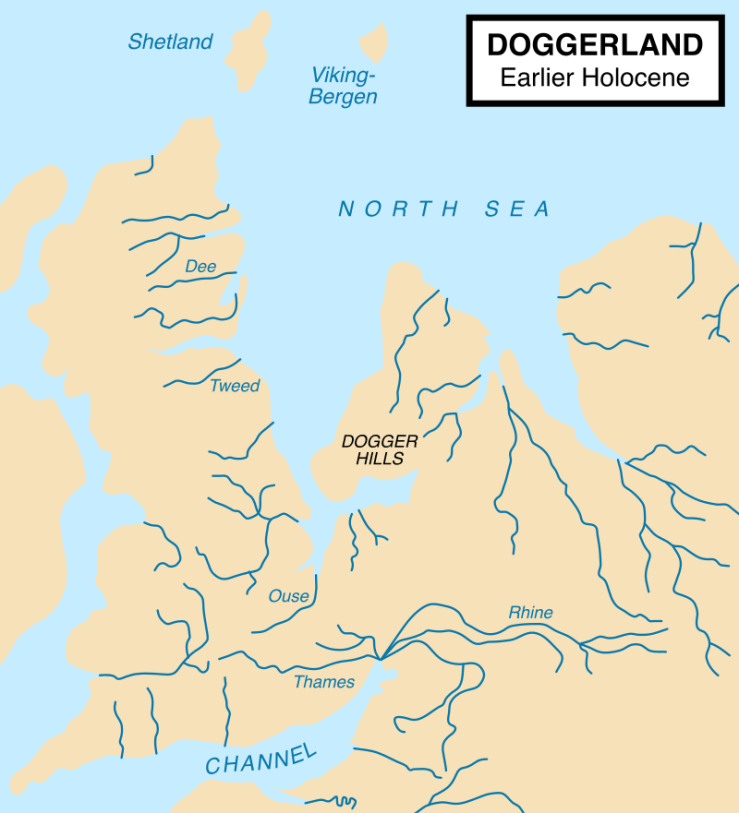
Parts of the Sydenham Hill and Dulwich woods are thought to have been covered by woodland since the first trees returned to Britain at the end last glacial period, some 14,000 years ago. The end of the UK glaciers came when climate change led to a period of warming. This warming melted the great ice sheets that had spread across the Northern Hemisphere and sat north of London. As the ice melted, the ensuing water created lakes, rivers and wetlands and the rocky debris carried by the retreating ice carved open valleys and new landscapes. While what is now the British Isles remained connected to continental Europe, the Thames was a tributary of the Rhine in Germany. Today, off Sydenham Hill runs the Ambrook stream, a tributary of the Effra, a ‘lost river’ which still enters the Thames at Vauxhall.
Trees spread by seed on the wind or with the assistance of jays (‘scatter-hoarding’), red squirrels and small mammals. This ‘wildwood’ provided habitat for returning wolf, bear, lynx, elk, beaver, otter and deer, along with birds, mushrooms, insects and wildflowers. Hunter gatherers followed their prey into this more hospitable landscape and made settlements in the woods by clearing trees and creating more open areas to live in.
By 6,500 BC the ice had melted to such an extent across Europe that sea levels rose and flooded the low-lying plain between Britain and Europe, creating the British Isles as islands physically separate from Europe. By the Neolithic period (4,000 BC) the wildwood had been much reduced and people exploited nature’s resources like never before. The growth of farming, developed in the Middle East and spreading through Europe, meant that populations were increasing and the hunter gatherer’s way of life was disappearing.
The coppices known as Peckarmans Wood in the 1800s, what is now Dulwich Wood
The Great North Wood: 500-1500 AD
The Dulwich woods are the largest remaining part of the Great North Wood, the early name given to what was left of the wildwood in south London by the Anglo-Saxon period (AD 410-1066). These remnant ancient woods straddled the clay ridge running from Honor Oak to Beulah Hill. The Romans had come and gone (AD 43-410), forging new roads and making use of the Great North Wood’s resources of oak, hornbeam and hazel, mining its clay for brick and pottery. It was the ‘north’ wood because it was north of Croydon, a thriving medieval market town. The Anglo-Saxons also wanted to differentiate between the Great North Wood and the Weald, another extensive woodland landscape that sits between the North and South Downs, running as far as Hampshire in the west and Kent in the east.
It was only later that placenames related to the woods began to appear: Selhurst and Brockley being two good examples. The use of ‘hurst’ at the end of a name indicates a wooded hill, possibly a place where timber was removed or used to some specific purpose, whilst ‘ley’ means a clearing or settlement in woodland. ‘Brock’ is the old English word for badger, an animal which still clings on today in secrecy. Names like Forest Hill are deemed artificial, though it likely refers to the wooded ridge of Sydenham Hill. The Great North Wood was no forest at all, unlike the New Forest, Ashdown Forest or Epping Forest, it was not created for the purpose of a royal hunting ground. ‘Norwood’ is arguably the single truest reflection of this ancient landscape. Penge is London’s only Celtic placename, meaning ‘the end of the woods’.
Woodland workers removing the buttresses of an oak before felling. Coppice poles can be seen in the background
Woodland industry
The Dulwich woods have been patrolled or cared for by a warden since as early as the 1200s. One of the key industries was tanning, where the oak bark was peeled off and taken to the tanneries and soaked in with hides to make leather. From the 1600s to the mid-1800s it was the second largest industry in England. The tannery at Bermondsey was the destination for much of the woodland produce. Oak trees were harvested after some 80-150 years to build ships, therefore allowing the British military to ‘rule the waves’ and put the ‘Great’ in Great Britain, as some people say. Britain’s oaks ships were the upper hand in battles waged at sea against the Spanish, the Dutch and attacks against the Chinese mainland.
Britain’s isolation as an island protected it from land invasion after the Norman Conquest of 1066 and the end of Anglo-Saxon rule. The harsh strictures of Forest Lawand later royal protections for woodland meant that up until the Napoleonic Wars, the oak resources in England enjoyed some stability. To make one oak ship today would likely require the entire felling of Sydenham Hill Wood and Dulwich Wood combined, some 25 hectares of woodland. Needless to say there is no appetite for such. We should also remember that the Dulwich woods were never ‘forest’ in the Norman term, despite what the word means today.
Colliers were charcoal burners who lived in the woods, an industry of huge importance to London and local villages. Trees like hornbeam were coppiced or cut down to their stump to form multi-stemmed trees that could be harvested for wood indefinitely. The wood was stacked into a kiln, in this case made from clay, and burned to create charcoal. Other woodland products included poles, posts, bavins (bundles of twigs for firewood known also as faggots), birch twigs for brushes and withies (long, thin hazel shoots).
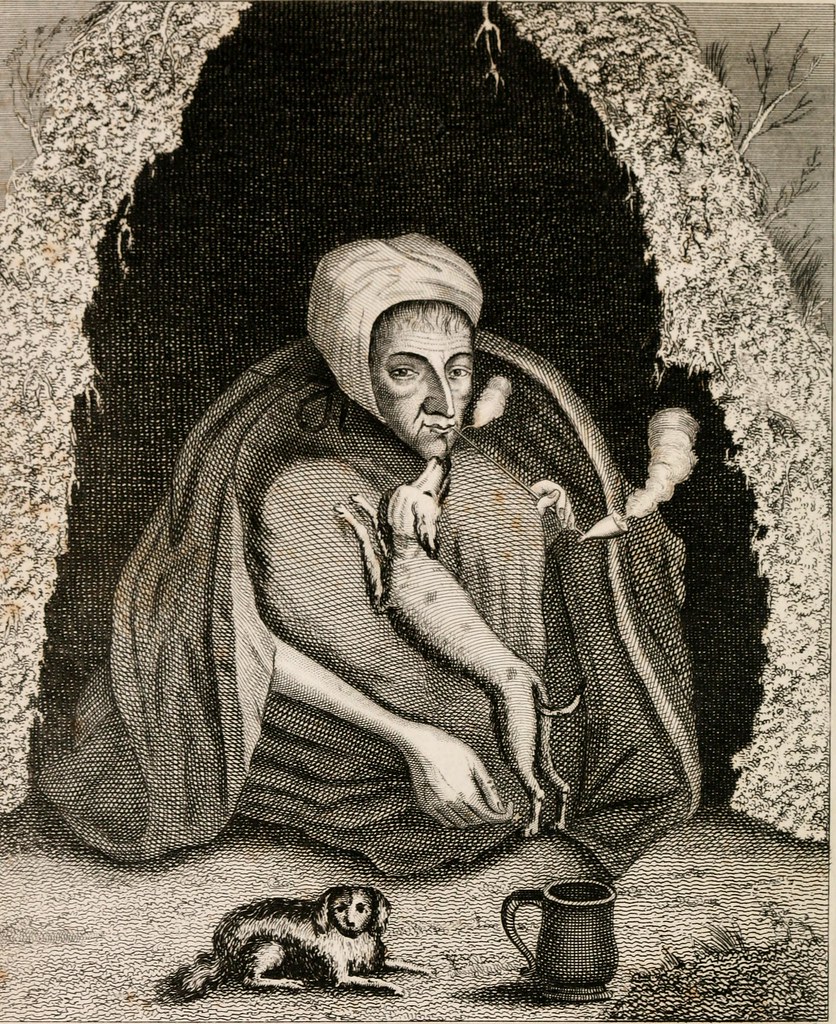
Margaret Finch in Norwood
The Norwood Gypsies and other local characters
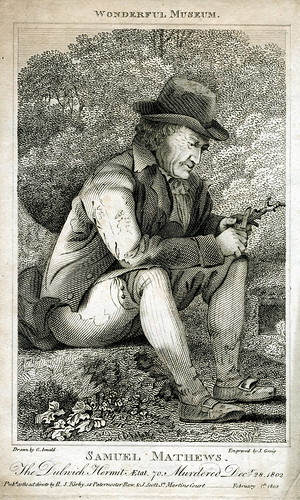
One of the more interesting local placenames is Gypsy Hill, in reference to a camp of ‘gypsies’ who were famed for their presence there. Margaret Finch was known as ‘queen of the gypsies’ and was visited by the Victorian middle classes to have their fortune told. It is said she was so ‘decrepit’ she could only ever crouch. Other notable dwellers within the woods included Samuel Matthews, the hermit who lived in a cave dug near where the Cox’s Walk footbridge is. He was murdered in 1802 for his wealth collected as a jobbing gardener in nearby properties. He was said to be a popular local figure but his murderer was never convicted.
Samuel Matthews (Steve Grindlay)
Local literary figures include William Blake, whose vision of angels took place on Peckham Common, possibly after a visit to the Dulwich woods in the 1760s (and maybe the ingestion of some magic mushrooms?). At the bottom of Cox’s Walk the poet Lord Byron studied at Dr. Glennie’s above what was then the Grove Tavern pub in 1799. John Ruskin walked in the woods during the time of the Crystal Palace, lamenting the place of the building on the wooded ridge.
An elm tree enclosed inside the Crystal Palace in 1851
Enclosure: 1720-1830s
In the 1700s Acts of Parliament were put in place to remove common lands from public ownership and allow their sale and enclosure. Locally affected commons included Westwood or Sydenham Common which covered much of what is now Forest Hill, Dulwich Common which is best represented by the Dulwich and Sydenham Hill golf course, Dulwich College playing fields and Dulwich Park, and Penge Common which was enclosed as Penge Place and is now Crystal Palace Park. Sydenham Hill Wood did not exist at this time but was a series of coppices spread across the Dulwich woods in the form of Peckarmans Coppice, Ambrook Hill Wood, Lapsewood, Kingswood and Vicars Oak Coppice.
This seismic political shift has created the townscape and suburbs we see today in London. It is only through hard-fought planning battles, philanthropic foresight and good fortune that any of London’s commons still exist. The enclosures put in place the eventual development of the coppices known today as Sydenham Hill Wood. By the 1730s Cox’s Walk had been cut through an area known as Fifty Acre Wood from Sydenham Hill in order to attract visitors from the Sydenham Wells to the Green Man Tavern at the junction of Lordship Lane and Dulwich Common, site of the Dulwich Wells where natural springs rose. By the early 1800s Fifty Acre Wood had been grubbed out for farming, now forming part of the Dulwich and Sydenham Hill golf course and the Marlborough Cricket Club fields.
The Hoo on Sydenham Hill, now returned to woodland in Sydenham Hill Wood
The Victorians: 1800-1900
Immense change came to Sydenham Hill and Dulwich with the construction of the Crystal Palace in 1854. In 1865 the Crystal Palace High Level railway was cut through the Sydenham Hill coppices. It took millions of people to the Crystal Palace’s Great Exhibition until its eventual closure in 1954, after the Palace had burned down in 1936. The Cox’s Walk footbridge was constructed over the railway line to allow the continued use of the pathway. The Crescent Wood tunnel, which plugs the southern end of Sydenham Hill Wood, was closed to the public in the 1990s due to Health & Safety concerns and later it was designated as a registered bat hibernation roost due to the presence of brown long-eared and pipistrelle bats using the crevices in the old brickwork.
In the early 1860s the construction of large villas along the Great North Wood ridge running from Forest Hill to Beulah Hill began. The coppices of Sydenham Hill Wood were separated into smaller plots of land and sold on 99-year leases by the Dulwich Estate. The residents of these houses were wealthy, with some houses accommodating more than 20 people, in this case servants for the families. Lapsewood House was home to Charles Barry Junior, the designer of newer Dulwich College, North Dulwich Station and St. Peter’s Church next to Cox’s Walk. Another house, Beechgrove, was lived in by Lionel Logue in the 1930s and ‘40s, the speech therapist characterised in The King’s Speech. A garden folly was constructed with Pulhamite, a material patented by James Pulham, in the grounds of Fairwood. The cedar of Lebanon which still remains was in the grounds of the Sydenham Hoo and can be seen as a sapling in Victorian illustrations of the garden.
Wood anemone is an indicator of ancient woodland in the Dulwich woods
The returning wild: 1950-present day
The advent of the First and Second World wars brought irreversible change. Traditional woodland management was extinct and the Victorian boom was over. Many of the houses were nearing the close of their leases in the 1950s and by 1980 all of them had been demolished. Local people had been entering the grounds of the old houses and the disused railway line since the 1950s. The landscape was returning to woodland as trees began to retake the gardens and railway cutting with no intervention taking place from either the Dulwich Estate or Southwark Council. In 1981 London Wildlife Trust were formed and by 1982 Sydenham Hill Wood had been designated as a nature reserve. This was after fraught and long lasting battles involving Southwark Council, the Dulwich Estate and local people spear-headed by London Wildlife Trust, the Dulwich and Sydenham Societies and the Horniman. London Wildlife Trust are now lease holder of Sydenham Hill Wood and each of the former mansion grounds running along Sydenham Hill. Today the Trust, Southwark Council and the Dulwich Estate are working in harmony to protect the natural heritage of the Sydenham Hill and Dulwich woods with the support of volunteers.
The woods are experiencing historically high numbers of visitors, with data suggesting that over 100,000 people step through each year. It is a critical time for people to access and understand our green spaces due to the dislocation many feel from nature and the impending threats of climate change and species loss. Sydenham Hill Wood is one of the most important green spaces in London for the story it can tell about human impacts on the land, challenging our concepts of what is natural and normal. Its 10ha has seen it all, surviving through all that our species has thrown at it in over 10,000 years of human history. It bears those scars but its wildness remains. Who knows what it will see in the next 100 years.




















 Unlocking Landscapes